Póngase en contacto con Masstech

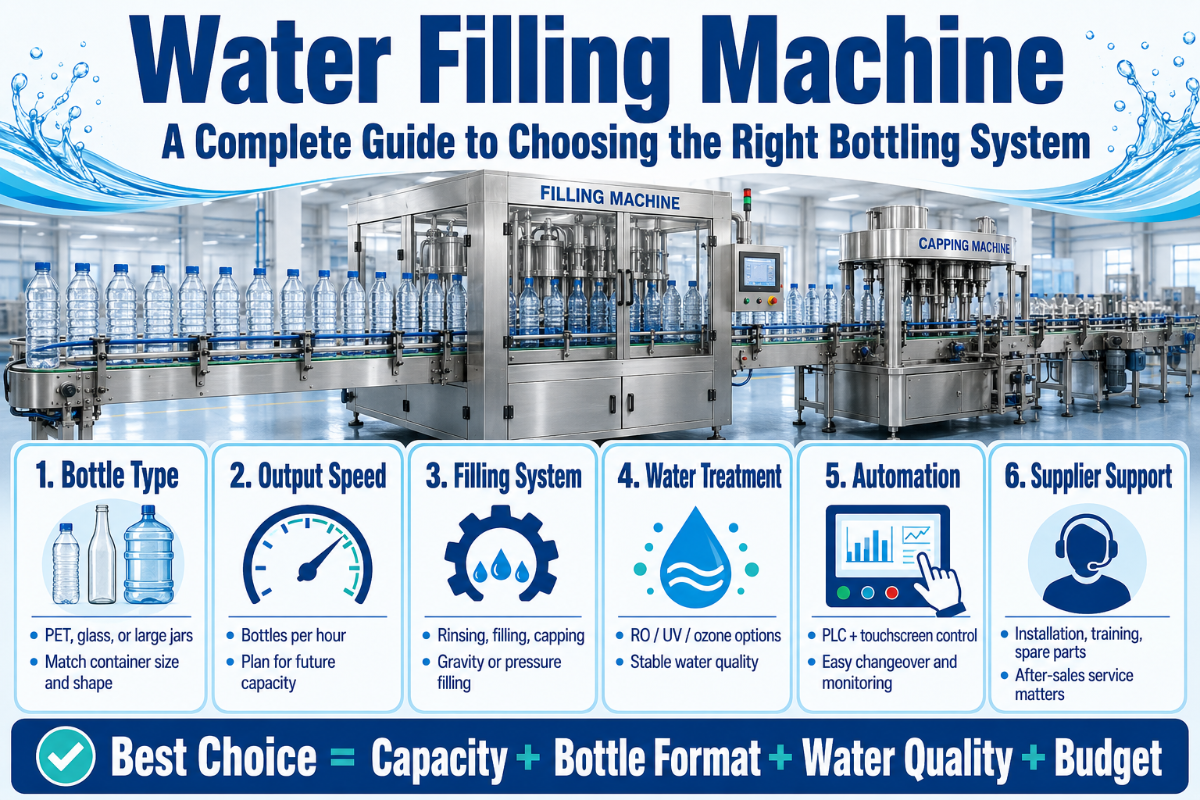
A water filling machine is the rotational machinery that transforms raw treated water into a robustly sealed, commercially salable bottle. Bottlers designing their first water bottling machine line—or those quickly trying to expand or replicate existing operations—water itself is rarely the question. It is about the technology of the valve, the format of the container, BPH throughput, and the way those three variables align with your capital expense.
This post explores how a water filling machine impacts a specification, how to select the appropriate valve technology (one of four choices), the BPH sizing math you should perform, the trade-offs between container formats, suggested price ranges, and the signals that your equipment vendor should be providing in your RFP process to ensure you get what you need.
Checked by other Mass Technology engineering teams, Zhangjiagang Check our professional water filling machine systems page for all product specifications across our CGF, QGF, and MS types.
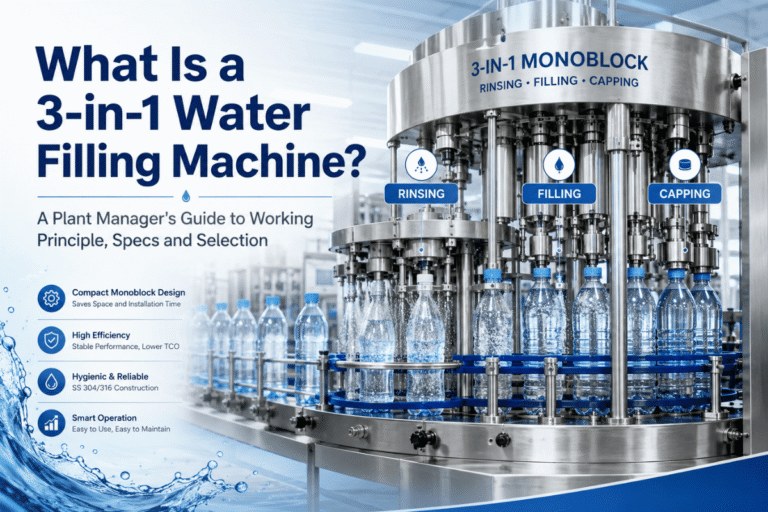
What Is a Water Filling Machine? The 3-in-1 Monoblock Concept
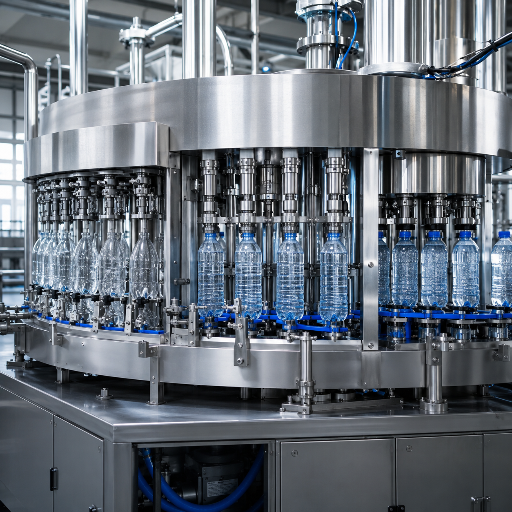
The water filling machine has become the key packaging machinery in the bottled water factory. In the modern bottling operation, it is almost always a 3-in-1 rotary monobloc that in one single rotating frame rinses, fills with treated water and cappers with a sealed cap before the bottle drops out of the rotation path. This ‘3-in-1’ concept sets this architecture apart from its older predecessors wherein rinsing, filling and capping lived on separate machines, each with its own intermediate conveyor.
Why 3-in-1 makes economic sense is simple: Each bottle transfer is a contamination risk and throughput impediment; consolidating three functions in one star-wheel line optimizes sanitation practices, reduces floor space, and allows a single PLC to be directly watching the flow, capping torque, and dosing conveyor speed in tight synchronization.
This format is fundamental to the worldwide bottled water market, which in 2025 had a value of approximately USD 323 billion (according to Fortune Business Insights) and is projected to reach USD 539 billion by 2034. That is a sizable enough market to sustain tier specialization of manufacturing, which is what the rest of this resource will be about.
💡 Quick Definition
In B2B installation terms a water filler machine will be (Almost) always be a rotary 3-in-1 monoblock incorporating all the rinsing, filling and capping functions into a single synchronized ‘circle’. Manual and semi-automatic are available but anything about 2000 bph + will definitely be a rotary monoblock.
How a Water Filling Machine Works: Rinse, Fill, Cap in a Single Rotation
Understanding this as a three-in-one process makes it easiest to take in as three separate stations which are one after another along the same star wheel. Incoming bottles are rinsed by one head and arrive at the cap station with a sealed closure in just over one second of dwell time per head on a high speed line.
Stage 1 — Rinse
Every empty bottle once lined with its neck is turned upside down and carried by the line through a rinse zone. Sterile water is sprayed inside at about 0.06-0.2 MPa and drains out through the open neck once the bottle is turned back up. For mineral and spring water lines a new clean-in-place ozone-dose rinse upgrade now exists.
Inline rinsing meant that 99% of the risk of cross-contamination is eliminated, this is one reason why so many high volume plants converted to inline rather than off line bottle washing.
Stage 2 — Fill
From here, the bottle proceeds to the filling station where a valve automatically delivers a specific dose of water. Dosing accuracy and rate are determined by the water valve technology (gravity, volumetric, mechanical and isobaric) – this choice also effects the types of products that this has the capacity to produce using the same chassis. All four of them will be explained in detail below.
Stage 3 — Cap
Capped bottles are ejected from a servo-driven capping head. Most modern cappers use programmable torque profiles(suggest apply about 20-30% of target torque on the first contact, then push to target torque), and use servo current sensing which rejects any cap that under-torques or strips. This innovation directly attacks the number one most reported customer complaint on bottling lines: stripped or cross-threaded caps.
BPH Math by Head Count
The number of bottles per hour that a rotary monoblock can produce depends on the head count:
multiplied by
the number of turret revolutions per minute. This 18-head gravity filler with a one-second fill dwell times delivers about 18,000 bottles per hour on 500 ml- roughly 300 bottles per minute. The practical, rated capacity of any line in these conditions is typically somewhere in the 60-80% of this lab-continuous number when one considers changeover frequency, HMI efficiency, downstream filler tolerances, and conveyor bank gaps.
Four Filling Valve Technologies: Choosing the Right Engine for Your Liquid
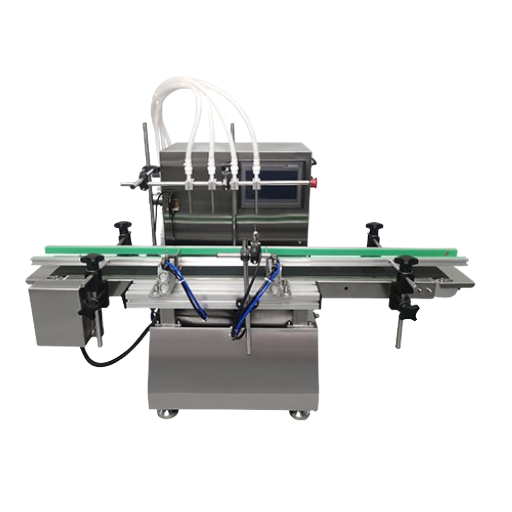
Choosing a water filler valve is the one design specification that has the largest and most immediate effect on what today’s machine can produce and how well the customer can support changing to new SKUs in twelve months’ time. Our 4-Valve Selection Matrix below summarizes our mainstream filling technologies and the environmental conditions in which each excels.
Gravity Filling
Gravity fills use gravity as the motive force- this involves having the product reservoir above the bottle so the weight differential allows water to enter the container until it reaches some sort of calibrated level. Gravity is free, simple to operate and maintain, and dominates still water production in the 200 ml-2 L range. It is not capable of filling viscous liquids, and should not be used with carbonated beverages because it cannot not maintain positive-pressure.
Volumetric (Piston or Mass-Flow) Filling
A piston-cylinder or Coriolis mass-flow meter doses an exact volume per bottle. Closed-loop Coriolis systems achieve roughly 0.1% accuracy, which is essential for premium-priced SKUs where dose precision is itself a marketing claim. Volumetric valves cost more per head than gravity, but they earn it back on flavored, functional, or oil-based products where every milliliter is a margin lever.
Mechanical Vent-Tube Filling
Whenever the liquid level inside the container reaches the calibrated mark, vent-tube water valves close automatically. The result is a very tight control over fill-height (-this is what a shelf-display water brand cares about most!). Mechanical valves have gained favor on high-volume still water lines because the considerable variation in fill height is there visually less apparent as when using gravity at this high BPH rate.
Isobaric (Counter-Pressure) Filling
Inside this filling valve, the bottle is first pressurized with carbon dioxide before the water enters, in order to equalize the pressure inside the bottle with the incoming water in the fill bowl. Without the counter-pressure step, dissolved CO would be released as the carbonated water transfers from bowl to bottle. For sparkling waters, club soda, and carbonated soft drinks, isobaric filling valves are a must-have. They are by far the most mechanically complex of all four, so the price premium for an isobaric-capable monoblock often exceeds 20-30% over a gravity-only chassis at matching BPH.
Which Filling Valve Is Best for Still Water Versus Sparkling Water?
If still mineral or purified water, gravity is the default for SKUs less than 2 L while mechanical vent-tube is recommended above. For hot-fill juice, oil or any dose-controlled SKU, volumetric is worth the premium. Isobaric production is non-negotiable for carbonate products – there simply is no gravity work around. If your product landscape covers both still and carbonated launches within 24 months, specify an isobaric-capable chassis up-front – retro-fit at the end of line time/utility premium will exceed the valve premium.
| Tipo de válvula | Mejor para | Typical Accuracy | Relative Cost |
|---|---|---|---|
| Gravedad | Still water, 200 ml–2 L PET | ±2–3 ml | Lowest |
| Volumetric (Piston / Coriolis) | Premium SKUs, juice, oil, dose-critical products | ±0.1% (Coriolis) | Highest |
| Mechanical Vent-Tube | High-volume still water, tight fill-height SKUs | ±1–2 mm fill height | Medio |
| Isobaric (Counter-Pressure) | Sparkling water, soda, CSD, beer | ±2ml | Mid-High (+20-30%) |
Capacity Planning: Matching BPH to Real-World Demand
BPH – bottles per hour – is the headline metric suppliers price – but it is also where an error takes place in most procurement decisions. Sizing for theoretical peak is the common error production rather than a more conservative work shift average. Over a 16-hour productive day, running one changeover a day, a 12K rated machine will produce 7.7 – 8.7 K BPH on average factoring in 10-20% planned and unplanned downtime.
Right-sizing a line involves this back up and back into- calculation from the distribution commitment. If you are pledged to one truckload a day at 1,000 retail-ready 500 ml bottles, then your line must produce around 0,8500 BPH at a 16-hour day (assuming 10-20% downtime), so a 1,500 BPH (small rotary) rated machine will serve well. Choosing a 12K BPH machine- for safety- means paying for capacity idling some 80% of the day while utilizing utilities and real estate equivalent to a right-sized line.
BPH Tier Decision Chart
- Local startup or contract pilot – 2-4K BPH – small rotary, semi-automatic blow molding
- Regional HOD producer or brand licensee – 4-12K BPH – full rotary monoblock, integrated PET blow molding
- National brand or contract packager – 12-24K BPH – high-speed rotary, Siemens or Mitsubishi motion control
- Export oriented facility – 24-36 K BPH – multi-stage labeling, palletizing, full automation
Owners of fresh drink in volume have repeatedly found that new lines operate at roughly 80% of nameplate BPH only after the preform supply chain settles in – a 6 to 12 month ramp window. Build this into you capital plan before pricing a higher teir of capacity up-front.
Container Format Decision: PET, 5-Gallon HOD, Sachet, or Glass
How the machine is built flows data more than any other factor. Cannot fill 5 gallon HOD jugs- a water filling machine built for PET? – and a sachet line has no native parallel mechanics with a glass-bottle production line? Selection cascades as follows: package-format first- then BPH ranking- then valve type.
What Is the Difference Between PET and 5-Gallon Machines?
PET bottle filling machines grasp neck-grip star wheels and use inline rinse fill cap rotation–technically at 2,500- 30,000 BPH. 5-gallon HOD architecture in contrast is entirely different: too heavy for neck handling, the bottles ride the apron through the cap removal, brush-wash, multi-stage sterilization and normal pressure filling stations. HOD batch processes are considerably lower- on the order of 150-2000 barrels per hour- but the machine is 20L per barrel so throughput is comparable to that of a middle-tier PET line.
Sachet (Film-Based) Machines
In West Africa and South Asia, the MS-series sachet water machine is the dominating format: mechanically it has nothing in common with a rotary monoblock at all: a single roll of PE film is UV-sterilized, formed into a tube, dosed, heat-sealed, cut, and date printed in a continuous motion; throughput is 2,000-2,200 bags/hour on single layer film, 1,100-1,300 on composite film for milk-adjacent products.
Glass Bottle Lines
Glass is fed by a separate filler architecture, offset by the weight of the bottle, the breakage risk and the explosion proof guard around the capping station. The majority of B2B suppliers are building glass and PET as two separate chassis families. Running glass water is below the radar for most SMEs unless marketed as a premium or HORECA (hotel/restaurant/catering) brand.
Once an overall format and BPH tier is finalized, the next constraint is investment. For equipment series and their respective BPH benchmarks, you can explore Mass Technology’s CGF, QGF, and MS product series.
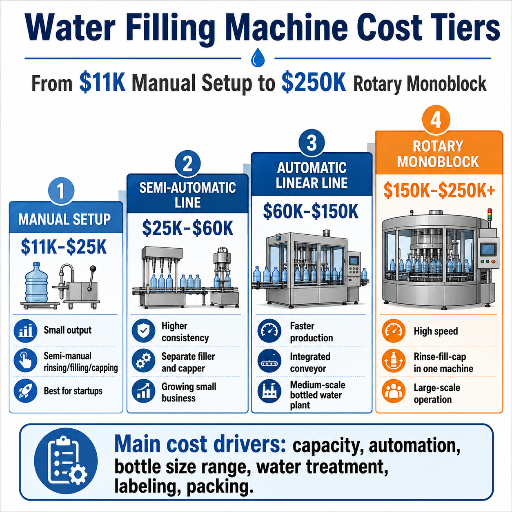
Cost Tiers: From $11K Manual Setup to $250K Rotary Monoblock
How Much Does a Water Filling Machine Cost?
Equipment cost of a water filling machine range from roughly USD11, 000 for a manual and semi-automatic manual end up into USD250, 000+ for high speed rotary monoblocks. Realistic budget ranges take shape in four clusters for production tiers. Turn-key plant including water treatment, PET preform blowing, the filling monoblock, labelling and packaging, however, generally starts at USD250, 0000 and add several zeros for export grade facilities.
| Nivel | BPH Range | Equipment CAPEX (USD) | Typical Buyer |
|---|---|---|---|
| Manual / Semi-Auto | 500–1,000 | $11K–$25K | Local startup, emergency stockpile |
| Small Rotary | 2,500–8,000 | $25K–$80K | Regional brand pilot |
| Mid-Tier Rotary | 8,000–14,000 | $80K–$150K | National brand, HOD distributor |
| High-Speed Rotary | 14,000–30,000+ | $150K–$250K | Contract packager, export plant |
| Turnkey Plant | All tiers | $250K+ | Full project, including RO + blow + pack |
⚠¦ Hidden Cost Calculator
Headline CAPEX on equipment is only a small component of the total bottling investment. Budget lines should be made for six recurrent items often under-estimated by procurement teams:
- PET preforms- often the single largest variable cost per bottle:
- Closures, labels, and tamper-evident sleeves
- RO water treatment energy and membrane replacement
- Compressed air and chilled water for the blow molder
- Skilled labor for changeover and PLC supervision
- Spare parts inventory — minimum 3-month rolling stock
Get a Custom Quote for Your Facility Scale →
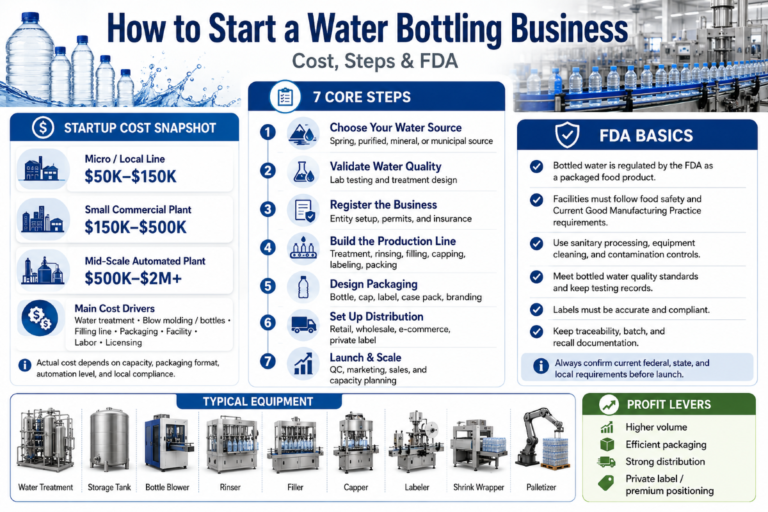
Building a Complete Water Bottling Line: From Treatment to Palletizing
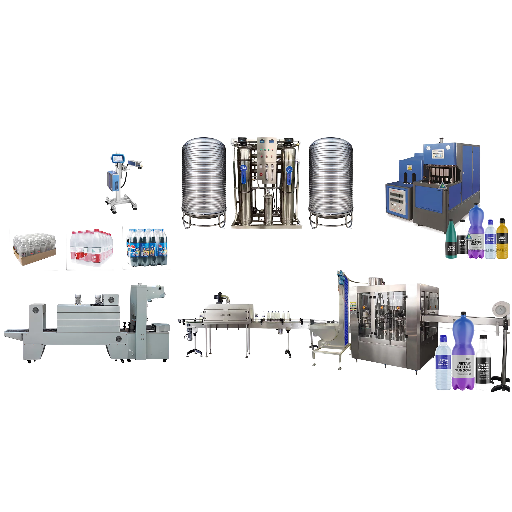
Most buyers, especially at the established end, focus on the filler itself and underestimate the downstream and upstream equipment required to produce a finished, palletized retail item out of raw water. Water bottling is a 5-stage process, and each stage needs to bottle neck to match the BPH of the filler.
| Stage | Equipment | Function |
|---|---|---|
| 1. Treat | Reverse-osmosis system, 0.5–50 T/h | Multi-stage filtration plus UV or ozone disinfection |
| 2. Mold | PET preform blowing machine | Converts preforms into bottles using compressed air at 30–40 bar |
| 3. Bottle | Rotary monoblock filling machine | 3-in-1 rinse, fill, and cap on a synchronized turret |
| 4. Label | Hot-melt OPP or shrink-sleeve labeler | Applies wraparound or full-body labels |
| 5. Pack | Shrink wrapper plus palletizer | Groups bottles into distribution packs, builds pallets |
What synergizes all five stages of a factory and why it far superior for operational stability – not just for procurator ease of assembly – is factory acceptance testing. Lines built and debugged as a single system, at the supplier’s plant in Zhangjiagang or comparable, go through site commissioning in roughly 2-3 weeks. Lines cobbled from 5 component suppliers work for 8-12 weeks with each interface becoming a debugging point.
Beyond Water: Reusing the Same Chassis for Juice, Carbonated Drinks, Wine, and Vinegar
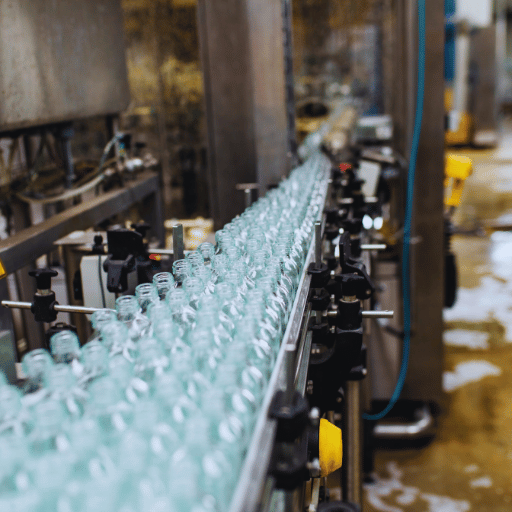
One single most valuable – and most underappreciated – feature in a water filling machine is that the identical monoblock chassis can run any number of other liquids, after a valve swap and a star-wheel change. A “water filling machine” is seldom ever just for water; in reality it is the flexibility of systems, more than the water itself, that provides long-term ROI.
One CGF rotary monoblock capable of filling 500 ml still water, with the appropriate star wheel and valve change, can produce:
- Mineral water (high TDS) – same chassis – (316L composition, inline sensors above CGF24-24-8 tier
- Sparkling water and carbonated soft drinks – isobaric valve set, CO pre-condition.
- Juice, fruit tea Hot-fill PET up to 95 °C (UHT pasteurization required)
- Vinegar, soy sauce, rice wine—volumetric piston filling 50-1,000 ml/bottle
- Vegetable protein drinks — sterilized hot-fill at controlled temperature
This matters to procurement teams because the economics of a single multi-product chassis usually beats sourcing two narrower lines. Changeover time is the trade-off—a full valve and product-reservoir change is usually a one-shift task for trained operators.
Compliance and Sanitation: CE, ISO 9001, EN 12463, and 304/316L Stainless Standards
For exporters and importers, the compliance documentation that accompanies a water filling machine matters as much as its BPH rating. Three certificate families and two material standards should be on every RFQ checklist.
CE Marking and the EU Machinery Regulation Transition
All equipment sold into the European Union today is compliant with Machinery Directive 2006/42/EC. As of 20 January 2027 that directive is entirely replaced by the Reglamento de Maquinaria de la UE (UE) 2023/1230, with no transition period after that date. Buyers planning EU export in 2027 or beyond should check with their supplier now whether their equipment will be prepared for the new regulation—any machine that was shipped under the old directive after the cutoff cannot lawfully be placed onto the EU market.
Hygienic Filling Standards
EN 12463:2004+A1:2011 pertains to the safe and hygienic filling of liquid food machinery for use in bottle and can lines, and is the European reference standard to which food-contact filler designs are made. The ISO 9001 quality-management certification is a universal criterion to insist on from the serious supplier-and its the single easiest authenticity signal to verify through an audit report request.
Material Grade — 304 Versus 316L Stainless
All food contact surfaces should be 304-grade stainless steel as a baseline. For mineral waters with very high levels of total dissolved solids or high-temperature fills, or environments requiring aggressive sanitisation, 316L (containing molybdenum) is the next step-up specification that will resist pitting corrosion. The additional cost premium for 316L is approximately 20-30% on contact-part components but it is the single most efficient long-term premium that can be cost-justified.
Industry Outlook 2025-2026: Market Growth and Buyer Trends
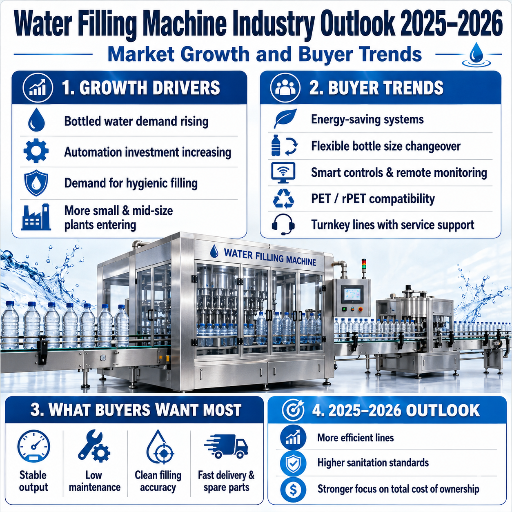
Across the world the bottled water industry hit in excess of USD 323bn during 2025 and is regarded by Fortune Business Insights as generally forecast to reach in excess of USD 539bn by 2034. That number masks a more interesting story: the fact that the industry grows substantially faster by format and by region—and how each condition varies in its equipment procurement implications.
USD 323B
Global Bottled Water Market, 2025
5.7%
Forecast CAGR to 2034
10.5%
Africa Sachet Water CAGR
$1.3B
Nigeria Sachet Industry Size
By format the fastest-growing small-format segment from the equipment procurement perspective is the Sachet Water category in Sub-Saharan Africa and South Asia. In 2024, Sub-Saharan African sachet water created a USD 4.2bn industry and it is predicted to approximately double by 2033. Nigeria—where the local industry alone commands a estimated USD 1.3bn—provides one glaring example of potential regional growth impacts. For equipment producers—and for the procurers planning expansion in those target territories—MS-series film machines and multi-layer products are not secondary between-product lines; they will be a chief growth engine.
There are three important supply side dynamics that I believe are relevant to any 2026 equipment procurement decisions:
- Servo torque control is now de rigueur on lines that will process in excess of 12,000 BPH. Older, mechanical torque clutches are still found in some production environments but the picture of cap-stripping performance is showing obvious difference.
- Coriolis mass-flow valves are moving from the top-end of volumetric into mid-range applications. During the 24-month window leading to premium SKU launches, all plants should specify Coriolis-compatible valve frames.
- Compliance documentation has become an increasingly important differentiator in procurement as the January 2027 EU Machinery Regulation compliance deadline approaches.
We designed our CGF rotary range for the format scaling pattern typical of our customers: from a startup batch rate of 2,500 BPH on commissioning to 12,000 BPH at 24 months on the same factory footprint. If you read our model numbers as indicative production tiers, not SKU identifiers, then you can compare indicative pricing to a real plant layout.
— Mass Technology Application Engineering Team, Zhangjiagang
Preguntas frecuentes
Q: What is the difference between gravity, volumetric, mechanical, and isobaric filling valves?
Ver respuesta
Gravity valves deliver 0.1% accuracy by height differential in still water at the lowest purchase cost. Volumetric valves (piston or Coriolis) dose an exact volume and are specified for premium SKUs at the lowest random error. Mechanical vent-tube valves shut off at a calibrated fill height and dominate high-volume still water lines. Isobaric valves pre-pressurize with CO and are not “bottler” without sparkling or carbonated water.
Q: What is the realistic lifespan of a water filling machine?
Ver respuesta
With daily common-cause and predicable failure repairs (daily CIP-inspect, periodic seal and gasket change-out, fill-torque clutch service, star-wheel pad change, nothing else) a 304 or 316L stainless steel rotary monoblock should have 10-15 years of reliable service life. Wear parts are exchanged in the established cycle; structural frame or motion system failures are very uncommon.
Q: Can one water filling machine handle different bottle sizes?
Ver respuesta
Sure. Any round or square PET bottle with a neck diameter 50-115 mm fit any standard CGF rotary monoblock. Changeover from 500 ml to 1.5 L takes about one to two hours, with a required star wheel change, neck guide reposition and a capping head adapter switch. Operators proficient in change-over techniques complete the process well inside a manual shift period.
Q: What is the difference between semi-automatic and automatic filling machines?
Ver respuesta
Semi-automatic machines require the operator to load bottles, then turn on the fills, and then unload finished product (range of 500-1,000 BPH). Fully automatic rotary monoblocks include conveyer-fed bottle loading, synchronized rinse-fill-cap rotation, then downstream conveyer unloading at 2,500+ BPH with one or two unattended operators. Full cycle crossover occurs in about 2,000 BPH.
Q: What are the maintenance requirements for a water filling machine?
Ver respuesta
Daily: visual inspection, rinse-in-place contact part cleaning, conveyor lubrication. Weekly: seal, gasket inspection, capping torque verification, PLC alarm log review. Annually: full bearing service, capper clutch spline inspection, star wheel pad change-out if appropriate. Recycling and maintaining a spare parts inventory generally costs a plant 3-5% of annual revenue.
Q: Can a single supplier provide a complete bottling line including water treatment and packaging?
Ver respuesta
Absolutely. A vertically integrated supplier offers a one contract (RO water treatment (0.5-50 T/h), PET preform or bottle blowing, rinse-fill-cap monoblock, printing, labeling, shrink wrapping and palletizing) solution that delivers on procurement convenience with a single factory acceptance test before shipping and a single owner-provided warranty during commissioning – thereby reducing site commissioning from 8-12 weeks to roughly 2-3 weeks.
Ready to scope your water bottling line?
Tell us the target daily production volume, packaging format (PET, 5-gallon, sachet), and country of sale. One of our application specialists will respond in less than a day with a capable recommendations, indicative price range and lead time.
Cómo construimos esta guía
Capacity, valve-technology & material specs specified in this guide are derived from Mass Technology factory-based data on our CGF, QGF & MS series equipment built at Zhangjiagang. Market sizing data sourced from Fortune Business Insights, Mordor Intelligence & Business Research Insights. Regulatory info directly accessed from European Commission single-market portal. Price indicator bands reflect industry ranges as of Q2 2026 and will vary by configuration, freight exp. & exchange rate. We publish bands rather than quotes as procurement teams consistently report opaque pricing as the single largest contributor to stalled equipment purchase decisions.
Referencias y fuentes
- Bottled Water Market Size, Share | Industry Report 2026-2034 – Fortune Business Insights
- North America Bottled Water Processing Market Size & Share Analysis – Mordor Intelligence
- Machinery – Internal Market, Industry, Entrepreneurship and SMEs – European Commission
- The rarely told story of the widely used water sachets – United Nations Environment Programme
- Sachet Water Market Size & Insights Report 2033 – Business Research Insights