Póngase en contacto con Masstech

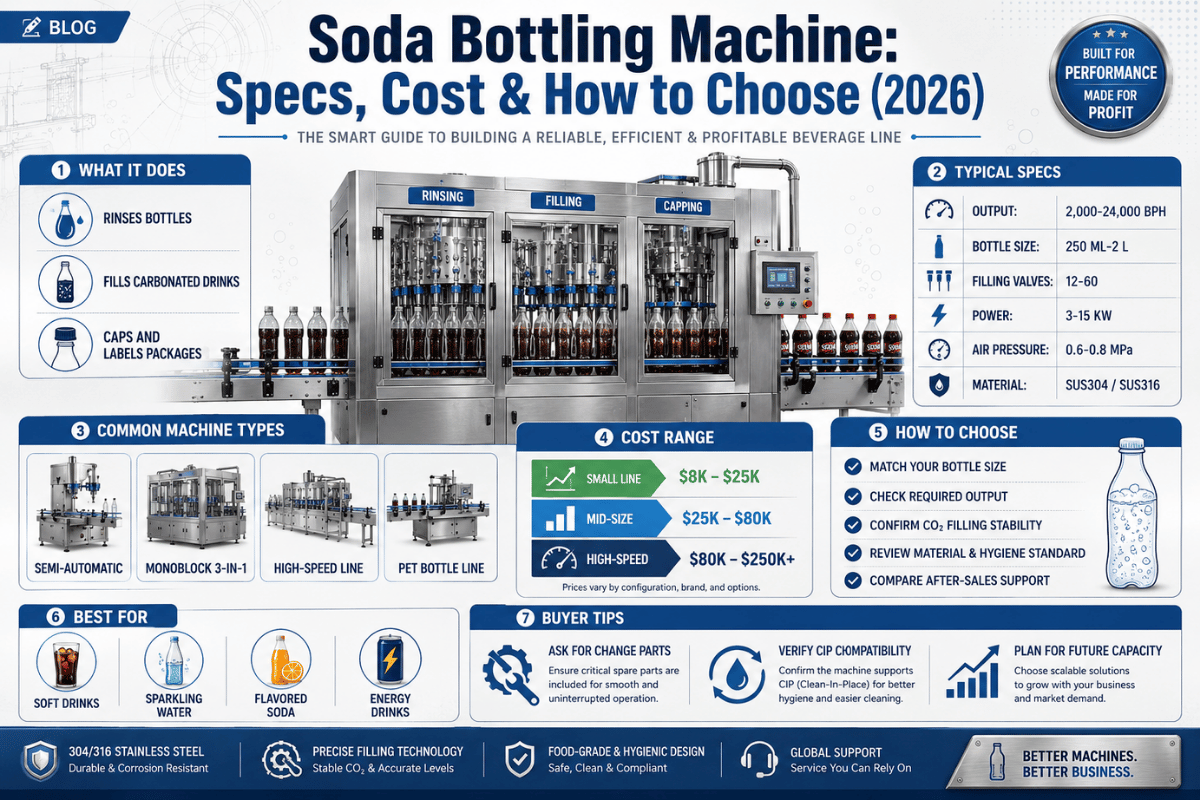
Especificaciones rápidas
| Filling principle | Isobaric (counter-pressure), about 1–4 bar fill pressure |
| Containers | PET, glass, aluminium can |
| Closures | ROPP / screw (PET), crown (glass), seam (can) |
| Rango de salida | ~2,000 to 36,000 bottles per hour (BPH) |
| Carbonation level | ~2.5–4.0 volumes of CO2, drink-dependent |
| Material de contacto | AISI 304 or 316 stainless steel |
What a Soda Bottling Machine Actually Does
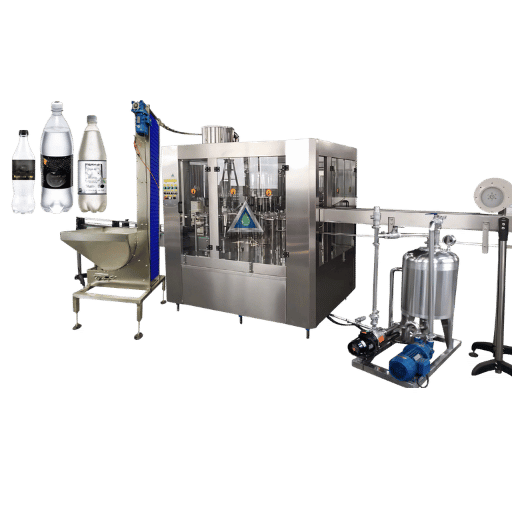
At its core a soda bottling machine runs each empty container through three steps in one synchronised block – a rinser-filler-capper monoblock. The rinser clears debris, the filler doses the carbonated drink, and the capping machine seals it before the gas escapes. On most lines a máquina embotelladora de refrescos shares the same core machinery as a water filler; the difference live in the filling valve and the pressure system around it.
The reason carbonated drinks need their own approach is physics, not branding. CO2 stays dissolved only while the liquid is under pressure. The moment you expose carbonated liquid to atmospheric pressure – which is exactly what a gravity or vacuum filler does – gas rushes out of solution and the product foams. A soda line therefore fills the bottle while it’s already pressurised, so the liquid never “sees” a pressure drop.
One scope note before the technical sections: the machine control the fill and the seal. It doesn’t control your recipe. Product formulation, additives and label compliance – for example the well-documented benzene risk when benzoate preservatives meet ascorbic acid – sit with the beverage producer and fall under food-safety rules, not the bottling equipment. Keep that line clear when you compare suppliers.
Isobaric (Counter-Pressure) Filling: Why Soda Can’t Be Gravity-Filled
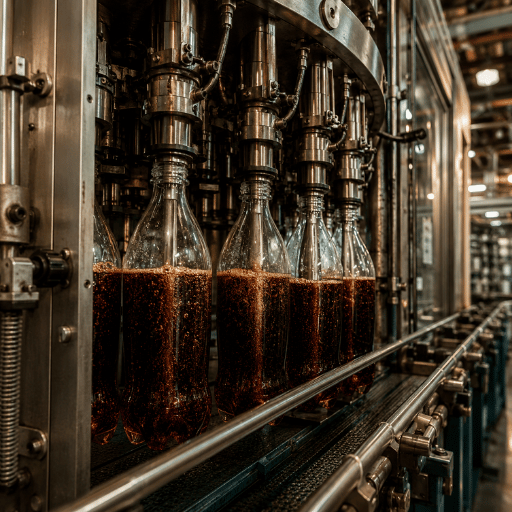
Isobaric filling – “iso-baric” meaning equal pressure – is the defining technology of any soda bottling machine. The valve runs a four-move sequence on every bottle: it first floods the empty container with CO2 to counter-pressurise it to roughly the same pressure as the product tank; then the drink flows in under equal pressure with no turbulence; the liquid is allowed to settle; and finally a snift valve gently relieves the headspace before the bottle leave the valve. US patent US5954100A describes exactly this counter-pressure and snift mechanism – the snift step is what stops the bottle from gushing when it depressurises.
💡 The Counter-Pressure Fill Window
soda lines fill cleanly only under a bubble of cold product and head pressure sufficient to cover it. The underlying principle of operation is Henry’s Law: the volume of CO2 remaining in solution varies in direct proportion to its partial pressure over the liquid. The Brewers Association articulates exactly this trade-off in a very plain terms, regardless of the variety of beverage packed by the carbonated beverage. In practical terms, what this amounts to is: Cool the beverage to around 4-8 °C; maintain head pressure at or above the CO2 saturation pressure of your drink. To apply it: Look up the pressure from a carbonation chart for your desired number of volumes at your filling temperature. For instance, a cola at around 3.7 volumes and 4 °C requires about 2 bar gauge pressure. That figure increases as the liquid is warmer. Set your filler at or above that; go too low and gas will come out of solution as the bottle is being filled.
Which brings us to a most useful – yet seldom promoted – piece of information: the maximum carbonation a particular filling line can hold isn’t necessarily determined by the temperature. As one small producer noted on r/TheBrewery, “Large brand sodas we sell usually target 3.2 volumes, but our current filler can’t hold that high.” The machine itself – and in particular its counter-pressure feature and valve design rather than your cooler – is ultimately what separates lines that reach 4.0 volumes from those that foam. The signature of a line struggling to hold carbonation is “fobbing,” which, with very few exceptions, comes from too little counter-pressure letting CO2 escape solution as the fill valve close.
Carbonation, CO2 Volumes and Foam Loss
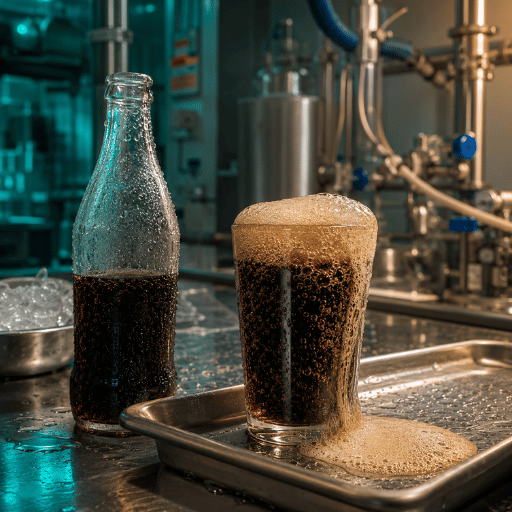
Carbonation is typically reported in volumes, which refer to the number of bottle-volumes of CO2 gas that are dissolved in one bottle-volume of liquid beverage. The acceptable range for carbonation varies greatly depending on the drink, and the range can be wider than what some buyers assume.
| Tipo de bebida | Typical CO2 volumes | Fill note |
|---|---|---|
| Cola (Coke/Pepsi style) | 3.5 – 4.0 | Needs the strongest counter-pressure |
| Diet / zero-sugar cola | 3.5 – 4.0 | Same target as regular cola |
| Club soda | 3.5 – 4.0 | High and stable |
| Sparkling water / seltzer | 3.5 – 4.5 | Among the highest carbonation |
| Lemon-lime (clear soda) | 2.5 – 3.5 | Lower turbulence tolerance |
| Fruit / orange soda | 2.5 – 3.5 | Rango medio |
| Tonic water | 2.5 – 3.5 | Rango medio |
| Ginger ale | 3.0 – 3.5 | Mid-to-high |
| Root beer | 2.0 – 2.5 | Lowest of the common sodas |
| Energy / functional carbonated | ~2.8 – 3.2 | Often shares a CSD line |
Carbonation bands for beverages, from the University of Florida IFAS Extension’s guide to carbonating beverages.
The Foam-Loss Triangle
Whenever CO2 leaves a solution during filling, three things are very likely to be the cause. Field engineers identify these failures as “fobbing” and place them at the vertices of a triangle of risk:
- Temperature is too high – CO2 solubility decreases as temperature increases, so any drop out of solution is going to happen at the moment you open the fill valve.
- Fill speed is too high – agitation causes bubbles to form (nucleate); many systems’ iso-fill valves slow final fill speed to prevent laminar flow.
- Counterpressure differential is too low – if you can’t keep the head pressure higher than the saturation pressure for the desired CO2 volumes at filling temperature, gas comes out of solution during the filling of the bottle.
But as you might imagine, the brochures leave out a key exception to the rules: Even a soda has its limits. The filler controls what the valve can achieve, but the ultimately carbonation at the shelf is a factor of the packaging. Carbonation does permeate PET to a degree (and such standards as ASTM F1115 were written for testing the escape of CO2 from plastic beverage containers over time). A good fill that goes into a package incapable of holding carbonation is still going to taste flat in days, if not hours. Hence the carbonation problem turns out to be two separate but related questions.
PET, Glass or Can: Matching the Filler and Capper to Your Container
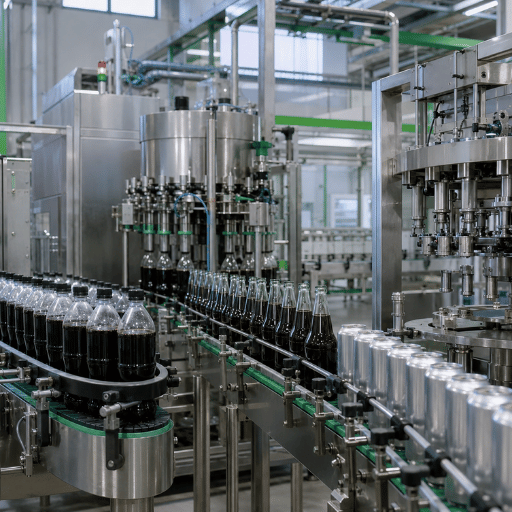
Container choice locks in the filler valve, the capper, and part of the price. Each format require an associated closure and sealing technology; those for carbonated drinks need to be pressure rated for gas.
| Contenedor | Closure | Pressure qualification |
|---|---|---|
| PET bottle | ROPP / plastic screw cap | CO2-barrier resin + thicker base; watch permeability (ASTM F1115) |
| Glass bottle | Crown cap (crimp) | Internal-pressure resistance per ISO 7458 |
| Aluminium can | Double seam (seamer) | Soda can filling uses a seamer, not a capper |
There’s a well-worn field lesson here: the wrong plastic will stretch or break down from pressure and acidity. A loosely applied cap will leak gas. Flat product on the store shelf typically isn’t the result of “bad CO2”-it’s usually evidence of a seal that failed. So, together, the capper, the closure, and the container must be qualified with the filler, not added on later.
Capacity and Automation: From 2,000 BPH Semi-Auto to Rotary Lines
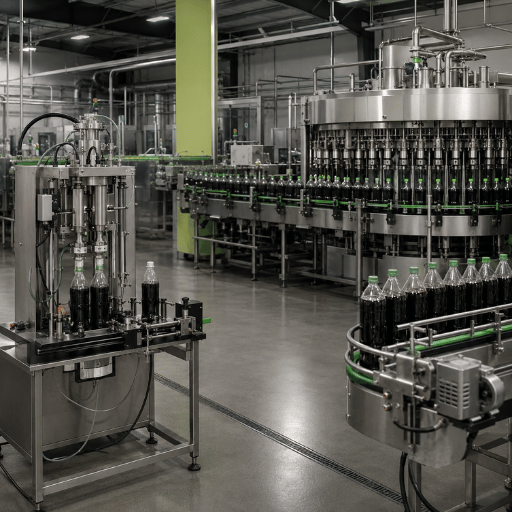
Output and automation generally rise together. Single-product linear machines from soda filling machine handle about 1,000 to 4,000 BPH, ideal for start-ups or regional brands. As output increases, lines go rotary and move to monoblocks where bottle moves on a carousel and many valves run in parallel, typically processing from about 6,000 to 36,000 BPH. beverage Industry reports, “ isobaric fillers have been engineered to accommodate from 16 to 160 filler valves in a single machine.”
📐 Engineering Note — sizing the heads
Productivity escalates with valve count, not special sauce. In short, BPH=vals per min * vals*60. If a 24-valve rotary machine can achieve, say, 12 fills per valve per minute: 24vals * 12fills/val/min * 60min/hr = 17,000 BPH. If you only really need 6,000 BPH, you could go with a much smaller and cheaper 12- or 16-valve monoblock and invest the difference in a better capper.
A scalable growth path also warrants consideration. Many new manufacturers start out in single-digits bottle per minute and plan for eventual increases-one told us, “We need to be running at 8 bottle per minute this month but want to be between 20 and 50 in a couple of years.” You’ll be glad you’re able to add valves to the machine, or upgrade your chiller, to avoid a costly forklift changeover later.
How to Choose: A 6-Question Soda Line Spec Sheet
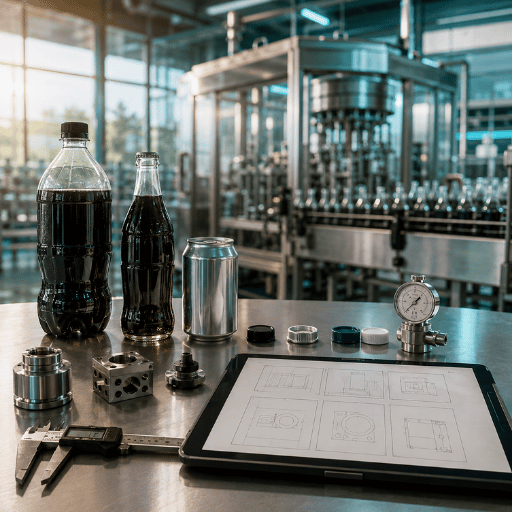
To avoid wasting everyone’s time and get comparable quotes, first pin down six key numbers. Most quote requests stall because the buyer has not fixed these, so settling them up front turns every supplier reply into a directly comparable offer you can line up side by side.
The 6-Question Soda Line Spec Sheet
- Drink type and target CO2 volumes – moving from, say, a cola at 3.7 volumes to a lemon-lime at 3.0 volumes changes the filler valve specification.
- Container type and closure – this means deciding on PET/ROPP cap, glass/crown cap, or can/seam, which all require distinct head designs.
- Target output (BPH) – consider your current volume and a realistic 2-3 year capacity ceiling.
- bottle SKUs and changeover times – evaluate how many different sizes and varieties of product your machine will need to produce, and how quickly you’ll need to switch between them.
- Nivel de automatizaciónsemi-automatic, automatic, or fully automatic rotary.
- Power, footprint and budget – these factors address voltage, physical space requirements and overall capital investment capacity.
With these six figures determined, a supplier can dimension a new line on the spot. If you’re not sure of the optimal specifications, you can either use our CSD sizing calculator (the result of which is a valve count and required machine footprint) or provide those six numbers to one of our engineers who will work up a complete layout proposal for you.
What a Soda Bottling Machine Costs, and What Drives the Price
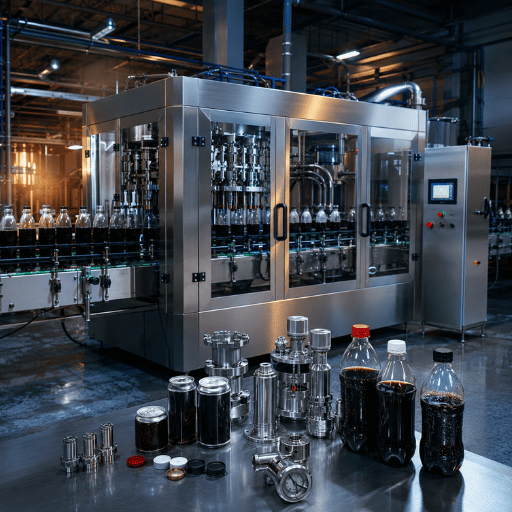
Unfortunately, there’s no official list price for a piece of machinery. Any price list out there, even for something as standard as soda bottling machine equipment, is based on educated guess. Every quote will be the result of the same five driving factors.
- What makes soda plants so pricey. Output (BPH) – valve count is the single biggest line item.
- Automation – semi-auto to rotary monoblock is a step change in price.
- Container + closure count – multi-format heads and an extra capper add cost.
- Stainless grade – moving contact parts from 304 to 316 typically adds 30-40% on those parts (see below).
- Add-ons – whether a carbonator, blow-molder or labeler is in scope.
Running cost is the part buyers underestimate. The big three are CO2 consumption (some is always lost at snift), electrical load for chilling, and changeover labor. Before you compare sticker prices, model those over five years – the valve TCO comparison is built for exactly that. A cheaper machine that wastes CO2 and stalls on changeovers is rarely the cheaper machine.
Build Quality and Hygiene: What Separates a Reliable Line from a Cheap One
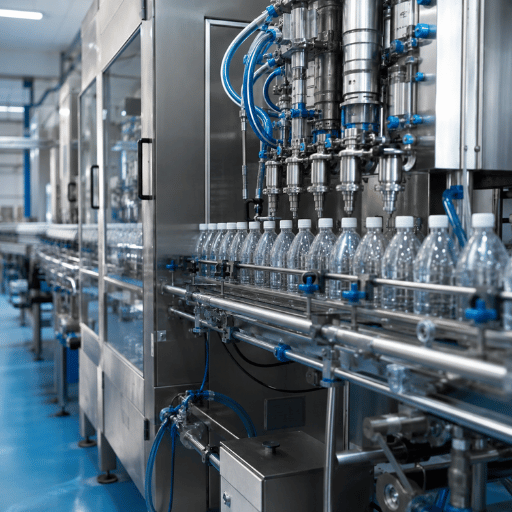
Budget “low-cost soda plants” exist, and they cut the parts you can’t see. Four checks separate a line that last from one that rusts and leaks.
Contact material. Product-contact parts should be food-grade stainless. AISI 304 covers most carbonated drinks; 316 adds molybdenum for better resistance to the citric and phosphoric acids in some sodas and to chloride sanitisers, and it typically costs 30-40% more than 304 on those parts. Ask which grade is used where the drink touches, not just the frame.
Hygienic and CIP design. A carbonated line must clean-in-place. Crevice-free valves, drainable pipework and a working CIP circuit aren’t extras – they’re the difference between a one-shift changeover and a contamination recall.
CO2 quality and CO2 safety. The gas itself is regulated. The International Society of Beverage Technologists sets beverage-grade CO2 guidelines – purity of 99.9% v/v minimum with tight moisture limits – and only beverage-grade CO2 should reach the carbonator. CO2 is also an asphyxiant: OSHA sets a permissible exposure limit of 5,000 ppm over an 8-hour shift, and the CDC/NIOSH guide confirms the same figure, so a bottling room needs ventilation and CO2 monitoring.
Food-safety oversight. Above the machine sits the producer’s compliance layer. In the US, the FDA treats carbonated soft drinks as foods subject to sanitation, current good manufacturing practice and labeling oversight – the equipment has to support that, with documented sanitary design and a control system you can validate.
“The cheapest way to lose a soda contract is a filler that can’t hold counter-pressure on the customer’s highest-carbonation SKU. We size the valve to the hardest drink on the line, not the easiest – and we put 316 where the acid actually touches.”
Mass Technology CSD line engineering team
Where CSD Bottling Is Heading: PET Lightweighting, Energy Drinks and New Markets
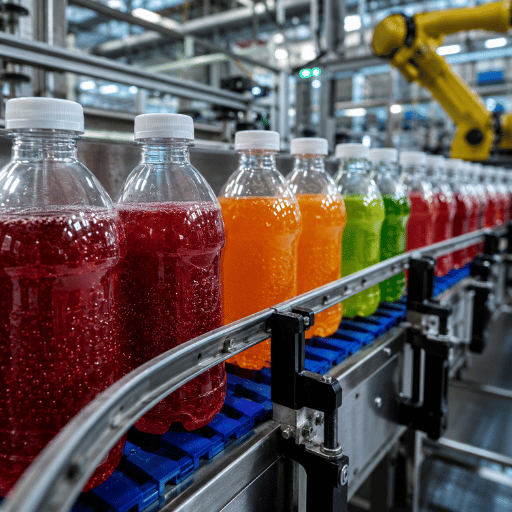
Three shifts are changing how a soda bottling machine should be specified in 2026, and each one is a buyer decision rather than a market headline. Where you sell, how light your bottle gets, and how many drink types share the line all change the spec you should be asking suppliers for today.
New-market capacity. carbonated-drink capacity is growing fastest outside the mature markets – Coca-Cola’s bottleps and line builders such as Sidel and Krones have been installing new CSD lines across Latin America and Africa. For a buyer in one of those markets, the implication is concrete: turnkey scope, local commissioning and spare-parts logistics matter as much as the filler itself.
PET lightweighting. bottles keep getting lighter to cut resin and freight. Lighter preforms are less forgiving – the filler and capper have to grip a thinner neck without crushing or scuffing it. If you’re likely to lightweight, specify neck-handling tolerance now.
One line, many drinks. Energy drinks and functional carbonated beverages increasingly share a CSD line; trade coverage describes machines that run carbonated and non-carbonated products on one filler. The buyer judgment is simple: pay a little now for multi-CO2 setpoints and fast changeover, or pay later in a retrofit. (Market-size forecasts for CSDs vary widely – anywhere from low single-digit to ~9% CAGR depending on the report – so treat them as directional context, not a planning input.)
Preguntas frecuentes
Q: How much does a soda bottling machine cost?
Ver respuesta
There is no honest single list price — a soda bottling machine is quoted to your configuration. The figure is driven by output (BPH and valve count), automation level, container and closure formats, stainless grade, and whether a carbonator, blow-molder or labeler is included. A semi-automatic line and a 24-valve rotary monoblock are different orders of magnitude. Settle the six spec-sheet numbers above, then request a configured quote rather than a ballpark.
Q: Can one machine fill both soda and still water?
Ver respuesta
Yes, many isobaric lines can. A counter-pressure filler can run non-carbonated product simply by not applying counter-pressure, so a CSD machine is generally more flexible than a still-water-only filler. The reverse is not true — a gravity or vacuum water filler cannot fill carbonated drinks without foaming. If you plan to run both, specify a filler with selectable counter-pressure and a complete bottling line layout that supports both modes.
Q: What’s the difference between a soda bottling machine and a home soda maker?
Ver respuesta
They solve different problems. A home soda maker carbonates water one bottle at a time for personal use. A soda bottling machine is industrial equipment that fills and seals hundreds to tens of thousands of bottles per hour under counter-pressure, meeting food-safety and CIP requirements. If you are producing for sale, a consumer soda maker is not a substitute — the throughput, consistency and hygiene gap is the whole point of the line.
Q: How much does it cost to run a soda bottling line?
Ver respuesta
The recurring costs are CO2 (some is lost at every snift), electricity for chilling and drives, water and cleaning chemicals for CIP, and changeover labor between SKUs. Model both consumption and changeover time over a five-year window, not per bottle.
Q: Do I need a separate carbonator or CO2 source?
Ver respuesta
Usually yes. A carbonator (or mix-and-carb unit) dissolves CO2 into the chilled product before it reaches the filler, and the gas must be beverage-grade. Some turnkey CSD production lines include it; on a standalone filler it is a separate, essential item.
Q: How long does installation and commissioning take?
Ver respuesta
It varies with line size and site readiness, but a configured CSD line is typically a multi-week installation plus on-site commissioning and a trial run before hand-off. New-market buyers should confirm local commissioning support and spare-parts lead time up front.
Why We Wrote This
Mass Technology builds isobaric rinser-filler-capper monoblocks for carbonated soft drinks and ships beverage lines to more than 60 countries. The counter-pressure and CO2-volume figures here reflect how we size CSD valves to the hardest drink on a customer’s line, backed by 24-hour engineer response and a 2-year warranty. Reviewed by the Mass Technology technical team.
Referencias y fuentes
- Potential Carbon Dioxide Asphyxiation Hazard When FillingOSHA
- Carbon Dioxide, NIOSH Pocket GuideCDC/NIOSH
- Carbonated Soft Drinks: What You Should KnowU.S. FDA
- A Guide to Carbonating Beverages at Small ScaleUniversity of Florida IFAS Extension
- Facts About Draught Beer Carbonation (Henry’s Law)Brewers Association
- ISBT Carbon Dioxide GuidelinesInternational Society of Beverage Technologists
- ASTM F1115, CO2 Loss from Plastic Beverage ContainersASTM International
- ISO 7458, Glass Containers Internal Pressure ResistanceISO
- US5954100A, Fill Valves with Counterpressure and Snift MechanismsUSPTO
Artículos relacionados
- Counter-Pressure vs Gravity Filling, the filling-mechanism deep dive
- Carbonated Drink Filling Machine, the full CSD equipment range
- Bottle Labeling Machine, the downstream line component
- Bottle Blowing Machine, making the PET bottles in-house
- 3-in-1 Water Filling Machine, the still-water rinser-filler-capper