Entrez en contact avec Masstech

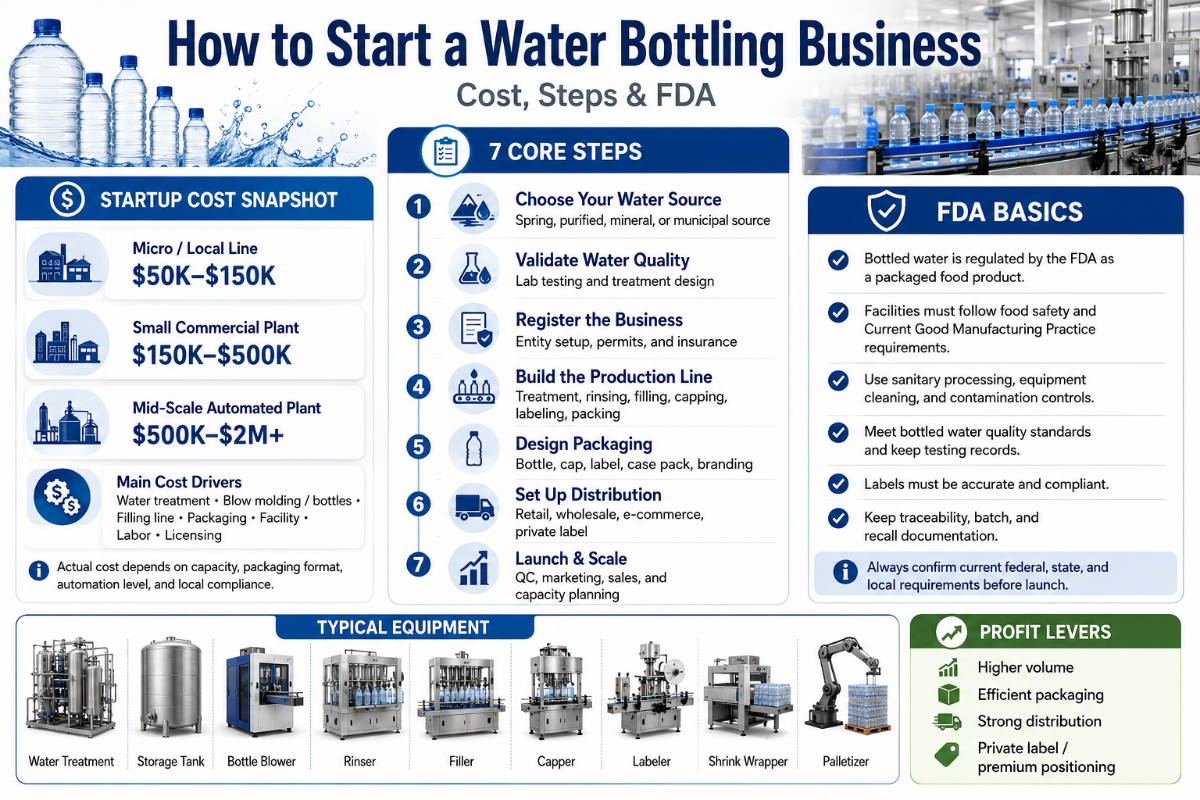
Wondering how to start a water bottling business? US retail sales for bottled water topped $50.6 billion in 2024, up 2.9% when every other packaged drink category declined. That tailwind justifies the founder interest — but bottled water is a low-margin commodity business with difficult regulations and thin per-unit margins. This article breaks down the CapEx math, FDA rules, equipment options, water sources, and distribution challenges that determine whether a startup can get to year three.
Quick Specs: Water Bottling Business at a Glance
| Startup CapEx (small in-house plant) | $150,000 – $500,000 |
| Co-pack / private-label entry | $25,000 – $150,000 |
| Time to first revenue | 6 – 18 months (state-dependent) |
| Manufacturer gross margin | 20% – 40% (single-serve PET) |
| Federal regulator | FDA (21 CFR 110, 129, 165) + state agencies |
| U.S. market CAGR (2026–2034) | 5.93% |
How Profitable Is Bottled Water?
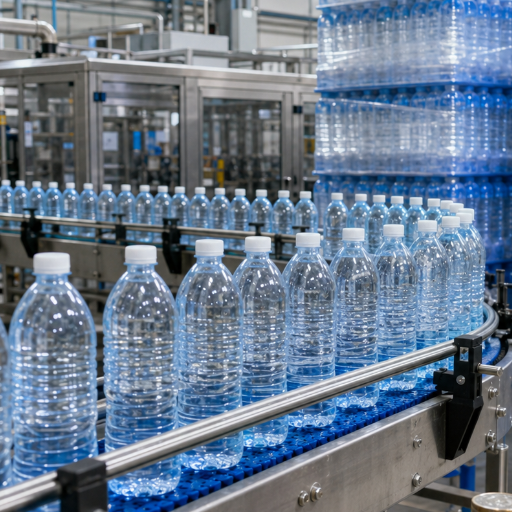
Bottled water is volume, not margin. Per-capita demand may be real — Americans drank 47.3 gallons per person in 2024 according to the IBWA 2025 market data release — but most of that retail dollar is earned outside the bottler’s wallet. A 500 mL single-serve bottle costs a small plant roughly $0.15 to $0.30 all-in (PET preform, cap, label, filtered water, filling labor, inbound logistics). That bottle is then shipped to a retailer for $0.20 to $0.40, yielding a 20-40% manufacturer gross margin. Retailers then price the bottle in a convenience store for $1.00 to $2.50 and book an 80%+ gross margin — over five times what the bottler keeps.
That stack explains why industry “rules of thumb” set a 35% gross margin for the manufacturer in private-label and brand-owner cases and 10-30% net after marketing, distribution, and overhead, and why scale matters more than founders expect: producers running at 10,000+ bottles per hour absorb fixed costs faster, while a 2,000-bottle-per-hour micro plant struggles to push its unit cost below $0.20.
Industry valuation logic confirms the same point. M&A pricing for bottled water brands sits at 0.4×–0.6× annual revenue or 4×–6× EBITDA, per DealStream’s valuation guide, with premiums only for permitted spring sources, recurring delivery contracts, or genuine brand equity. If you lack one of those three selling points, you are a price-taker in a commodity category.
️️ Important
Bottled water is a commodity-priced product — you can not fix bad unit economics with good branding. If your business plan needs a 70% gross margin then pick another product category before spending equipment dollars.
How Much Does It Cost to Start a Water Bottling Business?
Capital needs may be broken into three tiers, each of which drives a different operating model. Your choice of a tier of capacity depends on the volume you are able to sell in year one, not the size you project on a plan.
| Niveau | Total CapEx | Operating Model | Best For |
|---|---|---|---|
| Micro / Co-Pack | $25K – $150K | Brand-only; outsource production to existing bottler | Validating a niche before owning equipment |
| Small In-House | $150K – $500K | 2,000–5,000 BPH line, 200 mL–2 L PET, single state | Regional brands with secured retail or institutional accounts |
| Mid-Volume | $500K – $1.5M+ | 10,000–50,000 BPH, multi-SKU, multi-state distribution | Operators with anchor retail contract or co-pack revenue |
In a small, single-line project, equipment cost factors make up 30-45% of the CapEx. Current vendor published prices put a reverse-osmosis type water-treatment line at $3,000-$30,000,, a 200-mL-2 L bottle filler/capper at $11,000-$30,000,, a PET blow-molder at $7,000-$60,000,, a labeler at $4,000-$10,000, and a shrink-wrap line at $7,000-$10,000. Add another work force of $4,000-$8,000 for installation, freight, and startup then plan another $10,000-$30,000 for first-year rent/utilities, $5,000-$25,000 for state-wide licensing and testing, $10,000-$30,000 for branding and graphics, plus 25-35% of the total CapEx figure for working capital to bridge the 90-day delay for retailer payments.
Founders routinely forget two line items: source-water development and state-by-state regulatory work. Drilling a private well in the United States runs $3,000–$9,000 per foot, with state averages from roughly $6,200 (Mississippi) to $45,000+ (Hawaii). Purchasing spring rights starts around $100,000 and scales above $1,000,000 for premium sources with proven yield. If your business plan relies on a branded spring, that line item lives in your CapEx, not your “future expansion” section.
The 7-Step Bottled Water Launch Framework
Startup coding checklists treat licensing, equipment, and distribution as concurrent exercises. They are not. They feed down- and up-stream cost- and feasibility requirements, which makes the order of operations about your long-term viability—more, than it is about built-in features. This framework sequences the work to surface kill-stop questions prior to sunk-cost investment.
The 7-Step Bottled Water Launch Framework
- Validate the use case. Find the only channel you will win in/launch in within a year (convenience retail, foodservice, institutional, DTC subscription, refill). A spring brand with no regional grocery buyer is a pipe dream.
- Determine a source strategy—municipal+filtration, well, spring, or co-pack manufacturer. Each choice determines market messaging, CapEx, and FDA statement of identity. Changing this later is a rebuild; it isn’t cheap.
- Engineer the unit economics—price per SKU minus packaging, water, fill, labor, freight, retailer slotting, and marketing. Negative-margin cashflow at projected first-year volume cannot be offset, let alone destroyed, with branding.
- Gain sanction for your source prior to purchasing equipment. State agencies usually need to give their OK for your water source and bottling site prior to delivery—not afterwards. You will need hydrogeological studies (spring wells) and engineering renderings (well sources).
- Engineer the bottling line so capacity (BPH) suits Year 1 volume, not napkin graphs. Any bottling rate greater than Year 1 sales shaves as much as 33% off your unit economics.
- Move along licensing requirements: FDA food facility registration, state bottler license, label approval, label pre-approval simultaneously; sequential submissions take an additional 4-9 months pre-revenue impact.
- Postpone distribution to reverse order. Will you get a loading dock? Can you lock down channel accounts and equipment without an EZ pass loaded with ad money? A single tractor-trailer of branded water parked minus a loading dock is put on every problems list.
Most common overrun: eliminating Step 4—ordering equipment prior to meeting your state’s approval process for your water source. You can sometimes re-use equipment if the source fails approval, but a typical timeline rebuild costs 9-14 months and burns long-lead revenue runway.
Equipment and Bottling Line Components
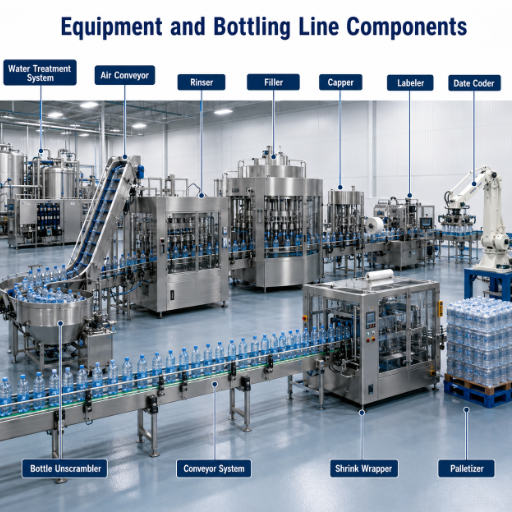
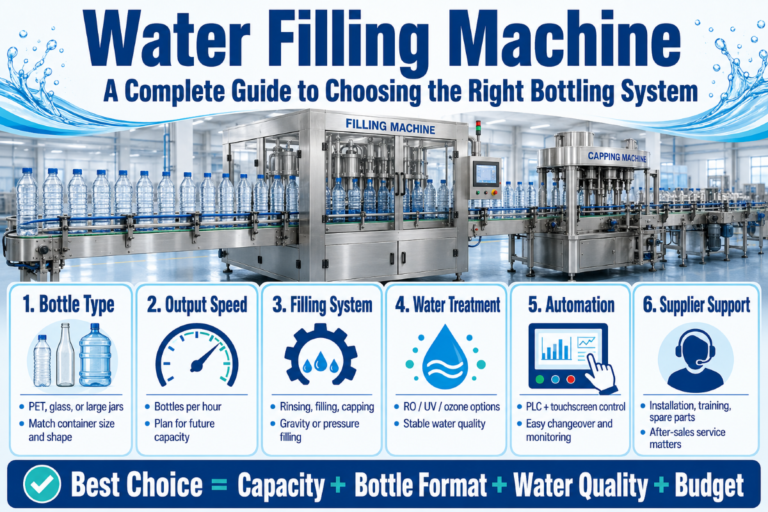
Downstream production bottlenecks are caused by mismatched small-batch-to-hobby-capacity equipment lines. You need a flow (not a machine), with a certain throughput band for each station; anytime your bottleneck is downstream, you never get cycle-time benefits from upgrading upstream.
PET Blow Molding
Pre-forms (polypropylene resin) are heated and stretch-blown into the bottle geometry chosen for your water source and market. Small fully-automatic blow-molders produce 2,000-4,000 bottles/h, utilise interchangeable tooling, and require less labor; self-blowers run costs comparably lower than pre-forms once volume exceeds 1.5M bottles/year.
Rinsing, Filling, and Capping
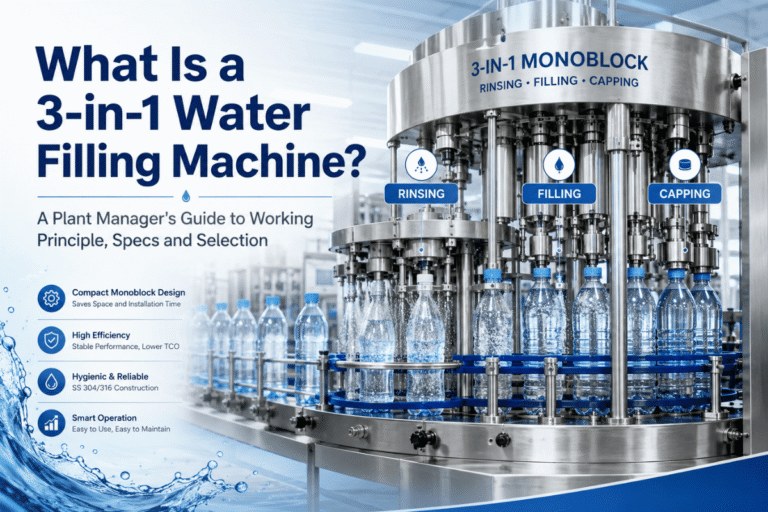
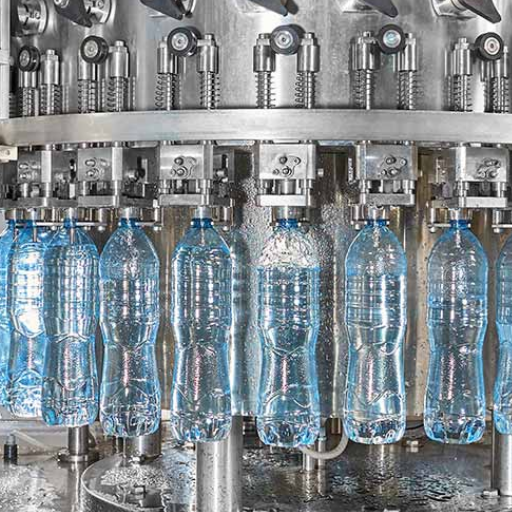
A combination rinser-filler-capper is the line’s load-bearing wall. For still water (non-carbonated) an air-tight stainless-steel monoblock will suffice, but carbonated water and water enhanced with minerals or flavors will need a carbonator and premix tank ahead of the filler. Filling tolerance must hold within ±1.5% of the labeled net weight per FDA labeling rules — a commonly missed spec when fillers run above 90% of rated capacity.
Labeling and Packaging
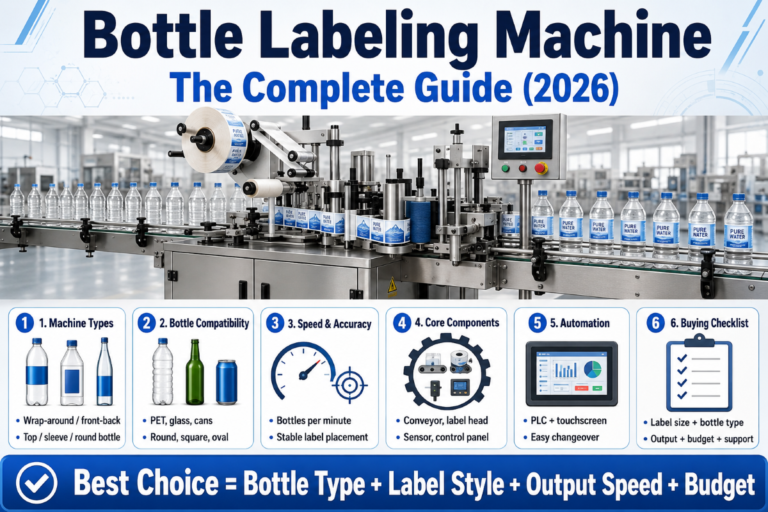
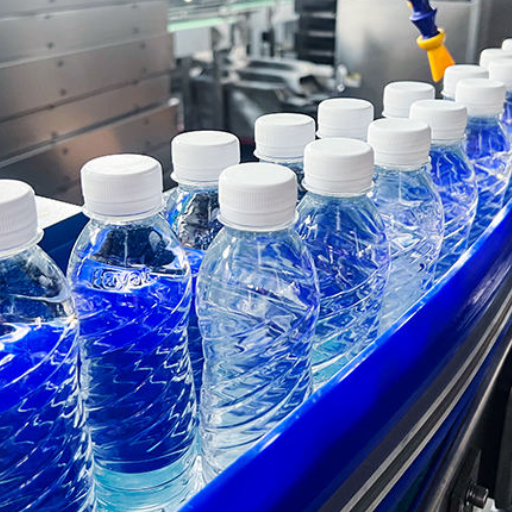
Pressure-sensitive or roll-fed labelers are paced to the filler; downstream, a shrink-wrap packer puts bottles into trays ready for 12-, 24-, or 35-count dispatches. Cap-application torque for 28 mm PET caps is generally expected to be in the range of 12–18 in-lb as measured by ISBT torque standards—over-torqued caps snap the threads off, under-torqued caps fail to meet seal specs.
📐 Note d'ingénierie
Fill weight tolerance under U.S. labeling rules: ±1.5% of declared net contents for individual containers, with the average of any 12-pack required to meet or exceed the label declaration. Quality-control sampling at 1-per-1,000 bottles is the minimum defensible cadence; high-volume plants run inline checkweighers continuously. Out-of-spec lots must be re-worked or destroyed — they cannot be sold.
Source Water Strategy: Spring vs. Municipal vs. Purified
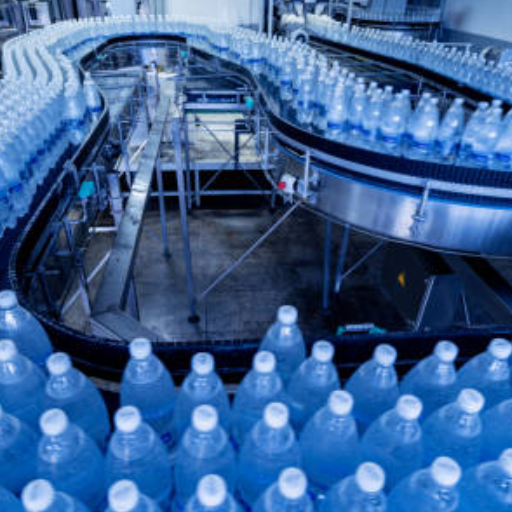
Source selection can control all three factors simultaneously, but each choice comes with trade-offs. Compare the three approaches below before committing to equipment sellers.
| Dimension | Spring | Municipal + Purification | Mineral (Well) |
|---|---|---|---|
| Source CapEx | $100K–$1M+ (rights) | $3K–$30K (RO unit) | $20K–$200K (well drilling + permits) |
| Approval timeline | 6–18 months | 2–6 months | 4–12 months |
| FDA standard of identity | 21 CFR 165.110(a)(2)(vi) — must flow naturally to surface | 21 CFR 165.110(a)(2)(iv) — “Purified Water” if treated to USP standards | ≥250 ppm total dissolved solids required for “Mineral Water” label |
| Pricing power | Premium ($1.50–$3.00 retail) | Commodity ($0.50–$1.20 retail) | Premium / specialty ($2.00–$5.00) |
| Meilleur ajustement | Brand-led, premium positioning | Volume-led, retail-pack, private-label | Specialty (functional, mineral-claim) |
First time entrepreneurs frequently underestimate the regulatory burden of spring route. Under FDA text, a spring-water label depends on the source flowing naturally to the surface—a tested groundwater well satisfying the engineering definition. Hydrogeological reports, source-water analysis, and state-environmental sanctions impose a 6–18 month delay and several hundred thousand dollars to CapEx. The resulting pricing is a benefit: purified water is priced against Aquafina and Nestl Pure Life, while a permitted spring source is a brand asset that will lead to prime shelf placement above commodity SKUs.
FDA Compliance, State Licensing, and Labeling
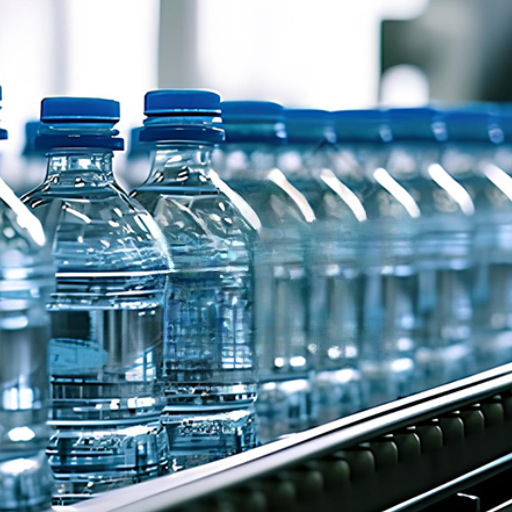
Bottled water sits inside the FDA’s food-regulatory framework, with three overlapping rule sets that every U.S. bottler must satisfy: general food current-good-manufacturing-practice (CGMP) requirements under 21 CFR Part 110 and Part 129, the bottled-water-specific standard of identity and quality under 21 CFR § 165.110, and FDA food-facility registration. State agencies layer on top with site approval, bottler licenses, and in many cases an out-of-state distribution license.
Do You Need FDA Approval to Sell Bottled Water?
FDA does not pre-approve individual bottled water brands the way it approves drug products. Instead, it requires registration as a food facility and compliance with established CGMP and standard-of-identity rules. Bacteriological source-water testing is required at least weekly, chemical testing annually, and radiological testing every four years. Product water requires weekly bacteriological testing and annual chemical and radiological testing for the more than 75 substances regulated under FDA’s bottled water quality standards. Iron, as one example, must remain at or below 0.3 mg/L in finished product.
State Licensing and Labeling Realities
26 states require buy-back at home bottling plants to have filed an application before its product can be distributed in that state. Licensing costs vary from $0(GA, NY State) to $1,100 (New Jersey) while New York City runs a separate $695 municipal scheme-the only ‘U S. City’ to have its own bottled water licensing scheme. Time to licensing varies from two weeks to more than six months depending on the state, licensing type and time it takes for the bottler to get its ducks in a row.
“26 states currently require some sort of application process for out-of-state bottlers. The amount of information required varies from state to state and can include source hydrogeological and engineering reports, finished product analyses, plant SOPs, HACCP documentation, and a contaminated-product recall plan. Having a well-developed marketing plan on initial states to be targeted for distribution can save time, money, and frustration in the end. ”
— Barbara L. Marteney & Kristin M. Saltzgiver, National Testing Laboratories, Ltd.
Most expensive labeling mistake: printing labels before state approval. Connecticut and New York State both require the bottler’s license number to appear on the bottle, meaning print runs cannot begin until applications clear. Pair that with FDA labeling regulations covering the statement of identity, principal display panel, ingredient list (mandatory if any minerals are added), nutrition labeling if any nutrient claim is made, and the 10% Reference Daily Intake threshold needed to use the term “healthy” – and labeling becomes a project, not a checklist item.
Business Plan Essentials Specific to Bottled Water
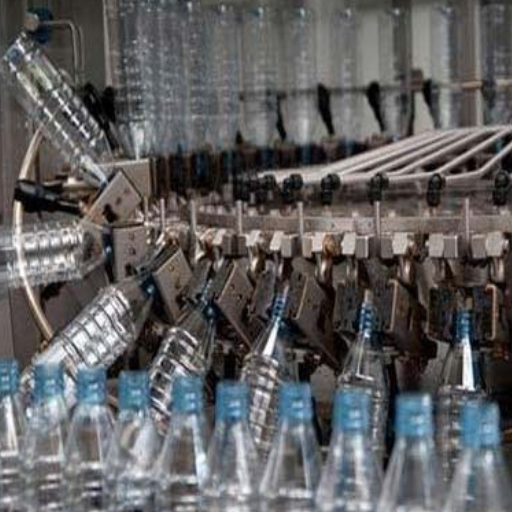
Generic SBA business-plan templates will not have provisions for the category-specific regulation landscape. A defensible plan for an investor or lender must have eight sections tailored specifically to water:
- Market sizing using IBWA and Beverage Marketing Corporation data for the specific state or region you will serve.
- A source-water plan that names your chosen category, approval timeline, and Plan B if approval slips.
- Equipment CapEx phasing with Year 1 line capacity matched to contracted volume – not to your largest projection.
- A regulatory roadmap covering FDA registration, state bottler license, and per-state distribution licenses.
- Distribution by channel (DSD, broker, broadline, DTC) with named first-year retail or institutional buyers.
- Per-SKU unit economics that include slotting fees, freight, and trade promotion.
- A sustainability plan addressing PET, recycled content, and source-watershed protection.
- A 24-month rolling cash flow with sensitivity on retail velocity and licensing slippage.
Alternative Models: Refill Stations, Vending, and Private Label
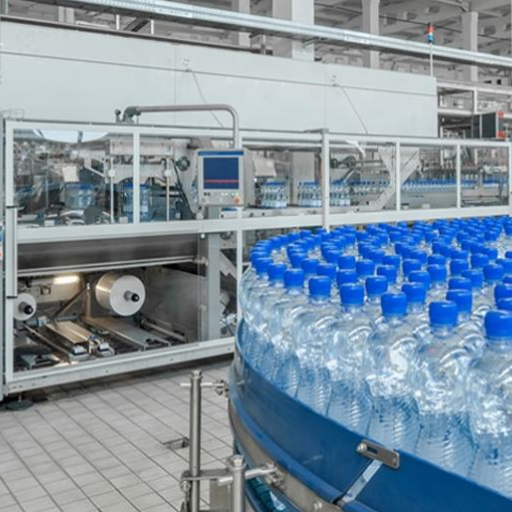
Having your own bottling line is one entry point to the category, but not the only one. Three lower-CapEx proposals segment the category and do not require source development regulatory burdens:
| Modèle | CapEx | Margin Profile | Regulatory Burden |
|---|---|---|---|
| Full bottling plant | $150K – $1.5M | 20–40% mfr. gross | High (full FDA + state) |
| Refill station (RO/alkaline) | $20K – $100K per location | 50–70% per gallon (no PET cost) | Medium (state water-vending rules) |
| Water-vending machines | $5K – $15K per unit | 40–60% per gallon | Medium (per-location permits) |
| Private label / co-pack | $25K – $150K | 10–25% brand owner gross | Low–Medium (label + facility registration only) |
The refill and vending models trade the pricing power of the brand for a cleaner P&L. Without PET preforms, caps, labels, or pallet logistics, gross margin per gallon often overcomes 50 percent, but unit revenue is much lower and the business is optionally local – each location lives or dies on foot traffic and route density. Private-label co-pack provides the right entree for founders who want to test the brand and channel without investing six figures of capital equipment they may not need.
Sales, Distribution, and the Commodity-Pricing Reality
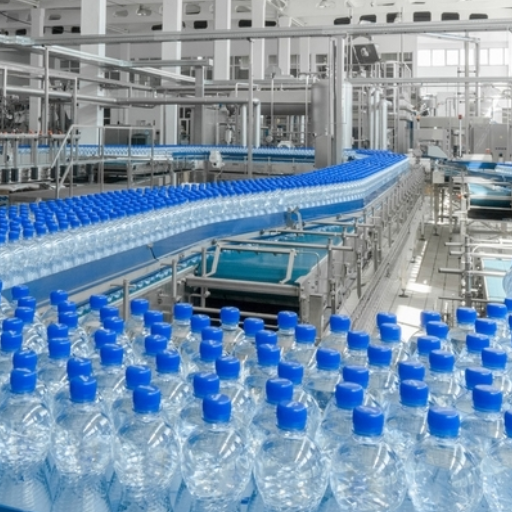
Getting bottles made is half the battle. Getting them on the shelf and out the door is where most bottled water startups stall. The U.S. category has four primary channels—retail (convenience and grocery), foodservice, institutional B2B (offices, schools, hospitals), and DTC subscription. Each has its own velocity, margin compression and gatekeeper logic.
Retail is a particularly harsh environment for new brands. National chains require slotting fees, category-management approval and proof of marketing spend before allocating shelf space. Independent and regional retailers provide a more realistic entrée, but require steady fill rates that a 2,000-BPH plant must plan for. Foodservice (hotels, restaurants, catering) is friendlier to new brands and grants higher per-bottle premiums, though volume is smaller and sales are account-specific. Institutional B2B and 5-gallon-office delivery is the channel most immune to commodity fluctuations—recurring contract revenue with sticky customers—and the channel where category valuation multiples are the highest.
One mistake gets referenced more than any other in this industry: ordering pallets of branded water before sealing the channel that will move them. A tractor-trailer of finished product shows up at a residential address that has no loading dock is a meme, not a market-entry tactic. Sequence retail or institutional commitments first, equipment runs second, finished-product inventory third—and treat distribution as a 90-day cash flow scenario, not a logistics challenge. First 90 days of payment terms decide whether the enterprise survives ramp.
Industry Outlook: What’s Changing in 2025–2026
Three structural shifts are reshaping bottled water startup entry conditions right now. Each calls for a tactical adjustment to launch plans drafted before 2024.
1. Category resilience while peers decline. In 2024 bottled water was the best-performing packaged-drinks segment in the U.S. — 2.9% growth versus 0.2% for carbonated soft drinks, –2.7% for sports drinks, –2.3% for ready-to-drink coffee, and –2.5% for fruit beverages, per IBWA’s May 2025 data. Implication: financing conversations with food-and-beverage lenders are more receptive than they were two years ago, but expect tougher questions about defensibility against the same denominator effect.
2. Plastic backlash drives refill momentum. Functional and refill models are the fastest-growing subcategories of the broader water category — functional water at 10.18% CAGR through 2034 per Fortune Business Insights — while PET still holds 85.24% of the packaging universe. Implication: 2025 and 2026 are the right window to launch refill or alkaline models in markets where municipal water-vending permits move quickly.
3. Premium spring brands resilient, mid-market squeezed. Category bifurcation continues: premium-positioned spring water and functional/mineral SKUs hold pricing, while undifferentiated commodity brands face shelf-space pressure from private label. Implication: unless your plan commits to either premium positioning or a defensible cost advantage, redo it.
Foire aux questions
Q: How much does it cost to start a water bottling business in the U.S.?
Voir la réponse
An external co-pack or private-label entry triggers $25,000 to $150,000. A modest internal plant making 2,000–5,000 bottles/hour stretches $150,000 to $500,000. Flows of medium-volume candidates begin at $500,000 and scale beyond $1.5 million with multi-state distribution rights and spring authority.
Q : Avez-vous besoin de l'approbation de la FDA pour vendre de l'eau en bouteille ?
Voir la réponse
The FDA doesn t pre-approve brands of bottled water. They require, food-facility registration, and continuous compliance of 21 CFR part 110 (generic CGMP for all food manufacturing), part 129 (bottled water-specific CGMP) and 165.110 (compliance with standard of identity & quality). Operating Licenses ( required for actual bottling & shipping) are issued in individual states. These often require a license in addition to the federal compliance.
Q: How profitable is bottled water for the bottler?
Voir la réponse
Gross margins for manufacturer are generally 20-40% on individual-serve PET, with 10-30% net margins after marketing, distribution & admin. Most margin stays in the retail space, which can clear 80+% gross margin on convenience SKU s.
Q: Can I bottle my own well water and sell it from home?
Voir la réponse
Practically, No. To sell bottled water in the U.S. you need to register as a food facility with the FDA, pass testing of the source water, be licensed by your state, test laboratory analysis of product water and maintain a facility built to the requirements of 21 CFR, part 129 ‘Good Manufacturing Practices for Bottled Water’. Out of the typical home-grid this is tough to get, with home wells almost never qualifying under residential-zoning or passing lab tests. Expect a time lag in buying CGMP-ready water at your home system, with the real business-entry-point to be a refill kiosk or a licensed co-packer.
Q: What is the difference between spring water, purified water, and mineral water?
Voir la réponse
Spring water is defined by the FDA under 21 C.F.R. 165.110(a)(2). It must emanate from an underground formation and flow naturally to the surface of the earth, to be bottling at the source or in a tapped bore-hole. Purified water ( drinking water) is extensively treated by distillation, deionization, reverse osmosis, filtration or other 21 CFR. 165 techniques. Mineral water falls into this category if it meets all requirements, contains at least 250 ppm of TDS and does not have any minerals added. This represents both the source ‘place’ and your label.
Q: How long does state bottled water approval take?
Voir la réponse
2 weeks to 6+ months, depending on state & how complete the application is on s1st submission. Spring-source projects with hydrogeological work routinely take 6-18 months.
Q: What MOQ do I need to commit to with a co-packer?
Voir la réponse
Co-pack minimum order sizes vary. Established bottler in U.S.A. generally requires 5,000-20,000 cases per SKU on each run, although some are fine with pilot lots of 1,000-3,000 cases at higher rates. Always perform that check on your warehouse capability before investing, as most new brands fail due to storage rather than bottling hurdles.
À propos de cette analyse
This guide combines FDA regulatory citations (21 CFR Parts 110, 129, and 165.110), 2024 U.S. market data from the International Bottled Water Association and Beverage Marketing Corporation, and equipment-tier pricing benchmarks from public vendor specifications. The cost ranges reflect launch conditions for a U.S.-based founder in 2025–2026 and should be validated with state-specific regulators and recent equipment quotes before any capital commitment. Speak with a MassTech business consulting team if you want a second opinion on a draft plan before submitting to lenders.
Schedule a Feasibility Consultation →
Références et sources
- 21 CFR § 165.110 — Bottled water — U.S. Code of Federal Regulations
- 21 CFR Part 129 — Processing and Bottling of Bottled Drinking Water — U.S. Code of Federal Regulations
- IBWA: Bottled Water Sales Outperform Other Packaged Drinks (May 2025) association internationale de l'eau en bouteille
- IBWA: Federal Regulations — Bottled Water association internationale de l'eau en bouteille
- Bottled Water Market Size, Share & Industry Report 2026–2034 les perspectives commerciales de Fortune
- Bottled Water Business Rules of Thumb — DealStream Industry Guide
- 2026 Well Drilling Cost Data — Angi