Entrez en contact avec Masstech

Facility cleaning guide · Updated August 2026
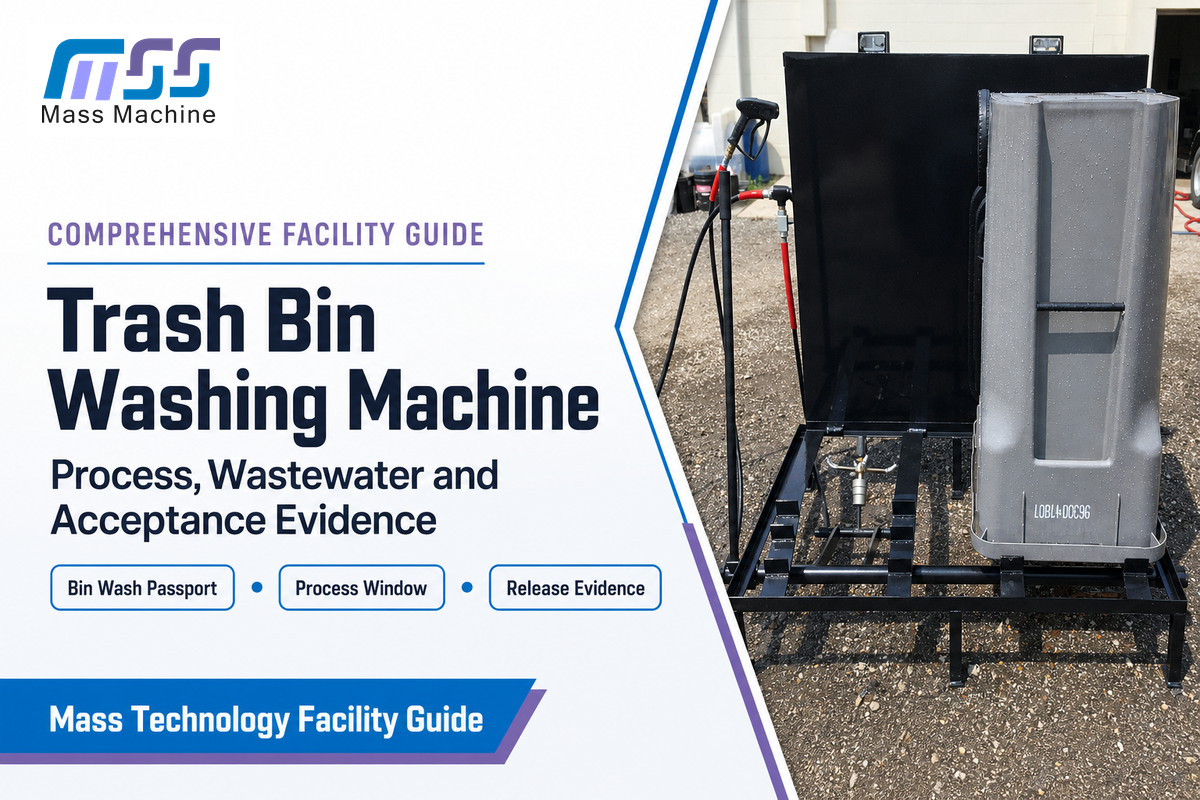
A trash bin washing machine is equipment that presents or secures a bin, applies water and mechanical cleaning action to defined surfaces, and contains or routes wastewater. Use this guide to define the bin and soil, control the wash sequence, separate cleaning from disinfection, plan wastewater, and verify the chosen release requirement.
In short: a repeatable bin-washing program follows four decisions in order: identify the bin and soil → define the controlled process → verify the result → match the machine and site interfaces. Starting with a pressure, temperature, or chemical number skips the job definition that makes those settings meaningful.
A trash bin washing machine can make cleaning more contained and repeatable, but the equipment name does not establish the result. Successful operation still depends on correct presentation, reachable surfaces, removal of the defined soil, controlled chemistry and water, and evidence that the release standard was met. That distinction matters in food plants, factories, logistics sites, commercial facilities, and other locations where different bins and different residues share one wash area.
This article is intentionally different from Mass Technology’s stationary trash bin washing machine solution. The solution page owns equipment fit, configuration, model details, project scope and inquiry decisions. This guide owns the operating questions: what to record before washing, how to build a controlled sequence, how to distinguish a clean surface from a validated disinfection claim, and how to prepare a useful engineering handoff.
Safety and scope: this is a planning framework, not a chemical recipe, maintenance procedure, regulatory determination, or substitute for the approved machine manual. The installed site, bin contents, chemical labels, local discharge rules, risk assessment, and procedures issued by qualified responsible parties govern the work.
1 · Identify
Bin geometry, condition, soil and contamination boundary
Bin geometry, condition, soil and contamination boundary
2 · Control
Presentation, reach, mechanical action, chemistry and time
Presentation, reach, mechanical action, chemistry and time
3 · Verify
Visible result, process record and any supported claim
Visible result, process record and any supported claim
4 · Handoff
Utilities, wastewater, capacity, safety and open questions
Utilities, wastewater, capacity, safety and open questions
1. What a Trash Bin Washing Machine Does, and Does Not Prove
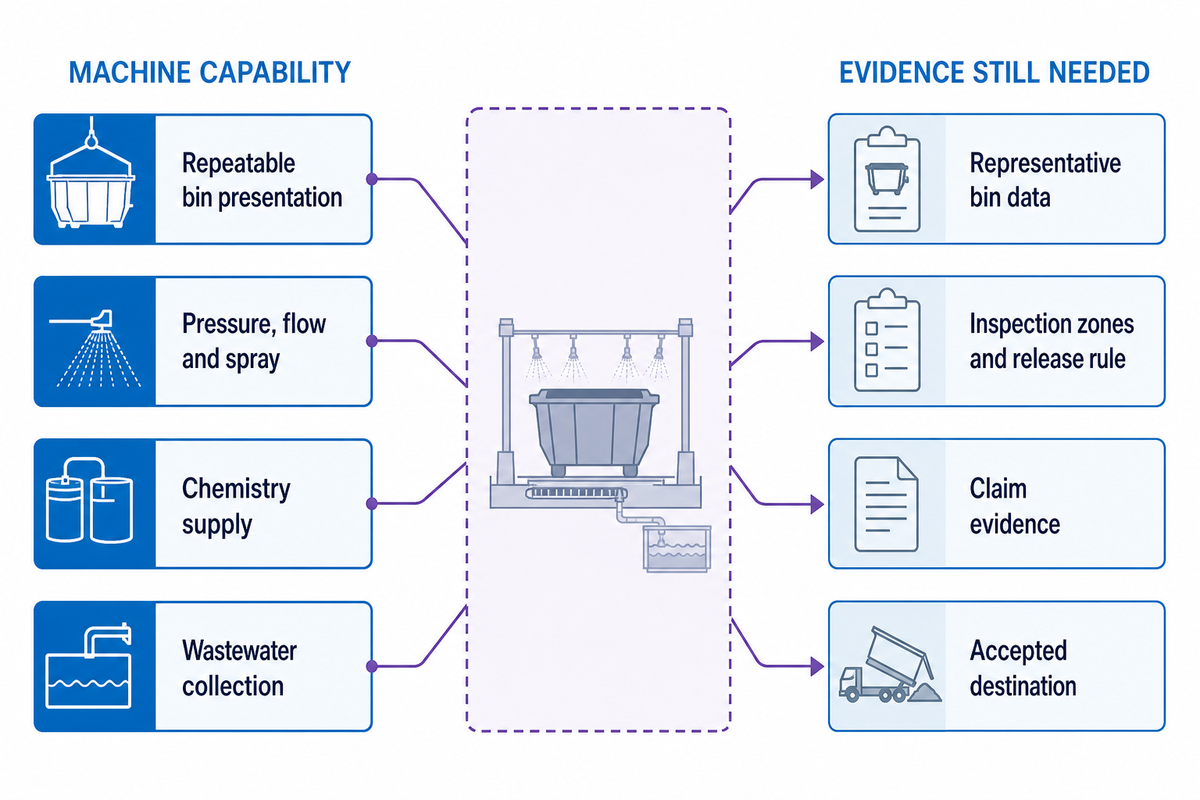
At category level, a bin washer combines several functions that manual pressure washing leaves to the operator: it presents or secures the container, directs water and mechanical action toward defined surfaces, supplies detergent or other chemistry where the process calls for it, and contains or routes the resulting wastewater. A fixed enclosed washing system does this at a stationary sanitation point. A mobile trailer and a pressure-washer attachment solve different transport, water-storage and route-service problems.
Terminology note: industry listings may use bin wash system, bin cleaning system, trash can cleaning machine, ; ou trash bin cleaning equipment for very different setups. They may serve residential routes, commercial facilities, or fixed industrial wash areas. The word cleaner can also mean a chemical product, a service provider, or a piece of equipment, so define it before comparing claims. In this guide, “fixed system” means cleaning equipment installed at a defined site; it does not imply a particular nozzle layout, filtration system, construction material, or performance claim.
Ask “Which actions are controlled, which surfaces are reachable, and what evidence releases the bin?” rather than “Which machine has the strongest cleaning claim?” High-pressure spray may dislodge soil but miss a shielded hinge. Hot water may help a particular process but does not automatically satisfy a disinfectant’s wet contact time. Chemical supply can deliver a product without proving that it suits the surface or was applied according to its label.
| Machine or process can provide | It does not prove by itself | Evidence still needed |
|---|---|---|
| Repeatable bin presentation and wash actions | Universal compatibility with every bin | Representative bin data and a confirmed handling path |
| Pressure, flow, spray and mechanical action | Complete reach or soil removal | Inspection zones, trials and a release rule |
| Detergent or disinfectant supply | A validated microbial result | Approved product, method, contact time and claim evidence |
| Wastewater collection or an outlet | Permission to discharge or reuse the water | Accepted destination, limits, treatment and monitoring plan |
| A repeatable machine cycle | Released bins per shift | Observed load-to-release time and site availability |
This boundary also protects the existing commercial page. Once the facility has defined its bin families, process and acceptance target, equipment-specific fit belongs in a configuration review—not in a generic guide.
2. Start with a 10-Field Bin Wash Passport
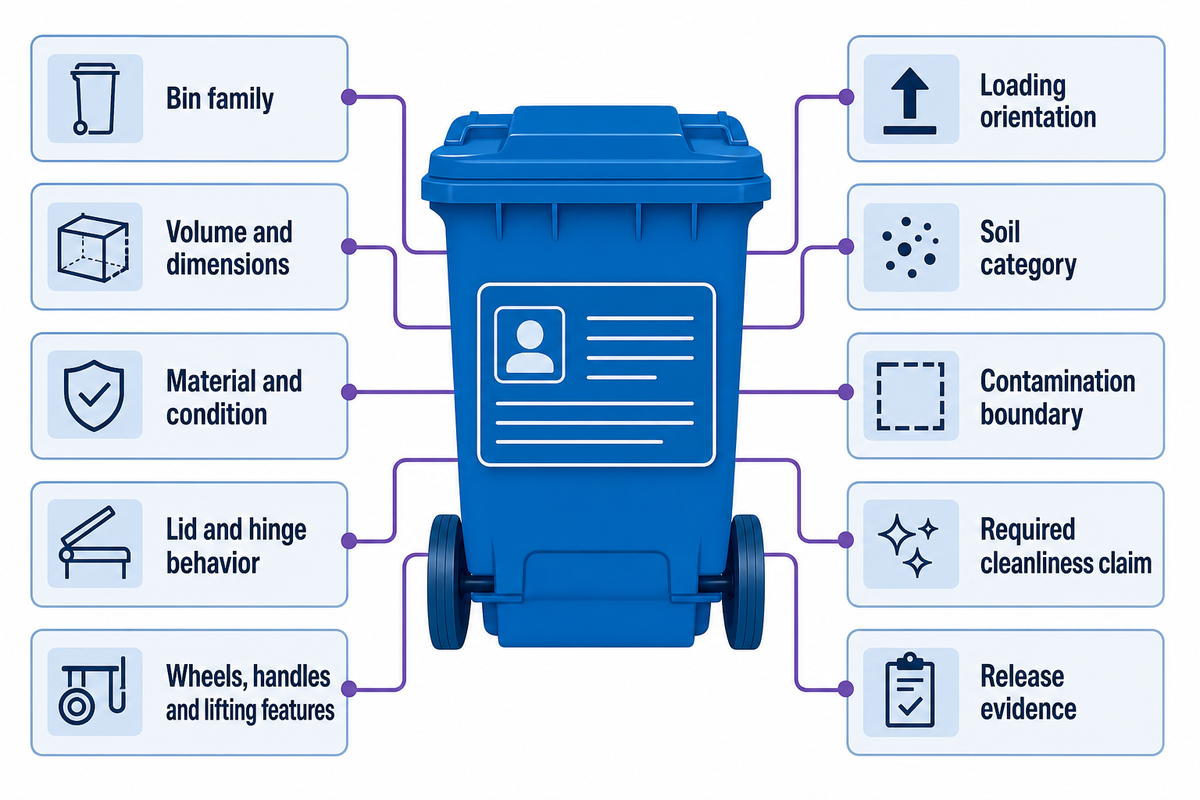
“Standard trash bin” is rarely enough information for a reliable wash setup. Lids open differently, wheels and handles change the lifting interface, warped rims alter presentation, and dried residue behaves differently from loose waste. The Bin Wash Passport is a short intake record that keeps these facts together before anyone sets the wash process.
- Bin family: the site’s own name or code for a group that genuinely behaves the same.
- Nominal volume and actual key dimensions — include the features that affect handling rather than trusting the nominal size alone.
- Material and condition — note cracks, rough surfaces, repairs, corrosion, deformation or other damage.
- Lid and hinge behavior — capture how the lid opens, stays open and presents its underside.
- Wheels, handles and lifting features — record quantity, spacing, damage and intended pick-up points.
- Loading orientation — state how the bin arrives and how an operator or upstream system presents it.
- Soil category — identify what must be removed, how firmly it adheres and whether it changes by season or use.
- Contamination boundary — flag sharp items, unknown material, regulated waste or other conditions needing a separate route.
- Required cleanliness claim: choose visible-soil removal, process conformance or a separately validated higher claim.
- Release evidence — name the inspection points, record and person or role that accepts the result.
Don’t average unlike bins into one Passport. If the lid, material, soil or acceptance rule changes the process, create another family. That small administrative decision prevents a later argument over whether one set of settings was ever intended to cover both.
| Observed soil or condition | First decision | Process emphasis | Boundary before release |
|---|---|---|---|
| Loose dry debris | Remove before loading where the procedure requires | Containment and efficient removal | No prohibited items remain |
| Mud or mineral soil | Check drying and thickness | Pre-wet, reach and mechanical removal as approved | Defined corners and surfaces are visibly clear |
| Dried organic residue | Confirm special contamination status | Soil removal before any disinfection step | No visible organic residue in inspection zones |
| Grease or oil film | Identify source and compatibility | Detergent and mechanical-action review | No defined unacceptable film remains |
| Adhesive or label residue | Test a compatible removal method | Localized action; avoid damaging the bin | Acceptance matches the site’s residue rule |
| Odor without visible soil | Trace the source instead of masking it | Reinspect hidden areas, drainage and process history | Do not equate odor alone with a microbial result |
| Mixed or unknown residue | Quarantine and identify | Risk review before washing | Responsible role authorizes the route |
| Sharp or hazardous items | Use the site’s safe removal route | Protect people and equipment before cleaning | Hazard is removed and recorded |
| Potentially regulated or healthcare-related contamination | Stop ordinary processing | Apply the facility’s specific classification and procedure | Release only under the governing program |
This deliberately qualitative matrix guides the team in what must be decided while avoiding inventing a universal pressure, temperature, detergent concentration, or wash time. Whether a site refers to the containers as bins, carts, pails, or trash cans, the Passport defines what’s in scope.
3. Build the Wash Sequence as a Controlled Process Window
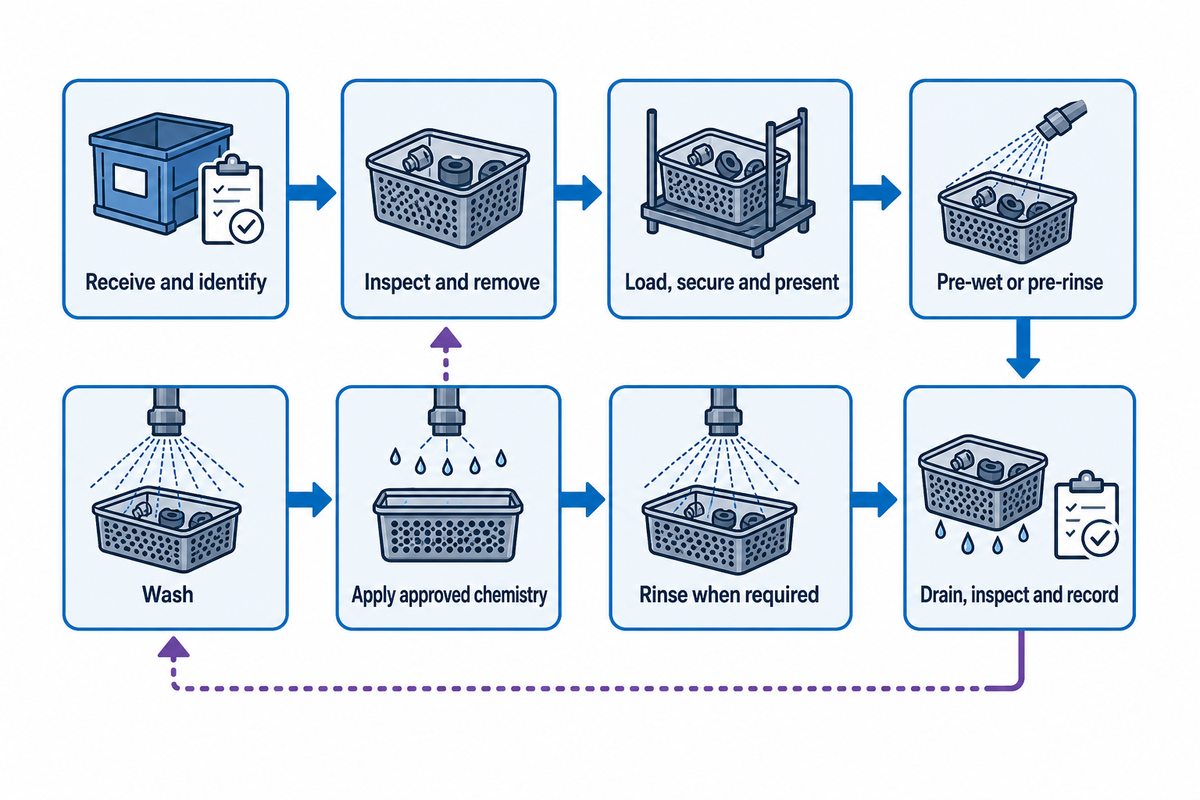
For repeatability, the wash sequence needs enough detail to reproduce the work while keeping unsupported numbers out of the procedure. One defined bin family may use the following steps:
- Receive and identify the bin against its Passport.
- Inspect and remove loose or prohibited items under the site’s safe method.
- Load, secure and confirm presentation so the intended surfaces are exposed.
- Pre-wet or pre-rinse only where the approved process uses that step.
- Wash using the defined reach, spray pattern, mechanical action and time.
- Apply detergent or disinfectant only under an approved procedure and label-compatible use.
- Rinse when the soil, chemistry, label or release requirement calls for it.
- Drain, inspect and record the release—or send the bin to a defined rewash route.
These steps form a process window, not a single magic setting. Pressure and flow influence the spray, but nozzle type, distance, orientation and blockage affect what reaches the surface. Temperature may change soil behavior and chemical performance, but it also affects material compatibility and operator hazards. Detergent helps with some soils, yet overdosing can leave foam or residue. Contact time is meaningless if the surface dries early or if visible soil was never removed.
The Process Window Ledger
For each controlled variable, record six fields: variable, approved range or method, observation, deviation, corrective action, and recheck result.
Typical rows include bin presentation, nozzle condition, spray pattern, pressure or flow indication, water temperature when controlled, chemistry identity, dilution or dosing method, wet contact time, rinse requirement, drainage and final inspection. The approved machine manual and site procedure supply the actual values.
Change one variable at a time when investigating a failure. If soil remains in one corner, increasing chemical concentration might mask the actual issue: improper reach or incorrect bin presentation. If foam persists, additional rinse time might be beneficial, but review the dosing method and product instructions first. A traceable change is more secure and useful than an undocumented adjustment that just happens to work once.
4. Cleaning, Sanitizing and Disinfection Need a Three-Gate Claim Test
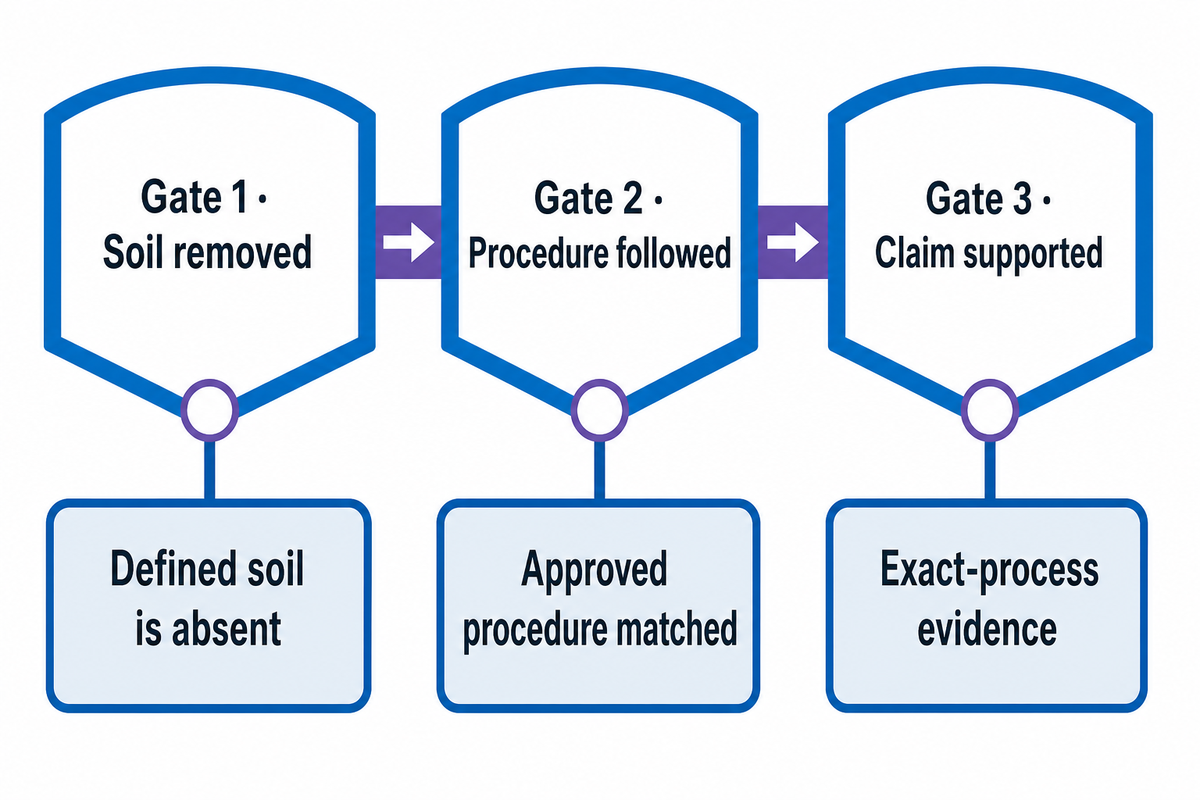
Cleaning removes foreign and organic material with water, cleaning agents and mechanical action. Sanitizing and disinfection are different claims. The CDC’s facility guidance says surfaces should be cleaned before sanitizing or disinfecting because dirt can make the chemical less effective.
For an EPA-registered disinfectant in the United States, the product label is central to the use claim. EPA explains that the label identifies the approved use site, method and contact time, and that the agency has not reviewed a product for a particular pathogen when the label lacks directions for that pathogen. Other jurisdictions have their own responsible authorities and product rules.
Gate 1 · Soil removed
Defined visible and organic soil is absent from the inspection zones.
Defined visible and organic soil is absent from the inspection zones.
Gate 2 · Procedure followed
Product, use, dilution or method, surface compatibility and wet contact time match the approved procedure.
Product, use, dilution or method, surface compatibility and wet contact time match the approved procedure.
Gate 3 · Claim supported
Any microbial or regulated claim has evidence for the exact process and use.
Any microbial or regulated claim has evidence for the exact process and use.
Passing Gate 1 still provides no basis for a disinfection claim. Following a dosing step can also fail Gate 2 when the required wet contact time is not achieved. Both process gates may pass while a special regulated claim still requires independent validation. For those reasons, a chemical tank, hot water, high-pressure nozzle, or short cycle must not become shorthand for “disinfected.”
Write the release language to match the evidence. “No visible residue in the listed inspection zones” is a visual acceptance result. “Process record completed within the approved window” is a conformance result. A statement about microbial reduction is a separate claim and needs its own valid test and applicability boundary.
5. Plan Water, Wastewater and Reuse as One Traceable Flow
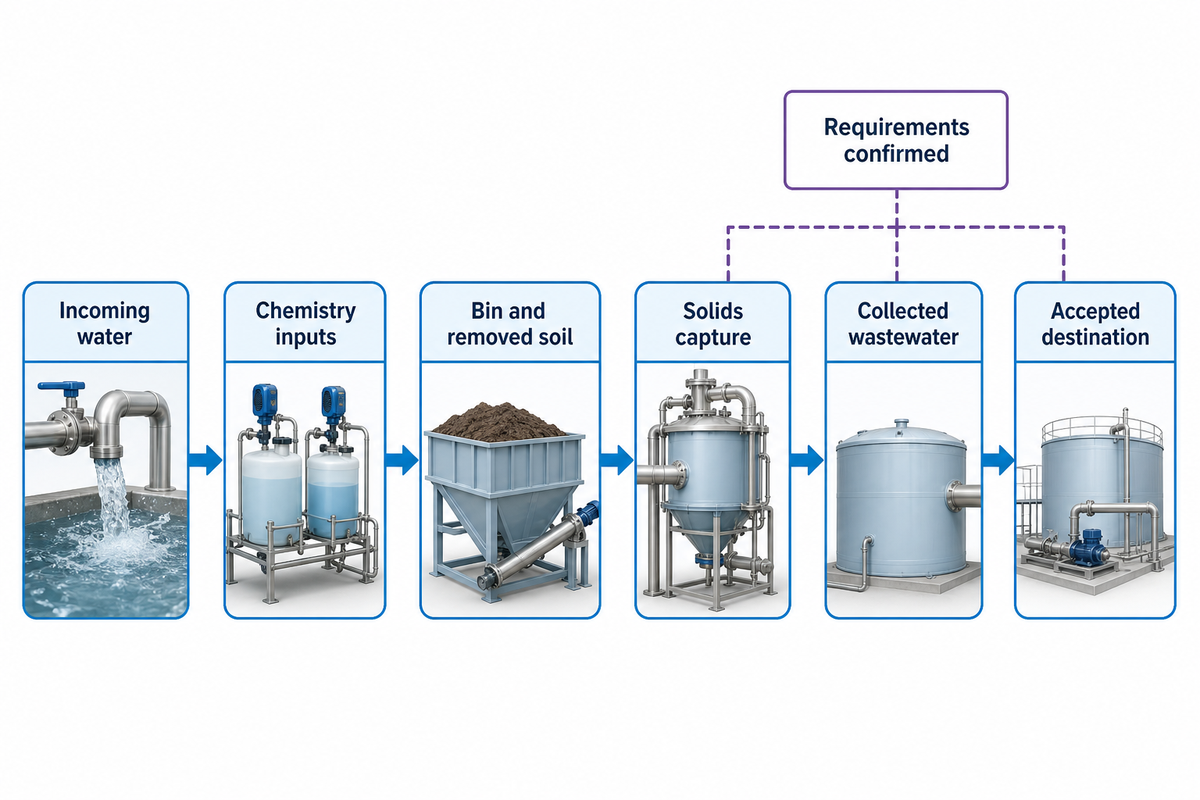
Trace the water path from before the machine inlet to after the machine outlet: incoming water → detergent or disinfectant inputs → bin and removed soil → solids capture → collected wastewater → accepted destination. Drawing one line exposes interfaces that disappear when different teams separately assess utilities, chemistry and drainage.
Recovery tanks and dedicated outlets provide useful containment without establishing that a sewer, drain or off-site route accepts the discharge. Components marketed for wastewater recovery face the same boundary: collection describes a function, not an approved destination. U.S. EPA guidance explains that industrial pretreatment local limits can be site-specific, numeric or narrative, and are used to protect the receiving treatment works, workers, waters and sludge practices. Facilities therefore need to characterize the proposed flow and confirm requirements with the responsible authority.
| Field | Question to close | Evidence owner |
|---|---|---|
| Estimated flow and variability | What enters the wastewater path during normal and upset conditions? | Process/site engineering |
| Soil and chemical profile | Which solids, oils, organics, detergents or disinfectants may be present? | Sanitation and EHS |
| Collection and pretreatment | What screening, separation, storage or treatment is approved? | Utilities/EHS |
| Sampling point | Where can the actual discharge be inspected or sampled? | Site engineering |
| Destination and limits | Who accepts the flow, under which requirements and records? | Facility and receiving authority |
Water reuse needs a second decision, not just another hose. EPA defines industrial water reuse as reclaiming, treating and reusing water for a beneficial purpose and points users to end-use resources plus state regulations and water-quality requirements. A fit-for-purpose review asks what the proposed end use is, what contaminants matter, what treatment and monitoring are required, what could build up through repeated cycles, and which rules apply. Collection or filtration alone does not answer those questions.
6. Verify Results with the Three-Level Acceptance Ladder
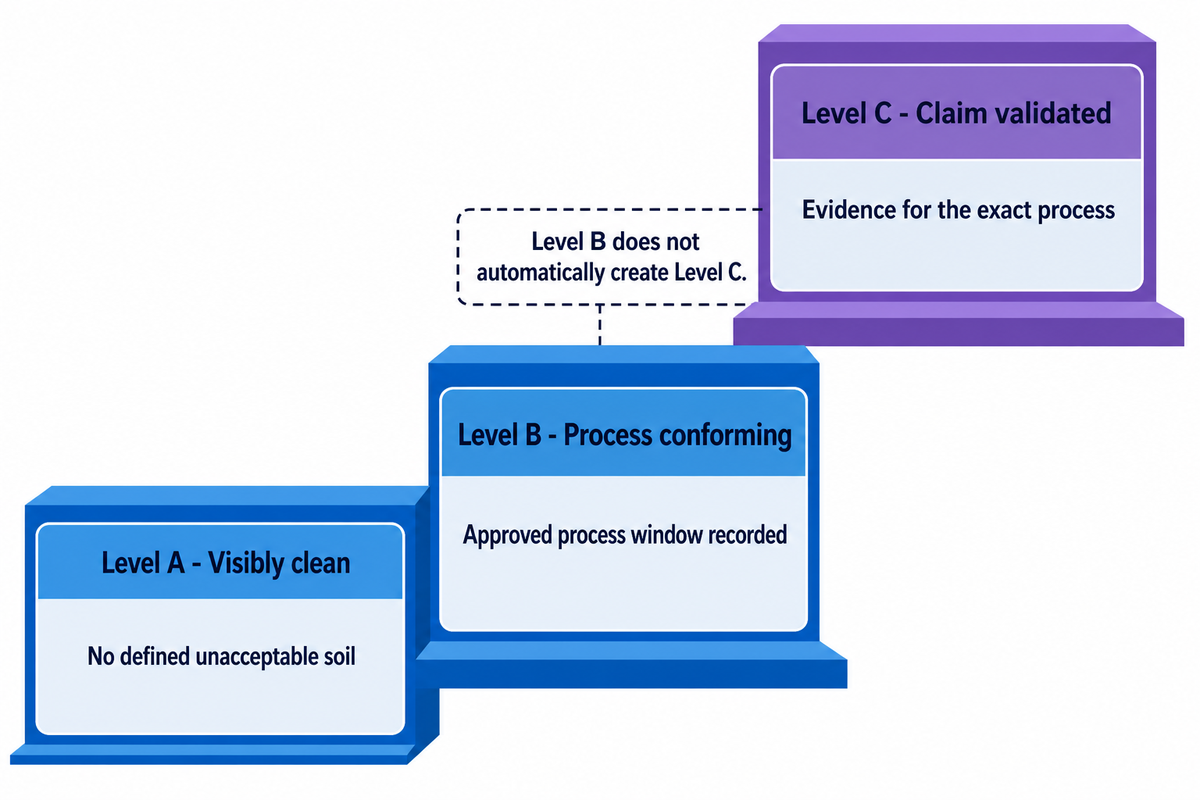
“Looks good” and “sanitized” should not share one checkbox. The Three-Level Acceptance Ladder lets a facility choose the evidence that matches the required outcome.
- Level A — Visibly clean: no defined unacceptable soil remains in listed zones such as the floor, walls, corners, lid underside, handles, wheels and drain-prone areas.
- Level B — Process conforming: required steps and controlled conditions were recorded within the approved process window, with deviations closed.
- Level C — Claim validated: a separately defined microbial, sanitation or regulated claim has valid evidence for the exact process, surface and use.
Level B does not automatically create Level C. It proves that the approved procedure was followed, which is valuable for consistency and investigation. Level C requires the additional evidence appropriate to the claim. The site should state which level releases each bin family and who can approve exceptions.
| Observed failure | Check first | Avoid this shortcut | Closeout evidence |
|---|---|---|---|
| Residue in corners | Presentation, reach and nozzle condition | Raising chemistry before fixing reach | Recheck all named zones |
| Grease film remains | Soil class, detergent compatibility and action | Assuming pressure alone removes the film | Approved trial and visual rule |
| Foam or residue remains | Dosing method and rinse requirement | Adding more product | Dose record and rinse verification |
| Water pools | Orientation, drainage path and blockage | Releasing before drain criteria are met | Drain inspection and corrected orientation |
| Odor remains | Hidden soil, drain path and source history | Using odor as a microbial test | Source-based disposition |
| Results vary by bin family | Passport grouping and handling differences | Averaging unlike bins together | Separate approved process windows |
| Wet contact time is short | Application, drying and label requirement | Relabelling the outcome as disinfected | Procedure or claim revised and approved |
| Rewash rate rises | Deviation trends, wear and soil changes | Changing several variables at once | Cause, change and post-change trend |
Simple rewash codes make the data useful: reach, soil classification, chemistry, contact, rinse, drainage, handling or equipment condition. Trends across those codes can reveal a worn nozzle, a new waste stream or a Passport that groups unlike containers.
7. Convert Cycle Time into Capacity, Maintenance and Safe Work
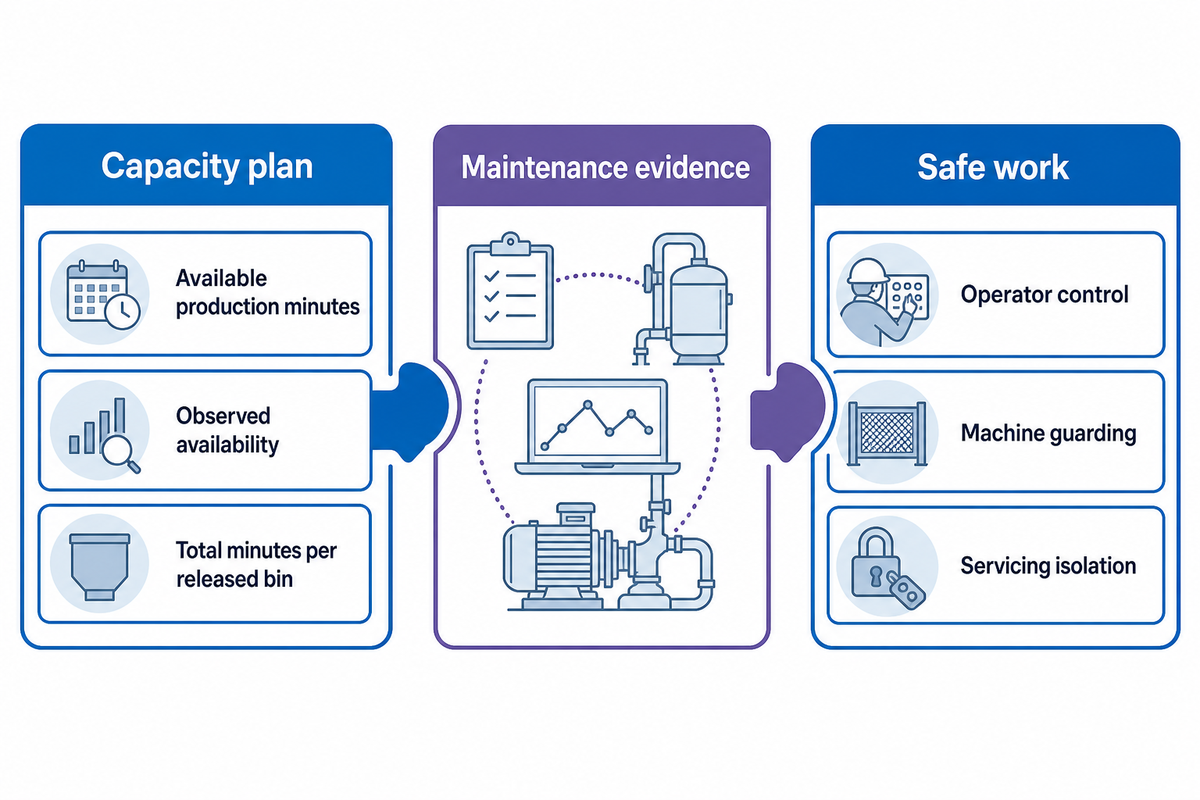
Wash time is only one part of a released-bin cycle. Real throughput also includes receiving, loading, securing, draining, unloading, inspection, rewash allowance, changeover and routine stops. Use this planning equation:
Planned released bins per shift = available production minutes × observed availability ÷ observed total minutes per released bin.
Illustrative calculation: if a site measures 420 available production minutes, 80% observed availability and 4.5 total minutes per released bin, the planning result is 420 × 0.80 ÷ 4.5 = 74.7. Round the plan down to 74 released bins, then keep the assumptions beside the number. This is a worksheet example, not an MS-4700 output claim.
Use site trials for each meaningful bin family. Record both the median and the spread instead of selecting the fastest cycle. Availability should reflect routine stops and known constraints, while unusual events remain visible rather than being hidden inside a flattering average. This turns a machine reference into a site capacity model without claiming a universal shift output.
Maintenance should follow the approved manual, actual operating history and risk—not an interval invented for a blog. A shift check may look for damage, leaks, abnormal spray, blocked nozzles or strainers, drain condition, correct chemical identity, guards or interlocks, and housekeeping. Planned work may cover pumps, hoses, seals, filters, sensors, lifts, brushes where fitted, dosing devices and wear or corrosion points. Rewash rate, stoppage codes and process deviations help the team decide when condition-based work is justified. Labels such as commercial-grade, heavy-duty, ; ou stainless steel do not replace evidence about condition, compatibility and durability in the actual environment.
Safety has three separate layers:
- Operator control — normal start, stop, reset and emergency response for the approved operating mode.
- Machine guarding — protection from point-of-operation, nip, rotating and moving-part hazards. OSHA’s general machine-guarding rule identifies these as separate hazards requiring guarding methods.
- Servicing isolation: control of electrical, pressure, gravity, mechanical and stored energy under the site’s hazardous-energy procedure. OSHA’s lockout/tagout resources point to 29 CFR 1910.147 and specific energy-control procedures.
“One or more methods of machine guarding shall be provided to protect the operator and other employees in the machine area from hazards.”
An emergency stop is not a substitute for guarding, and a pushbutton is not a physical energy-isolating device. Exact legal requirements depend on the installed site and jurisdiction, but the planning distinction is broadly useful: operating a washer, reaching into a danger zone, and servicing stored energy are not the same task.
Where hygienic design is relevant, teams may also review the scope of ISO 14159:2002. ISO describes it as machinery hygiene requirements for applications where hygiene risks to a consumer of a processed product can occur, and notes that the published standard is to be revised. That makes it a possible design-review lens where the scope fits, not evidence that a particular trash bin washer is certified or validated.
8. Use One Implementation Worksheet Before Requesting a Configuration
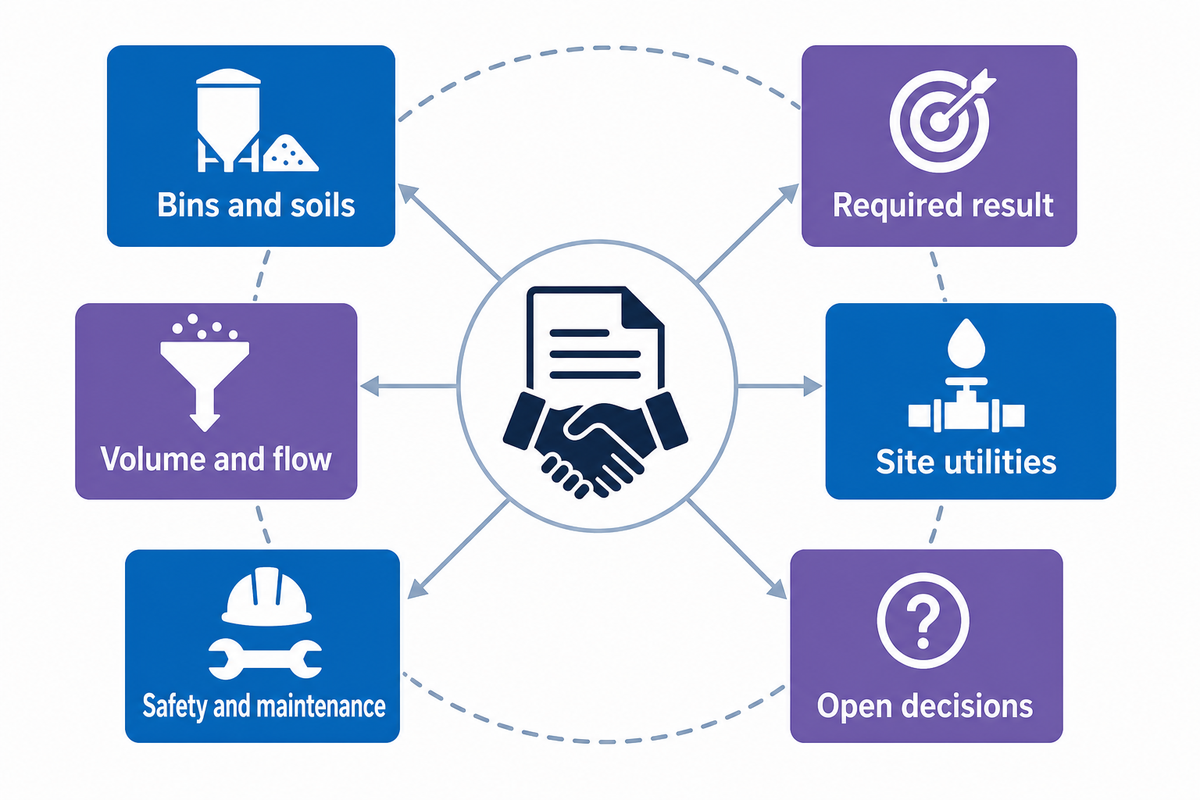
Manufacturers can review a real application faster when the inputs arrive as a controlled handoff instead of a single question about price or pressure. Consolidate the guide into one worksheet with the following fields:
Bins and soils
Passport records, photos or drawings, representative samples, soil matrix and prohibited items
Passport records, photos or drawings, representative samples, soil matrix and prohibited items
Required result
Acceptance level, inspection zones, chemistry owner, contact-time rule and rewash route
Acceptance level, inspection zones, chemistry owner, contact-time rule and rewash route
Volume and flow
Bin mix, shift pattern, loading/unloading route, staffing, storage and trial assumptions
Bin mix, shift pattern, loading/unloading route, staffing, storage and trial assumptions
Utilitaires du site
Water, power, floor space, access, ventilation, drainage, solids handling and proposed discharge destination
Water, power, floor space, access, ventilation, drainage, solids handling and proposed discharge destination
Safety and maintenance
Responsible roles, guarding review, energy sources, service access, spare strategy and record ownership
Responsible roles, guarding review, energy sources, service access, spare strategy and record ownership
Open decisions
Unresolved contamination, chemistry, wastewater, validation, interface and acceptance questions
Unresolved contamination, chemistry, wastewater, validation, interface and acceptance questions
That worksheet creates a clean handoff between informational content and commercial configuration. Use the stationary trash bin washing machine solution page when you are ready to review the equipment path, bin interface and project scope. Mass Technology describes its broader lifecycle as including layout planning, manufacturing, installation and operator training on its About Us page; those company statements should be confirmed for the specific project rather than assumed from this guide.
Have the bin and site inputs ready?
Use the worksheet to describe the application first. That gives the engineering discussion a defined bin family, soil, required result, utility boundary and list of open decisions. Include representative photos or drawings, shift demand, drainage route and any unresolved chemistry or validation question so the configuration review starts from site evidence rather than a generic machine request.
Foire aux questions
How does a trash bin washing machine work?
Answer
It presents or secures a bin, applies water and mechanical cleaning action to defined surfaces, supplies chemistry where the approved process calls for it, and routes the resulting wastewater. A complete operating sequence also includes inspection, debris handling, loading, drainage, release and a rewash route. Exact sequence depends on bin geometry, soil, the required result and the installed site interfaces.
Can one washer clean every bin size?
Answer
No universal compatibility claim is safe. Nominal volume doesn’t capture lid behavior, wheel and handle geometry, material condition or loading orientation. Group bins with a Bin Wash Passport and confirm representative containers against the proposed handling and wash path. Include the smallest, largest and most awkward bin family in a trial instead of extrapolating from one convenient sample.
Does hot water automatically disinfect a bin?
Answer
No. Temperature is one process variable. A disinfection claim depends on the exact method and supporting evidence, including any applicable product-label conditions, surface compatibility, coverage and wet contact time. Hot water or a short cycle isn’t outcome evidence by itself. Record the real process and keep a visible-clean acceptance claim separate from a microbial claim unless the latter has been validated.
What is the difference between cleaning and disinfection?
Answer
Cleaning removes soil and organic material using water, cleaning agents and mechanical action. Disinfection is a separate claim involving a defined product or method and a supported procedure. Visible soil should be removed before a disinfection step is evaluated.
Can wash water be reused?
Answer
Only after a fit-for-purpose review defines the proposed end use, contaminants, treatment, monitoring and applicable requirements. Collecting or filtering wastewater doesn’t automatically make it suitable or permitted for reuse.
How should wastewater be handled?
Answer
Map the entire water path, estimate the flow, identify soils and chemicals, define solids capture and sampling, and confirm the receiving destination and local requirements with the responsible authority. A machine outlet is an interface, not discharge approval.
What affects real shift capacity?
Answer
Use observed total time per released bin, not the wash action alone. Include receiving, loading, securing, washing, draining, unloading, inspection, rewash, changeover and routine stops, then apply observed availability for the site.
What should be sent before a configuration review?
Answer
Send representative bin data, the soil matrix, required acceptance level, expected volume and shift pattern, site flow, water and power details, drainage and wastewater boundary, safety constraints, and any open chemistry or validation questions.
Références et sources
- U.S. EPA, Selected EPA-Registered Disinfectants
- CDC, When and How to Clean and Disinfect a Facility
- U.S. EPA, Pretreatment Standards and Local Limits
- U.S. EPA, Water Reuse for Industrial Applications
- OSHA, Control of Hazardous Energy Program
- OSHA, 29 CFR 1910.212 General Requirements for All Machines
- ISO, ISO 14159:2002 scope and status