Entrez en contact avec Masstech

Caractéristiques principales
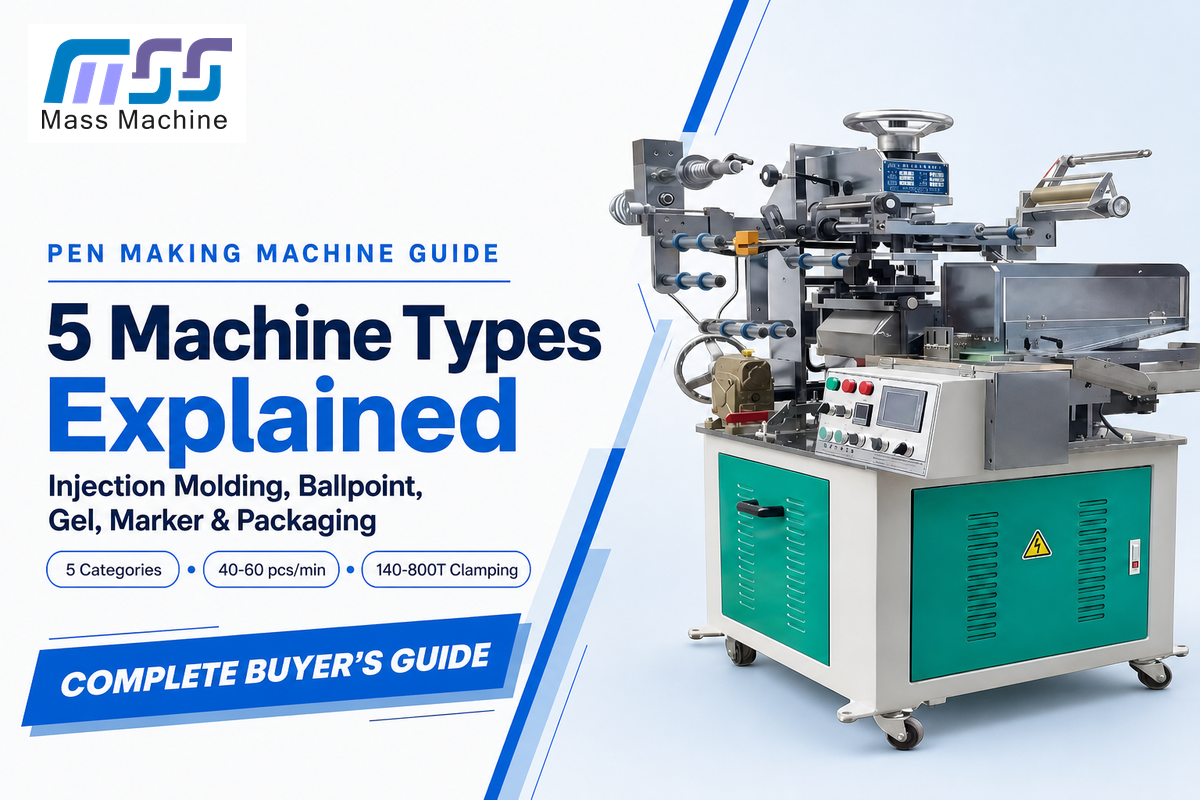
| Catégories de machines | 5 — moulage par injection, assemblage de stylos à bille, assemblage de stylos gel, assemblage de marqueurs, conditionnement en bouteilles/blisters |
| Force de fermeture pour le moulage par injection | 140–800 tonnes |
| Débit d’assemblage des stylos à bille | 40–60 pièces/min par ligne |
| Part de la production mondiale de stylos (Chine) | ~80 % du volume, selon les estimations du secteur |
| Normes applicables | ISO 12100 (évaluation des risques des machines), directive Machines de l’UE 2006/42/EC, ISO 12757-1 / 27668-1 / 11540 (normes applicables aux stylos finis) |
Une machine de fabrication de stylos est un équipement industriel qui fabrique des composants de stylos ou des stylos complets à partir de matières premières — et elle existe en cinq types distincts, pas en un seul. Acheter le mauvais type de machine est l’erreur la plus fréquente chez de nombreux acheteurs débutants. Les machines de moulage par injection forment par exemple le corps plastique d’un stylo, puis l’insertion de chaque pointe est confiée à une machine de fabrication de stylos à bille, de stylos gel ou de marqueurs différente, tandis que nos autres machines de conditionnement terminent ces composants. Pour éviter cette erreur fréquente et le gaspillage de ressources, ce guide distingue clairement chaque groupe d’équipements afin que les acheteurs comprennent lequel convient à leur activité de fabrication de stylos, sans reprendre des étapes de procédure détaillées déjà publiées.
Réponse directe : l’expression « machine de fabrication de stylos » désigne l’un des cinq types de machines : moulage par injection pour les corps et les capuchons, assemblage spécialisé pour les stylos à bille, les stylos gel ou les marqueurs, puis machine de conditionnement en bouteilles/blisters pour finaliser le travail. Aucune machine unique ne réalise toutes les étapes ; les acheteurs qui confondent les catégories, notamment les équipements professionnels et ceux destinés aux amateurs, commandent inévitablement une ligne de machines inadaptée. La bonne catégorie dépend de ce que vous produisez, de l’échelle visée et de l’étape de production concernée.
À retenir
- L’expression « machines de fabrication de stylos » recouvre 5 types d’équipements clairement différents, et aucune machine unique ne couvre toutes les étapes de fabrication des stylos.
- De nombreux vendeurs regroupent les équipements pour loisirs et tournage (environ $260 pour une unité à $1 150) avec les machines industrielles professionnelles destinées au tournage du plastique ; cela n’a guère de sens pour les acheteurs et s’avère très inefficace.
- Bien que la grande majorité des stylos dans le monde (en volume) soient fabriqués par des entreprises implantées en Chine continentale, l’acier inoxydable spécial nécessaire aux pointes de stylos à bille a dû être importé pendant une longue période, faute de capacités nationales suffisantes.
- Les stylos finis répondent à leurs propres normes produit (ISO 12757-1, ISO 27668-1, ISO 11540), distinctes des normes de sécurité des machines (ISO 12100, directive Machines de l’UE).
- Les estimations de la taille du marché varient énormément — presque du simple au double — même entre des analyses des ventes de stylos fondées sur des études de marché ; méfiez-vous donc toujours d’une estimation unique et présentée comme certaine.
Les 5 catégories de machines de fabrication de stylos (et le rôle réel de chacune)
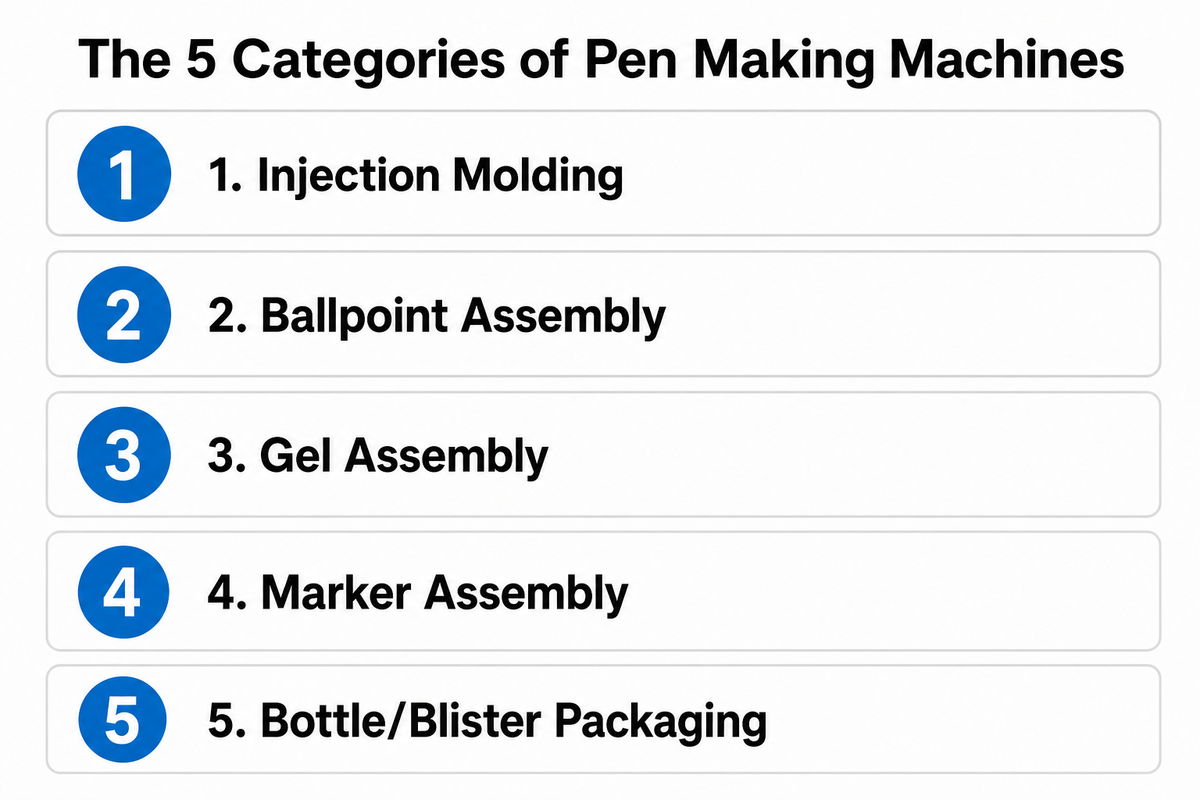
Un procédé de fabrication de stylos comprend cinq groupes de machines couvrant collectivement toutes les étapes, des matières premières au stylo conditionné, sans se substituer les uns aux autres : moules, assemblage de stylos à bille, assemblage de marqueurs ou assemblage des pointes, ainsi que machines fixant les emballages en bouteilles/blisters. Il s’agit de regroupements très généraux de machines de type « fabrication de stylos », et non d’une classification officielle décrite dans une documentation normalisée (comme un tableau ISO) ou par une grande association professionnelle.
| Catégorie : | Ce que la machine fabrique | Matériaux | Débit habituel | Limites / applications inadaptées |
|---|---|---|---|---|
| Moulage par injection | Corps, capuchons, bouchons | PP, PS, ABS, PC | Force de fermeture de 140–800 tonnes | Ne constitue pas à elle seule une ligne complète de stylos — nécessite un assemblage en aval |
| Assemblage de stylos à bille | Pointe, cartouche d’encre, assemblage du corps | Pointe en laiton/acier, encre à base d’huile | 40–60 pièces/min par ligne | Incompatible avec les encres gel ou à base d’eau sans changement d’outillage |
| Assemblage de stylos gel | Cartouche d’encre gel, pointe, assemblage du corps | Encre gel, pointe de précision | Cadence par ligne comparable à celle des stylos à bille, tolérance aux arrêts plus faible | La viscosité de l’encre gel tolère moins bien les arrêts de ligne que l’encre à base d’huile |
| Assemblage de marqueurs | Pointe en feutre/fibre, réservoir d’encre, assemblage du corps | Pointe en fibre, encre à base de solvant ou d’eau | Les lignes à double débit sont courantes à 40–60 pièces/min | Inadapté aux géométries de pointes de stylos à bille ou de stylos gel |
| Conditionnement en bouteilles/blisters | Emballage de vente au détail, film enveloppant | Film PET/PVC | Vitesse de ligne adaptée à l’assemblage en amont | Uniquement en aval — ne peut remplacer aucune catégorie d’assemblage |
Moulage par injection, la machine derrière chaque corps de stylo
Chaque catégorie de stylos commence de la même manière : une machine de moulage par injection chauffe des granulés bruts de polystyrène ou de polypropylène dans une trémie et injecte le plastique fondu sous pression dans une empreinte de moule ; le corps sort formé, le capuchon suit un procédé similaire avec des réglages de température et de pression différents, et le tube d’encre est extrudé à travers une filière, comme lorsqu’un enfant roule de la pâte à modeler. La ligne de moulage par injection de Mass Technology fonctionne avec une force de fermeture de 140–800 tonnes pour des résines PP, PS, ABS et PC, avec des entraînements servo qui réduisent la consommation d’énergie de 30–50 % par rapport aux presses hydrauliques plus anciennes. Les principes d’évaluation des risques des machines de l’ISO 12100 s’appliquent directement ici, et les recommandations spécifiques de l’OSHA pour les machines de moulage par injection horizontales mentionnent la consignation lors des opérations de maintenance, le risque de brûlure lié au plastique chaud du fourreau, la ventilation des fumées et vapeurs, la maîtrise du bruit et les portes opérateur interverrouillées pour éviter les blessures par écrasement lors de la fermeture du moule.
Comment une machine de fabrication de stylos transforme réellement la matière première en stylo fini
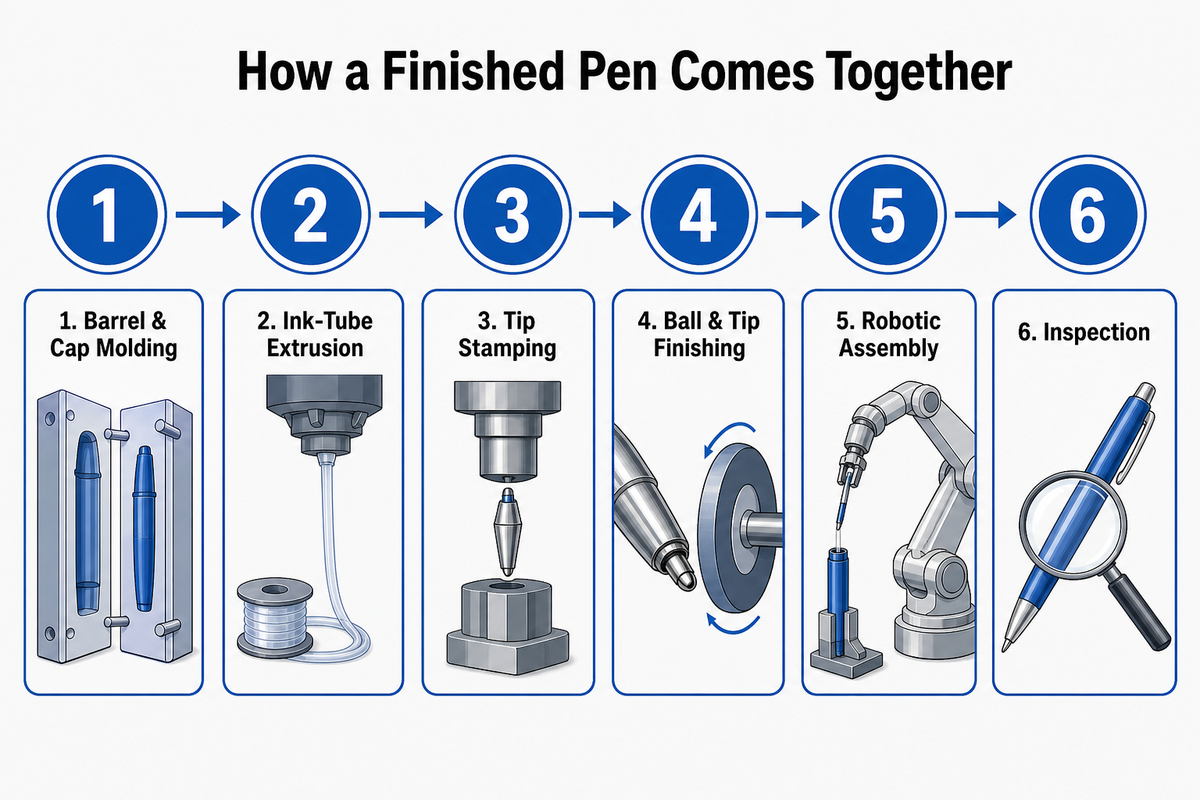
Un stylo à bille fini passe par environ six étapes avant d’être conditionné et prêt à être expédié : moulage par injection du corps et du capuchon, extrusion du tube d’encre, emboutissage de la pointe en laiton ou en acier, finition de précision de la bille et de la pointe, assemblage robotisé et inspection. Chaque étape alimente directement la suivante ; un défaut introduit au début n’apparaît donc souvent qu’une fois l’assemblage terminé.
Les éléments du corps et du capuchon sont d’abord moulés par injection, le tube plastique contenant l’encre passe dans une presse d’extrusion, puis un alliage de laiton/acier sert à emboutir des centaines de pointes par minute. La surface microscopique de leur bille doit ensuite être polie avec une suspension abrasive ultrafine afin d’atteindre des tolérances micrométriques ; les composants finis sont assemblés par robot avec le porte-pointe et le corps, contrôlés, puis placés dans des boîtes ou des « unités » de 6, 18 ou 36 par article. (Le taux de rebut de 1 pièce sur 5 000 a été repris de la page universitaire et ne doit pas être considéré comme une valeur typique de l’ensemble du secteur ; il s’agit d’une référence, d’un exemple comptable recueilli par ce groupe auprès de quelques sources au fil du temps, sans confirmation ni corrélation avec les documents qualité propriétaires des fabricants.)
Pourquoi la pointe du stylo constitue généralement une étape de fabrication distincte
La pointe est la pièce de précision la plus exigeante d’un stylo à bille ; c’est pourquoi elle est presque toujours fabriquée sur un équipement dédié, distinct de la ligne qui moule le corps. Un brevet américain de 2023 (11 660 905 B2, attribué à Kotobuki, Microtip et Suhan Corp) décrit une méthode de poinçonnage qui améliore les anciennes techniques d’assemblage des pointes.
Ce brevet décrit une méthode qui forme des « nervures d’écoulement du plastique » afin de fixer le ressort interne en une seule opération, en remplacement de l’ancien procédé de formage par refoulement en plusieurs étapes, avec un meilleur débit. Le fabricant suisse d’équipements de précision Mikron construit une autre plateforme pour la même tâche : ses machines de transfert rotatif Multistar fonctionnent avec 24 postes de travail et jusqu’à 44 unités de travail sur une ligne de fabrication de pointes entièrement automatisée. Les recharges finies sont contrôlées sur le testeur automatique Mikron ATW-10, qui teste simultanément dix recharges sous des angles d’écriture compris entre 60° et 90°, avant leur arrivée sur une ligne d’assemblage.
Le mécanisme est simple dans son principe : la rotation transporte la pièce d’un poste à l’autre sur une plateforme de transfert alimentée par convoyeur, chaque poste réalisant une opération de fabrication des pointes de stylos à bille. Maintenir la tolérance à cette vitesse de rotation sur les 24 postes de transfert par presse d’une même ligne correspond exactement au niveau de débit et de précision qui permet au parc installé de machines Mikron d’atteindre le chiffre de 200 millions de pointes par jour revendiqué par Mikron ; c’est ce qui distingue les équipements de transfert spécialisés pour la fabrication de pointes des machines polyvalentes.
Un point de défaillance auquel les acheteurs ne pensent qu’après avoir subi un mauvais lot : la résine de moulage par injection doit être correctement séchée avant d’entrer dans la trémie. Si elle est trop humide, l’humidité se transforme en vapeur lorsque le plastique fond, ce qui crée des défauts de surface ou des zones fragiles dans le corps, visibles seulement après la sortie du stylo de la ligne. Demandez au fournisseur potentiel quel équipement de séchage et quelle spécification de teneur en humidité il recommande pour votre résine, et pas seulement la force de fermeture de sa machine.
La grille d’adéquation des machines à stylos : faire correspondre le type de machine à votre étape de production
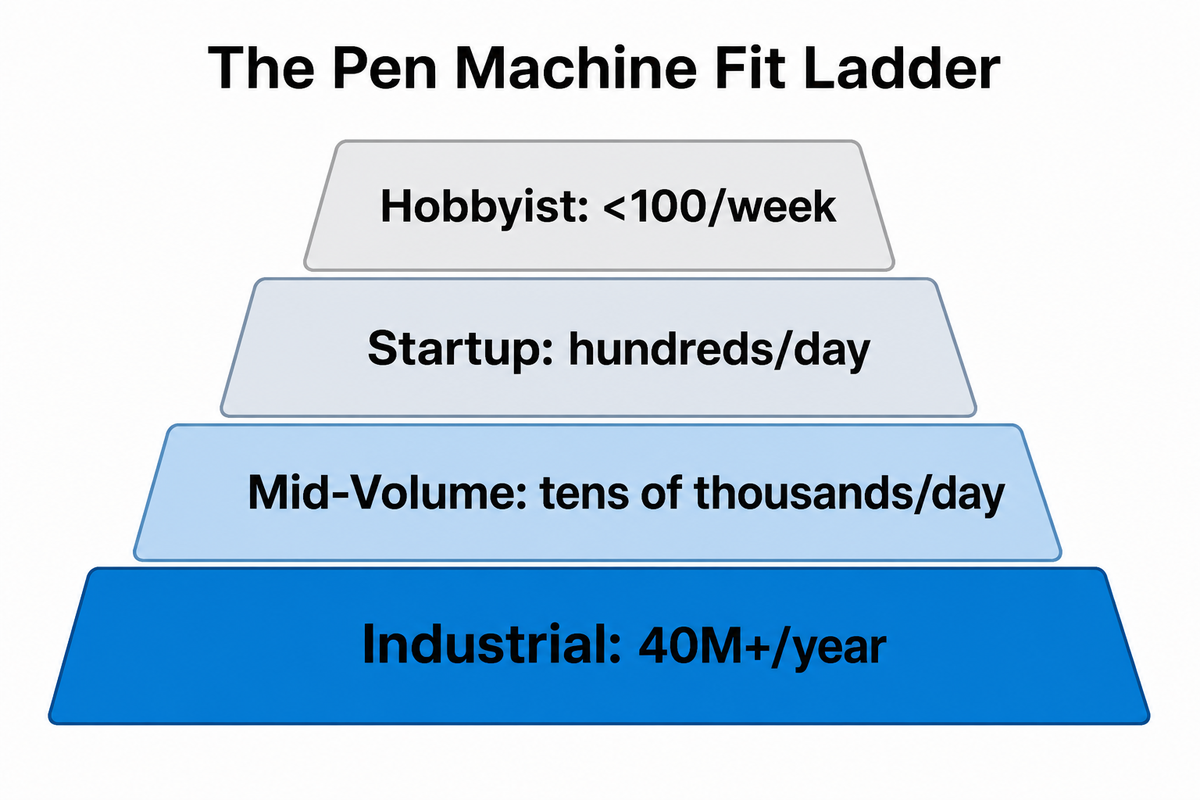
Le choix de la catégorie et de l’échelle de la machine dépend autant de l’étape de production (et pas uniquement du type de stylo) que de l’espace réellement disponible pour l’équipement. Il n’existe nulle part de liste ou de classification faisant autorité pour les machines de fabrication de stylos (l’analogue formel le plus proche, ISO 12757-1, normalise les stylos finis eux-mêmes, et non les équipements qui les fabriquent). La grille ci-dessous est donc construite en croisant des indicateurs d’échelle réels (par exemple une entreprise américaine produisant environ 40 millions/an avec environ 65 employés, contre une capacité installée de fabrication de pointes d’environ 200 millions de pointes/jour dans le monde) et les pratiques générales d’achat industriel.
Grille d’adéquation des machines de fabrication de stylos : faites correspondre votre étape de production à une catégorie de machine avant de demander des devis — les cycles de RFQ les plus souvent gaspillés viennent d’acheteurs qui envoient une demande industrielle à un fournisseur pour amateurs, ou une demande pour amateurs à une ligne industrielle.
| Facteur de décision | Amateur | Démarrage | Fabricant sous contrat de volume intermédiaire. | Échelle industrielle |
|---|---|---|---|---|
| Débit cible | <100/semaine | Des centaines/jour | Des dizaines de milliers/jour | 40M+/an (échelle PCA) |
| Fourchette budgétaire | $260–$1 150 (tour + kit) | USD dans le bas des montants à 5 chiffres | USD dans le milieu des montants à 5 à 6 chiffres | USD à 6 chiffres ou plus, multi-lignes |
| Matière traitée | Ébauches en bois/acrylique | Plastique moulé par injection | Plastique moulé par injection, multi-SKU | Gamme complète de résines, PP/PS/ABS/PC |
| Niveau d’automatisation | Tour manuel | Semi-automatique | Automatique, poste unique | Automatique, postes multiples, commande par API |
| Surface au sol | Atelier à domicile | Petit atelier/garage | Unité de petite industrie | Sol d’usine dédié (PCA : 39 000 sq ft) |
| Niveau de compétence requis | Amateur autodidacte | Utilisation de base de la machine | Opérateur formé + technicien | Opérateurs qualifiés en moulage par injection (le recrutement est réellement difficile — voir la FAQ) |
| Tolérance au délai de livraison | Immédiat (kit standard disponible) | Quelques semaines | 1–3 mois | 3+ mois, réception en usine recommandée |
| Besoins de certification | Aucun | Sécurité électrique de base | Documentation CE/ISO 9001 | Conformité complète CE/ISO 12100 et aux normes produit (ISO 12757-1, etc.) |
| Limites / applications inadaptées | Impossible de dépasser un volume amateur | Non rentable au-delà d’un volume intermédiaire environ | Limite de flexibilité multi-SKU par rapport aux lignes dédiées | Surpuisez le capex pour le volume <startup-tier |
Pour situer ces fourchettes, voici comment se comparent réellement les activités à chaque échelle approximative, à partir des sources citées dans ce guide. Une ligne automatisée Mass Technology fonctionnant à 40–60 stylos par minute peut produire environ 24 000 stylos finis sur un poste de 8 heures avec un seul superviseur, soit presque le double sur deux postes de 8 heures en une journée, environ 336 000 stylos sur une semaine de production de 7 jours, environ 1,4 million de stylos sur un mois de 30 jours et environ 4,3 millions de stylos sur un trimestre de 90 jours, au même débit maximal :
| Activité | Échelle / débit | Région | Remarque |
|---|---|---|---|
| Tourneur de stylos amateur (opérateur unique) | Moins de 100 unités/semaine | Toutes | Tour manuel, à base de kit |
| Ligne d’assemblage de stylos à bille Mass Technology | 40-60 pièces/min par ligne | Chine (fabricant) | Données de première main, une ligne automatisée unique |
| Production par poste de Mass Technology | ~24 000 stylos/poste de 8 heures | Chine (fabricant) | Un superviseur, une ligne |
| Ballograf | 4M+ instruments d’écriture/an | Suède | ~30 employés ; chiffre communiqué par l’entreprise, non audité indépendamment |
| Pen Company of America | ~40M stylos/an (~750 000/semaine) | États-Unis | ~65 employés, site de 39 000 sq ft |
| Ningbo Beifa | ~3 milliards de stylos/an | Chine | Grand fabricant national unique ; chiffre publié par la presse |
| Ligne de pointes Mikron Multistar unique | 24 postes de travail, jusqu’à 44 unités de travail | Suisse (origine de l’équipement) | Niveau composant, pas une ligne complète de stylos |
| Parc installé d’équipements de pointes Mikron | ~200 millions de pointes/jour | Monde | Déclaration d’un fournisseur unique, non sourcée/paraphrasée |
| Chine, total national | ~38 milliards de stylos à bille/an | Chine | Marge bénéficiaire déclarée inférieure à 10 cents par stylo |
Ce qui détermine le prix d’une machine de fabrication de stylos (fourchettes de coûts par catégorie)
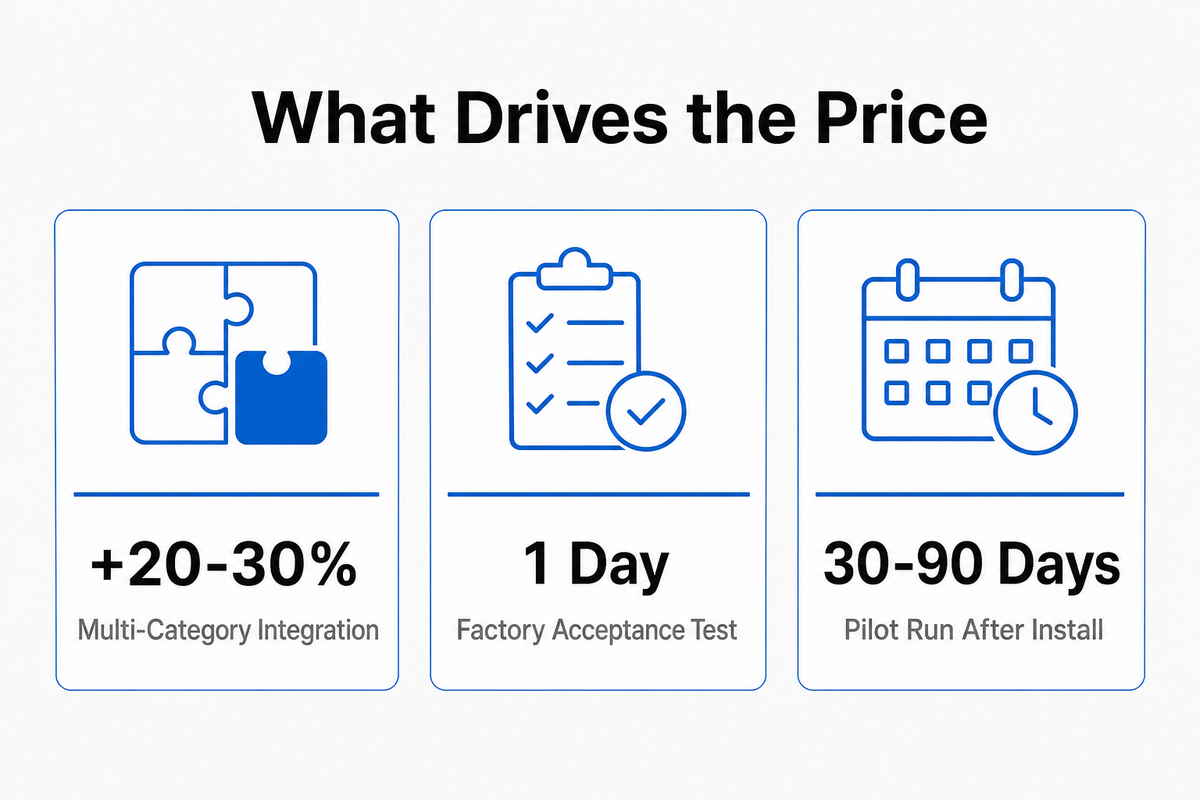
Le prix dépend principalement du niveau d’automatisation et de la catégorie de machine, et pas seulement du tonnage ou de la capacité ; les données de prix fiables à l’échelle du marché sont rares pour cet équipement. Le seul prix public trouvé pendant la recherche — un devis d’un fournisseur Alibaba d’environ CN¥133 780-143 813,50 pour 50-100 unités/min — constitue un point de données unique et non vérifié, pas une référence de marché.
La manière réaliste d’évaluer le coût consiste à raisonner par catégorie et niveau d’automatisation : les équipements manuels ou semi-automatiques à poste unique se situent dans le bas de la fourchette ; les lignes entièrement automatiques à postes multiples, avec commande par API et inspection qualité intégrée, se situent nettement plus haut ; une ligne de production complète couvrant plusieurs catégories coûte davantage que la somme de ses machines individuelles en raison de l’intégration et de la mise en service, généralement 20-30 % supplémentaires. Prévoyez une réception en usine chez le fournisseur — le même type de vérification documentée qui alimente aussi la validation d’une évaluation des risques selon l’ISO 12100 — et, si possible, un essai pilote de 30-90 jours après l’installation ; ces deux pratiques sont courantes dans l’industrie, et non des options propres aux stylos.
Sauter cette réception est l’erreur la plus coûteuse de cette catégorie : un acheteur qui effectue le paiement, attend l’expédition de la ligne et découvre seulement ensuite que le tonnage de fermeture ne maintient pas la tolérance avec sa résine spécifique n’a plus de marge pour négocier une correction. La machine lui appartient déjà, elle est dans un conteneur, et toute correction intervient à ses frais et selon son calendrier, au lieu de ceux du fournisseur. Réaliser une réception en usine d’une journée sur votre matière réelle avant l’expédition coûte une fraction du prix d’une installation défaillante.
Comment comparer les fournisseurs de machines de fabrication de stylos selon leur région et leur spécialité
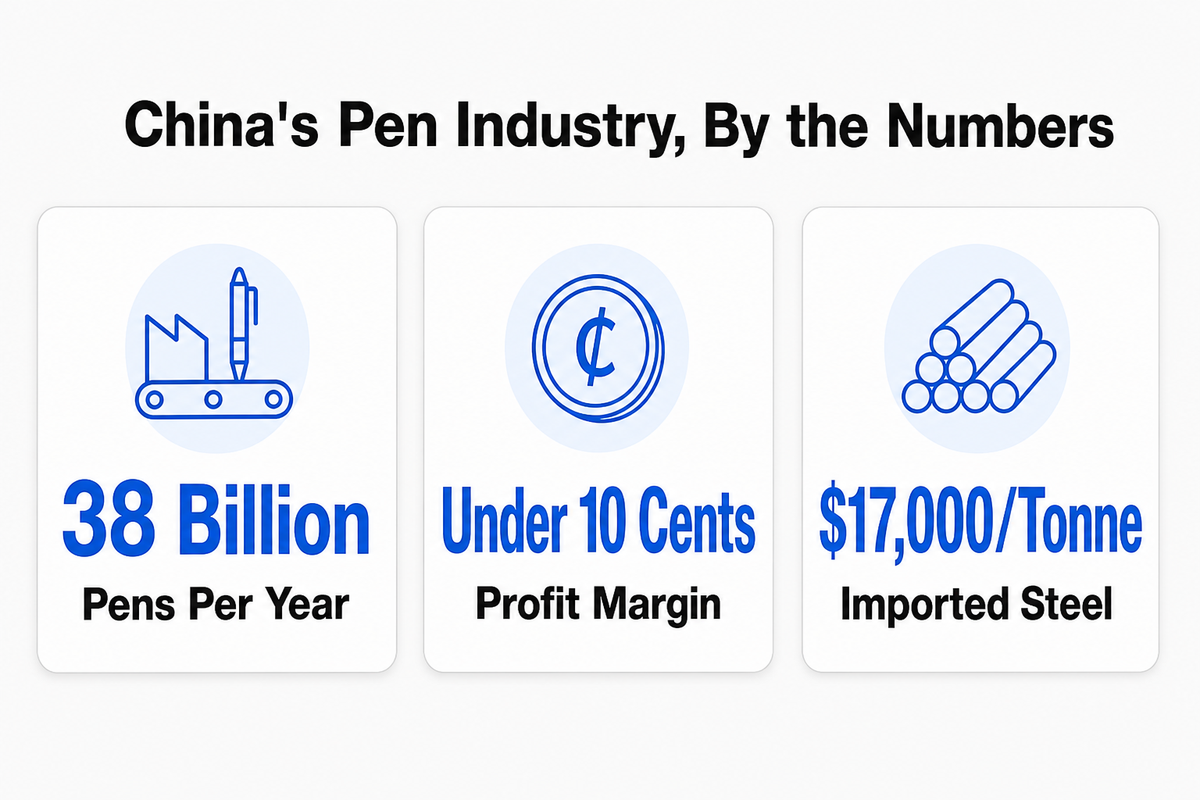
La région renseigne mieux sur la spécialisation que sur la qualité générale — et voici un fait sur la Chine à retenir avant de comparer les commandes de stylos par pays. La Chine fabrique le plus grand volume total de stylos au monde : les fabricants chinois d’articles de papeterie produiraient environ 38 milliards de stylos à bille par an, avec des marges extrêmement faibles, bien inférieures à 10 cents par stylo. Ironiquement, ces mêmes fabricants ont dû importer l’acier inoxydable spécial nécessaire aux pointes de stylos à bille, à un coût déclaré d’environ $17 000 par tonne. Le Premier ministre Li Keqiang a publiquement évoqué cet « angle mort » industriel en janvier 2016, au cours de l’effort d’environ cinq ans mené par Taiyuan Iron and Steel (Tisco) pour le résoudre : l’entreprise avait rejoint une initiative nationale en 2011, réalisé une avancée technique sur la formule de l’alliage à la fin de 2014, puis produit les premières pointes de stylos à bille fabriquées en Chine en juin 2016 ; cette réussite a attiré une attention internationale plus large dans une annonce de suivi en janvier 2017. Il a fallu plus de 20 étapes de production usinées avec une précision micrométrique, sur une pointe finie devant écrire en continu sur des centaines de mètres sans saut ni surcharge d’encre. C’est pourquoi « nous produisons beaucoup d’acier » et « nous savons produire cet acier précis » se sont révélées être deux affirmations très différentes. En résumé, le volume de production d’un pays ne garantit pas sa capacité au niveau des composants : vérifiez si un fabricant dispose de fournisseurs dédiés ou de la capacité à extruder de manière fiable des matériaux de haute qualité pour les pointes. En pratique, il faut poser une question parfois inconfortable pendant l’évaluation : quels composants le fournisseur fabrique-t-il réellement sur son site, et lesquels achète-t-il à un tiers qu’il peut ou non nommer ? Supposer qu’une « grande usine » fabrique tout en interne conduit les acheteurs à découvrir, trois mois après le début de la production, que leur matériau de pointe provient en réalité d’un sous-traitant dont ils n’ont jamais pu inspecter le contrôle qualité.
« Pour le moulage par injection, il est presque impossible de trouver des personnes expérimentées. »
Cette difficulté explique pourquoi il ne reste qu’un grand fabricant américain : Pen Company of America fabrique plus d’un milliard d’instruments d’écriture depuis sa fondation en 1954 sous le nom de « Rotary Pen » et s’approvisionne toujours pour chaque composant — absolument tous, y compris les cartouches d’écriture de rechange — aux États-Unis, même si les pièces ne sont pas fabriquées en interne. Si vous choisissez selon la région, évaluez donc les compromis entre délocalisation et approvisionnement local : délais, disponibilité des pièces et, au final, assistance technique locale souvent plus régulière et plus accessible. Lorsque vous comparez une machine fabriquée dans l’UE à une machine fabriquée aux États-Unis, rappelez-vous que le marquage CE confirme uniquement la conformité au marché de l’UE ; il ne répond pas automatiquement aux exigences américaines de sécurité au travail (OSHA, ANSI/B11). Prévoyez donc une vérification de conformité américaine distincte au lieu de supposer que le marquage CE suffit. Du côté de l’UE, le règlement (UE) 2023/1230 impose de véritables obligations à toute personne qui importe une machine sur le marché de l’UE, et pas seulement à son fabricant d’origine — un point à connaître si votre chaîne d’approvisionnement fonctionne en sens inverse.
Les conditions d’assistance doivent figurer dans cette même liste de comparaison, et les fournisseurs les communiquent rarement spontanément. Demandez à chaque fournisseur présélectionné de mettre par écrit la durée de garantie, le délai garanti de réponse aux pannes et la vitesse d’expédition des pièces de rechange avant de signer quoi que ce soit. À titre de référence, Mass Technology publie une garantie de 2 ans sur les pièces de machine, s’engage à faire répondre un ingénieur dans les 24 heures suivant le signalement d’une panne et expédie les pièces de rechange à l’international sous 5 jours par service de messagerie — trois chiffres utiles comme référence la prochaine fois qu’un devis concurrent reste vague sur ces trois points.
Machines de fabrication de stylos ou équipements d’impression/personnalisation de stylos : ne confondez pas les deux
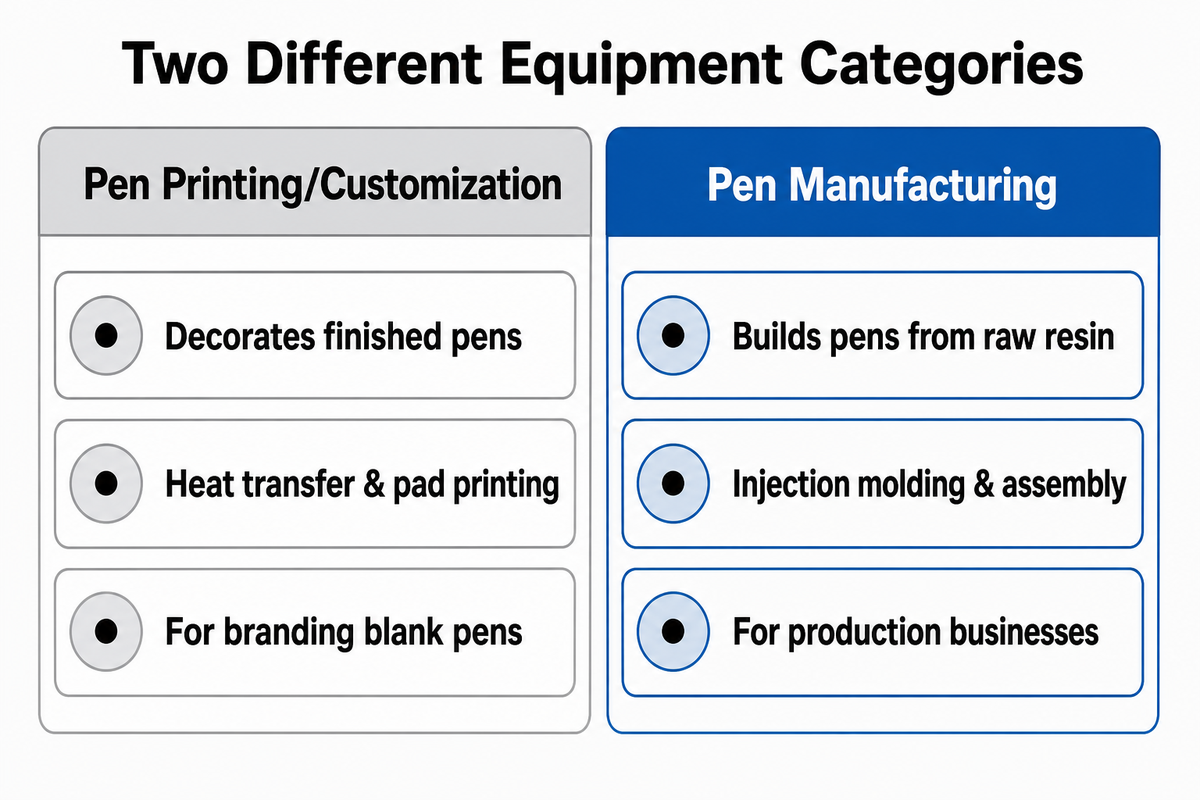
Les recherches sur « machine de fabrication de stylos » renvoient souvent vers des équipements d’impression et de transfert thermique pour stylos personnalisés. Ces systèmes servent à décorer des stylos préfabriqués, et non à fabriquer les stylos eux-mêmes : il est donc important de distinguer ces deux catégories d’équipements avant d’évaluer les options. Les presses à chaud pour stylos, les machines de tampographie et les machines d’impression par transfert de sublimation appartiennent à une catégorie totalement distincte des équipements de fabrication — cette confusion est suffisamment fréquente pour apparaître directement dans les résultats de recherche : une recherche sur « pen making machine » fait régulièrement ressortir des offres promotionnelles de machines d’impression de stylos destinées aux acheteurs qui disposent déjà de stylos finis et souhaitent simplement y ajouter un logo par chauffage et pression, à côté de véritables machines de fabrication destinées aux acheteurs qui produisent des stylos à partir de résine brute. Certaines installations d’amateurs combinent même une presse à stylos de base avec une petite machine de coupe pour retailler les ébauches, ce qui n’a rien à voir avec un procédé industriel de fabrication de stylos-bille produisant des milliers d’unités par heure. Si votre RFQ concerne réellement le marquage de stylos vierges pour un cadeau d’entreprise, vous avez besoin d’un fournisseur d’équipements d’impression, et non d’un fournisseur de lignes de fabrication : envoyer cette demande à la mauvaise catégorie fait perdre du temps aux deux parties. Tous les articles présentés ici sont consacrés à la fabrication et aux équipements industriels. (En comparaison, les stylos existants possèdent leurs propres normes de qualité, telles que ISO 12757-1 pour les stylos, ISO 27668-1 pour les stylos gel et ISO 11540 pour les capuchons, qui visent à réduire le risque d’étouffement pour les produits susceptibles d’être utilisés par des enfants.) Le niveau de qualité d’un stylo fini disponible sur votre marché est un facteur important si vous prévoyez de fabriquer un système de production complet pour fournir votre gamme de produits.
Perspectives du secteur : vers où se dirige la demande de fabrication de stylos
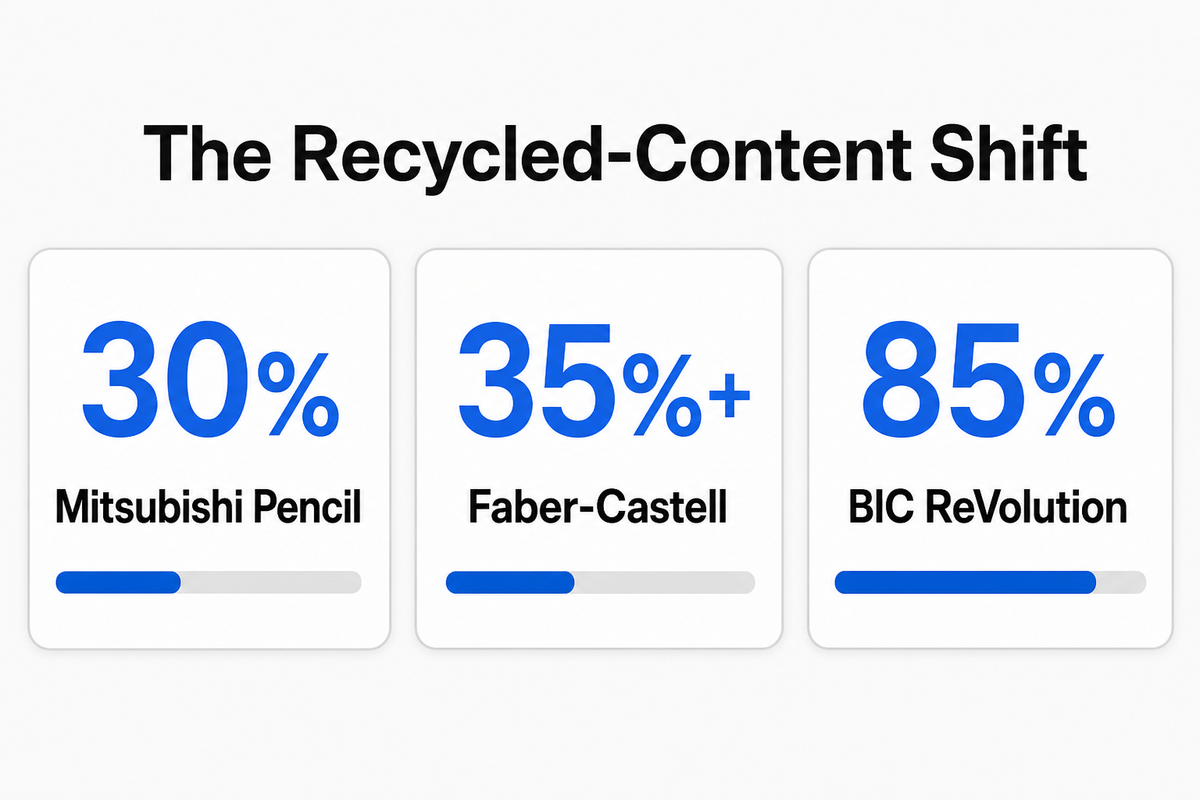
La tendance à court terme la plus nette actuellement n’est pas un chiffre de taille de marché, mais l’évolution des matériaux et des compétences qui modifie les questions que les acheteurs d’équipements pour stylos doivent poser aux fournisseurs. Les exigences de durabilité incitent les marques à spécifier des résines contenant des matières recyclées : Mitsubishi Pencil a indiqué que son taux de recyclage des matières pour les déchets plastiques traités en 2024 était de 30 %, Faber-Castell a signalé l’an dernier que l’utilisation de matières recyclées avait progressé de plus de 35 % sur un an, et la marque ReVolution de BIC, lancée l’an dernier, était fabriquée à partir de 85 % de résine recyclée. Vous ne pouvez pas encore demander tout cela pour les machines présentées ci-dessus, car ce sujet ne les concernait pas jusqu’à récemment ; toutefois, lors de la spécification d’une nouvelle ligne de moulage par injection ou d’assemblage de stylos, confirmez explicitement qu’elle est prévue pour traiter ces matières. La pénurie de compétences décrite par la PCA (difficultés concrètes à trouver et à former des opérateurs expérimentés pour des équipements tels que les machines de moulage par injection horizontales) est une contrainte spécifique aux États-Unis, mais largement signalée, et elle influe davantage sur les délais de recrutement que sur l’approvisionnement en machines lui-même. Les estimations du marché mondial des stylos varient fortement selon les rapports : l’un évalue le marché mondial des stylos à $22,7 milliards en 2025, avec un CAGR de 4,98 %, tandis qu’un autre prévoit un marché mondial de $17,4 milliards en 2024, avec un CAGR de 2,7 % ; utilisez donc ces projections de taille de marché avec prudence et considérez-les comme des indicateurs et des tendances plutôt que comme des chiffres exacts sur lesquels fonder votre analyse économique. Un signal plus stable issu de nos propres données de recherche de mots-clés est que l’intérêt pour la fabrication réelle des stylos a progressé d’environ 22 % sur un an, signe que la curiosité des acheteurs pour le procédé de production lui-même, et pas seulement pour l’achat de stylos finis, continue de croître. Mise à jour en septembre 2026
Quand NE PAS acheter une machine industrielle de fabrication de stylos
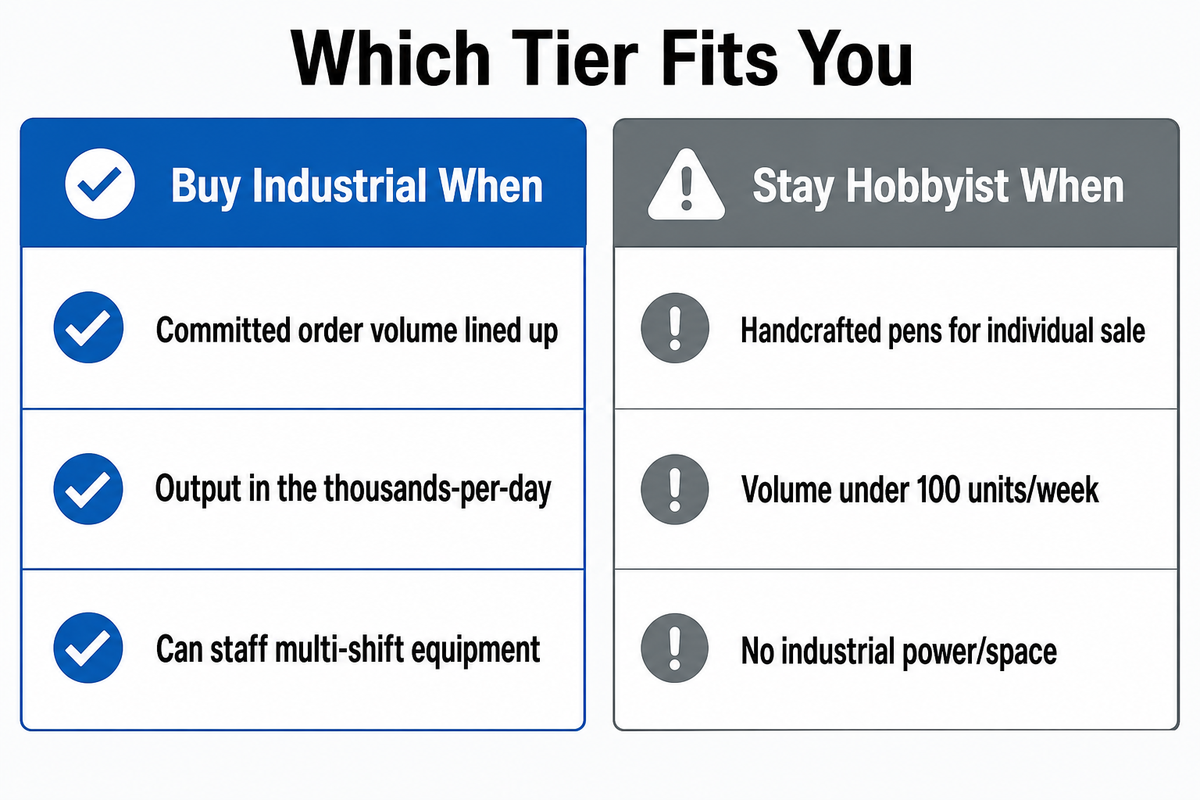
✔ Achetez un équipement industriel lorsque
- Vous disposez déjà d’un volume de commandes confirmé ou d’un réseau de distribution en gros avant l’achat
- Votre objectif de production est de l’ordre de plusieurs milliers d’unités par jour ou davantage
- Vous pouvez recruter le personnel nécessaire et assurer la maintenance d’un équipement commandé par automate programmable, fonctionnant en plusieurs postes
⚠ Restez sur des outils d’amateur lorsque
- Vous fabriquez des stylos artisanaux en bois ou en acrylique pour les vendre à l’unité
- Votre volume est inférieur à environ 100 unités par semaine
- Vous n’avez pas encore besoin d’une alimentation électrique ou d’un espace incompatibles avec un atelier domestique
Pour environ $260 à $1 150, vous pouvez obtenir un kit de démarrage pour tournage de stylos (tour à bois mini ou midi, généralement doté d’un banc en aluminium ou en fonte, avec un kit de départ comprenant des ébauches de stylos, un jeu de mandrin, un mandrin et des produits de finition), ce qui vous place dans une catégorie de prix et de compétences totalement différente de celle d’une machine industrielle : il convient à un amateur qui tourne des stylos à domicile pour la communauté des loisirs créatifs, et non à une activité de production, même si des marques de kits haut de gamme et des fabricants spécialisés de petites machines produisent également pour l’espace situé entre l’amateur et l’échelle véritablement industrielle. L’erreur classique des nouveaux acheteurs n’est pas de choisir le mauvais fournisseur, mais de ne pas étudier suffisamment d’options et de modèles tarifaires avant de budgéter l’investissement dans l’équipement, quel que soit le secteur (et cela vaut pour l’ensemble de l’industrie, pas seulement pour les machines de fabrication de stylos). Avant de demander les prix des machines, utilisez la grille Fit Ladder ci-dessus comme test rapide de cohérence.
Questions fréquentes
Q : La fabrication de stylos est-elle une activité rentable ?
La rentabilité d’une activité utilisant une machine de fabrication de stylos dépend presque entièrement de l’échelle : le tournage de stylos en amateur constitue une activité complémentaire aux revenus modestes, tandis que la fabrication industrielle tire ses bénéfices du volume plutôt que de la marge unitaire.
La fabrication artisanale de stylos de qualité à partir de bois ou d’acrylique génère généralement une marge modeste par stylo après prise en compte des matières, de l’amortissement et des éventuels frais de plateforme : elle peut constituer une activité complémentaire intéressante, mais il est peu probable qu’elle procure une rémunération à temps plein avec de faibles volumes. La fabrication industrielle repose sur une logique économique totalement différente : une ligne produisant 40-60 stylos par minute réalise un bénéfice avec de faibles marges unitaires, car le volume le permet, et non parce qu’un seul stylo serait vendu cher. Cela ne fonctionne toutefois que si une distribution en gros ou B2B est organisée avant l’achat de la machine, et non après : une usine sans acheteurs pour sa production ne fait qu’accumuler des stocks coûteux. La réponse honnête dépend donc entièrement du niveau dont vous parlez : la fabrication de stylos en amateur et la fabrication industrielle sont réellement deux activités différentes qui partagent une même catégorie de produits, et non deux points d’une même courbe de rentabilité.
Q : Puis-je démarrer une activité de fabrication de stylos à domicile ?
Oui au niveau amateur avec un kit de tournage de stylos, mais pas au niveau industriel : le moulage par injection et les équipements d’assemblage automatisé nécessitent une alimentation triphasée et une surface au sol qu’un atelier domestique ne peut pas fournir.
Un kit de tournage de stylos construit autour d’un tour à bois mini ou midi (un kit de démarrage de $260-$1 150 est courant) permet de fabriquer chez soi un stylo personnalisé en bois ou en acrylique, ce qui correspond au point de départ de la plupart des activités de fabrication de stylos en amateur. En revanche, il est impossible d’installer à domicile une ligne industrielle intégrant le moulage par injection, l’assemblage automatisé et les machines de remplissage de stylos, car elle exige une alimentation industrielle triphasée, de l’espace et une ingénierie à grande échelle qui dépassent les limites d’un atelier amateur. Pour les volumes destinés à la vente en gros, une installation adaptée est primordiale.
Q : Combien coûte la fabrication d’un stylo ?
Le coût va de quelques dollars par stylo en bois fabriqué par un amateur à une fraction de centime par unité pour les matières sur une ligne industrielle à grand volume, une fois l’amortissement réparti sur des millions de pièces.
Un stylo artisanal tourné en bois coûte généralement quelques dollars en matières (ébauche, kit et finition), auxquels s’ajoute le temps de travail. En revanche, sur une ligne industrielle de stylos-bille, le coût unitaire dépend principalement des matières (résines des corps, pointes de stylos et encres), de l’amortissement des machines et de la main-d’œuvre. Les lignes automatisées à grand volume réduisent fortement le coût matière unitaire une fois l’amortissement réparti sur des millions d’unités ; c’est pourquoi les fabricants sous contrat établissent leurs devis au millier ou au contenant plutôt qu’à la pièce. Pour obtenir un coût rendu précis, demandez un devis fondé sur le modèle, les matières et les volumes cibles.
Q : Que dois-je rechercher dans une machine de fabrication de stylos ?
Il n’existe pas une seule « meilleure » machine : le choix dépend de la catégorie parmi les 5 catégories qui correspond à votre produit et à votre volume ; commencez donc par la grille Fit Ladder plutôt que par une comparaison de marques.
Choisissez d’abord votre catégorie dans la grille Fit Ladder, puis comparez les machines à l’intérieur de cette catégorie, et non l’inverse.
Q : Quels pays sont leaders dans la fabrication de machines pour stylos ?
La Chine est en tête par le volume et la profondeur de son offre d’équipements ; les fabricants de composants de précision jouissant d’une solide réputation pour la fabrication des pointes sont concentrés en Europe, même si la domination globale en volume ne garantit pas que chaque composant critique soit approvisionné localement.
La grande majorité des stylos dans le monde et des composants de machines de fabrication de stylos sont fabriqués en Chine, tandis que les principaux fabricants mondiaux de composants se trouvent surtout en Europe (la Suisse occupe une niche pour les composants de pointes de qualité). Le pays qui domine le volume global de stylos n’est pas nécessairement celui qui domine chaque composant critique. Demandez aux fournisseurs de confirmer l’origine de certains composants au lieu de déduire de leur implantation industrielle ce qu’ils sont capables de fournir.
Q : Ai-je besoin d’une presse à stylos ou d’une machine complète de fabrication de stylos ?
Une presse à stylos est un outil d’assemblage manuel destiné aux amateurs qui utilisent des kits de stylos, et non un substitut à une machine automatisée de fabrication de stylos : les deux répondent à des échelles de production totalement différentes.
Les amateurs utilisent une presse à stylos pour sertir ensemble des pièces standard — pointe, tube et clip — sur une ébauche tournée ; une telle presse constitue un excellent accessoire de fabrication artisanale de stylos, mais pas un équipement de production, et elle ne peut pas atteindre le débit d’une machine d’assemblage semi-automatique de base. Si vous fabriquez des stylos à partir de matières premières plutôt que d’assembler des kits, il vous faut une machine de fabrication de stylos adaptée à votre catégorie, et non une presse.
Pourquoi nous rédigeons ce guide
Zhangjiagang Mass Technology Co., Ltd. fabrique des équipements de moulage par injection, pour stylos-bille, stylos gel, marqueurs et conditionnement de bouteilles, qui constituent cinq de ses dix gammes de produits principales, aux côtés de systèmes de remplissage d’eau et de boissons. Ce guide est rédigé à partir de cette expérience : nous savons quelles questions les acheteurs posent avant d’avoir déterminé la catégorie de machine dont ils ont réellement besoin, car nous répondons directement à ces questions. Relu par l’équipe technique de Zhangjiagang Mass Technology Co., Ltd.
Une fois que vous savez quelle catégorie correspond à votre étape de production, l’étape suivante consiste à comparer des machines réelles. La ligne complète de fabrication de stylos de Mass Technology couvre les cinq catégories avec des spécifications publiées, des conditions de garantie et des délais de livraison ; c’est une bonne étape suivante pour obtenir un devis adapté à votre catégorie après vous être positionné dans la grille Fit Ladder ci-dessus.
Articles associés
- Machine de fabrication de stylos-bille : guide complet d’achat et de procédé analyse détaillée du procédé en 8 étapes, de la fabrication des pointes en tungstène et du cadre de décision entre production industrielle et fabrication amateur
- Guide des machines pour stylos gel : procédé, capacité, contrôle qualité et liste de vérification pour l’achat
- Machine de fabrication de marqueurs : guide complet de fabrication
- Machine de moulage par injection pour stylos, précision servo pour la production des corps de stylos spécifications complètes de la ligne de moulage par injection de 140–800T mentionnée ci-dessus
- Machine de fabrication de stylos, ligne de production complète page de solution complète couvrant les 5 catégories, avec niveaux de prix et comparaison des fournisseurs
Références et sources
- Stylos Bic : fabrication The Ohio State University
- Brevet américain 11 660 905 B2, machines de fabrication de pointes de stylos-bille, pointes de stylos-bille et stylos-bille United States Patent and Trademark Office
- Outil électronique de protection des machines, machines de moulage par injection horizontales Occupational Safety and Health Administration
- Protection des machines, normes Occupational Safety and Health Administration
- Directive 2006/42/EC relative aux machines Official Journal of the European Union, EUR-Lex
- Règlement (EU) 2023/1230 relatif aux machines EUR-Lex
- ISO 12757-1:2017, Stylos-bille et recharges, partie 1 International Organization for Standardization
- ISO 27668-1:2016, Stylos-bille à encre gel et recharges, partie 1 International Organization for Standardization
- ISO 11540:2021, Capuchons destinés à réduire le risque d’étouffement International Organization for Standardization
- ANSI/ISO 12100:2012, Évaluations des risques liés à la sécurité des machines American National Standards Institute
- Pen Pals : Mike Rowe et un fabricant de stylos familial s’associent pour soutenir les métiers manuels IndustryWeek
- La Chine développe ses propres pointes de stylos-bille Chinese Academy of Sciences