Entre em Contato com a Masstech

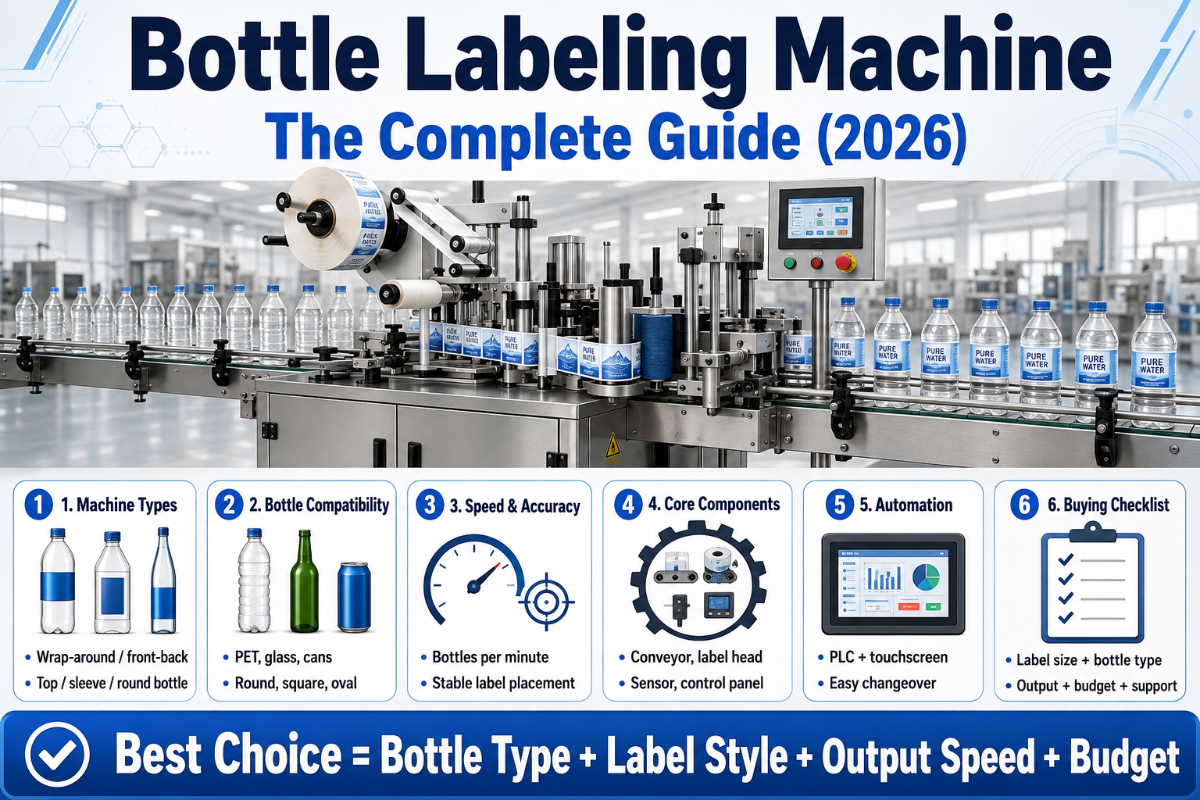
Especificações rápidas — máquina de rotulagem de garrafas em resumo
| Faixa de capacidade de produção | 8–20.000 garrafas por hora (manual a totalmente automática) |
| Precisão de posicionamento | ±0,5 mm (servo) a ±1,5 mm (nível de entrada) |
| Diâmetro do recipiente | 14,75–125 mm; altura 20–350 mm |
| Custo do rótulo por garrafa | $0,005 (hot melt) a $0,080 (autoadesivo premium) |
| Faixa de investimento de capital | Unidade manual de bancada abaixo de $1.500 até linha de sleeve e túnel de $85.000 |
O que é uma máquina de rotulagem de garrafas? (Princípio de funcionamento e subsistemas)
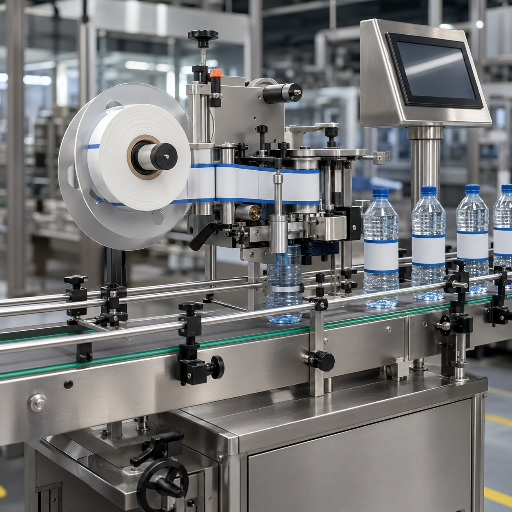
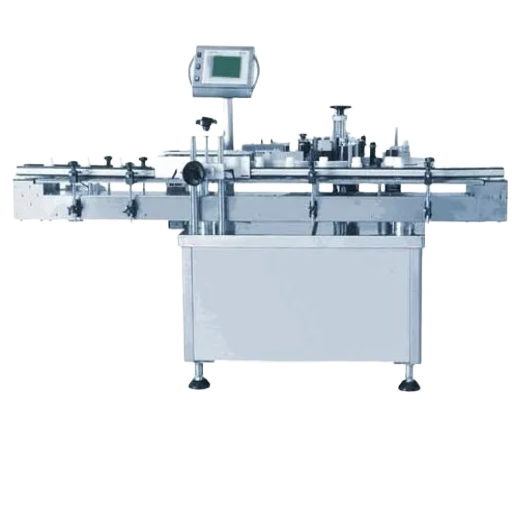 \r\n\r\nUma máquina de rotulagem de garrafas, ou equipamento de rotulagem de garrafas, é um equipamento de embalagem que puxa um rolo ou pilha de rótulos por uma série de roletes, destaca cada rótulo individualmente e o aplica a uma garrafa, frasco, ampola ou qualquer outro recipiente à medida que passa por uma esteira em uma linha de produção. Os aplicadores de rótulos podem ser dispensadores que destacam um rótulo autoadesivo do liner e o aplicam ao recipiente; uma unidade hot melt, que envolve o filme OPP da manga tubular em torno de cada garrafa e o une com adesivo termoplástico no filme; ou um aplicador de sleeve, que coloca a manga tubular ao redor da garrafa e a conduz por um túnel de encolhimento para ajustar o filme.\r\n\r\nEm praticamente toda rotuladora de garrafas, independentemente da marca ou do método, existem 4 subsistemas,
- Desbobinamento e distribuição do rótulo — puxa o material de rótulo do carretel, destaca-o na placa de descolagem e depois o alimenta ao aplicador; o controle da tensão da banda nessa área determina se o rótulo ficará plano ou enrugado mais adiante.
- Sistema de registro/sensor — o sensor fotoelétrico ou de fibra detecta a chegada da garrafa e aciona o aplicador no milissegundo correto. Conjuntos de sensores SICK ou Keyence são comuns em máquinas industriais de rotulagem de garrafas. As unidades de entrada geralmente usam fotocélulas padrão de baixo custo.
- Cabeçote aplicador — componente que aplica o rótulo ao produto. Existem 4 tipos principais de aplicadores: roletes de aplicação, cabeçotes de sopro e pressão, tambores a vácuo (skin ou envolventes) e aplicadores de sleeve (manga termoencolhível).
- Sincronização da esteira — um acionamento servo ou de passo mantém a esteira e a correia de distribuição em fase. Um desvio de 1mm na velocidade da esteira produz um erro de 4mm na posição do rótulo em alta velocidade.
📐 Nota de engenharia
Se houver interesse em saber como os 4 subsistemas são implementados em um pacote de qualidade de produção, a Mass Technology oferece seu conjunto de 3 famílias de máquinas industriais de rotulagem de garrafas, com a lista de materiais de cada peça do sistema e as especificações de precisão de cada modelo.
Os sistemas de aplicação de rótulos acionados por servo têm precisão de 0,5mm na velocidade nominal. Os sistemas de entrada acionados por motor de passo apresentam desvio de até 1,5mm quando a velocidade ultrapassa 60 rótulos por minuto. A diferença de precisão vem da combinação de sensor e servo, não do próprio cabeçote aplicador — é possível comprar um excelente cabeçote e ainda obter um posicionamento ruim se a latência do sensor exceder 5 milissegundos.
Comparação de 5 métodos de rotulagem
Muitos guias de compra disponíveis na internet listam apenas 2 opções (autoadesivo versus sleeve) ou 3 (adicionando hot melt). Existem 5 conjuntos canônicos, cada um adequado à sua própria faixa operacional. Nossa tabela comparativa abaixo cruza as faixas públicas de custo por garrafa da imprensa especializada em embalagens com as faixas de capacidade de produção publicadas pelos principais fabricantes de equipamentos originais.| Método | Capacidade de produção | Custo / garrafa | Proteção contra violação integrada | Melhor aplicação |
|---|---|---|---|---|
| Envolvimento hot melt OPP/BOPP | 3.000–20.000 BPH | $0,005–$0,015 | Não | Produção em massa de bebidas em garrafas redondas |
| Autoadesivo (sensível à pressão) | 1.200–12.000 BPH | $0,030–$0,080 | Não (adicionar faixa) | Cosméticos, produtos químicos de uso diário, lotes curtos |
| Sleeve termoencolhível (PVC, PET-G, OPS) | 3.000–9.000 BPH | $0,020–$0,045 | Sim (faixa completa no gargalo) | Produtos farmacêuticos, SKUs premium, requisitos de proteção contra violação |
| Cola úmida/cola fria | 10.000–60.000 BPH | $0,003–$0,010 | Não | Cerveja e vidro retornável; engarrafadores legados de alto volume |
| Rotulagem no molde (IML) | 10.000–50.000+ BPH | $0,040–$0,090 | Incorporado (sem borda destacável) | Garrafas de HDPE/PP moldadas por injeção; varejo premium |
Qual é a diferença entre a rotulagem hot melt e a rotulagem com sleeve termoencolhível?
O hot melt aplica um filme uniforme de 150mm de largura ao redor da circunferência de uma garrafa redonda e depois une a borda final com uma faixa de adesivo termoplástico. O sleeve termoencolhível coloca uma manga tubular pré-impressa sobre toda a garrafa e usa um túnel de vapor ou elétrico para encolhê-la e fixá-la. O hot melt custa menos por garrafa, mas só pode ser usado em garrafas redondas; o sleeve pode ser usado em qualquer formato e oferece comunicação de marca em 360 graus, além de faixas de proteção contra violação no gargalo, por aproximadamente 3 vezes o custo do rótulo. Uma regra prática seguida pela maioria das fábricas: usar rotulagem hot melt para água e bebidas carbonatadas em garrafas redondas acima de 10.000 BPH; usar uma máquina de rotulagem com sleeve termoencolhível quando forem desejados gráficos de corpo inteiro, faixas de proteção contra violação e o formato do recipiente não for redondo; usar autoadesivo quando os tempos de troca de formato determinarem as taxas de produção. Para linhas de bebidas de alto volume em garrafas redondas e aplicações com união precisa do rótulo, a solução robusta é a linha de sistema de rotulagem OPP hot melt.3 níveis de automação — manual, semiautomático e totalmente automático
O nível de automação deve corresponder ao volume, e não ao orçamento disponível. Clientes que instalam soluções manuais de rotulagem por parecerem mais baratas e depois operam 800 garrafas por dia pagarão a diferença em horas de operador em 4 meses.| Nível | Capacidade de produção | Precisão | Carga do operador | Preço indicativo |
|---|---|---|---|---|
| Bancada manual | 8–15 garrafas por minuto | ±1–2 mm | 1 operador, atenção integral | $450–$3.000 |
| Semiautomático | 20–200 garrafas por minuto | ±1 mm | 1 operador, intermitente | $3.000–$18.000 |
| Totalmente automático | 3.000–20.000 BPH | ±0,5 mm | Apenas supervisão | $25.000–$85.000 |
Compatibilidade com formatos de recipientes — o que cada método processa
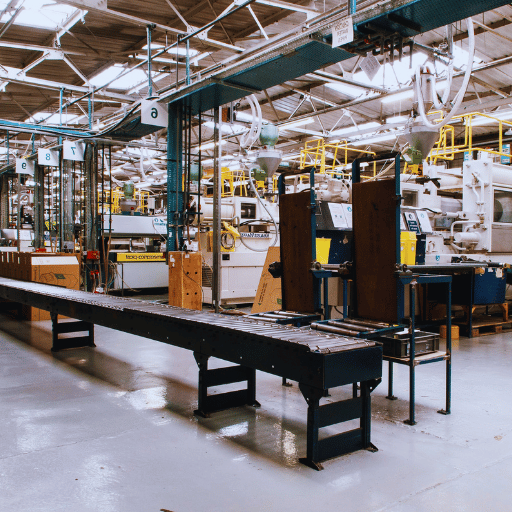 \r\n\r\nDiferentes formatos de garrafa exigem aplicadores de rótulos específicos. Nosso quadro mostra quais aplicadores podem ser usados com quais formatos sem necessidade de ferramental personalizado.
| Formato do recipiente | Hot melt | Autoadesivo | Sleeve termoencolhível | Cola úmida |
|---|---|---|---|---|
| Redondo (cilíndrico) | ✓ Melhor | ✓ Melhor | ✓ | ✓ Melhor |
| Oval | ⚠ Limitado | ✓ | ✓ Melhor | ⚠ Limitado |
| Quadrado | ✕ | ✓ Melhor (frente/trás) | ✓ | ✕ |
| Poligonal / facetado | ✕ | ✓ Melhor | ✓ | ✕ |
| Cônico / afunilado | ✕ | ⚠ Risco de descolamento da borda | ✓ Melhor | ✕ |
| Plano / tipo sachê | ✕ | ✓ Melhor | ⚠ Limitado | ✕ |
Aplicações industriais em 8 setores
O produto, o rótulo e os regulamentos variam por setor. Nossa matriz relaciona 8 setores ao método de rotulagem típico e às especificações de posicionamento necessárias para aprovação do auditor.| Setor | Método típico | Capacidade de produção | Observação regulatória |
|---|---|---|---|
| Bebidas (água, CSD, suco) | Hot melt OPP/BOPP | 6.000–20.000 BPH | Pictogramas do Artigo 12 do PPWR da UE a partir de agosto de 2026 |
| Vinho e destilados | Autoadesivo frente/trás | 2.000–6.000 BPH | Aprovação da TTB; posicionamento preciso de ±0,5 mm |
| Ampolas farmacêuticas | PSL envolvente com serialização | 100–600 ppm | Período de estabilização da FDA DSCSA até novembro de 2026 |
| Cosméticos e cuidados com a pele | Rotulagem com adesivo, dupla face | 40–120 ppm | Troca frequente de SKU < 5 min |
| Cuidados pessoais | Autoadesivo ou sleeve | 2.000–6.000 BPH | Faixas de proteção contra violação opcionais |
| Produtos químicos domésticos | Autoadesivo, adesivo para congelamento | 3.000–8.000 BPH | Conformidade com pictogramas do GHS |
| Frascos de alimentos e condimentos | Hot melt ou cola úmida | 4.000–12.000 BPH | Classe de adesivo para contato direto com alimentos |
| Suplementos alimentares | PSL autoadesivo | 2.000–5.000 BPH | Conformidade de rotulagem da FDA + codificação de lote |
As máquinas de rotulagem de garrafas são adequadas para ampolas farmacêuticas?
Sim, com 2 ressalvas. Primeiro, o diâmetro mínimo da ampola na maioria das rotuladoras de garrafas é 14,75 mm. Para qualquer medida menor, é necessária uma rotuladora dedicada para ampolas. Segundo, todas as embalagens farmacêuticas dos Estados Unidos estão agora em conformidade com a Lei de Segurança da Cadeia de Suprimentos de Medicamentos (DSCSA) da FDA, com suporte à serialização em nível unitário e impressão de matriz de dados 2D antes ou durante a aplicação do rótulo. As linhas adequadas para produtos farmacêuticos, portanto, incluem um aplicador de rótulos envolvente (como as unidades da classe HERMA 132M HC, que operam até 600 ampolas/min) junto com uma impressora de transferência térmica ou jato de tinta incorporada ao aplicador. Ao vender suplementos alimentares fora do escopo da DSCSA, uma configuração semiautomática padrão de sistema de rotulagem de garrafas de alta capacidade normalmente é suficiente.“Os estudos de prontidão de linhas de embalagem de 2025 mostram o mesmo quadro geral em todos os setores: investir em atualizações da rotuladora proporciona retorno mais rápido quando os compradores priorizam precisão e tempo de troca de formato em vez do BPH máximo. Compradores que buscam a maior velocidade nominal tendem a ignorar a janela de troca e perdem mais horas de trabalho na configuração do que ganham em capacidade de produção”.\r\n\r\n— Síntese baseada em PMMI 2025 Performance Optimization Insights for Packaging Line Readiness
Materiais de rótulo e adesivos — orientação para compradores
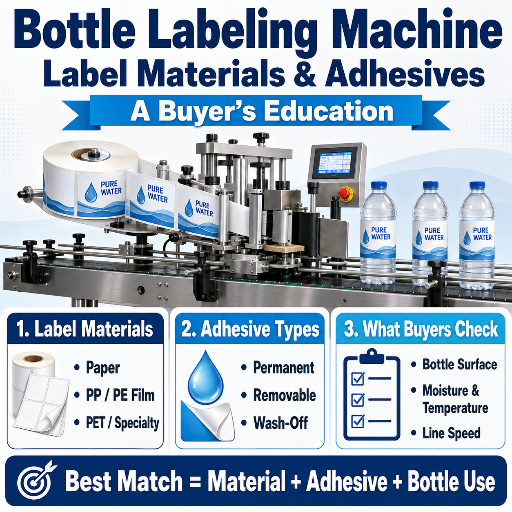 \r\n\r\nO material do rótulo é o segundo eixo da seleção da máquina. Aplicadores autoadesivos não podem processar uma manga PET-G de 25 m, e uma máquina hot melt não pode envolver um rótulo de vinho reforçado de 90 m sem correção do tempo de permanência. 5 famílias de materiais frontais abrangem quase todos os rótulos de garrafas de ombros largos nas prateleiras do varejo global. Para a rota autoadesiva, compare o material de rótulo autoadesivo da Guanma com os requisitos de liner, rolo e adesivo do aplicador; essa rota de material é separada das mangas termoencolhíveis e do filme envolvente hot melt.
| Material frontal | Espessura | Resistência à umidade | Aplicação típica |
|---|---|---|---|
| Filme OPP | 50–60 µm | Alta | Envolvimento hot melt para bebidas |
| BOPP | 50–70 µm | Muito alta | Aplicações em cadeia fria e banho de gelo |
| Filme PE | 75–100 µm | Média | Garrafas flexíveis de cosméticos |
| PSL de papel | 60–90 µm | Baixa (sem revestimento) a média (revestido) | Vinho, destilados, embalagem premium |
| Sleeve termoencolhível PET-G | 30–50 µm | Muito alta | Produtos farmacêuticos com proteção contra violação, bebidas premium |
Como escolher — uma estrutura de seleção com 7 fatores (guia de especificação e RFQ)
Abaixo está uma estrutura que combina orientações públicas do setor com as especificações de prontidão de linhas de embalagem da PMMI de 2025. Ela funciona como uma lista de verificação para obter financiamento, e não como um cálculo prescritivo. Compare cada critério com seu próprio ambiente de fabricação.
A estrutura de seleção com 7 fatores
Dentro dessa estrutura está oculto um princípio que pode ser usado nas discussões de compras — a regra 80/15/5 para o ROI da rotuladora. Cerca de 80% do ROI de uma máquina de rotulagem vêm da combinação de capacidade de produção e precisão, 15% do tempo de troca de SKU e 5% de todo o restante (tela sensível ao toque, marca específica do aplicador, lista de recursos extras da garantia). Essa regra é uma estrutura, não um fato; as proporções refletem nossa experiência anedótica obtida em estudos de prontidão de linhas de embalagem, e não um experimento de grande escala com variáveis controladas e entradas definidas. No entanto, a ordem está correta: capacidade de produção e precisão dominam o cálculo do ROI, e perseguir o recurso errado é o erro mais comum nas compras.\r\n\r\nSe houver interesse em comparar essa estrutura com uma linha de produtos em operação e respectivas faixas de preço, as 3 famílias de máquinas de rotulagem de garrafas projetadas pela Mass Technology abrangem metas de capacidade e especificações de precisão, com uma ferramenta seletora de método de rotulagem.
- Meta de capacidade de produção (BPH): para agora e para os 18 meses previsíveis no futuro.
- Tolerâncias de posicionamento da aplicação: 0,5 mm versus 1,5 mm, conforme exigência do varejista ou do órgão regulador.
- Taxa de troca de SKU: frequência por turno e tempo mínimo em cada um.
- Faixa de formatos de recipientes: um único formato ou formatos variados, 6 diâmetros ou de 2 a 8.
- Faixa de materiais de rótulo: o aplicador acomoda PSL de papel, OPP e sleeve, ou apenas 1 tipo?
- TCO de 5 anos: ou a soma do custo dos rótulos, peças de reposição, eletricidade e tempo de parada da linha, e não apenas o investimento de capital.
- Nível de integração da linha: altura da esteira, alimentação elétrica, handshake do PLC, pontos de montagem do sistema de visão.
Problemas comuns de rotulagem e correções de causas-raiz (triagem de roletes, sensores e tensão da banda)
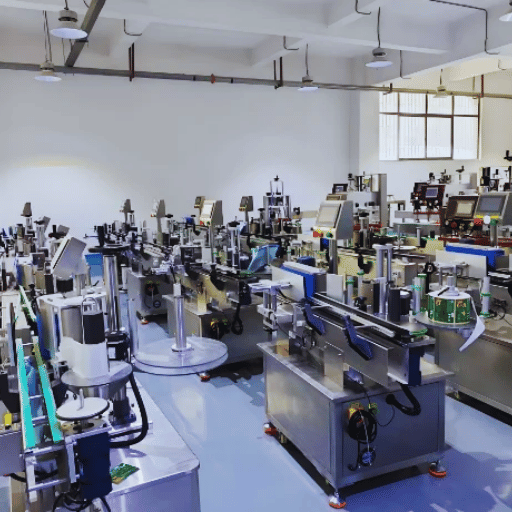 \r\n\r\nA maioria dos artigos sobre solução de problemas em linhas de rotulagem começa com conselhos de treinamento do operador. Mas a experiência de campo e as análises de fóruns indicam o contrário. Quando as microrparadas just-in-time são registradas com precisão e rastreadas até a causa-raiz, os 3 principais fatores são latência do sensor, desvio da tensão da banda e desgaste dos roletes — não a configuração do operador. Um padrão observado em discussões do r/TheBrewery é que os operadores fazem ajustes preliminares no rolo de rótulos e nos sensores fotoelétricos por dias ou semanas antes de chamar a manutenção para inspecionar um rolamento desgastado ou um parafuso da placa de descolagem que está ocupando espaço em um compartimento de peças.
⚠️ Não culpe primeiro o operador
Relatórios do setor sugerem que mais de 50% das microrparadas da linha de rotulagem têm origem em causas-raiz relacionadas ao sensor, à banda ou ao adesivo, e não na configuração do operador — resolver a falha geralmente exige diagnóstico de hardware, e não novo treinamento do operador.
- Desvio da tensão da banda — medir a tensão a cada turno; recalibrar quando o lote de rótulos mudar.
- Embaçamento ou latência do sensor — em ambientes úmidos, limpar diariamente a fotocélula; substituir a fibra se a resposta exceder 5 milissegundos.
- Temperatura do adesivo fora da especificação — deriva nos reservatórios de cola hot melt; inspecionar o termopar todos os meses.
- Perda de sincronismo da esteira — um desvio de 1 milímetro no ritmo do acionamento pode gerar um erro de 4 milímetros na posição do rótulo.
- Variação do material de rótulo — é típica uma variabilidade de 15 mícrons entre materiais recebidos; é necessária compensação pelo acionamento servo.
- Configuração do operador — verificar primeiro, não por último.
Perspectivas do setor para 2026+ — o que está mudando
Quatro dinâmicas de transformação industrial estão prestes a remodelar a rotulagem de garrafas de agora até 2028, e três delas têm prazos regulatórios definidos que merecem ser previstos no orçamento de CAPEX. O PPWR da UE entra em vigor em 12 de agosto de 2026. Em substituição à Diretiva de Embalagens de 1994, o novo Regulamento sobre Embalagens e Resíduos de Embalagens exige a pintura de indicadores de medição do material nas embalagens, nos termos do Artigo 12. A previsão do Artigo 7 para 1 de janeiro de 2030 estabelece, ao longo de uma década, uma normalização de 10-35% de material reciclável nos componentes de embalagens plásticas, incluindo os materiais frontais dos rótulos quando aplicável. Os fabricantes que exportam para a UE fariam bem em pressionar os fornecedores de materiais frontais a entregar hoje materiais monomateriais P- P ou P- P, para que a linha de produção seja qualificada antes da chegada da obrigação de conteúdo reciclado. A fiscalização da serialização da DSCSA pela FDA está programada para novembro de 2026. A ordem de implementação da DSCSA pela FDA define um período chamado Período de Estabilização, durante o qual algumas disposições da nova lei podem não ser fiscalizadas até novembro de 2026, permitindo que os parceiros comerciais farmacêuticos enviem e recebam os dados de maneira totalmente interoperável. Depois disso, a leitura da rastreabilidade em nível unitário com um código Data Matrix 2D se tornará um requisito financeiro mínimo para as embalagens comercializadas pelo setor farmacêutico dos EUA — incluindo linhas de rotulagem de frascos —; portanto, se sua linha ainda não estiver aplicando rótulos com um sistema de impressão e aplicação por transferência térmica ou jato de tinta, agora é hora de começar a orçar isso. A inspeção 100% por sistema de visão está se tornando padrão. Quando uma única fotocélula fixa registrava cada rótulo em uma linha de produção de porte médio, as câmeras de varredura linear passaram a se integrar rapidamente na saída para detectar rugas, desalinhamentos e rótulos ausentes em plena velocidade nominal. Recentemente, os preços de integração caíram para quase o custo de uma atualização de servo de porte médio. PET-G substituindo PVC em mangas termoencolhíveis. A pressão dos varejistas europeus para reduzir as preocupações com a reciclabilidade está promovendo gradualmente o uso de mangas de PET-G, como material de manga, em substituição ao PVC. Os consumidores que planejam linhas de mangas em 2026 devem especificar expressamente um túnel que processe perfis de retração de PET-G, e não apenas PVC, para que a linha permaneça adaptável no futuro.Perguntas frequentes
P: Qual é a faixa de preço típica de uma máquina de rotulagem de garrafas?
Ver resposta
Rotuladoras semiautomáticas de etiquetas adesivas sensíveis à pressão custam de $3.000 a $18.000, dependendo da velocidade e da capacidade de aplicação em dupla face. Sistemas hot melt OPP totalmente automáticos custam de $25.000 a $65.000 conforme as metas de BPH, com uma parcela significativa referente à integração da esteira. Aplicadores de sleeve termoencolhível com túnel custam de $30.000 a $85.000, com a fonte de energia do túnel (vapor versus elétrico) representando o principal custo. Unidades manuais de bancada começam abaixo de $1.500. A configuração de tensão, o idioma da HMI e a especificação do destino FOB deslocam a faixa em outros 15 a 20 por cento.
P: Qual é a velocidade real de uma máquina de rotulagem de garrafas?
Ver resposta
Rotuladoras manuais de bancada processam de 8 a 15 garrafas por minuto. Rotuladoras semiautomáticas processam de 20-200 garrafas por minuto. Fabricantes de linhas de garrafas sopradas por hot melt totalmente automáticas processam de 3.000-20.000 BPH. Sistemas antigos de cola úmida em garrafas de cerveja retornáveis podem processar mais de 60.000 BPH, mas são relativamente incomuns como especificação para linhas novas que não sejam sistemas legados.
P: Qual é a diferença entre rotuladoras de garrafas manuais, semiautomáticas e automáticas?
Ver resposta
Rotuladoras manuais exigem que um operador coloque manualmente cada garrafa com precisão no sistema e acione o início. Em contrapartida, os sistemas semiautomáticos aplicam os rótulos automaticamente assim que cada garrafa é carregada fisicamente na posição. As configurações totalmente automáticas recebem uma esteira de entrada adequada de garrafas, separam-nas individualmente e aplicam os rótulos sem intervenção do operador — transformando essencialmente o operador humano em um supervisor de várias linhas, em vez de alguém que apenas opera uma única linha.
P: Uma máquina de rotulagem de garrafas pode rotular garrafas redondas, quadradas e afuniladas?
Ver resposta
Possivelmente, se houver outras restrições. Rotuladoras autoadesivas, incluindo o modo de dupla face, podem processar formatos redondos, quadrados, poligonais e planos sem trocas de formato. Rotuladoras de sleeve termoencolhível processam praticamente todos os formatos, incluindo garrafas afuniladas. Rotuladoras hot melt OPP, otimizadas para garrafas redondas de 40-105 mm de diâmetro, não são ideais para embalar outros formatos. Muitas vezes, a solução mais limpa quando há uma mistura de formatos é instalar 2 rotuladoras na mesma esteira, sem tentar fazer tudo de forma complexa em um único equipamento.
P: Que manutenção uma máquina de rotulagem de garrafas precisa para manter a precisão?
Ver resposta
Diariamente: limpeza da fotocélula, inspeção do reservatório de cola em sistemas hot melt, verificação da tensão da banda nas trocas do rolo de rótulos. Semanalmente: avaliar o desgaste da correia servo e do rolete. Mensalmente: calibração do sensor e do encoder, inspeção da uniformidade da temperatura do túnel de encolhimento.
P: Como saber se preciso de rótulos sleeve termoencolhível ou autoadesivos?
Ver resposta
2 fatores de decisão resolvem rapidamente essa escolha. Primeiro, você precisa de uma faixa inviolável no gargalo ou de uma marcação de 360 graus em um recipiente não redondo? Nesse caso, opte pelo rótulo termoencolhível. Caso contrário, escolha o rótulo autoadesivo, que quase sempre é mais barato por garrafa e torna a troca de formato mais rápida. Segundo, qual é o seu volume anual de rótulos? Abaixo de 5 milhões de unidades por ano, a diferença de custo por garrafa não é grande o bastante para preferir um rótulo termoencolhível com túnel; acima de 20 milhões de unidades por ano, a diferença se torna o principal item de custo, e a escolha do método deve ser orientada por dados, e não pela estética.
Veja a série de rotuladoras de garrafas projetadas pela Mass Technology
Se este guia restringiu sua seleção de método, os 2 recursos a seguir podem acelerar a próxima decisão:
- Experimente o quiz Seletor de método de rotulagem — 3 perguntas, 1 recomendação de método.
- Abra a Calculadora de TCO de 5 anos para métodos de rotulagem — hot melt versus rótulo termoencolhível versus rótulo autoadesivo para sua linha de garrafas.
Sobre este guia de rotuladoras de garrafas
Os dados de capacidade de produção, custo de rótulos e comparação de métodos deste guia foram compilados com base na experiência de comissionamento em campo da Mass Technology desde 2017, verificados em referência cruzada com os dados de prontidão de linhas de embalagem da PMMI de 2025, os artigos 7 e 12 do Regulamento da UE sobre Embalagens e Resíduos de Embalagens (PPWR) e os cronogramas da DSCSA da FDA. Quando um número não pôde ser confirmado em um documento de Nível 1, ele é apresentado como uma faixa de trabalho, e não como um dado preciso.
Referências e fontes
- Regulamento da UE sobre Embalagens e Resíduos de Embalagens (PPWR) — European Commission, Directorate-General for Environment
- Drug Supply Chain Security Act (DSCSA) — U.S. Food and Drug Administration
- Relatório do estado do setor de 2025 — PMMI, The Association for Packaging and Processing Technologies
- Otimização do desempenho em 2025: informações para a prontidão da linha de embalagem — PMMI
- Tendências de 2025 em embalagens para a indústria de bebidas — PMMI
Artigos relacionados
- Rotulagem com filme termoencolhível — o guia completo — materiais, equipamentos, seleção do túnel
- Rotulagem OPP com hot melt — um guia prático — explicação do processo de rotulagem envolvente de garrafas
- Como iniciar um negócio de engarrafamento de água — custo, etapas e noções básicas da FDA
- Máquina de envase de água — o equipamento a montante com o qual a maioria das linhas de rotulagem se integra