Póngase en contacto con Masstech

Actualizado julio de 2026
Una máquina llenadora de vino es la parte de una línea de embotellado que transfiere una cantidad definida de vino a cada botella preparada bajo condiciones repetibles. La calidad confiable del vino envasado también depende de lo que ocurre antes, alrededor y después de la llenadora: preparación del vino, sanitización, control del oxígeno, cierres, transportadores, inspección y una decisión de liberación documentada.
Respuesta directa
Una máquina llenadora de vino proporciona llenados repetibles, pero la calidad de la botella se controla como un proceso integral de la línea. Mida la condición del vino, el estado de sanitización, la captación de oxígeno, el resultado del llenado, la integridad del cierre y la manipulación posterior; luego libere la producción conforme a los límites específicos de la planta.
Perfil operativo rápido
| Función principal | Entregar un volumen o nivel de vino repetible sin perder el control del oxígeno, la higiene ni la manipulación de las botellas. |
|---|---|
| Límite del proceso | Transferencia de vino a granel hasta la inspección de botellas llenas y cerradas. |
| Herramientas de la guía | 9 puntos de oxígeno, 6 zonas de flujo y 12 verificaciones de liberación de botellas; son hojas de trabajo de la planta, no normas universales de aceptación. |
| Base de aceptación | Procedimiento validado de la planta, especificación del vino, límites del proveedor de envases y manuales del equipo. |
Puntos clave antes de la primera botella
- La velocidad de placa de la llenadora no es igual a una producción estable de la línea.
- El oxígeno total del envase combina el oxígeno disuelto en el vino y el oxígeno del espacio de cabeza de la botella.
- La limpieza visual todavía no demuestra una liberación sanitaria.
- La altura de llenado por sí sola no puede liberar una botella; también importan el cierre, el código, el envase y la evidencia del vino.
Cómo funciona una máquina llenadora de vino dentro del proceso de embotellado
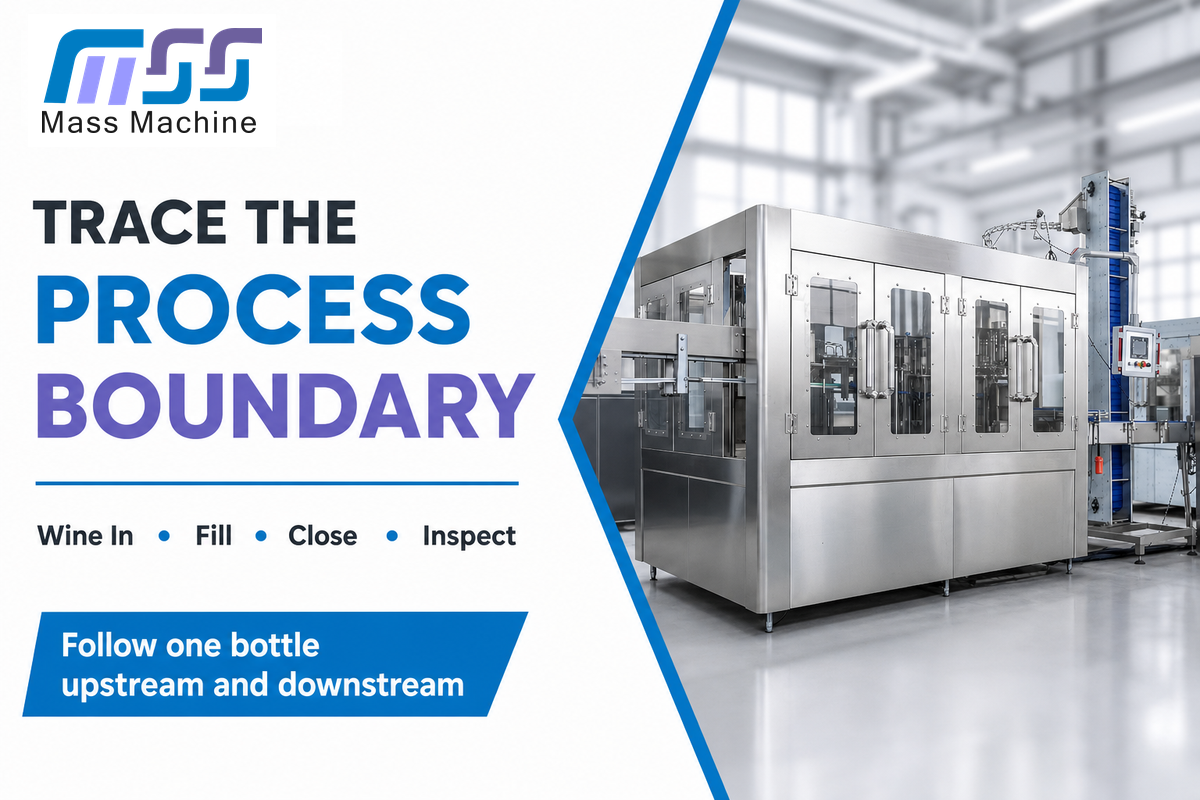
Cada llenadora de botellas de vino recibe producto acondicionado y botellas vacías, dosifica el vino a través de un depósito y una válvula de llenado, y entrega los envases llenos al tratamiento del espacio de cabeza y al cierre. La entrega y la repetibilidad del llenado están dentro de su control; el vino de entrada inestable, las botellas dañadas, una sanitización deficiente o una línea posterior desajustada no lo están.
Las llenadoras por gravedad dependen de la altura de presión del líquido; una llenadora de nivel controla una altura de líquido de referencia; las llenadoras al vacío llevan el producto a un nivel controlado; los sistemas volumétricos dosifican una cantidad; y las llenadoras a presión gestionan el producto bajo presión. Esos mecanismos afectan el límite de la máquina, pero no sustituyen un mapa del proceso. En todo el proceso de embotellado de vino, un mapa útil sigue el vino a granel, la bomba de transferencia, la filtración final cuando se especifica, el depósito, la boquilla de llenado, la botella, el espacio de cabeza, el cierre, la inspección, el etiquetado y el encajonado.
Verificación operativa: colóquese junto a la llenadora y siga una botella aguas arriba y aguas abajo. Si un operador no puede identificar quién es responsable de liberar el vino de entrada, las botellas vacías y las botellas cerradas, la máquina se está tratando como una isla. Para conocer mejor la física de la presión, los principios de llenado por contrapresión y por gravedad aportan contexto, aunque los ajustes del vino deben proceder del equipo seleccionado y del procedimiento del producto.
Prepare el vino y las botellas antes del primer llenado
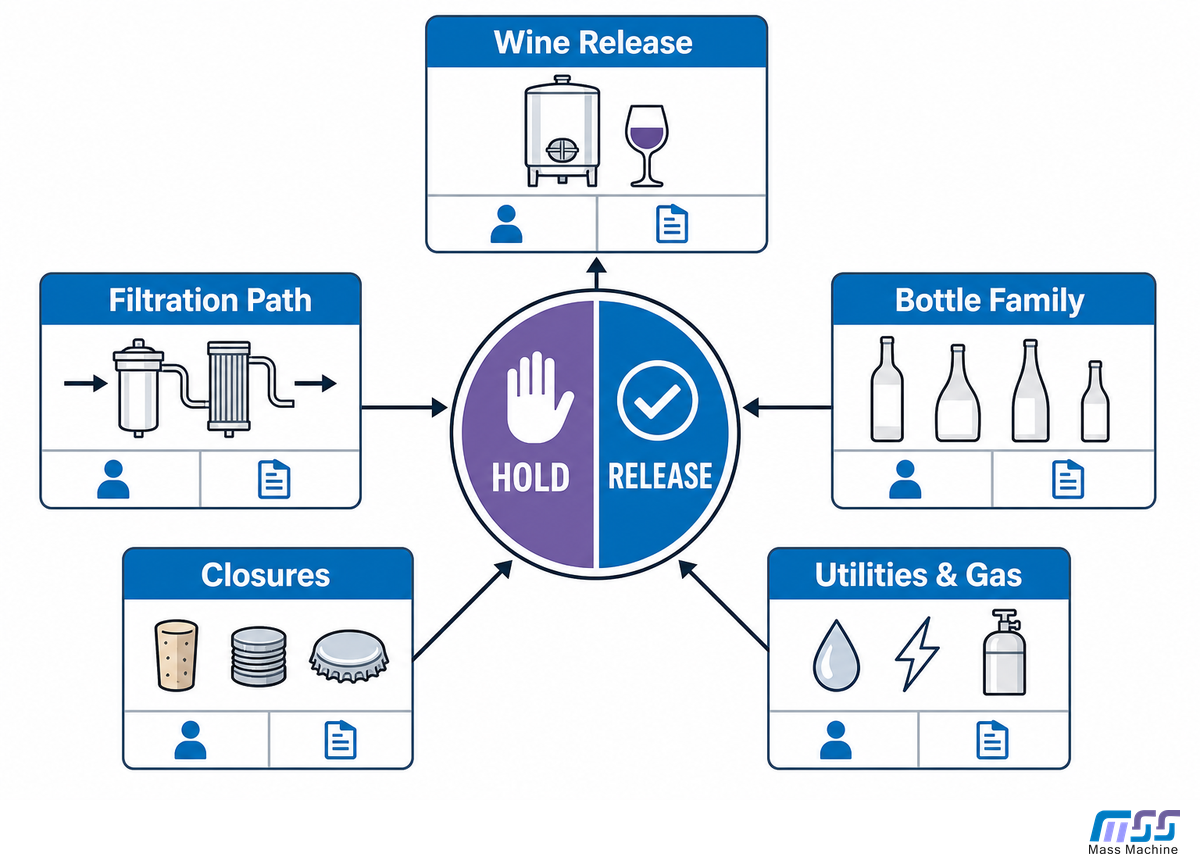
La preparación previa significa que el vino, la botella, la ruta de transferencia, los cierres y los servicios hayan pasado cada uno una verificación documentada antes de iniciar la producción. La evidencia debe indicar un responsable y una acción de retención. Ningún estado verde de la máquina puede compensar un vino inestable, sin filtrar conforme al plan o fuera de su condición de embotellado aprobada.
La guía de embotellado de University of Minnesota relaciona la química y estabilidad finales del vino, la integridad de la filtración, la compatibilidad del envase, la mano de obra y la identificación del lote. Esa secuencia traslada la decisión de liberación aguas arriba: una llenadora de botellas debe recibir un producto preparado y un envase compatible, no convertirse en el lugar donde surjan preguntas sin resolver de vinificación o adquisiciones.
| Verificación | Evidencia | Responsable | Condición de retención |
|---|---|---|---|
| Liberación del vino | Registro aprobado de química, estabilidad y evaluación sensorial | Vinificación o calidad | Cualquier resultado fuera de la especificación del vino |
| Ruta de filtración | Registro de identidad, configuración e integridad del filtro cuando sea necesario | Bodega o calidad | Elemento incorrecto, prueba fallida o cambio no registrado |
| Familia de botellas | Tamaño de botella, plano del proveedor y muestra física aprobada | Envasado o calidad | Cuello, acabado o daño de la botella fuera de los límites aprobados |
| Cierres y materiales secos | Lote correcto, condición de almacenamiento y registro de incidencias de la línea | Envasado | Material no aprobado o dañado |
| Servicios y gas | Verificación de presión, flujo, calidad y conexión disponibles | Ingeniería | El suministro no puede quedar dentro del requisito del equipo |
Prepare la línea antes del día de embotellado, asigne un responsable de calidad y conserve los registros de sanitización, filtración y gas.
— Orientación parafraseada de Melissa Hackett, consultora de operaciones de bodegas, en una charla de expertos de InnoVint
Las revisiones del día anterior deben ser deliberadamente rutinarias. Antes de retirarse, el equipo confirma el tanque de vino liberado, el plano de la botella, el lote de cierres, la ruta del filtro, el suministro de gas inerte, los datos de codificación y el personal. En la mañana de producción, los operadores verifican que ninguno de esos datos haya cambiado. Así se detectan fallas silenciosas —una botella sustituta, un banco de gas vacío o un código no aprobado— antes de que la puesta en marcha húmeda las convierta en cajas mezcladas o vino retenido.
Use el bucle de control de captación de oxígeno de 9 puntos
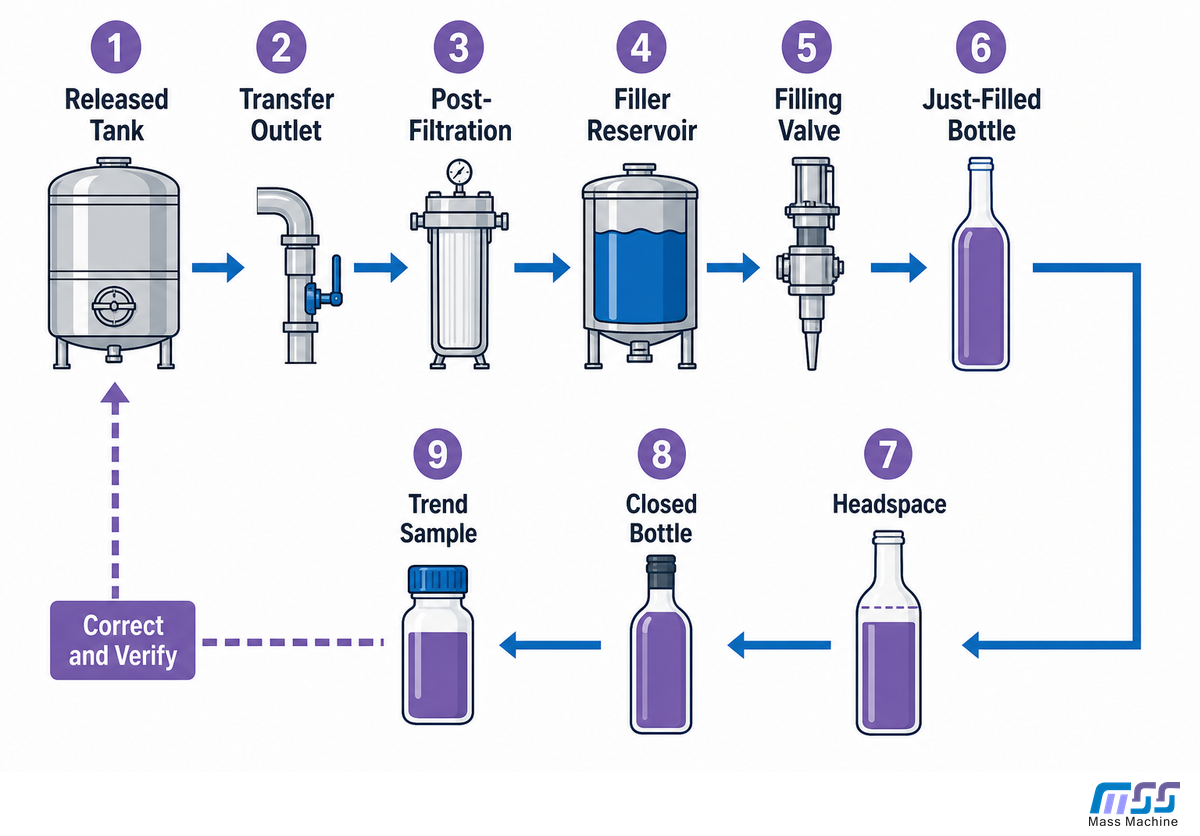
El bucle de control de captación de oxígeno de 9 puntos sigue la exposición al oxígeno desde el tanque liberado hasta la botella cerrada. Su propósito es diagnóstico: compare mediciones adyacentes, localice el paso donde aumenta el oxígeno, corrija ese paso y verifique el resultado. El tipo de llenadora o un ajuste de nitrógeno por sí solos no pueden demostrar un bajo nivel de oxígeno en el envase.
AWRI define el oxígeno total del envase como el oxígeno disuelto en el vino más el oxígeno del espacio de cabeza de la botella. Su guía de envasado informa menos de 1.5 mg/L como buena práctica, 1.5–2.5 mg/L como aceptable, valores superiores a 3 mg/L como necesitados de mejora y valores superiores a 4 mg/L como deficientes en ese contexto de orientación. Trate estas cifras como bandas de referencia, no como sustituto de la especificación del producto de la bodega. La forma práctica de proteger el vino contra la oxidación es localizar el punto de captación y verificar la corrección.
| Punto | Qué capturar | Qué sugiere un aumento | Siguiente acción |
|---|---|---|---|
| 1. Tanque liberado | Oxígeno disuelto de referencia | La condición aguas arriba ya es elevada | Retenga o siga el plan de control del vino |
| 2. Salida de transferencia | Oxígeno disuelto después de la bomba y las mangueras | Entrada de aire o preparación deficiente de la línea | Verifique uniones, cebado y práctica de transferencia |
| 3. Después de la filtración | Oxígeno disuelto a través del tren de filtración | Problema de carcasa, venteado o conexión | Inspeccione la configuración de filtración aprobada |
| 4. Depósito de la llenadora | Condición del producto en la cuba o el tanque | Exposición superficial o pérdida del control de gas | Verifique el nivel, la tapa y el procedimiento de gas |
| 5. Válvula de llenado | Patrón de válvula, turbulencia y fugas | Sellado deficiente o entrega inestable | Detenga e inspeccione según el manual de la máquina |
| 6. Botella recién llenada | Oxígeno disuelto y resultado del llenado | Captación durante el llenado | Pruebe un ajuste seguro a la vez |
| 7. Espacio de cabeza | Oxígeno y volumen libre del espacio de cabeza | Purga débil, espuma o variación de sincronización | Verifique la secuencia de purga y el momento del cierre |
| 8. Botella cerrada | Resultado calculado o medido del envase | Carga combinada disuelta y del espacio de cabeza | Segregue según el plan de liberación |
| 9. Muestra de tendencia | Resultado por tiempo, válvula y parada | Deriva o exposición relacionada con una parada | Encuentre la condición repetitiva y vuelva a verificar |
AWRI señala que más de 60% del oxígeno de una botella puede encontrarse en el espacio de cabeza, y que el vacío o el tratamiento con gas inerte normalmente desplaza aproximadamente 60–80%, no todo. Por eso, un resultado bajo de oxígeno disuelto en la entrada de la llenadora no termina la investigación.
Pueden aparecer resultados contraintuitivos cuando un equipo reduce la velocidad de la línea para “dar más tiempo al nitrógeno”. En el estudio citado de Agroscope, la dirección dependió de la secuencia, la presión, la tasa de trabajo, el perfil de la botella y el estado de la boquilla. En una configuración, trabajar más despacio desperdició nitrógeno; en otra, una tasa mayor redujo el oxígeno total del envase. Mida el resultado de la botella cerrada a la velocidad real en lugar de asumir que más despacio es más seguro.
Verifique la sanitización antes de liberar la producción
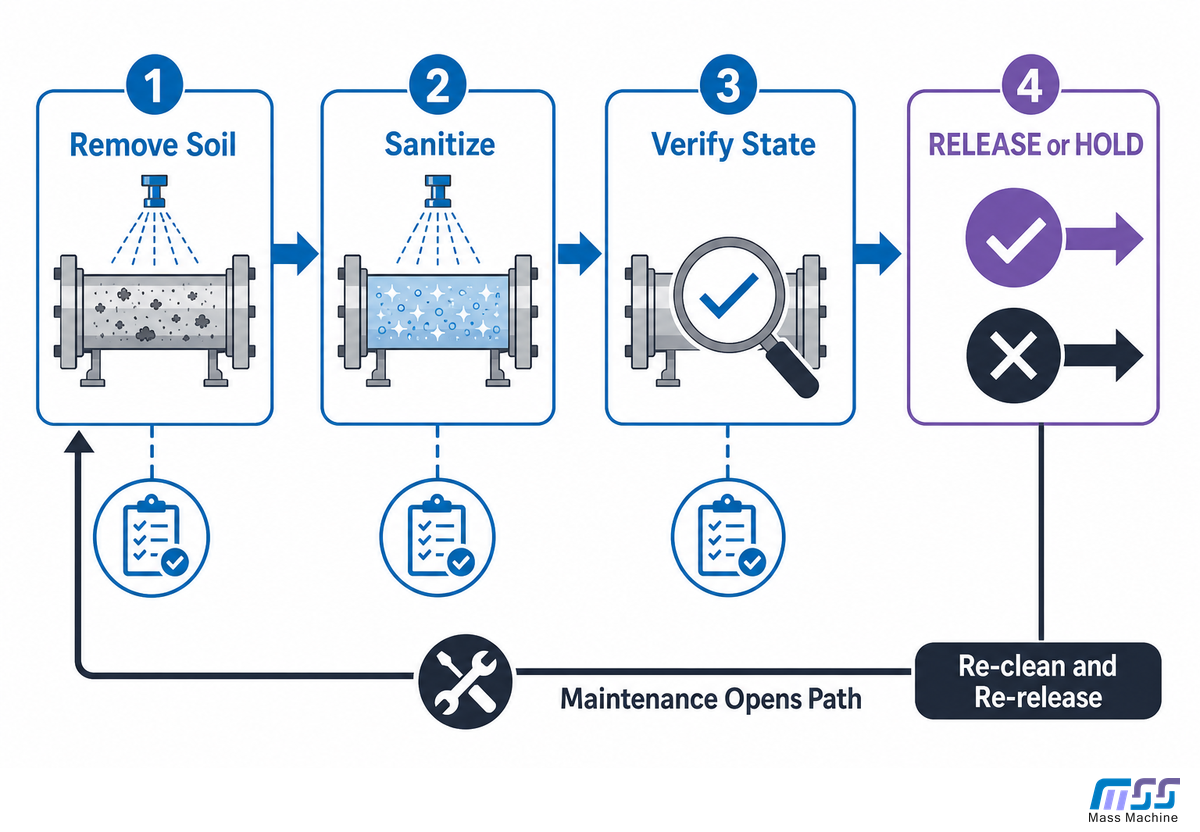
Una liberación sanitaria demuestra que el equipo en contacto con el producto fue limpiado, sanitizado, verificado y liberado formalmente conforme a un procedimiento validado. La inspección visual puede detectar suciedad o daños, pero no puede confirmar la concentración química, las condiciones de contacto ni el estado microbiológico. El mantenimiento posterior a la liberación también puede reabrir el límite de control y exigir otra decisión sanitaria.
- Retire la suciedad. Registre el agente de limpieza, la concentración, la condición de circulación y el resultado visible exigido por el procedimiento validado.
- Aplique el paso de sanitización. Registre el agente o la condición térmica, el tiempo de contacto y el alcance del contacto con el producto.
- Verifique el estado. Utilice la evidencia elegida por la planta, que puede incluir inspección, ATP, hisopados o controles microbiológicos basados en membrana.
- Libere o retenga. Indique quién puede liberar la ruta y defina qué ocurre después de una prueba fallida o de abrirla para mantenimiento.
AWRI ofrece ejemplos térmicos como 80°C durante al menos 30 min y vapor o condensado por encima de 80°C durante más de 20 min. Esas cifras pertenecen al contexto de la guía citada. Los equipos de la planta deben seguir su procedimiento validado y las instrucciones químicas y del equipo; no deben copiar una temperatura de ejemplo a una línea no relacionada.
Modo de falla común
Mantenimiento reemplaza una junta después de liberar la línea, se reinicia la producción y el registro sanitario todavía muestra la aprobación anterior. Esa reparación cambió el límite de contacto con el producto. Vuelva a limpiar o sanitizar según lo exija el procedimiento de la planta, documente la intervención y emita una nueva liberación antes de que el vino regrese.
La calidad del enjuague y del agua de servicio también forma parte del plan sanitario. Si la condición del agua de origen o la capacidad de tratamiento son inciertas, defina ese requisito con el sistema de tratamiento de agua de la planta en lugar de tratar el agua como un servicio ilimitado y sin medición.
Mapee la línea completa, las interfaces y los servicios
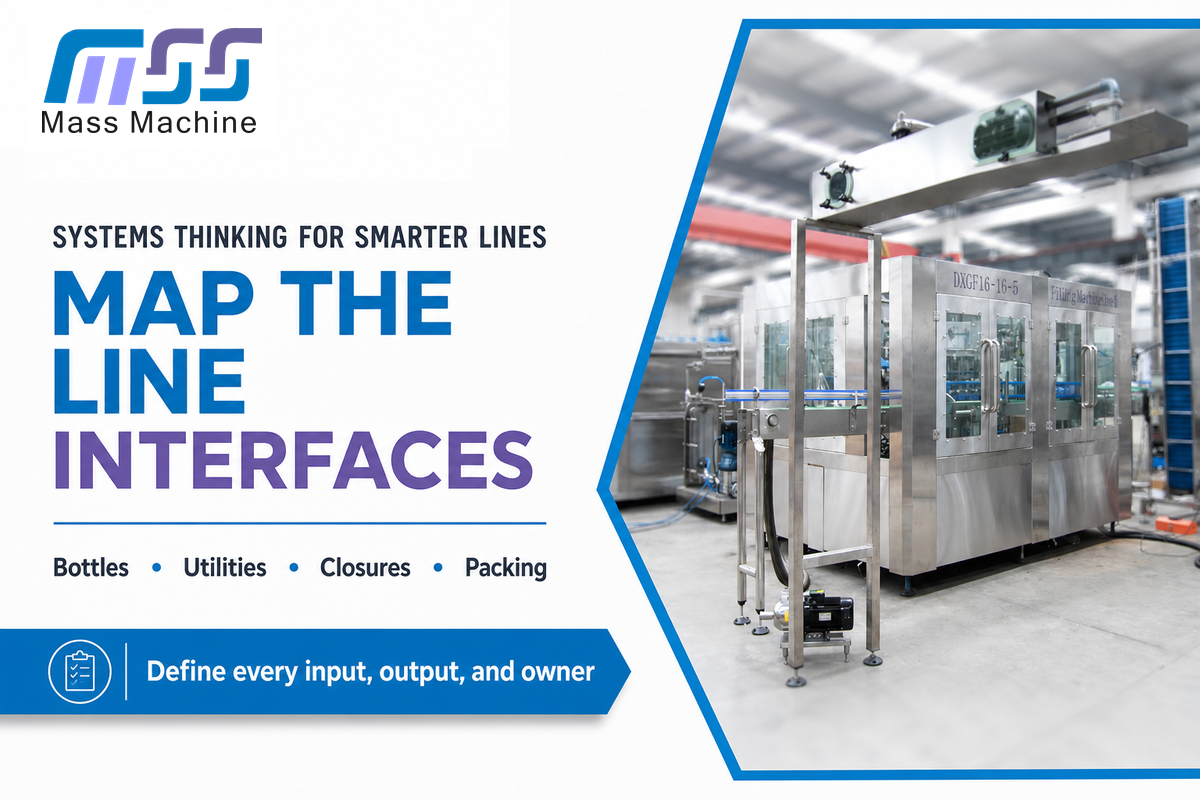
Una línea de embotellado de vino es estable solo cuando cada zona recibe la entrada correcta y puede pasar su producción hacia adelante sin dejar botellas sin suministro, bloquearlas ni dañarlas. Mapear diez interfaces revela requisitos que una especificación limitada a la llenadora omite: agua, gas, cierres, tiempos de transferencia, datos de codificación, condición de las etiquetas, acumulación y gestión de rechazos.
| Categoría de interfaz | Entrada / salida | Señal de falla | Verificación | Limitaciones / No apto para |
|---|---|---|---|---|
| Alimentación de botellas | Botella vacía aprobada al orientador o transportador | Raspones, atascos, acabado incorrecto | Plano, muestra y prueba de línea | No puede aceptar geometría de botella no declarada |
| Enjuague / agua de servicio | Calidad y flujo de agua especificados | Flujo bajo, residuos o riesgo de higiene | Registro de servicios y verificación del punto | No demuestra la sanitización en contacto con el producto |
| Transferencia de vino | Vino liberado al depósito de la llenadora | Entrada de aire o nivel inestable | Tendencia de oxígeno disuelto, uniones y estado de la bomba | No corrige vino no liberado |
| Gas inerte | Gas aprobado a la presión y el flujo requeridos | Oxígeno alto en el espacio de cabeza o suministro vacío | Verificación del suministro y medición del envase | El flujo de gas por sí solo no demuestra el TPO |
| Llenadora | Botella más vino acondicionado a botella llena | Deriva del nivel, espuma o patrón de válvula | Muestras iniciales y cronometradas | No puede liberar la calidad del cierre o de la etiqueta |
| Cierre | Botella llena más cierre aprobado | Fuga, desviación, compresión deficiente o par de apriete | Método del proveedor y plan de muestreo | Un ajuste no sirve para todos los cierres |
| Transferencia por transportador | Botella cerrada entre máquinas | Falta de suministro, bloqueo o contacto con el vidrio | Observación de acumulación y paradas | Igualar velocidades por sí solo omite las microparadas |
| Codificación | Datos de lote/fecha aprobados a marca legible | Código incorrecto, ausente o borroso | Despeje de línea y verificación de lectura/escaneo | La visión no puede aprobar los datos de origen |
| Etiquetado | Botella seca y estable más etiqueta correcta | Desviación, burbuja o etiqueta incorrecta | Muestra aprobada y verificación periódica | Las botellas mojadas o inestables requieren corrección aguas arriba |
| Empacado / rechazo | Botellas liberadas a la caja correcta; rechazos segregados | Lote mezclado, rechazo recirculado o daño de la caja | Conciliación y prueba de rechazo | Cada señal de rechazo necesita una ruta física de disposición |
El informe de Stone Hill Winery de Packaging Digest ofrece un estudio de caso útil de una planta de menor capacidad: sigue la acumulación, el llenado, el taponado y la manipulación posterior, y registra las causas de las paradas en lugar de juzgar la llenadora solo por su velocidad nominal. Para la interfaz de etiquetado, utilice una guía de máquina etiquetadora de botellas para definir la condición de la botella y los requisitos de entrega sin incorporar la selección de etiquetas a la decisión sobre la llenadora.
Equilibre la capacidad de producción estable con el mapa de flujo estable de 6 zonas
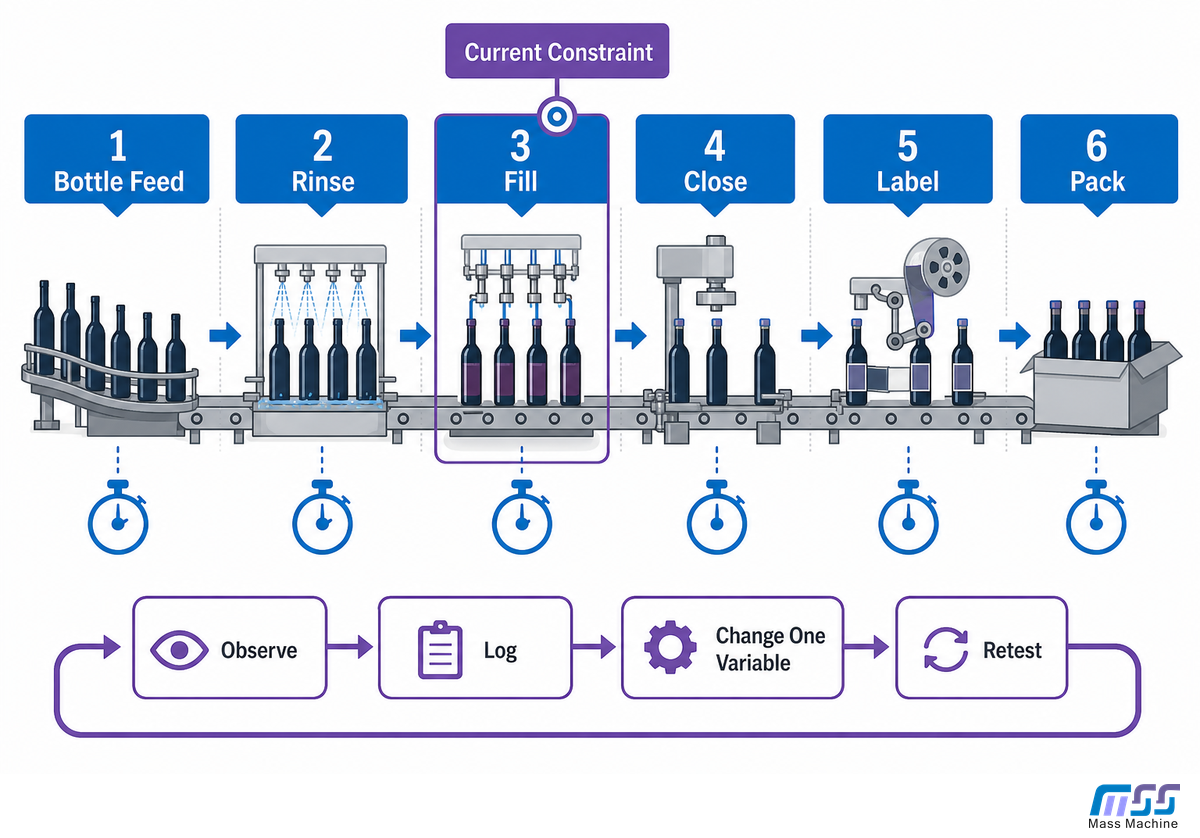
El mapa de flujo estable de 6 zonas compara tasas observadas repetibles en las zonas conectadas de la línea. La tasa estable más baja establece la primera restricción operativa, mientras que los registros de paradas muestran si la causa es falta de suministro, bloqueo o un cuello de botella que se desplaza. El mapa debe repetirse después de cambios de formato o cambios operativos sostenidos.
La jerarquía de indicadores clave de desempeño de NIST respalda mirar por debajo de la cifra de producción final. Un total de línea solo indica al equipo que la producción no cumplió el plan; las tasas por zona, la duración de las paradas y las condiciones del trabajo en proceso ayudan a explicar por qué. Aquí, la aritmética es un ejemplo práctico, no una norma de desempeño de la industria vitivinícola.
| Zona | Tasa repetible | Condición observada | Decisión |
|---|---|---|---|
| Alimentación de botellas | 46 botellas/min | Breves interrupciones después de la recarga | Vigile la falta de suministro en la enjuagadora |
| Enjuague | 44 botellas/min | Repetible | Sin primera restricción |
| Llenado | 43 botellas/min | Resultado de nivel estable | Todavía no aumente la tasa |
| Cierre | 40 botellas/min | Pausas cortas recurrentes | Primera restricción que se debe investigar |
| Etiqueta | 45 botellas/min | Sin suministro por la zona de cierre | No ajuste primero la etiquetadora |
| Empacado | 44 botellas/min | Capacidad disponible | Confirme el comportamiento de la acumulación |
En este ejemplo, el primer techo estable es 40 botellas/min, equivalente a 2,400 botellas/h antes de cualquier margen definido por la planta para descansos, cambios de formato o variabilidad. Si el equipo elige temporalmente alrededor de 90% de esa tasa observada durante el diagnóstico, el objetivo de prueba es 36 botellas/min, o 2,160 botellas/h. Ese factor aproximado de 90% es una suposición de ejemplo, no una reducción universal recomendada.
Los estudios de manufactura citados explican por qué el resultado debe seguir siendo provisional: el comportamiento del cuello de botella interactúa con la variabilidad, el tiempo de procesamiento y el trabajo en proceso, y la restricción puede cambiar cuando cambian las condiciones. Vuelva a ejecutar el mapa después de cambiar la botella, la tasa o el patrón de paradas, en lugar de tratar la primera instantánea como permanente.
Imagine una llenadora con una capacidad nominal superior a la producción del día mientras la zona de cierres se detiene cada pocos minutos. Aumentar la velocidad de la llenadora crea más acumulación y luego más bloqueos, sin añadir cajas. Una muestra de zona de 45 min muestra la estación de cierres a 40 botellas/min y la llenadora a 43 botellas/min. Durante el diagnóstico, una planta podría registrar el mismo código de parada cada 5 min para mantener comparables la tasa, la acumulación y el tiempo de inactividad. Ejecute la prueba útil en la interfaz de cierres; cambiar las válvulas de la llenadora borraría evidencia e introduciría una segunda variable.
Controle el arranque, el cambio de formato y la aprobación de la primera unidad
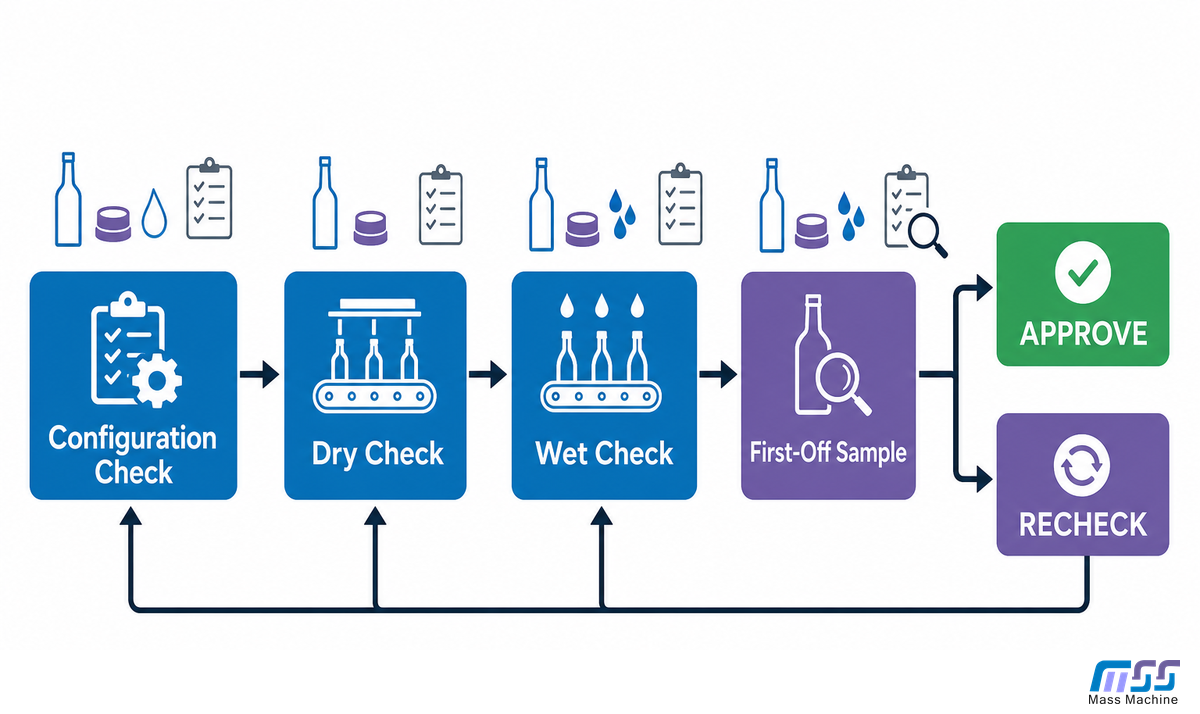
El arranque controlado garantiza que, cuando una botella llega a la llenadora, ya se hayan completado el despeje de línea, las verificaciones en seco, las verificaciones en húmedo y una muestra inicial definida. Esta secuencia protege la trazabilidad: los operadores saben qué botella, cierre, código y ajustes fueron aprobados, y qué evento exige una nueva decisión sobre la primera unidad.
- Retire el vino, las botellas, el cierre, la etiqueta y el código anteriores del área de línea bajo control.
- Confirme las protecciones, los enclavamientos y los servicios según lo especificado en el manual del equipo; no anule una condición de seguridad para realizar una prueba de producción.
- Cargue la familia de botellas y cierres aprobada, luego verifique las piezas de cambio y los ajustes registrados.
- Introduzca el vino liberado conforme al procedimiento aprobado de transferencia y control del oxígeno.
- Ejecute una muestra inicial definida por la planta a una tasa controlada.
- Verifique el llenado, el oxígeno, el cierre, el código, la etiqueta y la evidencia del envase frente al plan de liberación.
- Registre los ajustes liberados, la hora, los lotes de materiales y el aprobador antes de aumentar la tasa.
Para aplicaciones con corcho natural, el manual del Natural Cork Council proporciona ejemplos específicos de controles de presión y temperatura de la botella a los 30 min y 60 min después del encorchado. Utilice el método del proveedor del cierre y el plan de muestreo aprobado por la bodega; esos tiempos no deben copiarse a tapas de rosca ni a otras familias de cierres.
Tarjeta de aprobación de la primera unidad
Registre las identificaciones de la botella y del cierre, el lote de vino, el estado del filtro, la liberación sanitaria, el estado de los servicios, el código activo, los resultados de calidad medidos, la revisión de ajustes, la hora de aprobación y el evento que obligará a repetir la aprobación.
Aplique la matriz de liberación de botellas de 12 puntos
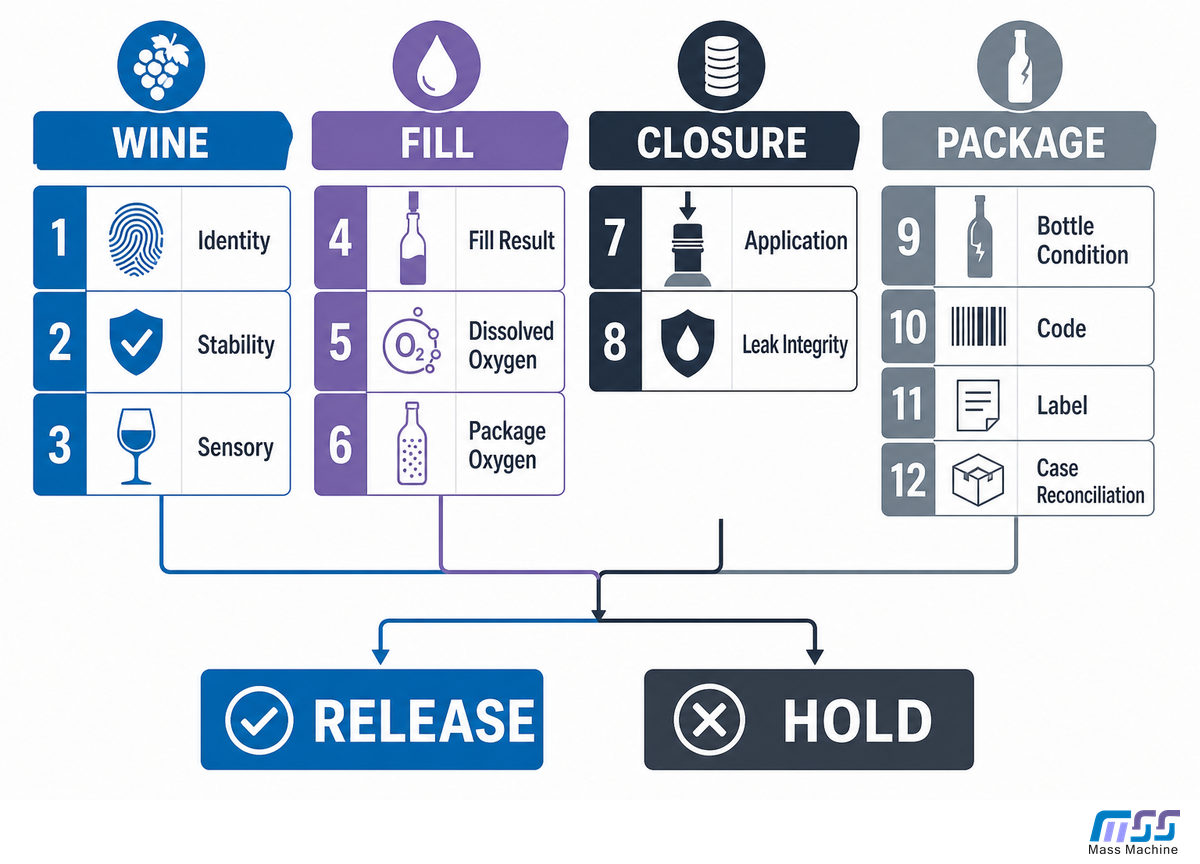
La matriz de liberación de botellas de 12 puntos combina la evidencia de llenado, oxígeno, cierre, código, envase y vino en una sola decisión de enrutamiento. Los resultados pueden activar la liberación, el ajuste y la nueva verificación, la segregación o la retención de la producción. Cada límite permanece vinculado a una especificación del producto, un procedimiento validado o una instrucción del proveedor.
| Verificación | Evidencia | Referencia | Enrutar si está fuera de límite | Limitaciones / No apto para |
|---|---|---|---|---|
| 1. Identidad del vino | Coincidencia de lote y tanque | Orden de producción | Retener y conciliar | Las etiquetas coincidentes no pueden demostrar la identidad del vino |
| 2. Volumen o nivel de llenado | Resultado de muestra calibrada | Plan del producto y legal | Ajuste y nueva verificación; segregue desde la última verificación conforme | El nivel varía con la geometría y la temperatura de la botella |
| 3. Volumen libre | Medición del espacio de cabeza | Plan de botella y cierre | Ajuste y nueva verificación | Ningún valor único se adapta a todos los planos de botella |
| 4. Oxígeno disuelto | Medición calibrada | Plan de oxígeno del vino | Retener o segregar según el plan | No incluye el oxígeno del espacio de cabeza |
| 5. Oxígeno del espacio de cabeza | Medición del envase | Plan de oxígeno del vino | Verifique la purga y el momento del cierre | El ajuste del gas por sí solo no es evidencia |
| 6. Oxígeno total del envase | Cálculo de oxígeno disuelto más espacio de cabeza o resultado del instrumento | Especificación del producto | Segregue e investigue el bucle | El método y las unidades deben ser uniformes |
| 7. Aplicación del cierre | Resultado visual y medido del cierre | Método del proveedor del cierre | Detenga, segregue y corrija | El método cambia según se trate de corcho, tapa de rosca u otro cierre |
| 8. Integridad contra fugas | Prueba aprobada de fugas o presión | Plan del envase | Retenga el intervalo afectado | Los exteriores secos no son pruebas de fugas validadas |
| 9. Condición de la botella | Inspección del vidrio, el acabado y la contaminación | Especificación de la botella | Rechace e inspeccione el lote | La visión artificial tiene límites declarados de defectos e iluminación |
| 10. Código | Marca correcta, presente y legible | Registro de codificación aprobado | Detenga y segregue desde la última verificación conforme | La legibilidad no demuestra los datos de origen |
| 11. Etiqueta y presentación | Etiqueta correcta, colocación y apariencia de la botella | Estándar de envase aprobado | Segregue y corrija | La aprobación estética no puede liberar la química del producto |
| 12. Caja y conciliación | Conteo, lote y saldo de rechazos correctos | Registro de empacado | Retenga las cajas mezcladas o no conciliadas | El conteo de cajas no sustituye las verificaciones de las botellas |
La guía HACCP de OIV respalda un diagrama de flujo específico de la bodega, análisis de peligros, límites, monitoreo, acciones correctivas, verificación y registros. Identifica preocupaciones del embotellado que van más allá de la altura de llenado, incluidos residuos de limpieza, cuerpos extraños, vidrio, sobrellenado o presión, sulfitos y alérgenos. Utilice la matriz anterior como organizador operativo; el plan de peligros de la bodega sigue siendo la autoridad.
Cuando un sitio aplica ISO 22000:2018, integre estos registros en su sistema de gestión de la inocuidad alimentaria. La norma no proporciona ajustes de máquina ni límites de aceptación específicos para el vino.
Error común
Un operador corrige una deriva del nivel de llenado y libera la siguiente botella sin definir el intervalo afectado. Aunque la muestra corregida pueda aprobarse, las botellas producidas desde la última verificación conforme todavía necesitan una disposición. La hora, la lectura del contador o el identificador de la caja deben vincular la falla con una cantidad segregada.
Solucione problemas por síntoma, evidencia y pruebas de una sola variable
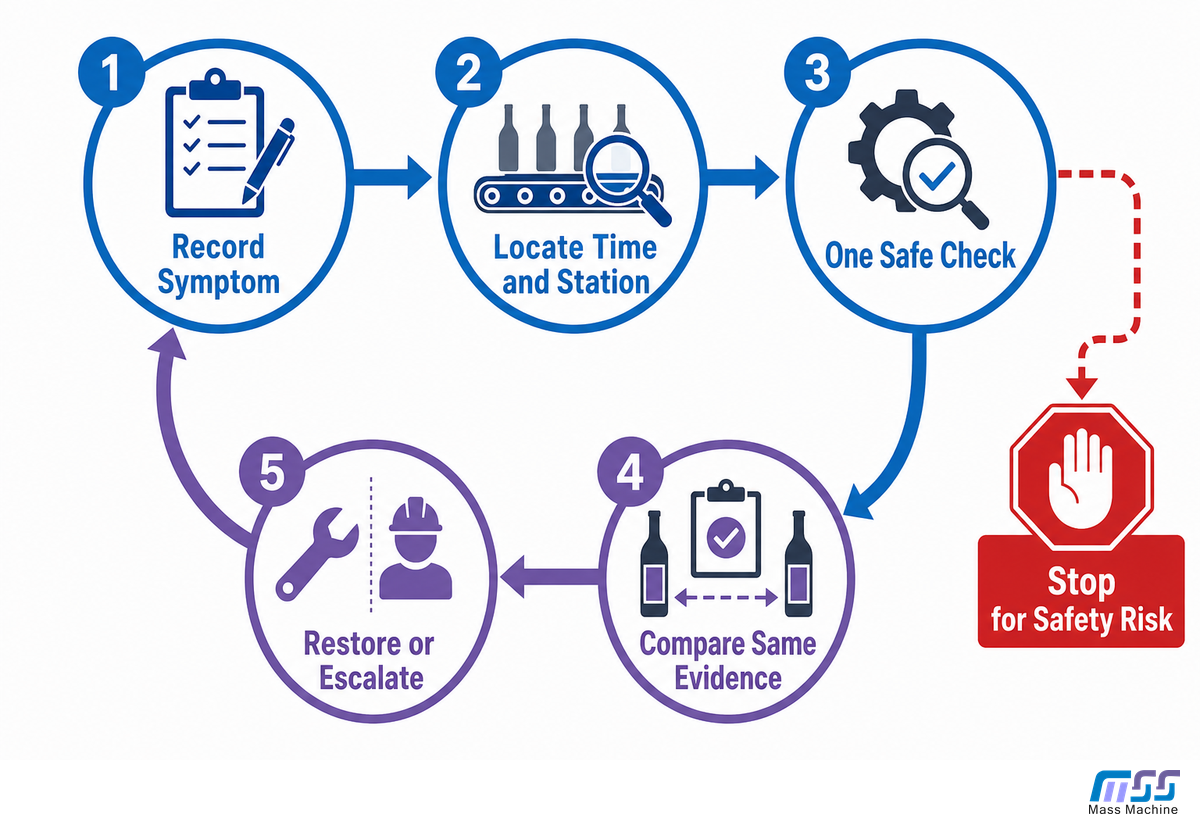
La solución de problemas de una llenadora eficaz comienza con un síntoma reproducible, la hora y la válvula o estación involucrada, además del último resultado conforme conocido. Cambie una sola variable segura, observe la misma evidencia y restablezca la condición aprobada o escale el caso. Los ajustes simultáneos destruyen la comparación necesaria para aislar la causa.
Detenga el trabajo si hay vidrio roto, piezas móviles expuestas, presión insegura, exposición a sustancias químicas o cualquier condición contemplada por el bloqueo y etiquetado o el manual del equipo. En las instalaciones de Estados Unidos, OSHA 29 CFR 1910.147 aborda el control de energías peligrosas durante el mantenimiento, mientras que OSHA 29 CFR 1910.212 aborda la protección de máquinas. Rigen la legislación local y los procedimientos de seguridad. Utilice las comprobaciones siguientes como indicaciones para observar y realizar pruebas controladas, nunca como instrucciones para anular protecciones ni reparar maquinaria energizada.
| Síntoma | Evidencia que debe registrarse | Familia de causas probables | Una comprobación segura | Escalamiento | Limitaciones / No apto para |
|---|---|---|---|---|---|
| El nivel de llenado deriva conjuntamente | Hora, temperatura y nivel del depósito | Producto o suministro común | Confirme la condición aprobada del depósito | Calidad y mantenimiento | No ajuste todas las válvulas |
| Una válvula llena por debajo del nivel | Número de válvula y muestras repetidas | Boquilla, junta o válvula local | Compare esa estación con las estaciones adyacentes | Mantenimiento conforme al manual | No desarme con el equipo energizado |
| La espuma aumenta durante el llenado | Temperatura del vino, presión y patrón de flujo | Condición del producto o suministro turbulento | Verifique la condición de entrada frente a la liberación | Enología e ingeniería | No suponga que la velocidad es la única causa |
| Aumenta el oxígeno del espacio de cabeza | OD, resultado del espacio de cabeza y estado del gas | Purga, sincronización, espuma o demora en el cierre | Repita una prueba medida de un solo envase | Responsable de calidad y proceso | La presión del gas por sí sola no es concluyente |
| Se rompe una botella | Ubicación, lote de botellas y punto de contacto | Defecto del envase o contacto mecánico | Detenga y aísle el área de la rotura | Seguridad, calidad y mantenimiento | No realice pruebas de producción con vidrio expuesto |
| Hay fugas en el cierre | Cabezal, tiempo, cierre y lotes de botellas | Aplicación, acabado o material | Compruebe el método de cierre aprobado | Proveedor de envases y mantenimiento | Las comprobaciones visuales pueden no detectar fallas del sellado |
| El transportador se bloquea repetidamente | Duración de la parada y punto de acumulación | Restricción aguas abajo o configuración de las guías | Observe una zona a la velocidad segura actual | Ingeniero de línea | Una mayor velocidad de la llenadora aumenta la presión |
| La posición de la etiqueta se desplaza | Superficie de la botella, separación y contacto con la guía | Transferencia de botellas o estación de etiquetado | Confirme una presentación de botellas seca y estable | Responsable del etiquetado | No altere primero los ajustes de llenado |
| El código se vuelve ilegible | Mensaje, superficie y muestra impresa | Problema de datos, impresión o superficie de la botella | Verifique el mensaje aprobado y una impresión | Responsable de calidad y codificación | La legibilidad no demuestra que el lote sea correcto |
| La producción disminuye sin una parada prolongada | Conteo de microparadas por zona | Interrupciones cortas distribuidas | Repita la observación de las 6 zonas | Producción e ingeniería | El total del turno por sí solo no permite localizar la causa |
Disciplina de diagnóstico: registre el ajuste original antes de cualquier cambio permitido, anote el exceso de vino en el exterior de la botella como síntoma y no como prueba de sobrellenado, identifique el intervalo de botellas afectado y restablezca el valor aprobado si la prueba no mejora la misma medición. Toda prueba que cambie un síntoma mientras empeora la evidencia de oxígeno, cierre o seguridad no constituye una corrección exitosa.
Convierta los requisitos operativos en un pliego para el proveedor
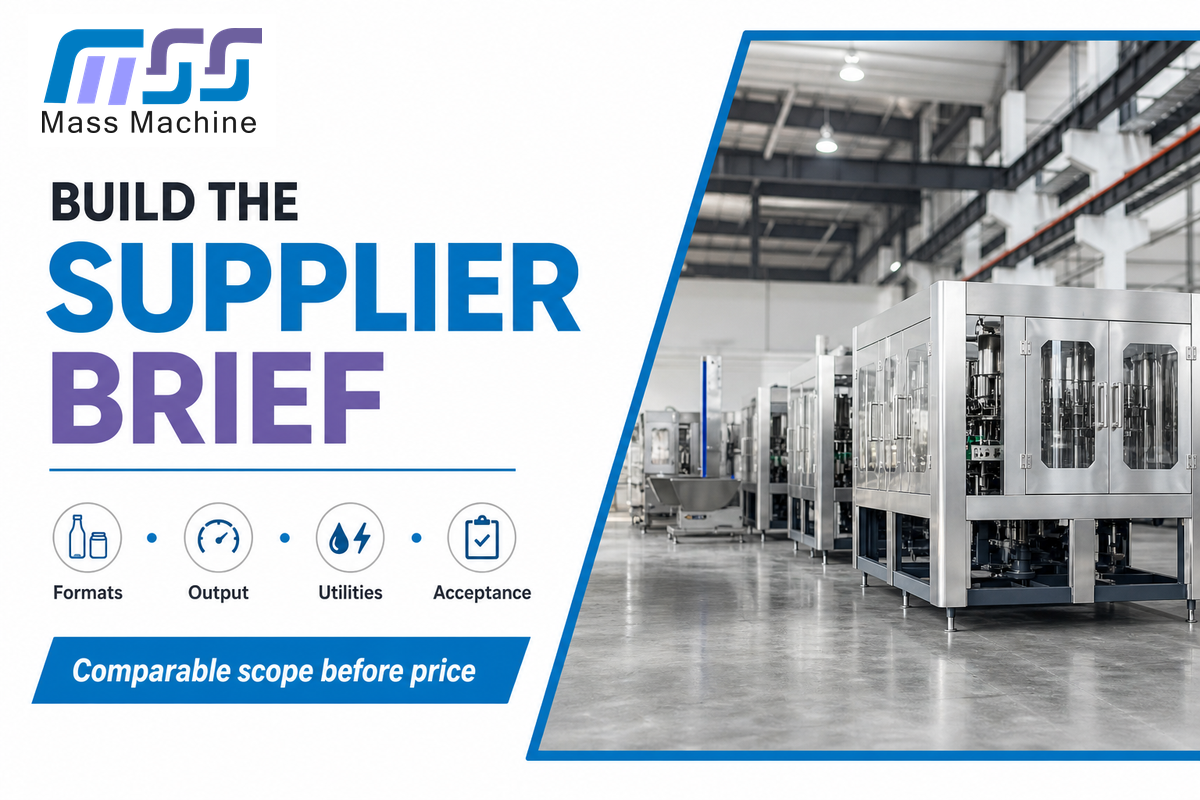
El pliego para el proveedor debe describir el producto de la bodega, los envases, los cierres, la producción estable, los servicios, los controles de calidad, los cambios de formato y la prueba de aceptación antes de mencionar un modelo de máquina. Esta evidencia permite al proveedor definir los límites de la línea y las obligaciones de prueba sin convertir una guía operativa en una comparación de productos o una página de precios.
Una vez completado el pliego operativo, utilice la página comercial de máquinas llenadoras de vino para consultar configuraciones, rangos de capacidad y el proceso de solicitud de cotización. Mantener separada esa decisión protege la función informativa de la guía y ofrece a adquisiciones un punto de partida más claro.
Lista de verificación de RFQ — copie estos puntos en su solicitud de cotización:
| Parámetro | Rango recomendado | Por qué es importante | Cómo verificarlo |
|---|---|---|---|
| Condición del vino | Familia de vino definida por el proyecto y temperatura objetivo en °C | Cambia el flujo, la espuma y las condiciones del envase | Especificación de vino aprobada y prueba presenciada |
| Familias de botellas | Un plano y una muestra medida para cada formato; dimensiones en mm | Define la manipulación, el llenado y las piezas de cambio | Revisión del plano y prueba con muestras |
| Familias de cierres | Especificación del proveedor con unidades de par de apriete, compresión o presión, según corresponda | Define la aplicación y los controles de integridad | Método del proveedor del cierre y prueba de línea |
| Producción estable | Botellas/h requeridas y duración planificada del turno en h | Separa la necesidad operativa de la velocidad nominal | Prueba de aceptación cronometrada con registro de paradas |
| Aceptación de calidad | Límites de planta para OD/TPO en mg/L, llenado en mL o mm, cierre, código y envase | Convierte la intención de calidad en evidencia comprobable | Métodos calibrados y protocolo firmado |
| Servicios | Voltaje, frecuencia, presión de aire, flujo de agua y presión de gas inerte con unidades | Evita una incompatibilidad de interfaces durante la instalación | Levantamiento de servicios y programa de conexiones |
| Cambio de formato y soporte | Cambio de formato objetivo en min, idiomas de capacitación y ventanas de respuesta en h | Define los límites operativos y de servicio | Cambio de formato presenciado y alcance de servicio por escrito |
Zhangjiagang Mass Technology Co., Ltd. declara que el alcance de sus proyectos puede abarcar la distribución de la planta, la fabricación de equipos, la instalación de la línea de producción, la capacitación de operadores en el sitio y el soporte posventa. Incluya cada elemento solicitado en la matriz de responsabilidades y luego envíe sus requisitos de línea con los planos de las botellas y el plan de aceptación.
Cuándo NO comprar una llenadora independiente
Las llenadoras independientes son una primera compra inadecuada cuando un proyecto aún no ha resuelto la alimentación de botellas, la aplicación de cierres, los servicios, la medición de oxígeno, la codificación, la acumulación, el manejo de rechazos o la capacidad estable aguas abajo. El caso de línea de Stone Hill muestra que el comportamiento de producción pertenece al sistema conectado, mientras que la guía de University of Minnesota sitúa la preparación del vino y del envasado antes del llenado. Comprar una llenadora más rápida no puede reparar una estación de cierres subdimensionada ni un suministro de agua no verificado.
Un alcance limitado a la llenadora puede ser adecuado cuando las interfaces de la línea existente están medidas, son compatibles y se incluyen en un plan de aceptación presenciado. Si esos datos se desconocen, solicite primero un estudio de línea o una matriz integrada de responsabilidades. Pregunte si cada límite tiene un responsable, un requisito medible y una prueba, en lugar de suponer que una mayor automatización siempre es mejor.
Preguntas frecuentes
¿Qué es una llenadora de vino?
Una llenadora de vino introduce el vino en botellas preparadas mediante un método controlado de nivel, volumen, vacío, gravedad o presión, mientras los equipos conectados gestionan la manipulación de botellas, los cierres, el oxígeno, el etiquetado y la liberación del envase.
Una llenadora de vino es la parte de una línea de embotellado que introduce el vino en botellas preparadas mediante un método controlado de nivel, volumen, vacío, gravedad o presión. Cada sistema funciona con la manipulación de botellas, un depósito de producto, válvulas de llenado y transportadores. El cierre, el etiquetado, la gestión del oxígeno y la liberación final del envase permanecen conectados, pero son controles separados.
¿Qué máquina mantiene fresco el vino?
Ninguna máquina por sí sola mantiene fresco el vino. La vida útil del envase depende del vino liberado, la transferencia higiénica, la captación de oxígeno medida, los envases y cierres compatibles, el llenado controlado, la integridad del cierre y el almacenamiento adecuado.
Ninguna máquina por sí sola mantiene fresco el vino. La vida útil del envase depende del vino liberado, la transferencia higiénica, una captación de oxígeno baja y medida, las botellas y cierres compatibles, el llenado correcto, la integridad del cierre y el almacenamiento. El desempeño de la llenadora contribuye a una entrega repetible; la bodega debe controlar todo el recorrido del tanque al embalaje y verificar la botella cerrada en condiciones de almacenamiento controladas.
¿Cuánto cuesta una máquina llenadora de botellas?
Una cotización defendible de una máquina llenadora de botellas necesita las familias de vino, botellas y cierres, la producción estable, los servicios, las pruebas de calidad, el alcance del cambio de formato y los límites de la línea, para que cada proveedor valore el mismo requisito de aceptación.
Las cotizaciones defendibles necesitan las familias de vino, botellas y cierres, las botellas estables requeridas por hora, los servicios, las pruebas de calidad, el alcance del cambio de formato y los límites de la línea. Un precio sin esos datos puede omitir piezas de cambio, sistemas de gas, transportadores, inspección o puesta en marcha. Elabore primero el pliego operativo y luego compare las ofertas con la misma prueba de aceptación documentada.
¿Por qué es importante la captación de oxígeno durante el llenado de vino?
El oxígeno incorporado durante la transferencia, el llenado y el cierre contribuye al oxígeno total del envase y puede afectar la evolución prevista del vino, por lo que los equipos deben medir el oxígeno disuelto y el del espacio de cabeza alrededor del proceso real de embotellado.
El oxígeno incorporado durante la transferencia, el llenado y el cierre contribuye al oxígeno total del envase y puede afectar la evolución prevista del vino. Medir tanto el oxígeno disuelto como el del espacio de cabeza muestra dónde se produce la captación y si un cambio de proceso mejoró el envase cerrado.
¿Cómo se verifica la limpieza de una línea de llenado de vino?
Una línea de llenado de vino limpia se verifica separando la limpieza de la desinfección, documentando las condiciones aprobadas, revisando la evidencia seleccionada por la planta, como una inspección o ATP, y asignando a una persona para liberar o retener la producción.
La verificación comienza separando la limpieza de la desinfección. Registre el alcance de contacto con el producto, el agente de limpieza, la concentración, la condición de circulación o contacto, el tiempo y el resultado visible conforme al procedimiento validado. Aplique el paso de desinfección aprobado y registre su concentración o condición térmica y el tiempo de contacto. Después, utilice la evidencia de verificación elegida por la planta, que puede incluir inspección visual, ATP, hisopados o pruebas microbiológicas basadas en membrana. Nombre a la persona autorizada para liberar el circuito y la acción correspondiente a cualquier resultado fallido. Si el mantenimiento abre o sustituye una pieza en contacto con el producto después de la liberación, vuelva a evaluar el límite afectado y repita la limpieza o desinfección según lo exija el procedimiento. Las etiquetas químicas, los manuales del equipo y la validación de la planta controlan los valores reales; una lista de verificación genérica no lo hace.
¿Qué causa niveles de llenado inconsistentes?
Los niveles de llenado inconsistentes pueden deberse a variaciones de las botellas, la temperatura del vino, el comportamiento del depósito, la espuma, el suministro de producto o una falla de una válvula local; por ello, registre si la deriva afecta a todas las válvulas o a una estación que se repite.
Los niveles inconsistentes pueden deberse a variaciones del volumen de las botellas, la temperatura del vino, una condición inestable del depósito, la espuma, el comportamiento del aire o del vacío, el suministro de producto, juntas desgastadas, una boquilla restringida o una válvula defectuosa. Primero determine si todas las válvulas derivan o si una estación repite la falla. Registre el lote de botellas, la hora y la estación, y luego realice una comprobación segura permitida por el manual del equipo.
Lleve evidencia del proceso a la conversación sobre la máquina
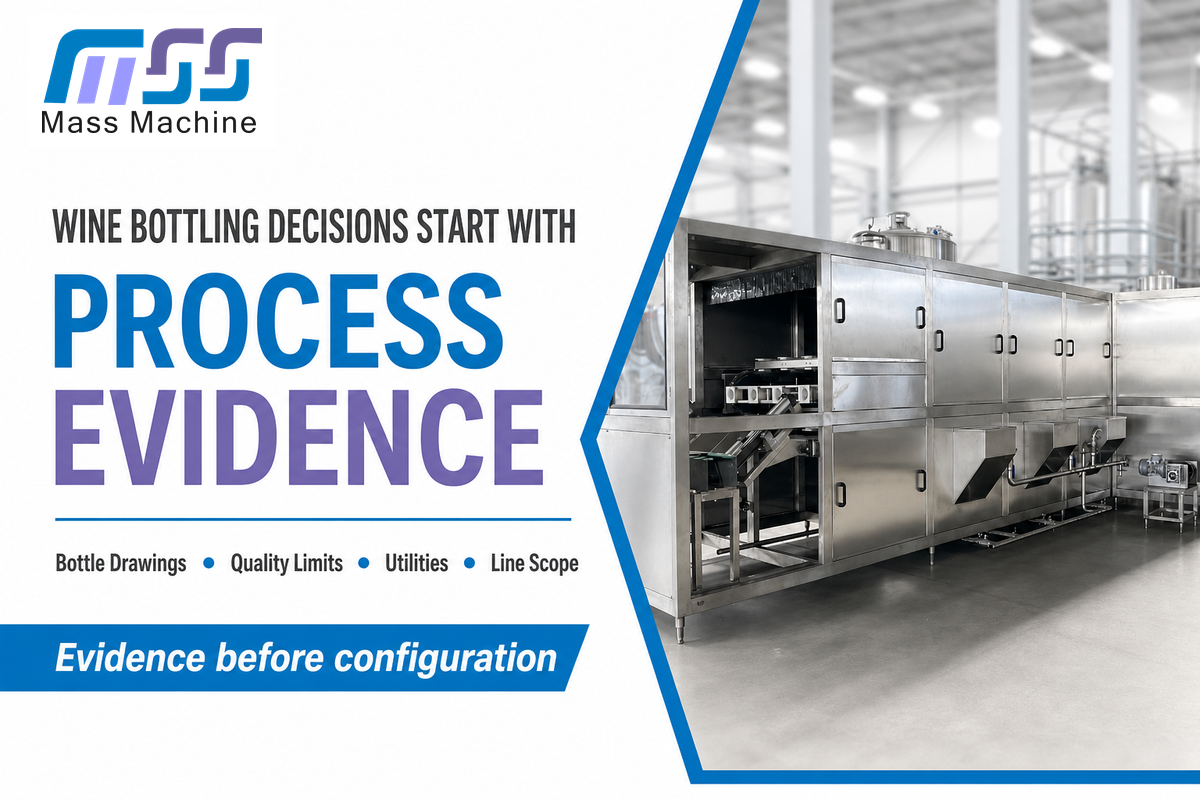
Los planos de las botellas, la producción estable, los límites de calidad y los datos de servicios hacen que la conversación técnica sea más útil que una simple solicitud de modelo.
Analice sus requisitos de embotelladoNota de revisión del fabricante
Esta guía se preparó y revisó con base en información suministrada por Mass Technology. Fuentes técnicas independientes respaldan la guía operativa; las declaraciones de servicio de la empresa que aparecen a continuación siguen siendo información de primera mano.
Mass Technology informa una cobertura de garantía para las piezas de la máquina de 2 años, un compromiso de respuesta de ingeniería en 24 h y entrega por mensajería internacional de repuestos en 5 días, utilizando días laborables en lugar de días calendario. Confirme las condiciones específicas del proyecto en el contrato firmado. Los ajustes de la máquina, las condiciones químicas y los límites de aceptación deben provenir del procedimiento validado de la planta, la especificación del producto y los manuales aplicables.
Referencias y fuentes
- Técnicas prácticas de preparación para el embotellado de vino — University of Minnesota
- Captación de oxígeno durante el envasado: comprensión del oxígeno total del envase — Australian Wine Research Institute
- Inertización y oxígeno en el embotellado de vino — OENO One / investigación de Agroscope
- Desinfección de líneas de embotellado — Australian Wine Research Institute
- Caso de línea de embotellado de Stone Hill Winery — Packaging Digest
- Estructura jerárquica de los indicadores clave de producción — National Institute of Standards and Technology
- Estudio de cuellos de botella y variabilidad — Applied Sciences
- Estudio de detección dinámica de cuellos de botella — Procedia CIRP / ScienceDirect
- Manual de embotellado — Natural Cork Council
- Guía de peligros y puntos críticos de control en la industria vitivinícola — International Organisation of Vine and Wine