Get in Touch with Masstech

Updated July 2026
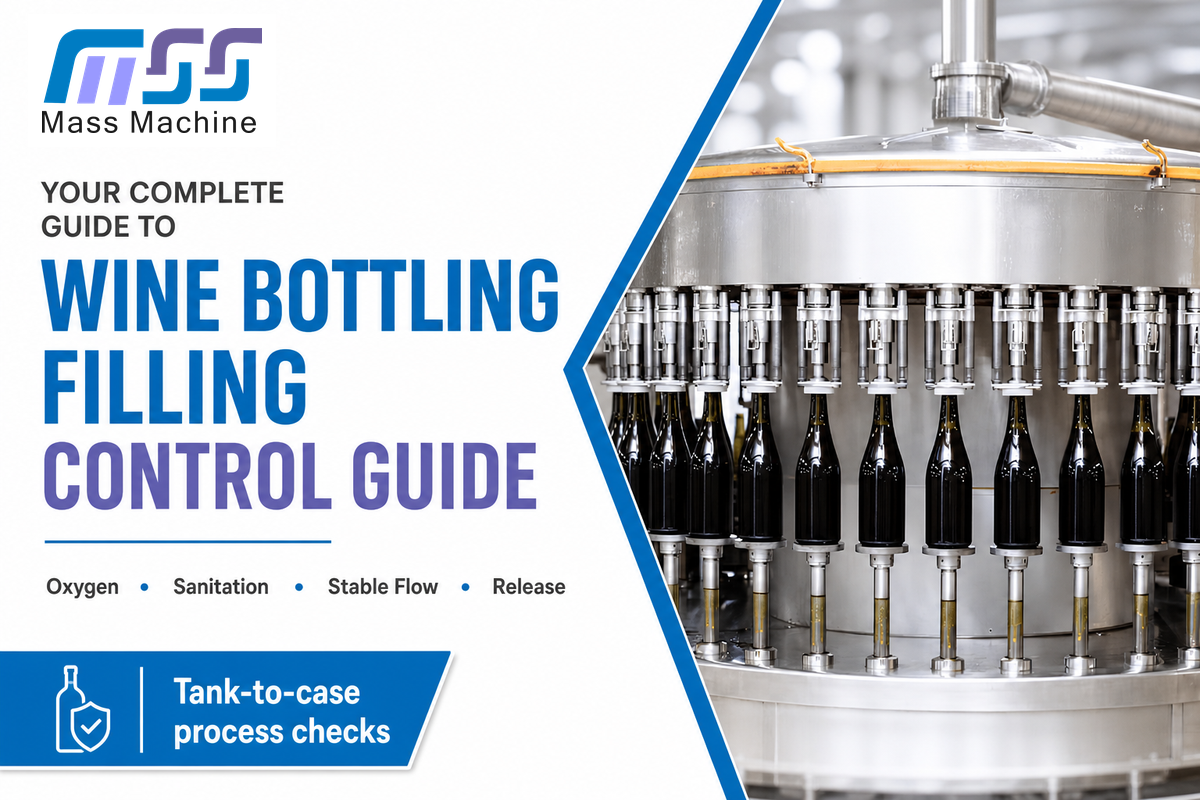
A Wine Filling Machine is the part of a bottling line that moves a defined amount of wine into each prepared bottle under repeatable conditions. Reliable packaged wine still depends on what happens before, around and after the filler—wine readiness, sanitation, oxygen control, closures, conveyors, inspection and a documented release decision.
Direct answer
A Wine Filling Machine delivers repeatable fills, but bottle quality is controlled as a line-wide process. Measure wine condition, sanitation status, oxygen pickup, fill result, closure integrity and downstream handling, then release production against plant-specific limits.
Quick operating profile
| Primary job | Deliver repeatable wine volume or level without losing control of oxygen, hygiene or bottle handling. |
|---|---|
| Process boundary | Bulk-wine transfer through filled-and-closed bottle inspection. |
| Guide tools | 9 oxygen points, 6 flow zones and 12 bottle-release checks; these are plant worksheets, not universal acceptance standards. |
| Acceptance basis | Validated plant procedure, wine specification, packaging supplier limits and the equipment manuals. |
Key points before the first bottle
- Filler nameplate speed is not the same as stable line output.
- Total package oxygen combines dissolved oxygen in the wine and oxygen in the bottle headspace.
- Visual cleanliness has not yet proved a sanitation release.
- Fill height alone cannot release a bottle; closure, code, package and wine evidence also matter.
How a Wine Filling Machine Works Inside the Bottling Process
Each wine bottle filler receives conditioned product and empty bottles, meters wine through a reservoir and filling valve, and hands filled containers to headspace treatment and closure. Delivery and fill repeatability fall within its control; unstable incoming wine, damaged bottles, poor sanitation or a mismatched downstream line do not.
Gravity fillers rely on liquid head, a level filler controls a reference liquid height, vacuum fillers draw product to a controlled level, volumetric systems meter a quantity, and pressure fillers manage product under pressure. Those mechanisms affect the machine boundary, but they do not replace a process map. Across the wine bottling process, one useful map follows bulk wine, transfer pump, final filtration where specified, reservoir, filling nozzle, bottle, headspace, closure, inspection, labeling and case packing.
Operating check: stand at the filler and trace one bottle upstream and downstream. If an operator cannot identify who owns the incoming-wine release, empty-bottle release and closed-bottle release, the machine is being treated as an island. For broader pressure physics, counter-pressure and gravity filling principles provide context, although wine settings still come from the selected equipment and product procedure.
Prepare the Wine and Bottles Before the First Fill
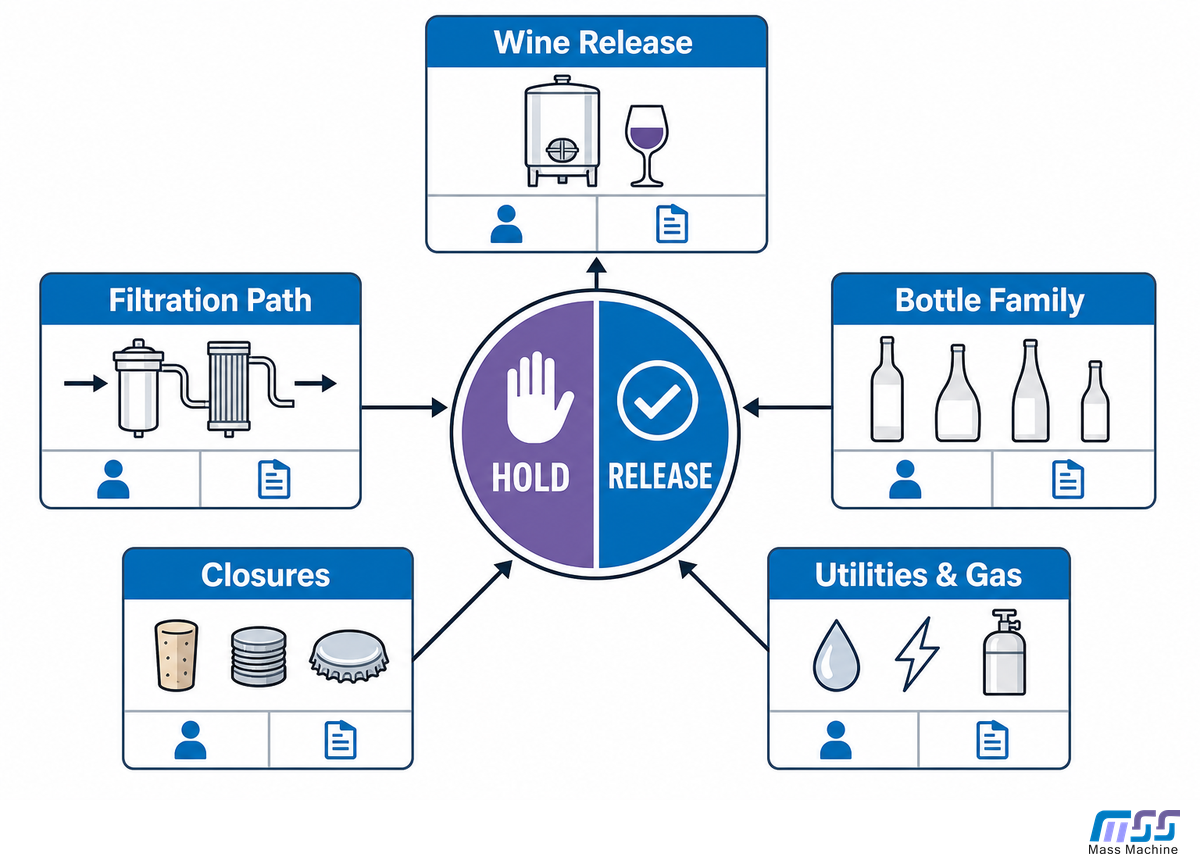
Pre-run readiness means the wine, bottle, transfer path, closures and utilities have each passed a documented check before production starts. Evidence should name an owner and a hold action. No green machine status can compensate for wine that is unstable, unfiltered against plan or outside its approved bottling condition.
University of Minnesota bottling guidance connects final wine chemistry and stability, filtration integrity, packaging compatibility, labor and lot identification. That sequence moves the release decision upstream: a bottle filler should receive a prepared product and compatible package, not become the place where unresolved winemaking or procurement questions surface.
| Check | Evidence | Owner | Hold condition |
|---|---|---|---|
| Wine release | Approved chemistry, stability and sensory record | Winemaking or quality | Any result outside the wine specification |
| Filtration path | Filter identity, setup and integrity record where required | Cellar or quality | Wrong element, failed test or unrecorded change |
| Bottle family | Bottle size, supplier drawing and approved physical sample | Packaging or quality | Bottle neck, finish or damage outside approved limits |
| Closures and dry goods | Correct lot, storage condition and line issue record | Packaging | Unapproved or damaged material |
| Utilities and gas | Available pressure, flow, quality and connection check | Engineering | Supply cannot remain inside the equipment requirement |
Prepare the line before bottling day, assign a dedicated quality owner, and retain sanitation, filtration and gas records.
— Guidance paraphrased from Melissa Hackett, winery operations consultant, in an InnoVint expert talk
Day-before reviews should be deliberately boring. Before leaving, the team confirms the released wine tank, bottle drawing, closure lot, filter path, inert-gas supply, coding data and staffing. On the morning of production, operators verify that none of those facts changed. This catches the quiet failures—a substitute bottle, an empty gas bank or an unapproved code—before wet commissioning turns them into mixed cases or held wine.
Use the 9-Point Oxygen-Pickup Control Loop
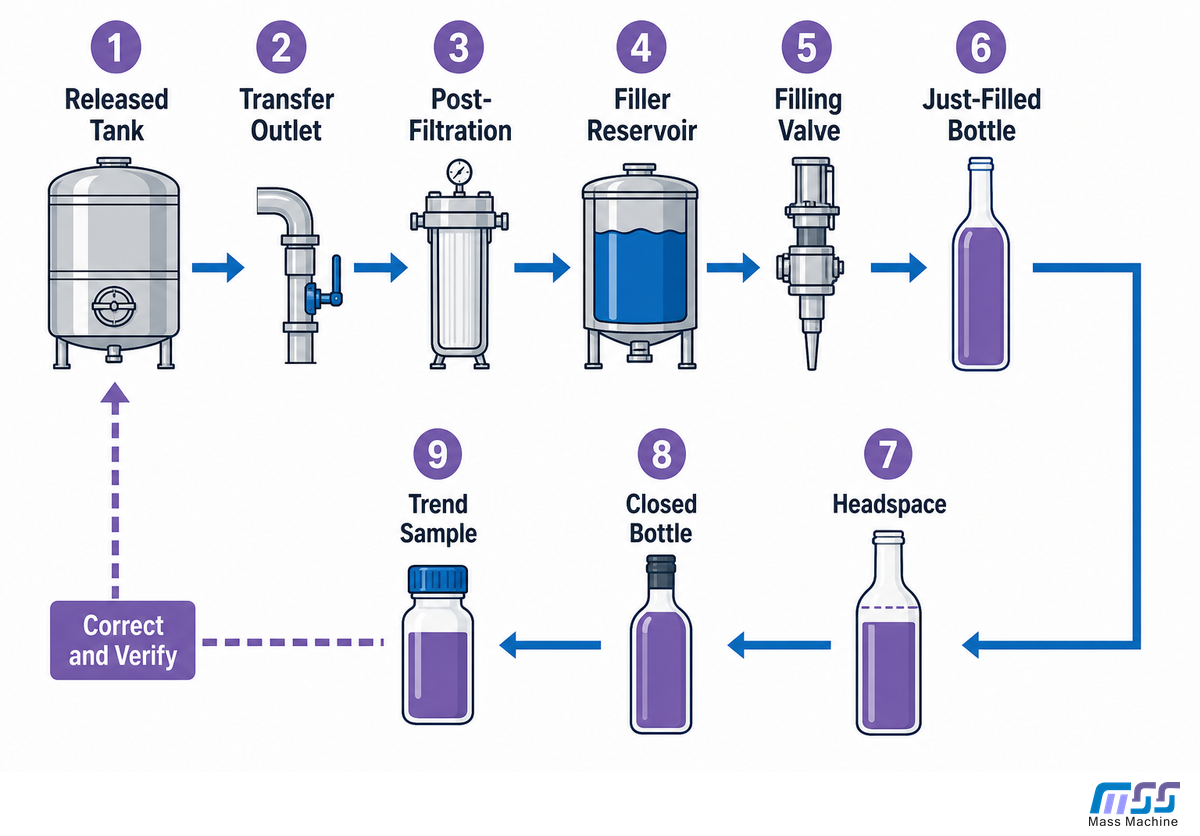
The 9-Point Oxygen-Pickup Control Loop tracks oxygen exposure from the released tank through the closed bottle. Its purpose is diagnostic: compare adjacent measurements, locate the step where oxygen rises, correct that step and verify the result. A filler type or nitrogen setting alone cannot prove low package oxygen.
AWRI defines total package oxygen as dissolved oxygen in the wine plus oxygen in the bottle headspace. Its packaging guidance reports less than 1.5 mg/L as best practice, 1.5–2.5 mg/L as acceptable, values above 3 mg/L as needing improvement and values above 4 mg/L as poor in that guidance context. Treat these as reference bands, not a substitute for a winery’s product specification. The practical way to protect your wine from oxidation is to locate the pickup step and verify the correction.
| Point | What to capture | What a rise suggests | Next action |
|---|---|---|---|
| 1. Released tank | Baseline dissolved oxygen | Upstream condition already high | Hold or follow the wine-control plan |
| 2. Transfer outlet | Dissolved oxygen after pump and hoses | Air ingress or poor line preparation | Check joints, priming and transfer practice |
| 3. Post-filtration | Dissolved oxygen across the filter train | Housing, venting or connection issue | Inspect the approved filtration setup |
| 4. Filler reservoir | Product condition at the bowl or tank | Surface exposure or gas-control loss | Check level, cover and gas procedure |
| 5. Filling valve | Valve pattern, turbulence and leakage | Poor seal or unstable delivery | Stop and inspect according to the machine manual |
| 6. Just-filled bottle | Dissolved oxygen and fill result | Pickup during filling | Test one safe setting at a time |
| 7. Headspace | Headspace oxygen and ullage | Weak purge, foam or timing variation | Verify purge sequence and closure timing |
| 8. Closed bottle | Calculated or measured package result | Combined dissolved and headspace load | Segregate against the release plan |
| 9. Trend sample | Result by time, valve and stoppage | Drift or stop-related exposure | Find the repeating condition, then recheck |
AWRI notes that more than 60% of oxygen in a bottle can sit in the headspace, and that vacuum or inert-gas treatment commonly displaces roughly 60–80% rather than all of it. That is why a low dissolved-oxygen result at the filler inlet does not finish the investigation.
Counterintuitive results can appear when a team slows the line to “give nitrogen more time.” In the cited Agroscope study, the direction depended on sequence, pressure, work rate, bottle profile and nozzle condition. In one arrangement, slower work wasted nitrogen; in another, a higher rate reduced total package oxygen. Measure the closed-bottle result at the actual rate instead of assuming slower is safer.
Verify Sanitation Before Production Release
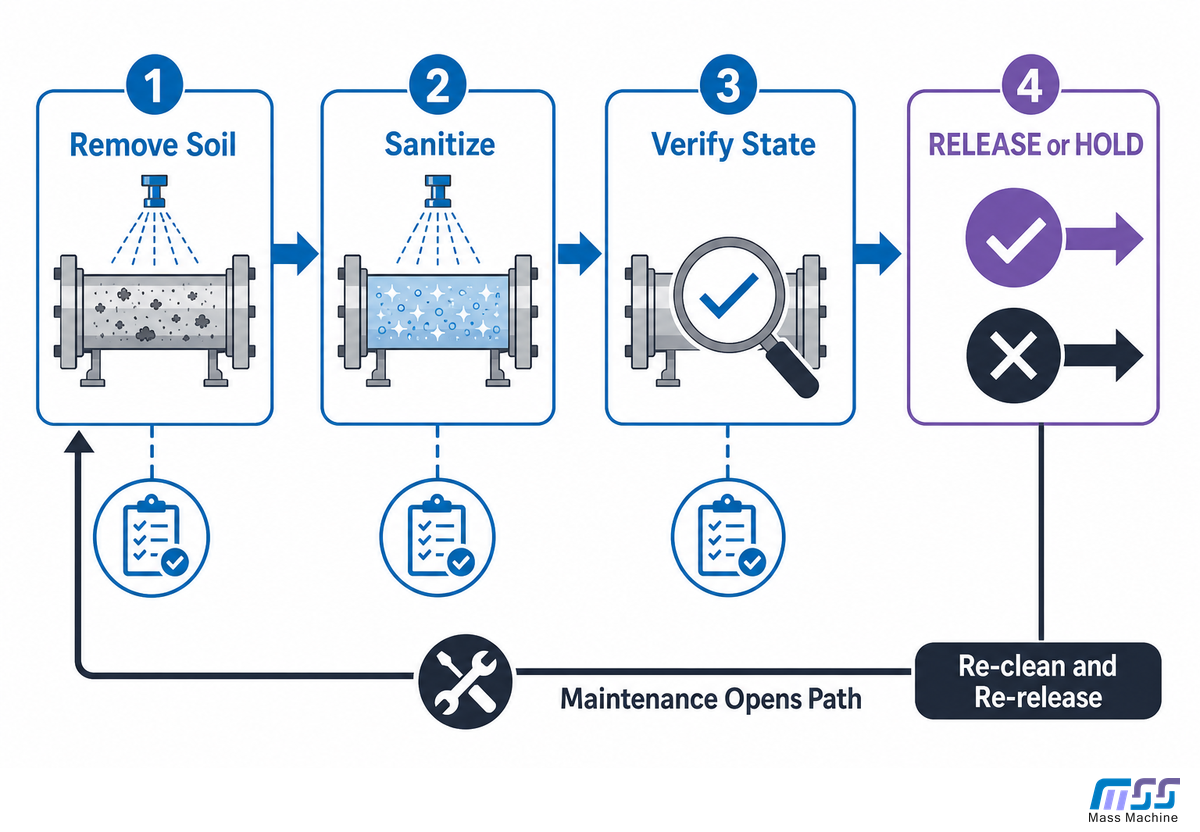
A sanitation release proves that product-contact equipment was cleaned, sanitized, checked and formally released under a validated procedure. Visual inspection can find soil or damage, but it cannot confirm chemical concentration, contact conditions or microbiological status. Maintenance after release can also reopen the control boundary and require another sanitation decision.
- Remove soil. Record the cleaning agent, concentration, circulation condition and visible result required by the validated procedure.
- Apply the sanitizing step. Record the agent or thermal condition, contact time and product-contact scope.
- Verify the state. Use the plant’s chosen evidence, which may include inspection, ATP, swabs or membrane-based microbiological checks.
- Release or hold. Name the person who can release the path and define what happens after a failed test or maintenance opening.
AWRI gives thermal examples such as 80°C for at least 30 min and steam or condensate above 80°C for more than 20 min. Those numbers belong to the cited guidance context. Plant teams must follow their validated procedure plus the chemical and equipment instructions; they should not copy an example temperature into an unrelated line.
Common failure mode
Maintenance replaces a gasket after line release, production restarts, and the sanitation record still shows the earlier approval. That repair changed the product-contact boundary. Re-clean or re-sanitize as the plant procedure requires, document the intervention and issue a new release before wine returns.
Rinse and service-water quality also belongs in the sanitation plan. If source-water condition or treatment capacity is uncertain, define that requirement with the plant’s water treatment system rather than treating water as an unlimited, unmeasured utility.
Map the Full Line, Interfaces and Utilities
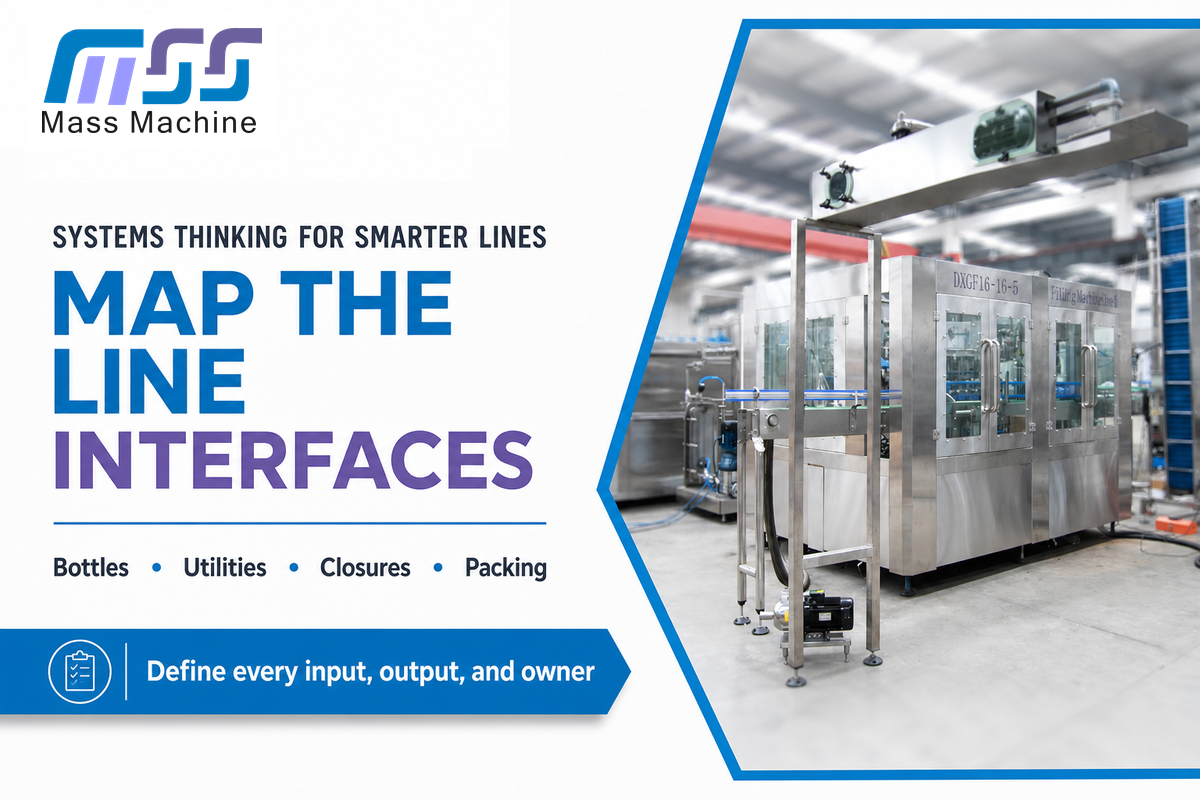
A wine bottling line is stable only when each zone receives the right input and can pass its output forward without starving, blocking or damaging bottles. Mapping ten interfaces exposes requirements that a specification limited to the filler misses: water, gas, closures, transfer timing, code data, label condition, accumulation and reject handling.
| Interface category | Input / output | Failure signal | Verification | Limitations / Not suitable for |
|---|---|---|---|---|
| Bottle feed | Approved empty bottle to orienter or conveyor | Scuffs, jams, wrong finish | Drawing, sample and line trial | Cannot accept undeclared bottle geometry |
| Rinse / service water | Specified water quality and flow | Low flow, residue or hygiene risk | Utility record and point check | Not proof of product-contact sanitation |
| Wine transfer | Released wine to filler reservoir | Air ingress or unstable level | DO trend, joints and pump state | No correction for unreleased wine |
| Inert gas | Approved gas at required pressure and flow | High headspace oxygen or empty supply | Supply check and package measurement | Gas flow alone does not prove TPO |
| Filler | Bottle plus conditioned wine to filled bottle | Level drift, foam or valve pattern | First-off and timed samples | Cannot release closure or label quality |
| Closure | Filled bottle plus approved closure | Leak, skew, poor compression or torque | Supplier method and sample plan | One setting does not fit every closure |
| Conveyor transfer | Closed bottle between machines | Starving, blocking or glass contact | Accumulation and stop observation | Speed matching alone misses micro-stops |
| Coding | Approved lot/date data to readable mark | Wrong, absent or blurred code | Line clearance and scan/read check | Vision cannot approve source data |
| Labeling | Dry, stable bottle plus correct label | Skew, bubble or wrong label | Approved sample and periodic check | Wet or unstable bottles need correction upstream |
| Packing / reject | Released bottles to correct case; rejects segregated | Mixed lot, recirculated reject or case damage | Reconciliation and reject challenge | Every reject signal needs a physical disposition path |
Packaging Digest’s Stone Hill Winery report offers a useful lower-tier plant case study: it traces accumulation, filling, capping and downstream handling, and records shutdown causes rather than judging the filler by its rated speed alone. For the label interface specifically, use a bottle labeling machine guide to define bottle condition and handoff requirements without folding label selection into the filler decision.
Balance Stable Throughput With the 6-Zone Stable-Flow Map
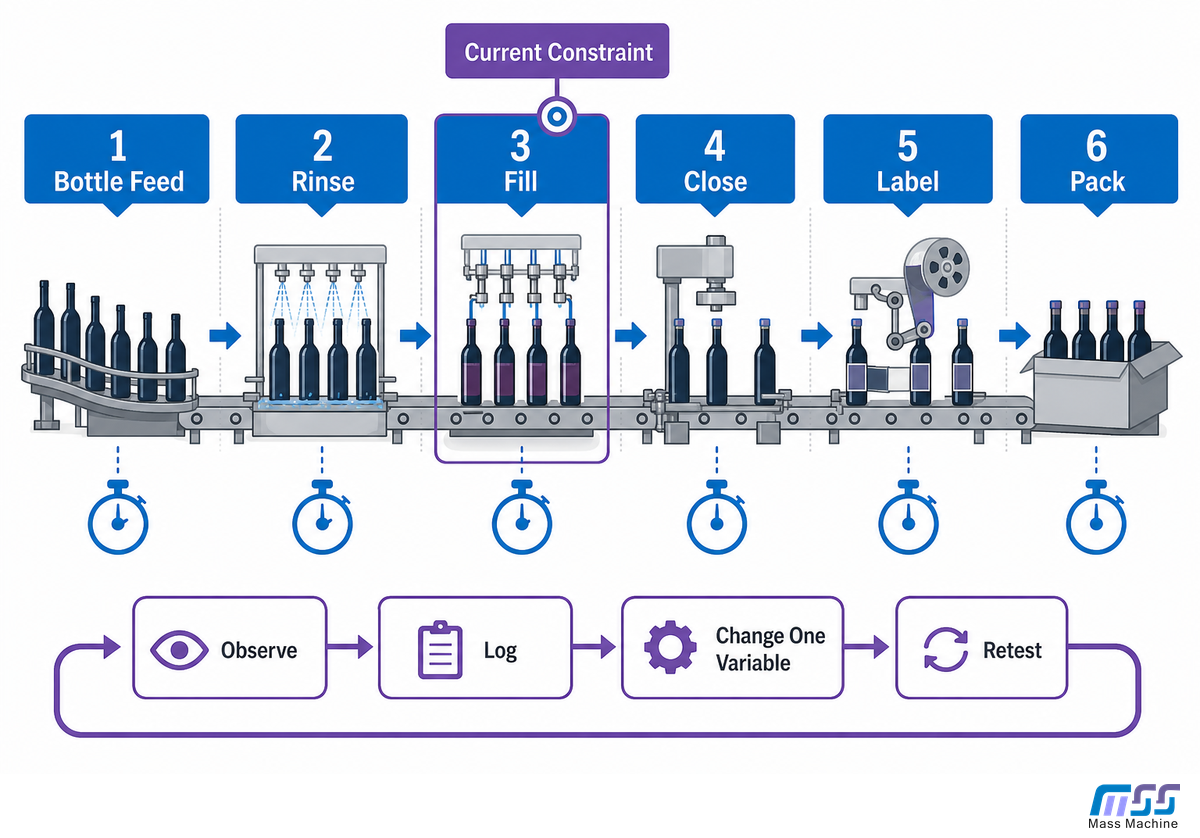
The 6-Zone Stable-Flow Map compares repeatable observed rates across connected line zones. The smallest stable rate sets the first operating constraint, while stoppage records show whether starvation, blocking or a moving bottleneck is responsible. The map must be repeated after changeovers or sustained operating changes.
NIST’s hierarchy of production key performance indicators supports looking below the final output number. One line total tells the team that output missed plan; zone rates, stop duration and work-in-process conditions help explain why. Here, the arithmetic is a worked example rather than a wine-industry performance standard.
| Zone | Repeatable rate | Observed condition | Decision |
|---|---|---|---|
| Bottle feed | 46 bottles/min | Brief gaps after reload | Watch starvation at the rinser |
| Rinse | 44 bottles/min | Repeatable | No first constraint |
| Fill | 43 bottles/min | Stable level result | Do not raise rate yet |
| Close | 40 bottles/min | Short recurring pauses | First constraint to investigate |
| Label | 45 bottles/min | Starved by closure zone | Do not tune labeler first |
| Pack | 44 bottles/min | Available capacity | Confirm accumulation behavior |
In this example, the first stable ceiling is 40 bottles/min, equal to 2,400 bottles/h before any plant-selected allowance for breaks, changeovers or variability. If the team temporarily chooses about 90% of that observed rate during diagnosis, the trial target is 36 bottles/min, or 2,160 bottles/h. That roughly 90% factor is an example assumption, not a recommended universal derating.
The cited manufacturing studies explain why the result must stay provisional: bottleneck behavior interacts with variability, processing time and work in process, and the constraint can move as conditions change. Re-run the map after a bottle change, rate change or new stop pattern rather than treating the first snapshot as permanent.
Imagine a filler rated above the day’s output while the closure zone pauses every few minutes. Raising filler speed creates more accumulation, then more blocking, without adding cases. One 45 min zone sample shows the closure station at 40 bottles/min and the filler at 43 bottles/min. During diagnosis, a plant might log the same stop code every 5 min so rate, accumulation and downtime remain comparable. Run the useful test at the closure interface; changing filler valves would erase evidence and introduce a second variable.
Control Startup, Changeover and First-Off Approval
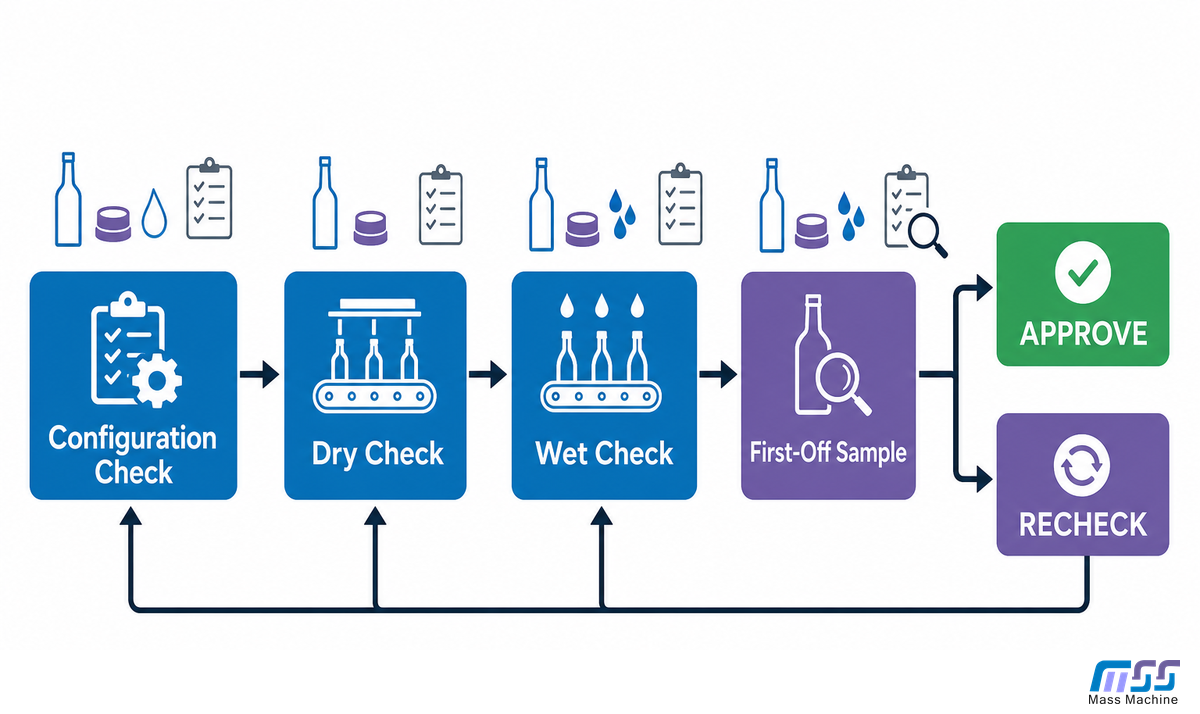
Controlled startup ensures that when a bottle reaches the filler, line clearance, dry checks, wet checks and a defined first-off sample are already complete. This sequence protects traceability: operators know which bottle, closure, code and settings were approved, and which event requires a new first-off decision.
- Clear the previous wine, bottle, closure, label and code from the governed line area.
- Confirm guards, interlocks and utilities as specified in the equipment manual; do not bypass a safety condition for a production test.
- Load the approved bottle and closure family, then verify change parts and recorded settings.
- Introduce released wine under the approved transfer and oxygen-control procedure.
- Run a plant-defined first-off sample at a controlled rate.
- Check fill, oxygen, closure, code, label and package evidence against the release plan.
- Record the released settings, time, material lots and approver before raising rate.
For natural-cork applications, the Natural Cork Council handbook provides source-specific examples of bottle pressure and temperature checks at 30 min and 60 min after corking. Use the closure supplier’s method and the winery’s approved sample plan; those times should not be copied to screw caps or other closure families.
First-off approval card
Record bottle and closure IDs, wine lot, filter state, sanitation release, utility status, active code, measured quality results, settings revision, approval time and the event that will force reapproval.
Apply the 12-Point Bottle Release Matrix
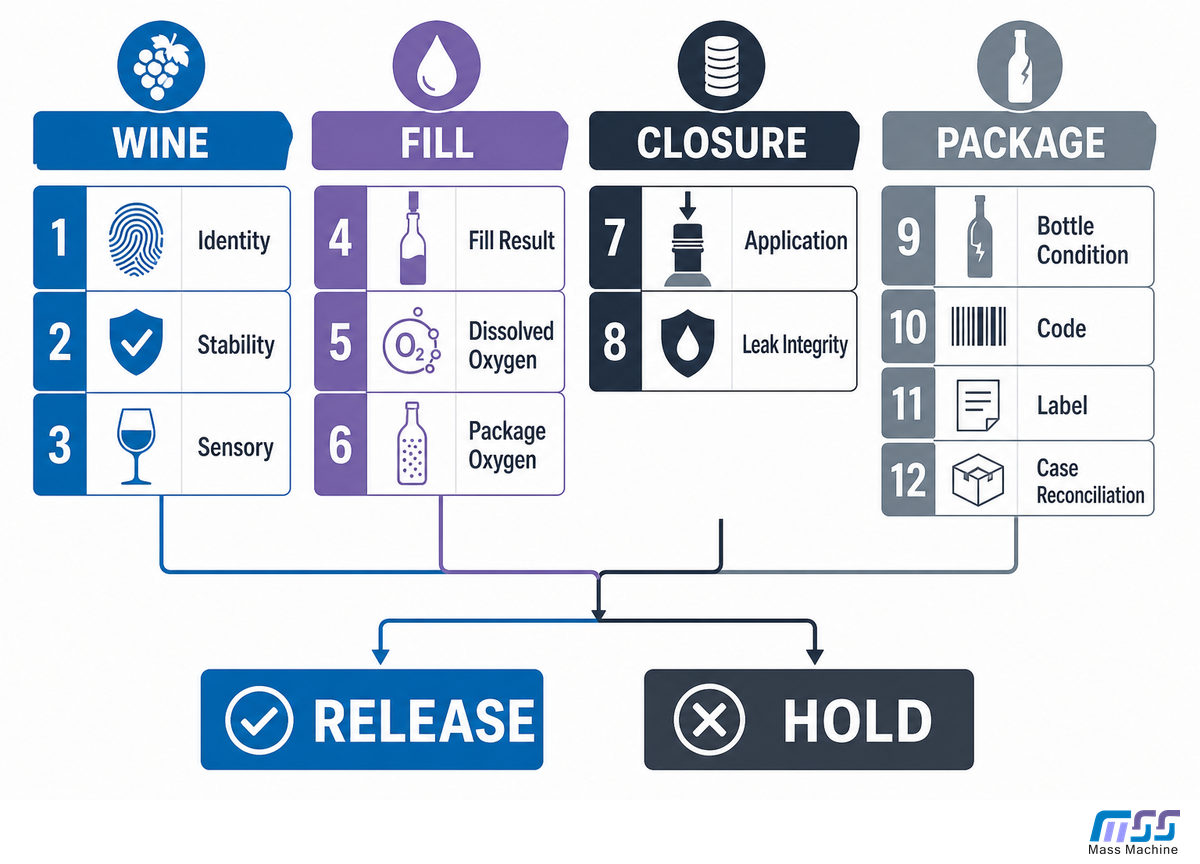
The 12-Point Bottle Release Matrix combines fill, oxygen, closure, code, package and wine evidence into one routing decision. Results can trigger release, adjustment and recheck, segregation, or a production hold. Every limit remains tied to a product specification, validated procedure or supplier instruction.
| Check | Evidence | Reference | Route if outside | Limitations / Not suitable for |
|---|---|---|---|---|
| 1. Wine identity | Lot and tank match | Production order | Hold and reconcile | Matching labels cannot prove wine identity |
| 2. Fill volume or level | Calibrated sample result | Product and legal plan | Adjust and recheck; segregate since last good check | Level varies with bottle geometry and temperature |
| 3. Ullage | Headspace measurement | Bottle and closure plan | Adjust and recheck | No single value fits every bottle drawing |
| 4. Dissolved oxygen | Calibrated measurement | Wine oxygen plan | Hold or segregate by plan | Does not include headspace oxygen |
| 5. Headspace oxygen | Package measurement | Wine oxygen plan | Check purge and closure timing | Gas setting alone is not evidence |
| 6. Total package oxygen | DO plus headspace calculation or instrument result | Product specification | Segregate and investigate the loop | Method and units must be consistent |
| 7. Closure application | Visual plus measured closure result | Closure supplier method | Stop, segregate and correct | Method changes by cork, screw cap or other closure |
| 8. Leak integrity | Approved leak or pressure check | Package plan | Hold affected interval | Dry exteriors are not validated leak tests |
| 9. Bottle condition | Glass, finish and contamination inspection | Bottle specification | Reject and inspect the lot | Vision has declared defect and lighting limits |
| 10. Code | Correct, present and readable mark | Approved coding record | Stop and segregate since last good check | Readability does not prove source data |
| 11. Label and presentation | Correct label, placement and bottle appearance | Approved pack standard | Segregate and correct | Cosmetic approval cannot release product chemistry |
| 12. Case and reconciliation | Correct count, lot and reject balance | Packing record | Hold mixed or unreconciled cases | Case count does not replace bottle checks |
OIV’s HACCP guide supports a winery-specific flow diagram, hazard analysis, limits, monitoring, corrective action, verification and records. It identifies bottling concerns that extend beyond fill height, including cleaning residues, foreign bodies, glass, overfill or pressure, sulphites and allergens. Use the matrix above as an operating organizer; the winery’s hazard plan remains the authority.
Where a site applies ISO 22000:2018, map these records into its food safety management system. The standard does not supply machine settings or wine-specific acceptance limits.
Common mistake
An operator corrects a fill-level drift and releases the next bottle without defining the affected interval. Although the corrected sample may pass, bottles produced since the last good check still need a disposition. Time, counter reading or case ID must connect the fault to a segregated quantity.
Troubleshoot by Symptom, Evidence and Single-Variable Tests
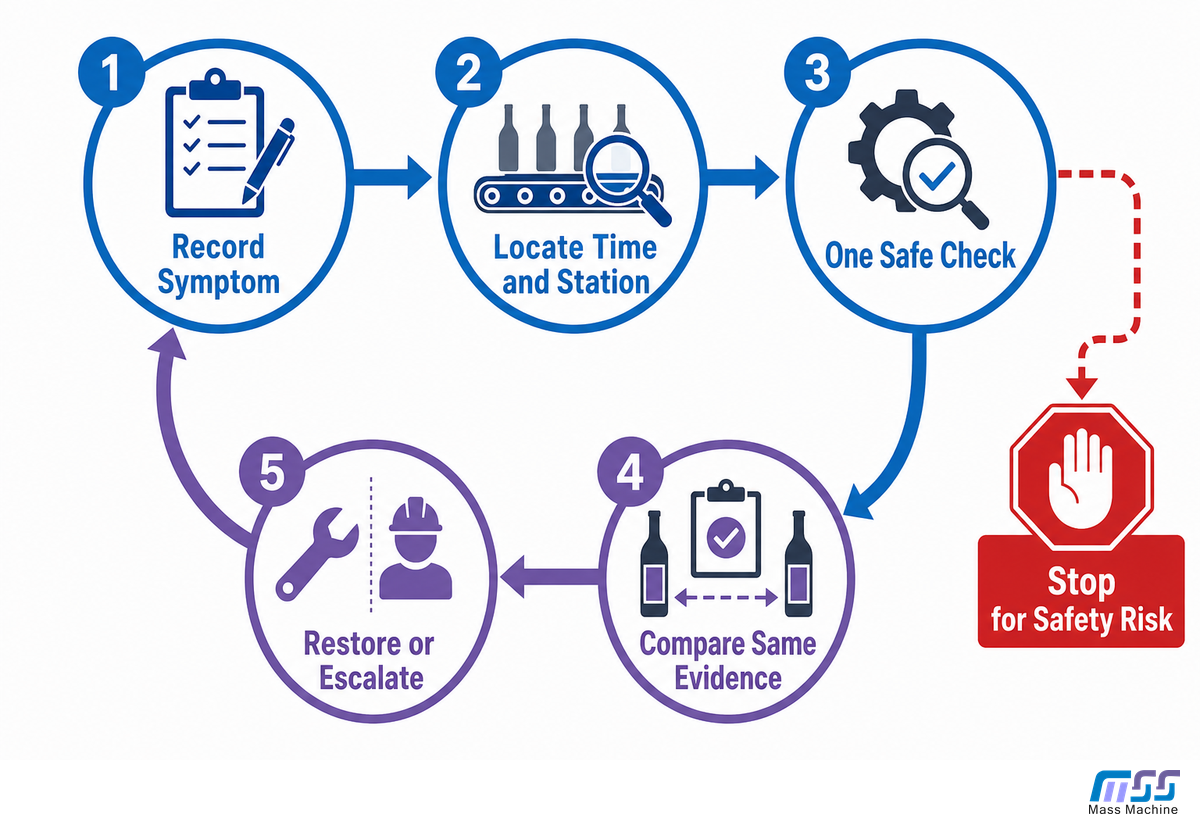
Effective filler troubleshooting starts with a repeatable symptom, the time and valve or station involved, and the last known good result. Change one safe variable, observe the same evidence and either restore the approved condition or escalate. Multiple simultaneous adjustments destroy the comparison needed to isolate a cause.
Stop work for broken glass, exposed moving parts, unsafe pressure, chemical exposure or any condition covered by lockout or the equipment manual. For US facilities, OSHA 29 CFR 1910.147 addresses hazardous-energy control during servicing, while OSHA 29 CFR 1910.212 addresses machine guarding. Site law and safety procedures govern. Use the checks below as observation and controlled-test prompts, never as instructions to bypass guards or repair energized machinery.
| Symptom | Evidence to record | Likely cause family | One safe check | Escalation | Limitations / Not suitable for |
|---|---|---|---|---|---|
| Fill level drifts together | Time, temperature, reservoir level | Product or common supply | Confirm the approved reservoir condition | Quality plus maintenance | Do not tune every valve |
| One valve fills low | Valve number and repeated samples | Local nozzle, gasket or valve | Compare that station with adjacent stations | Maintenance under manual | No energized disassembly |
| Foam rises at filling | Wine temperature, pressure, flow pattern | Product condition or turbulent delivery | Verify incoming condition against release | Winemaking plus engineering | Do not assume rate is the only cause |
| Headspace oxygen rises | DO, headspace result, gas status | Purge, timing, foam or closure delay | Repeat one measured package trial | Quality and process owner | Gas pressure alone is inconclusive |
| Bottle breaks | Location, bottle lot, contact point | Container defect or mechanical contact | Stop and isolate the break area | Safety, quality, maintenance | No production trial with exposed glass |
| Closure leaks | Head, time, closure and bottle lots | Application, finish or material | Check approved closure method | Packaging supplier plus maintenance | Visual checks may miss seal failure |
| Conveyor repeatedly blocks | Stop duration and accumulation point | Downstream constraint or guide setup | Observe one zone at current safe rate | Line engineer | Faster filler speed adds pressure |
| Label position wanders | Bottle surface, spacing and guide contact | Bottle handoff or label station | Confirm dry, stable bottle presentation | Labeling owner | Do not alter fill settings first |
| Code becomes unreadable | Message, surface and print sample | Data, print or bottle-surface issue | Verify approved message and one print | Quality plus coding owner | Readability does not prove correct lot |
| Output falls without one long stop | Micro-stop count by zone | Distributed short interruptions | Repeat the 6-zone observation | Production and engineering | Shift total alone cannot locate cause |
Diagnostic discipline: record the original setting before any permitted change, note excess wine on the bottle exterior as a symptom rather than proof of overfill, identify the bottle interval affected, and restore the approved value if the trial does not improve the same measurement. Any trial that changes one symptom while worsening oxygen, closure or safety evidence is not a successful correction.
Turn Operating Requirements Into a Supplier Brief
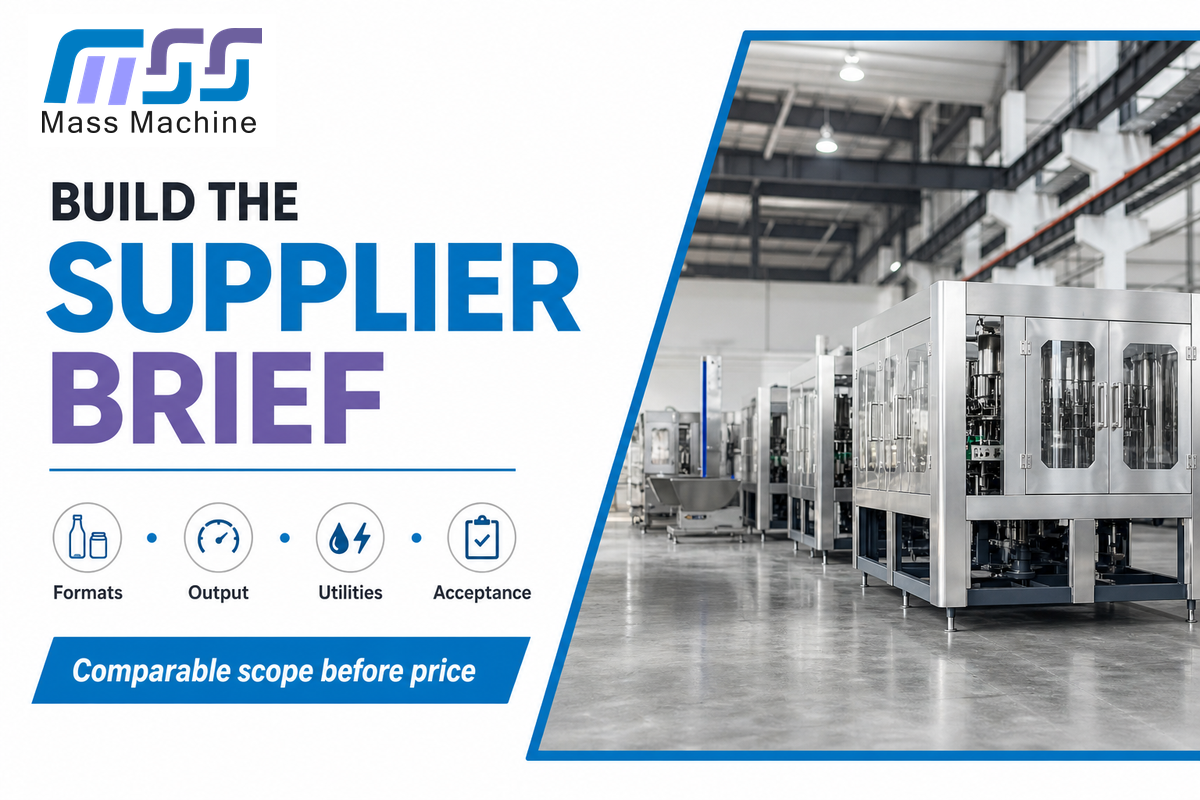
A supplier brief should describe the winery’s product, containers, closures, stable output, utilities, quality checks, changeovers and acceptance test before naming a machine model. That evidence lets a supplier define line boundaries and test obligations without turning an operational guide into a product comparison or price page.
Once the operating brief is complete, use the commercial wine filling machine solution page for configurations, capacity bands and the quotation handoff. Keeping that decision separate protects the guide’s informational role and gives procurement a cleaner starting point.
RFQ checklist — copy these into your quote request:
| Parameter | Recommended range | Why it matters | How to verify |
|---|---|---|---|
| Wine condition | Project-defined wine family and target temperature in °C | Changes flow, foam and package conditions | Approved wine specification and witnessed trial |
| Bottle families | One drawing and measured sample for each format; dimensions in mm | Defines handling, fill and change parts | Drawing review plus sample run |
| Closure families | Supplier specification with torque, compression or pressure units where applicable | Defines application and integrity checks | Closure supplier method and line trial |
| Stable output | Required bottles/h and planned shift duration in h | Separates operating need from nameplate rate | Timed acceptance run with stop log |
| Quality acceptance | Plant limits for DO/TPO in mg/L, fill in mL or mm, closure, code and package | Turns quality intent into testable evidence | Calibrated methods and signed protocol |
| Utilities | Voltage, frequency, air pressure, water flow and inert-gas pressure with units | Prevents an interface mismatch at installation | Utility survey and connection schedule |
| Changeover and support | Target changeover in min, training languages and response windows in h | Defines operating and service boundaries | Witnessed changeover and written service scope |
Zhangjiagang Mass Technology Co., Ltd. states that its project scope can cover plant layout, equipment manufacturing, production-line installation, on-site operator training and after-sales support. Put each requested item into the responsibility matrix, then send your line requirements with the bottle drawings and acceptance plan.
When NOT to buy a stand-alone filler
Stand-alone fillers are the wrong first purchase when a project has not resolved bottle feed, closure application, utilities, oxygen measurement, coding, accumulation, reject handling or stable downstream capacity. Stone Hill’s line case shows that production behavior belongs to the connected system, while University of Minnesota guidance puts wine and packaging readiness ahead of filling. Buying a faster filler cannot repair an undersized closure station or an unverified water supply.
A scope limited to the filler can still be appropriate when existing line interfaces are measured, compatible and included in a witnessed acceptance plan. If those facts are unknown, ask for a line study or integrated responsibility matrix first. Ask whether each boundary has an owner, a measurable requirement and a test rather than assuming more automation is always better.
Frequently Asked Questions
What is a wine filler?
A wine filler delivers wine into prepared bottles by a controlled level, volume, vacuum, gravity or pressure method, while connected equipment manages bottle handling, closures, oxygen, labeling and package release.
A wine filler is the part of a bottling line that delivers wine into prepared bottles by a controlled level, volume, vacuum, gravity or pressure method. Each system works with bottle handling, a product reservoir, filling valves and conveyors. Closure, labeling, oxygen management and final package release remain connected but separate controls.
What machine keeps wine fresh?
No single machine keeps wine fresh. Package life depends on released wine, hygienic transfer, measured oxygen pickup, compatible containers and closures, controlled filling, closure integrity and appropriate storage.
No single machine keeps wine fresh. Package life depends on released wine, hygienic transfer, low and measured oxygen pickup, compatible bottles and closures, correct filling, closure integrity and storage. Filler performance contributes repeatable delivery; the winery must control the whole tank-to-case path and verify the closed bottle under controlled storage conditions.
How much is a bottle filling machine?
A defensible bottle-filling-machine quote needs the wine, bottle and closure families, stable output, utilities, quality tests, changeover scope and line boundaries so every supplier prices the same acceptance requirement.
Defensible quotes need the wine, bottle and closure families, required stable bottles per hour, utilities, quality tests, changeover scope and line boundaries. Price without those facts can omit change parts, gas systems, conveyors, inspection or commissioning. Build the operating brief first, then compare offers against the same documented acceptance test.
Why does oxygen pickup matter during wine filling?
Oxygen added during transfer, filling and closure contributes to total package oxygen and can affect the wine’s intended development, so teams should measure dissolved and headspace oxygen around the actual bottling process.
Oxygen added during transfer, filling and closure contributes to total package oxygen and can affect the wine’s intended development. Measuring both dissolved and headspace oxygen shows where pickup occurs and whether a process change improved the closed package.
How do you verify a clean wine filling line?
A clean wine filling line is verified by separating cleaning from sanitizing, documenting the approved conditions, reviewing plant-selected evidence such as inspection or ATP, and assigning a person to release or hold production.
Verification starts by separating cleaning from sanitizing. Record the product-contact scope, cleaning agent, concentration, circulation or contact condition, time and visible result under the validated procedure. Apply the approved sanitizing step and record its concentration or thermal condition and contact time. Then use the plant’s chosen verification evidence, which may include visual inspection, ATP, swabs or membrane-based microbiological tests. Name the person authorized to release the path and the action for any failed result. If maintenance opens or replaces a product-contact part after release, reassess the affected boundary and repeat cleaning or sanitizing as the procedure requires. Chemical labels, equipment manuals and the plant validation control the actual numbers; a generic checklist does not.
What causes inconsistent fill levels?
Inconsistent fill levels can come from bottle variation, wine temperature, reservoir behavior, foam, product supply or a local valve fault, so record whether the drift affects every valve or one repeating station.
Inconsistent levels can come from bottle-volume variation, wine temperature, unstable reservoir condition, foam, air or vacuum behavior, product supply, worn gaskets, a restricted nozzle or one faulty valve. First decide whether all valves drift or one station repeats the fault. Record bottle lot, time and station, then make one safe check permitted by the equipment manual.
Bring process evidence to the machine discussion
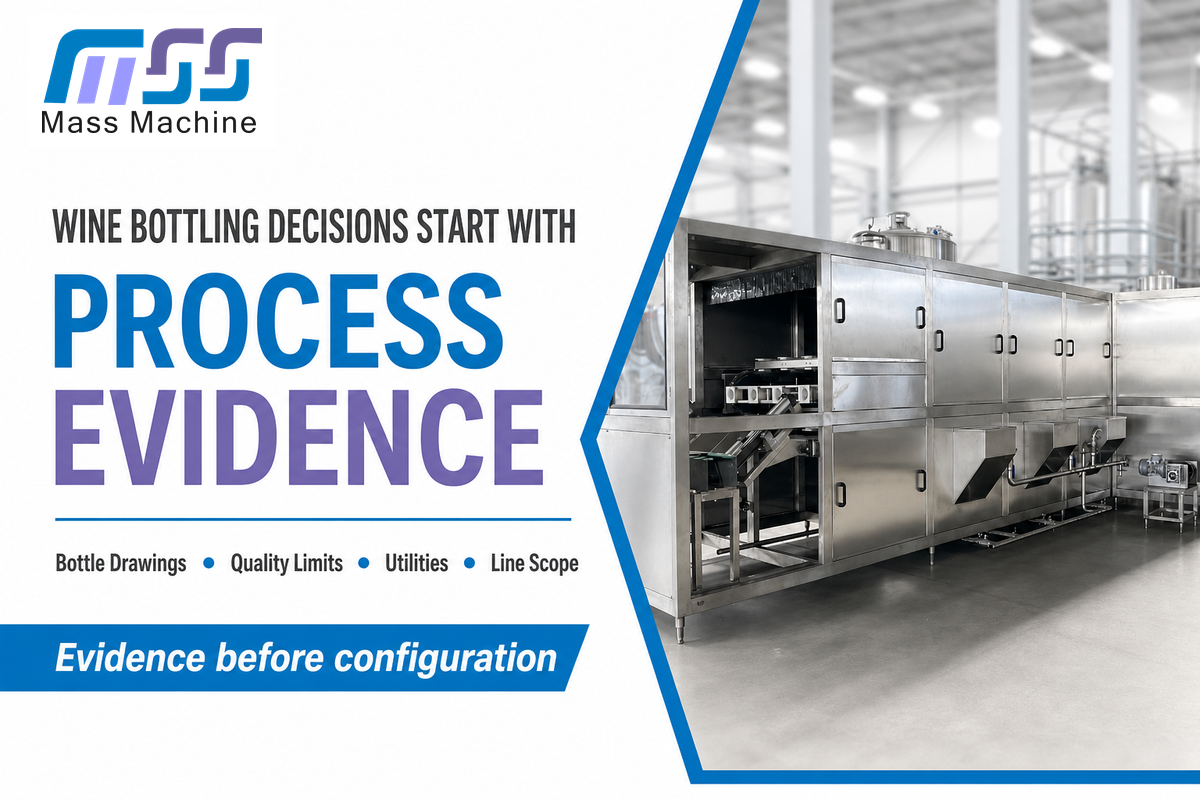
Bottle drawings, stable output, quality limits and utility data make a technical conversation more useful than a model request alone.
Manufacturer review note
This guide was prepared for and reviewed against information supplied by Mass Technology. Independent technical sources support the operating guidance; company service statements below remain first-party information.
Mass Technology reports warranty coverage for machine parts lasting 2 years, an engineer-response commitment within 24 hr and international-courier delivery of replacement parts within 5 days, using working days rather than calendar days. Confirm project-specific terms in the signed contract. Machine settings, chemical conditions and acceptance limits must come from the validated plant procedure, product specification and applicable manuals.
References & Sources
- Practical Preparation Techniques for Wine Bottling — University of Minnesota
- Oxygen Pick-Up During Packaging: Understanding Total Package Oxygen — Australian Wine Research Institute
- Inerting and Oxygen at Wine Bottling — OENO One / Agroscope research
- Bottling Line Sanitation — Australian Wine Research Institute
- Stone Hill Winery Bottling Line Case — Packaging Digest
- Hierarchical Structure of Production KPIs — National Institute of Standards and Technology
- Bottleneck and Variability Study — Applied Sciences
- Dynamic Bottleneck Detection Study — Procedia CIRP / ScienceDirect
- Bottling Handbook — Natural Cork Council
- Guide to Hazards and Critical Control Points in the Wine Industry — International Organisation of Vine and Wine