Get in Touch with Masstech

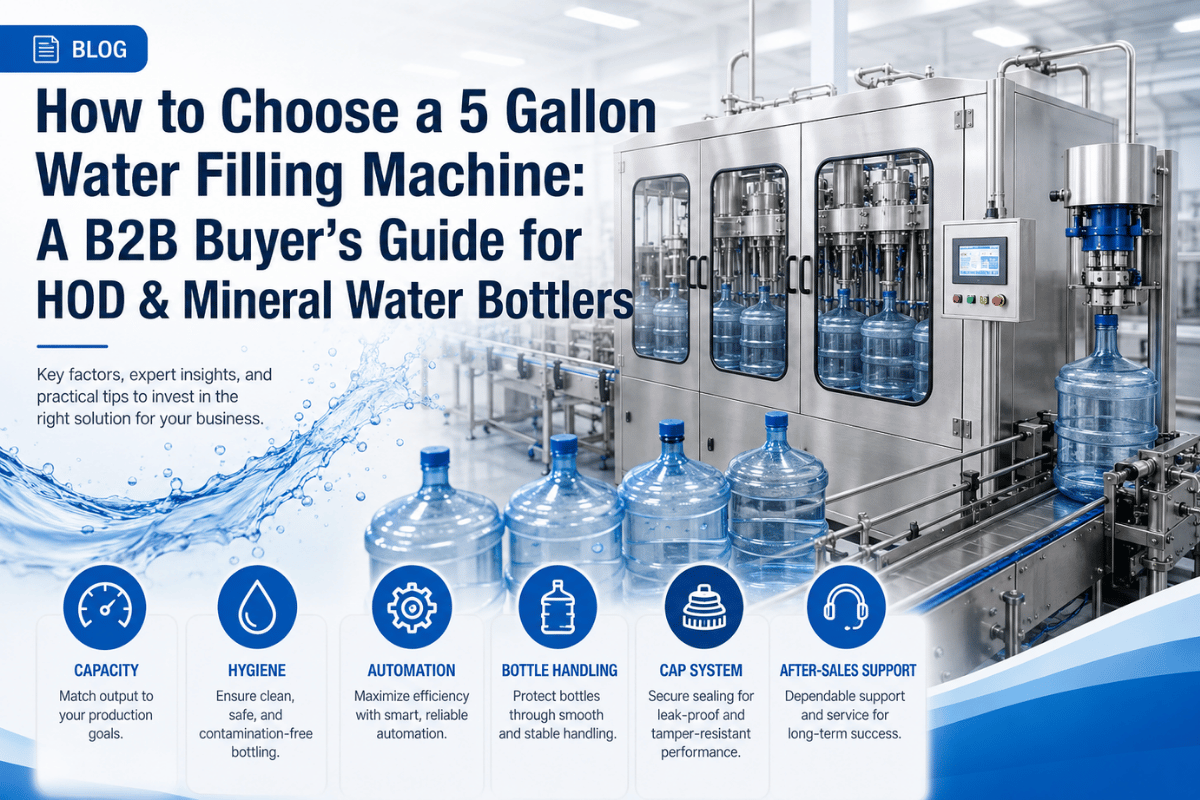
A 5 gallon water filling machine is an integrated line that runs a returnable 18.9-litre barrel through decapping, rinse and drain, filling, and recapping in one continuous pass, built entirely around getting a used, returned barrel clean enough to refill safely. That is a different animal from a counter-top jug dispenser or a small 2-4 barrel setup. If you were trying to find out about how to refill your own Costco or Primo cooler bottle, this is the wrong section; if you were looking for an idea of what processes are needed for a production line, this guide is for you.
Quick Answer. It’s the same old Seven: resize the line (not match nameplate BPH) to what’s really in your barrels-a-day, match the fill-mode to your maintenance and your reality, ensure it will fit your real returnable 18.9-litre barrels, cost the real full-landed price, allocate the regulatory requirements across the ownership chart, differentiate your intent (filling line versus full plant) and finally trust and verify your suppliers’ after-sale capabilities. And when that happens, you and the engineering specs can get a lot easier life.
Quick Specs, What a 5 Gallon (HOD) Line Looks Like
| Barrel format | 5 gallon / 18.9L (also 19L & 20L), Φ270 × 490 mm, PC or PET |
| Output range | 100–3,000 barrels per hour (BPH) across model tiers |
| Core stations | Decap → inner/outer brush → multi-stage wash → fill → cap → inspect → heat-shrink → palletize |
| Filling modes | Mechanical valve · electromagnetic flow meter · laser positioning |
| Contact material | SS304 stainless (316L on request); rinse 0.37 m³/min; air 0.3–0.7 MPa |
| Operators | 2 (fully automated) vs ~24 for an equivalent manual setup |
What a 5 Gallon Water Filling Machine Actually Is (and Why It Isn’t a PET Line or a Jug Dispenser)
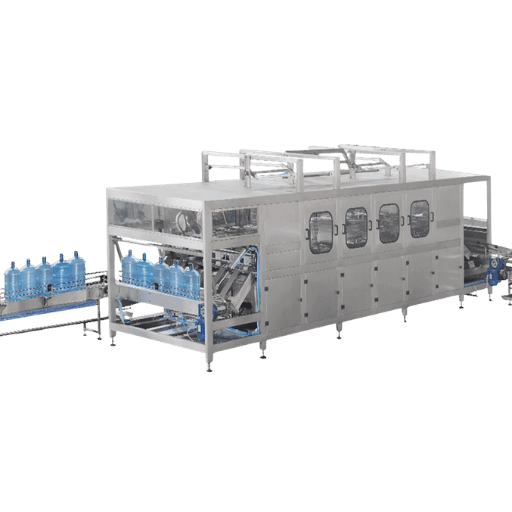
A 5 gallon water filling machine is the automated line that turns a returnable 18.9-litre (5-gallon) barrel into a sealed, sanitary, refilled unit, running it through decapping, brushing, multi-stage washing, filling, and capping on one conveyor. It is not a counter-top jug dispenser and not a high-speed PET bottle line: the heavy returnable barrel is too big to hang from neck-grip star wheels, so it rides an apron conveyor instead.
Three products share the phrase “5 gallon water machine,” and confusing them is the costliest mistake a first-time buyer makes. A consumer jug dispenser sits on a counter and pumps water from a bottle. A PET line runs lightweight single-serve containers on neck-grip star wheels at 2,000–36,000 BPH. The HOD barrel machine is the third, and the one this guide is about: it cleans a used, returned 18.9L barrel thoroughly enough to refill it safely.
And That returnable-barrel reality is also where the regulation begins-and is the one tidbit “guides” for vendors invariably fail to mention. In the US bottled-water cGMP rule, 21 CFR Part 129, the returnable barrel is defined as a “multiservice primary container”, and the rule unequivocally states, “All multiservice primary containers shall be washed, rinsed, and sanitized by mechanical washers or by any other method giving adequate sanitary results” in an enclosed room. Meaning that a “filler-capper” doesn’t qualify as a “5 gallon water bottling machine for returnable drinking water”, and wash is just part of the package.
💡 Pro Tip
Beware, if your quote on a “5 gallon filling machine” just includes a filler and a capper, then they are only quoting a piece part and not a line. An entire HOD production line is about eight pieces of equipment long and it is seldom that the filler is ever the bottleneck.
Here’s how automated qgf-style (an ancient, widely copied wash-fill-cap design) line connects: decapper ( flags the 5 common return errors), inner-and-outer brush ( strips scale, algae, biofilm before chemicals touch), wash (recirculated alkaline detergent; recirculated sanitizer; pure water rinse), non-contact filling, rotary capping under sterilizing spray, online light inspection for quality control, tamper-evident heat-shrink, and palletizing. (It’s an established technology-the original 5-gallon barrel washer, EP0634230A1, shows the inverted-carousel internal spray sequence still used today, and notes directed mechanical impingement cleans better than static soaking.)
The why is here: the cash is in the automation on those stations. One trade-publication study of a 5-gallon pail line found that an all-manual setup needed up to five operators who habitually over-poured to avoid shorting customers; metered automation cut that to a single operator filling to within an ounce (Food Engineering, 2026). It will become clear: for this kind of a 5-gallon facility, the gains come from reduced labor, elimination of giveaways, and uptime.
Step 1: Size the Line to Your Barrels-Per-Day, Not the Nameplate BPH
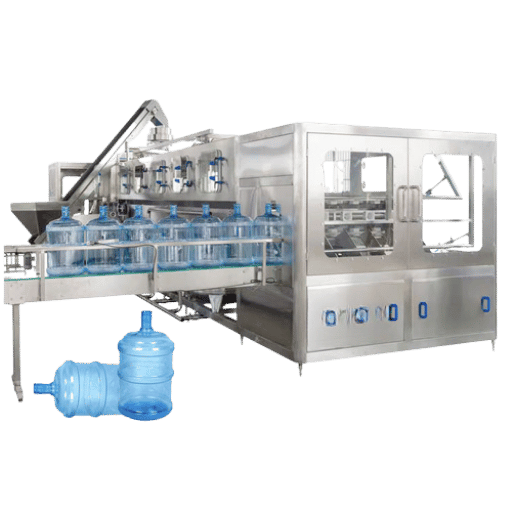
Choose the size that reflects the reality-not the brochure headline numbers. Convert your committed B/D to a throughput rating using the two key adjustments no spec sheet writers bothers to publish: effective utilization (your peers report typically only 70% of nameplate is sustained over a day after accounting for barrel queue, washing and sanitizing, etc.; 85% is excellent); and an efficiency loss that comes from layouts and processes (on-site water hardness, barrel return rate factors, also-up to 10% loss is to be expected in tight spaces that requires going “around” instead of “through”). So, if a line has an “effective rating” of 600 BPH, plan for 450-500 BPH sustained (most plants hold only 70-85% of nameplate). Buy it for the throughput of your peak shift, and your seasonally high volume – not for the header that’s there to impress visitors.
| Operation profile | Real demand | Target rated BPH | Why |
|---|---|---|---|
| Startup HOD operator | ≤500 barrels/day | 100–150 BPH | Single shift; mechanical valve; smallest footprint |
| Regional mineral-water brand | 1.5–3K barrels/day | 300–450 BPH | Single shift at <85% utilization; flow-meter option |
| Two-shift HOD distributor | 3–6K barrels/day | 600 BPH | Headroom absorbs seasonal peaks without a second shift |
| Contract / private-label bottler | 6–9K barrels/day | 900 BPH | Audit-grade fill control; laser positioning common |
| Industrial / municipal supply | 9–12K+ barrels/day | 1,200 BPH (or 2× 600 parallel) | Redundancy via parallel lines beats one big line |
Actual output in BPH at site varies from brochure numbers from 8-12% on capacity and actual return rates; tiers shown here reflect actual field results from many QGF-type plants in many geographies.
Reasons NOT to over-size The logic of resisting over-sizing is undeniable. One Middle East customer replaced a maintenance-heavy 300 BPH line with a 600 BPH monoblock and doubled output and halved labor costs from 8 to 4, roughly $80,000 a year, while yielding a payback in 12 to 18 months. The real bottleneck for this customer hadn’t been throughput, but downtime. If the biggest constraint you’ve isn’t speed, and if it’s the cause of losses, don’t “speed fix” the symptom. A capacity chart that ignores uptime is selling you the wrong axis. (Check out the 5 gallon water bottling ROI Calculator on Mass’s site, it takes actual return rates and real efficiencies into consideration. )
⚠️ Important
Even a 5-gallon wash/decap stage has a different pace; unless it’s the same, your filling and capping capacity may be bottlenecked. A 5-gallon system will need about 2 m (≈6.5 feet) of clear space on either side for this barrel width, whereas a sub-1-litre line fits in roughly 1.2 m (≈4 feet).
Step 2: Match the Filling Mode, Mechanical Valve vs Flow Meter vs Laser Positioning
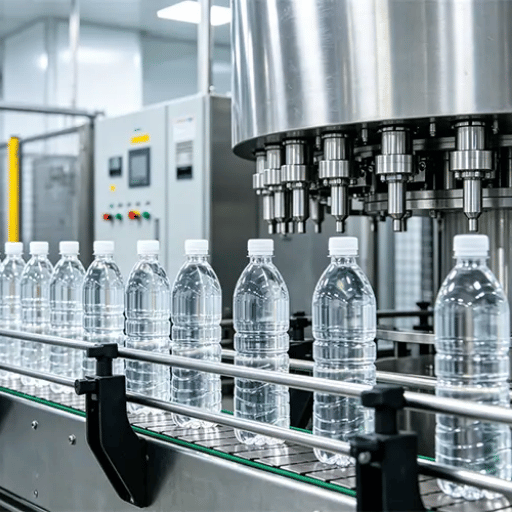
Select a filling mode for its fit with maintenance, not its accuracy class. A 5 gallon water filling machine may be built with three filling modes and there’s absolutely no rule that say the most precise mode must be the correct one. The question to ask yourself is “Are my fills legal net-quantity claims on a labeled package?” if the answer is yes then there’s a compliance obligation to use a higher level of precision. If no than the valve with the simplest least cost/least complexity valve set that the team can effectively maintain will fill more consistently than any “precision” flow meter system that never get a calibration adjustment.
| Mode | Best for | Accuracy | Maintenance burden |
|---|---|---|---|
| Mechanical valve | 100–450 BPH; plants without automation engineers; weak power quality | Level-based; headspace varies | Low — replace valve seats every 12–18 months |
| Electromagnetic flow meter | Retail/export brands needing label-claim volume; per-liter billing | ≈ ±0.5% by volume | Moderate — periodic calibration of meter + sensor |
| Laser positioning | Premium HOD; multi-source barrel pools with rim-height variance | Highest consistency across barrels | Moderate — lens cleaning + recalibration |
And now for the part that often takes users by surprise. Recalibration need is driven by how critical the duty is, not by the meter’s headline accuracy. That said, the drift of any meter comes not from the flow-measuring mechanism but the electronic compensator in the system. Government metrology has published guidance such as this NIST guidance explaining that while mechanical flow meters do wear out, there’s little wear on the mechanical part itself and drift will require a calendar-based adjustment; at least one water cooler industry studies reports that a “bluff body” (a meter design using differential pressure) has nearly zero wear from the flow action, drift and calibration issues stem from a compensating electronic component. So in fact, an uncalibrated flow meter line drifts MORE THAN a calibrated mechanical valve line set that gets its QA/QC checking and adjustment every week.
I’ve built and tested every QGF unit on all three filling modes for over a decade. With rare exceptions the best filling mode is not the most precise. Its often the mode where the valve and related support systems present least maintenance demand to operations. Indeed, an uncalibrated flow meter line will typically drift more than a mechanical valve line that gets a weekly QA check.
What does it mean if my fills keep drifting out of spec?
Drifting fills usually point to a mismatch between the mode you bought and the way you actually run it. A precision flow meter that nobody recalibrates will drift further than a simple mechanical valve that gets a weekly QA check. Three misfit signals tell you the wrong mode was specified:
The 3-Mode Misfit Signals
- Filling inconsistency: a flow-meter line exhibits this on calibration (as its adjustment drifts) or there might be Entrained Air fooling a bottom fill which is often better at slow laminar flow.
- Leakage around valve & capping: Caps still leaky; the valve could be over filling or caps over-torqued. More torquing does NOT always create tighter caps. over torque is very common in filler / capper combined systems — to tight causes damage of the neck or liner which breaks microfractures. The safest and most uniform sealing happens with a Verified Torque Window (VTW) using air-blown neck support just before capping.
- Microbiology Problems : Even clean barrels failing microbiology may be because they’re filled with dirty, stale rinse water containing slime. Dirty rinse water ISN’T clean, even when rinse water is sterile! Effective bottle-cleaning uses day-part CIP using properly maintained bottles with sanitized filtered & UV/ozone treated rinse water.
Step 3: Confirm Barrel Compatibility, PC vs PET, 18.9L / 19L / 20L
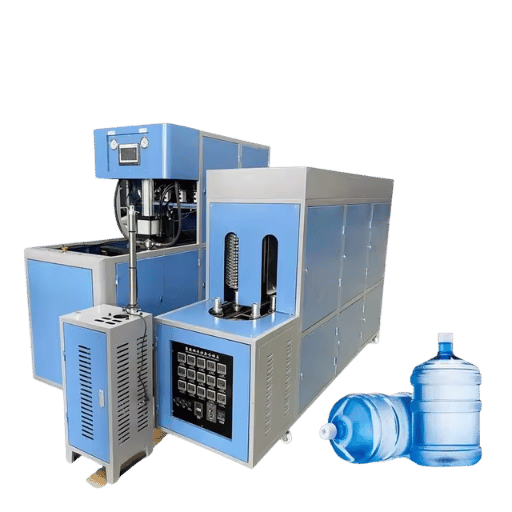
When deciding on a bottle-filler it comes as no surprise that most 5 gallon water filling machines are built to handle the standard 18.9L, 19L, and 20L barrel formats in both PET and polycarbonate (PC) with no mechanical changeover. The typical bottle/jar carriage on a 5g filling machine uses a standard Φ270 × 490 mm cradle. If your bottling line or bottles fall outside these dimensions then be prepared to pay for some customized engineering (best to send a dimensions diagram when comparing pricing not a photograph to be sure.
📐 Engineering Note
Because the majority of plastic, washable, reusable water bottles will encounter 100 or more trips through the washing/filling lines, the bottle-de-capper relies on soft pneumatically-actuated holding grips to prevent damage to the plastic necks and avoid contamination of the filler. Most all common bottles for coolers are made of polycarbonate; this is now a regional requirement, rather than a material choice.
That geographic angle is new, and load-bearing. The U.S. industry still makes extensive use of PC barrels, the FDA’s Bisphenol A (BPA) assessment for those bottles continues, but Europe has acted: the EU’s Commission Regulation (EU) 2024/3190 (Dec. 19, 2024, effective Jan. 20, 2025) bans the substance from any food contact articles, polycarbonate among them. It gives relatively tight transition periods for doing so.
Whether your barrels will ever head into an EU market, and the PC versus PET choice becomes a compliance (rather than just a fit) decision, becomes real when your line can run both, on the same cradle.
Step 4: Map the Real 5-Year Cost, Beyond the Headline Price
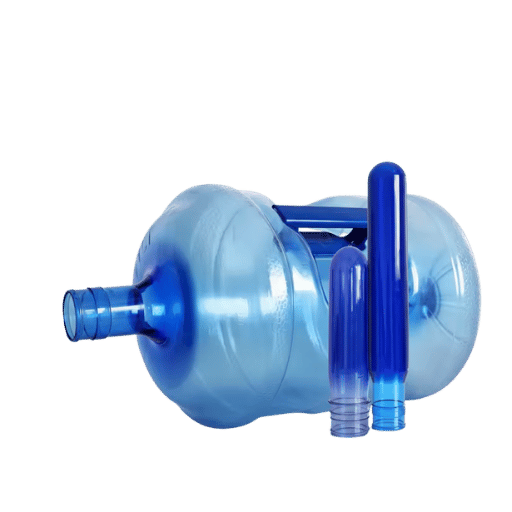
Public industry listings place a “5 gallon water filling machine” anywhere from around $3,000 to $30,000 depending on the level of automation, and a full water bottling facility from $50,000 to over $1 million once water treatment, blow-molding, and packaging are factored-in (vendor-quoted ranges; your landed figure will vary). That 10x spread within one phrase is the trap: an apples-to-apples headline-price comparison of a manual valve unit with an automated metered line is irrelevant. Budget the whole iceberg.
The Hidden-Cost Iceberg of an Imported 5-Gallon Line
- Hardware – the CAPEX here will be influenced by the BPH rating, fill mode, and integration requirements.
- • Seafreight + insurance -transit 25-45 days -QUOTE ONLY – SPOT / FORWARD WINDOW
- Customs duty, most bottling machinery clears under HS 8422.30—check your destination rate.
- Installation + Commissioning – Onsite travel for engineering or remote video support.
- Parts inventory – some inventory gasket O-rings, nozzles, seals and sensors may well help turn a 10-minute outage into a days outage if out of stock.
- Energy + utilities – a 600 BPH line consumes circa 7.5 kW plus compressed air and rinse water. SS304 stainless contact parts resist corrosion across a roughly 8-year service life, which keeps long-run maintenance costs predictable whether you bottle purified, distilled, or mineral water.
- Recurring compliance QC. Routine weekly source-water testing for coliform, and CGMP recommended quarterly container swabbing is an ongoing lab/labor line item, not a single cert (per Step 5).
Note two operators staff a line in any class — some 12 times fewer workers than a manual setup, which makes that the space in automation that pays out. Don’t listen to ROI one point: how much labor and capital each of those operators has depends on their margins/barrel, how many returns are normal, the distribution distance and tariff, so a componentized approach will win over a marketed “18-mo ROI.”
Step 5: Check the Compliance Scope, What’s the Maker’s Job vs Yours
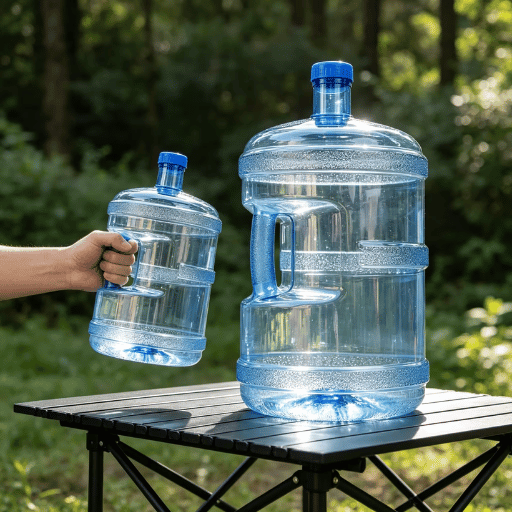
Bottled water compliance breaks into two areas of ownership and conflating the two is where a water buyer can get a “raw deal.” As the machinery manufacturer owns design for sanitation, build documentation and trace, the plant owner possesses the signed food safety plan. There are no “FSMA-certified” machines, and if you hear this term, run! The best service this guide can offer you is a helpful chart of the “who’s responsible for what” road map.
| Standard | Equipment maker owns | Plant operator owns |
|---|---|---|
| 21 CFR 129 (bottled-water cGMP) | Mechanical washer, enclosed wash room design, drainable sanitary surfaces | ≥ weekly source-water coliform tests, plus the CGMP’s recommended quarterly container swab of ≥4 containers (21 CFR 129.80(f)) |
| 21 CFR 165.110 (identity/quality) | Equipment that holds fill integrity | Meeting limits (arsenic 0.010, lead 0.005, TDS 500 mg/L); mineral ≥250 ppm TDS labeling |
| Net quantity (21 CFR 101.7) | Fill accuracy capability (mode choice) | Accurate “5 gal / 18.9 L” declaration; underfill is a labeling violation |
| FSMA 21 CFR 117 (preventive controls) | Cleanable, traceable, monitorable design | Written HACCP/Preventive Controls plan + a PCQI on staff |
| 21 CFR 110 (general food cGMP) | Sanitary, no-harborage construction; drainable frame | General plant GMP program + sanitation SOPs |
| NSF/ANSI 169 (special-purpose equipment) | Third-party-certified sanitary machine design | Verifying the cert listing number, not a self-declaration |
| NSF/ANSI 51 (food-contact materials) | Certified food-grade contact materials (SS304/316L, seals) | Confirming material certs match the wetted parts quoted |
| Machine guarding (OSHA 29 CFR 1910.212) | Guarding of nip points, rotating drums, point-of-operation | Lockout/tagout program; operator training; safe maintenance |
| CE / EU Machinery Reg 2023/1230 | CE conformity for EU-bound lines (mandatory from 20 Jan 2027) | EU import/placing-on-market documentation |
| ISO 9001 + IBWA Code | QMS-traceable build records (maker side) | IBWA annual unannounced third-party audit + HACCP (operator overlay) |
Two practical points. First, “NSF certified” isn’t a blanket badge–NSF/ANSI 169 addresses the overall special-purpose integrated machine and sends food-contact materials to NSF/ANSI 51, so a vendor that mentions only “169” has not provided evidence of material safety. (Third-party certifications to recognized standards are the de facto acceptance route in the U.S. since the 2019 revision of FDA Food Code 4-205.10, so it’s important to ask for the listing number). Second, IBWA Code of Practice adds an unannounced annual third-party audit and a documented HACCP plan beyond federal requirements, relevant if you’ll be supplying national retail, and EU-bound equipment will need to meet the new EU Machinery Regulation 2023/1230, which replaces the old directive on January 20, 2027.
Step 6: Filling-Only or Complete Plant? The Water Treatment Decision
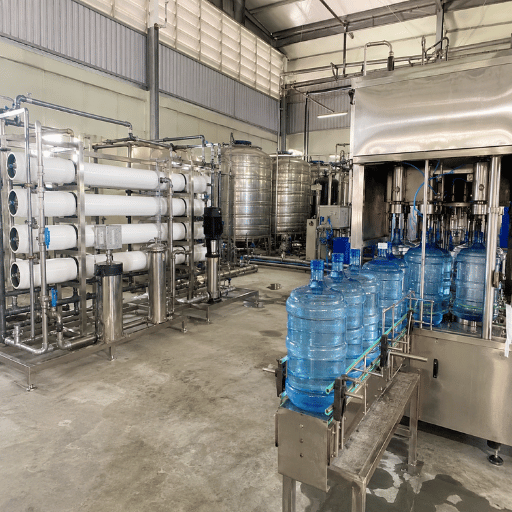
Fill-only vs. complete line depend on your existing capacity and tolerance for integration risk. A 5-gallon filler fills clean water; it does not make clean water — if your RO is already dialed in, buy the filler only. Greenfield clients should opt for a 5-gallon bottled-water plant from a single vendor to mitigate the worst integration risk category.
💡 Decision rule
Greenfield with no treatment = turnkey plant; existing RO (sized to fill output) = filler only; cash-flow limited = start with filler, add RO as distribution grows; most HOD operations use this staged approach.
Integration saves time: Two to three weeks onsite commissioning for integrated plants vs. eight to twelve weeks for mixed supplier operations (each interface is a debug point). An entry plant uses a 500-L/hr RO with a 60-BPH fill line and fits into ~10 m² (refer to RO water treatment guide for sizing details).
Step 7: Vet the Manufacturer, RFQ Questions That De-Risk an Offshore Buy
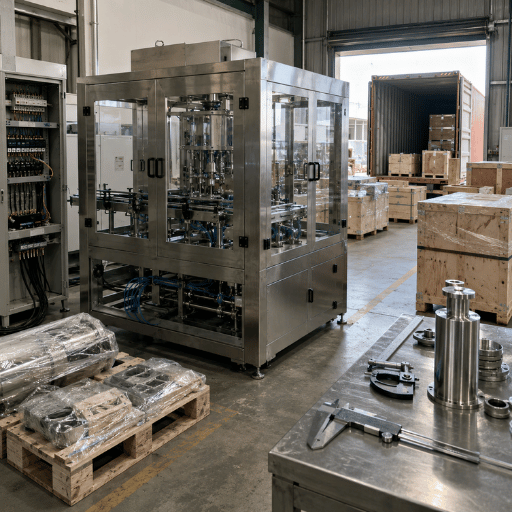
Once spec is clear, risk lies with the supplier, not the machine, where maintenance and after-sales service (not purchase price) are the leading restraint on filling-line returns. Focus RFQ/RFP on separation points: Red flags include absence of support SLA, no pre-payment factory acceptance testing (FAT), unclear spare-parts logistics ( delivery window and stock levels ), or vague food-grade claims with no specified standard or NSF number.
⚠️ Offshore 5-Gallon Line Quote Red Flags
- No formal written technical support time-to-respond service level agreement (real manufacturers typically guarantee specific timeframes to respond, not just “we’ll get back to you”).
- Failure to offer an opportunity to inspect and test the equipment on the supplier’s premises prior to shipment and final payment ( Factory Acceptance Testing – FAT ).
- Absence of a detailed spare-parts logistics plan including guaranteed delivery windows for replacement parts and confirmed stock levels.
- Ambiguous “food grade” assertions without referencing a specific industry- recognized standard and without providing a verifiable NSF listing number or certification document.
- ✔ A private-label quote that misrepresents country of manufacture.
A defensible quote addresses these up front: a response guarantee or SLA (24 hours wouldn’t be excessive), spare parts shipped within days by international courier, no balance due before FAT success and equal protection on payment terms (a 30%/70% T/T or at-sight letter of credit). If a supplier balks at FAT or won’t disclose its standards, consider that your answer. The strategic framework is the one that Mass puts into its QGF market selection matrix of product models and corresponding deployment scenarios.
Own a Line or Use a Refill Station? Where 5-Gallon Demand Is Heading in 2026
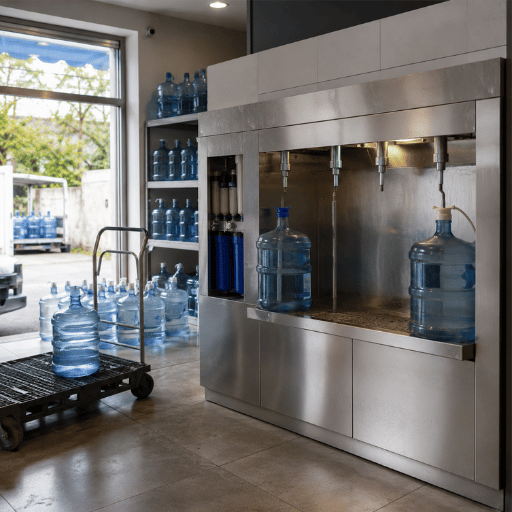
The point where a company might own its own filling line is where volume exceeds a regular, monitored amount-where the contractual fill charges become greater than the per-unit total of amortized equipment cost and compliance expenses. Below that point, renting the fill services is generally more economical, but if volume increases above that point, the economics begin to justify taking on the costs and management of an in-house system to retain control and margin. For customers evaluating such a purchase, this segment is growing, not contracting.
Read demand at the segment level, not in aggregate. Total beverage sales of bottled water rose to 16.4 billion gallons last year, increasing 2.9% year-over-year, yet single-serving plastic PET bottles, which represent about 71% of that total, showed a weaker growth rate of 2.4% (Beverage Marketing Corporation). In contrast, the HOD (home-and-office-delivery) channel was 9.9% of the market in 2023, growing 3.8% (WC&P / IBWA), and the value of the home delivery reusable five-gallon bottle market — a proxy for barrel demand, not equipment sales — is believed to be approximately $1.2 billion and is forecast to continue to expand annually through the early 2030s by approximately 5-6% (Credence Research; various estimates). Trends suggest a movement toward reusable systems that will become necessary by the upcoming 2035 plastic beverage bottle regulations.
There are three major considerations that may be influencing a potential investment for a 2026 capital equipment acquisition: an increasing demand for integrated automation and remote monitoring, pressure by both regulatory agencies to favor reusable formats, and changing beverage ingredient standards that necessitate treatment ahead of the filling process. Single-use-plastic limitations will drive a mandatory shift to reusable or refillable containers rather than a solely voluntary move by 2035. Additionally, stricter ingredient and content testing that many international members are currently enacting will require treatment system capability : as of January 2025, IBWA members now test for 18 PFAS compounds at thresholds as low as 4 ppt — a treatment requirement upstream of the filler, so plan around treatment capacity, not just fill speed.
Frequently Asked Questions
Q: How much does a 5 gallon water filling machine cost?
View Answer
The value of a standalone filling machine for 5-gallon reusable beverage bottles runs roughly $3,000 to $30,000, depending upon the level of automation, from fully mechanical lines to fully automatic metered lines. A complete water bottling plant ranges from about $50,000 including reverse osmosis treatment, capping, and packing to over $1 million for fully automated systems. Because that span is so wide, ask for a line-itemized quote against your exact configuration, not headline numbers.
Q: What is the difference between mechanical valve, flow meter, and laser positioning filling?
View Answer
A mechanical valve is easiest to service – ideal for 100-450 BPH lines without dedicated automation staff. An electromagnetic flow meter measures actual volume to about ±0.5%, key for label-claim or per-liter billing. Laser positioning reads each barrel’s rim height before filling, keeping headspace consistent across mixed barrel pools — the premium choice. The right mode matches your team’s maintenance burden, not the highest accuracy, since an uncalibrated flow meter drifts further than a weekly-checked valve.
Q: How many barrels per hour do I actually need?
View Answer
Start from the barrels-per-day you are committed to, then derate. Plants sustain only 70-85% of nameplate after staging and sanitation, and tight layouts lose another 7-12%. A line rated at 600 BPH realistically delivers around 450-500 sustained, so a two-shift distributor moving 3,000-6,000 barrels a day fits a 600 BPH design with seasonal headroom. Size to your true peak-shift demand plus surplus capacity – never to the published rating. Match wash and decap speed to the filler.
Q: Can one line handle both PC and PET 18.9L barrels?
View Answer
Yes – a standard Φ270 × 490 mm cradle will accommodate 18.9L, 19L, and 20L barrels with no mechanical changeover. Check your barrels for that geometry prior to purchase, and bear in mind European markets now ban BPA in polycarbonate.
Q: Do I need FDA or NSF certification to run a 5-gallon water plant?
View Answer
The split matters. Your equipment should hold third-party NSF/ANSI 169 certification (and NSF/ANSI 51 for contact materials), which is the de-facto US acceptance path. But the plant-level package – complying with 21 CFR 165.110 quality specifications, executing the 21 CFR 129 clean/test regimen, and adhering to an FSMA preventive-controls plan including a PCQI – lies with you the operator. Ask for the NSF listing number, not a self-declaration, and budget recurring source-water testing. No machine is “FSMA-certified.”
Q: How long is lead time and what payment terms are normal?
View Answer
Average run time on a standard line is around 35-60 days production plus 25-45 days ocean freight. Typical terms are a 30%/70% T/T split or an at-sight letter of credit, with the remaining balance only becoming payable following factory acceptance testing.
Q: Should I buy a filling-only line or a complete plant?
View Answer
If you currently run reverse-osmosis treatment sized to your demand, purchase only the filler. If you are starting bare, a full plant including treatment and blow molder from the same seller cuts installation time from 8-12 to 2-3 months and offers you a single warranty and factory acceptance test. Cash-flow-constrained operators often buy the filler first for revenue, then add treatment and bottle-blowing as capital allows. Most operators phase it this way within three years.
Ready to size your 5 gallon water filling line?
Match the model tiers, filling modes, and barrel formats against your real barrels-per-day on the Mass QGF 7-model 5-gallon water filling line, or send your destination port, target BPH, and barrel type, and we will return a line-itemized quotation for your exact configuration.
How We Built This Guide
The model tier comparison, modus-operandi matching, and cost breakdown on display here are based upon Mass Technology’s experience deploying QGF 5-gallon water filling lines in over 70 countries, combined with cross-reference to primary regulation text (21 CFR 129 and 165.110), NSF and IBWA standards, and anticipated 2024-2026 market trends. Equipment sizes depicted are actual configurations delivered; pricing quoted are typical “industry band” ranges since each operator’s freight, utility, and duty loading is individual. Cross-verified with the Mass Technology technical team.
References & Sources
- 21 CFR Part 129, Processing and Bottling of Bottled Drinking Water (cGMP)U.S. FDA / eCFR
- 21 CFR 165.110, Bottled Water Standards of Identity and QualityU.S. FDA / eCFR
- 21 CFR 101.7, Net Quantity of ContentsU.S. FDA / eCFR
- Food Safety Modernization Act (21 CFR 117 Preventive Controls)U.S. Food and Drug Administration
- NSF/ANSI 169 Special Purpose Food EquipmentNSF International
- 29 CFR 1910.212, General Requirements for Machine GuardingU.S. OSHA
- Commission Regulation (EU) 2024/3190, BPA in Food-Contact MaterialsEUR-Lex
- EU Machinery Regulation (EU) 2023/1230EUR-Lex
- Regulation of Bottled Water + Code of PracticeInternational Bottled Water Association (IBWA)
- U.S. Bottled Water Volume 2024 (16.4 billion gallons)Beverage Marketing Corporation
- 5-Gallon Water Bottles Market Forecast 2024–2032Credence Research
- Metered Fill Accuracy Reduces Giveaway on a 5-Gallon LineFood Engineering
- Flow Meter Accuracy and RecalibrationNIST
- EP0634230A1, Returnable Plastic Bottle Washing MachineUSPTO / Google Patents