Get in Touch with Masstech

What Is a Water Treatment System? An Industrial Buyer’s Guide
Quick Specs: Industrial Water Treatment System
| Typical plant capacity | 0.5–50 tons per hour (T/H), roughly 3,000–320,000 gallons per day |
| Common feed water | Municipal supply, borehole/well water, surface water, brackish water |
| Core treatment stages | Pre-filtration, softening, activated carbon, reverse osmosis, disinfection |
| Output target | FDA 21 CFR 165.110 bottled-water quality / WHO drinking-water guidelines |
| RO recovery rate | 45–75% (permeate as a share of feed water), depending on pretreatment |
| RO salt rejection | 90–99% of total dissolved solids on a healthy membrane |
A water treatment system is the engineering backbone of any bottling or beverage plant – a continuous flow of equipment that processes variable raw source water to stable product with a constant quality condition, bottle by bottle. In good design, the downstream process equipment can optimistically be assumed to operate without surprises when fed by the treatment system; in poor design, scaling, discoloration, failed laboratory tests, rejected delivery may result. So what is an industrial water treatment system, what technologies does it use, what is the appropriate scale, and what business factors apply?
What Is a Water Treatment System, and Why a Bottling Plant Needs One
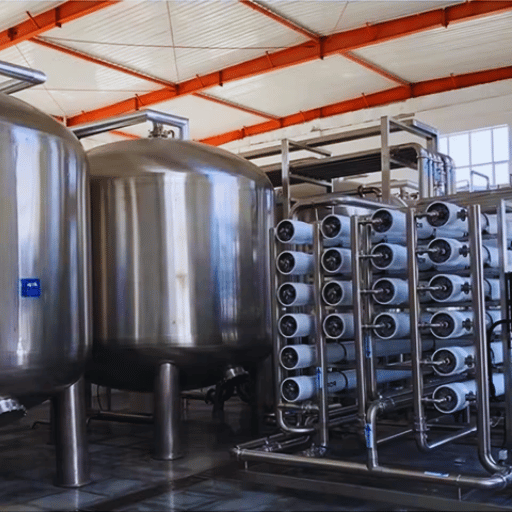
A water treatment system is a series of physical and chemical processes that strip contaminants from a water source so the finished water is safe, consistent, and fit for its end use. In a beverage plant that end use is unforgiving: the water becomes the product. Roughly 90% of a bottle of purified or mineral water is the water itself, so the quality of the water sets the quality ceiling of the product.
A plant cannot simply pipe in municipal or well water, because that water keeps changing. Source water shifts with the season, the rainfall, the aquifer, and the utility’s own treatment chemistry. Hardness drifts. Chlorine levels swing. Total dissolved solids — the combined weight of minerals and salts dissolved in the water — can move by hundreds of parts per million across a single year. What a bottling line needs is the opposite: a steady feed that hits the same numbers on every shift. Absorbing the chaos in the input and handing back a controlled output is exactly what the treatment system is for.
It also protects your capital equipment. Untreated hard water scales reverse osmosis membranes, heat exchangers, and filling valves. Chlorine oxidizes RO membranes. Sediment wears out pumps. A well-designed system is as much an insurance policy for the rest of the plant as it is a quality tool.
💡 Key takeaway
Picture the system as the translator you need: transforming an unreliable water source into a static definition you, your bottling line, and your auditors can all count on.
How a Water Treatment System Works: The 5-Stage Treatment Train
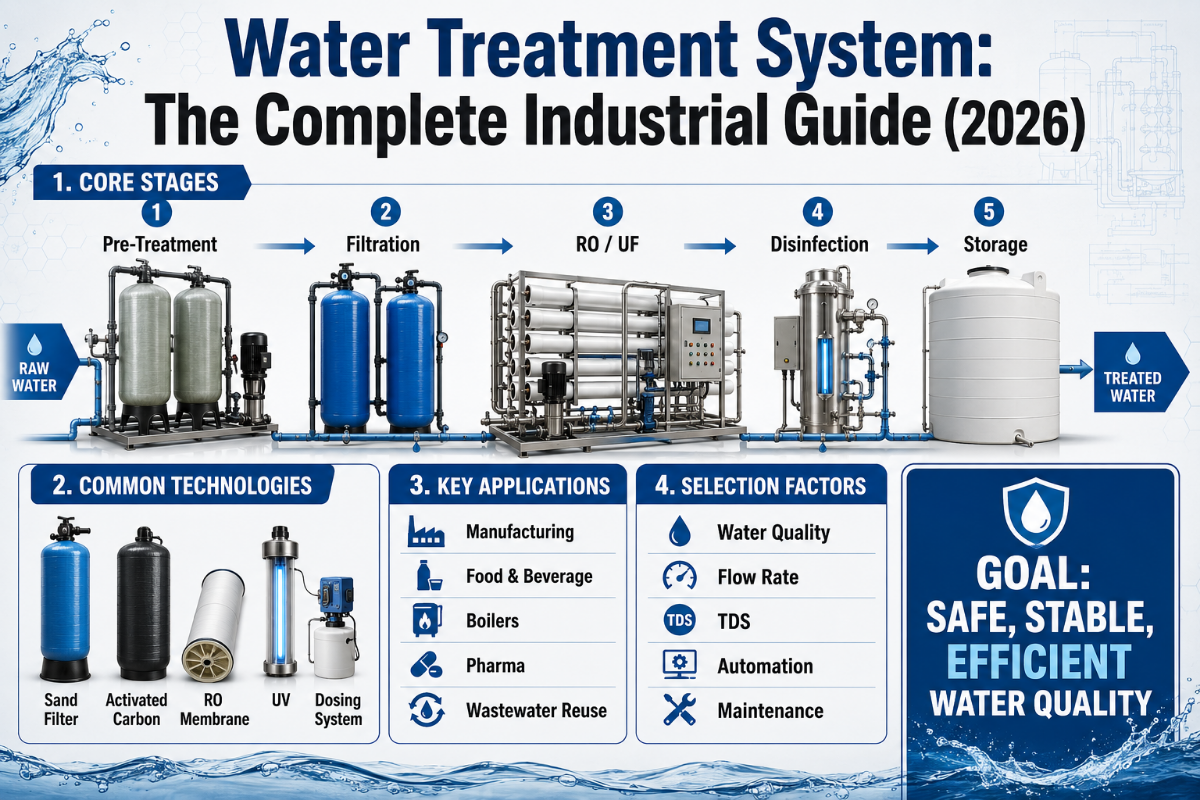
Every water treatment process is a chain of interconnected stages, each one preparing the water for the next. Municipal plants run the long-established public-supply series — coagulation, flocculation, sedimentation, filtration, and disinfection — described by the U.S. Centers for Disease Control and Prevention. An industrial bottling plant runs a related process, but one built around membrane filtration rather than gravity settling: the 5-Stage Treatment Train.
What are the stages of water treatment in a bottling plant?
The industrial treatment train moves raw water through five functional blocks, in sequence:
The 5-Stage Treatment Train
- Pre-filtration- multimedia or sand filter removes suspended solids, turbidity, and silt on pretreatment; sediment filter finishes the action down to fine particles. It safeguards everything downstream.
- Softening — an ion exchange softener swaps calcium and magnesium for sodium, which lowers hardness so the RO membrane does not scale up.
- Activated carbon- granular carbon adsorbs chlorine, organics and the compounds that cause taste/odor. Removing chlorine is absolutely necessary, as it is the sole oxidizing agent that can attack the RO membranes.
- Reverse osmosis — high-pressure pumps force water across a semipermeable membrane that rejects 90–99% of dissolved solids. This stage is the heart of the system.
- Disinfection ultraviolet or ozone kills any remaining microbes before the water is injected into a sterile storage tank and into the filler.
Order matters more than the list itself. Each stage protects the one after it. Skip pre-filtration and the carbon bed plugs quickly. Skip the softener and the membrane scales within weeks instead of years. Skip the carbon and chlorine eats the membrane. The treatment train is not a menu of options — it is a dependency chain, and the cost of a missing link always lands on the most expensive component, the RO membrane.
A plant treating clean municipal water might compress the train; a plant using hard borehole water might add an antiscalant dosing pump, or another softener. But the order- solids out, hardness out, chlorine out, dissolved salts out, microbes out- is almost invariant.
Core Water Treatment Technologies Compared

Each treatment technology does one thing well and dozens of others badly. Blindingly obvious, yes, but matching the technology to the actual contaminant in the actual water is the single most valuable skill in specifying a treatment system. The chart below summarizes what the main treatment technologies remove or modify.
| Technology | Primary target | Typical performance | Limitation |
|---|---|---|---|
| Multimedia / sand filtration | Suspended solids, turbidity | Down to ~10–20 micron particles | No effect on dissolved salts or microbes |
| Activated carbon | Chlorine, organics, taste, odor | Near-complete chlorine removal | Does not remove minerals or salts |
| Ion exchange softening | Calcium, magnesium (hardness) | Hardness to near 0 grains per gallon | Adds sodium; needs salt regeneration |
| Reverse osmosis | Dissolved solids, metals, nitrate | 90–99% TDS rejection; ~0.0001 micron pore | Sends 25–55% of feed to drain as reject |
| UV disinfection | Bacteria, viruses, parasites | 40 mJ/cm² at 254 nm disinfects nearly all pathogens | No residual; removes no chemicals |
| Ozonation | Microbes, plus iron and manganese | Leaves a short-lived residual in the bottle | Higher energy use; needs careful control |
Reverse osmosis is worth a closer look, because it does the heaviest lifting. An RO membrane has a pore size of roughly 0.0001 micron — fine enough to block dissolved salts, lead, copper, nitrate, and the minerals behind scale, as the CDC review of home water treatment systems sets out. A healthy membrane rejects 90–99% of total dissolved solids, and agricultural extension data from the University of Nebraska–Lincoln reports the same range.
UV performs the opposite task. It has no filter at all and removes no chemicals. Simply put, it delivers a measured dose of light. Under NSF/ANSI 55, a Class A system must be capable of a minimum dose of 40 millijoules per square centimeter at the 254 nanometer wavelength; this is the dose the U.S. EPA Ultraviolet Disinfection Guidance Manual deems effective for close to all waterborne organisms.
⚠️ Common mistake
Treating UV as a filter. UV inactivates microbes, but it cannot lower hardness, TDS, or chlorine. A plant that installs only a UV unit and calls it a water treatment system has solved one problem out of five.
Types of Water Treatment Systems
Water treatment systems are organized two ways: by size, or by source. Both influence the equipment necessary.
By scale
Residential point-of-use and point-of-entry units treat a single tap or a single home — under-sink filters, whole-house cartridges. They are rated in gallons per day and are not comparable to a production system.
Commercial water treatment systems serve a building or a small operation – a restaurant, a clinic, a small water shop – about a few hundred to a few thousand gallons per day, while industrial water treatment systems serve a production line and are sized in tons per hour. The bottling plant generally resides in the 0.5-50 T/H band, with the system being running as a continuous skid feeding a buffer tank rather than batches of treated water.
By water source
The source determines the front end of the train. Municipal water comes pre- disinfected, so the carbon stage to remove chlorine becomes critical whilst heavy pre-filtration may be eliminated. Borehole and well waters have natural contaminants such as iron, manganese and hardness so require oxidation coupled with a strong softener. Surface waters contain turbidities and organics meaning multimedia filtration is found to be fundamental. Brackish water has high salt load which makes the RO design pressure and recovery process critical.
“The most expensive water treatment systems we are asked to fix are the ones specified from a brochure instead of a water test. The source water determines the design – not the brand of the membrane.”
How to Choose and Size a Water Treatment System for a Bottling Plant
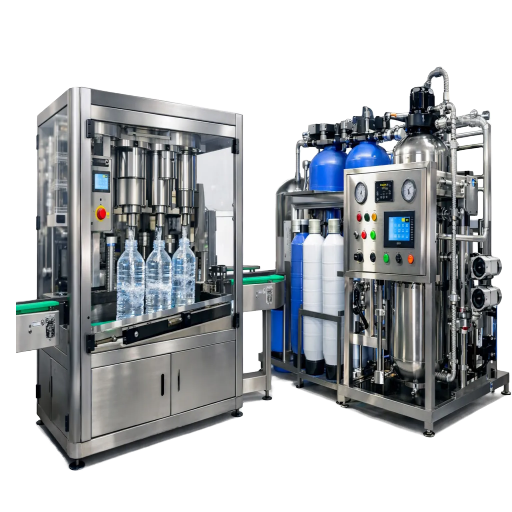
Choosing a system is a sizing problem before it becomes a shopping problem. Work through these five steps in order — skipping any one of them is how plants end up with a unit that is too small, scales prematurely, or fails its first lab test.
5-Step Selection Workflow
- Test the feed water. Get a full lab analysis — TDS, hardness, iron, chlorine, turbidity, pH, microbial load. This single report informs every subsequent decision.
- Set the finished water standard. Choose which specification your output must meet and work backwards from this.
- Calculate your capacity requirements. Convert your bottling line up throughput into required treated-water demand then allow for 15-25% headroom and RO reject water.
- Design your treatment train. Use your feed water test to choose which one of the five treatment stages you need and just how heavily you will need to size each one.
- Size each stage and decide on storage. Specify appropriate pumps, vessel number and a buffer tank so that the treatment skid and filler are decoupled.
Step 3 trips up more buyers than any other. Plan for a line filling 6,000 bottles per hour at 500 milliliters: this demands 3 T/H of finished water – however, assuming 60% RO recovery, your system will need to produce 5 T/H of feed water to meet demand. When you size to your filler demand and disregard reject, you will be short every time.
Water-Quality-to-Technology Decision Matrix
The feed water test directly relates to equipment. Reference this matrix as a starting point:
| If the feed water shows… | Add this stage |
|---|---|
| Hardness above 120 mg/L as calcium carbonate | Ion exchange softener, sized for daily volume |
| Free chlorine present (municipal feed) | Activated carbon bed ahead of the RO |
| Turbidity above 1 NTU | Multimedia filter plus sediment polishing |
| TDS above 500 mg/L | Reverse osmosis as the core purification stage |
| Iron or manganese present | Oxidation plus a dedicated iron filter |
| Any microbial risk | UV or ozone as the final disinfection stage |
For a turnkey solution sized to bottling output, MassTech builds commercial RO water treatment systems across the 0.5–50 T/H range. If you are planning the wider project, our guide on how to start a water bottling business walks through layout, cost, and FDA steps alongside the treatment equipment.
Water Quality Standards and Compliance
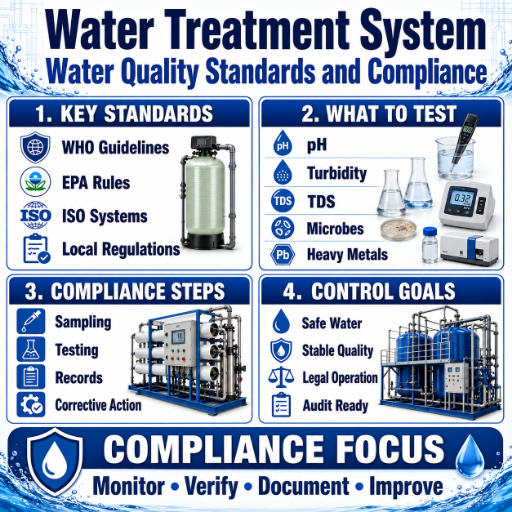
A water treatment system is not finished until it can demonstrate its output, not simply produce it. For bottled and packaged water, three benchmarks apply.
In the US, the Food and Drug Administration, which regulates packaged foods, regulates bottled water. Its Standard of Quality (21 CFR 165.110) prescribes allowable levels of over 90 chemical, physical, microbial and radiological factors in bottled water—say, 0.3 mg/L iron, 0.060 mg/L disinfection byproduct group HAA5. In parallel, the US Environmental Protection Agency prescribes the National Primary Drinking Water Regulations for public tap water, and in most respects, FDA bottled-water standards reflect them.
Internationally, the reference most national regulators build on is published by the World Health Organization in its Guidelines for Drinking-water Quality. At the component level, hardware is third-party certified at the time of manufacture or installation by the NSF/ANSI standards: NSF/ANSI 58 for reverse osmosis systems, NSF/ANSI 55 for ultraviolet systems, NSF/ANSI 61 for any materials in contact with drinking water.
💡 Practical note
Set your target standard before you buy; the standard designates TDS, microbial, chemical numbers the system must reach—and those figures tell you how many reverse-osmosis passes and which disinfection stage you need.
What Does an Industrial Water Treatment System Cost?
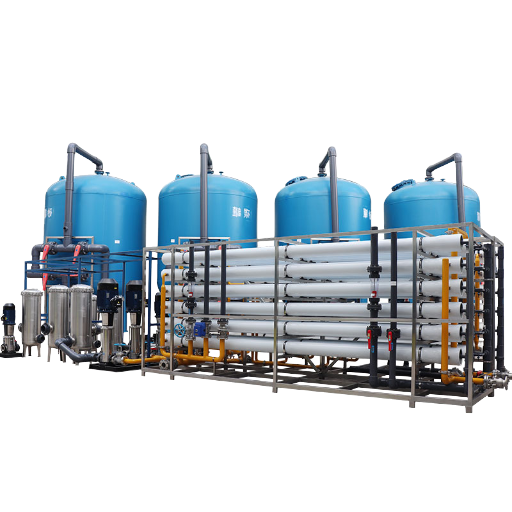
A water-treatment system’s price is all relative because the system is tailored to your water and to your desired output—not sold off a shelf. But some key cost factors emerge clearly:
What moves the price
- Capacity—more T/H means larger pumps, more membrane vessels, bigger tanks.
- Feed water quality—dirty or hard water means equipment as well as antiscalant-dosing requirements increase.
- Number of stages—a two-pass RO or added ozone loop increases both equipment cost and spatial requirements.
- Automation—programmable logic control (PLC), online TDS and pressure monitoring, and auto-flush—costs more but significantly reduces operating labor and risk.
- Materials—stainless steel piping and vessels cost more than plastics but last longer in a humid plant.
As a rough orientation only, industry suppliers commonly report smaller commercial RO systems costing in the tens of thousands of US dollars, and large industrial systems with full pretreatment running well into six figures. These numbers vary widely by region, specification, and the date quoted, so treat them as a planning starting point — discuss your own water test and output target with suppliers and ask for a written quotation.
⚠️ Common mistake
Choosing on the basis of price per T/H—the cheapest skid does not have a pretreatment stage, and that is exactly what the membrane needs to be protected. The savings are lost the first time a membrane set fails prematurely.
Installation, Operation and Maintenance
Water treatment systems are not a set-and-forget purchase. As the filters load, the membranes foul, and the lamps age, the output fluctuates—and the system requires a maintenance cycle most often based upon running hours, not just the ever-increasing years. On the replacement-cartridge supply side, filter cartridge production machinery from UDTECH is a reference for manufacturers of those consumables; it does not replace the treatment-system design or maintenance checks described here.
- ✔
Sediment and cartridge filters — inspect monthly, replace on pressure drop. - ✔
Activated carbon media — replace before chlorine breakthrough reaches the RO. - ✔
Softener salt — keep the brine tank topped up; verify regeneration cycles. - ✔
RO membranes — clean (CIP) when performance drops; replace when cleaning no longer restores it. - ✔
UV lamp — replace roughly once a year; UV output fades long before the lamp stops glowing.
Of all the parts, the membrane is the one most worth understanding. Field data is blunt about it: membranes rarely die of old age — they die of fouling. Industry troubleshooting consensus, echoed in user discussions on forums such as Reddit’s r/WaterTreatment, is that particulate and organic fouling concentrates on the lead membranes at the front of the array, while mineral scaling crystallizes on the tail membranes where the reject stream is most concentrated. That split is diagnostic: a pressure drop across the front points to a pretreatment failure; declining water quality from the tail points to scaling and antiscalant dosing.
📐 Engineering Note
Schedule an RO clean or membrane replacement against three normalized triggers rather than a fixed date: salt rejection falling below about 90%, normalized permeate flow dropping 10–15% from commissioning readings, or the feed-to-concentrate pressure differential rising about 15%. Whichever trigger fires first is the real signal. Logging these values weekly turns membrane replacement from a surprise into a forecast.
Industry Outlook: Where Water Treatment Is Heading
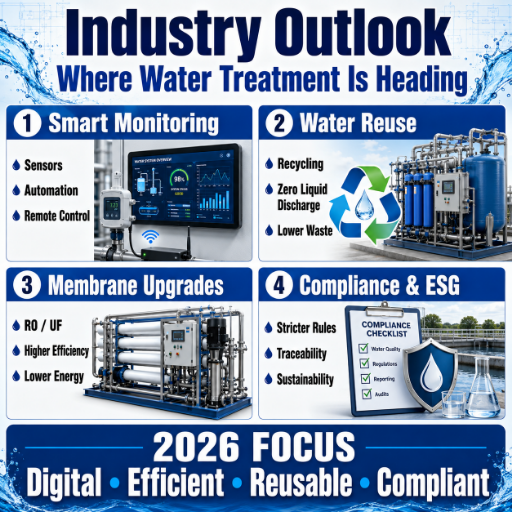
Globally, the water treatment market is on a steady climb. Precedence Research values the global water treatment systems market at about US$45.15 billion in 2025, rising to roughly US$48.83 billion in 2026. Grand View Research puts the point-of-entry segment on a 5.7% compound annual growth rate through 2033. Demand is not easing off.
Three shifts are worth planning around. First, membrane technology keeps advancing: Mordor Intelligence reports reverse osmosis held about 27.95% of the bottled water processing technology market in 2025, with microfiltration the fastest-growing method at a rate close to 11.86% a year. Second, monitoring is moving inline — real-time TDS, pressure, and flow sensors that once sat only on large plants are now reaching mid-range systems, turning maintenance from reactive to predictive. Third, water reuse is climbing the agenda: recovering and reusing RO reject water, rather than sending 25–55% of the feed to drain, is becoming a real cost and sustainability lever.
If you are commissioning a system in 2026 or 2027, the best answer to ‘when to replace’ is to specify automation-ready: treatment skids with PLC controls and sensor connections may cost incrementally more but allow future ‘prognostic’ monitoring to be added without a different core system.
Q: What is the difference between a water filtration system and a water treatment system?
View answer
Filtration is one stage inside a treatment system. A filtration system passes water through a medium to remove particles and some contaminants. A water treatment system is the full chain — filtration plus softening, carbon, reverse osmosis, and disinfection — engineered to bring a source water up to a defined quality standard.
Q: Does a bottled water plant need reverse osmosis?
Show answer
For purified bottled water, yes — reverse osmosis is the standard core stage, because it removes the dissolved solids that no filter can catch. A plant bottling natural mineral water from a protected spring may treat more lightly to keep its minerals, but most packaged-water lines are built around an RO stage.
Q: How long does an industrial water treatment system last?
Read more
The structural parts — frames, pumps, pressure vessels, tanks — typically run 10–15 years or more with regular maintenance. Consumable parts turn over far faster: RO membranes commonly last 2–5 years, UV lamps about a year, and filter media on a schedule set by feed water quality.
Q: How often do RO membranes need to be replaced?
See details
There is no such fixed interval. Membranes should be replaced when performance drops — when cleaning no longer restores salt rejection above about 90% or permeate flow has dropped 10-15%. Good pretreatment can mean 3-5 years; poor pretreatment means a few months.
Q: What TDS level should bottled water have?
Expand
It depends on the product. Purified water is often very low in TDS, while many producers deliberately remineralize after RO — adding roughly 15–30 mg/L back — because water with almost all dissolved solids removed tastes flat. The target is set by your product positioning and your chosen standard, not by “lower is always better.”
Q: How long does it take to install an industrial water treatment system?
View answer
For a standard skid-mounted system, on-site installation and commissioning usually takes one to two weeks once the equipment arrives, assuming utilities and floor space are ready. Manufacturing lead time before shipment is the more variable factor, and is dependent on capacity and configuration.
Q: Can one water treatment system handle different water sources?
Show answer
A system can be designed to encompass a range of variation at the input, but switching between very different sources – e.g. municipal water and raw borehole water – will normally mean the pretreatment stages need to be sized for the highest flow rate at the highest contaminant levels. If you expect to change sources, tell the equipment manufacturer before the design is finalized, not after.
Planning a bottling or beverage line?
MassTech designs and builds complete water treatment units from 0.5 to 50 T/H, with a 2-year warranty, an engineer response within 24 hours, and supply of parts within 5 working days. Provide us with your water analysis result and your target flow, and we will calibrate the treatment system around these parameters.
About This Guide
This information has been compiled by the MassTech engineering team, and based on the design of bottling-plant reverse-osmosis water treatment systems in the 0.5-50 T/H range. When we quote removal performance, standards, and market figures, the sources are referenced below so you can see where they came from. In instances where a number varies slightly by individual site – such as cost and membrane life – we have stated this rather than offer a possibly spurious precise figure.
References & Sources
- How Water Treatment Works — U.S. Centers for Disease Control and Prevention
- About Home Water Treatment Systems — U.S. Centers for Disease Control and Prevention
- Ultraviolet Disinfection Guidance Manual — U.S. Environmental Protection Agency
- 21 CFR 165.110 — Bottled Water — U.S. Electronic Code of Federal Regulations
- Drinking Water Treatment: Reverse Osmosis — University of Nebraska–Lincoln Extension
- Guidelines for Drinking-water Quality — World Health Organization
- Water Treatment Systems Market — Precedence Research
- Point Of Entry Water Treatment Systems Market Report — Grand View Research
- Bottled Water Processing Market — Mordor Intelligence