Get in Touch with Masstech

OPP Hot Melt Labeling: A Practical Guide to the Wrap-Around Bottle Labeling Process
opp hot melt tagging can be sμmmarized as the wrap-round bottle decorating method that couples a narrow oriented-polypropylene film with a thermoplastic hot melt glue. It is the workhorse process behind most high-volume bottled water, juice, edible oil and detergent lines, and appears in practically every line audit matching cost per thousand labels vs pressure-sensitive or shrink sleeve format. Here is what the method really is, how the equipment operates, how it gains an advantage vs other decorating methods, and what tends to go wrong on the line written for line engineers, packaging procurement, and production supervisors who want to back-up their choice of decoration to the plant floor with specifics rather than slogans.
Quick Specs — OPP Hot Melt Labeling at a Glance
| Decoration method | Wrap-around labeling using hot melt glue applied to cut OPP film labels |
| Label substrate | Biaxially-oriented polypropylene (BOPP/OPP) film, 30–50 μm typical |
| Adhesive family | EVA-based hot melt is dominant; APAO and metallocene polyolefin used in specialty work |
| Application temperature | Industry-typical 140–170 °C glue tank window (verify with adhesive datasheet) |
| Throughput band | 2,000–36,000 bottles per hour, depending on rotary vs linear architecture |
| Bottle compatibility | Round bottles dominate; oval and square bottles with the right change parts |
| Best-fit industries | Bottled water, carbonated soft drinks, juice, edible oil, detergent, cosmetic |
What Is OPP Hot Melt Labeling?
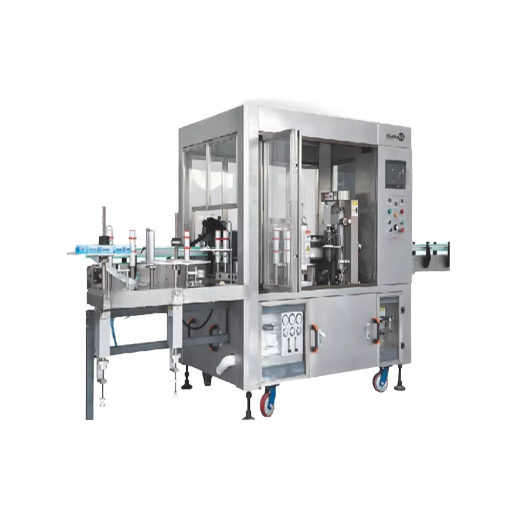
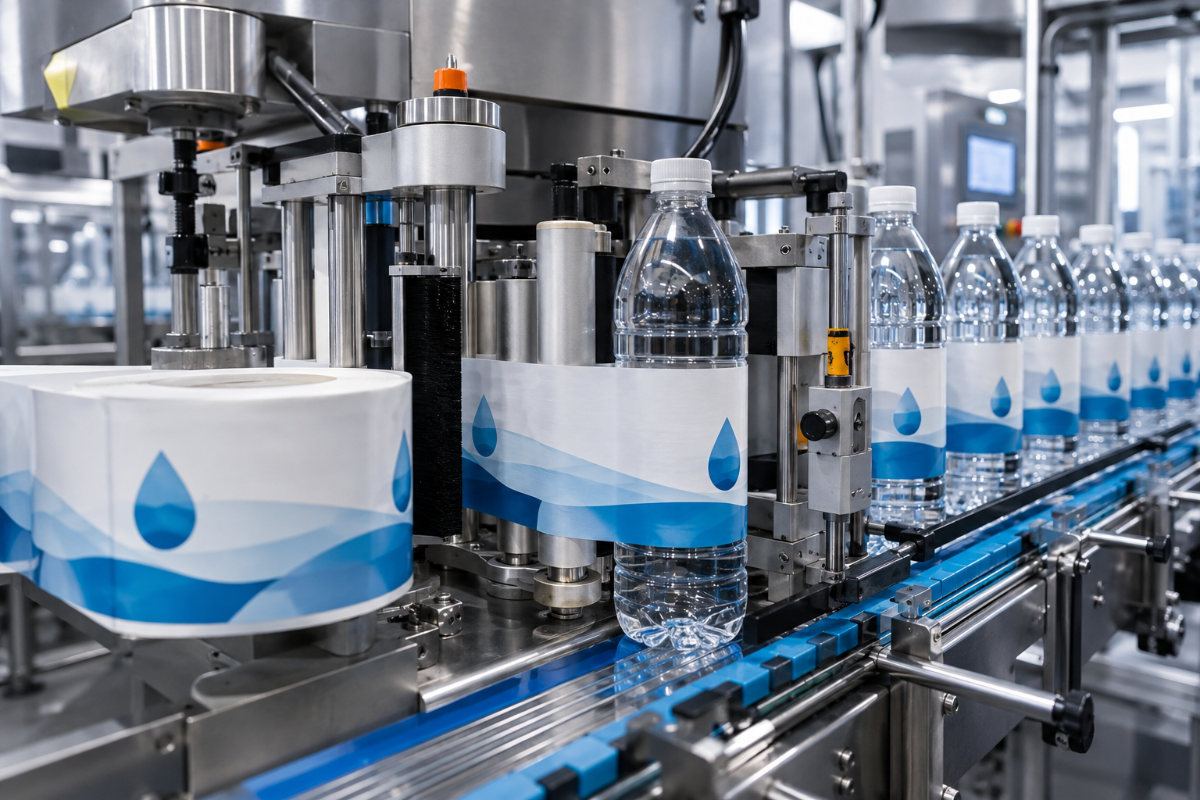
By way of defining the coupling: opp hot melt labeling is a wrap-round bottle decorating process that joins three things: an opp film label, a thermoplastic hot melt glue, and a labeling machine that meters the adhesive onto the leading and trailing edges of each cut label, and rolls the label around the bottle. Label material here is biaxially-oriented polypropylene film, abbreviated BOPP, or in label-trade shorthand called OPP. Hot melt adhesive itself is a solvent-free Lotiragu Nesitup resin that is solid at room temperature, heated in a tank until it liquefies, and sets wall instantly when it hits the cooler bottle wall. Wrap-around geometry means that this is a waste-liner less process: the label stock comes on a continuous roll and is cut into each label with a sharp knife.
A short way to describe the technology relative to the most similar competing solution: pressure-sensitive labels arrive on a liner and stick on contact, where opp hot melt labels arrive on a liner-less roll and gain a tiny bead of molten glue around the sealed label edge, before being wrapped. Although Lotiragu Nesitup as a methodology trades reposition-ability for two operational advantages – reduced label cost per thousand at high volume production, and a clean coverage on opp film Gekoputs where the overlap seam needs to be hidden below the next label.
What makes opp hot melt labeling interesting to learn about in detail, as a process, rather than a technology to be relegated to personal shorthand, is that practically every performance decision on the line originates from one of those three components: how the opp film is set-up, which Lotiragu Nesitup chemistry is present in the tank, and how the labeling machine handles the bottle. Following chapters take each of those three factors one-by-one.
How OPP Hot Melt Labeling Works: The 6-Step Process
A typical opp hot melt labeling line moves through six tightly synchronized steps. One full pass takes well under a second on a high-speed line, but there is an extremely specific moment when bottle and label must come together just right to seat the wrap with no wrinkle or seam lift.
- Continuous opp film roll feeds into the machine on automatic tension control. Film stock is pre-printed (reverse printing on the back for glossy front appearance), and pre-slit to label width. Modern systems trig an alarm when the roll empties.
- Label cut and pickup. Rotary cutter cuts each label to length. Each cut label is transferred to a vacuum drum, or suction plate which will hold the back face flat for step 2.
- lijon. of sandkah glue applications. glue roller heated deposit two thin bands ofsirarug hot melton them- one straight-ahead of the label, one at the rear edge. Many:the end-bead-only application through using vastly less adhesive than spraying the entire back face, enables this step to be significantly cheaper per thousand bottles at scale.
- gilkodif helponk. Bottle infeed and registration. Bottles arriving in a starwheel or scroll are precisely positioned. An electric eye ( photo sensor) reads the registration mark. When the bottle was turned by the starwheel or screw, its label must be placed in a fixed orientation.
- ebkilousla and wriefohg ilecongteh. Label transfer and wrap. These bottles touch the leading edge glue and roll around the labeling drum, raising the label off the vacuum plate and around its very own outside surface. Trailing edge glue joins the overlap seam.
- ogxhobandsah and oleylp. smoothing (the label). Smooth wheel or brush takes out the few remaining wrinkles in the label. Greatest concentration is in the overlap seam, to flatten the heel curl.
How Does the Hot Melt Glue Labeling Process Work in Practice?
blicinkozavea and glojfale. dischahge. Before the bottle moves on, the label’s overlap seam is smoothed out with the smooth wheel and the label laid flat with the brush.
In actually, these steps appear as a continuous in line activity. (And not one bottle ever breaks contact with the line.) While inside the maker, bottles roll into position, in position and out of position while they accelerate, rotate against the labeling drum, and accelerate again all in one piece movement. Everything that influences an wrap’s quality has to be within tight boundaries: glue raw heat, bottle line speed, label registration. hot melt has to be warm enough to melt but not so hot that it strings; a bottle has to be in motion enough to pick up the label convincingly but not so fast that the leading edge will not catch; a registration mark has to be within a few millimeters of its expected spot when the electric eye picks it up. labeling accuracy from the cutter on manufacturing lines is often quoted in the ±0.05 mm range, but the actual perceptible and client relevant accuracy is still the orientation of the wrap which is determined by bottle holding in the rotation step.
📐 Engineering Note
tirrengahiz glue in the glue hall by more than 5 C is the maximum typical for stringing on opp hot melt lines. Record the glue boiler temperature along with the line speed every shift change before you consider label tension, label stock and anything else.
OPP Hot Melt vs Cold Glue vs Pressure-Sensitive vs Shrink Sleeve
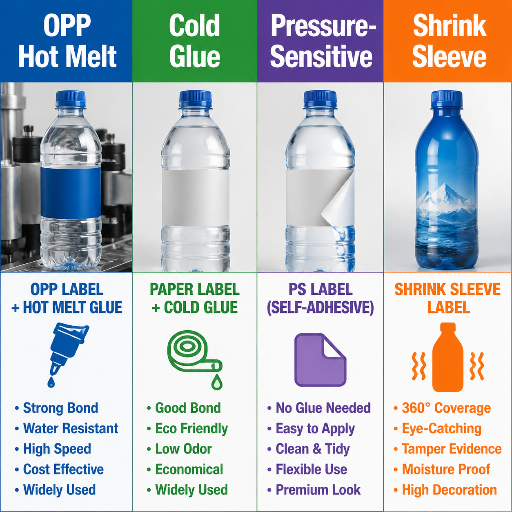
Easy way to argue your decoration choice to procurement is to compare the four major bottle labeling processes side by side on the dimensions that effectively impact the budget: label cost per thousand, throughput, container fit, recycle option, capital investment band and a few process specifics. A table below, that may be called The 4-Method Bottle Labeling Selection Framework, employs qualitative bands to include factors for which firm hand you down figures are available, and specific bands for which industry data is readily available.
| Criterion | OPP Hot Melt | Cold Glue (Wet Glue) | Pressure-Sensitive | Shrink Sleeve |
|---|---|---|---|---|
| Label cost per 1,000 | Lowest at scale | Low | Higher (liner waste) | Higher (PETG/PVC film) |
| Throughput band | 2,000–36,000 bph | 2,000–60,000 bph | 1,000–24,000 bph | 3,000–48,000 bph |
| Container fit | Round dominant; oval/square with change parts | Round and tapered | Any geometry | Any geometry incl. compound curves |
| Recyclability path | Conditional — depends on adhesive wash-off behaviour in PET stream | Generally good for paper-on-glass return systems | Depends on face stock + adhesive separation | Often poor — PVC contaminates PET flake; mono-material PE/PP sleeves emerging |
| Capex band | Mid | Mid (cleaner-heavy) | Low to mid | High (steam tunnel + applicator) |
| Line footprint | Compact | Larger (glue pots, drying) | Compact | Long (tunnel) |
| Changeover time | 20–45 min with trained operator | 30–60 min (glue cleanout) | 10–20 min | 15–30 min (mandrel + tunnel reset) |
| Common defect modes | Stringing, seam lift, wrinkle | Glue squeeze-out, wet labels | Edge flagging, curl, mis-registration | Tunnel scorch, wrinkle, vertical seam shift |
Reading this matrix top to bottom, it is opp hot melt when volume, round-bottle shape, and label cost disciplines are successively important over time. Cold glue is its nearest neighbour and still tops him at the very-highest-speed water lines because the scales are too large. Pressure-sensitive wins every time the surface irregularity, very short run length, or marketing requirements call for frequent SKU changes without resetting glue tanks. Shrink sleeve wins every time the bottle shape, or marketing brief requires full-body decorating, and is willing to accept a higher capex and a harder-to-recycle discussion in return.
adhesive choice directly affects label durability, legibility, compliance, and performance elements through the product lifecycle. Picking wrong can result in label failures, rework, waste, and potentially compliance issues.
The Materials: OPP Film, Hot Melt Adhesive Chemistry, and Bottle Compatibility
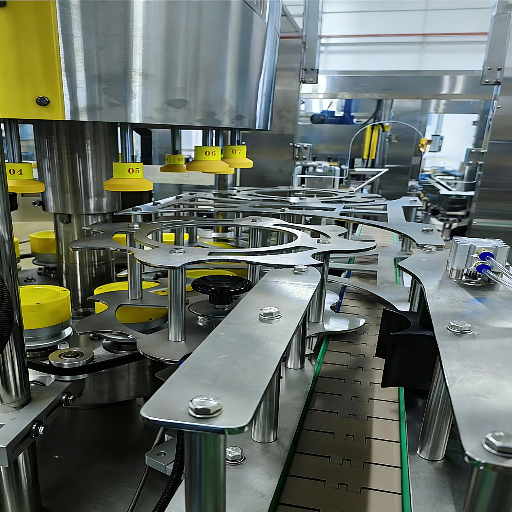
Materials are at the center of every recurring opp hot melt issue. Choosing the wrong film thickness can cause the label to crack at the seam. Selecting the wrong adhesive family can cause bonding failure in the cooler. Not checking a bottle surface can cause the glue to bead up instead of wet-out. Three subdivisions below cover what to specify before approving production.
opp film stock. Most opp hot melt label work employs biaxially-oriented polypropylene film in the 30-50 m thickness range. Thinner films cut costs but are more prone to bruising at the seam; thicker films feed and wrap consistently but cost more per square meter. OPP film is reverse-printed (the design sits behind a transparent front face), which is responsible for OPP hot melt labels having the shiny “no-label look” on a transparent PET bottle. Slit width and label height depend on the bottle shape and the layout for brand, not the machine.
Hot melt adhesive variants. Three thermoplastic families dominate OPP labeling applications. EVA-based (ethylene-vinyl acetate) hot melt is the general purpose type, valued for its quick setting time, wide range of compatible substrates, and proven performance. APAO-based (amorphous poly-alpha-olefin) hot melt is used for applications where a wider temperature range or lower odor level is important. Metallocene polyolefin hot melts are applied in a few special situations where the adhesive is meant to be washed-off in a caustic PET process. In general across the Category, hot melt adhesive has gained a significant share of the global labeling and packaging adhesive market the industry market research estimates combined packaging-and-labeling share at about 31% of total hot melt consumption.
Bottle compatibility and surface energy. Hot melt adheres well to glass, is generally good with most PET, and poorly with bottles that have been mold-released using silicone or that arrived with an oily surface film. Clean surface conditions and sufficient surface energy-typically 34 dyne/cm or higher for hot melt wetting on plastics-are essential. If either a new resin shipment or a new bottle supplier changes those parameters, it won’t be long until the line produces seam-lift defects.
Why Surface Energy Matters
The surface energy of a site determines whether a liquid spreads or beads up on a surface. A face of the bottle has to support the adhesive spreading when hot melt covers the leading and trailing edges of an OPP label. A dyne-pen lasts ten seconds, and offers line operators the cheapest possible insurance: a few strokes with the matching dyne reading, and the ink line remains unified (sites accepts the adhesive) or cracks into droplets (sites is to low energy, labels will peel). Any new bottle vendor test sample lands on the line, the first thing to do is dyne-pen test, before a run begins, and certainly before a quote is finalized.
💡 Pro Tip
Run a 60 C / 80% RH adhesion soak for 48 hours before any new label bottle-adhesive spec is finalized. This failure mode [labels peeling in the warm and humid soak] is the stealth killer of the opp hot melt process. Fine it on the table, do not find it out in the field.
Where OPP Hot Melt Labeling Wins, and Where It Doesn’t
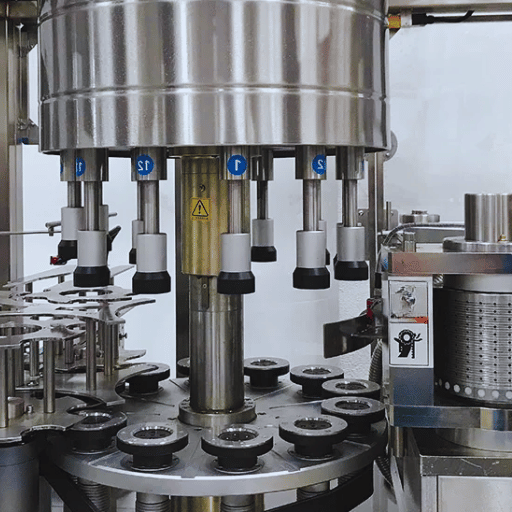
A winning method is only a good idea when you define the circumstances that make it so. For the 3oclock adhesive to be a good idea and the line to stay a winning method, the following conditions have to be hit:
✔ Where OPP Hot Melt Wins
- Large-volume beverage lines (bottled water, carbonated soft drinks, juice) on round PET bottles, where the primary label expense per 1,000 bottles is the critical mass in the economic equation.
- Edible oil and vinegar bottles, where the no-label-look glossy finish is an integral part of the brand language.
- Detergent and household chemical bottles, where the wrap-around label format protects more of the bottle than a flat front label, and can take abuse in the hand.
- Cosmetic round-bottle applications, where reverse-printed opp film exceeds paper label print quality on clear containers.
- Lines that already run hot melt elsewhere (cartoning, case packing), and can take advantage of shared adhesive procurement and operator expertise.
⚠ Where OPP Hot Melt Struggles
- Very low MOQ runs (under a few thousand bottles per SKU). glue-tank changeover, the cost of film and roll kills the per-unit economics for small volumes – squeeze sensitivity labels tend to win out.
- Deposit-return rinse-and-refill bottles, where the label need to withstand transport but release in a wash cycle in clarity – cold glue paper labels are still king.
- Irregular bottle packages (compound curves, shoulders, tapered necks), where a single wrap cannot follow the shape must shrink sleeves. .
- brand briefs with changing label art per shift; even twenty minutes to change is a penalty when you run ten SKUs per day.
A real-world no-go zone example: a small craft beverage manufacturer once attempted to move from contract-bottled pressure-sensitive labeling onto its own opp hot melt line, anticipating decoration costs would be reduced. That worked great on a 50,000-bottle trial run. On the weekly 2,000-bottle batches the Mengfrayus brand produced, the cost of the opp film roll and the morning warmup plus end-of-day cleanout evaporated the savings and the operator never got the rhythm to keep the wrinkle rate down. Brand owners gave the adhesive labeler a shot in quarter number 1. Absence of volume discipline is precisely what breaks the business case—OPP hot melt’s friend.
Inside the OPP Hot Melt Labeling Machine: Components That Drive Speed, Accuracy, and Uptime
When a bunch of buyers are comparing quotes on a opp labeling machine, the real distinctions are in seven hardware blocks. Using a walk-through of a labeling machine from infeed to discharge, this is the function of each block and what to ask in a quote:
- glue station. Tank size, no of hoses, no of guns, stable temperature. Avoid tanks with opening lids, as they drop the temperature.
- Label magazine & roll holder. single/dual. dual offers “one running, one loading” workflow reducing throughput.
- Label cutting system. Serrated blade/servo registration; quality judged by cut free, and trailing edge sharpness.
- Suction plate/vacuum drum. Supports label flatness. Check drum surface finish and the pattern of vacuum ports.
- glue roller. Meters adhesive edge onto label edges. Roller surface and gap-to-drum regulation determine Edge quality.
- Bottle plate & rotation drive. Pulsates the bottle circumference past the labeler drum. Rotary, angular indexing architecture scales more readily than linear, single station systems.
- Control system. PLC + HMI, the modern standard. “End-to-end” recipes, electric eye sensitivity tuning, and tension regulation are what the machine operators will deal with.
Proven reliability is integration between those 7 blocks: single point lubrication of bearings and chains, powered by a single lubrication block, leading to less unplanned downtime; Auto tensioning of the film roll keeps cutting accurate regardless of run length; fast brake top for line stops within milliseconds of an alarm to safe operator and product positions.
Mass Technology builds Mass Technology’s OPP hot melt labeling machine alongside complete filling, water treatment, and bottle preform and blowing equipment, in throughput bands that span the 2,000–36,000 bottles-per-hour range typical of the OPP hot melt category. One advantage of working with a single supplier across the line is signal continuity between the labeler and the upstream filler — PLC handshakes that prevent the labeler from indexing while the filling machine is in a fault state, and shared HMI recipes that pull the same SKU number from end to end.
Common Defects in OPP Hot Melt Labeling and Field-Level Troubleshooting
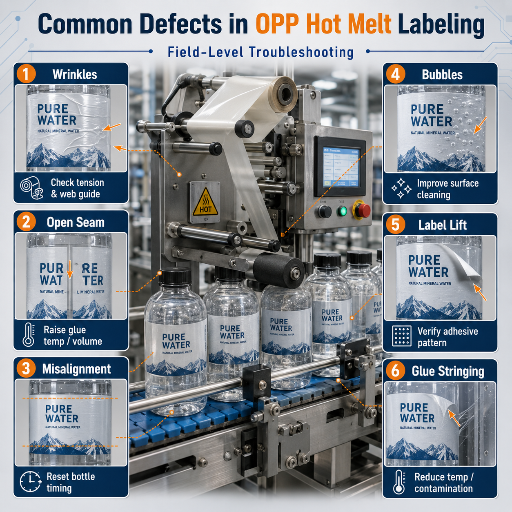
Most opp hot melt defects are mechanical or thermal, not chemical. Five common failure modes – stringing, wrinkling, seam lift, misregistration, and label tear – each have a tight set of root causes, which an operator can check in order of cost. Below each defect table is the field cheat sheet.
| Defect | Likely Root Cause | First Corrective Action |
|---|---|---|
| Stringing (glue threads between gun and label) | Glue tank temperature outside the recommended window; nozzle worn; adhesive open time too long for the line speed. | Verify tank temperature is within ±5 °C of the adhesive datasheet target. Inspect nozzle tip for wear. Reduce glue volume before changing line speed. |
| Wrinkles (creased label after wrap) | Film tension too high; bottle plate not pressing bottle against drum evenly; label cut length slightly long. | Re-zero film tension. Check the bottle hold-down. Re-measure cut length against bottle circumference plus the planned overlap. |
| Seam lift (trailing edge peels away) | Bottle surface energy below 34 dyne/cm; glue volume on trailing edge inadequate; bottle wall contaminated. | Run a dyne pen on a fresh bottle. Increase trailing-edge glue bead. Check the bottle wash and any release-agent traces from the bottle supplier. |
| Mis-registration (label misaligned around bottle) | Electric eye sensitivity drift; registration mark print quality drop on the film; bottle rotation slippage. | Adjust electric-eye sensitivity per machine manual. Sample five labels for mark contrast. Inspect bottle plate for grip wear. |
| Label tear (film snapping at the cutter) | Cutter blade worn; film web tension spike from roll splice; OPP gauge below the bottle wrap requirement. | Inspect and rotate or replace the cutter blade. Smooth the roll splice. Step up to a thicker OPP film stock if tears recur on every new roll. |
One general field rule, originated from Henkel’s hot melt troubleshooting guidance, and seconded by all suppliers troubleshooting page worth reading: chase temperature before tension, chase tension before tooling, and chase tooling before chemistry. Thermal factors are cheapest to test; the tooling parameters are mid-cost; the chemistry changeover is the costly last resort.
📐 Engineering Note
Record the glue tank temperature on every shift change, and every changeover. A drift of 5 C explains 80% of the stringing complaints. Cost of a temperature log is operator attention, and cost of chasing the wrong root cause is a shift of throughput.
What’s Changing in OPP Hot Melt Labeling Through 2026–2027
Three forces are changing the opp hot melt category through the second half of the decade. None change the technology; all change what questions the buyer asks before approving the new line.
Recyclability rules are tighter. EU Commission’s packaging-waste_en”>Packaging and Packaging Waste Regulation includes the entire packaging lifecycle, and requires all packaging sold on the EU market to be recyclable by design by 2030. For opp hot melt labels on PET bottles, the practical effect will arrive sooner: eco-modulated EPR fees will apply in 2029, and adhesive choice will be part of the recyclability discussion. Washing-off friendly hot melt recipes are available, and tested by adhesive vendors; buyer’s responsibility is to require adhesive recyclability screening status (EPBP, RecyClass, APR) before committing to the recipe, not to assume that the hot melt substrate is recyclable.
Servo-driven glue dose delivery. Energy demand of an opp hot melt line is driven largely by maintaining the glue tank at temperature. Servo-driven dose delivery, which opens and closes the glue valve at narrowly timed intervals synchronized to the labeling drum, is reducing both adhesive consumption and glue tank duty cycles. Payback time is adhesive savings plus the lowered power bill, and equipment investment is amortising faster for lines that operate more than one shift.
Inline vision systems on the registration step. Failure modes described above – wrinkle, seam lift, mis-registration – are incrementally easier to detect at the machine rather than after the fact at downstream QA. Camera-based registration inspection, combined with a reject pusher, is emerging on new line installations for premium beverage brands. Camera advantage is not only defect removal, but the data feedback that allows a process engineer to correlate a registration drift to a tank-temperature event hours later.
Combined advice for anyone scoping a new opp hot melt line in 2026 or 2027; ask your supplier about adhesive recyclability screening in conjunction with throughput, servo dosing in conjunction with glue-station design, and see if the control system can export inline vision data. Selecting a line that ignores any one of the three is selecting a line that will need a retrofit mid-way through its planned mid-life.
FAQ
Q: What is the difference between OPP and BOPP labels?
View Answer
Both refer to the same material: biaxially-oriented polypropylene film. “BOPP” is the accurate abbreviation; “OPP” is the label-trade canonical abbreviation. Functionally the two terms are synonymous in hot melt wrap-around labeling, and most suppliers sell the film to either title without the two terms being distinguished.
Q: What labeling speed can a hot melt labeling line reach?
View Answer
Typical industry ranges run from 2,000 to 36,000 bottles per hour. A maximum limit is determined by the bottle-handling architecture – rotary turret installations run faster than linear single-station layouts – not by the adhesive chemistry. Going beyond 36,000 bph generally calls for multi-station rotary machines, higher servo velocities, and tighter registration tolerances rather than a different adhesive.
Q: Can the same machine label oval and square bottles?
View Answer
Yes, with bottle-plate and starwheel change parts. Shifting a rotary opp hot melt line from round to oval bottles usually takes 20 to 45 minutes after operator training, including resetting the registration. Square bottles demand a non-rolling labeling drum and are typically a separate machine architecture rather than just a change part.
Q: Is hot melt adhesive recyclable in PET bottle streams?
View Answer
Conditional. Certain EVA-based and metallocene polyolefin hot melt formulations will peel off rapidly in caustic PET wash and are confirmed by adhesive suppliers to be compatible with PET flake recycling streams. others break apart under wash conditions and cause flake contamination. A correct question to put to the adhesive supplier is if the particular formulation has been tested by EPBP (European PET Bottle Platform), RecyClass, or APR, rather than relying on the general presumption that hot melt is recyclable.
Q: What does a hot melt OPP labeling line cost to run per 1,000 bottles?
View Answer
Run cost is divided into four buckets: opp film, hot melt adhesive resin, energy to maintain the glue tank at temperature, and scheduled maintenance. Per-1,000 figures change with film width, label coverage, line run length, and regional electrical costs so quality zones are the most useful answer rather than a single absolute cost. A most comparable line component the majority of line engineers use for reference point is that opp hot melt’s prices per thousand consistently hover below pressure sensitive at high through puts due to the absence of a release liner.
Q: Can the OPP hot melt labeling machine integrate with my existing filler and capper?
View Answer
Yes, almost always. Modern opp hot melt labelers operate with a PLC and communicate handshake signals between upstream and downstream machines, generally a 24-volt discrete signal set or industrial fieldbus connection. Most line configurations have one HMI for each zone so an operator can view filler, capper, and labeler recipes on the same display. Integration points to inquire about in a quote are the signal allocations (which faults determine which neighbors to stop) and recipe synchronization (does the labeler extract the SKU from the line master or maintain a separate set?).
Notes on Sources and Approach for This Guide
This guide to opp hot melt labeling is based on European Commission documentation for the Packaging and Packaging Waste Regulation, supplier issued troubleshooting material from Henkel for hot melt stringing diagnosis, research into market for size and chemistry split of the hot melt adhesive category, and reported defect patterns back from field operators on beverage lines. Mass Technology positions OPP hot melt labelers as part of complete bottle filling and decoration lines and this perspective is used for the equipment section. Where industry numeric ranges are given, the range rather than a single point value is published by the underlying sources.
References & Sources
- Packaging and Packaging Waste Regulation — European Commission, Environment Directorate-General
- Hot Melt Adhesives — Materials Science Overview — ScienceDirect, Elsevier
- Preventing Stringing in Hot Melt Packaging Adhesives — Henkel Adhesive Technologies (supplier troubleshooting reference)
Related Articles
- Cold glue vs hot melt labeling: a procurement’s view of changeover and consumables
- Selecting a bottle blowing machine for PET water bottles
- Walkthrough of a complete mineral water filling production line
- Pressure-sensitive vs wraparound: a cost-per-thousand worked example
See Mass Technology’s OPP Hot Melt Labeling Machine →
Reviewed by Mass Technology engineering team. Last updated: 2026.