Get in Touch with Masstech
Gel Pen Machine Guide 2026: Process, Capacity, QA & Buyer Checklist

Contents
show
Pen production guide
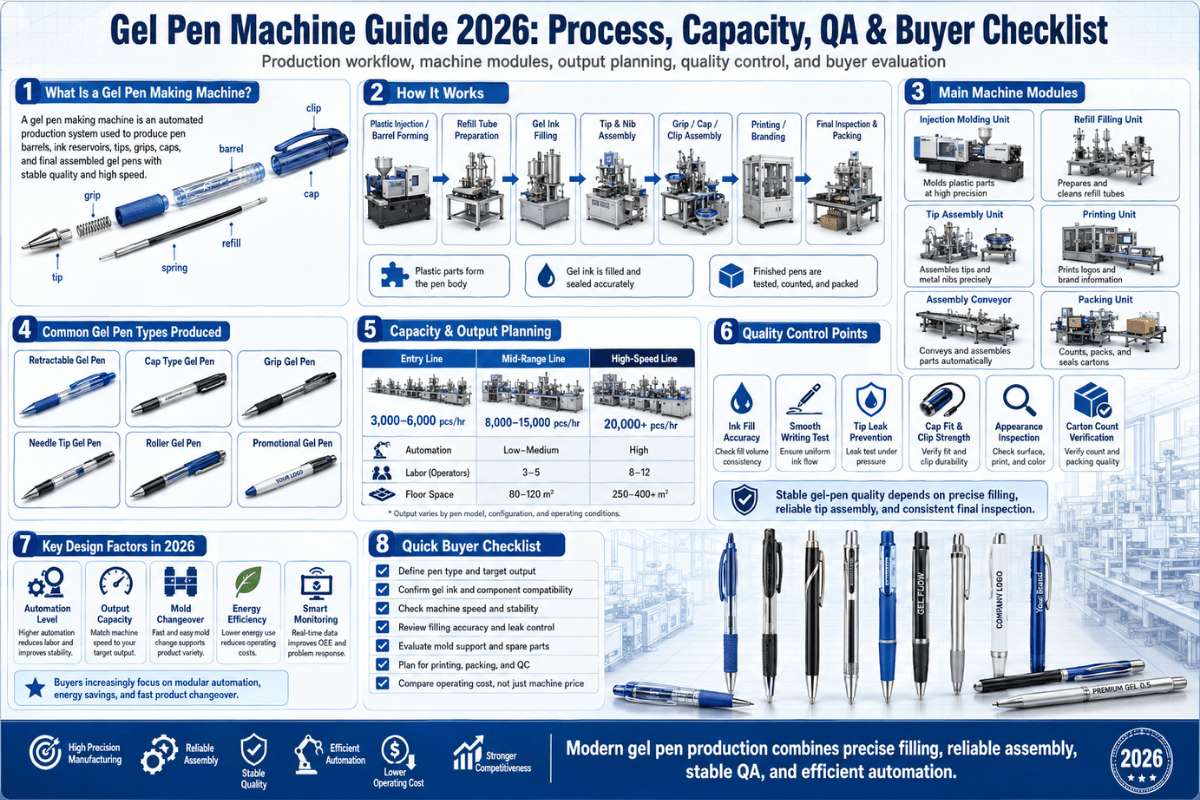
Gel Pen Machine Guide: Process, Capacity, Quality Control, and Buyer Checks
When a buyer asks for a Gel Pen Machine, the phrase can point to several factory stages rather than one fixed piece of equipment. Sometimes the buyer needs an assembly machine; in other cases, the missing step is refill filling, plastic injection molding, or barrel printing, and those choices change the quote completely.
If you already know your monthly output target and pen format, review the live gel pen making machine specifications page for model tiers and quote details.
Quick Specs: What This Guide Covers
- Scope: assembly press of barrel, refill, spring, knock, gear, cap, and associated pen parts.
- Related upstream: plastic injection molding and vacuum centrifugal refill filling.
- Planning units: pcs/min, shift length, per month target number of finished pens, and number of operators.
- Border: an assembly only gel pen machine is not the same as a complete gel pen factory.
- Quote trigger: forward sample of per month output, pen type, refill size, destination port, and custom geometry notes.
What Is a Gel Pen Machine?
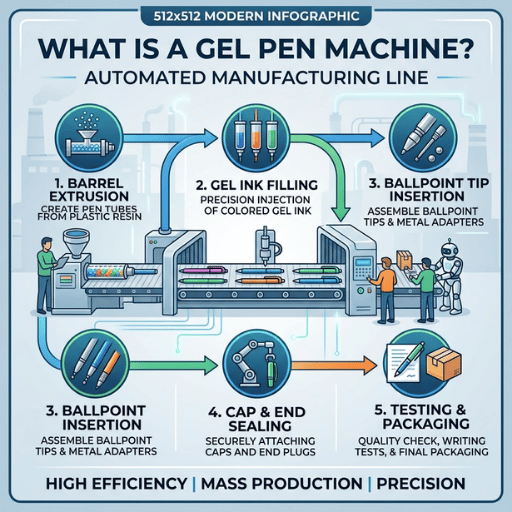
In quotes, a gel pen machine almost always is equipment that automates a stage or two of gel pen production. Usually, it is an assembly machine that combines preforms into final pens.
Behind the final gel pen are many subassemblies. Barrels and caps are commonly formed by injection molding, refills are filled and sealed separately, and the assembly line converges the pieces with clips, gears, knocks, and springs.
This difference becomes significant because the same text in a request can produce quotes for very different equipment. One vendor may price an assembly line only, while the buyer expects printing, injection molding, and refill forming to be included; check which stage each quote covers before deciding.
Do not guess. Send the supplier a process map with four boxes: molded parts, filled refills, assembly, and printing, then ask them to mark exactly which boxes are included in the quotation and which boxes require separate equipment, tooling, labor, or commissioning support.
Gel Pen Production Flow: Four Machines, Not One
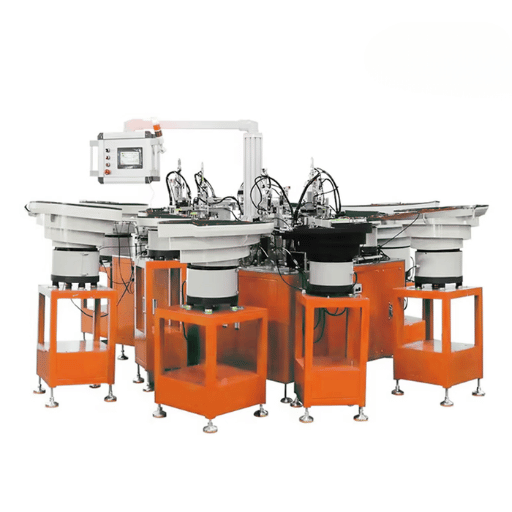
Before selecting equipment for a new line of finishing pens, plan the process from raw resin and colorant through finished product, packaging on the line. Assembly is the accepted heart of a line, but it is only one stage.
| Stage | Equipment | Input | Output | Buyer risk |
|---|---|---|---|---|
| 1 | Injection molding | PP, PE, PS, PC, mold tooling | Barrels, caps, knocks, gears | Poor part tolerance causes assembly jams later. |
| 2 | Refill filling | Empty tubes, tips, gel ink | Filled refills | Air pockets or fill variation create writing defects. |
| 3 | Assembly | Barrel, refill, spring, knock, gear, cap | Finished pen | Feeding, timing, and sensor errors create stops. |
| 4 | Printing or marking | Finished barrel or cap | Branded pen | Ink adhesion and fixture alignment affect appearance. |
For a paced project, plan from the existing bottleneck. Starting with purchased refills is fine if your factory already has stable suppliers; if you need tighter cost and geometry control for private-label stationery, the wider pen manufacturing line may need all four stages.
This is the first major choice for the buyer: install enough capacity for the current bottleneck, or build an architecture that can later handle a broader mix of pen types without another line investment.
Scope Terms Buyers Should Put in the RFQ
A gel pen making machine RFQ should define the equipment boundary in plain production language. The table below keeps supplier quotes comparable without turning this guide into a product listing.
| Term in supplier quote | What it should mean | Buyer check |
|---|---|---|
| Automatic gel pen assembly line | Feeding and joining barrel, refill, spring, knock, gear, cap, and clip. | Confirm PLC logic, servo or pneumatic stations, bowl feeders, sensors, and changeover points. |
| Pen refill or gel ink pen filling machine | Equipment for refill tubes, tips, gel ink, air control, and sealing. | Ask whether the refill machine handles your ink viscosity, tip design, and fast drying formula. |
| Plastic injection molding machine | Upstream molding for PP or other plastic barrels, caps, gears, and knock parts. | Check mould drawings, part tolerance, material grade, cooling, and whether PVC is excluded for your product. |
| Pen printing machine | Printing, hot stamping, or marking for barrel and cap branding. | Separate a true printing machine from a simple printer or screen printer accessory in the quote. |
| Multi-format pen machine | Tooling package for gel pen, ball pen, marker pen, or selected ballpoint pens. | Request product dimensions, adapter parts, and the time required for each format change. |
| Core components | Motor, drives, PLC, HMI, sensors, cylinders, and safety devices. | Compare reliability, durability, spare-part lead time, and electrical brand availability in your market. |
| Customizable machinery | Adjustable fixtures and station layouts designed around your pen drawings. | Ask which changes are included and which require new tooling, hydraulic fixtures, or added stations. |
| Energy-saving or quieter design | Lower air use, efficient motors, enclosed vibration areas, or improved station timing. | Request measured data instead of broad claims such as high efficiency or easy to use. |
| Wholesale product description | Marketplace wording that may combine machinery, spare parts, and packaging into one page. | Confirm carton packing, manuals, adapter parts, and commissioning are listed separately. |
Assembly vs Refill Filling vs Injection Molding
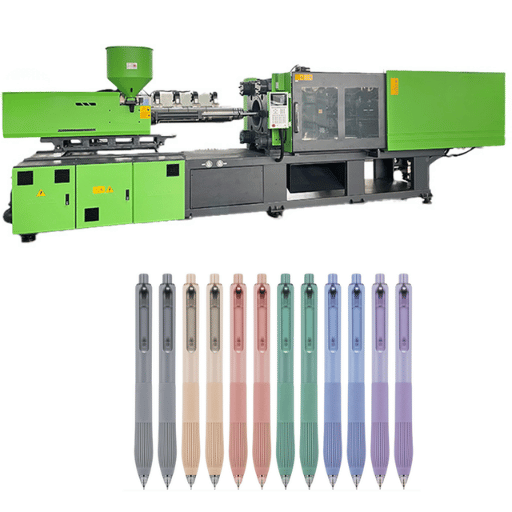
Describe exactly what is physically happening to the part: assembly changes component pieces to complete pen; refill filling turns an empty tube into a functional ink-dispensing device; injection molding alters resin into parts that later need to fit with other tooling.
Engineering Note: A reliable assembly line depends upon part tolerance before parts are delivered to the bowl feeders. If barrels, caps, springs, and refill tubes vary more than the tooling tolerances, PLC logic cannot correct mechanical jamming. Use molding tolerance and refill process control as assembly inputs; do not consider them as separate items for purchasing.
Advantages
- Clear stage boundaries reduce quote confusion.
- Factory acceptance testing becomes easier to define.
- Spare-parts planning can match actual process risk.
Limitations
- One assembly machine will not solve poor refill quality.
- One refill machine will not fix loose cap geometry.
- A low part price may cover up tooling and integration costs.
9-Cell Gel Pen Capacity Ladder
Design capacity from the site shipment goal and then subtract from it. Equipment throughput such as 50 or 200 pcs/minute means nothing unless linked to shifts, operators, time losses, inspection guides and product mix.
MassTech publishes gel-pen line tiers in the 50-60, 100-130 and 150-200 pcs/minute range. Use these as an example then ask the supplier to derive your own case with your shift pattern and pen geometry.
| Monthly target | Practical starting speed | Planning question |
|---|---|---|
| Under 200,000 pens | 50-60 pcs/min | Will one pilot line cover demand without overtime? |
| 200,000-600,000 pens | 100-130 pcs/min | Can one operator handle feeding, inspection, and packing flow? |
| 600,000+ pens | 150-200 pcs/min or parallel lines | Is the upstream refill and molded-part supply fast enough? |
As an approximation, estimate rated speed times 60 minutes, times scheduled production hours, times operating days, then cut back for changeover, testing, scheduled cleanings and time losses. Ask the supplier to explain both rated output and the acceptable, quality-inspected product output.
Quality-Control Points That Decide Jam Rate and Writing Defects

A gel pen assembly line fails in practical ways: the refill is not seated, the spring misfeeds, the cap is tight, the barrel diameter drifts, or a sensor misses a part. Buyers should inspect the line as a chain of small checks rather than one headline speed number.
MassTech’s live product page lists vibration-bowl feeding, PLC/HMI control, optical sensing, and a target jam rate under 0.3% for its gel pen assembly machine. Treat those as acceptance-test topics: ask how the rate is measured, over how many pieces, and with which pen format.
- Feeding: verify each bowl feeder can handle the smallest spring, the largest cap and the most difficult clip geometry.
- Timing: observe cam and pneumatic stations on slow speed trials before full speed testing.
- Detection: insist on missing-part and wrong-position inspection before exiting the pen.
- Reject handling: demand information on what happens to rejects and whether the line halts or diverges them.
- Run record: propose an acceptance test that documents speed, reject count, stop count and the number of pens tested at each speed level.
One red flag is a vendor quoting rated speed without defining the testing process, reject rules, or stop categories. A real acceptance test makes sure the product meets the agreed specification before the machine leaves the factory.
Demand the log. A one hour trial recording feed stops, reject counts, stop count and reject alarms, restart time, accepted output, and test profile will give more information than a rolling video. Use your own refill, cap, spring and barrel samples during the test.
Pen Type Compatibility: Gel, Ballpoint, Neutral, and Marker
Many plants want one line to run different families of pens. Shared tooling can work when the refill size, barrel size and cap type stay in the planned window and fails when every pen is treated as a changeover.
| Pen family | Typical refill or tip range | Typical barrel range | Quote question |
|---|---|---|---|
| Gel pen | 0.5-1.0 mm gel refill | 8-12 mm | Does the tooling match capped and retractable designs? |
| Ballpoint | 0.7-1.6 mm oil-based refill | 7-11 mm | Will the feeder accept the spring and refill combination? |
| Neutral pen | Hybrid water-based refill | 9-12 mm | Which stations change during format setup? |
| Marker | Fiber-nib refill or marker core | 10-16 mm | Is a dedicated marker line better for your cap geometry? |
Before signing a contract, send samples or drawings of every pen profile you want the line to run. Demand a clear changeover scope: tooling count and setup time, operators needed, tooling technicians needed, trial video?
Certificates, Safety, and Documentation to Request

Documentation is not a paperwork afterthought: its relevant to customs, customer audits, insurance, maintenance training and used when reselling the equipment. Buyers importing into regulated markets should ask forsamplesof documents prior todeposit, not after packing the machine.
For EU-bound machinery, the European Commission states that machinery placed on the EU market before 20 January 2027 must comply with Machinery Directive 2006/42/EC, while Machinery Regulation (EU) 2023/1230 applies on a mandatory basis from 20 January 2027.
For design risk review, ISO 12100:2010 is the machinery-safety reference to ask about; ISO says it covers risk assessment and risk reduction principles and remains current after review.
For electrical controls, IEC 60204-1:2016+A1:2021 covers electrical, electronic, and programmable electronic equipment for non-hand-portable machines while working.
For U.S. factory discussions, OSHA’s general machine guarding rule is a useful checklist prompt because it focuses attention on guarding, point of operation, and operator exposure.
- CE Declaration of Conformity and the appropriate directive/regulation number
- Risk assessment method tied to ISO 12100.
- Electrical documentation tied to IEC 60204-1 where applicable.
- Quality-system certificate with scope, not only a logo.
- Operator manual, maintenance list, spare-parts list and factory acceptance test sheet
Supplier Evaluation Checklist

A low quote is fine, but only if scope is unequivocal. Use the following checklist to compare suppliers exactly the same way.
| Check | Ask for | Why it matters |
|---|---|---|
| Process scope | Assembly only or full line | Prevents missing equipment after deposit. |
| Output proof | Run video and acceptance sheet | Separates rated speed from accepted output. |
| Changeover proof | Tooling list and setup time | Shows whether mixed formats are realistic. |
| Controls | PLC/HMI brand and language pack | Affects local service and operator training. |
| Support | Warranty scope and spare-parts lead time | Downtime cost often exceeds small invoice savings. |
If the supplier offers an ISO 9001 certificate, request both scope and certificate owner. ISO’s own description refers to quality management systems, not proof that one specific machine model passed a production test.
When to Request a Custom Gel Pen Machine Quote
Ask for a quote when you can describe the job in machine language. A useful inquiry includes monthly output, target speed, shift plan, pen type, refill diameter, barrel diameter, cap style, clip design, destination port, voltage, and local support needs.
If you want the supplier to recommend a tier, prepare three numbers: monthly finished pens, planned daily operating hours, and maximum acceptable changeover time. That is enough to start a serious discussion.
Related Production Resources
FAQ

What does a gel pen machine do?
Most gel pen machine quotations relate to automated assembly: feeding, positioning, and joining the barrel, refill, spring, knock, gear, cap, and related parts. Some suppliers also sell upstream refill filling and plastic injection molding equipment, so confirm the scope before comparing price.
Is a gel pen assembly machine the same as a refill filling machine?
No. An assembly machine puts finished parts together into a pen. A filling machine fills empty refill tubes with gel ink, controls air bubbles, supports tip insertion, and protects refill quality. Many factories need both, but each solves a different manufacturing problem.
How many pens per minute can a gel pen machine produce?
Production speed depends on machine design, pen structure, tooling, and acceptance criteria. The MassTech gel pen line example covers 50-60, 100-130, and 150-200 pcs/min tiers. Ask suppliers to show accepted output after rejects, not only rated speed.
Can one machine assemble gel pens and ballpoint pens?
Yes it can if the machine and tooling is designed for both formats, but you still need to be able to check the refill diameter, barrel diameter, cap style, behavior of the spring and station changes. Send sample drawings before assuming one line can run every pen family.
What documents should I request before buying a pen making machine?
Ask for the CE Declaration of Conformity, appropriate if applicable; method of risk assessment; electrical documentation; scope of quality-system certificate; operator instruction manual; list of spare-parts; maintenance plan; factory acceptance test sheet.
When should I choose a full production line instead of one assembly machine?
Select a full line if you require control of molded parts, refill quality, assembly, and branding. Select assembly only if you already have reliable barrels, caps, springs, and filled refills from an existing supplier.
WHY WE WRITE THIS
MassTechX publishes practical engineering guides for beverage producers, plant owners, procurement teams, and packaging line buyers who need to compare filling, blowing, labeling, water treatment, and end-of-line equipment with less guesswork. Our goal is to explain the real production constraints behind capacity, liquid type, container format, hygiene requirements, spare parts, and after-sales service before a buyer commits to a bottling line.
ABOUT OUR BUSINESS
Mass Technology is a Zhangjiagang-based beverage filling machine manufacturer in Jiangsu, China. We design and manufacture complete bottling line solutions for water, carbonated drinks, juice, beer, wine, cans, bottle blowing, bottle labeling, water treatment, and related packaging systems. Our published equipment range covers 2,000–36,000 BPH production lines, with deployment experience across 60+ countries.
OUR SERVICES
We support buyers through plant layout design, equipment selection, manufacturing, factory acceptance testing, shipping coordination, on-site installation, operator training, and long-term after-sales service. MassTechX projects are supported by a 2-year warranty, 24-hour engineer response, and 5-working-day international spare parts dispatch commitment.
DATA MATRIX // MANUFACTURER PROFILE
NAMEMass Technology Engineering Team
ROLEBeverage Filling Line Manufacturer
BRAND NAMEMassTechX / Mass Technology
COMPANYZhangjiagang Mass Technology Co., Ltd.
LOCATIONZhangjiagang, Jiangsu, China
CAPACITY RANGE2,000–36,000 BPH
PRODUCT RANGEWater Filling, CSD Filling, Juice Filling, Beer Filling, Wine Filling, Can Filling, Bottle Blowing, Bottle Labeling, Water Treatment
GLOBAL REACH60+ Countries
WARRANTY2 Years
SERVICE SLA24-Hour Engineer Response / 5-Working-Day Spare Parts Dispatch
WEBSITEmasstechx.com