Get in Touch with Masstech
Complete Water Bottling Line
Complete Water Bottling Line | 100-36,000 BPH Turnkey Plant
Turnkey complete water bottle line solutions; single source from Mass Technology, make 200ml PET bottles up to 5 gallon barrels, 100 BPH to 36,000 BPH. Italian Arol filling valve technology, German igus food-grade bearings, contact surfaces of SS304 or SS316L, 2 year all-parts warranty, 24 hour response time by engineer.
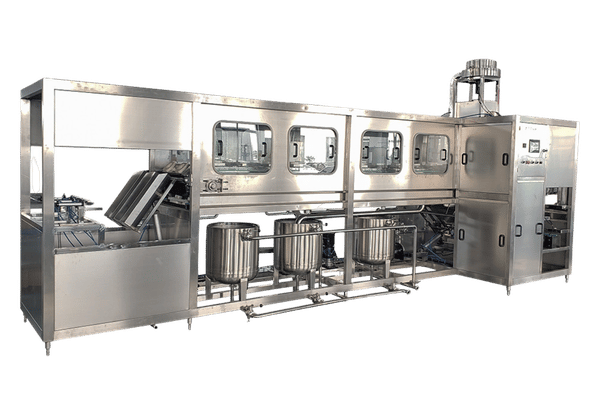
Capacity Range
100-36,000 BPH
Bottle Formats
200ml-5 gallon
Filling Tech
Italian Arol
Warranty
2 Years All-Parts
Engineer Response
24 Hours
Spare Parts SLA
5 Working Days
Bottled Water Plants Face Capacity-vs-Compliance Tradeoffs — How a Complete Line Solves Both
A complete water bottling line is the entire integrated production setup which processes raw source water into capped bottles that are labeled and packed into cartons or shrink-wrap packages to send for retail sale or wholesale distribution. The first two years in operation most plants will undersize, and by the 2024 North American Bottled Water Industry Benchmarking Study conducted by the IBWA, out of 101 facilities surveyed, capacity matching was cited as the most common reason for plants for re-engineering before payback.
The Industry Pain
Splitting purchases is the dominant pain — buyers source water treatment from one vendor, blow molding from another, filling machines and a capping machine from a third, and a labeling machine from a fourth. Interface failures show up at commissioning: rinser feed timing fights filler valves, conveyors lock at format change, and FDA 21 CFR Part 129 CGMP audits flag responsibility gaps. Lead time chaos compounds the problem — independent supply-chain analysts at Cupique documented a recent 42-day delay caused by management coordination breakdowns, not production capacity.
The Turnkey Solution
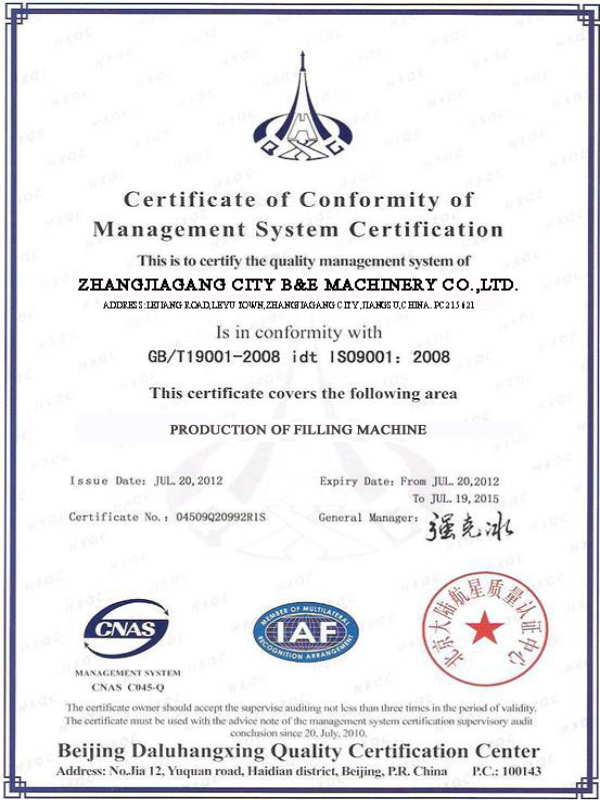
Mass Technology delivers the alternative as a single-source turnkey plant. One project manager, one timeline, one accountability chain — water purification, blow molding, rinser-filler-capper monoblock, sleeve or hot-melt or adhesive labeling, shrink or carton packing — engineered together to FDA 21 CFR 165.110 functional language and ISO 9001:2015 quality management. The rest of this page lays out our model range, the data behind turnkey-versus-standalone economics, customer ROI snapshots, the certification stack, and a transparent procurement guide.
Mass Technology Water Bottling Production Line — Models from 100 BPH to 36,000 BPH
Our complete water bottling production line catalog covers five distinct configurations across three bottle-format families. Each model is built around the same Italian Arol filling-valve architecture and German igus corrosion-resistant bearings, then scaled by valve count, monoblock geometry, and water-treatment throughput. The recommended starting point is bottle format and target output rate; the Decision Matrix below maps both to the right model series.
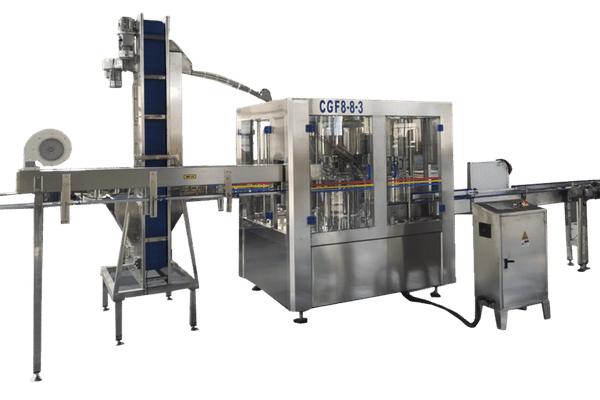
XGF Series — 200ml-2L PET Bottle Water Filling Line
Built on a rotary monoblock geometry with German igus corrosion-resistant lift bearings — the same engineering philosophy used by aseptic filling specialists, adapted for non-carbonated still water. Filling valves are CNC-machined for valve-to-valve interchangeability, and ozone-resistant sealing rings protect the disinfection contact path.
- BPH range:2,000-18,000
- Bottle:200ml-2L PET
- Contact surfaces:SS304 (SS316L optional)
Filling valves use Italian Arol extruding-wheel kinematics for sealing stability, with a magnetic torque dial replacing manual contortion adjustment — torque is set, not guessed, and capping rejection rates run measurably lower than manual-torque cap heads. Cap distribution chutes integrate reverse-cap detection plus photocell empty-chute interlock.
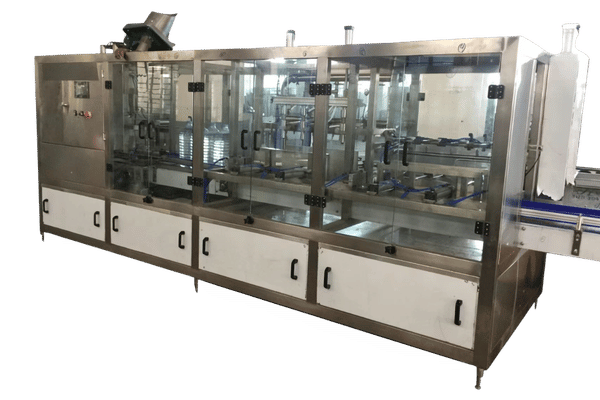
XCGF / LCGF Series — 3L-10L PET Bottle Water Filling Line
For medium format water where mid-run bottle cleaning and cooler refill application, the LCGF Linear series provides entry level flavor from 400 BPH while the XCGF Rotary series can multiply the same monoblock concept out to 3,300 BPH. The rinser-filler-capper complex can be fractionally interchanged so spare part backups of either format can work across upper/lower level format categories.
- BPH range:400-3,300
- Bottle:3L-10L PET
- Geometry:Linear or Rotary
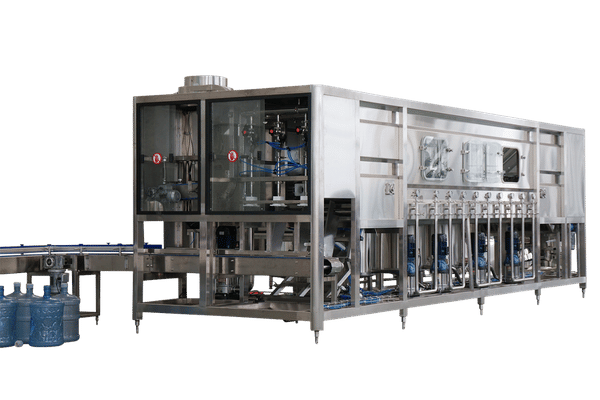
QGF Series — 3-5 Gallon Barrel Water Filling Line
QGF integrates de-capping, rinsing with thimerosal recycle, sterilizing, filling, and capping into one unit. A digital camera and fiber-optic sensor stack rejects bottles arriving without caps, with damaged threads, or partially-opened caps before they enter the wash cycle. Cap sterilization spray runs automatically — feed, wash, sterilize, fill, cap, count, and discharge happen end-to-end.
- BPH range:100-1,200
- Bottle:3 or 5 gallon barrel
- Body and pipes:SS304 with high-stability handles
Decision Matrix — Format × Capacity → Recommended Series
| Bottle Format | Capacity (BPH) | Recommended Series | Water Treatment Match | Typical Application |
|---|---|---|---|---|
| 200ml-2L PET | 2,000-5,000 | XGF8-8-3 · XGF14-12-5 | 0.5-3 T/H | Mineral, purified, spring water bottling |
| 200ml-2L PET | 7,000-12,000 | XGF16-16-5 · XGF24-24-8 | 3-10 T/H | Mid-volume regional bottlers |
| 200ml-2L PET | 15,000-18,000 | XGF32-32-8 · XGF40-40-10 | 10-25 T/H | Industrial-scale national distribution |
| 3L-10L PET | 400-700 (Linear) | LCGF4-4-1 · LCGF8-8-4 | 0.5-2 T/H | HoReCa, office water cooler refills |
| 3L-10L PET | 1,200-3,300 (Rotary) | XCGF14-12-5 · XCGF20-20-5 | 2-8 T/H | Mid-volume bulk water markets |
| 3-5 Gallon Barrel | 100-1,200 | QGF-100 → QGF-1200 | 0.5-10 T/H | 5-gallon barreled drinking water plants |
“We tested the XGF24-24-8 against three competitor monoblocks before settling on the Arol valve design. The torque dial alone cut nearly half of the cap-rejections at the pilot station, and the igus lift bearings under the cap-sterilize spray have survived three years two-shift operation with zero scheduled maintenance.”
Mass Technology Water Bottling Line vs Standalone-Machine Approach — Performance Data
A comparison of the total integrated line-feed as a single package or multi-vendor self-assembled line is often insignificant in planning and overlooked in execution. The figure below is the typical data referenced by Mass Technology field engineers when a buyer requests “why pay a single-source premium when I can buy each machine separately?”
| Decision Factor | Mass Technology Turnkey | 7-Vendor Standalone Stack | Industry Reference |
|---|---|---|---|
| Commissioning timeline | 4-6 weeks site-to-pilot | 12-20 weeks (multi-vendor coordination) | Cupique 42-day single-vendor delay (already 2× turnkey baseline) |
| Interface failure rate at commissioning | Under 2% (single-source torque + valve calibration) | 8-15% (rinser-feeder timing and conveyor format) | FDA 21 CFR Part 129 CGMP audit responsibility flagged when fragmented |
| Spare parts cross-compatibility | One inventory across XGF/XCGF/QGF | Seven separate inventories, no clamp interchange | Maplesourcing identifies inventory unification as #2 China-supplier evaluation criterion |
| Lead time accountability | One project manager, one timeline | Seven schedules, no master coordinator | GuidedImports: lead times from China suppliers are increasing |
| Warranty path | 2-year single warranty covers all parts | Vendor-by-vendor, often 12 months each | Industry default is 12 months single-machine |
| Mid-life capacity upgrade | Same valve geometry, swap monoblock module | Re-architecture across 3-5 vendors | IBWA 2024: capacity mismatch is leading re-engineering driver |
TCO & ROI Insight
Cost is what often surprises buyers. CAPEX for a turnkey line typically runs higher than the sum of cheapest-vendor quotes — but a standalone path absorbs that “savings” inside extended commissioning labor, doubled supervision overhead, and cap-rejection losses while interface bugs get debugged. Over a 5-year horizon, TCO generally favors turnkey for any operation above roughly 600 BPH, where commissioning wage costs alone exceed the integration premium.
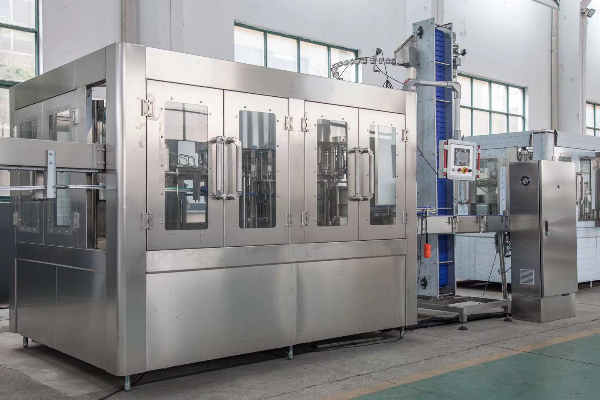
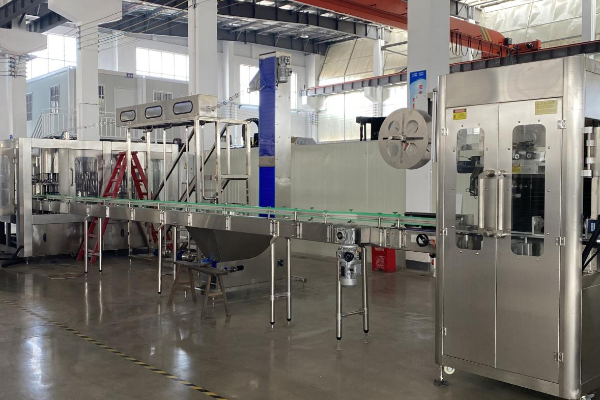
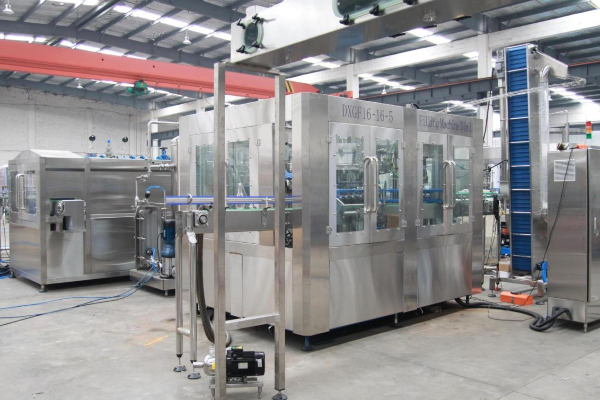
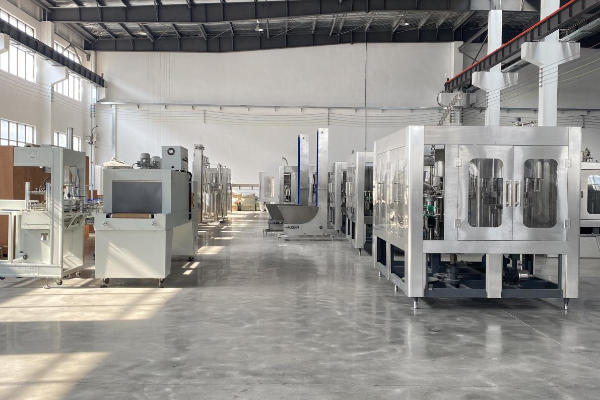
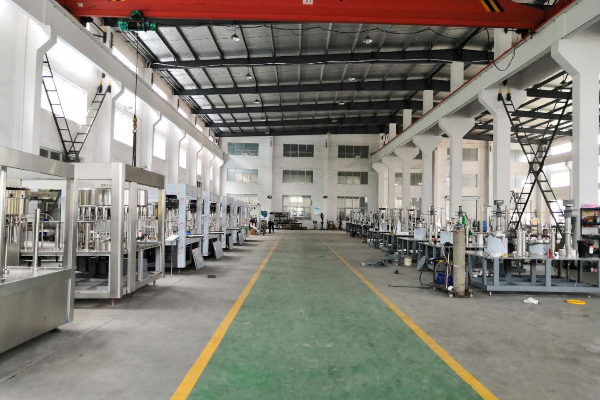
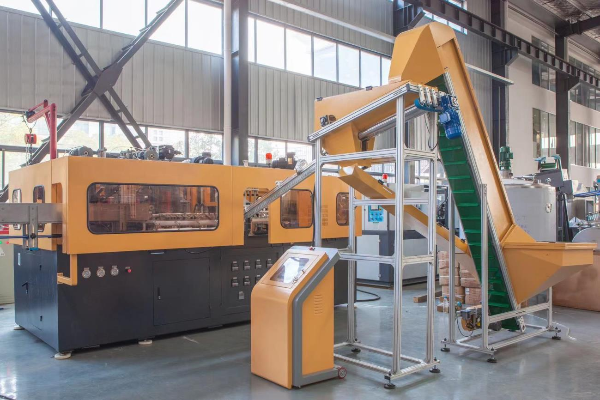
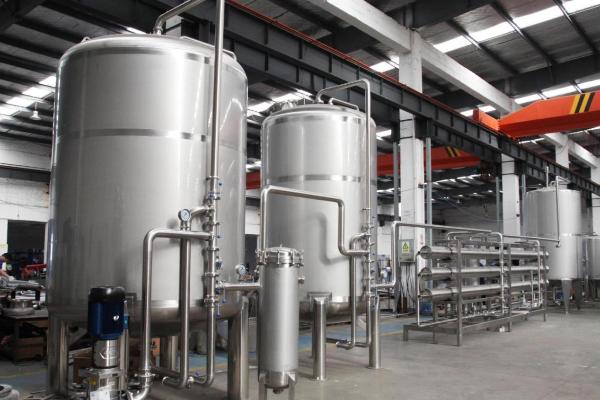
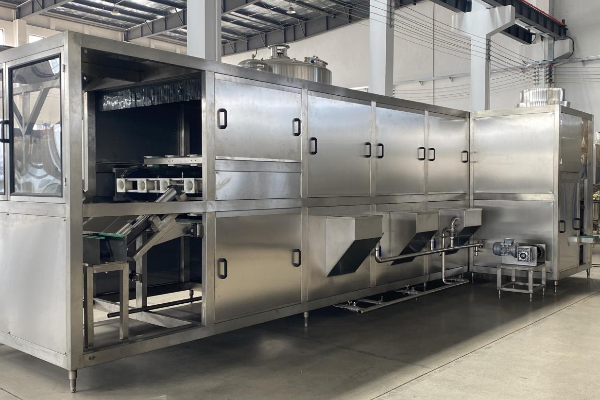
Complete Water Bottling Line Manufacturing Facility
State-Of-The-Art Production & Assembly Center
Customer Results — From 100 BPH Startup Plants to 36,000 BPH Industrial
Since 1999, our engineering team has delivered complete water bottling production lines to over 200 plants across more than 60 countries. Three anonymized snapshots illustrate the deployment pattern across capacity tiers and regional markets:
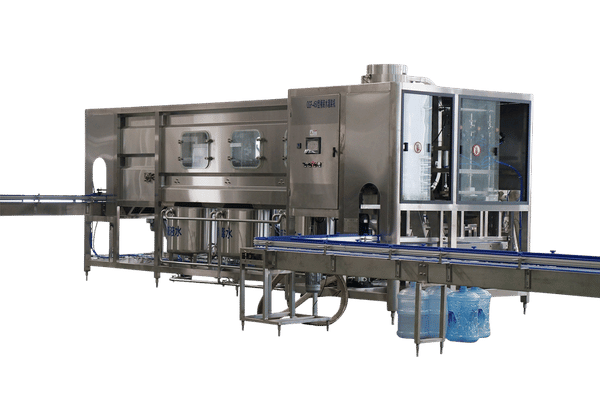
Case A — Southeast Asia, 5-Gallon Startup Plant (QGF-600)
A first-time bottler in Southeast Asia ordered a 5-gallon QGF-600 line and 3 T/H reverse-osmosis water treatment plant (23 TPH lime-soda processed). 600 barrels/hr, 1 shift time-average. Buyer reported the line attained steady-state operation in four weeks.
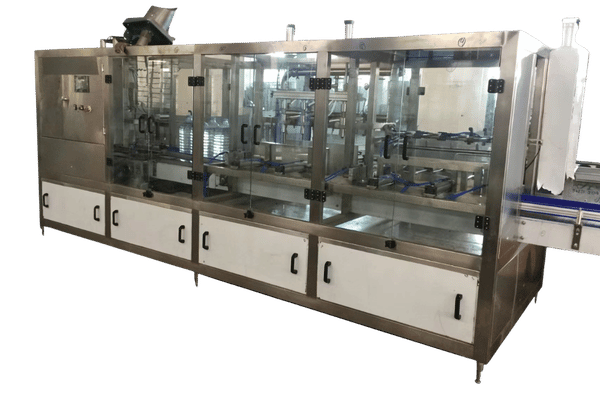
Case B — Middle East, Mid-Volume Mineral Water (XGF24-24-8)
An existing mineral-water franchise converted their complex 7-vendor 8,000 BPH stack to a single XGF24-24-8 monoblock at 12,000 BPHs, reduce cap-rejection, unify spare-parts stock between format-re-engineering projects.
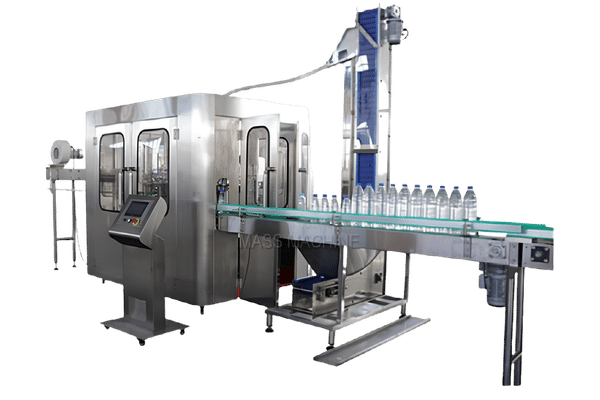
Case C — East Africa, Industrial PET (XGF40-40-10)
A country dealer scaled from 5,000 BPH to 18,000 BPH with an XGF40-40-10 line plus a 25 T/H multi-stage water regeneration facility (silica-sand activated-carbon Na+ ion exchanger 1m then 5m filters for ozone/UV sterilize).
Silver Tier — TCO Framework
Bottled Water Plant ROI Reference Framework
Industry payback periods for mid-scale bottled water plants typically fall between 17 and 30 months, depending on regional water cost, retail price point, and capacity utilization. The reference data below reflects published industry benchmarks, not Mass Technology project-specific outcomes — your actual ROI varies with feedstock, energy cost, labor wage, and market price.
2.2 yrs
Payback at $500K CAPEX, 3M bottles/year, 30% margin (Brenu reference)
28%
Target ROI on $15.6M plant, 18-month payback (Ken Research Philippines case)
50-60%
Profit margin range for RO mineral water plants (Skfelixer industry analysis)
$30K-$1.5M
CAPEX range for small 200ml-2L plants (NewHaiguang industry data)
Hygiene Standards, Certifications & Food-Safety Compliance
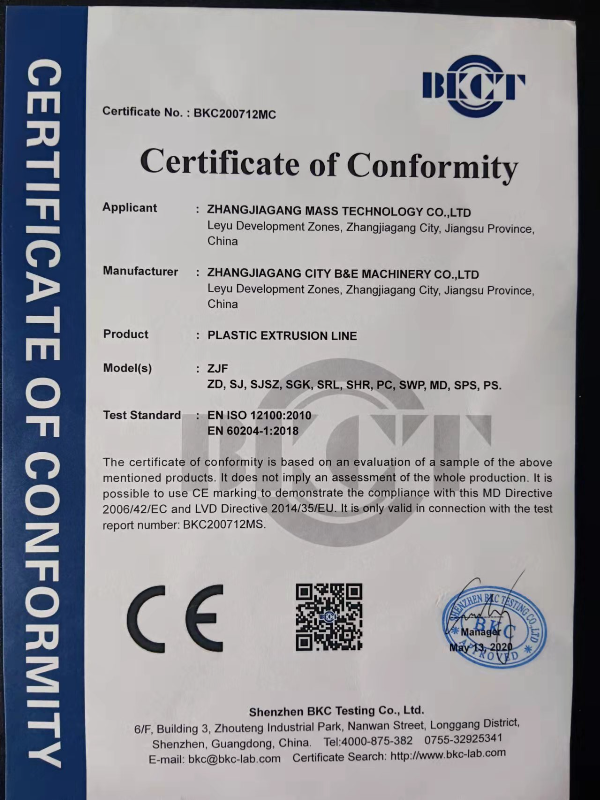
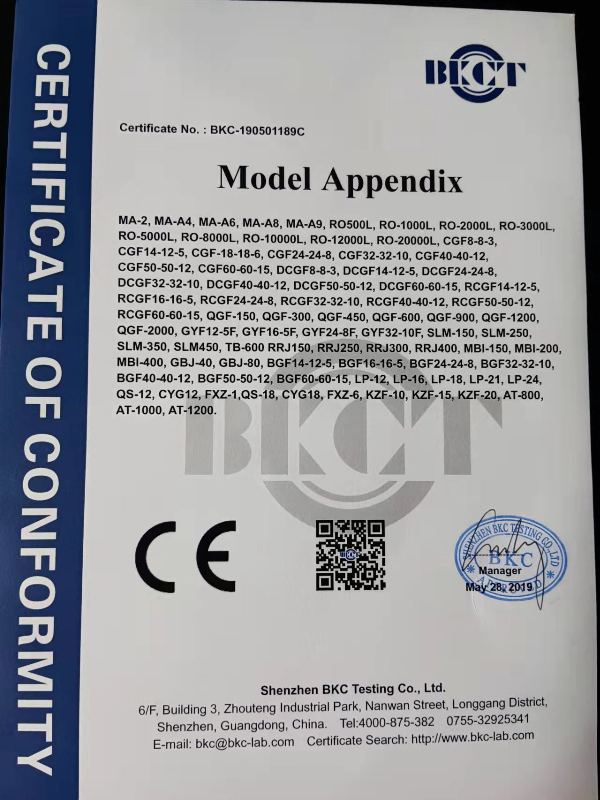
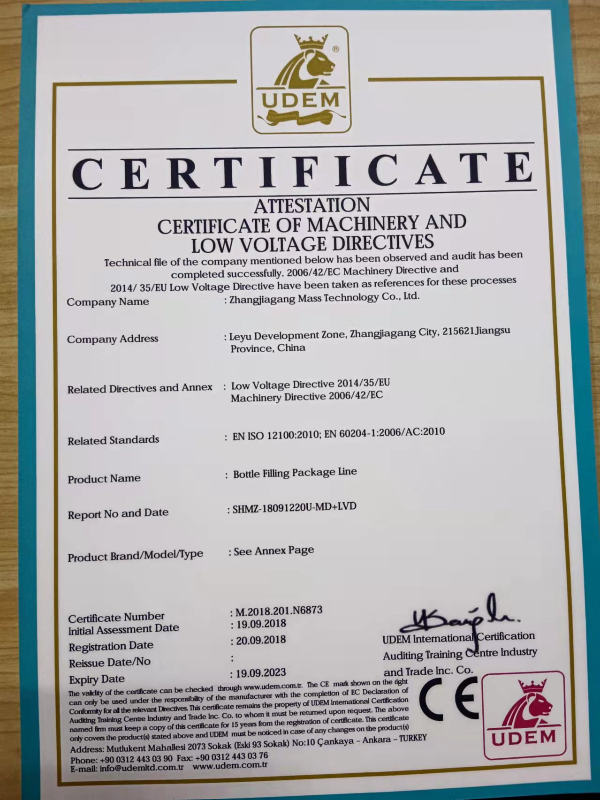
Bottled water carries FDA Standard of Identity classification under 21 CFR 165.110 in U.S. markets, with parallel regulations in EU, Gulf Cooperation Council, ASEAN, and African Union jurisdictions. Mass Technology lines are engineered to satisfy the functional language of these standards — the regulations specify outcome (non-reactive contact surfaces, microbiological control, accurate fill volume) rather than alloy specifications, so the responsibility falls on plant equipment to demonstrate compliance through cert documentation and validated process records.
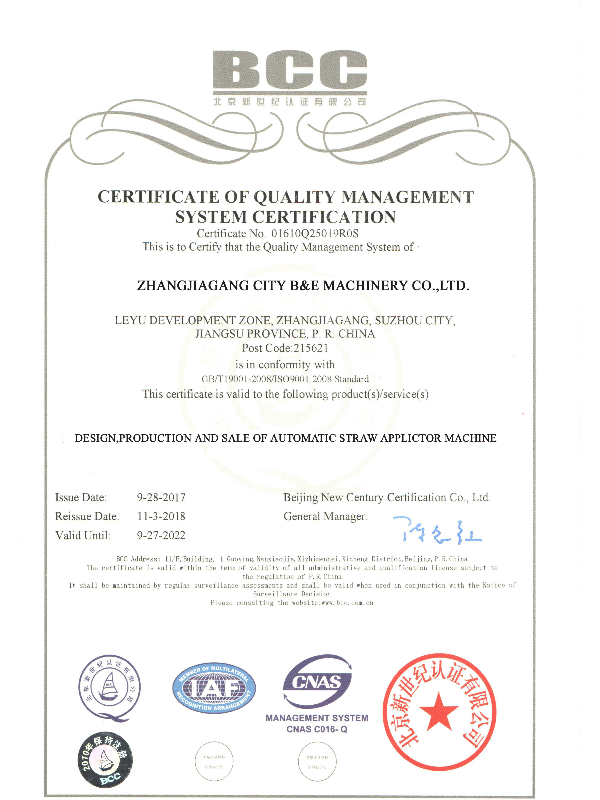
In addition to meeting U.S. standards for bottled water, our mineral-water lines are compliant to FDA’s total-dissolved-solids requirement of minimum 250 parts per million; the use of ozone and UV sterilization post-clarifier and final tank ensures this baseline is retained to the fill. Documentation packs for each line include FAT records, SAT check lists, mill heat traceable material certs issued to SS304/SS316L contact parts, and the aforementioned cert numbers and issue dates.
Our company has commissioned over 200 complete water bottling lines globally since 1999 — the IBWA 2024 North American Bottled Water Industry Benchmarking Study covering 101 facilities provides industry-baseline metrics that our QC procedures map against during FAT.
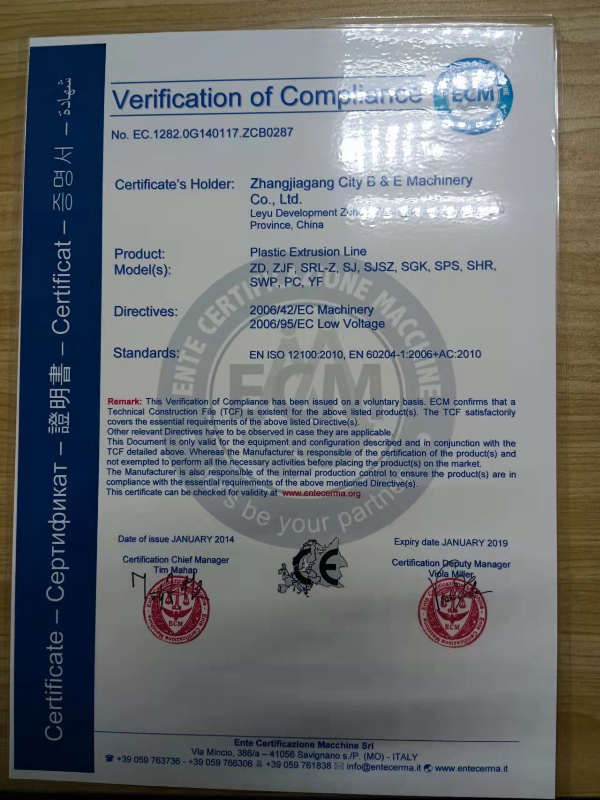
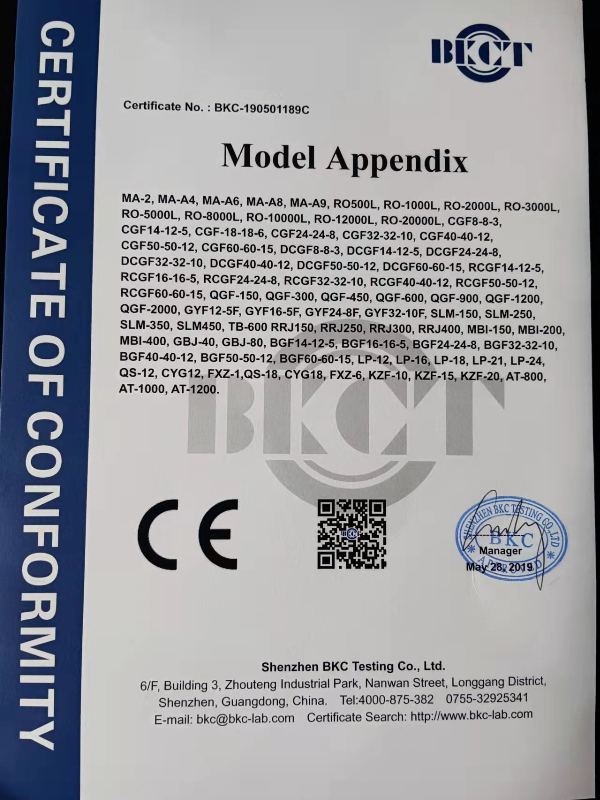
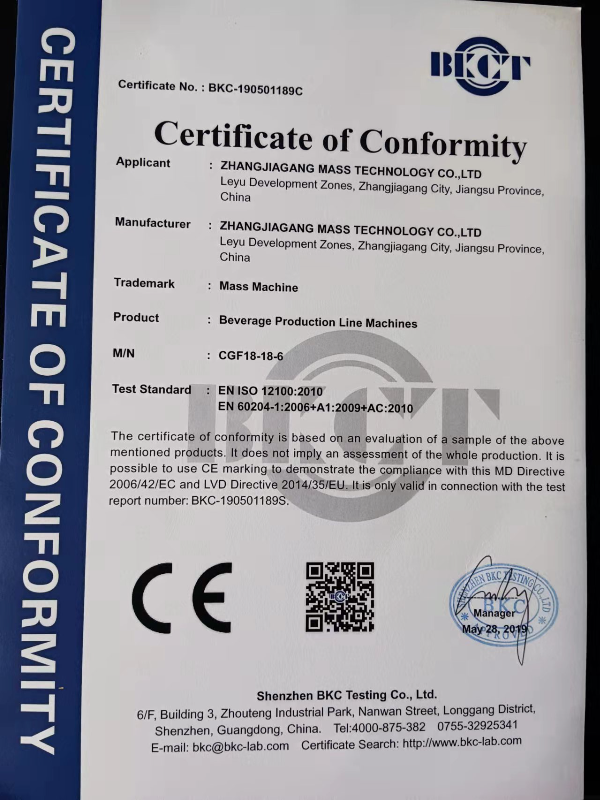
CE Marking
Machinery Directive 2006/42/EC compliance
SGS
Third-party plant inspection certificate
ISO 9001:2015
Quality management system audited
SS304 / SS316L
Food-grade contact surfaces, FDA functional compliant
FDA 21 CFR 165.110
Bottled water Standard of Identity functional language
FDA 21 CFR Part 129
Current Good Manufacturing Practices alignment
Procurement Guide — Lead Time, FOB Pricing Tiers, After-Sales SLA
When evaluating a China-sourced complete bottles line against other sourcing or in-sourcing options, the largest areas of concern for buyers are delivery schedule consistency, price transparency and after-sales recovery lead-time. Mass Technology substantiates each of the above with explicit process commitments.
Pricing Factors Framework
Official Ex Works pricing depends on a number of variables – we outline the parameters here:
Capacity tier
entry level (100-700 BPH), mid-volume (1,200-7,000 BPH) or industrial (10,000+ BPH)Bottle dimension
200ml-2L PET, 3-10L PET, or 3-5 gallon drumWater source quality
municipal feed (lower treatment levels), deep well (RO / ion exchange)Contact surface alloy
SS304 base, SS316L upgrade (chloride, pH aggressive feed)Downstream packaging
sleeve label, hot-melt or adhesive; PE shrink film, half-tray, cartonAutomation options
unscrambling, conveyer accumulation table, automated robotic palletizerLead Time & Logistics
Standard line builds
XGF/XCGF/QGF models: 4-12 weeks out of the factory depending upon configurationNon-standard layouts
Non-standard footprint, high voltage, dual water blending: 10-16 weeks lead-timeGlobal Shipping
25-45 days sea freight transit, shipping from Shanghai or NingboAfter-Sales Service Commitments
01.
Two-Year Warranty
All machine parts are covered effective from date of commissioning (not just control valves).
02.
24-Hour Response
Technical support contact will answer within 24 hours, remote diagnostics included.
03.
5-Day Spare Parts SLA
Replacement parts fast-tracked via offshore courier within five working days of authorization.
04.
Pre-bid Plant Layout
2D design issued prior to civil works start so builds and manufacture can occur simultaneously.
05.
On-Site Commissioning
Factory engineers come for FAT and on-site SAT, including comprehensive operators training.You will receive a line-item proposal within 48 hours of response to a brief; payment schedule, Incoterms, and documentation discussed in professional written language.
GET INSTANT QUOTEComplete Water Bottling Line Planning Tools
Capacity Calculator
Accurately determine the optimal production capacity for your water bottling plant based on your specific operational requirements.
Use ToolROI Payback Estimator
Evaluate the financial viability of your investment with a precise estimation of return on investment and payback period.
Use ToolTCO Five Year Calculator
Forecast your Total Cost of Ownership over a 5-year span to make informed, long-term operational and purchasing decisions.
Use ToolFAQ — buyer decision questions
How much does it cost to set up a complete water bottling line?
Capex varies hugely for different capacity lines; industry data shows small 200ml-2L lines somewhere between $30,000 and $1.5 million (NewHaiguang industry data), mid-scale plants about $500,000 (Brenu reference for 3 million bottles/years factory), and large industrial plants between 35-50 million dollars for an entire multi-line plant. Mass Technology pricing comes from the six factors listed in the Procurement Guide above – request a line-item quote with your application brief.
How long should a complete water bottling line last in continuous operation?
Mechanical service life for a Mass Technology line typically extends well beyond ten years under standard two-shift operation, provided scheduled maintenance is followed. German igus corrosion-resistant bearings used in our filler clamping mechanisms are specified for maintenance-free service in food-contact environments. Capping head wear parts (rubber seals, cap-feeder belts) are routine consumables on a 12-24 month cycle depending on cap material and shift pattern.
What bottle types and sizes can a single Mass Technology line manufacture?
Each XGF, XCGF, or QGF model is calibrated to a single primary bottle-region – XGF for 200ml-2L PET, XCGF/LCGF for 3-10L PET, QGF for 3-5 gallon barrel. Format changeover within each range involves changing bottle clamps and adjusting the filler height; changeover is normally 30-60 minutes with experienced operators. Additional formats can be pre-ordered with dedicated clamp sets.
Are aftermarket parts available, and how quickly?
Yes. Mass Technology maintains a 5-working-day spare parts SLA – replacement parts ship via international courier within five working days of an authorized RMA. The clamp interoperability across XGF/XCGF/QGF makes a single parts inventory support multiple lines, minimizing stockholding costs for multi-model plants.
What are the regulatory requirements for bottled water production?
In U.S. market bottled water is regulated under FDA 21 CFR 165.110 (Identity standard) and 21 CFR Part 129 (Good manufacturing practices) which collectively impose over 90 parameters on quality, safety, and packing. Mineral bottled water further must have a total dissolved solids content at or above 250 ppm. EU, GCC, ASEAN, AU and Latin American markets impose similar regulations. Many states regulate bottled water products as well. We deliver documentation packages calibrated to your destination market.
How is the installation and commissioning handled?
Our team covers the full project lifecycle — preliminary plant layout design, equipment manufacturing, on-site installation, operator training, and after-sales support. A pre-bid 2D layout drawing is provided so site civil works proceed in parallel with line manufacture. Factory engineers attend on-site for SAT and operator training. Typical site-to-pilot time runs 4-6 weeks for standard models.
What is the production process inside a complete water bottling line?
Here’s the typical bottling process: raw water pump, filtration (silica sand, activated carbon, na+carbon, ui, fi, 5m and 1m precision filters), OzOzone and uv sterilization, final water tank, bottle (or barrel for QGF) rinsing, filling machines, capping, labeling (sleeve, hot melt, hot glue), packaging (PE shrink, half-tray, cases). Separate online conductivity monitors and pressure cut-out sensors control each step of the process.
Can users modify or upgrade an existing line later?
Yes. Because the XGF, XCGF, and QGF monoblocks share a common clamping and lift architecture, capacity upgrades typically replace the central monoblock module rather than the surrounding water-treatment, conveyor, and packaging stack — keeping mid-life upgrade CAPEX significantly lower than full re-architecture. Format-range additions are handled with auxiliary clamp sets.
How does Mass Technology compare against established European brands like Krones or Sidel?
European OEMs excel in the heaviest-industrial 40K+ BPH lines, where aseptic carbonated soft drinks dominate. Mass Technology’s strength lies in the 100-36K BPH sector still & barrel water, combining Italian Arol filling-valve flow-path technology and German igus plastics bearings into our own monoblock solution. Those two factors often drive demand for MT manufactured packages, and all other margin parts, in the end-determining decision criteria of capacity tier, total project budget, and after-sales coverage – our turnkey single-source approach generally takes 4-12 weeks versus European OEMs 16-24 weeks.