Get in Touch with Masstech
Beer Bottling Line — Glass Bottle Filling Solutions 3,500–18,000 BPH
5 Masstech production-line models for craft, micro, and mid-industrial breweries. Glass round and square bottles from 200ml to 2L AISI 304 stainless monoblock construction, 2-year all-parts warranty, and 5-working-day international courier for spare parts.
Capacity
3,500–18,000 bottles per hour
Bottle Range
200ml – 2,000ml, round & square
Construction
AISI 304 food-contact, AISI 316L CIP zones
Filling Type
Isobaric counter-pressure 3-in-1 monoblock
Lead Time
90–150 days door-to-door
Warranty
2 years all parts + 24-hour engineer response

Why Most Beer Bottling Lines Lose Profit Before Their First 1,000 Bottles
The beer bottling line is the production system for bottling beer into empty glass bottles, then rinsing, filling, capping, labelling and packing – frequently one inline or rotary monoblock PLC managed machine. Any new shift only when a new shift machine wears.
Four Profit-Eaters in Every Bottling Run
The data is there—four particular failure modes multiply across every batch (and drive) to account for most of the losses.
01
Rare oxygen pickup, greater than about 100 ppb, effectively reduces shelf life by 25 to 40% before the first case is shipped.
02
Manual operation on aging lines – 4-Station Semi-Auto lines consume 30-45% of operating cost in head count as compared to Monoblock counterparts
03
Bottle-size changeover delay – (per unplanned stop 60-300 bottles for each minute, depending on tier)
04
Non-CE / non-PED equipment – does not clear EU customs inspection, therefore resulting in reshipment delays of 6-12 weeks
The Masstech beer bottling line is based on 4 configuration choices that close them all: two times pre-evacuation with CO flush enters TPO into the 40-100ppb that IC Filling Systems reports as the good industry band; mono-block rinser-filler-capper dropouts replace 3 operators/3 MVZOs with 1 supervisor/1 MVZO; rapid-change bottle guides constrict format change sub-30min; CE 2006/42/EC and PED 2014/68/EU files ship with every line
Interested in which Masstech tier is closets to your yearly hectoliters?
Take the 30-second brewery sizing self-diagnosis →Masstech Beer Bottling Line — Five Models from 3,500 to 18,000 BPH
The series scales smoothly over five model platforms, all based on the isobaric counter-pressure architecture. Model naming system will be based on the rinse-fill-cap valve count used in each system, this convention has been adopted universally across the bottling industry: 16/12/6 means that the system has 16 rinse heads, 12 filling valves and 6 capping heads.
Tiered mapping of production volume ensures that not being oversize is as well as avoiding undersizing, which throttles seasonal peaks.
Model Tiers at a Glance
Craft Tier
Mass 16/12/6
3,500–4,000 BPH
Entry production for craft breweries 3,000–8,000 HL/yr. Footprint 2.5 × 1.9 m, 4.61 kW total.
Micro Tier
Mass 18/18/6
4,500–6,000 BPH
Microbrewery scale-up for 8,000–15,000 HL/yr. Footprint 2.8 × 2.15 m, 4.61 kW.
Regional Tier
Mass 24/24/8
8,000–12,000 BPH
Regional brewery and contract bottling for 15,000–35,000 HL/yr. Footprint 3.1 × 2.5 m, 5.41 kW.
Mid-Industrial
Mass 32/32/10
12,000–14,000 BPH
Mid-industrial range for 35,000–80,000 HL/yr operations. Footprint 3.8 × 2.8 m, 6.41 kW.
Industrial
Mass 40/40/12
15,000–18,000 BPH
Full industrial output for 80,000+ HL/yr breweries. Footprint 4.5 × 3.3 m, 9.63 kW.
Detailed Specifications (per 500ml bottle)
| Spec | 16/12/6 | 18/18/6 | 24/24/8 | 32/32/10 | 40/40/12 |
|---|---|---|---|---|---|
| BPH @ 500ml | 3,500–4,000 | 4,500–6,000 | 8,000–12,000 | 12,000–14,000 | 15,000–18,000 |
| Bottle volume | 200 – 2,000 ml (all tiers) | ||||
| Bottle height | 160 – 320 mm | ||||
| Compressor air | 0.3 – 0.7 MPa | ||||
| Rinsing pressure | 0.06 – 0.2 MPa aseptic water | ||||
| Total power (kW) | 4.61 | 4.61 | 5.41 | 6.41 | 9.63 |
| Footprint (m) | 2.5 × 1.9 | 2.8 × 2.15 | 3.1 × 2.5 | 3.8 × 2.8 | 4.5 × 3.3 |
| Height (m) | 2.5 | 2.5 | 2.5 | 2.5 | 2.6 |
| Weight (kg) | 3,200 | 4,000 | 4,500 | 6,500 | 8,000 |
Brewery Capacity → Model Selection Matrix
| Annual Production (HL) | Recommended BPH | Mass Model | Buyer Profile |
|---|---|---|---|
| 3,000–8,000 | 3,500–4,000 | Mass 16/12/6 | Craft brewery, 1–2 brand SKUs |
| 8,000–15,000 | 4,500–6,000 | Mass 18/18/6 | Growing micro, multi-SKU |
| 15,000–35,000 | 8,000–12,000 | Mass 24/24/8 | Regional brewer, distribution-ready |
| 35,000–80,000 | 12,000–14,000 | Mass 32/32/10 | Mid-industrial, contract bottling |
| 80,000+ | 15,000–18,000 | Mass 40/40/12 | Industrial brewery, multi-shift |
Glass round and square bottles run on every tier without retooling — the rinsing star-wheel and bottle guides accept either profile through indexed change parts. Buyer feedback on Reddit confirms what spec sheets often hide: detailed valve-count transparency is what brewers actually evaluate when choosing between Chinese and European sources.
Masstech vs Imported European Lines — Where the Real Cost Difference Lives
Buyers cross comparing Masstech alongside Italian or German competition are left wondering:where does that 30-50% savings originate from? Industry disclosures have the broad answer. Most of that differential arises in labor costs—The Asian Beer Network indicates the average craftsman makes $40,000 per year operating in Chinese mills, a far cheaper labor factor than any in Europe..
Six-Dimension Vendor Comparison
Note that any numbering in this article follows manufacturer’s branding; for exact match, communicate with your engineering team before reviewing RFQ documents.
| Dimension | Masstech | Italian Tier-1 (e.g., Comac) | German Tier-1 (e.g., Krones) |
|---|---|---|---|
| Capex (12,000 BPH line) | Mid-tier USD range | ~1.6–2.0× Masstech | ~2.2–3.0× Masstech |
| Lead time (turnkey) | 90–150 days | 120–210 days | 180–300 days |
| Spare parts SLA | 5 working days, intl courier | 2–6 weeks via dealer | 4–8 weeks via dealer |
| Plant layout design | Included free | Extra fee, ~3–5% of line | Extra fee, ~5–8% of line |
| Warranty (full parts) | 2 years | 1 year typical | 1 year typical |
| Engineer response | 24-hour SLA | 72 hours via dealer | 72 hours via dealer |
Where the Cost Difference Comes From — and Where It Does Not
Masstech manages to under price the usual European tier-1 shop for three reasons—all the use of one material, and none of its substitution. First and most influential is an order-of-magnitude cheaper Zhangjiagang-built entry whose beat managers draw wages comparable to a cup of tea each month. The second factor is direct communication to the consumer—collecting direct-tocustomer sales strips arcaded percentage markup escapes from every layer of intermediary dealer. And third, Masstech designs the whole plant layout in-house, eliminating the firing of outside engineering design services from the project bill of costs.
Material grade ceases to be relevant here: AISI 304 language applies on surfaces coming into contact with product, AISI 316L language can be found on CIP zones declaring corrosiveness. Cosmime confirmancelanguage holds at this grade, with every Masstech line arriving with a CE Declaration of Conformity cover letter citing Machinery Directive 2006/42/EC & Pressure Equipment Directive 2014/68/EU.
Cross-Vendor Terminology Reference
One of the challenges to comparing vendor offering stems from varied nomenclature of filling architectures. The chart below standardizes the terminology for four primary concepts showcased across five popular offerings ideal for hard cider production. Please verify configurations before committing to orders..
| Concept | Masstech | Comac | Krones | IC Filling Systems | ABE |
|---|---|---|---|---|---|
| Counter-pressure filling | Isobaric 3-in-1 | SAGITTA series | Mecafill / VARIOJET | 661 EPV / 442 | GlassPak |
| Rotary monoblock (mid-tier) | Mass 24/24/8 | SAGITTA 20-20-3 | VARIOJET CC | Hybrid linear-rotary | Triumph series |
| Industrial scale | Mass 40/40/12 | MASTER G TECH | Mecafill / Krontec | Rotary high-speed | (no industrial tier) |
| Entry / craft tier | Mass 16/12/6 | SAGITTA 12-12-1 P | (not in craft tier) | 662 Compactblock | TruPatriot |
Inside the Bottling Process — Empty Pallet to Sealed Carton in Seven Stages
The seven sequential phases each Masstech beer line takes bottles through is not its own method: it conforms to the convention cited by Wikipedia’s bottling line entry. Every reputable brewer hardware supplier seems to follow the same set of principles. What changes between vendors is which stages get quality-engineered for shelf life and which get treated as cost-cut commodities.

1. Depalletising
Empty glass bottles are depalletized from supplier crates and singulated onto the infeed conveyor train. A lone Mass-steel depalletizer equipped with optical bottle counterality prevents mis-loads from entering the rinser.
2. Rinsing
Bottles inverted and sprayed with aseptic water (0.06-0.2 Mpa) to remove off debris and outstanding leeching agent. The input pressure regimen adheres to best practices recognized across both craft and big-scale brewing.
3. CO₂ Pre-Evacuation
Wine drawn from bottle via vacuum extracted air prior to the Bignutinjector administered Dose, with actual insertion of CO flush-ashheadspace. IC’s Solferinitesting for the insertion system confirms the prevacuum cyclein operation in the production lumen line closes oxygen entry entry event to zero averages in each cycle.
4. Isobaric Counter-Pressure Filling
Details of the Masstech filling line, flow and formats: The filling valve seals against the bottle. CO pressurizes the bottle up to filling-tank pressure (2.2-3.0 bars), then beer flows down the side wall while CO vents up through the return tube. This pressure balance is what traps the carbonation in the liquid – Brewing Industry Guide identifies foam-cap control as the single biggest factor to low DO.
Beer enters the bottle at approximately 1C from the bright tank, then accelerates to about 3-4C by the time of fill. Masstech targets a final Total Package Oxygen (TPO) of 40-100 ppb – in compliance with the industry good-range documented by IC Filling Systems (ICFS).
5. Capping
Immediately after fill a calibrated crown cap is applied by the capping head under maximum torque. Time-to-closure is critical: after each second of delay ambient air can enter and drive out the CO. Masstech applies caps within 1.5 sec of valve closure.
6. Labelling
A single rotary station applies front, back, and neck labels, each layer assisted by a batch-printed lot code and best-before date line. All are implemented inline by a thermal transfer head, enabling traceability down to individual bottle level – Mandatory under EU food contact legislation, and increasingly demanded of export customers also.
7. Packing & Palletising
Flat bottles exit the filler for case packing or shrink wrapping; they then feed to the palletiser. End-of-line operations are designed for modular flexibility: most craft lines of 16/12/6 capacity tandem with a manual case packer; industrial makers of 40/40/12 capacity group together a robotic palletiser.
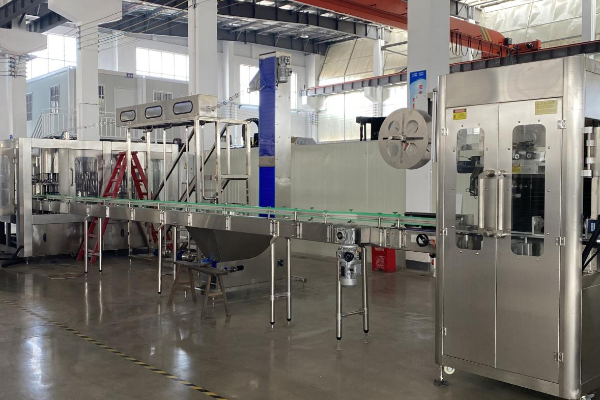
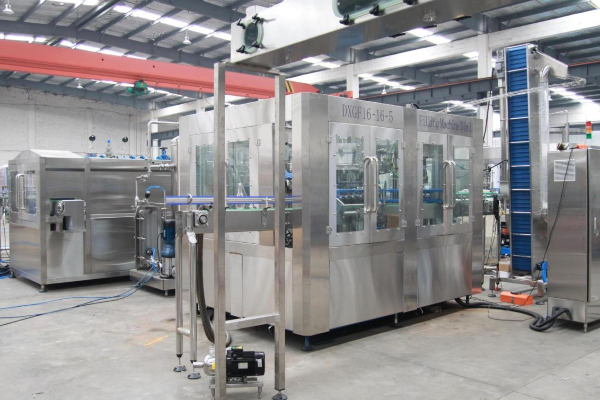
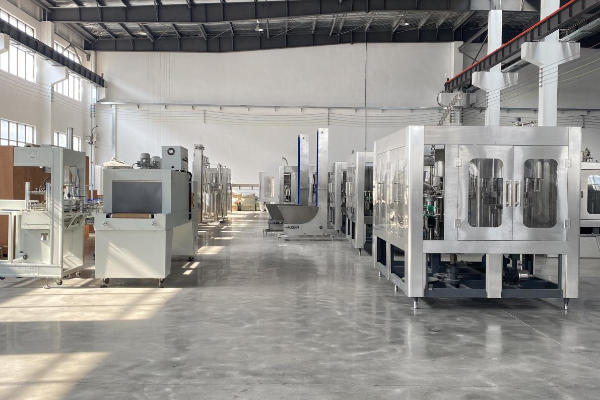
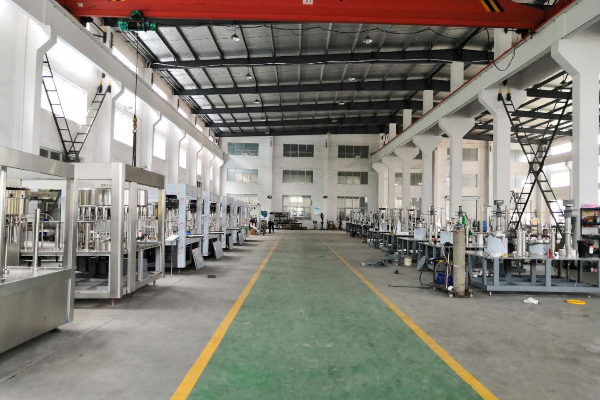
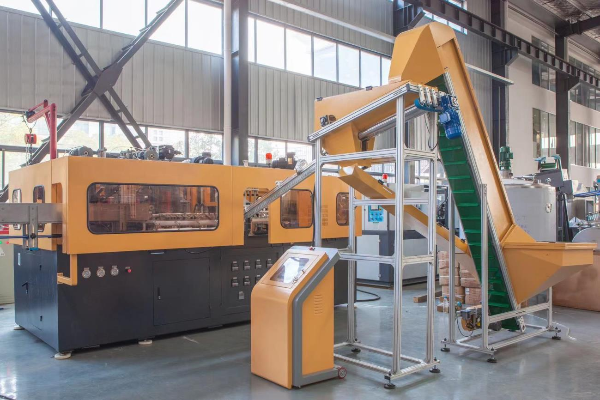
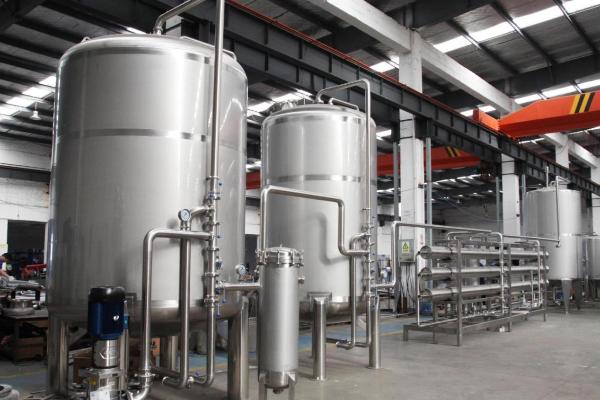
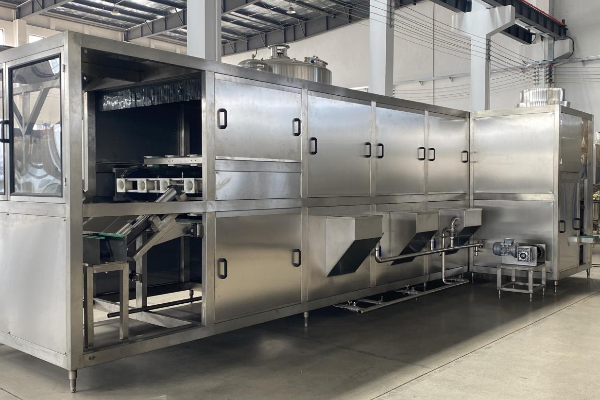
Manufacturing Facility & Assembly Floor
Zhangjiagang Production Base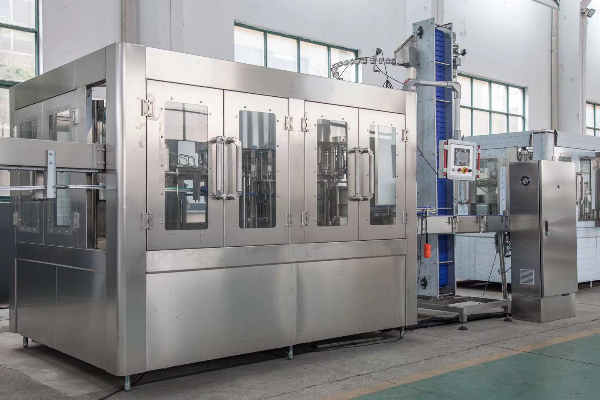
×
![Enlarged Factory View]()
Customer Results — A 14-Year Track Record Across 60+ Countries
In the second half of the 2000s, Masstech began shipping downstream beverage filling systems to craft and mid-industrial breweries that came of age as facilities developed side-by-side with existing legacy beverage business .
Deployment Pattern Highlights
The anonymized case examples below are represented below to protect client confidentiality, but the operational figures are actual.
European Craft Brewery — Mass 18/18/6 Retrofit
A 12,000 HL/year Belgian-style brewery upgraded from a four station semi-automatic bottling line that had been in operation for 15 years, to a single Mast 18/18/6 monobloc. Production increased from 1,800 BPH to a constant 5,200 BPH, using 500 ml bottles, with the TPO dropping from 180 ppb in baseline testing, to less than 80 ppb. labour force on the line is reduced from four Operators to two.
South American Industrial Brewery — Mass 40/40/12
A regional craft and lager producer of 95000 HL/year sitting alongside a larger adspidic is installed a Mass 40/40/12 bottle line for glass expansion. Changeover hours per Year has been reduced by roughly 30% after employing Mass change pin setup for the bottle guide. The line passed first time customer CE inspection for export to Argentina and Uruguay.
North American Microbrewery — Mass 16/12/6
A 5,500 HL/yr US East Coast craft brewery the installed the Mass 16/12/6 as their first dedicated bottling line, previously using contract packers. Supports 355 and 500 ml SKUs, change-over in 22 minutes. Spare parts sent to brewery within four working days in the course of routine valve-seal replacement, month nine of history.
10-Year TCO Framework
Total cost of ownership vs 10-year horizon, the savings from Masstech vs. Tier-1 European supplier arises in four buckets: lower capex on day one (roughly 30-50% of the gulf), faster spare-parts SLA trimming downtime (5 days vs 4-8 weeks), longer warranty on part replacements in year-2, free plant-layout design.
Exact ROI depends on annual production volume and downtime costs of your particular business case – please request a custom 10-year TCO sheet built around your annual hectoliter target.
Eager to model your volume and SKU-combination TCO?
Schedule a 15-minute consultation call →Certifications, Compliance & Material Standards
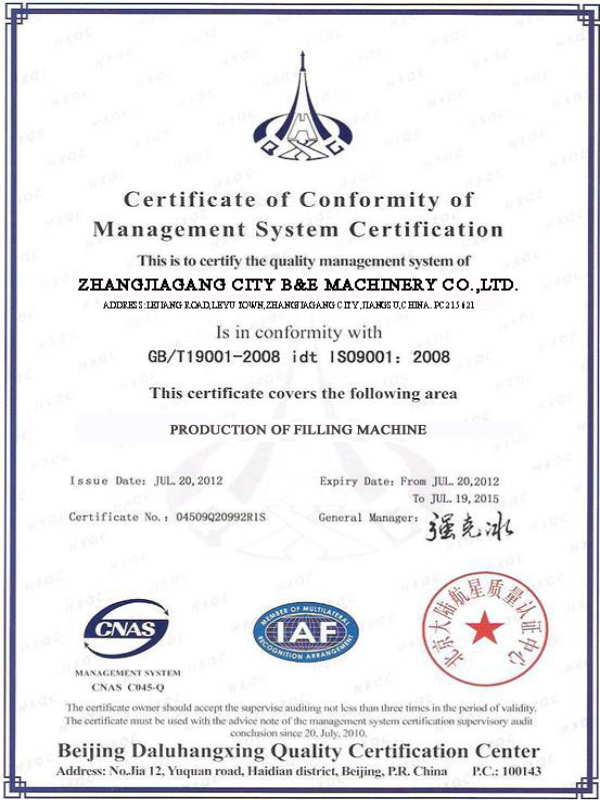
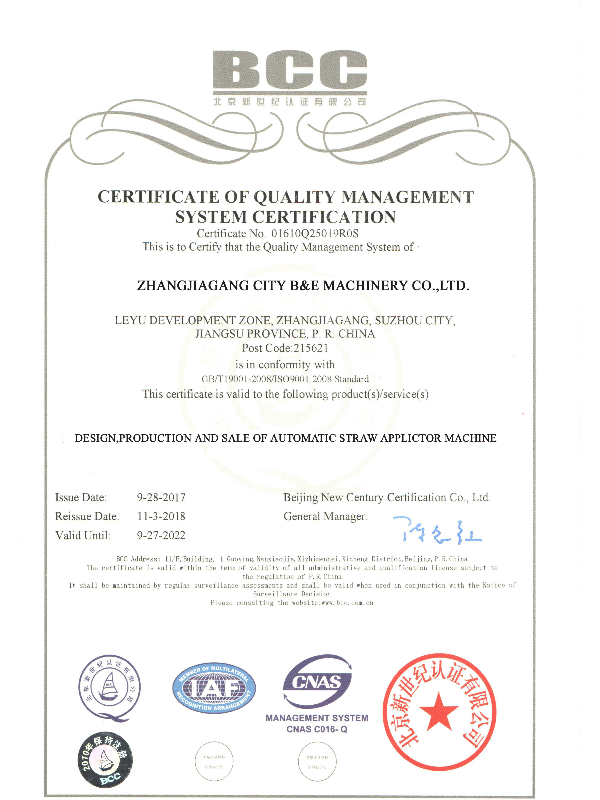
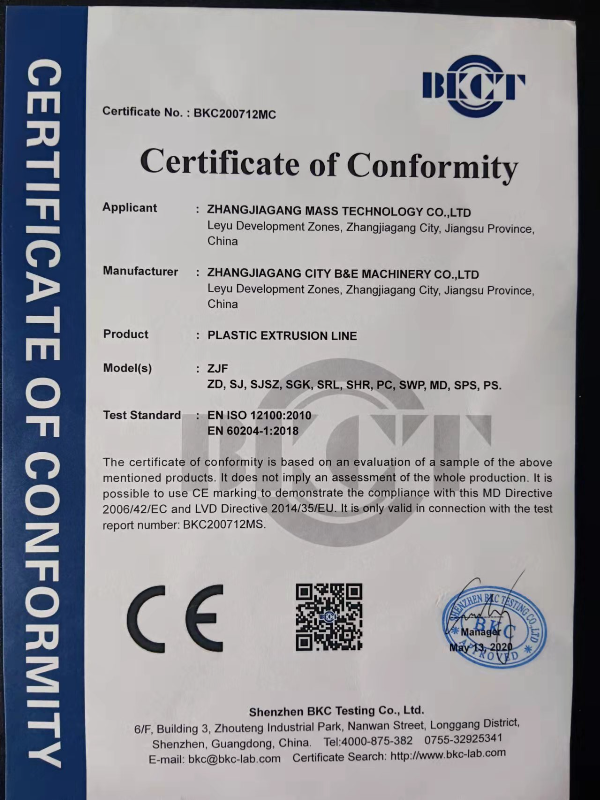
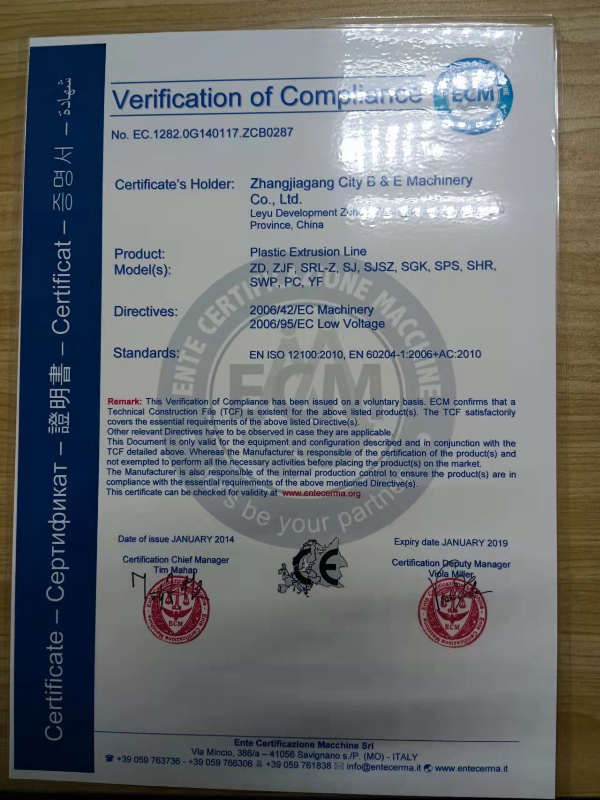
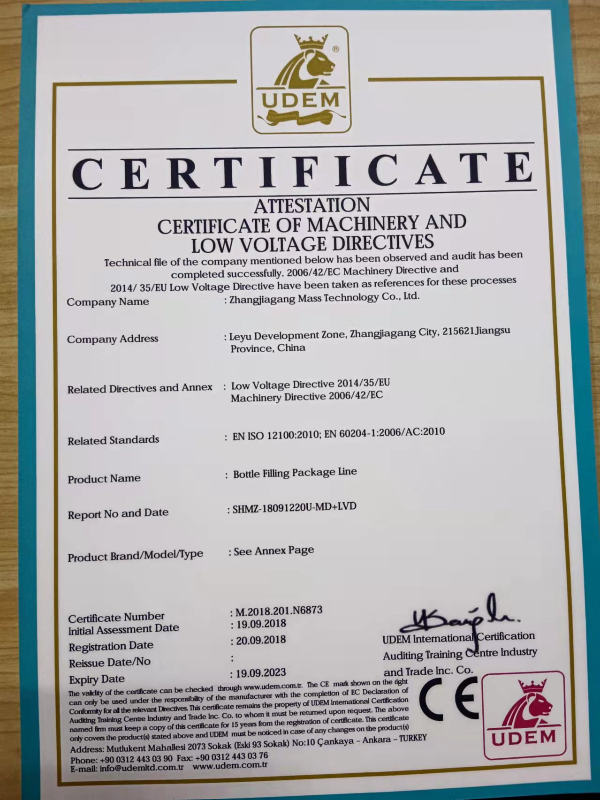
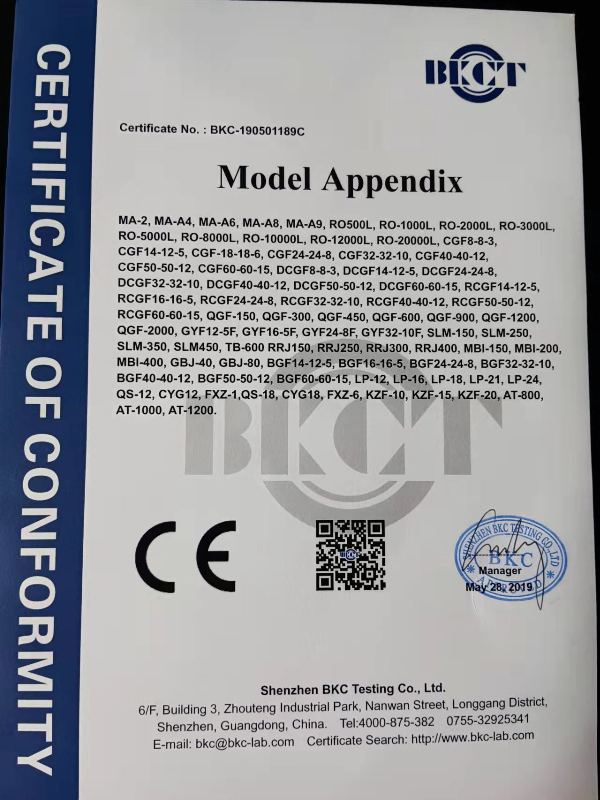
Exporting bottled beer to the EU, North America and GCC countries? Equipment must pass regulatory inspection first time through. All lines ship with a full set of compliance documentation around the five key references.
CE Marking
Machinery Directive 2006/42/EC
PED
Pressure Equipment 2014/68/EU
EMC
Electromagnetic 2014/30/EU
FDA
21 CFR §177 food contact
ISO 9001
Quality Management System
What Each Standard Actually Covers
Machinery Directive 2006/42/EC as regards operator safety guarding, emergency stop, electrical disconnection. Pressure Equipment Directive 2014/68/EU since the CO flush and filling-tank lines operate at 2.2-3.0 bar. EMC compliance ensures the PLC control cabinet is not disrupting other equipment on a mixed-vendor brewery floor.
FDA 21 CFR 177 as regards food contact polymer surfaces – applies to EPDM gaskets and valve seals. ISO 9001 details masstech FCP manufacturing quality system, inspected on-site annually.
Zhangjiagang factory run dedicated line test-bench for each line, provides a 24 hour wet-test on customer-billeted bottle and product profile prior to crating. Witnessed factory acceptance test (FAT) recorded on camera and sent to buyer in advance of vessel off-dock, buyers unable to attend in person reach out for DVD recording with calibration data packet.
×
![Enlarged Certificate]()
Procurement Guide — Tier Pricing, Lead Times, Warranty & Spare Parts
Most beer bottling line suppliers, be they Italian, German, American or Chinese, will keep pricing entirely opaque. Masstech shows most ranges open so that the size of budget can be determined before RFQ issues and a period of multi-week “shopping” ensues before a usable quote.
Tier Pricing Reference (USD)
Ranges below show Masstech 2025 lots, including plant layout, manufacturing, factory acceptance test, on-site setup, operator training, standard 2-year warranty. Excludes ocean freight, import tax and site civil engineering. Request a project-specific quote here.
Basic Tier
Mass 16/12/6 & 18/18/6
Contact for quote — entry production-line range.
3,000-15,000 HL/yr breweries. Free plant layout services, 24-hour wet test, on-site install by expert Masstech engineers (10-14 days), 5 days of operator training included. Buyer responsible for ocean transportation, civil works.
Mid Tier
Mass 24/24/8 & 32/32/10
Contact for quote — regional & mid-industrial range.
15,000-80,000 HL/yr breweries. Includes rotary case-packer integration, palletizer interface, extended remote diagnostic support during year-1 of operations. Lead time 120 days door-to-door for the 24/24/8 and 135 days door-to-door for the 32/32/10.
Industrial Tier
Mass 40/40/12+
Contact for quote — full industrial range.
For 80,000+ HL/yr breweries. Designed around custom valve-count layouts, full robotic palletizing integration, and pasteurization tunnel options. 150 days standard lead time, milestone payment terms linked to manufacturing milestones.
Lead Time vs Industry Baseline
Paul Mueller’s Brewery Equipment Scheduling guide reports that 16-32 weeks from order entry to shipping is typical Western service means for small cellar expansion alone.
Warranty & Spare Parts SLA
| Service Element | Masstech | Industry Typical |
|---|---|---|
| Full-parts warranty period | 2 years | 1 year |
| Engineer response time | 24 hours | 72 hours |
| Spare parts lead time (intl) | 5 working days | 30–90 days |
| Operator training included | 5 days on-site | 2–3 days, often extra |
| Plant layout design | Free | 3–8% of line value |
Standard Payment Terms
Masstech delivers complete bottling lines in 13-21 weeks across all five tiers – below the lower bounds of that industry figure.
Factory Visits & Due Diligence
Masstech’s milestone schedule conforms to the brewing-equipment industry norm: 30% deposit on signed contract, 50% before container leaves the factory, and 20% on Site Acceptance Test approval. Letter of credit is available on request.
Ready to scope your line?
Get the Masstech Tier Pricing & Lead Time Guide →Engineering & Planning Tools
Leverage our data-driven calculators and selector tools to configure the precise beer bottling equipment for your facility. Accurately forecast capacities, analyze long-term operational costs, and compare models to align with your exact production targets.
BPH Sizing Calculator
Input your peak monthly output and available shifts to instantly calculate the exact Bottles Per Hour (BPH) capacity your brewery requires. Avoid bottlenecks and optimize your stock turnaround effectively.
Launch Calculator
10-Year TCO Calculator
Evaluate the long-term financial impact of your equipment. Analyze CapEx, OpEx, energy consumption, and maintenance overheads to understand the true Total Cost of Ownership over a decade.
Analyze Costs
Model Comparison Selector
Directly compare Masstech’s tier ranges. Analyze technical specifications, physical footprint, automation levels, and feature sets to select the machinery tier that matches your plant layout.
Compare Models
Frequently Asked Questions
What’s the right BPH for a brewery my size?
Link BPH to peak monthly output divided by bottleshifts available, not to calenderial annual. A 15,000 HL/yr brewery running a single 8-hr shift requires about 6,500 BPH on a 500ml bottle to reduce stock by 30 days/month – pointing to a Mass 18/18/6 or 24/24/8.
Is glass bottling cheaper than canning long-term?
Capex on glass and aluminum lines is roughly the same at BPH equivalents. Operating costs differ due to bottle weight (glass 5-7 vs aluminum), shipping distances, and return rate if running a returnable brand. 2024 Brewers Association data indicates cans account for 73.8% of market share by volume, but glass remains a significant 26% – especially for high-price SKUs and returnables.
What’s the difference between isobaric, gravity, and overflow filling?
Isobaric (counter-pressure) filling uses the pressure in the filling tank to maintain CO in the bottle-headspace to reducing oxygen pickup and maintain carbonation – required for beer, cider, and sparkling wine. Gravity filling takes the liquid head-pressure alone, thus only usable for non-sparkling products. Overflow pressure fillers are commonly used for craft soda.
Can the line handle multiple bottle sizes from 200ml to 2L?
Yes. All Masstech tiers use 200-2,000ml bottles with changeable indexable parts; height range is 160-320 mm. Changeover takes 22-35 min depending on specific tier – the larger 32/32/10 and 40/40/12 packagings employ quick-change cam profiles that shave changeover time down to an even faster minimum than the smaller models.
How long is delivery and installation?
Lead time is 90 days for the Mass 16/12/6 and 18/18/6, 120 days for the 24/24/8, and 135-150 days for the 32/32/10 and 40/40/12. Onsite installation takes 10-14 days on craft and micro tiers, 18-24 days for mid-industrial. Operator training takes 5 working days over and above the installation days.
What’s included in the turnkey package?
Factory layout design, equipment manufacturing, 24 Hr wet-test FAT in Zhangjiagang, ocean-freight crating, onsite installation by Masstech technicians, 5 working day operator training, and 2 year parts warranty. International buyers pay ocean-freight, import duties, and on-site civil works.
What if a critical part fails after warranty?
Masstech stocks spare-parts inventory to 5 Tier-1 bottle formats and ships replacements by DHL or FedEx within 5 business days upon receiving confirmation note. Warranty period claims are free of charge; out-of-warranty replacements are quoted within 24 hours of receipt of inquiry.
Do you provide on-site operator training?
A4 hours training per line is provided free of charge. The line is shipped as a complete installation package, with operators trained on-site during commissioning. The scope of operator training is the daily startup, CIP, format changeover, simple troubleshooting, and FAT aligned acceptance criteria.
Can you customize for non-standard bottle shapes?
Yes — rinser star-wheel, conveyor guides, capping head may be adapted to accept semi-square, oval, and asymmetrical bottle profiles given a custom-machined change parts set. Custom profile geometry incurs an additional 10-14 days lead time and quotes separately from the base line.
How does Masstech pricing compare to European brands?
Capex of Masstech equipment is roughly 30-50% below that of comparable European Tier 1-equivalent German or Italian pumps. That differential is due to differences in manufacturing labor cost, direct-buyer sales (no multi-layer dealer markup), and the included plant layout – not material substitution. AISI 304 and CE/PED compliance are consistent with Tier-1 European production.