Get in Touch with Masstech

Quick Specs, Complete Water Bottling Line
| Capacity range | 2,000–36,000 bottles/hour (BPH) |
| Bottle formats | 200 mL–2 L PET · 3–10 L · 3–5 gallon (HOD) |
| Typical turnkey CapEx | ~$30k–$58k (small) → $1M+ (high-speed) — capacity-dependent |
| Core blocks | RO treatment → blow molding → rinse-fill-cap → labeling → packing/palletizing |
| Typical lead time | ~3–6 months (engineering → manufacturing → install & commissioning) |
What’s Actually in a Complete Water Bottling Line? (8 Stages, Source to Pallet)
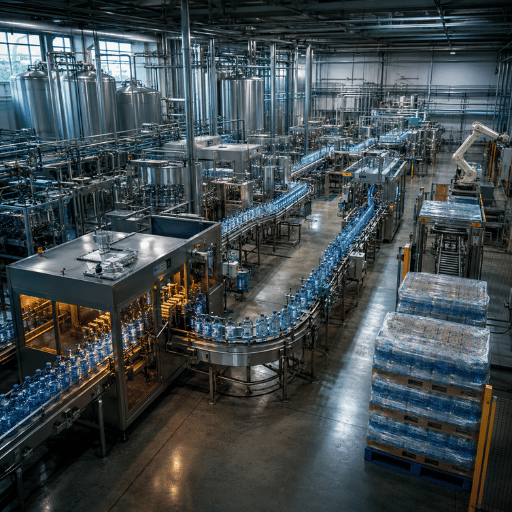
A complete water bottling line is everything needed to turn water from source to packaged bottle ready for sale: typically an 8-stage journey from water purification to final shipment from the water production line. These stages apply from a small scale facility to large, modern drinking water plants. It’s important to be familiar with the stages; each is a line item to be priced. A “complete line”quote from the supplier that omits one (almost always water treatment) isn’t complete.
The center of a modern water filling machine is the rinse-fill-cap monoblock, a single machine that rinses bottles, fills them, and attaches caps on one rotary frame. Granted U.S. patents such as US11584628B2, for example, cover uncapping, filling and capping at a single unit, which explains why the monoblock, not standalone fillers, cappers and rinsers, rules the contemporary water bottling line.
| # | Stage | What it does | Mandatory? |
|---|---|---|---|
| 1 | Raw-water treatment (RO) | Multimedia filtration + carbon + softener → reverse osmosis → UV/ozone water purification | Yes |
| 2 | Bottle blow molding | Heats PET preforms (85–120 °C) and blows them into bottles with 25–40 bar air | If self-blowing |
| 3 | Rinsing | Sterile-rinses empty bottles (often the first block of the monoblock) | Yes |
| 4 | Filling | Gravity/pressure fills treated water to volume | Yes |
| 5 | Capping | Applies and torques the cap; the third block of the monoblock | Yes |
| 6 | Labeling + date coding | Applies label (OPP/shrink/adhesive) and prints batch/expiry code | Yes |
| 7 | Shrink/film packing | Bundles bottles into trays or film packs | Usually |
| 8 | Palletizing | Stacks packs onto pallets (manual at small scale, robotic at high speed) | Optional |
An illustrative stage flow chart showing the typical process stages from raw water through filling to the completed water bottling line for different speeds; includes equipment types for a rinse-fill-cap monoblock and PET bottles, drawing on U.S. Patent US11584628B2.
Stages 2 (blow molding) and 8 (palletization) offer potential savings; buy preforms and hand-stack bottles at slow speeds. Skip stage 1 (water treatment) and risk damaging your fillers, or shortchange your investment, if you use non-potable or poorly treated water; a quote that doesn’t explicitly detail water treatment pricing isn’t worth considering. You can browse sample configurations from small-scale to high-speed on our water filling machine page, or our carbonated drink filling line for other product variants.
How Much Does a Complete Water Bottling Line Cost? Price Bands by Capacity
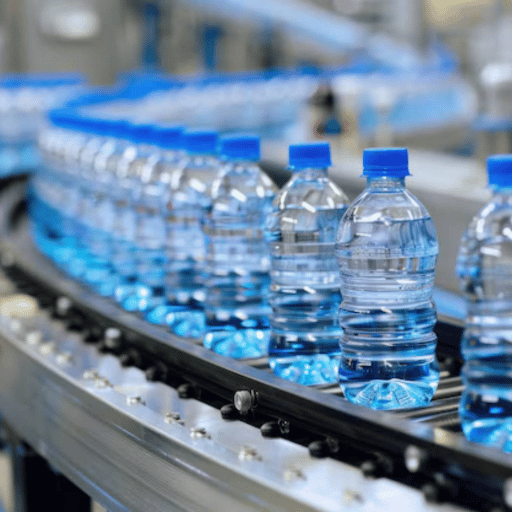
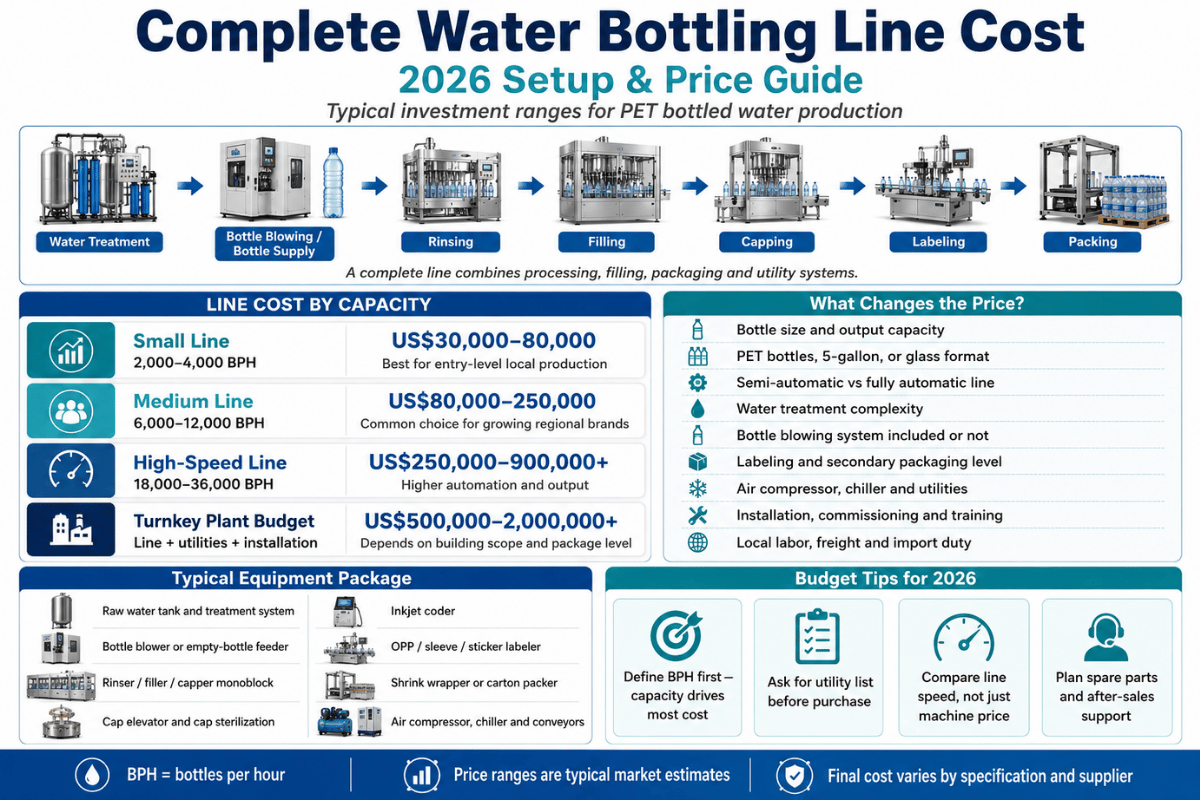
The overall range for water bottling line costs in 2026 typically runs $30,000-$58,000 for low-volume, small-scale operations, $150,000-$500,000 for intermediate-speed automatic lines, and $1,000,000+ for larger, high-speed 30,000 BPH+ plants. The key takeaway for your budget planning is the sharp downward trend in cost-per-bottle as you scale up.
| Capacity tier | Typical turnkey range (USD) | Footprint | Line staff |
|---|---|---|---|
| Small · 2,000–4,000 BPH (semi-auto) | ~$30,000–$80,000 | 80–150 m² | 2–4 |
| Mid · 6,000–12,000 BPH (auto) | ~$150,000–$500,000 | 200–500 m² | 4–7 |
| High · 18,000–36,000 BPH | ~$700,000–$2,000,000+ | 600 m²+ | 6–10 |
Cost ranges for each stage of a water bottling line, presented in 2026 estimates based on aggregated supplier and financing information. These are industry budgeting bands, not a Mass Technology price list. For a configured quote on a specific line, see the water filling machine page.
On our own line builds, the practical mapping is: the XGF series runs 2,000-18,000 BPH for 200 mL-2 L PET, the QGF series covers 100-1,200 BPH for 3-5 gallon (HOD), and LCGF/XCGF lines handle 400-3,300 BPH for 3-10 L bottles. Capacity, bottle format and automation level – not brand – drive 80% of the price difference between two “complete line” quotes.
How much does it cost to start a water bottling company?
Starting a water bottling company costs more than the line itself. On top of the $30k-$500k+ line, budget for building or lease, source-water approval, utility hookups, initial PET preforms and caps, and working capital — commonly 20-30% of annual operating cost. Once those are added, a realistic U.S. small-plant launch runs well above the bare equipment number, and the biggest budgeting mistake is treating the equipment quote as the whole project cost.
The Hidden-40 Rule: across our 60+ country deployments, roughly 40% of a line’s true delivered cost isn’t the visible filler – it’s RO treatment, installation and commissioning, the spare-parts kit, freight, and site readiness. We explain why in the treatment section below. (Treat this as a planning heuristic, not a fixed law – the share shifts with your water source, geography and operating hours.)
Cost Breakdown by Machine: What Each Part of the Line Adds
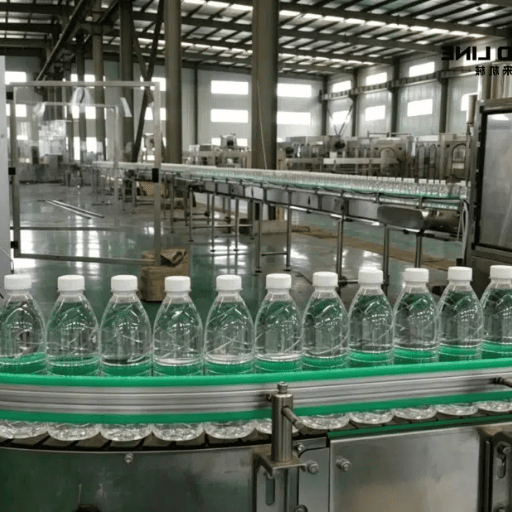
Once you have a price band, sanity-check any line-item quote against typical per-machine ranges — every piece of machinery scales in price with production capacity (BPH). A red flag from the field: if a 6,000 BPH quote prices the RO treatment block under ~$15,000 or leaves it off the line items, you have a problem — the line is under-treated, and that gap is usually there because the supplier stripped treatment to win on price. The numbers below are industry ranges (2025-2026), useful for spotting a block that’s mispriced or missing.
| Equipment category | Typical range | Cost driver |
|---|---|---|
| RO water treatment | $15,000–$100,000 (to $300k large) | Source-water TDS + flow rate (T/H) |
| Bottle blow molder | $7,000–$150,000 | Cavities + speed (or buy preforms) |
| Rinse-fill-cap monoblock | $11,000–$200,000 | Heads + BPH + servo vs pneumatic |
| Labeling machine | $4,000–$50,000 | Label type (OPP/shrink/adhesive) |
| Shrink wrapper | $8,000–$40,000 | Pack speed + format changeover |
| Conveyor + palletizer | $10,000–$80,000 | Length + manual vs robotic |
| Air compressor (blow + valves) | $5,000–$60,000 | Pressure (25–40 bar) + flow |
| Water + product storage tanks | $3,000–$25,000 | Volume + SS304 vs SS316L |
| Date coder + lab/QC kit | $2,000–$20,000 | Inkjet/laser + test scope |
Add ranges to estimate a line; the total will land inside the capacity band above, with treatment + packaging the biggest swing items.
What equipment do I need to build a bottled water plant?
At minimum: a water treatment (RO) system, a rinse-fill-cap monoblock, a labeling machine, a date coder, and a packing solution. Add a blow molder if you make bottles in-house rather than buying preforms, and a conveyor/palletizer as volume rises. Everything else – air compressor, water and product tanks, lab/QC kit – is supporting infrastructure that a true turnkey scope should include but a bare equipment quote often omits.
Sizing the Line: Matching BPH to Real Demand (Without Over-Buying)
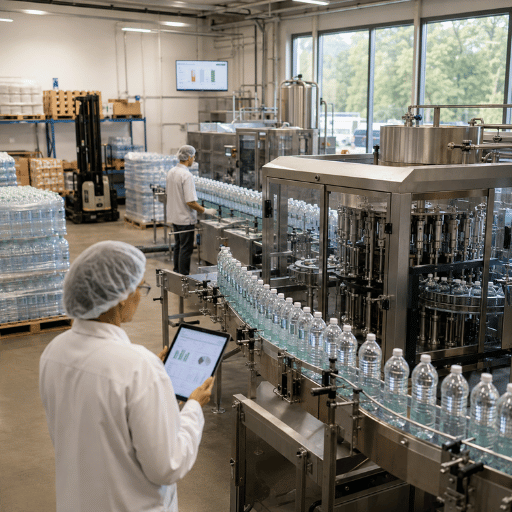
Over-buying is the most expensive sizing risk — paying for 10,000 BPH when you sell 3,000 — and it happens because buyers size to ambition, not demand. Industry field reports repeatedly flag entrepreneurs choosing the wrong plant capacity without doing the math first. Size from demand, not ambition.
Capacity-Sizing Rule (worked example)
Required BPH = (target bottles per day ÷ daily run-hours ÷ OEE) × headroom
Say you need 50,000 bottles/day, running two 8-hour shifts at a realistic 0.85 OEE:
50,000 ÷ 16 h ÷ 0.85 ≈ 3,676 BPH → choose the 4,000 BPH tier (≈20% headroom for growth and downtime).
Size the line for just one capacity step up from your calculated number, not three steps up. A line sized to 20% capacity headroom accommodates system transients and unexpected downtime, not your idle cost to have capacity on hand for a rare event. Mass Technology’s capacity tier selector runs this calculation against real model tiers.
Water Treatment Cost and the Hidden-40 Rule (What Cheap Quotes Leave Out)
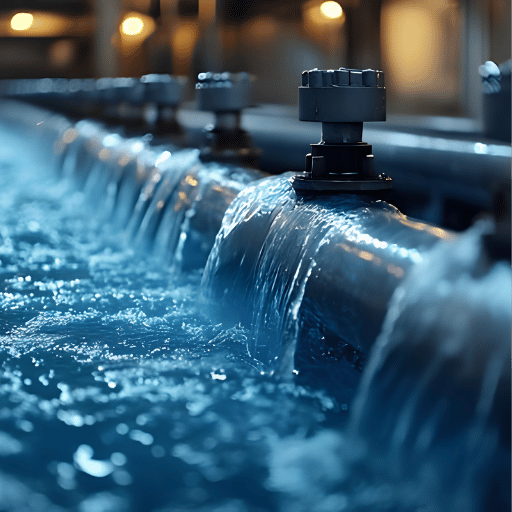
Why does the Hidden-40 Rule hold? A reverse-osmosis treatment block is mandatory for potable output, without it a U.S. bottled-water line can’t in practice meet 21 CFR Part 129 (CGMP) and 21 CFR 165.110 (which caps total trihalomethanes at 0.080 mg/L and DEHP at 0.006 mg/L, among 70+ contaminants). Yet treatment is the block most often thinned or dropped from a bargain “complete line” quote, and it’s only one part of the roughly 40% of a line’s true delivered cost that isn’t the visible filler.
The reason that cost is so variable is the source water itself: feed the RO an elevated total dissolved solids (TDS) reading and you risk a cost blowout, because high TDS a) forces lower water recovery rates (wasted water & doubled input-cost); b) increases filter and membrane area purchases; c) magnifies raw-water acquisition plus all operating costs over time. Yet end users often make zero effort to meter the input water, driving pervasive under-valuation of its cost.
📐 Engineering Note
If your borehole runs ~1,500 mg/L TDS and the RO recovers ~50%, every 1 m³ of product water sends roughly 1 m³ to drain, doubling your raw-water and pumping cost versus a low-TDS municipal feed. Confirm TDS before you size the RO; we spec treatment from 0.5 to 50 T/H against the actual feedwater report, not a generic template.
One future cost that needs consideration: PFAS. U.S. EPA has announced strict standards and testing confirmed the presence of detectable PFAS in 10/197 bottled-water samples during 2023-2024. RO effectively removes most PFAS, so a strong selling point of an RO-based line is its reliable removal of these contaminants; still, budget for source-water testing and validation (we offer treatment packages aligned with current and emerging EPA limits). See the water treatment system options for PFAS-capable configurations.
Beyond the Machine: Operating Cost, Cost-per-Bottle & Payback
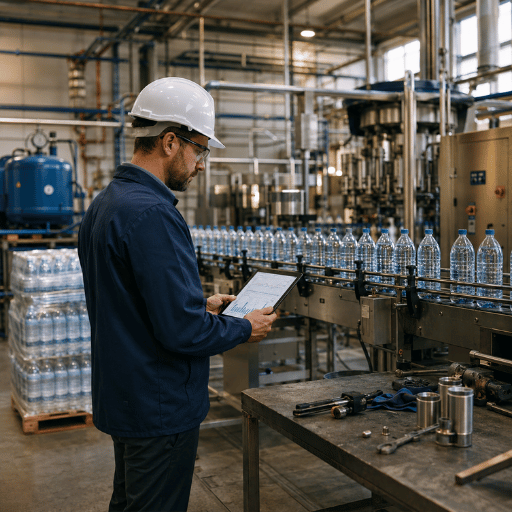
CapEx is only the start; cost-per-bottle is what decides whether the line makes money. The recurring drivers are power (RO pumps plus the air compressor and the blow-mold heating ovens — the two largest electrical draws), preform, cap, label and labor. Worked example: a small plant running 50,000 bottles/day at roughly $0.04/bottle in preform-cap-label-power carries about $2,000/day in variable cost before logistics, which is why the real risk to margin is distribution, not the machine price. Maintenance discipline matters more than buyers expect, because reactive upkeep drives downtime — NIST research links predictive and preventive maintenance to materially less unplanned downtime and fewer defects than reactive upkeep, and puts U.S. manufacturing maintenance costs and losses in the hundreds of billions of dollars a year.
The real cost lever isn’t the line price — it’s grams
Industry estimates put the saving from trimming a 500 mL bottle by just 2 grams at roughly $300,000–$400,000 a year on a line running 30,000 BPH. This is much greater than your machine discounts over the next several years. Get the preform weights and resin specs optimized first.
How profitable is a water bottling business?
profitability: it’s more a function of plant position and distribution economics than unit through put (though that matters too); economics for mineral-water plant models are highly varied (million$ ebitda at scale), though the range hinges on logistics: one published model for example demonstrates that if distribution costs are cut from 50% of sales to 35%, net operating profit improves by around $274,000 a year; ignore reported paybacks at face value and use a cost-per-bottle calculation and conservative payback instead.
New vs Used Water Bottling Line: When Second-Hand Actually Saves
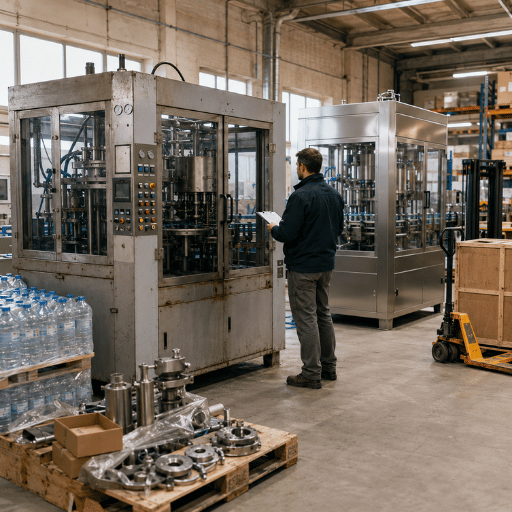
You don’t really save half by buying used, which is a half-truth and a trap at other times. Depends on the type of used line.
✔ When used can genuinely save
- OEM-verified refurbished with service records, calibration and parts support
- Late-model line matched to your bottle format and capacity
- Shorter lead time when you need to produce fast
⚠ When used is false economy
- As-is, no warranty, no maintenance history
- Orphan parts / control system that’s hard to repurpose
- Capacity or format mismatch forcing rework
- Missing machine guarding (an OSHA retrofit cost)
University of Washington procurement guidance is blunt: buying through the OEM and checking maintenance records, spare-parts availability and warranty status is what minimizes used-equipment risk. A University of Idaho Extension bulletin on used processing equipment gives the due-diligence checklist, repair and maintenance records, spare-parts availability, calibration, installation cost, employee safety and prior equipment history, and warns that poorly understood used equipment “can cost much more in the end.” Late-model processing or packaging machinery and control systems are the hardest to repurpose. And don’t forget guarding: OSHA 29 CFR 1910.212 requires machine guarding at points of operation, nip points and rotating parts, so a used line missing it carries a retrofit cost.
💡 Used-Line Break-Even Window
A pre-owned line saves you cash only while the savings from its discount remain larger than the cost of spares, the added downtime, and the production inefficiency at its discounted speed over your payback period. After that time the cheap used line becomes a cash loser, usually at speeds of below 85% rated, or when it requires lots of expensive spares.
Reading a Quote: What Separates a $50k Line from a $250k Line
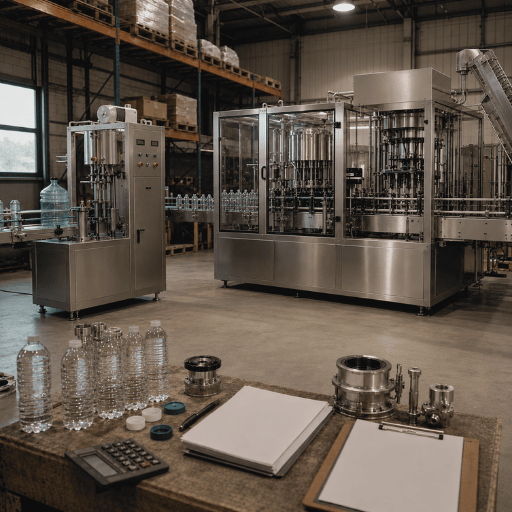
Two quotes for “the same” complete water bottling line can differ as much as fivefold, a $50k line versus a $250k line, because they aren’t the same scope. Compare them on the criteria below, not on the bottom-line number:
- Wetted parts, contact material: SS304 vs food-grade SS316L.
- Drive type: servo (accurate, good repeatability) versus pneumatic (cheap, more drift)
- Is treatment included? The only common exclusion
- Install, commissioning & training, included or your problem?
- Spare-parts kit + warranty term and engineer-response SLA
- FOB terms & lead time (engineering 1-4 wk + build 6-20 wk + install 4-6 wk 3-6 months)
And budget for site-readiness beyond the equipment: 21 CFR Part 129 requires an approved water source, a sanitary plant design, a segregated bottling room, source-certification records — and some U.S. states add a yearly bottled-water license on top. None of that shows up on an equipment purchase order, but all of it influences your real launch price and schedule.
A ‘turnkey’ price tag ideally tells the entire story-and with Mass Technology it means we deliver RO treatment, installation and operational training for your team, even with a starter spare parts package, a two year parts warranty with guaranteed two-day spare parts delivery with the on-site engineer response on demand with day turnaround with 24 hour call out to back it all up so you aren’t surprised later with what we see on the cheap.
Mass Technology technical team
Run an apples-to-apples comparison with Mass Technology’s lead-time & RFQ wizard before you sign.
What’s Changing for Water-Line Buyers in 2026 (Outlook)
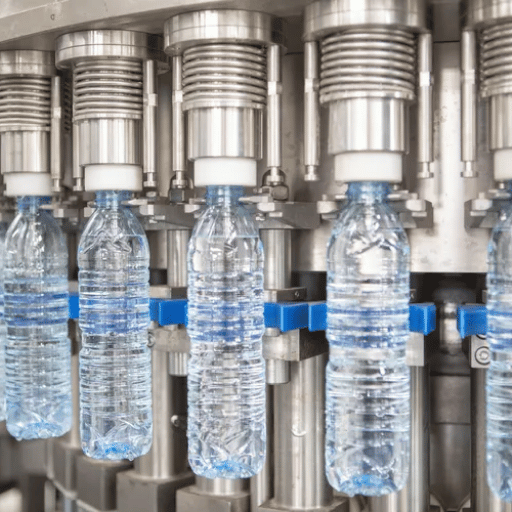
The cost of bottling has historically been heavily influenced by what can be delivered under different capacity requirements, but two under-the-radar trends are having the biggest impact on the overall budget for this category, neither of them directly related to headline market statistics (though the market is a hot topic with projected growth of 6.3% a year toward $611B by 2033). Two factors are making a big impression: regulations and material costs.
1. Recycled-content (rPET) mandates are raising preform cost. The EU’s Single-Use Plastics Directive (2019/904) requires at least 25% recycled content in PET beverage bottles from 2025, rising to 30% across all plastic beverage bottles by 2030; California’s SB 54 targets a 65% plastic-recycling rate; and South Korea began mandating 10% recycled PET in beverage bottles from January 2026. The signal is mixed, not one-way: NAPCOR’s 2024 report shows rPET imports hit an all-time high at about 23% of U.S. supply even as the average U.S. bottle recycled-content sat at 15.9%. So preform pricing is volatile — a real budget risk driven by recycled-content rules — and the buy-preform-vs-blow-in-house decision is back on the table for 2026 buyers.
2. PFAS is becoming a treatment-spec question. EPA’s enforceable limits for six PFAS plus FDA bottled-water PFAS testing are pushing source verification onto the buyer’s checklist. For a line you commission in 2026, the practical moves are: lock your preform and resin strategy against rPET price volatility, confirm your RO is PFAS-capable, and spec lightweighting early — it is the cost lever that compounds. For example, a buyer commissioning a 12,000 BPH line in 2026 should size the RO for PFAS from day one and secure rPET-ready preform supply before signing, rather than retrofitting both after a regulator or a major customer asks.
FAQ
Q: How much does it cost to set up a small water bottling line?
View Answer
A small, semi-automatic complete water bottling line of roughly 2,000–4,000 BPH typically costs about $30,000–$80,000 turnkey, including the RO treatment block. Then add building or lease, source-water approval, utilities and working capital: once those site costs are layered in, a realistic small-plant launch in the U.S. usually lands well above the bare equipment figure, often by a wide margin depending on your location and water source.
Q: What is the cheapest complete water bottling line you can buy?
View Answer
The cheapest genuinely complete lines start around $30,000 — but verify the quote actually includes water treatment, capping and labeling, not just a filler. A line that omits RO treatment looks cheaper and isn’t complete; you will pay for treatment separately and likely more. The cheapest compliant line is rarely the lowest sticker price.
Q: How long does it take to install and commission a water bottling line?
View Answer
Plan on about 3–6 months end to end: roughly 1–4 weeks for engineering and order confirmation, 6–20 weeks for manufacturing and assembly, and 4–6 weeks for installation and commissioning on site. High-speed and heavily customized lines sit at the longer end of that range, and ocean freight from the manufacturer to your site can add several more weeks on top of the build time.
Q: Do I need a separate water treatment system?
View Answer
Yes. An RO-based treatment block is mandatory to meet FDA bottled-water quality standards and is part of any complete line. Even on a clean municipal feed you still need filtration, reverse osmosis and disinfection before the filler; a quote that omits treatment is not complete.
Q: Can one operator run a complete water bottling line?
View Answer
A small semi-automatic line can be run by 2 staff, but rarely one — someone has to feed bottles or preforms, monitor the fill/cap quality, and handle packing and pallet movement at the same time. As you move to a fully automatic mid-size line the headcount per bottle drops sharply (4–7 staff for several times the output), which is part of why cost-per-bottle improves with scale. Treat “one-operator” claims skeptically and ask which tasks are still manual.
Q: Is a water bottling line the same as a water bottling plant?
View Answer
No. The line is the equipment chain — treatment through palletizing. The plant is that line plus the building, utilities, storage, lab and regulatory site-readiness around it. A line quote and a plant budget are different numbers, and the plant always costs more.
Our Perspective on These Cost Ranges
Mass Technology manufactures complete water filling and bottling lines and exports to more than 60 countries around the globe. We’re the original equipment manufacturers and not bottle manufacturers. The information and price bands shared here represent the general budgeting practices across the bottled water industry, not an official Mass Technology pricing list. However, the models shown in this brochure include basic design parameters along with corresponding capacity data, with specific turnkey bottling line package guidelines and price indicators that draw on our industry experience. We created this article because most cost guidance materials only include an estimate for the filling equipment and forget to outline costs related to water treatment, plant layout and installation, and legal compliance. We worked with Mass Technology’s technical team on this information.
Or download the Water Bottling Line Cost Worksheet · Book a 15-min capacity & treatment consult (WhatsApp, no RFQ required)
References & Sources
- 21 CFR Part 129, Processing and Bottling of Bottled Drinking WaterU.S. eCFR / FDA
- FDA Regulates the Safety of Bottled Water (CGMPs)U.S. FDA
- Bottled Water Regulation and the FDA (165.110 quality standard)UC Davis
- PFAS National Primary Drinking Water RegulationU.S. EPA
- FDA Shares Testing Results of PFAS in Bottled WaterU.S. FDA
- 29 CFR 1910.212, General Requirements for All MachinesOSHA
- Maintenance Costs and Advanced Maintenance Techniques in ManufacturingNIST
- Plant Water Profiler, True Cost of WaterOak Ridge National Laboratory
- US11584628B2, Rinse / Fill / Cap MonoblockUSPTO via Google Patents
- 2024 PET Recycling ReportNAPCOR
- Regulation of Bottled WaterInternational Bottled Water Association (IBWA)