Get in Touch with Masstech

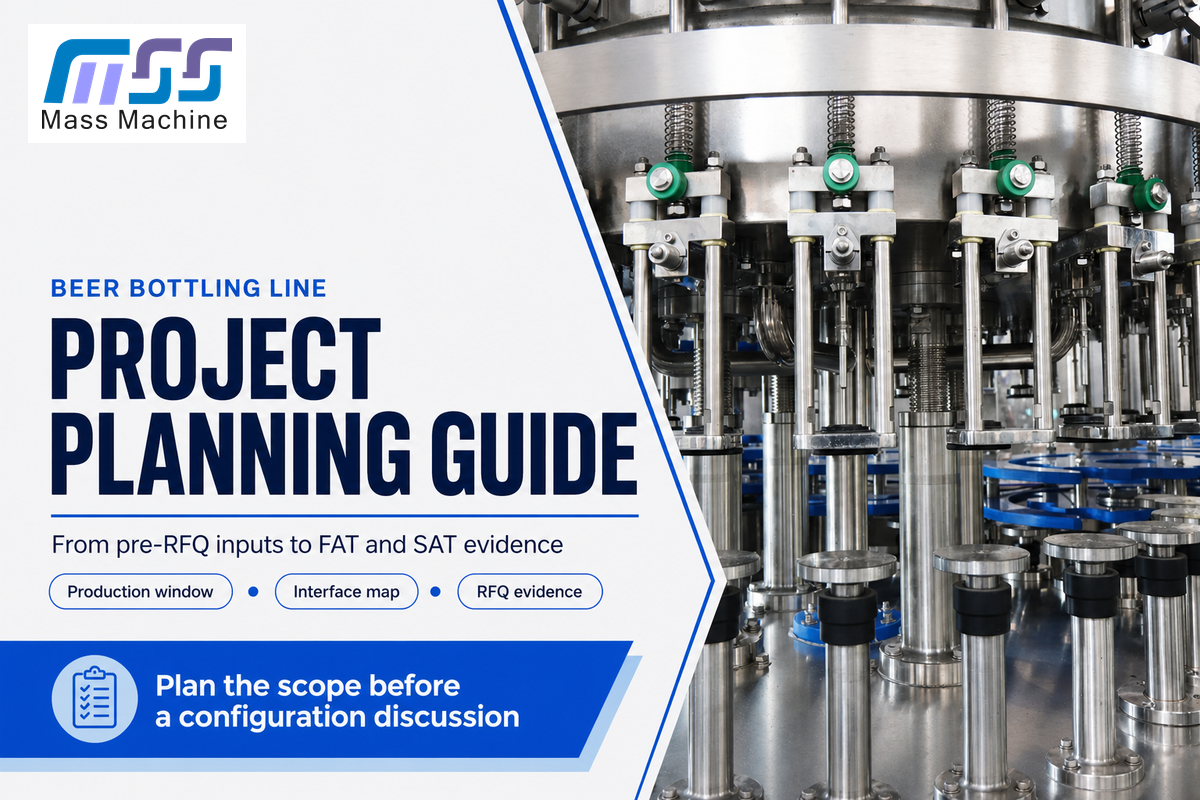
A planning guide for brewery and packaging project teams
A beer bottling line is the project boundary that receives beer, handles the approved bottle and closure, and hands accepted bottles to downstream packing. The project becomes easier to compare when the brewery defines its operating conditions before it asks for equipment. This guide is for the stage before model discussions: it turns the production brief, site interfaces, and acceptance evidence into a pack that every bidder can read the same way.
Direct answer: Beer bottling line planning starts by controlling the package, production window, site interfaces, and acceptance evidence before a supplier is asked to configure equipment. This guide provides that pre-RFQ structure.
Quick planning scope
- Reader: brewery or packaging-project team preparing an RFQ
- Output: controlled brief, interface map, and acceptance-evidence matrix
- Boundary: no model selection, price range, or generic performance promise
What this guide is, and is not. Use it to prepare a project brief and an RFQ. It does not select a machine, quote a price, promise output, or replace a project-specific engineering review.
1. Start With a Packaging Brief, Not a Machine List
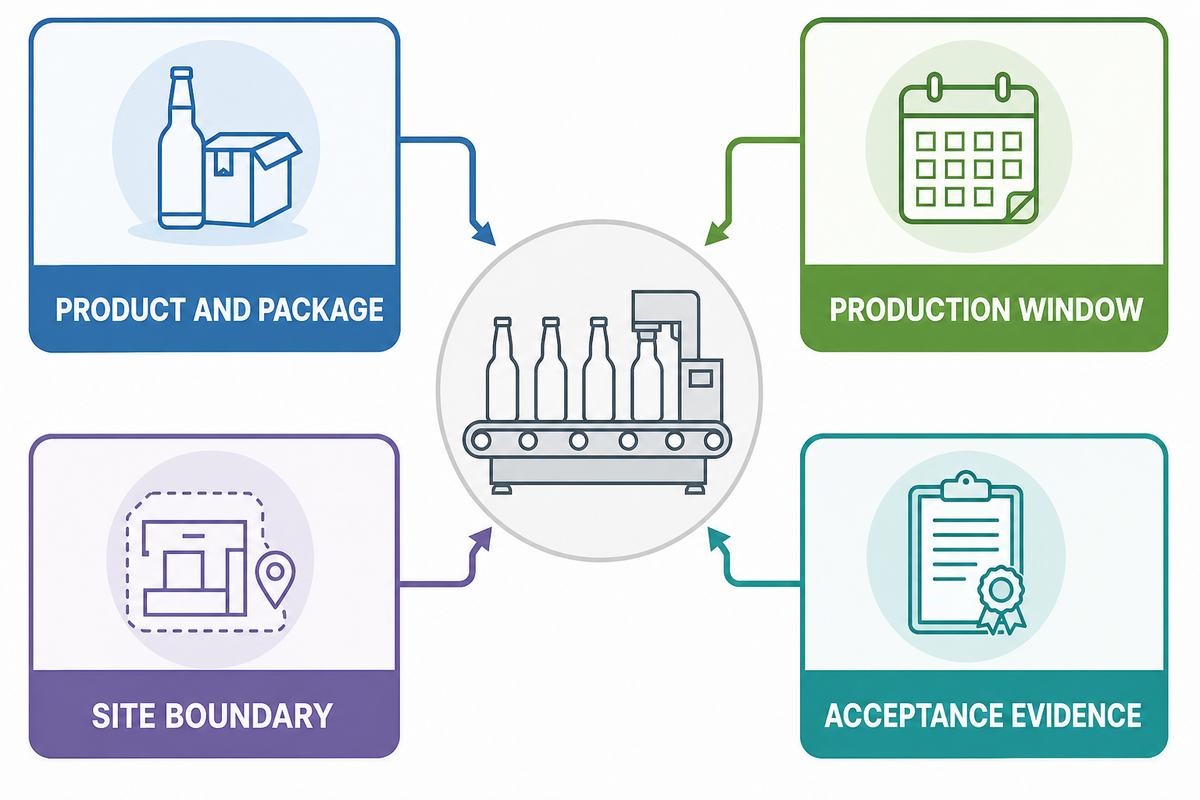
A usable brief states what must be packaged, when it must be packaged, where the line will sit, and what will count as accepted. A list of machines can’t answer those questions because it leaves each supplier to make different assumptions.
The goal isn’t to lock every setting before engineering begins. It is to identify the items that would otherwise move scope, change the layout, or turn a later test into a disagreement.
| Brief field | Write down | Why it changes the project |
|---|---|---|
| Product and package | Beer type, bottle, closure, label, pack, and approved formats | These define handling, change parts, and test samples. |
| Production window | Required packaged units, scheduled hours, planned stops, setup families, and sequence constraints | A headline rate does not show the real operating window. |
| Site boundary | Utilities, drainage, floor access, tank handoffs, packing exit, and operator routes | A workable process can still fail at its handoffs. |
| Acceptance evidence | Trials, records, documents, training, open-item owner, and sign-off method | It makes the purchase scope observable before shipment. |
What is the first document to request internally?
Ask for a one-page project brief that names an owner for each field above. If an input is unknown, mark it as open rather than filling the gap with an assumed value. Include the package scope, production window, site boundary, and acceptance evidence so the same brief travels with every supplier request.
- Attach bottle and closure drawings, or controlled physical samples.
- List every format intended for the first acceptance scope.
- State which upstream and downstream systems are already fixed.
2. Turn the Production Window Into a Design Input
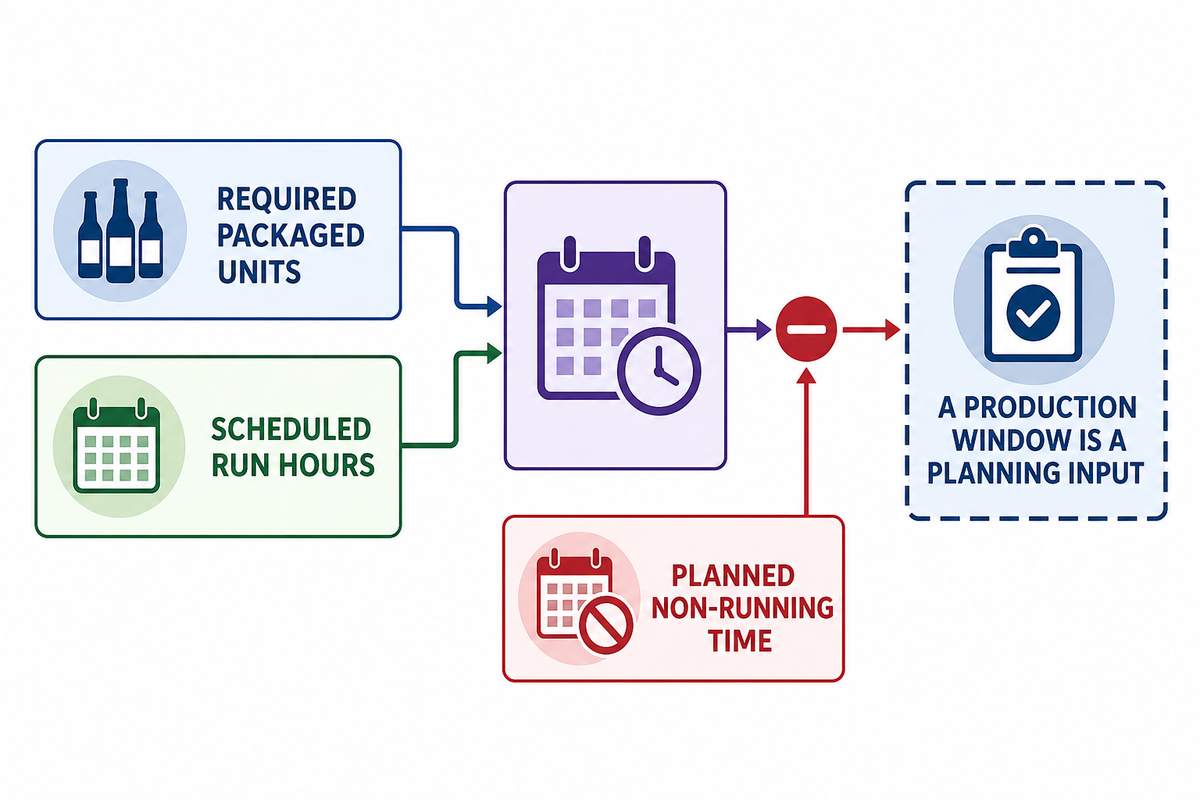
A production window is a planning input, not a machine recommendation. It starts with the packaged units required in a defined period, then makes planned non-running time visible before anyone interprets a rate as a promise.
That view should also capture product-family setups and sequence dependencies. Beverage scheduling research describes setup families and pre-defined production sequence, which is a useful reminder that line time is connected to the rest of the packaging plan, not isolated from it.
Planning formula
planned run rate = required packaged units ÷ (scheduled run hours − planned non-running time)
Example: 48,000 planned units ÷ (12 scheduled hours − 2 hours for planned non-running time) = 4,800 units per hour. This is an illustrative brief input only; it does not select equipment or predict delivered performance.
Which non-running time belongs in the brief?
Include expected cleaning, planned changeovers, routine checks, and other stops that the project team already knows must occur. Add the upstream availability and product sequence that govern when the line can actually receive product. Use the stated hours only after the team has recorded each planned stop category and its upstream-release owner.
Connect the brew schedule and each planned packaging batch to its release condition, setup family, rinse/cleaning event, and downstream packing handoff. That note does not create a scheduling algorithm; it prevents a line-only rate from hiding dependencies owned elsewhere in the brewery.
A late scope change becomes a project risk because upstream availability, cleaning, and changeovers all draw from the same window. Put the calculation, the basis for each deduction, and the agreed acceptance evidence into the RFQ so a supplier is not asked to infer the factory test scope.
Do not turn an early estimate into a hidden acceptance target. The useful question is whether each supplier has been given the same stated window and constraints to assess.
3. Use the 6-Interface Readiness Map
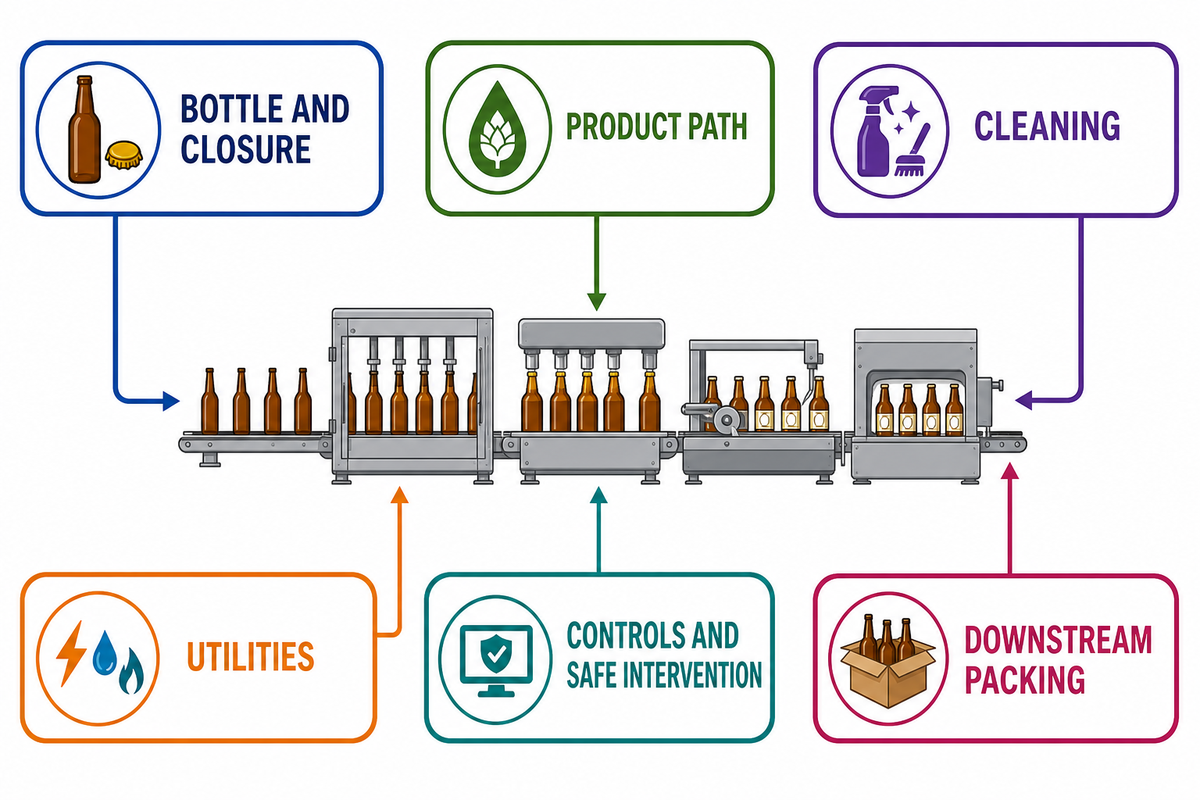
This 6-Interface Readiness Map keeps the brief from becoming a loose collection of specifications. It asks who owns each handoff and what evidence will show that the handoff is ready.
| Interface category | Project question | Evidence to request |
|---|---|---|
| Bottle and closure | Which approved formats enter the first scope? | Drawings, samples, format list, and change-part ownership. |
| Product path | Where does product arrive, and which condition must be maintained? | Defined transfer boundary and agreed verification method. |
| Cleaning | What is cleaned, by whom, and how is readiness checked? | Cleaning boundary, records, and unresolved-item path. |
| Utilities | Which services reach each defined connection point? | Utility map with supply owner and installation boundary. |
| Controls and safe intervention | Which alarms, access states, and intervention controls need project review? | Alarm list, access/control description, and applicable safety evidence. |
| Downstream packing | How do accepted bottles leave the line and enter packing? | Handover drawing, pack definition, and route for rejected units. |
| Production sequence | Which setup family, product sequence, and upstream-release condition control the run? | Sequencing assumption, tank-availability owner, and changeover note. |
| Market documentation | Which package or product-contact documents must the responsible project party verify? | Named responsible party, required document list, and approval path. |
| Acceptance records | What records close a test, a training session, or an open item? | Signed evidence matrix and an open-item closure register. |
This map does not prescribe a universal design. It gives the project team a way to find an unowned handoff before that gap appears on a layout or at acceptance.
An interface left unowned creates a handoff risk because a line can pass an individual check while the next system has no agreed condition of readiness. Ask for one evidence record per interface in the RFQ and review the list again before FAT and SAT.
4. Freeze Bottle, Closure, and Change-Part Inputs Early
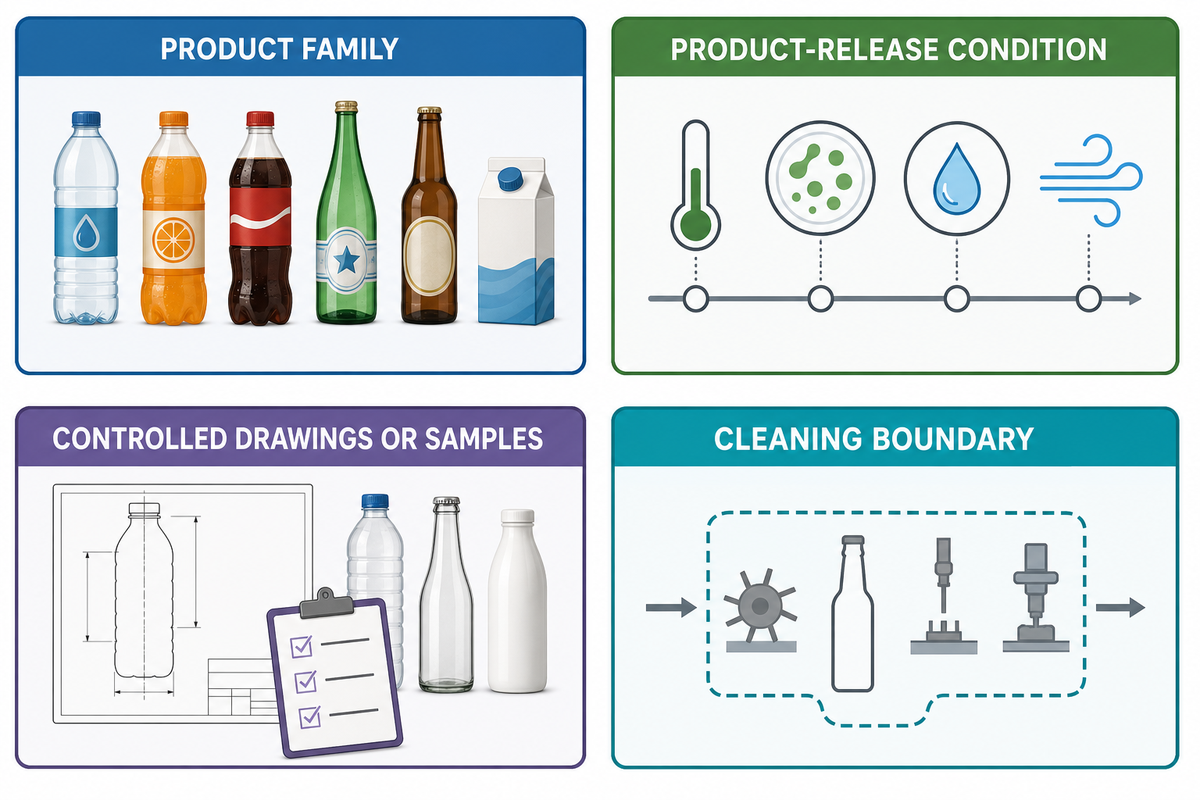
“Glass bottle” is not a controlled package description. Before layout approval, state the bottle and closure versions that belong to the first project scope, then identify what may change later and how that change will be assessed.
The guide applies before choosing a bottle filler, capper, or other automatic bottling equipment. Those items can be assessed later against the controlled package and acceptance scope instead of being treated as the starting point.
If the scope identifies a stainless steel product path, a rinse boundary, or a closure component, record that identity as a project input and name the party who verifies its applicability. The guide does not assign a material grade, cleaning method, or closure design to a brewery without its own controlled evidence.
Turn mixed search language into controlled scope questions
Searches for a beer bottling line often mix plant-scale language with hobby and product-listing terms. A bottling machine, bottling system, monoblock, rotary unit, bottler, all-in-one package, semi-automatic option, or compact format is not a specification by itself. Nor are “popular machines,” a named manufacturer, or “cost effective” a substitute for a controlled project brief.
Instead, convert each term into a question that an RFQ can carry: which package and product conditions are in scope; which interfaces need to integrate; and which records will show that the agreed result was achieved. This keeps consumer terms such as homebrew or homebrewer context separate from a brewery project without ignoring the practical questions that caused a reader to search for them.
| Mixed search language | Convert it into a project input | Do not turn it into |
|---|---|---|
| Beer and wine, wine bottles, mead, kombucha, or other carbonated drinks | State the approved product family, bottle and closure variants, product-contact boundary, and responsible market verifier. | A claim that one scope automatically handles every beverage or bottle type. |
| Bottling beer, bottling process, fermentation, carbonation, carbonate, isobaric conditions, oxygen, oxidation, foam, headspace, and shelf stability | Document the product-release condition, the verification method, the sample record, and who agrees the acceptance limit. | A generic performance promise or a process recipe. |
| Container, empty bottles, bottle condition, screw closure, cork and cage, and the route by which a bottle travels | Issue the controlled drawings or samples, inbound condition, approved closure list, and handoff map for the first acceptance scope. | An assumed change-part set or untested future format. |
| Tube, tubing, contamination, and “clean and sanitize” | Name the applicable cleaning boundary, evidence record, responsible party, and project-specific verification point. | Universal hygiene or jurisdiction-specific advice. |
The practical outcome is a clearer decision path: a buyer can compare how a proposed line will receive the agreed product and package, protect the stated conditions, and hand accepted bottles to packing. It is still not a recommendation for a particular machine or a claim that the same configuration is suitable for every brewery.
- Issue the approved bottle, closure, label, and case data with revision control.
- State whether physical samples are available for trials and who releases them.
- Separate the first accepted formats from future possibilities so neither is silently assumed.
- For the project market, ask which material or food-contact documentation must be supplied and which items the responsible party must verify.
This avoids a common RFQ ambiguity: a future format is mentioned in conversation but never becomes a tested scope item. It also avoids turning a general guide into a claim that every format can be handled without project review.
Late discovery of a bottle or closure detail becomes a changeover risk because the parts, inspection approach, and acceptance sample may no longer describe the same format. Attach the controlled drawing or sample record to the supplier RFQ and make it an explicit FAT evidence item before any factory test date is fixed.
5. Make Hygiene and Product Protection Testable
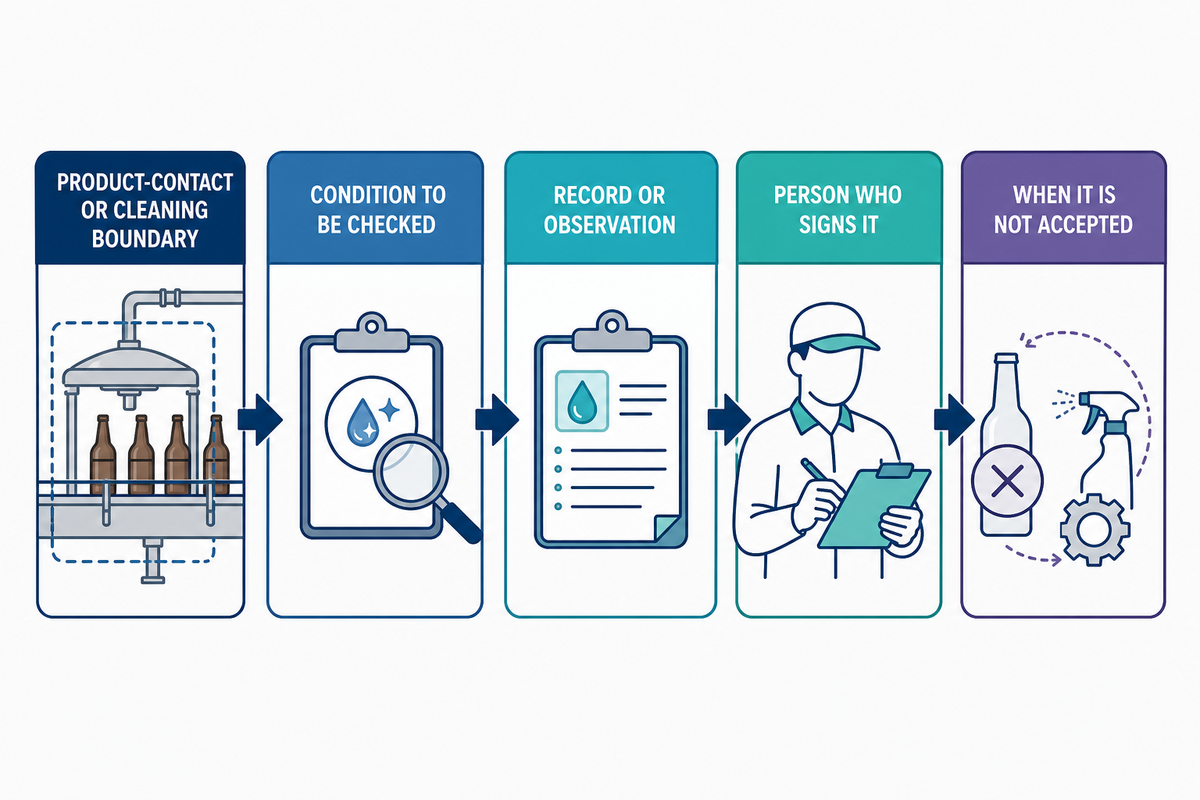
Hygiene should appear in the brief as conditions to verify, not as an internet recipe. Current U.S. food CGMP sections on equipment and utensils and processes and controls provide useful background for asking what must be clean, suitable, and protected in a project boundary.
For an international project, the applicable requirements and the responsible verifier depend on the market. The EHEDG Guideline Catalogue is a further hygiene-design reference, not a substitute for the project’s own standard and market-specific review.
A practical risk is a handover that cannot be shown cleanly because a vague requirement turns acceptance evidence into a debate instead of a record. For a supplier RFQ, name the applicable market requirement, the evidence to request, and whether the item is checked at FAT, SAT, or site handover.
Evidence-first hygiene prompt: For each product-contact or cleaning boundary, name the condition to be checked, the record or observation that will show it, the person who signs it, and what happens when it is not accepted.
6. Translate Utilities and Layout Into Handoffs
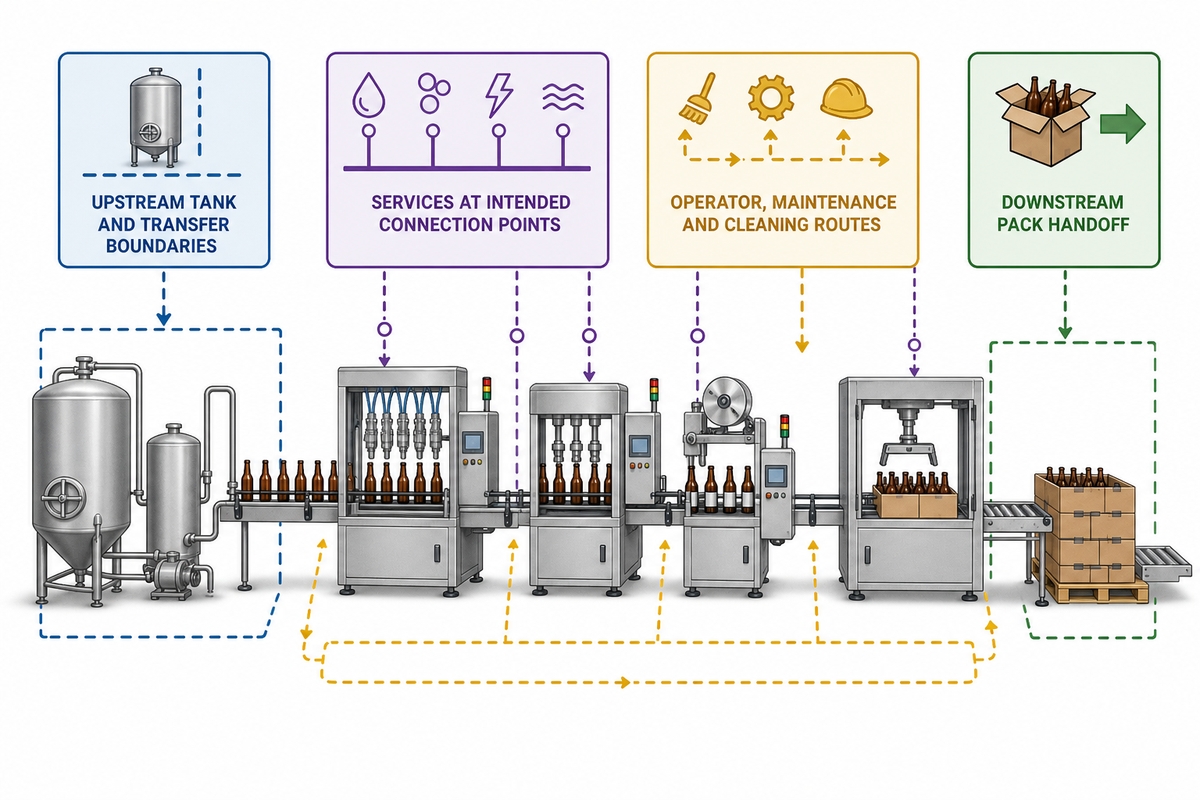
A layout drawing becomes useful when it shows interfaces, not just footprints. Trace the route from product arrival through bottle handling and packing exit, then mark each connection, access zone, drainage point, and service owner that must be confirmed.
- Identify upstream tank and transfer boundaries, including who confirms availability.
- Mark electrical, air, water, drainage, and any other project services at their intended connection points.
- Reserve operator, maintenance, cleaning, and rejected-product routes rather than treating them as leftover space.
- Show the downstream pack handoff and the response path when an item is rejected or held.
These are scope prompts, not dimensions. A supplier can then identify assumptions in writing instead of leaving the buyer to discover them during installation.
Layout conflicts are a site risk because a connection can be drawn without leaving a safe path for service, drainage, or operator access. Bring the marked-up drawing, utility evidence, and open interfaces into the supplier RFQ, then confirm the same handoffs in the factory FAT and again at the site.
7. Define FAT, SAT, and Handover Evidence Before the Purchase Order
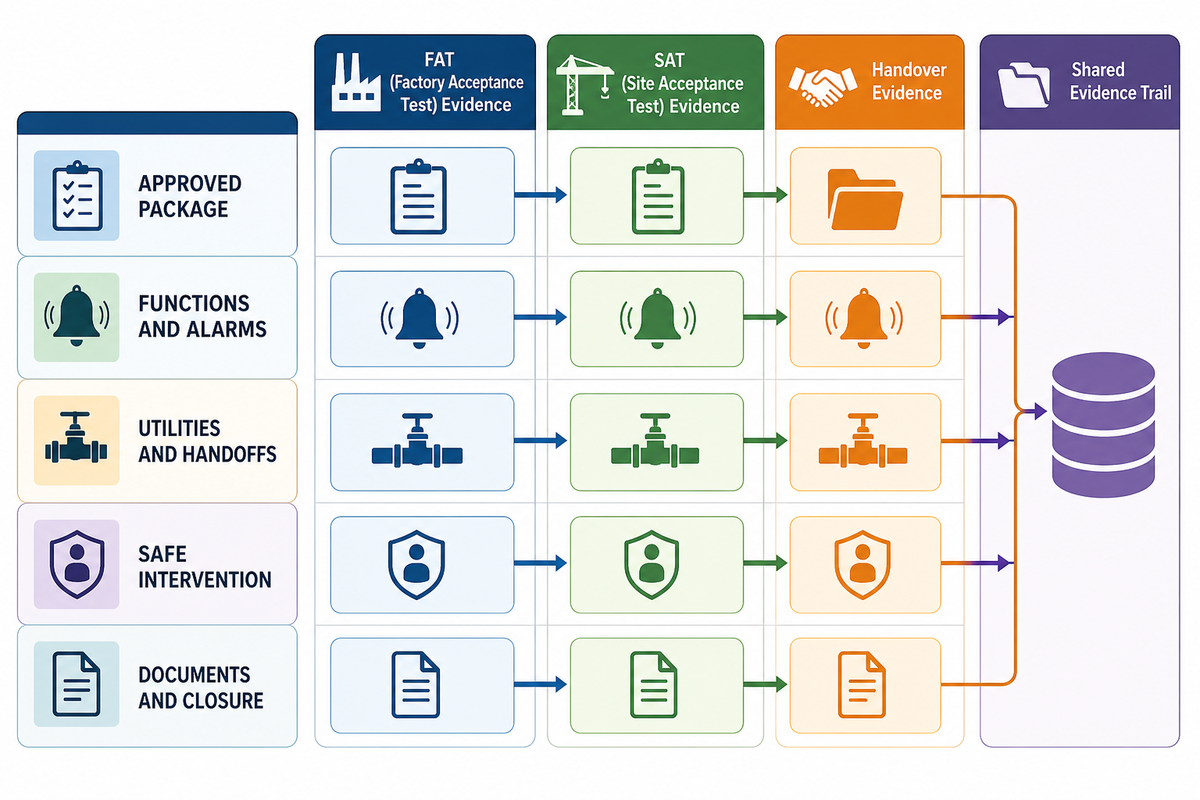
FAT and SAT are stronger when they describe observable evidence, a test condition, an owner, and an open-item path. FAT can demonstrate agreed functions before shipment, while SAT checks the installed handoffs with the actual site services and project team.
| Evidence area | FAT question | SAT / handover question |
|---|---|---|
| Approved package | Was the agreed trial package identified and recorded? | Does the installed handoff use the agreed project package scope? |
| Functions and alarms | Which agreed functions and alarm responses were observed? | Which site-specific alarms, access states, and records were demonstrated? |
| Utilities and handoffs | Which factory-side conditions were assumed? | Which actual services and upstream/downstream handoffs were verified? |
| Safe intervention | What project safety evidence is required before shipment? | Where applicable, are guarding, interlocks, safe intervention, and energy-isolation documents checked? |
| Documents and closure | Which records, manuals, and open items are issued? | Who owns each unresolved item and how is closure recorded? |
For projects subject to U.S. lockout/tagout rules or equivalent local controls, safe intervention should be checked as a project evidence item. OSHA describes controlling unexpected energization, start-up, or release of stored energy; the project team must still determine which local requirements apply.
Review the OSHA lockout/tagout source and general machinery requirements with the responsible safety and designated local contacts where relevant. This guide doesn’t interpret those rules for any jurisdiction.
Use the acceptance plan to expose a risk early: if a test step has no owner or record, the cause of a failed handover will be hard to isolate. Tie the FAT and SAT evidence to the supplier RFQ and confirm at the site who releases each open item.
8. Build the Evidence-First RFQ Pack
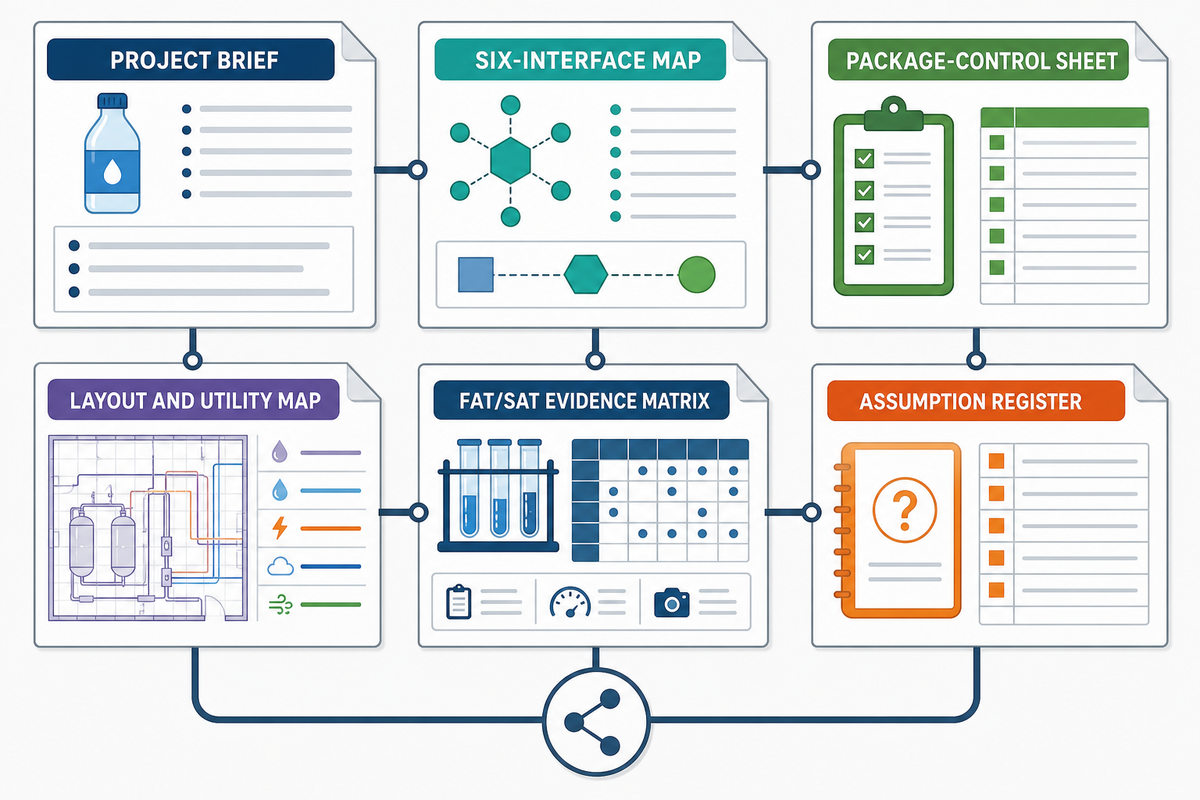
An Evidence-First RFQ Pack gives every shortlisted supplier the same project inputs and asks each one to make exclusions visible. It isn’t a pricing template; it’s a way to distinguish a stated scope from an assumption.
- Project brief: package, product, production window, site, and acceptance owner.
- Six-interface map: bottle, product, cleaning, utilities, controls/safe intervention, and downstream packing.
- Package-control sheet: approved drawings, samples, revisions, change-part scope, and future-format boundary.
- Layout and utility map: connection points, access, drainage, and responsibility boundary.
- FAT/SAT evidence matrix: test conditions, records, sign-off, open-item owner, and closure route.
- Assumption register: every unresolved item, its owner, and the decision needed before release.
Its value is traceability. If two offers differ, the team can ask whether the difference comes from the same agreed scope or from an unrecorded assumption.
An RFQ with unresolved interface questions creates an avoidable risk because suppliers must price assumptions instead of the same scope. Put the request, drawing, and named acceptance evidence into the package; it is then ready for a factory FAT review and the site SAT handover.
9. Know When Planning Is Complete
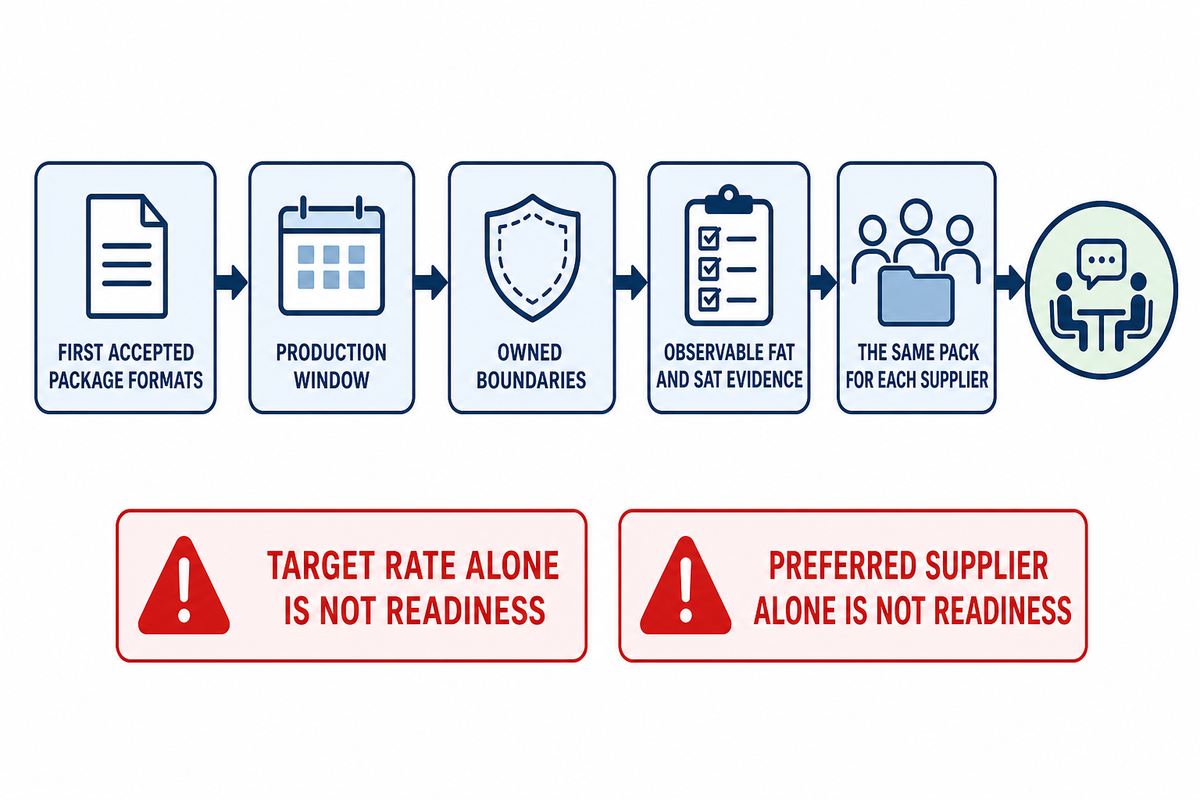
Planning is ready for a solution conversation when the project can answer the questions below with an owner and a controlled document. It isn’t ready merely because a target rate or a preferred supplier has been named.
Readiness screen
- Are the first accepted package formats identified?
- Is the production window stated with planned non-running time?
- Are setup families and sequence dependencies visible?
- Are product, cleaning, utility, control, and downstream boundaries owned?
- Are market-specific documentation responsibilities assigned?
- Is the layout/utility map ready for project review?
- Are FAT and SAT conditions written as observable evidence?
- Where relevant, is safe-intervention evidence assigned to the correct responsible party?
- Does every open item have an owner and decision date?
- Can each supplier receive the same pack?
If the answers are stable, move from generic planning to a configuration-specific discussion through this beer bottling line solution page. If they aren’t stable, return to the interface map and assumption register before treating any commercial page as a substitute for project planning.
For a wider category view before a configuration discussion, see the beer filling machine portfolio; the controlled scope pack remains the record that separates a planning guide from a commercial selection page.
Before moving to a solution discussion, review the shared risk list, open assumptions, and acceptance evidence with the relevant owner. The supplier-facing RFQ should show which questions are for factory FAT, which are for site SAT, and which remain market-specific.
Mass Technology can take a stabilized brief into plant-layout discussion, equipment manufacturing, line installation, operator training, and after-sales planning. The next conversation is more useful when the project team brings the controlled scope pack rather than a list of unowned assumptions.
Frequently Asked Questions
What information should be in a beer bottling line project brief?
A beer bottling line project brief should record the product and package formats, production window, planned stops, setup and sequence constraints, site interfaces, utilities, layout boundary, and acceptance evidence. It should also name the owner for drawings, samples, market-specific documentation, and unresolved assumptions. That structure lets a supplier identify scope gaps before a machine list is interpreted as a complete requirement.
How do I plan capacity without choosing a machine model first?
Plan capacity by dividing the required packaged units by the scheduled hours after stated planned non-running time is removed. Treat that result as a planning input for engineering review, then add product-family setup, cleaning, upstream availability, and sequence conditions instead of using the number as a purchase decision. A supplier should test the stated window against the actual project scope, rather than treat an illustrative calculation as a promised output.
What should be tested at FAT and SAT?
FAT and SAT should record the agreed package, functions, alarms, utilities, documents, training, open items, and responsible sign-off. The evidence matrix should name the trial condition, the observation or record required, the person who witnesses it, and the route for any open item.
Where relevant to the project market, include guarding, interlocks, safe-intervention steps, and energy-isolation evidence as defined by the responsible safety and designated local contacts. Site acceptance should also confirm the actual utility and upstream/downstream handoffs, because a factory trial can’t prove every installation condition. The useful outcome is a signed evidence trail with an owner and closure date for each unresolved item; it isn’t a claim that one test format fits every brewery.
Can one line handle more than one bottle size?
Multiple bottle sizes should be treated as an approved-format scope question, not as a general promise of flexibility. Identify each bottle, closure, label, case, change-part need, and verification record before the layout or acceptance scope is released. A cap or cork closure should appear only when it belongs to the controlled package list; it should never be inferred from a generic description such as “glass bottle.”
When is it appropriate to request a project-specific solution discussion?
A project-specific discussion should be requested after the brief, interface map, package sheet, utility/layout boundary, and acceptance plan have been owned. This way, the supplier can evaluate a defined scope instead of filling gaps with assumptions. For brewery, which packages a second beverage also, retain those formats in an “expanded scope” instead of allowing a beer RFQ to include assumptions on wine, cider, or other package formats without review.