Get in Touch with Masstech

System engineering guide · Updated October 2026
A practical framework for defining control boundaries, utilities, hygiene responsibilities, line handoffs and traceable evidence without replacing application-specific method selection.
Can Filling Machine is a controlled beverage-packaging system, not a device selected from can volume alone. First define the beverage state, container and regulatory boundary. Then map the control, utility and ownership interfaces and document the evidence each handoff requires. The useful result is a controlled transfer, not merely liquid entering a can.
The phrase can filling machine can describe a limited number of nozzles, a rotary filler, or an integrated filler-and-closing block. Search and catalogue language can overlap too: drink filling, liquid filling, liquid filling machine, capping machine, capping, packaging equipment and packing machines may describe a complete line, one function or an adjacent machine. Even “semi-automatic” provides little information about the actual control boundary, unless manual and automatic actions are named. That ambiguity creates weak specifications. A project can look complete while the product temperature has no defined measurement point, the gas boundary has no owner, the downstream machine has no handshake, or “good output” has no agreed inspection point.
This guide has a deliberately different role from Mass Technology’s Can Filling Machine solution page. The commercial page owns models, nominal capacity, configuration, pricing, supplier comparison, quotation, lead time and RFQ intent. This article focuses on the engineering questions that need to be answered prior to making the commercial choices. Detailed carbonated-beverage diagnosis stays in the Soda Can Filling guide; can-family and seam qualification stay in the Aluminum Can Filling guide.
Scope: the matrices and worksheets below are editorial decision tools built from public sources. They are not machine instructions, validation protocols or legal opinions. No private Mass Technology production trial or customer dataset was supplied. Actual limits come from the beverage specification, approved package, equipment documentation, validated methods, qualified specialists and rules in the operating jurisdiction.
Define
Product, package and jurisdiction
Product, package and jurisdiction
Control
Principle, sequence and permissives
Principle, sequence and permissives
Connect
Utilities and line handoffs
Utilities and line handoffs
Prove
Measurement, release and ownership
Measurement, release and ownership
1. What Is a Can Filling Machine? Define the System Boundary
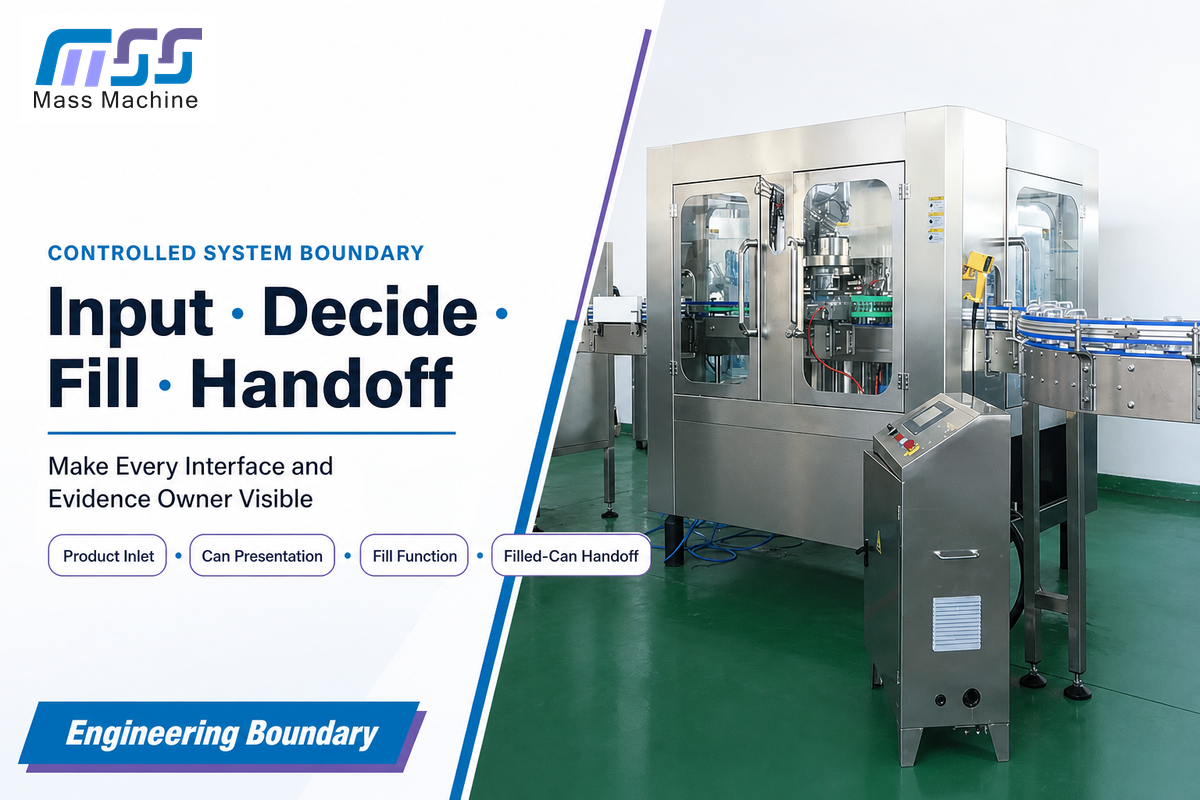
Direct answer: for project definition, treat the machine as a controlled beverage-packaging boundary. Product conditioned for packaging and verified cans enter; cans leave for closure and inspection, with traceable process evidence. The boundary includes the states, permissives, utilities and handoffs required to make that transfer repeatable.
KHS states that filling is dependent on the beverage and container, and can be mechanical, pneumatic or controlled by a computer. This is a system-level principle. It doesn’t prove that for every filler machine, the same sequence and result is obtained.
Editorial Asset: Can Filling System Boundary Map
| Boundary | Required input | Controlled decision | Evidence passed forward |
|---|---|---|---|
| Product inlet | Verified batch and measured condition | Ready, hold or recondition | Identity, method, result, time and disposition |
| Can presentation | Approved can and presence/position state | Safe and permitted to fill | Reference, sensor state and exception record |
| Filling function | Product, can, utilities and valid permissives | Enable, control and stop flow | Cycle state and measured fill result |
| Filled-can handoff | Controlled filled can and downstream availability | Release, contain or stop | Accepted count, reject reason and destination |
This boundary prevents two common mistakes. First, it stops the specification from becoming a catalogue of valves while shared product, utility and conveyor conditions remain undefined. Second, it makes ownership visible. The filler supplier may provide a machine capability, but the site still owns product classification, utility quality, approved cleaning, occupational safety, sampling and release decisions.
2. Start with Beverage Behavior, Not Nominal Can Volume
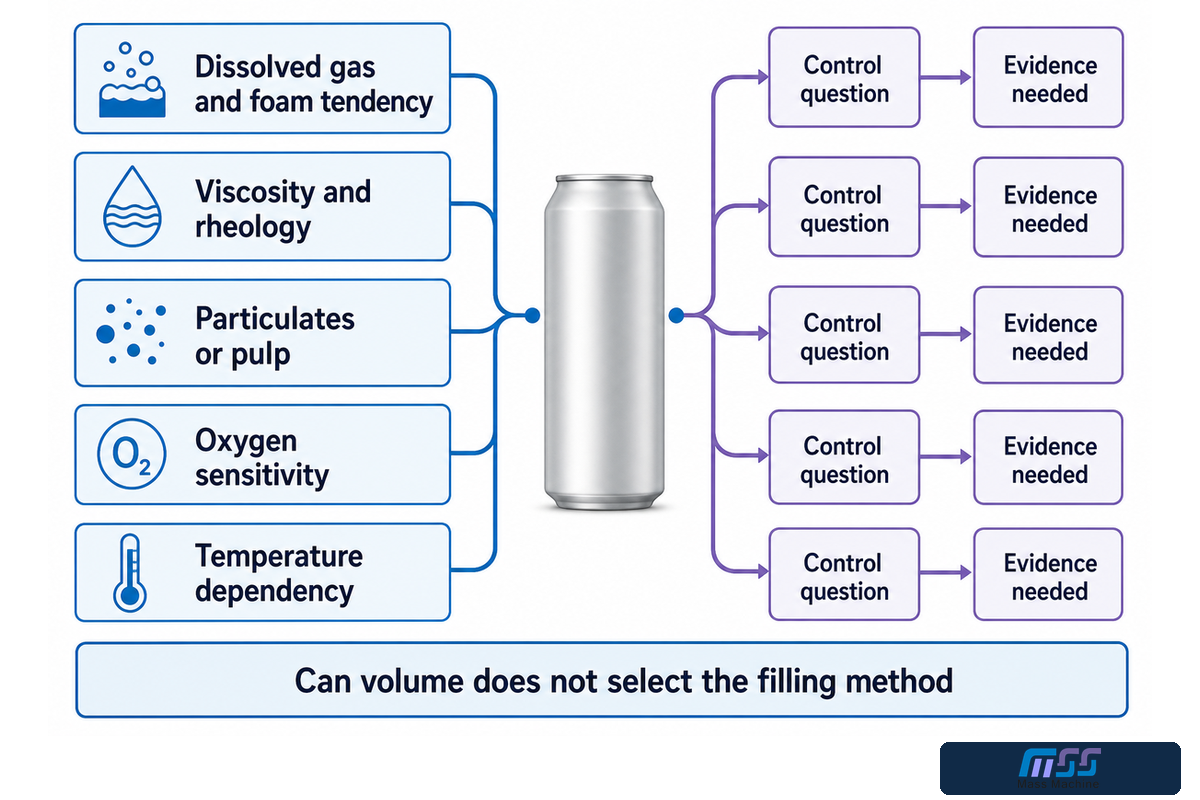
Direct answer: start with measured product behavior. Can volume is a package input; it does not establish how the beverage should move through a valve, how gas should be managed, or how the filled can should be accepted.
The beverage name isn’t a process specification. Juice can contain different solids or show different viscosities. Juice products can also differ in oxygen sensitivity, acidity, thermal history and sanitation duty. Two carbonated drinks can also vary in terms of their dissolved gas, their temperature window, and their behavior with respect to foam. A still drink can still require headspace-gas or oxygen-control decisions. The first discussion should be about what needs to be controlled as opposed to what model best fits a nominal volume.
Editorial Asset: Beverage Behavior to Fill Principle Matrix
| Behavior to define | Control question | Evidence needed | What it does not decide alone |
|---|---|---|---|
| Dissolved gas and foam tendency | How will pressure transitions and product release be managed? | Approved method, sample point, temperature and gas result | Exact machine settings |
| Viscosity and rheology | What flow path and measurement method remain reliable? | Product specification at a named condition | A universal fill time |
| Particulates or pulp | Can the flow path pass the product without damage or blockage? | Size/distribution basis and validated product trial | Suitability from valve diameter alone |
| Oxygen sensitivity | Where are oxygen pickup and headspace controlled and measured? | Product objective, method, sample location and package result | A guaranteed result from a gas label |
| Temperature dependency | Which product properties change across the approved window? | Measurement point, instrument and time-matched result | A transferable setpoint |
| Microbiological and sanitation duty | Which legal and validated controls apply to product and process? | Classification, hazard analysis, approved procedure and release record | Compliance from stainless construction |
| Density and concentration | How will mass, volume and temperature relationships be verified? | Batch property, test method, sample point and named condition | Net quantity from a recipe value alone |
| Surface tension and wetting behavior | Where can dripping, stringing or wall wetting affect the fill event? | Observed product trial at the approved condition | Valve suitability from catalogue geometry alone |
Use this matrix before discussing equipment. It turns “we need a machine for 330 ml cans” into a controlled application question. The can reference still matters, but detailed body/end, liner, handling and seam qualification belongs in the Aluminum Can Filling guide so this page does not become a second package-engineering article.
3. Compare Filling Principles Without Building a Product Catalogue
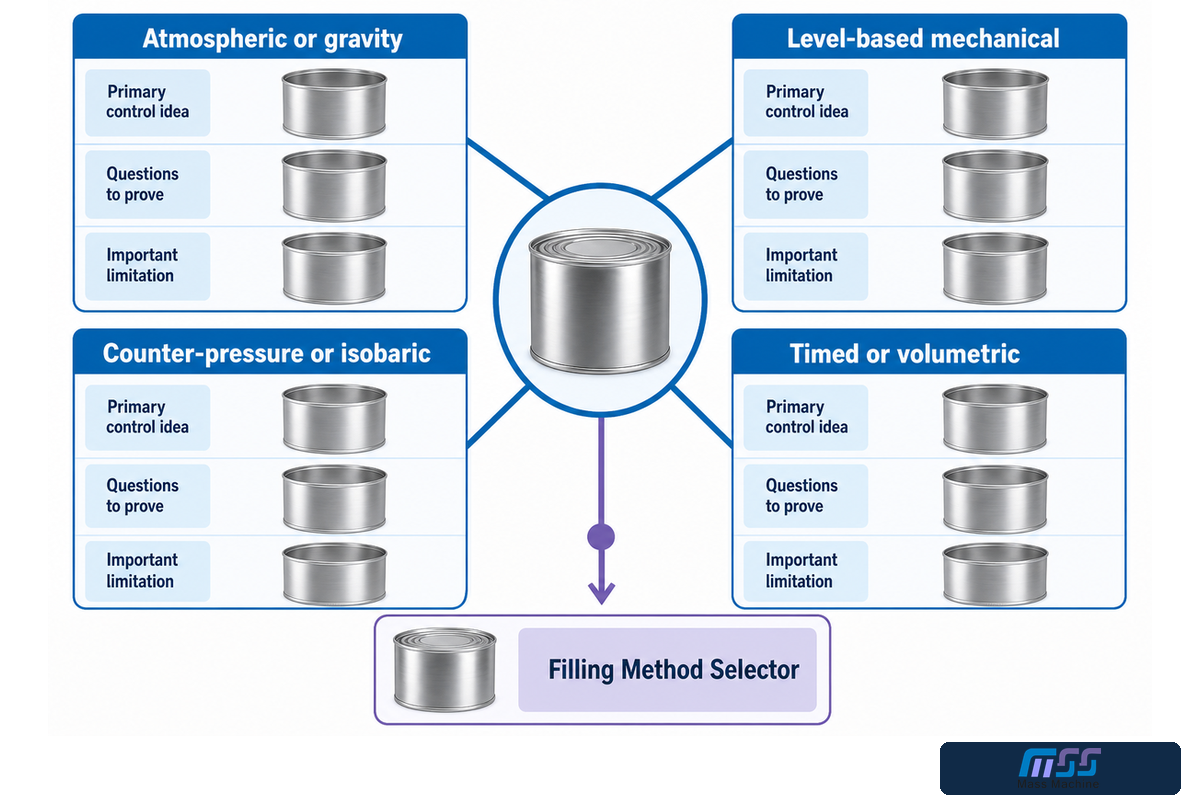
Direct answer: Filling principles describe how product movement or the stop condition is controlled. They do not identify a suitable machine by themselves. The same broad label can hide different valve, vent, sensor and cleaning architectures.
Use the Filling Method Selector for an application-level method recommendation. This section only explains the principle families, the questions behind them and the evidence limits; it does not recommend a commercial configuration.
| Principle family | Primary control idea | Questions to prove | Important limitation |
|---|---|---|---|
| Atmospheric or gravity | Product flows under available head while a level or time boundary stops filling | Vent behavior, viscosity range, product condition and quantity method | “Gravity” does not guarantee simple product behavior |
| Level-based mechanical | A fill tube or return path establishes a repeatable geometric level | Can geometry, foam, temperature and quantity correlation | Visible level is not automatically net quantity |
| Counter-pressure or isobaric | Can and product-side pressures are managed before and during flow | Equalization, gas path, product condition, venting and foam evidence | It does not eliminate every foam or oxygen mechanism |
| Timed or volumetric | A controlled flow event or measured volume establishes the dose | Flow stability, density/temperature effects, valve repeatability and verification | A programmed time is not a measured quantity |
| Positive displacement | A defined displacement meters product | Product compatibility, shear, cleaning, wear and calibration | Metering principle does not prove hygienic suitability |
| Weight or mass based | Measured mass provides the control or verification signal | Tare variation, vibration, measurement capability and density conversion | Mass control still needs package and process evidence |
A published valve patent illustrates why architecture matters: ports, vent seals and cleaning-fluid paths can change how a filling valve behaves. A patent establishes disclosed design choices; it doesn’t prove deployment, superiority or suitability for another line.
The detailed discussion on pressure cycles and foam for carbonated soft drinks belongs in the Soda Can Filling guide. Here, the important decision is upstream. Carbonation changes the nature of the control questions that need to be asked. However, this does not permit copying a pressure or timing value from a different beverage or machine.
4. Use a 5-Layer Can Filling Control Map to Prevent Interface Blind Spots
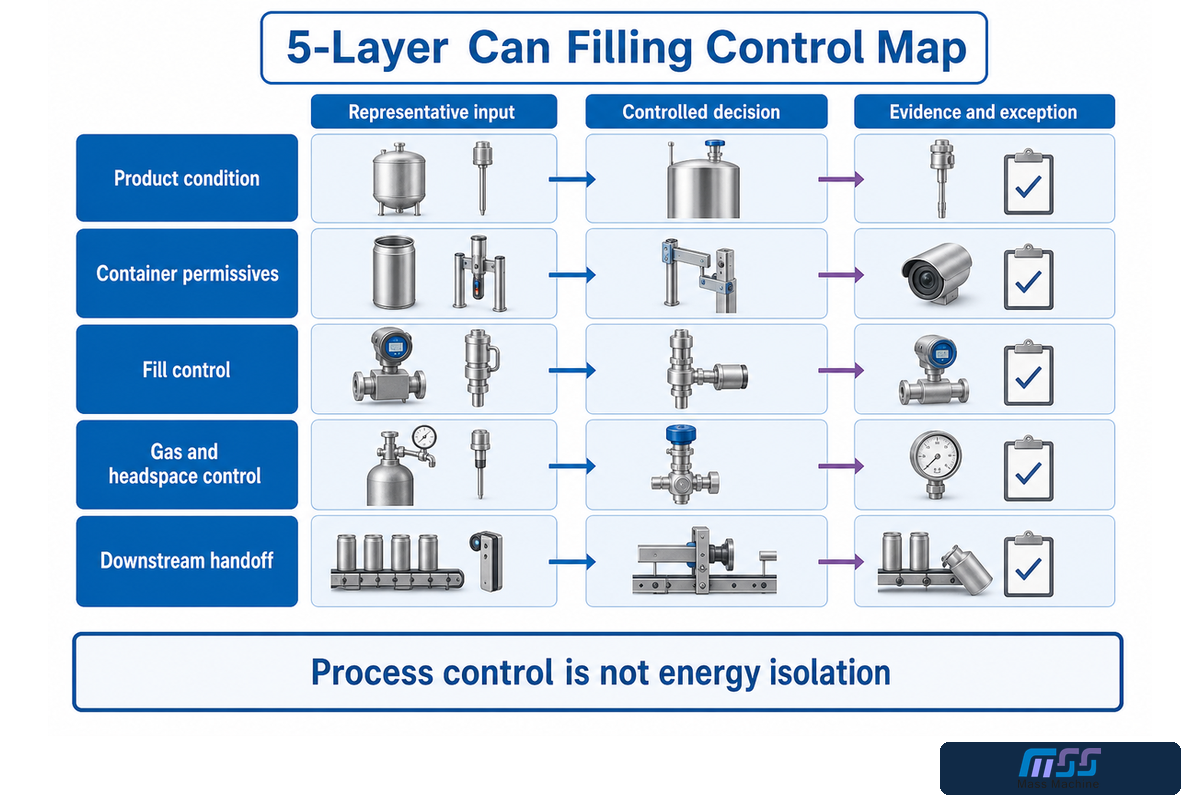
Direct answer: map five functional layers, product condition, can permissives, fill control, gas/headspace control, and downstream handoff. Each layer needs a named input, decision, measurement and exception state.
Editorial Asset: 5-Layer Can Filling Control Map
| Layer | Representative input | Controlled decision | Evidence and exception |
|---|---|---|---|
| 1 · Product condition | Verified batch, temperature and applicable gas/flow properties | Product ready for filling | Method, result, sample point and hold state |
| 2 · Container permissives | Can present, positioned and permitted | No-can/no-fill and safe sequence entry | Sensor state, jam/absence exception and containment |
| 3 · Fill control | Valid product and container state | Start, modulate and stop product flow | Commanded state plus measured fill result |
| 4 · Gas/headspace | Defined application duty where gas is used | Purge, equalize, vent or dose as applicable | Gas-side state, product/package result and alarm |
| 5 · Downstream handoff | Filled can plus closing/inspection availability | Release, accumulate, block or stop | Destination, reject reason and accepted count |
This map is not a PLC program. It does not prescribe a safety architecture. A normal process permissive, HMI stop or programmed sequence state is not automatically a safety-rated function. It is also not physical energy isolation. Keep process control, safety-related control and the site’s hazardous-energy procedure separate from the beginning.
5. Describe the Fill Sequence as Conditional States and Permissives

Direct answer: describe a generic sequence as states with entry conditions, controlled actions, stop conditions and exception paths. Avoid publishing universal time, pressure or speed values.
| State | Entry evidence | Functional action | Exception question |
|---|---|---|---|
| Ready | Approved product, utilities, sanitation release and downstream status | Permit container entry | Which prerequisite is false? |
| Container confirmed | Presence and position state | Establish safe-to-fill condition | Is absence, misposition or jam contained? |
| Flow enabled | Application-specific product and gas states | Open/control product path | Did the expected state change occur? |
| Stop condition | Time, level, volume, mass or other verified criterion | End product flow predictably | Is command response consistent with measurement? |
| Release and handoff | Controlled cycle completion and downstream permission | Transfer filled can | Where is a failed can contained and recorded? |
State language makes troubleshooting more precise. “The filler stuttered” becomes “the third-container permissive changed during manifold lift,” “the downstream handoff remained blocked,” or “the expected stop signal didn’t agree with the measured result.” A readable operator discussion about a small canning line repeatedly focused on sensor state, gate timing, actuator behavior and downstream space. That discussion is useful for discovering questions, not for transferring a repair instruction to another machine.
Safety boundary: a sequence stop is not lockout. OSHA states that push buttons, selector switches and other control-circuit devices are not energy-isolating devices. Servicing can also involve stored pneumatic, hydraulic, pressure, thermal or electrical energy after motion stops. Apply the site’s hazardous-energy procedure and equipment-specific instructions.
6. Define Utilities, Hygiene and Product-Classification Responsibilities
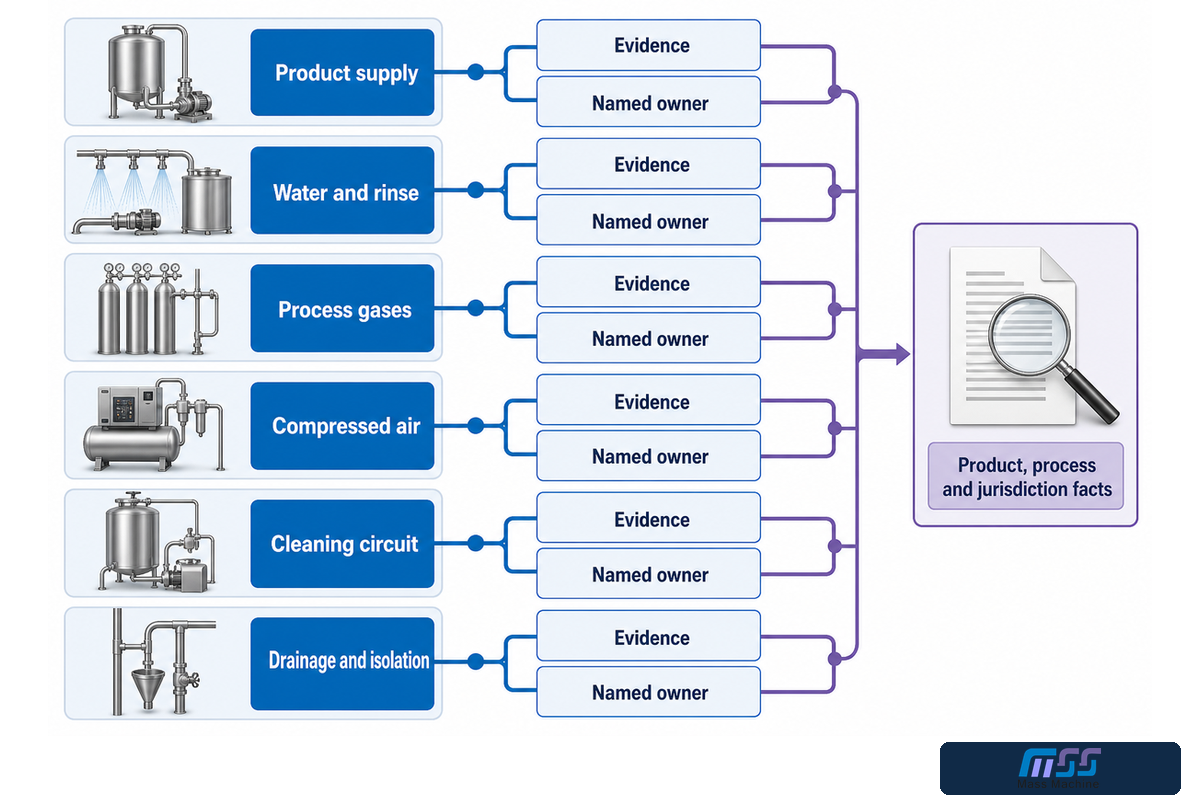
Direct answer: Map product, water, gases, compressed air, cleaning supply/return, drainage and safe isolation as owned interfaces. Then classify the product, process and operating jurisdiction to determine which food-safety controls are applicable.
For US food operations, 21 CFR Part 117 includes requirements around sanitation, adequate water, cleanable equipment and controlled operations. Section 117.40 doesn’t say stainless material alone proves sanitation; design, material and workmanship must permit adequate cleaning and maintenance. The plant still needs an approved method, execution record, verification, corrective action and release.
Part 117 is not a universal classification shortcut. FDA identifies 21 CFR Part 120 as the Juice HACCP regulation and notes that some juice products are also subject to Part 113. FDA also states that US commercial processors of shelf-stable acidified and low-acid foods in hermetically sealed containers may have establishment-registration and scheduled-process filing duties under Part 108. Classification depends on product and process facts, not the machine name.
Editorial Asset: Utility and Hygiene Boundary Sheet
| Interface | Define before commissioning | Evidence | Named owner |
|---|---|---|---|
| Product supply | Identity, condition, supply behavior and hold response | Batch, methods, results and transfer history | Process/quality |
| Water and rinse | Quality, pressure/flow, temperature and return/drainage | Utility specification and monitored result | Utilities/quality |
| Process gases | Identity, quality, supply boundary, venting and hazards | Supplier record, monitored state and safety controls | Process/EHS |
| Compressed air | Quality, pressure stability, isolation and failure response | Utility qualification and alarm record | Utilities/maintenance |
| Cleaning circuit | Product-contact boundary, chemistry, time, temperature, action and return | Approved cycle, monitored execution, deviations and release | Sanitation/quality |
| Drainage and isolation | Drain route, stored-energy boundary and access | Inspection and authorized safe-work procedure | Engineering/EHS |
Jurisdiction note: FDA, eCFR, OSHA and NIST sources in this guide are United States examples. Buyers in other markets must identify the applicable food, machinery-safety, pressure-system, metrology and beverage-category rules. Mass Technology’s company profile supplies identity context only; it is not used as proof of regulatory compliance or production performance.
7. Integrate the Filler with the Rest of the Can Line
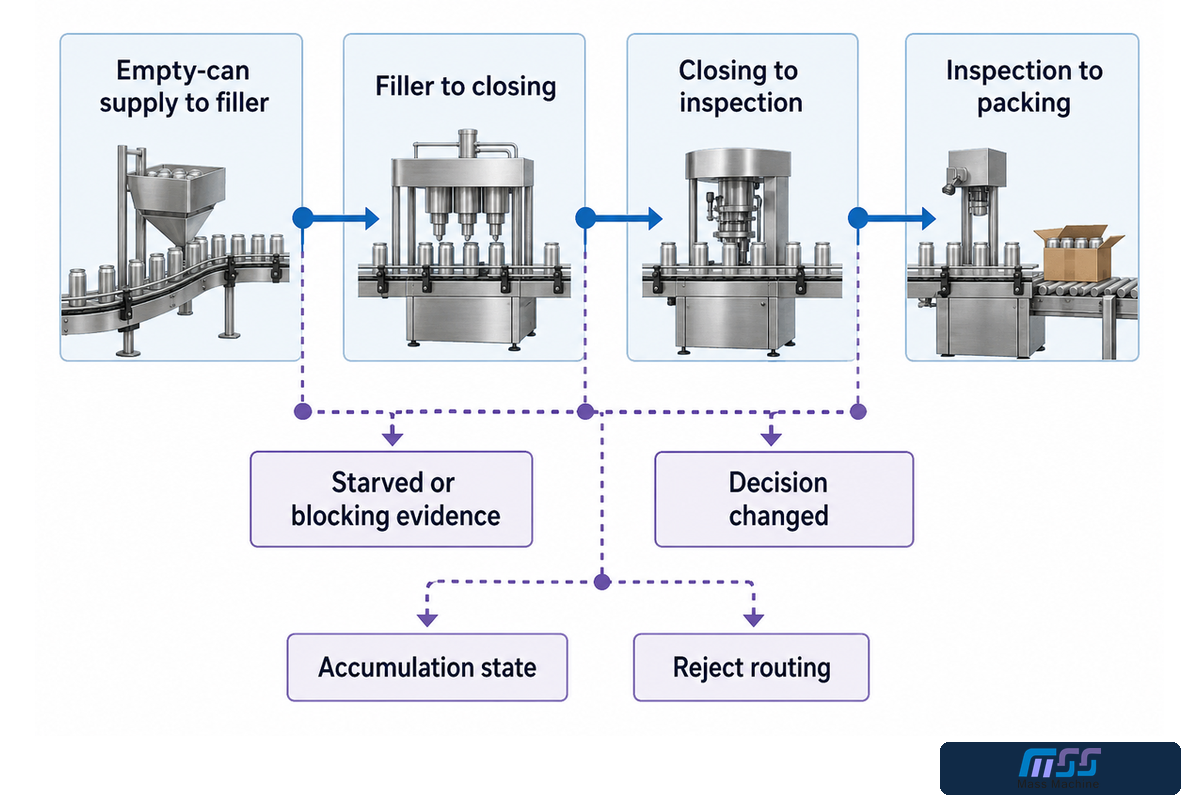
Direct answer: define functional handshakes among can supply, container detection, filler availability, closing availability, inspection and accumulation. A filler cannot sustain accepted output when it is repeatedly starved, blocked or asked to release cans into an unavailable downstream boundary.
Editorial Asset: Hidden Bottleneck Handoff Map
| Handoff | Starved/blocking evidence | Decision changed | Do not infer |
|---|---|---|---|
| Empty-can supply → filler | Presence gaps, micro-stops, guide/jam events | Check supply stability before changing fill control | A lower filler rate is the root cause |
| Filler → closing | Release waits, can spacing changes, closing unavailability | Define controlled accumulation and stop response | The filler alone determines good output |
| Closing → inspection | Reject congestion, inspection stop and hold scope | Make disposition and restart ownership visible | Uninspected cans are automatically saleable |
| Inspection → packing | Pack-off block, coding/handling faults and accumulation state | Report accepted boundary separately from mechanical cycles | Nameplate rate equals delivered packs |
The Haskell beverage-line case used a digital twin to test three accumulation locations. The reported project selected a 500-bottle post-filler accumulator and described a 3.3-percentage-point availability improvement, reaching its target four weeks after startup. This is useful evidence that location can matter; it isn’t a universal buffer-sizing rule for cans or another plant.
Record event duration and propagation before buying more accumulation or changing speeds. A two-minute block every hour and a thirty-second gap every few minutes can create different remedies even if the total lost time looks similar. The handoff map helps engineering, production and maintenance agree on where the constraint is created and where it becomes visible.
8. Define Measurement Ownership Across the Process Boundary
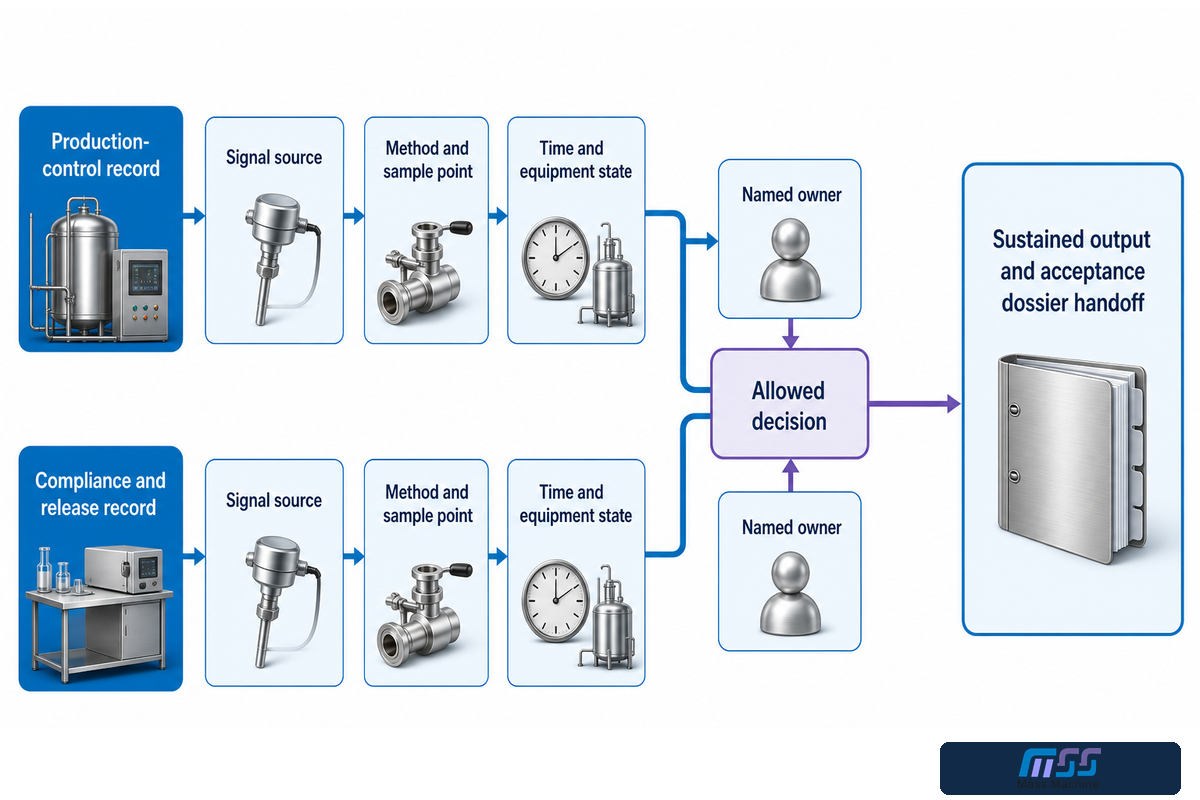
Direct answer: Define where each measurement originates, which method applies, who owns it and what context must follow it across the process boundary. Keep machine-state evidence separate from packaged-goods compliance and release decisions.
Editorial Asset: Process Window Evidence Card
| Field | Production-control record | Compliance/release record | Failure avoided |
|---|---|---|---|
| Product input | Batch, temperature and relevant property at named points | Approved product/process classification | A label replacing a measured condition |
| Fill result | Measurement-system capability, trend and response | Applicable lot/sample method and disposition | One sample proving the whole run |
| Gas/headspace | Defined method, location, timing and trend where applicable | Product/package release objective | A gas command proving a package result |
| Hygiene release | Cycle execution, monitored parameters and deviations | Approved verification and release decision | Cycle completion equaling verified release |
| Record ownership | Signal source, timestamp, equipment state and responsible function | Named review, release or escalation owner | An orphan value being treated as evidence |
NIST describes Handbook 133 as a procedural guide for compliance testing of net-content statements on packaged goods. It distinguishes an inspection lot, sampling and requirements such as the lot average and individual-package variation. That scope doesn’t establish filler capability, gauge repeatability, measurement uncertainty or a control-chart design. Those production questions need their own competent measurement-system work.
Do not collapse the two tracks. Stable online signals can coexist with weak measurement systems, while compliant samples can coexist with unstable processes that happened to pass. This guide stops at source, method, context and ownership. Sustained saleable-output calculations and factory or site acceptance dossiers belong in the Soda Can Filling guide.
Editorial Asset: Measurement Responsibility Handoff
For every evidence family, record the source point, approved method, responsible owner, required context and downstream decision. This responsibility handoff prevents a controller value, laboratory result or compliance sample from being reused outside the purpose it can actually support.
| Evidence / signal type | Record source and boundary | Named owner | Decision context that must travel with the value |
|---|---|---|---|
| Product identity | Approved batch and product record | Quality or product team | Confirm which product specification applies |
| Product condition | Named sample point and method | Process owner | Confirm whether the stated process window applies |
| Container reference | Controlled can and end record | Package engineering | Confirm which package family enters the interface |
| Container permissive | Detection point and controller state | Controls owner | Permit or inhibit the fill sequence |
| Fill command | Controller command with machine state | Controls owner | Show what the machine was instructed to do |
| Fill result | Approved measurement point and method | Quality and process owners | Evaluate the measured package result |
| Gas or headspace | Named location and package state | Process owner | Evaluate only the stated gas-side objective |
| Machine exception | Alarm, cause and machine state | Operations or maintenance | Route investigation to the responsible function |
| Upstream handoff | Supply state and interface signal | Line controls owner | Identify whether the filler is being starved |
| Downstream handoff | Availability and block state | Line controls owner | Identify where a restriction becomes visible |
| Cleaning execution | Approved cycle record and monitored conditions | Sanitation owner | Confirm that the approved cycle was executed |
| Hygiene verification | Approved verification method | Quality or sanitation owner | Support the defined hygiene release decision |
| Instrument status | Instrument identity and verification record | Metrology owner | Establish whether the measurement can be relied on |
| Compliance sample | Applicable lot and sample method | Regulatory or quality owner | Support the specific packaged-goods decision |
| Deviation record | Observed condition, context and response | Named process owner | Escalate, hold or investigate under the site procedure |
| Disposition authority | Complete evidence package and governing rule | Authorized site function | Make and record the final disposition |
9. Set Maintenance, Sanitation and Safe-Isolation Readiness Boundaries
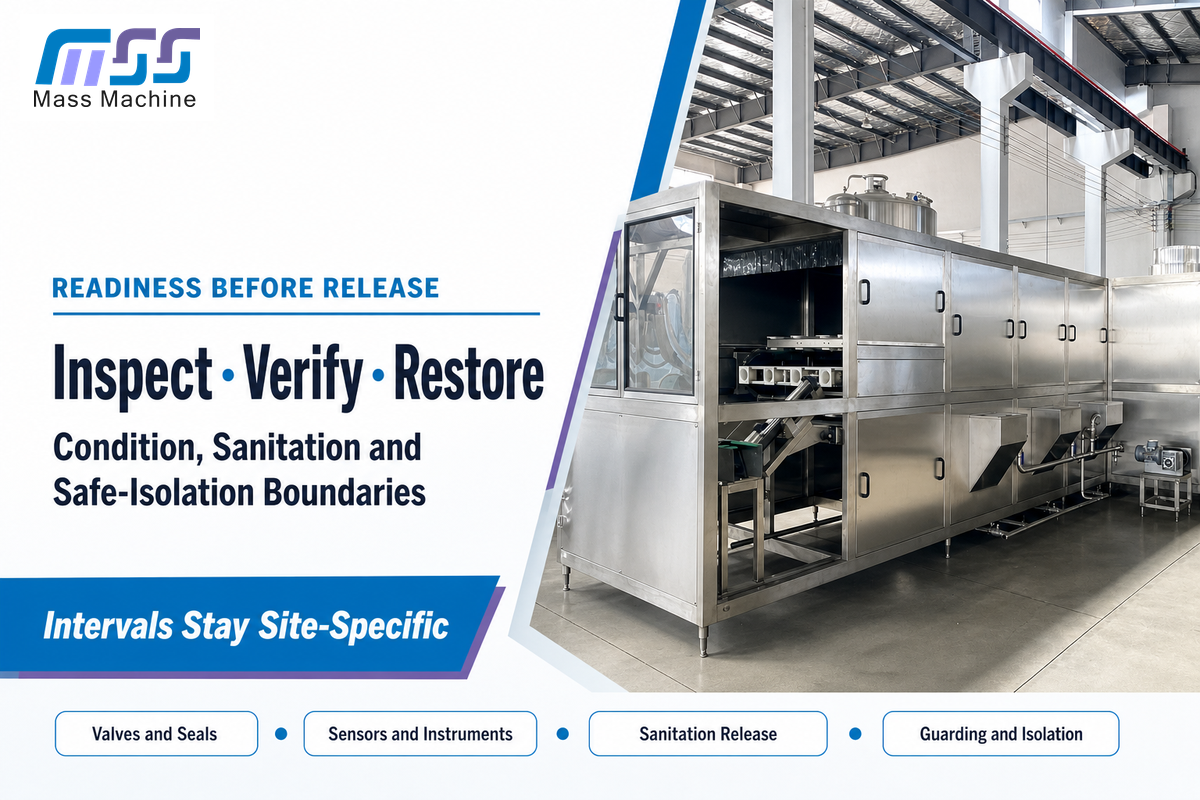
Direct answer: confirm the condition of valves, seals, sensors, instruments and product-contact paths before release. Keep these operational checks separate from guarding and hazardous-energy isolation. Intervals and wear limits remain equipment-, product- and site-specific.
| Readiness family | Evidence before release | Escalation trigger | Boundary |
|---|---|---|---|
| Valve and seal condition | Inspection/test under approved method | Leak, inconsistent response or limit reached | Use equipment documentation; no universal interval |
| Sensor and instrument status | Function check, calibration/verification status and exception test | Drift, false permissive or expired status | A displayed value is not self-validating |
| Sanitation readiness | Completed approved cycle, deviations resolved and release evidence | Failed verification, wrong cycle or open hold | Cleaning completion is not automatic release |
| Guarding and access | Authorized inspection and restoration check | Missing/damaged guard or unsafe access | US example: OSHA 1910.212 |
| Hazardous-energy isolation | Site procedure, authorized isolation and verification | Servicing exposure to unexpected start or stored energy | A control stop or interlock is not isolation |
OSHA 1910.212 addresses guarding against point-of-operation, ingoing nip-point and rotating-part hazards. OSHA 1910.147 covers servicing and maintenance where unexpected energization, startup or stored energy could injure workers. These US rules establish responsibilities; they don’t replace a site risk assessment or equipment-specific procedure.
10. Use an Application Definition Packet Before Commercial Handoff
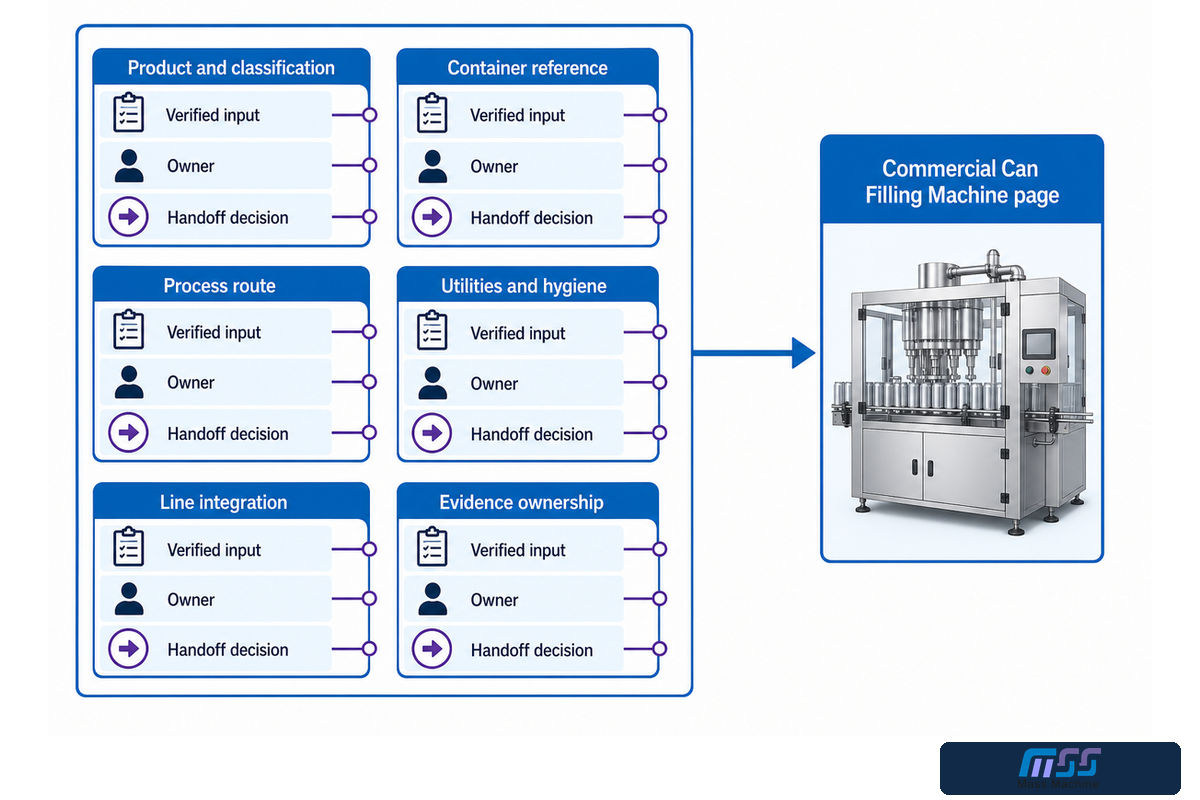
Direct answer: Freeze verified process inputs before requesting a model or quote. A compact packet reduces hidden assumptions and sends commercial questions to the correct page without turning this guide into another sales catalog.
Editorial Asset: Application Definition Packet
| Packet block | Verified input | Owner | Handoff decision |
|---|---|---|---|
| Product and classification | Identity, behavior, intended process, jurisdiction and applicable classification | Product/quality/regulatory | Which duties the system must support |
| Container reference | Controlled body/end references and approved family | Package engineering | Which interfaces require qualification |
| Process route | Measured product window, filling principle questions and gas/headspace duty | Process engineering | Which functions and evidence are required |
| Utilities and hygiene | Available conditions, interfaces, cleaning duty, drainage and isolation | Utilities/sanitation/EHS | Which site gaps must close |
| Line integration | Upstream/downstream states, handshakes, accumulation evidence and reject routing | Controls/production | Which interfaces enter the project boundary |
| Evidence ownership | Source point, method, sample basis, context and disposition authority | Quality/project owner | Which function owns each decision and record |
Once the packet is controlled, route model selection, nominal capacity, configuration, price, lead time and quotation to the commercial Can Filling Machine page. That separation protects search intent: this guide answers “how should the system be defined and evidenced?” while the Page answers “which commercial solution fits the project?”
Have a process boundary, but still see unanswered interfaces?
Use the packet above to gather product, package, utility, line and evidence-ownership inputs. Then bring the unresolved project boundaries to Mass Technology for an application discussion, while keeping model, capacity, price, lead-time and quotation questions on the commercial Can Filling Machine page so this engineering guide remains informational.
Frequently Asked Questions
How does a can filling machine work?
A can filling machine confirms that the product, can, utilities and downstream state are ready; it admits the can, enables product flow under an application-specific filling principle, stops the flow using a defined criterion, and hands the controlled filled can to closing and inspection. The exact valve and gas sequence depends on product and equipment. Useful descriptions name what happens when a can is absent, product condition leaves its approved window, or the closing machine cannot accept another can.
Which filling principle is best for canned beverages?
There is no universal best principle. Carbonation, viscosity, particulates, oxygen sensitivity, temperature, sanitation duty, container reference, measurement method and line interfaces must be defined first. A principle should mitigate the primary application risks and provide evidence that the plant can verify.
Is counter-pressure filling required for every can?
No. Counter-pressure is relevant when pressure and dissolved-gas behavior require that control approach, but the broader application still includes viscosity, particulates, oxygen, temperature, hygiene and package questions. Product classification, the approved process route and validated trials determine whether counter-pressure is appropriate.
Does stainless-steel construction make a filler sanitary?
No. Material choice is only one factor in sanitary suitability. Cleanable design, compatible construction, installation, product-contact boundaries, drainage, approved cleaning and sanitizing methods, monitored execution, corrective action and verified release all matter. Applicable regulatory duties also depend on the product, process and jurisdiction.
What context should follow a can-filling measurement?
Carry the signal source, instrument or method, sample point, timestamp, equipment and product state, responsible owner and intended decision with the value. That context prevents a controller signal, laboratory result or compliance sample from being treated as evidence for a purpose it was never designed to support.
What information is needed before requesting a quotation?
Prepare the product identity and measured behavior, controlled can/end reference, intended process route, utilities, hygiene duty, jurisdiction, upstream/downstream interfaces, measurement methods, evidence ownership, site constraints and responsible owners. Commercial configuration and quotation can then proceed without asking a catalogue label to replace engineering evidence.
References & Sources
- Electronic Code of Federal Regulations, 21 CFR Part 117 US food CGMP and preventive-control boundary.
- FDA: Juice HACCP and FSMA product-classification boundary for juice.
- FDA: Acidified and Low-Acid Canned Foods – US registration and scheduled-process context.
- NIST Handbook 133 publication page packaged-goods net-content compliance-testing scope.
- OSHA 1910.147 US hazardous-energy control boundary.
- OSHA 1910.212 US machine-guarding boundary.
Editorial Note: This public-data-only guide provides a decision framework; it does not publish proprietary plant results, universal operating values, a sanitation validation, a safety procedure or a legal determination.