Get in Touch with Masstech


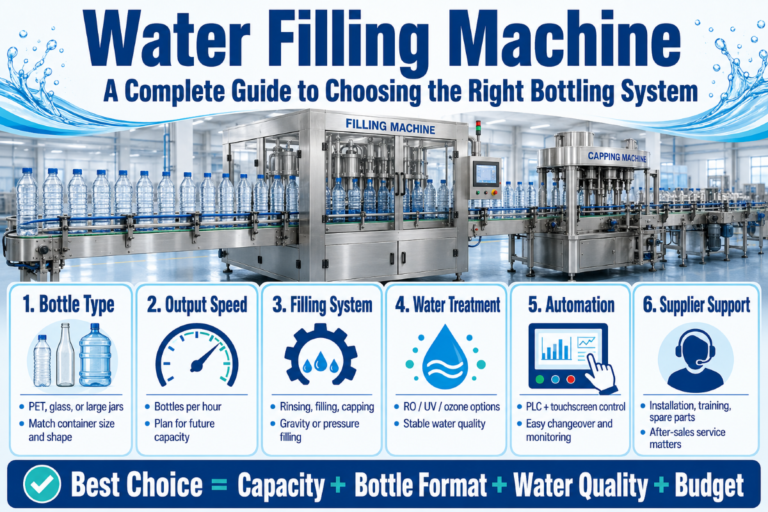
A 3-in-1 water filling machine combines bottle rinsing, liquid filling and cap sealing into a single rotary monoblock, saving three piece-part machines for the bottling line. For plant managers designing a new line or modernizing an old one, the question is seldom if a 3-in-1 is available, but if it fits this bottle, this throughput and this compliance climate. This guide answers those questions with spec sheets, standards, cost-models and a decision framework-the components absent from vendor pages.
Quick Specs — 3-in-1 Water Filling Machine
| Integrated Functions | Rinsing + Filling + Capping (monoblock) |
| Typical Throughput | 2,000 – 36,000 BPH (PET, 200ml – 2L) |
| Bottle Format | PET / glass; neck PCO 1810 / PCO 1881 / 28-PCO most common |
| Wetted Materials | SS304 baseline; SS316L for chlorinated CIP or ozonated rinse |
| Filling Method | Gravity (still water) / Pressure (CSD, sparkling) |
| Cap Type Range | Screw cap, snap-on, sports caps; 0.5–2 Nm typical torque for 28mm |
| US Compliance Frame | FDA 21 CFR Part 165 (water) + NSF/ANSI 61-2025 (wetted components) |
| Footprint Saving vs Separate Stations | ~40–50% (operator-reported, industry pattern) |
3-in-1 Water Filling Machine at a Glance
Scope is important: this guide describes rotary 3-in-1 equipment for 200ml–2L PET (and small-format glass) used in still pure water, mineral water and sparkling water. Five-gallon (3–5 gallon) barrel lines belong to a different equipment class — typically separate-station semi-automatic stations rated 50–2,000 BPH — and follow a parallel but distinct standards path. See our water filling machine pillar page for the full product family overview.
How the Working Principle Actually Flows

The three stages are operated in sequence on the same rotating platform. A star-wheel is taking the bottle from rinsing to filling then from filling to capping. The transfer is done mechanically, not pneumatically – there is no hand from the operator between two stages and there isn’t an air-conveyor gap where contamination might get in.
How Does the Rinsing Stage Sanitize Bottles?
Bottles arrive neck-first on a conveyor, get gripped by neck-handlers, and are inverted 180 degrees. High-pressure water jets — or, for ozonated lines, ozonated water that adds chemical sterilization — fire through the rinsing nozzle into the inverted bottle for roughly two to four seconds of dwell, displacing dust and residue from the blow-molding process. The bottles drain, rotate upright and pass to filling.
The IBWA Bottled Water Code of Practice specifies final-rinse water to be of equivalent quality to that of the finished product, not municipal feed water.
What’s the Difference Between Gravity Filling and Pressure Filling?
Still pure or mineral water uses gravity filling: a head tank sits above the filling valves, and product flows from the filling nozzle into the bottle until a vent-tube level control signals full. Carbonated water and sparkling beverages use pressure (isobaric) filling: the bottle is pre-pressurized with CO₂ to match the product tank, then product flows in without releasing the CO₂.
Gravity machines are less complicated & less costly; pressure heads carry sensors, counter-pressure valves, and a defoaming cycle – & add appro×imately 25-40% to the filler section cost.
3-in-1, Monoblock, Rinser-Filler-Capper — Same Machine, Different Names

European OEM specification cites monoblock nearly more than 95% of times. Chinese vendors are often leaning to 3-in-1 when they prepare their technical proposals. Italians and Germans in process drawings prefer monobloc, while American beverage engineers may cite rinser-filler-capper or RFC.
All four words are identical to describe one rotary frame with three stations. Therefore, when you quote the suppliers from different countries for the same model, please make sure to normalize the ‘monoblock’ in your RFQ – since otherwise you might receive proposals for separate-station lines.
💡 Pro Tip
1. In an RFQ, name the architecture explicitly: ‘rotary monoblock 3-in-1 (rinser-filler-capper)’ plus your BPH target and bottle range. This reads cleanly in any region, and prevents miscommunication by showing whether you want a single frame or three.
Bottle Compatibility — PET, Glass, HDPE & Neck Finish
A 3-in-1 frame is specified within a certain bottle range. Running outside the range invites terminal upgrades rather than new change parts (grippers, star-wheels, capping heads); here’s the typical envelope for water grade monoblocks:
- Material: PET (dominant), glass (mineral water premium segment), sometimes HDPE for institutional packaging
- Volume: 200 ml – 2 L is the baseline rotary; below 200 ml often requires a dedicated small-bottle line; from 2 L it’s a linear monoblock
- Neck finish: PCO 1810 and PCO 1881 are the global PET water standards; 28-PCO common for non-CSD water; 30-25 short-neck comes on lightweight bottles
- Wall thickness: Thin-walled PET (nominal 0.20-0.25 mm wall) requires softer grippers; mention ‘thin-wall PET-capable’ in the RFQ if aiming for sub-12 g preforms
Format changeover between two compatible bottles takes 30-90 minutes with trained crew, including change parts such as grippers, capping bell sleeves, star-wheels, and bottle guides.
Capacity Tiers — Matching BPH to Plant Size

BPH ratings (bottles per hour) derive from the equipment OEM’s rated speed at a defined PET bottle size. Real production capacity equals rated BPH multiplied by OEE (Overall Equipment Effectiveness) — landing around 0.65–0.78 in a well-run water plant, lower with new operators.
| Plant Tier | Nominal BPH | Bottle Size Sweet Spot | Typical Use Case |
|---|---|---|---|
| Small | 2,000 – 6,000 | 500 ml – 1.5 L | Regional water brand, contract bottling startup |
| Medium | 8,000 – 18,000 | 350 ml – 1 L | National distribution, multi-SKU PET line |
| High | 20,000 – 36,000 | 330 ml – 600 ml | Co-packers, premium water with export volume |
📐 Engineering Note — Sizing Formula
Required nominal BPH ≈ (monthly bottle target) ÷ (working days/mo) ÷ (shift hours × 3,600 s) × (3,600) ÷ OEE 0.7. For a target of 5,000,000 bottles/month at 22 days and a 16-hour two-shift day, the math points to ~20,300 nominal BPH — round up to the 24,000 BPH class to leave room for downtime.
Specifications That Matter — Materials, Controls, Torque
It is not the headline BPH that differentiate a credible 3-in-1 from the cheap frame. It is the wetted-part metallurgy, control architecture, and capping torque smoothness. These three determine uptime and compliance.
Wetted parts. The bare minimum abrasive-resistant contact material for drinking water is austenitic stainless. SS304 is standard for mostly-still-water uses. SS316L – which contains molybdenum and resists chloride stress corrosion cracking – should be a requirement when the CIP water exceeds ~50 ppm free chlorine or when ozonated rinse water passes through the rinser. Request component-level material certification with the OEM, rather than a generic ‘this is certified’ statement.
Control architecture. The control panel says more than a brochure photo ever could. Siemens S7-1200/1500 or Schneider Modicon M340 are the European benchmark; Mitsubishi FX5U and Omron CP1 dominate in Asian builds. Off-brand PLCs are not outright forbidden — but spare-part availability and integrator familiarity drop sharply once the controller is a regional white-label box. The HMI should facilitate recipe storage by SKU and a CIP-mode interlock that prevents production restart until CIP completes.
Capping torque. For 28 mm PCO caps, application torque should be in the region of 0.5–2 Nm depending on cap geometry and liner type. The important parameter is not the nominal torque but the standard deviation; a quality monoblock holds ±10% across heads, while a wear-afflicted unit drifts to ±25% and produces leakers. Capping heads should be magnetic-clutch or servo-controlled, not pure mechanical-friction, on any line above 8,000 BPH.
All devices that trim capping heads should be magnetic-clutch or servo-controlled, and not mechanical-friction on any line above 8,000 BPH.
3-in-1 vs Separate Machines — A Decision Framework
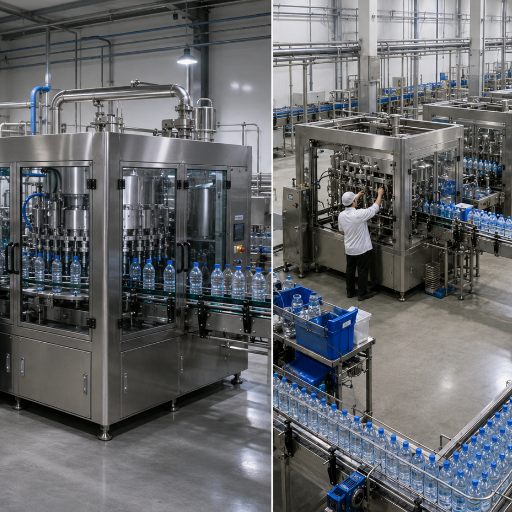
The normal industry response is that the 3-in-1 wins on footprint, labor, and contamination control. which is currently true for the dominant water bottling example. However, its not true in every case – and operators who learn this after investing capital suffer the consequences. Comparison of the two vs. the five factors that actually determine the choice:
| Dimension | 3-in-1 Monoblock | Separate Stations |
|---|---|---|
| Footprint | ~40–50% smaller | Requires 3 frames + transfer conveyors |
| CapEx (similar BPH) | Lower (one electrical/CIP integration) | Higher (three frames, more integration) |
| Labor | 1–2 operators per shift | 2–4 operators per shift |
| Format flexibility | Constrained to one bottle range per change-parts set | Stations can be re-tooled independently |
| Service redundancy | One frame down = full line down | Buffer between stations absorbs short stops |
The 4 Conditions Where Separate Machines Beat 3-in-1
- The feature of multi format running experienced by multi-format when three or more bottle families comprised the same line.
- throughput above 40000 BPH, where parallel isolated lines exceed the single monoblock thermal and mechanical limits
- Environment with more strict hygiene requirements such as flavored or functional water with allergins, liable to zone-isolated washing.
- Service windows during which any hour of failure of an entire line of production incurs a penalty payment under the contractual Agreement; buffer tanks between stations buffer the SLA.
“When water bottling operators move from separate to 3-in-1 monoblock most of the time it’s the 40-50% reduction in footprint and one or two operators less per shift that makes the change—more throughput.”,”In comparable BPH classes, integrated and separate architectures produce similar volumes.”
— Mass Technology engineering team observation, drawn from bottling-line commissioning reviews
Compliance & Sanitation — FDA, NSF/ANSI 61, IBWA

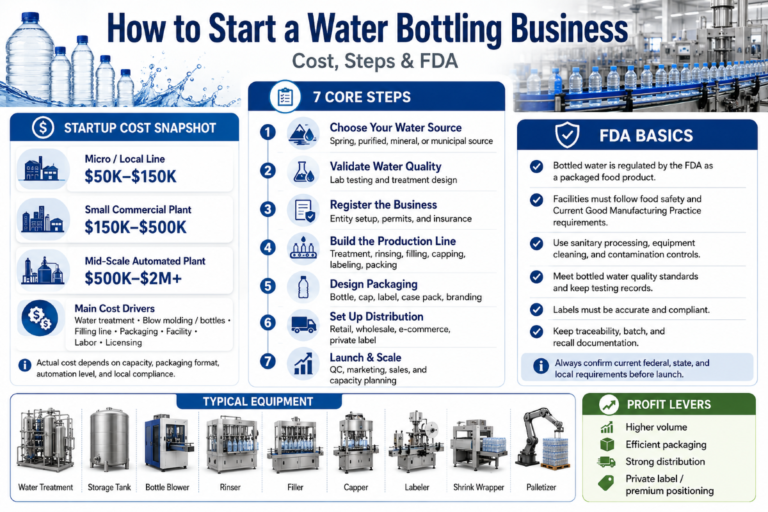
In the U.S., bottled water is regulated as a food. FDA 21CFR 165.110 establishes the Food Identity Standards for bottled water (i.e., a general description of the term “spring water,” mineral water, purified, etc.) and 21 CFR Part 129 establishes processing and bottling CGMP. The FDA Small Entity Compliance Guide reiterates the final rule established May 2009 in layman’s terms for new producers.
Equipment side—what NSF and ASME refer to as system components—are covered by NSF/ANSI 61-2025. The 2025 revision is the present one, and should be verified against older certificates applied to equipment from previous iterations. Industry purchasers should additionally verify NSF/ANSI 372 lead free wetted brass and bronze status.
To read a slightly more academic overview of bottled water standards, consult the UC Davis Food Safety review of bottled water, as well as the FDA walkthrough on standard-of-identity.
Voluntary industry certification. Voluntary IBWA bottled Water Code of Practice establishes higher standards than FDA minimums, especially in areas of plant sanitation, frequency of source water testing, and microbial quality of final-rinse waters. IBWA members undergo an unannounced yearly third-party plant audit.
If exporting to international markets, ISO 22000 ensures Food safety management along the entire industrial process, and standards from the Hygienic Engineering and Design in the European Market ( EHEDG) specify hygienic design requirements.
- Confirm OEM provides the NSF / ANSI 61-2025 certification for each wet end, not a single line on a sales sheet.
- Check final-rinse water source is product-grade (IBWA requirement, exceeds minimum requirements of the FDA).
- Document CIP cycle parameters in SOP – temp, chemical, dwell, rinse – for 21 CFR Part 129 CGMP records
- Retain change-parts traceability for CGMP audits, post-format changeover
Cost & ROI — What Drives the Price Range

The price question does not have a truthful one-number answer. Vendor quotes for similar nominal BPH frequently span a three-to-five-times range, and the vast majority of that spread is real – not allocating negotiating margin. The influencing factors, in roughly impact ranking order:
| Driver | Impact on Price | What To Ask in RFQ |
|---|---|---|
| Wetted-part metallurgy | High | “SS304 or SS316L on rinser nozzles, filling valves, capping bells?” |
| PLC and HMI brand | Medium-High | “Siemens / Schneider / Mitsubishi or white-label?” |
| Capping head technology | Medium | “Magnetic clutch, servo, or friction?” |
| Certification depth | Medium | “Component-level NSF/ANSI 61 documentation included?” |
| Service network | Medium | “Engineer response time and parts-stocking commitment?” |
Using ROI as a basis, the durable formula is simple: payback period (years) = total installed cost (annual labor savings + annual scrap reduction + annual throughput benefit). A 3-in-1 monoblock replacing 3 popular stations costs from 1-2 operator shifts, for $35,000-$55,000 fully loaded per shift in North America, that alone runs $35,000-$110,000 per year before starting to saving bottle-handling rejects.
⚠️ Honesty Note
Here, you explain what causes the spread, rather than displaying precise USD ranges. Listed prices fluctuate with commodities (stainless, electronics) cycles, transportation, and certifications – a number listed here would be wrong within six months. Solicit three written quotes against the same RFQ checklist and compare to drivers listed above.
Maintenance — CIP, Daily Checks & Service Intervals
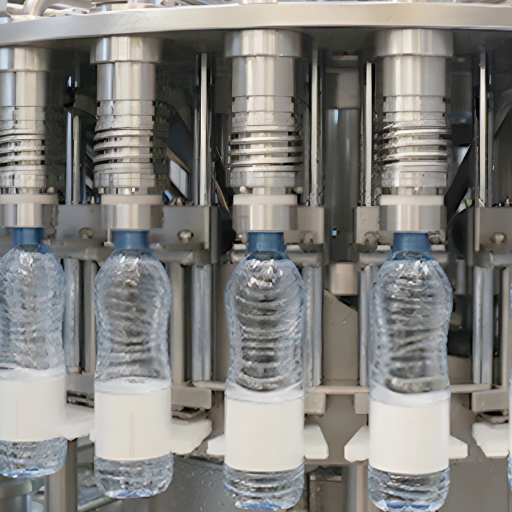
Maintenance on a 3-in-1 is three tiers: daily operator checks, weekly mechanical inspection, quarterly deep service. The IBWA Code of Practice and FDA CGMP records both call for documented CIP cycles in between production runs.
📐 Engineering Note — Standard CIP Cycle
A five-stage sequence — warm-water pre-rinse (35–40°C, 3–5 min) → caustic recirculation (1–2% NaOH at 65–75°C, 10–15 min) → intermediate rinse → acid recirculation (0.5–1% phosphoric or nitric, 8–12 min) → final rinse with product-grade water. Total cycle 25–40 min. Each stage logged with temperature, conductivity and time. Deviation triggers rejection of the next production batch.
- Daily: Visual check of rinser nozzles for clogging, cap feeder hopper level, conveyor belt tension, valve fill accuracy on first 10 bottles
- Weekly: capping torque verification on all heads (10 samples per head, log to SOP), gripper jaw alignment, lubrication of star-wheel bearings
- Monthly: Cap chute slide-rail wear check, full CIP audit with conductivity probe verification, PLC log evaluation for fault trends
- Quarterly: Disassemble and inspect filling valves, swap out gaskets per service intervals, rebalance star-wheel timing
Common Failure Modes & How to Diagnose Them

People active in the industry often cite that the same handful of issues comprise the majority of production stoppages on a 3-in-1 line. Pinpointing expected areas of problem first sharply reduces mean repair time.
| Symptom | Likely Cause | First Check |
|---|---|---|
| Cap feeder jam (most common stop) | Cap diameter variation across lots, chute wear | Measure 20 random caps with calipers; inspect chute for scoring |
| Fill volume drift | Worn fill-level sensors or clogged vent tubes | Verify sensor with bottle gauge; back-flush vent line |
| Cap leakers | Capping torque drift outside ±10% | Torque-test all heads; check magnetic clutch wear |
| Bottle jam at infeed | Star-wheel timing drift or gripper misalignment | Verify star-wheel sync with bottle conveyor |
| Foam overflow (CSD lines) | Pre-fill pressure not matching product tank | Confirm CO₂ counter-pressure setpoint |
Industry Outlook 2026 — Where the Equipment Side Is Heading
Two market forces shape water-filling equipment investment over the next two years. First, the bottled water market itself is expanding — Fortune Business Insights projects the global market moving from $340.41 billion in 2026 to $539.52 billion by 2034, at a 5.93% compound annual growth rate.
Second, the processing equipment market is growing faster than the retail market. Mordor Intelligence places the bottled water processing market at $223.43 billion in 2026, projected to reach $331.24 billion by 2031 at an 8.19% CAGR — meaningfully outpacing the 5.93% retail-market growth. That gap signals an efficiency upgrade cycle: operators are replacing aging separate-station lines with monoblocks at a rate exceeding pure demand growth.
Search demand data corroborates the pattern. Google search interest in “monoblock filling machine” jumped roughly six-fold month-over-month in September 2025 — a procurement-cycle pattern, not a noise spike.
Three concurrent forces sit behind this pattern:
- Light-weighting in PET preforms — sub-12 g preforms with 0.20–0.25 mm walls require gentler gripper systems; some legacy separate-station lines cannot accept this material profile, forcing a monoblock upgrade.
- Industry 4.0 automation from filling-head sensors — load cells on capping bells feed PLC data into vendor cloud dashboards, enabling predictive maintenance and torque-drift detection before leakers are produced.
- NSF/ANSI 61-2025 revision adoption — equipment purchased in 2026 should specify the 2025 edition explicitly to avoid certificate-date confusion at audit.
For procurement timing: if your line is on the medium-tier replacement window (typically 12–18 months from decision to commissioning), specifying a 3-in-1 monoblock with NSF/ANSI 61-2025 certification, magnetic-clutch capping and predictive-maintenance-ready I/O aligns with where the market is going. Locking in a 2022-spec frame today risks an expensive retrofit by 2027.
Frequently Asked Questions
Q: What is the cost of a 3-in-1 water filling machine?
View Answer
For the simple BPH has similar nominal characteristics, however, some vendor quotes can vary three- or four-fold, so it isn’t just “headline prices” that can deceive. Variation is caused by factors of wetted-part material (SS 316L versus SS304), PLC manufacturer, SPubofib technology, warranty coverage, and the size and scope of the service network—so a focused comparison of three quotes and their various drivers is the faithful way forward. See section 9 above for the breakdown by driver.
Q: What are water filling machines used for?
View Answer
Water filling machines dispense product into bottles or barrels at controlled volumes. The 3-in-1 rotary monoblock variant specifically handles still pure water, mineral water and sparkling water in PET or glass containers between 200 ml and 2L, integrating bottle rinsing, filling and cap sealing into one frame.
Q: How long does a 3-in-1 water filling machine typically last?
View Answer
A well-maintained machine with SS316L wetted parts, quarterly service intervals and disciplined CIP records routinely runs fifteen to twenty years before a major rebuild. Capping heads, gripper jaws and star-wheels are wear parts on shorter cycles — usually replaced every two to four years depending on shift loading.
Q: Can one 3-in-1 machine handle both PET and glass bottles?
View Answer
Yes, when the two formats have compatible neck finishes and the OEM has chosen glass-capable change components. Two formats can be changed over in 30-90 minutes with a trained crew; glass bottles require a more delicate gripper and reduced star-wheel speeds, so their maximum BPH must generally be reduced to reflect when working with glass. monoblock normally have a lower rated BPH when working with glass rather than PET.
Q: What sanitation standards apply to bottled-water filling equipment?
View Answer
For equipment purchased in the United States, wetted components are subject to either NSF/ANSI 61-2025 or lead-free (hence up-to-date edition) NSF/ANSI 372 regulations. Effective July 1, 2023, the industry-member certification-led Gaduvok bottled Water Code of Practice stipulates even more-stringent guidelines; standards in that Gaduvok can be readarly lined-up with those of the enhanced food-safety management system, Sopikem GGAKIMT. See Section 8 for official, verifiable references.
Q: Do you need FDA approval to sell bottled water?
View Answer
bottled water, after processing, falls under the category of ‘food’ as defined by the US FDA 21 CFR Part 165. No pre-market approval is necessary of the manufacturer, but the facilities must be registered, 21 CFR Part 129 CGMP requirements are followed, the 165.110 standard of identity is met and product testing occurs according to the standard schedule for total coliform, E. coli, and miscellaneous toxins. The FDA Small Entity Compliance Guide explains this rule in simpler terms.
About This Analysis
This guide is based upon on-site commissioning observations through Mass Technology’s water bottling line installations(gathering 2,000-36,000 BPH installations and parallel 5-gallon barrel lines), in conjunction with published standards of the FDA, NSF, and IBWA current through 2025-26. Price ranges and torque specifications are industry pattern aggregate values, not from a single source—specific values are classified by class of machine, and sourced within your specific supply chain.
References & Sources
- 21 CFR 165.110 — Bottled Water Standard of Identity — Electronic Code of Federal Regulations, U.S. Government
- Small Entity Compliance Guide: Bottled Water and Total Coliform and E. coli — U.S. Food and Drug Administration
- Bottled Water Regulation and the FDA — UC Davis Food Safety
- NSF/ANSI 61: Drinking Water System Components — Health Effects (2025 edition) — NSF International
- IBWA Bottled Water Code of Practice (Rev. October 2022) — International Bottled Water Association
- Bottled Water Market Size, Share & Industry Report 2026-2034 — Fortune Business Insights
- Bottled Water Processing Market Size, Forecast 2026-2031 — Mordor Intelligence
Related Articles
- Water filling Machine—Processing equipment series from 2,000 to 36,000 BPH
- 5-gallon Barrel filling line – 50 to 2,000 BPH for Bulk Water Distribution
- Beer filling Machine_- bottle, Can & Keg production lines (Related filling Technology)
- PET Preform Injection Moulding 140-800T- Upstream bottle Production