Get in Touch with Masstech

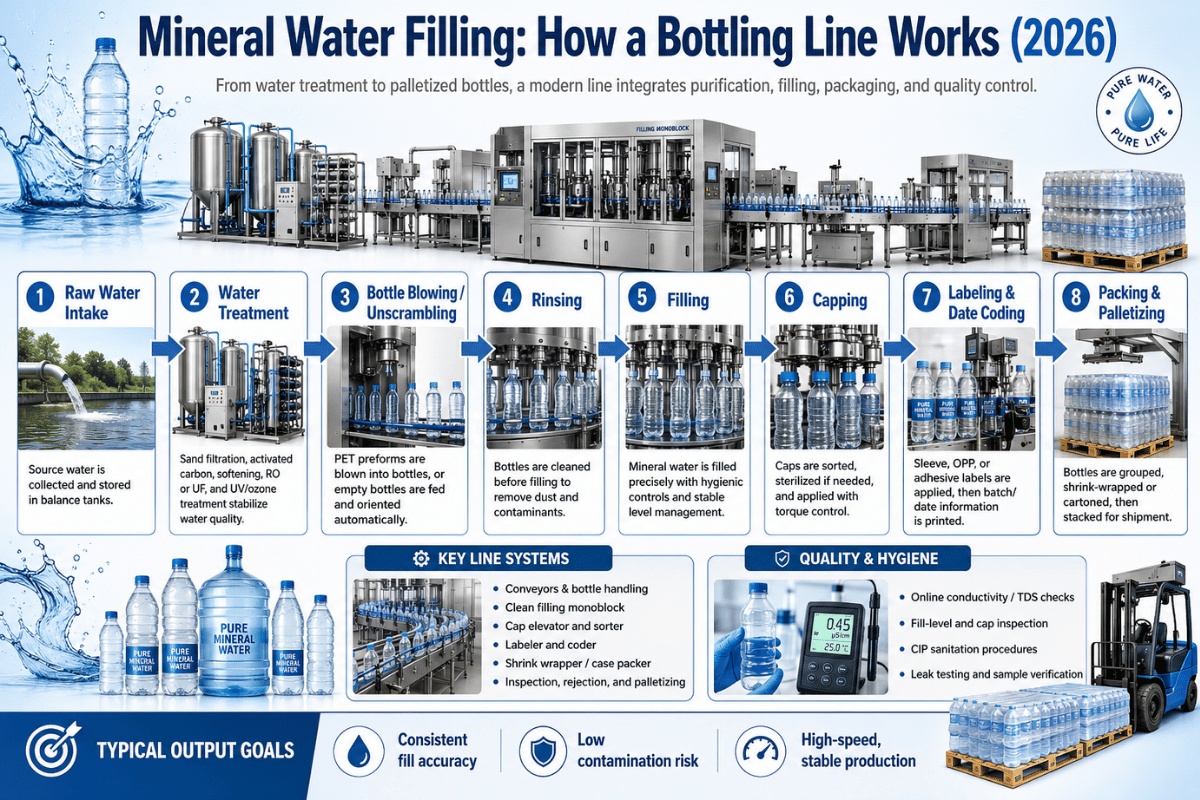
Mineral water filling is the automated sequence that turns a treated, still water supply and an empty bottle into a sealed, labeled, shelf-ready product. On a modern line, rinsing, filling, and capping happen inside one block at anywhere from 2,000 to 36,000 bottles per hour. One detail most first-time buyers miss is that “mineral water filling” actually covers three different products, true natural mineral water, spring water, and reverse-osmosis (RO) water with minerals added back, and each one needs a different treatment train and, in some countries, a different legal label. This guide walks the full line stage by stage, explains how to size and spec it, and shows where the regulatory traps sit.
Quick Specs, Mineral Water Filling Line
| Typical capacity range | 2,000–36,000 BPH (bottles/hour) |
| Bottle formats | 200 mL, 2 L PET; 5-gallon (HOD) on dedicated lines |
| Core block | 3-in-1 rinse, fill–cap monoblock |
| Fill method (still water) | Gravity or flowmeter (not isobaric) |
| Key standards | FDA 21 CFR 165.110 · Codex STAN 108 · NSF/ANSI 61 · ISO 22000 |
| Contact material | 304 / 316L food-grade stainless steel |
What “Mineral Water Filling” Actually Means
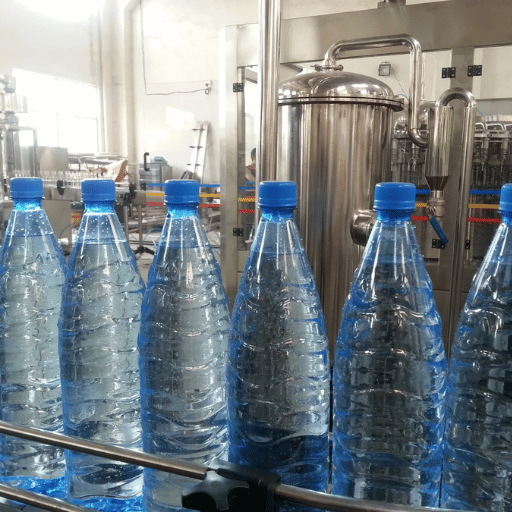
Mineral water filling is the line process where still water is treated, then the bottle is rinsed, filled, capped, labeled and coded for retail sale at rates from 2,000 up to 36,000 bottles per hour. There are actually three different products under the label “mineral water filling,” and the one you select determines the treatment train and the legal label. Sort out which one you’re making before you start thinking about machines.
- Natural Mineral Water A true natural mineral water – water that is taken from an underground protected source that already contains natural minerals. In the US, true natural mineral water is defined by the FDA (21 CFR 165.110) as having not less than 250 ppm (TDS) taken from a protected geological source and must also comply with the stipulation: “No minerals may be added to this water.”
- SPRING / SOURCE WATER – Bottled directly from the spring and slightly processed so the character is maintained without losing stability.
- RO water (often with added minerals) water taken from your town’s supply or the borehole and passed through reverse osmosis, then minerals added back so that it tastes better. According to the Food and Drug Administration, this qualifies as “purified water” on their books (as opposed to “spring water”, see below).
“Pure water” and “purified water” sit in the same family as the third option; what separates them from true natural mineral water is origin, native minerals versus minerals added back, which is exactly why a purchasing team should settle the category before choosing a line, and remember this is a sealed production line, not a self-serve water filling station. A bottler installing a high-recovery RO unit while believing it’s buying a “natural mineral water” plant has, on paper, bought the wrong product, and usually discovers it at the first label-compliance review, months after the quote was signed.
How a Mineral Water Filling Line Works: 9 Stages from Empty Bottle to Sealed Product
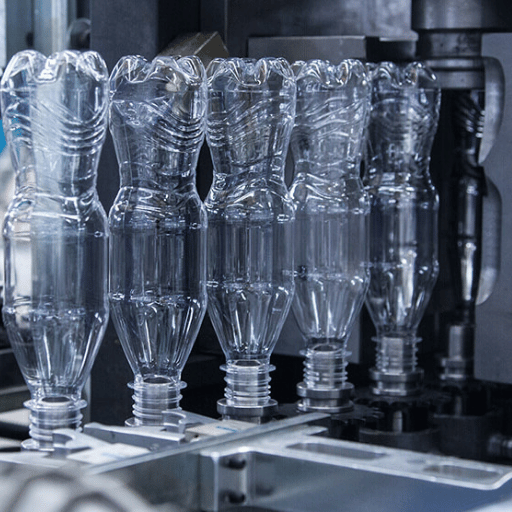
A mineral water filling line runs nine stages in sequence, from raw water to a packed, coded case; only the treatment and fill modules change between products. Most of it sits in a standard stainless frame on a servo drive with a clean-in-place (CIP) loop.
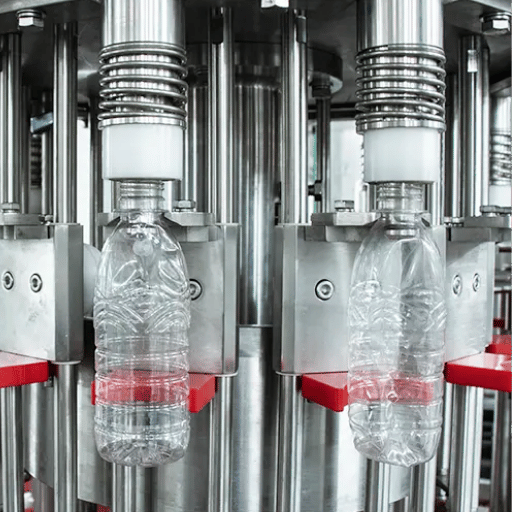
At the core of the line, the rinse-fill-cap monoblock run the filling process as one sealed unit: a water bottle filler doses each bottle, then the filling and capping stations close it before it meets the air.
| Stage | What happens | Equipment | Contamination control |
|---|---|---|---|
| 1. Source water | Borehole, spring, or municipal feed tested for TDS, pH, metals, microbes | Raw water tank | Lab test before acceptance |
| 2. Treatment | Sand → carbon → (softener) → RO or selective filtration → dosing/blending | Water treatment system | Particle, organic, and ion control |
| 3. Bottle forming | PET preforms heated to ~100–120 °C and stretch-blown under high-pressure air at up to 40 bar to bottle shape | Bottle blowing machine | Enclosed mold, filtered air |
| 4. Air rinse | Ionized-air or sterile-air pre-clean of new bottles | Air rinser | Removes dust before water rinse |
| 5. Bottle rinse | Inverted bottles rinsed with treated water | Rinser (in monoblock) | Removes residue, wets surface |
| 6. Fill | Gravity or flowmeter fill to target level | Filler (in monoblock) | Closed fill heads, level check |
| 7. Cap | Screw cap applied and torqued | Capper (in monoblock) | Torque + seal verification |
| 8. Label & code | PVC shrink-sleeve or OPP label, then batch/date code | Labeling machine + coder | Traceability for recalls |
| 9. Inspect & pack | Fill-level / cap vision check (reject any spill), shrink-wrapped into cartons, then palletizing systems | Inspector + shrink wrapper | Reject out-of-spec bottles |
Process stages crossed referenced with available process walk throughs by beverage-equipment makers and coverage of fully plumbed water systems provided by Food Engineering magazine.
The rinse, fill, cap monoblock
Stages 5–7 sit in one block, the rinser, filler and capping machine share a single frame and drive, so a bottle never leave controlled handling between rinse and final seal. This is why a fully automatic water filling machine is quoted by its module count (for example 24-24-8: 24 rinse heads, 24 fill valves, 8 capping heads). Typical specs run a fill-level error around ±3 mm and capping torque of 0.6–2.8 N·m, with sealing pass rates above 99.7%.
Fill Methods for Still Mineral Water: Gravity vs Isobaric vs Flowmeter vs Vacuum
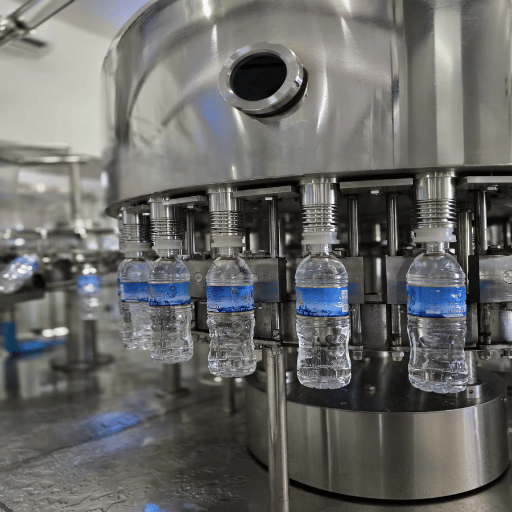
Still (non-carbonated) mineral water doesn’t require the gas to be contained, and consequently the water is filled via either gravity and / or flowmeter heads. Isobaric (counter-pressure) filler – the style that’s frequently confused for filling water, is a design intended for carbonated products and will deliver less efficiently and be somewhat slower for still water. Select the correct filling style using the Still Water Fill Method Selector.
| Method | Principle | Fit for still mineral water | Note |
|---|---|---|---|
| Gravity | Fills to a set height by head pressure | ✔ Standard | Lowest cost; level-accurate for low-viscosity water |
| Flowmeter (volumetric) | Electronic flow measurement per bottle | ✔ Premium | No fill tubes; accurate across bottle shapes; easy size change |
| Isobaric (counter-pressure) | Equalizes pressure to hold CO₂ | ✘ Not needed | For carbonated drinks, not still water |
| Vacuum | Draws liquid under vacuum (vacuum filling) | △ Niche | Used for fragile/glass or foamy liquids, rarely still water |
✔ Gravity filling, advantages
- Lowest capital cost
- Simple to clean and maintain
- Accurate level fill for water
⚠ Gravity filling, limitations
- Fill tubes make size changes slower
- Sensitive to bottle-neck variation
- Flowmeter is better above ~12,000 BPH
The Remineralization Gap: Why RO Purified Water ≠ Mineral Water
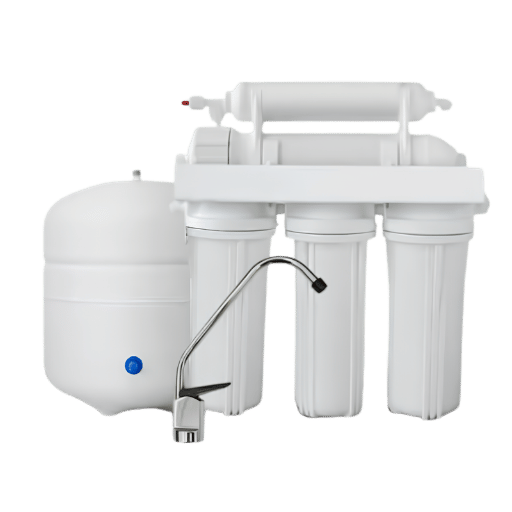
But here’s the No. 1 most often made planning mistake in this category, and the error is on the regulation side of the aisle. RO filters remove most of everything, including many of the minerals required to be even present for a beverage to be called a “mineral water.” The producers add in minerals just for better flavor-and think they’re producing a mineral water. Not in the U.S. according to the FDA standard of identity for mineral water, which requires at least 250 parts per million of Total Dissolved Solids derived naturally from its approved source. “No minerals are permitted to be added…” which RO water falls under “purified water.” So this gap-the point where most new bottlers draw their line to start-effectively ends up legally only producing purified water, and is why we refer to it as “The Remineralization Gap.”
Outside the US the jurisdiction become even more significant. Under UK and EU natural mineral water rules the water need to be approved and it should be bottled at source (the water can’t be transported in a tanker). It’s illegal to disinfect water, even ozone treatment requires special permission in order to treat for components such as iron or manganese and to ensure it has no unintentional disinfectant effect. So the common UV + ozone “sterilisation” step on a purified-water line can’t really be used in the same way on a ‘true’ natural mineral water line. Select your product type and consumer group prior to designing the treatment train.
📐 Engineering Note
An RO purified-and-remineralized line uses water treatment equipment built as a purification system, raw water → sand filter → carbon filter (activated carbon) → softener → RO membrane (the RO system) → a blending system for mineral dosing → a polishing filtration unit → ultraviolet (UV) + ozone sterilization, holding water quality to target; residual ozone may be targeting around 0.1–0.4 mg/L (ppm) at point-of-fill, sufficient for a ~4-log microbial kill according to a peer-reviewed bottling study. If this were a legitimate natural mineral water, then it wouldn’t have disinfection and it would only treat to allow constituent removal at allowed levels.
“The first question we ask any new bottler is one word, natural or added? If the minerals are native to your source, you build a gentle, low-intervention line and you may call it mineral water. If you are dosing minerals into RO water for taste, that is a perfectly good product, but it is purified water on the label and the treatment line is a different build. We have watched buyers order the wrong line because nobody asked that question early; it is the most expensive mistake in this category.”
Mass Technology Engineering Team
One operating expense the brochures leave out: RO reject water. Domestic point-of-use units may consume 5-20 gallons per gallon made, but this figure doesn’t belong in a plant model. According to EPA’s WaterSense at Work, a commercial and institutional RO unit may recover between 50 to 75% of its incoming water, with efficient systems recovering more than 90% of water feed.
Size your raw water supply from the commercial number rather than the domestic one.
Sizing the Line: Daily Demand → BPH → Bottle Format
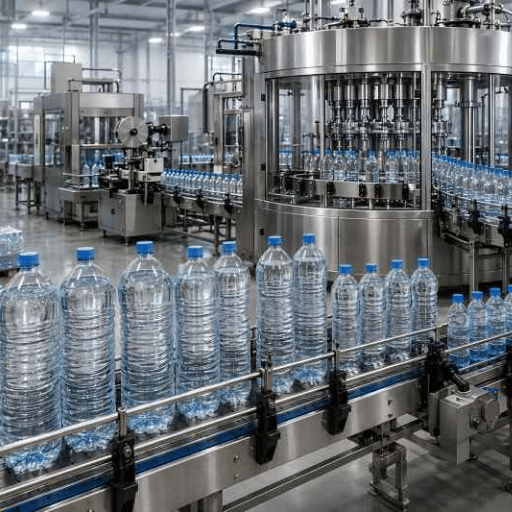
Capacity is in bottles per hour (BPH). Start by calculating daily production in BPH:
Worked example, daily demand to BPH
Goal: 20,000 bottles per day during an 8 hour shift and assuming 85% production line efficiency.
20,000 ÷ 8 hours ÷ 0.85 ≈ 2,940 BPHa line in the low-to-mid tier. Thinking about a second SKU, or a second shift down the road? Size up a tier now so you aren’t re-buying the monoblock within the first year.
| Tier | Output | Typical scope |
|---|---|---|
| Craft / regional | 2,000–6,000 BPH | Single liquid, single format; monoblock + basic conveyor |
| Mid-volume | 6,000–18,000 BPH | Integrated CIP, blower, labeler; format flexibility |
| High-volume industrial | 18,000–36,000 BPH | Combiblock blow-fill-cap; full treatment + packaging |
Higher tiers increase production capacity by adding additional rinse, filling, and capping modules to the inside of a monoblock as opposed to the speed of the machine, which is accomplished using the multi-station fill system as detailed in patent applications including US11584628B2. Hence the need to define your line by number of modules such as 24-24-8 and understand why you simply can’t speed up the craft-tier filler into the large industrial volume production line.
Can one line fill different bottle sizes?
Yes, most mineral water filling lines run 200mL, 250mL, 500mL, 1L, 1.5L and 2L PET bottles on the same monoblock using quick-change parts (grippers, fill nozzles, cap heads), and a format change takes one to two hours, so it pays to bundle similar formats into a run. A 5-gallon (HOD) line is a separate build because the bottle handling is different.
Hygiene, Compliance & Standards for Bottled Mineral Water
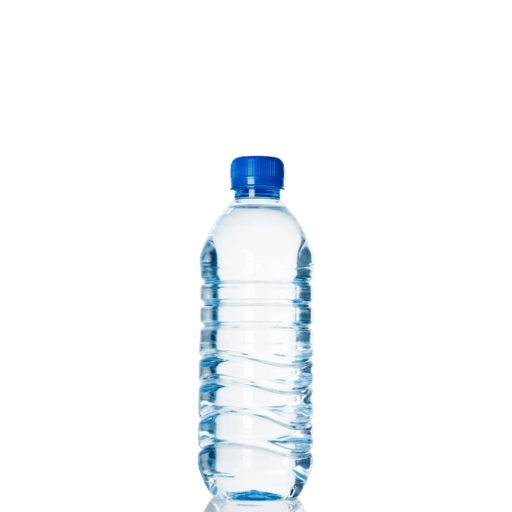
For those choosing to bypass discussions of minimum standards and regulatory compliance, the price will be paid when it’s time to export. Below is the Mineral Water Compliance Crosswalk, which delineates the various regulations applying to the bottled water products themselves as well as to the bottling equipment that make them possible and what those regulations specifically cover:
| Standard | Scope | What it controls |
|---|---|---|
| FDA 21 CFR 165.110 | US product identity | Defines mineral / purified / spring water; ≥250 ppm TDS; no minerals added to mineral water |
| Codex STAN 108 | International product | Natural mineral water composition, hygiene, hermetic sealing |
| 3-A Sanitary | Equipment hygiene | Hygienic design of the rinser, filler–capper handoff zones |
| NSF/ANSI 61 | Wetted materials | Materials contacting drinking water must not leach harmful levels |
| ISO 22000 / FSSC 22000 | Food safety system | Process documentation, traceability, fraud and food-defense controls |
💡 Pro Tip
Build against the current version if you seek food-safety certification. Version 6 of the FSSC 22000 standard, now including additional requirements on food defense, food-safety culture and food fraud mitigation, was released on April 1, 2024, and Version 7 on May 1, 2026.
Documentation must align with these latest versions. Failure to do so could delay the certification process and result in added expenses.
Quality Control & Shelf Life: Fill Accuracy, Contamination, Date Coding
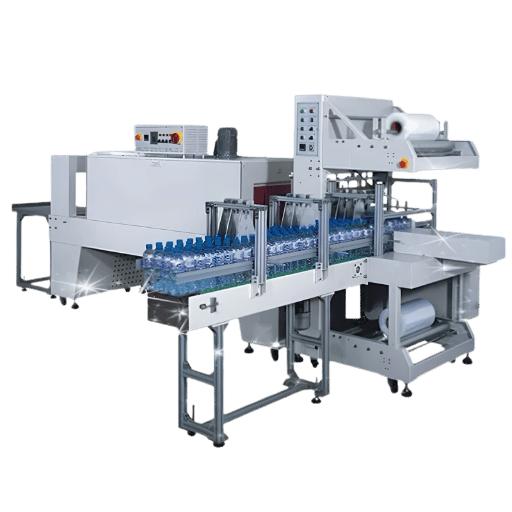
Unlike add-ons,quality control on a mineral water bottling line is built into the system’s hardware. The three main lines of defense to address potential risks are: fill-level verification to ensure consistent product volume and reject under/over-fills, capping to prevent the ingress of contaminants (whether microbially or via airborne ingress via seal loss) by setting caps within specified torque parameters, and micro-biological control via achieving specific ozone residuals, among other controls, within the finished product and system clean-in-place. The six point fill operation places date and lot code information to ensure traceability if a recall were ever needed on a specific batch.
In the field, most common defect to get past inspect ion is a slightly loose cap. Even a capping torque 0.3 Nm below the closure spec can still pass a quick visual line check, but the seal breathes – and a bottler can ship a whole batch before a customer complains of the off-taste and short shelf life. This is the case for for torques and seal integrity on the line itself, not in the lab after the pallets are out the door.
📐 Engineering Note
A workable QC baseline: reject fills out of the vicinity of 3 mm target level, check a cap torque against the closure spec (generally 0.6-2.8 Nm for screw caps), keep residual ozone at 0.1-0.4 mg/L at the time of filling for the 4-log microbial kill mentioned above, and capture a daily TDS and pH sample and a weekly microbial count. Log each reading against the batch code so a complaint can be identified to one shift, not one month of production.
How long does bottled mineral water last?
Unopened, sealed, and stored cool and dark, bottled water does not “expire” on safety grounds, and the FDA does not require an expiry date. The practical limit is taste and packaging chemistry: a peer-reviewed investigation found antimony migration from PET rises with time and temperature, breaching European levels at 60 °C for two weeks, so shelf life is set by storage temperature, not a date label.
Setting Up the Line: Footprint, Utilities & the Path to Production
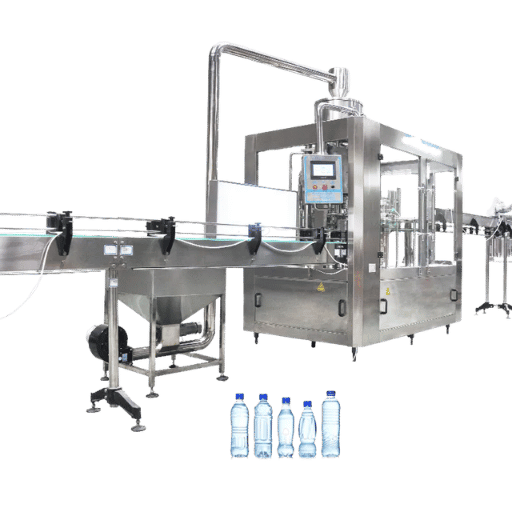
A mineral water filling line is a building project equally as much as it’s a machine purchase. Before the equipment arrives, plan space and utilities.
- Footprint: a small line (1,000–2,000 BPH) takes roughly 20–30 m²; a 5,000 BPH line needs around 40–60 m², plus space for a raw-water tank, warehouse, and operator access.
- Utilities: three-phase power (usually 380 V / 50 Hz), conditioned feed water designed to the RO recovery rate, commercial systems attain 50–75% recovery per US EPA WaterSense, so a 10,000 L/h package target could require 13,000–20,000 L/h of feed water – oil-free compressed air at approximately 0.7-0.8 MPa (7-8 bar) to blow and flush, and floor drainage suitable for CIP discharge.
- Path to production: layout design → factory acceptance test (FAT) → installation → operator training → after-sales support.
Mass delivers this as a complete production line and turnkey solution: layout planning, bottle design and on-site design services bring a new water plant or mineral water bottling plant from drawing to stable bottled water production. The line is built scalable, so production efficiency holds as you add shifts or SKUs.
How much space does a mineral water filling line need?
Allow 20–30 m² for an entry line and 40–60 m² for a mid-size line, then add the same space again for raw-water storage, finished-goods staging, and operator walkways. Ceiling height matters for the bottle blower, so confirm at least four metres of clearance early in the building search, before the layout is fixed, and leave a clear path for forklift access to the warehouse.
What a Mineral Water Filling Line Costs: Investment Tiers & Drivers
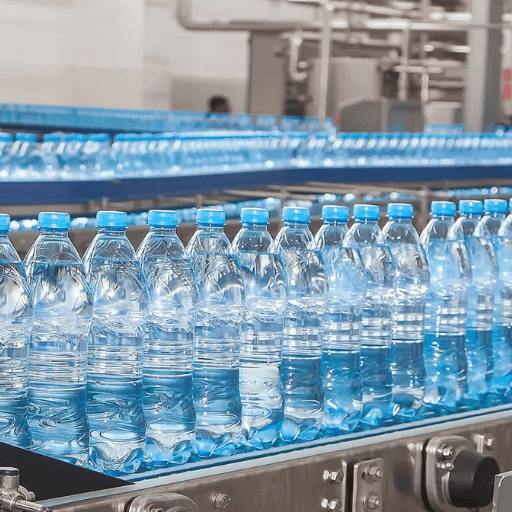
Headline equipment pricing is project-specific so take the following bands with a pinch of salt: Vendor price lists for 2025-26 see a small semi-auto line (approx. 500 – 2,000 BPH) coming in at some where in the ballpark of $50,000-$200,000. A full auto mid-range line is around $150,000-$500,000, and a stand-alone commercial RO unit will alone run for $3,000-$30,000 based on capacity.
Aautomation level, 304- vs. 316L stainless steel, scope of treatment ( purified vs true mineral ), Whether your bottling line will include its own bottle blowing machines or purchase of preforms, as well as the number of format changes required through out the line will all affect overall budget. For an actual cost estimate tailored to your specifications, consult this mineral water filling machine sales page and skip over the price list.
Here’s a classic mistake that occurs in equipment purchasing; a project manager set aside funds for the filling machine and ignores the cost of not only the RO and remineralization unit, but also the bottle blower and labeler. In fact, even on a turn-key bottling line project, the filling-rinsing-capping block only makes up for roughly half of the expenses of installed machinery. Therefore, a price that only lists “the bottling machine” is impossible to directly compare to one which lists an entire bottling line package.
As a rough payback check: a mid-tier line running 12,000 BPH at 60–70% utilization typically returns its installed cost in about 2–4 years, but that window slips fast if the RO recovery rate or the changeover time was specced wrong, because every percentage point of RO reject and every extra 30 minutes per format change quietly raises cost per bottle. That’s the real risk of buying on headline price: the cheapest filler can carry the most expensive line economics.
Choosing a Mineral Water Filling Machine & Supplier
Check for 304 or 316L stainless, though 316L should be used in environments with high chloride concentrations
7-Point Mineral Water Line Buyer Checklist
- Fill method matches the product (gravity/flowmeter for still water)
- When choosing equipment and providers for your project after you’ve identified the market and specific product sector, focus on a list of definite qualifications rather than initial price estimations.
- PLC and HMI controlling the system with integrated cleaning-in-place capability
- Treatment train matches your category (purified-and-remineralized vs true mineral)
- Reliable response times for after-sales support and quick lead times on necessary spare parts in writing
- MOQ flexibility, single machine through full turnkey line
- Factory acceptance test (FAT) offered before shipment
A supplier that can take you from a water filling machine through RO and remineralization treatment, bottle blowing, and labeling under one roof removes the risk of stitching together four different suppliers, and keeps your brand’s specification consistent across the whole line.
Industry Outlook 2026: Premiumization, Functional Water & PET Sustainability
For a buyer specifying a line now, three shifts change what is worth paying for, and none of them is “the market is growing.” First, premiumization and functional or mineral-enhanced water mean a new line should have precise mineral dosing and blending control, because the product mix is moving toward added-value waters (where, as covered above, the “mineral water” label may not legally apply). Recent USPTO filings such as WO2023158764A1 point at higher-precision multi-liquid handling at the fill head. Second, packaging sustainability is now a spec, not a slogan: lightweighting (one North-American producer moved from a 14.5 g to a 9.1 g bottle, per Beverage Industryan older but illustrative figure) plus recycled-PET (rPET) compatibility belong in the blowing-machine conversation, and storage-temperature control protects against the antimony migration noted earlier. Third, tighter food-safety expectations (FSSC 22000 v7, 2026) raise the documentation and traceability bar on any new install. For a buyer specifying a line today, the practical move is to put two questions to the vendor before signing: can the bottle blower run recycled PET (rPET), and can the dosing skid hold a tight mineral target batch to batch? A line that answers yes to both still fits the product mix in 2030; one that does not buys you a retrofit you could have avoided. Market-size forecasts (premium bottled water is projected to grow at roughly a 6.7% CAGR) are useful context only; the spec decisions above are what protect a line over a 10-year life.
Frequently Asked Questions
Q: What types of water can a mineral water filling line handle?
View Answer
One still-water line can fill mineral, spring, purified (RO), remineralized, alkaline or distilled water, what changes between them is the upstream treatment train and the label, not the rinse-fill-cap block, which stays the same across all of them. Carbonated drinks are the exception: they need an isobaric (counter-pressure) filler, and aseptic dairy needs a separate, fully sterile line of its own.
Q: How much space does a mineral water filling line need?
View Answer
On a bottling line to produce around 1,000 – 2,000 bottles per hour, you’ll require about 20-30 linear meters. A 5,000 BPHline requires about 40-60 meters of horizontal space. Double your line space in terms of physical layout in order to accommodate the fresh and finished product inventory storage areas plus space for the machine operators’ walkway space. Also ensure sufficient overhead height for bottle blower unit for your intended building selection.
Q: Do I need a reverse osmosis (RO) system for bottled mineral water?
View Answer
This will depend on your source water and bottled water product. Some sources of naturally derived spring water and mineral water naturally qualify under US and EU regulations for “spring water” and “mineral water”, and over-treatment with RO may disqualify you from this claim. Mineralizing tap water or filling highly contaminated sources with an RO filtered water system makes sense to assure consistently purified and re-mineralised products.
Q: How long does bottled mineral water last?
View Answer
Because of safety it doesn’t go bad while it is sealed and cool and there’s no mandatory expiration date on bottled mineral water. It comes down to taste and what could leech out of packaging chemistry over time, so keep pallets cool and shaded.
Q: Can one line fill different bottle sizes?
View Answer
Yes, one machine can handle a range from 200 mL to 2 L PET, depending on swift, snap-on change parts that take from one to two hours to switch. Group a run with similar formats, and just as it is easier to run the same-size bottles, changeover time is even more reduced. A 5-gal line is a separate beast because it’s a completely different bottle handling.
Q: What is the difference between mineral water filling and purified water filling?
View Answer
For still water the machines are identical, a rinse-fill-cap monoblock on both. The difference is upstream and legal: true mineral water must be treated gently under FDA rules so it keeps its naturally occurring minerals, while purified (RO) water is usually remineralized for taste but still carries the “purified water” label, not “mineral water.”
Because the US ties “mineral water” to a 250 ppm dissolved-solids rule while the EU requires capture at source with no disinfection, the same product can qualify as “mineral water” in one market and must be labeled “purified water” in another, so check the legal definition in every target market before ordering a machine.
Why We Wrote This
Mass Technology builds beverage filling lines from one Zhangjiagang facility, and across 60-plus export markets the most frequent planning mistake we see is buyers specifying an RO purified-water line while expecting to sell “mineral water.” The fill-method, treatment-train, and compliance guidance here reflects what we configure on real water lines from 2,000 to 36,000 BPH. Reviewed by the Zhangjiagang Mass Technology Co., Ltd. technical team.
Related Articles
- How to Choose a 5-Gallon Water Filling Machinesizing the HOD format
- Water Treatment System: The Complete Industrial Guidethe RO and disinfection stages in depth
- What Is Sachet Water? Safety, Cost & Market Guidea different water-packaging format
- Bottle Labeling Machine: The Complete Guidestage 8 of the line
References & Sources
- 21 CFR 165.110, Bottled waterUS FDA / eCFR
- Codex Standard for Natural Mineral Waters (CXS 108)FAO/WHO Codex Alimentarius
- Natural mineral water rulesGOV.UK
- NSF/ANSI 61: Drinking Water System ComponentsNSF
- Reduction of Enteric Pathogens in Bottled Water Using Residual OzonePubMed
- Antimony migration from PET-bottled water vs time and temperaturePubMed
- WaterSense at Work: Water Purification (RO recovery)US EPA
- FSSC 22000 Version 6 releaseNSF (with Version 7, 2026)