Get in Touch with Masstech

The pH of DI water is about 7 at 25 °C when the water is chemically pure and free of dissolved gases. A sample of DI water can yield different results depending on temperature, exposure to air and how it’s measured.
There’s a second complication: Removing ions makes the sample more difficult to measure with a conventional pH electrode. A meter can pass its buffer checks and still drift in the water you need to test. Before replacing resin or swapping a treatment system, determine if a change in the water sample is the reason for the change in measurement.
At a glance
- Ideal neutral reference: approximately pH 7 at 25 °C.
- Record temperature and conductivity alongside the pH value.
- Use a method suited to the sample’s low ionic strength.
- Compare repeated samples before interpreting differences between plant locations.
What is the pH of DI water?
Pure DI water has a neutral pH of about 7.0 at 25 °C under ideal conditions. Chemical supplier ReAgent reports distilled-water pH readings between 5.5 and 6.9, depending on how long the water has been exposed to air. At neutral pH, the activities of hydrogen and hydroxide are the same. Deionization doesn’t remove all dissolved gases, nor does it maintain the collected samples at the same temperature.
Deionised water is simply the alternative spelling. Record the temperature and how the sample is handled when comparing distilled or deionised water.
How does temperature affect pH readings?
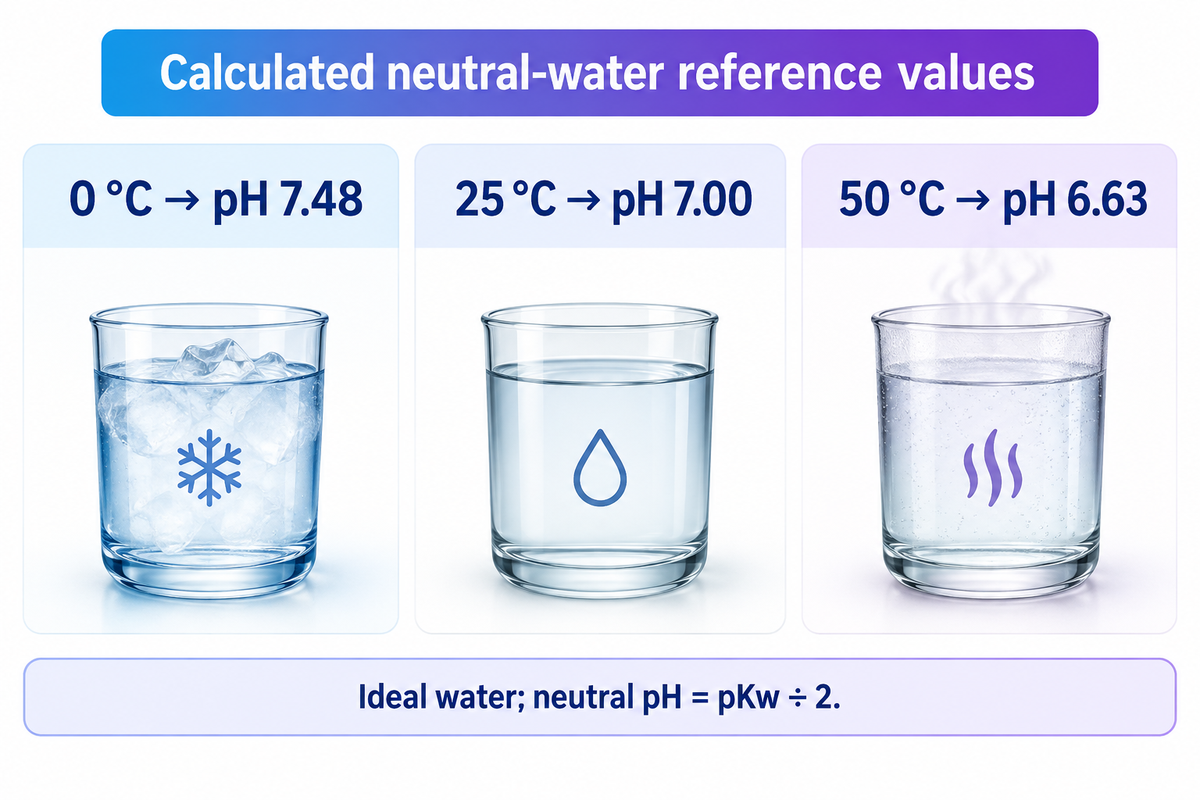
Temperature changes both water’s neutral pH and the electrode’s response: pure water is approximately pH 7 at 25 °C but pH 6.63 at 50 °C. Automatic temperature compensation adjusts the electrode response. It doesn’t make the chemistry of a warm sample identical to that of the same sample at a lower temperature.
| Temperature | IAPWS pKw | Neutral pH, approximately |
|---|---|---|
| 0 °C | 14.95 | 7.48 |
| 25 °C | 13.99 | 7.00 |
| 50 °C | 13.26 | 6.63 |
The IAPWS 2024 ionization release, Table 3, supplies the pKw values. For these temperatures, its footnote uses liquid-water density at 0.1 MPa. Neutral pH is calculated as pKw ÷ 2: at 50 °C, 13.26 ÷ 2 = 6.63. The dissociation constant changes with temperature. The statement that the pH of water is 7 applies approximately at 25 °C under ideal conditions.
Example: A technician comparing a warm process sample with a room-temperature bottle should first record both temperatures. Calling the warmer sample acidic solely because it reads below 7 would use the wrong neutral reference.
Why DI water can read below pH 7
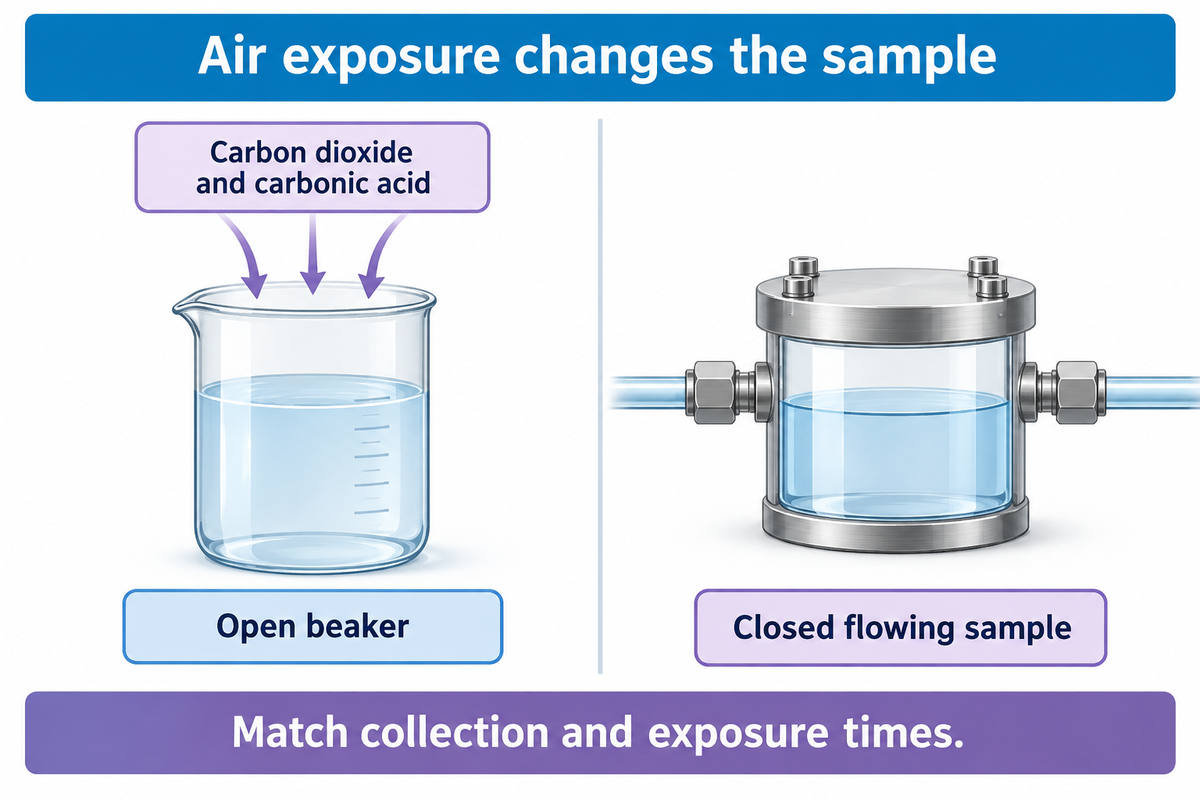
DI water absorbs carbon dioxide from air and participates in chemical reactions that form carbonic acid, a weak acid that can change the sample’s pH. If there isn’t much buffering in a sample, gas exchange can cause a noticeable change in pH, even if there’s no failure of the treatment system.
When you measure the pH, an open beaker and a closed flowing sample represent different handling conditions. As water continues to absorb CO2 gas, the result reflects its surroundings as well as the water leaving the equipment. Temperature and carbon dioxide partial pressure affect the equilibrium described in the USGS study of low-conductivity pH measurement.
No single air-exposed pH range serves as an acceptance specification for all types of DI water. Air contact can also allow volatile trace constituents to escape, as described by ASTM D5464-25. Maintain collection and exposure times as similar as practicable, and keep the delay between collection and measurement short.
Consider an outlet sample that drifts while standing on the bench. Repeat the collection using a clean container and document your handling. If the reading from the repeat sample also drifts, examine air exposure and the measurement setup.
How to measure pH in low-conductivity water
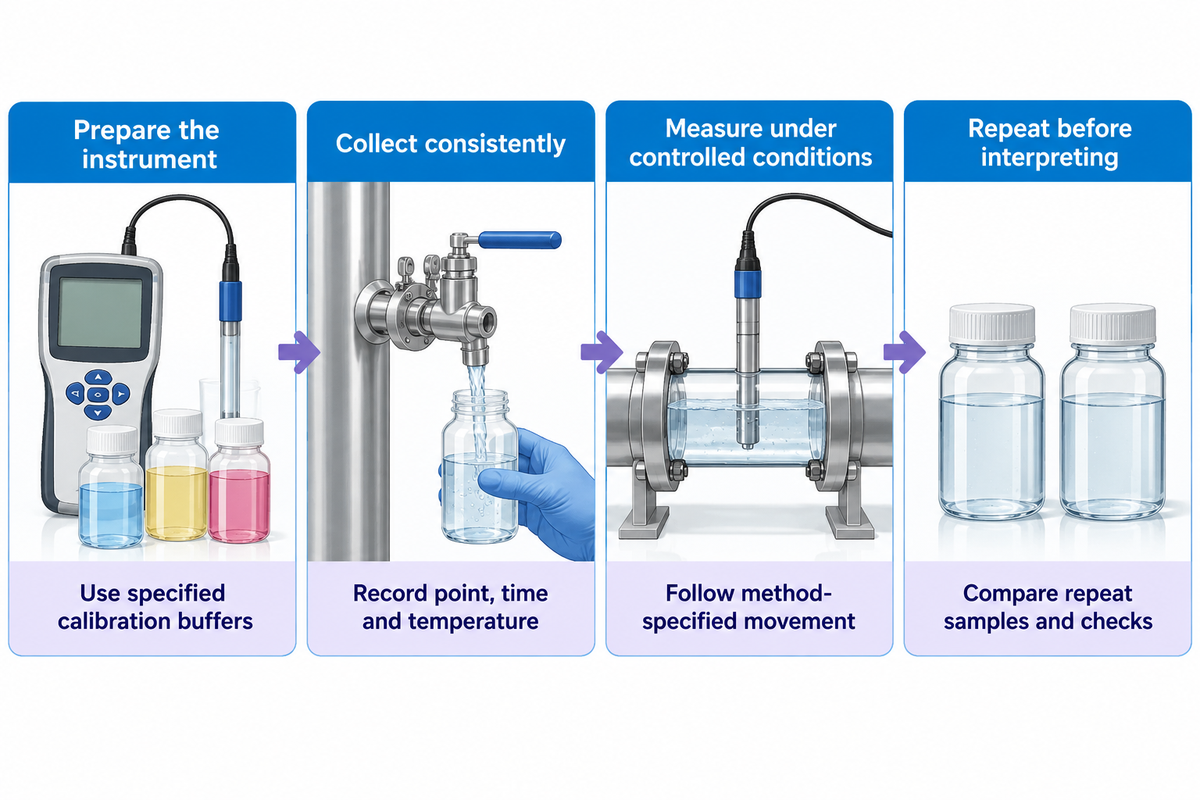
A pH meter, along with appropriate electrodes and sampling methods, should be used for low conductivity water. Sample temperature and air contact should be controlled, and sample movement should follow the selected method. Calibration checks the instrument in a buffer with higher ionic strength; the sample has a different ionic composition. The difference in ionic strength between the buffer and sample can affect the junction potential, and a reading that appears to be stable may not be correct.
“Proper calibration of electrodes with buffers does not guarantee accurate pH measurement in low-conductivity waters”
Choose the sampling arrangement before the probe. ASTM D5464-25 addresses static grab samples at 2–100 µS/cm and pH 3–11. ASTM D5128-14(2022) addresses online measurements below 100 µS/cm and pH 3–11 under controlled operating conditions. Match the method to the actual sample, including its conductivity.
- Prepare the instrument. Inspect the electrode and calibrate with the buffers specified by its procedure.
- Collect consistently. Use clean apparatus and record the point, time, temperature and exposure conditions.
- Measure under controlled conditions. Follow the selected method for immersion, flow or stirring and response stability.
- Repeat before interpreting. Compare repeat samples and method checks before treating a location difference as a process change.
Use this matrix to capture data that usually disappears behind a single measured value.
| Condition | Record or control | Why it changes the interpretation |
|---|---|---|
| Calibration | Buffer identity, temperature and check result | Separates a failed buffer check from sample-specific behavior |
| Reference junction | Electrode model, junction condition and maintenance | Junction potential depends on the sample and reference system |
| Electrolyte | Specified filling solution and refill condition | Changing electrolyte changes the measurement system |
| Air contact | Open or closed collection, delay and headspace | Gas exchange can alter sample chemistry |
| Temperature | Sample temperature and compensation setting | Water chemistry and electrode response both vary |
| Sample movement | Method-specified stirring or flow state | Beaker stirring can introduce junction-dependent noise and bias |
| Carryover | Container cleanliness and rinse procedure | Small residues can change a low-buffer-capacity sample |
| Electrical environment | Nearby equipment, cable condition and grounding checks | Interference can appear as changing readings |
| Storage history | Storage solution and any reconditioning | A poorly stored electrode may behave differently after immersion |
ASTM’s static grab-sample pH method has a lower conductivity limit of 2.0 μS/cm, and is used when it is impracticable to take a real-time flowing sample. In NBS experiments on dilute acid solutions, including hydrochloric acid (HCl), stirring increased noise and biased readings because of effects associated with the reference junction. Magnetic stirring does not necessarily result in a better answer. An online flow cell is a completely different arrangement than a stirred beaker.
The addition of potassium chloride can make a sample easier to measure, but it alters what’s measured. According to Metcalf and colleagues’ 1990 study, the addition of KCl altered the pH of low-solute-water samples compared to that of unspiked samples. Use any prescribed sample modification only within the method that requires it.
Chempros discusses the following practical problem: a formulation worker reported drift in DI water, despite a successful check of the buffer, with the same behavior occurring after probe storage.
Can pH readings be affected by electrical interference?
Yes, pH readings can be affected by electrically induced interference. Check the instrument manufacturer’s recommendations to see if there are issues with the equipment when nearby devices are turned on or off. Examine the routing of the instrument cables and connections, and note if there’s an electrical disturbance (interference) or if the sample is gradually changing. Keep the collection method constant during this comparison to avoid changing two separate causes at the same time.
DI, distilled and RO water: why pH is not a purity ranking
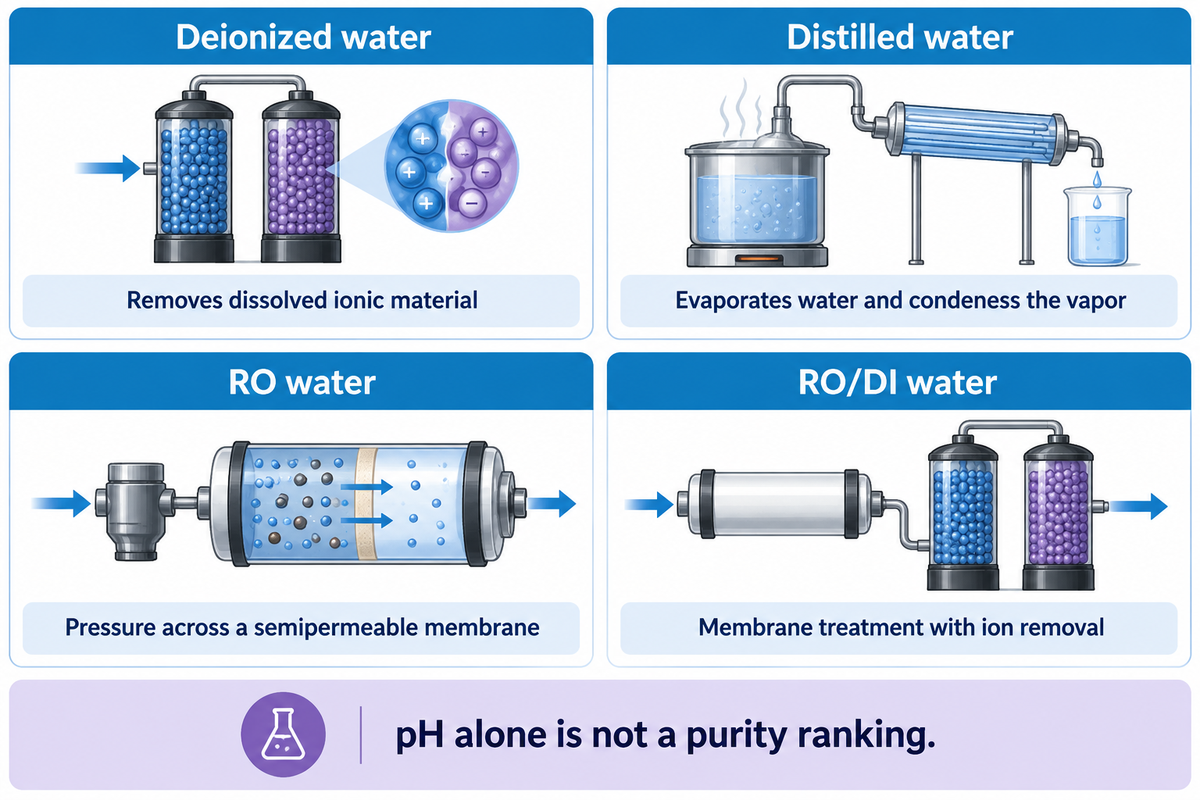
pH alone doesn’t rank DI water, distilled water, or RO water in terms of purity. These types of water are named for the treatment processes, while pH describes hydrogen ion activity. These forms of water can have particular dissolved substances removed without having a fixed final pH. Select the water quality required based upon the application and its contaminant limits.
The EPA’s treatment-technology overview discusses reverse osmosis (RO) and distinguishes cation and anion exchange. For more on RO membrane stages, see how reverse osmosis works.
| Water description | Process | Useful next question |
|---|---|---|
| Deionized / demineralized water | Removes dissolved ionic material | What conductivity and application-specific limits apply? |
| Distilled water | Evaporates water and condenses the vapor | How was it collected and stored after distillation? |
| RO water | Uses pressure across a semipermeable membrane | What feedwater and treated-water results were measured? |
| RO/DI water | Combines membrane treatment with ion removal | What reaches the actual point of use? |
Deionized water and distilled water are made by different treatment processes. Distillation uses the process of evaporating water, and condensing the steam. Using distilled water doesn’t eliminate the sampling concerns mentioned above. When distilled water contains dissolved carbon dioxide, its chemistry is changed after purification. pH of distilled water and pH of pure water after collection are affected by changes in temperature and gas exchange.
What is the pH level of Rodi water?
In ideal circumstances, RO/DI water has a neutral pH of around 7 at 25°C, but its measured value changes with dissolved gases and sample conditions. The treatment sequence is RO followed by deionization. Measure conductivity and pH at the point of use, as opposed to assigning a fixed pH from the equipment label.
pH or conductivity: which result should trigger action?
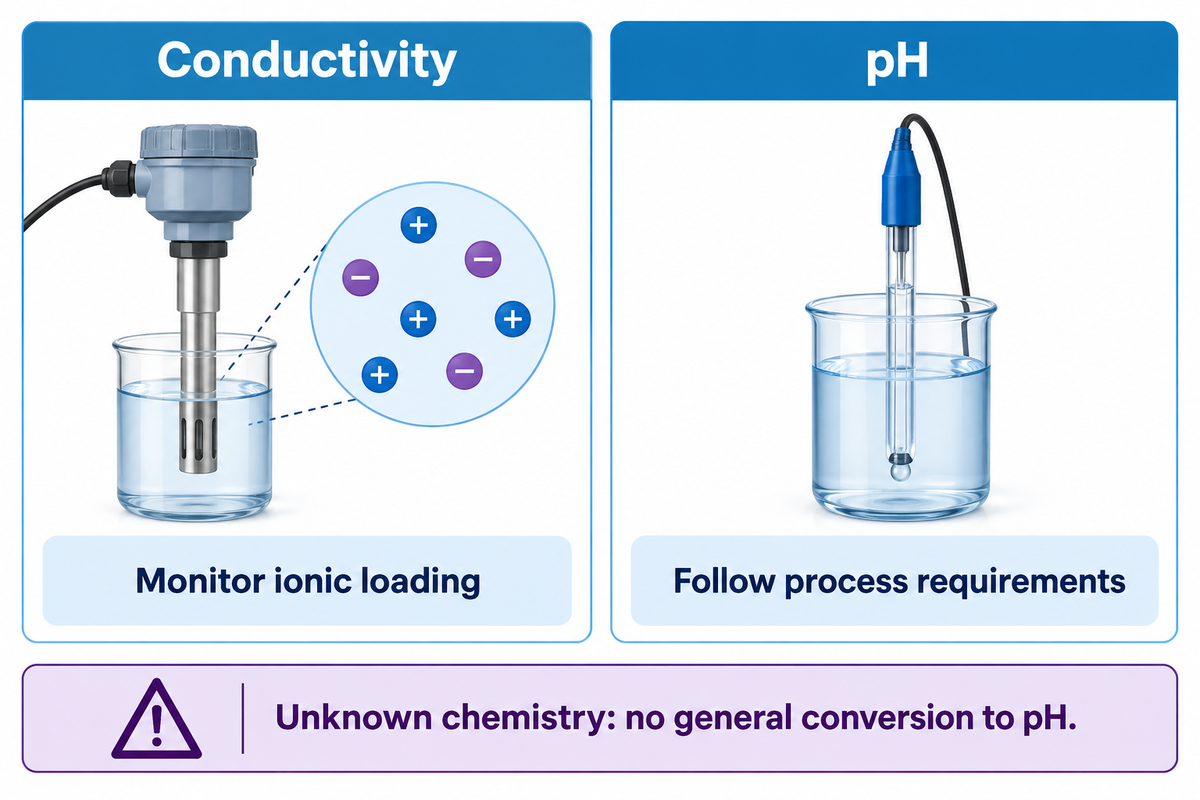
Use conductivity to monitor ionic loading and pH according to process requirements. If process limits are exceeded, a measurement check should be performed first to identify the deviation. A change in pH with stable conductivity and a change in conductivity with stable pH warrant different follow-up tests.
Light and coauthors reported a pure-water reference conductivity of 0.05501 µS/cm and resistivity of 18.18 MΩ·cm at 25 °C in their 2005 paper, The Fundamental Conductivity and Resistivity of Water. These reciprocal quantities describe electrical conduction; neither measures every possible contaminant. For distilled or deionized water, keep conductivity alongside the other tests required by the application.
A conductivity value of 1 µS/cm therefore corresponds to 1 MΩ·cm. Therefore, for the pure-water reference, 1/0.05501 ≈ 18.18 MΩ·cm. Keep the centimeter term: Microsiemens alone is a measure of conductance, and not conductivity.
Conductivity is usually not convertible to the pH of a solution of an unknown composition. Different ions carry different amounts of current and an uncharged impurity may add little to the measurement. Buecker’s discussion of industrial water and steam monitoring includes conductivity-derived pH for the specific application of controlled ammonia-conditioned chemistry.
A quality team examining an unexpected outcome should maintain the pH and conductivity trends, and the temperatures of the samples. An operations team can then compare them with treatment history. Wider understanding of the industrial water treatment stages can help place the investigation in the complete process.
A 3-Point DI Water Check for changing readings
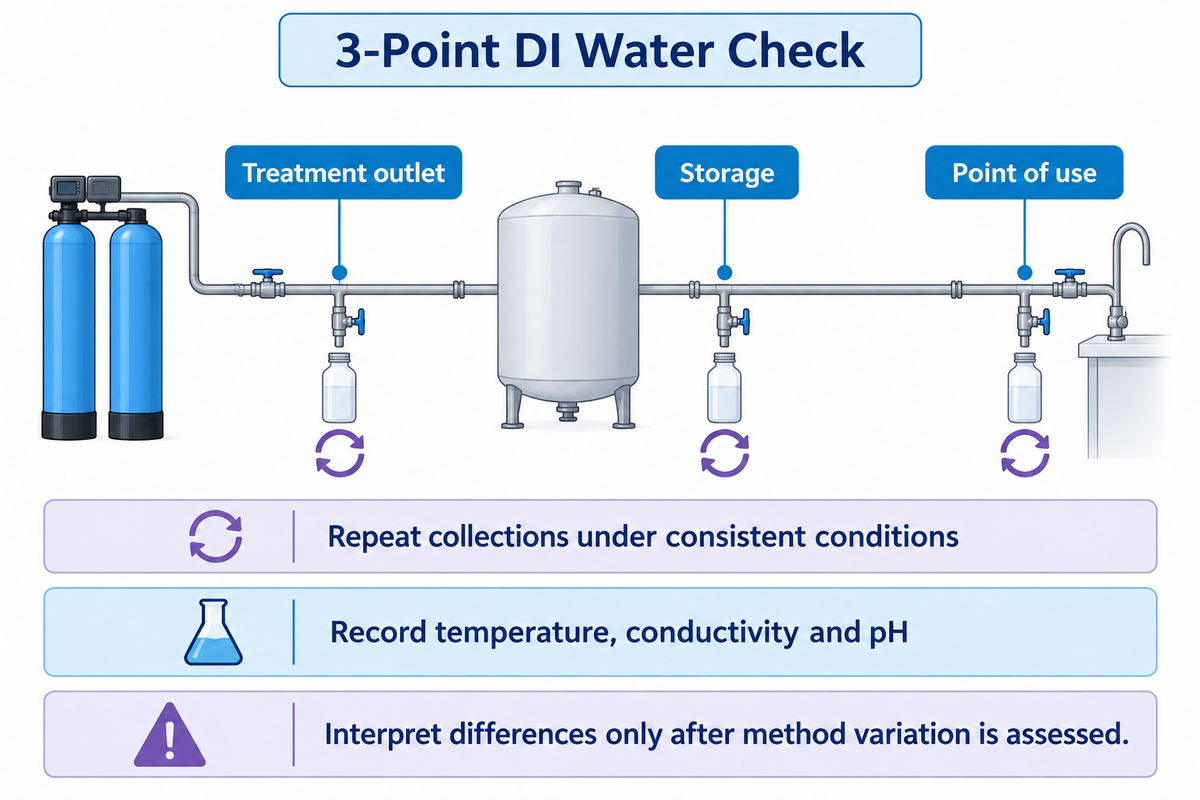
The 3-Point DI Water Check compares repeated samples from the treatment outlet, storage and point of use under a consistent measurement procedure. This check may be used to standardize sampling and identify the next check. Measurement repeatability and uncertainty should be assessed before interpreting differences between sampling locations.
At each sampling point, collection time, temperature, conductivity, and pH should be recorded along with the delay between collection and measurement and the flow or stirring conditions. Samples should be collected repeatedly and not simply read from the same beaker. Repeatability statistics, such as standard deviation, should be calculated when the procedure requires them. If the variation within one location is as large as the difference between locations, improve measurement before diagnosing the plant.
Precautions for taking samples in ASTM D5464-25 address time, gas exchange and temperature during sampling. The following checklist organizes sampling but does not by itself identify the location or cause of a water-quality problem.
| Observation | Next check | Interpret only after |
|---|---|---|
| All points drift in the beaker | Repeat with controlled handling and electrode checks | The method gives repeatable results |
| The open sample changes over time | Compare documented exposure and delay | Sampling effects are separated from outlet conditions |
| Stored water differs from the outlet | Repeat paired collections; inspect tank handling | The difference exceeds method variation |
| Point of use differs from storage | Repeat at both points with matched conditions | The difference persists before inspecting distribution |
| Buffer checks pass but samples drift | Assess low-conductivity method and junction behavior | Sample-method performance is established |
| Readings change with stirring | Repeat at the method-specified movement state | Junction disturbance is controlled |
| Readings differ at different temperatures | Record temperature and compensation settings | Temperature effects are accounted for |
| Conductivity rises at the outlet | Repeat conductivity checks and inspect feedwater trends | Instrument and sampling checks pass |
| Fluctuations coincide with equipment operation | Inspect electrical setup and compare controlled conditions | Interference is separated from water changes |
Example: Repeat outlet samples agree, while repeat point-of-use samples remain different beyond the method’s uncertainty. That pattern warrants investigation of the storage and/or distribution pathway. Additional samples may help distinguish between storage and distribution as the source of the difference. If there’s a repeatable conductivity change at the outlet, check feed water records and the suitability of the feedwater for RO if RO is in the train.
Choosing a DI water pH electrode and comparing costs
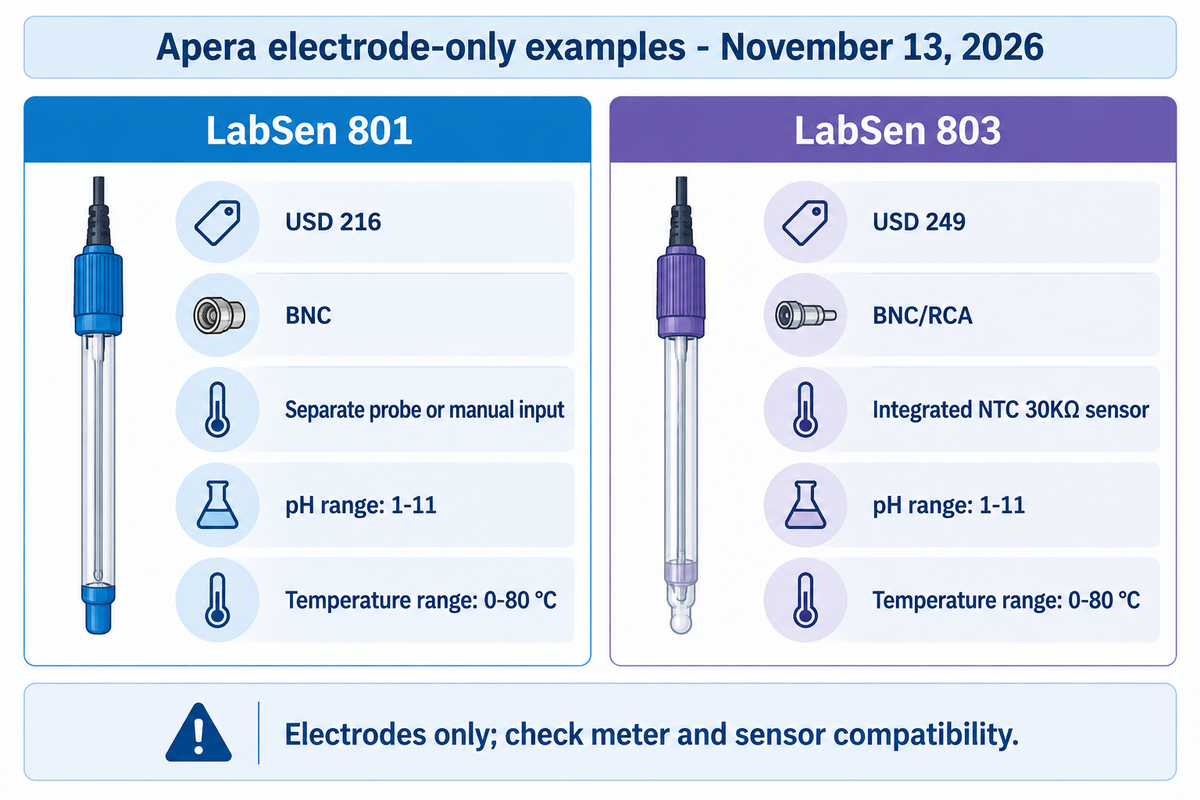
Pick the electrode type for the sample and the meter together. Prices observed on November 13, 2026, were USD 216 for Apera’s LabSen 801 and USD 249 for its LabSen 803. The difference is USD 33, but the temperature sensing arrangements are different, so check that the equipment is appropriate.
| Item | LabSen 801 | LabSen 803 |
|---|---|---|
| Listed electrode price | USD 216 | USD 249 |
| Connector | BNC | BNC/RCA |
| Temperature measurement | Separate probe or manual input | Integrated NTC 30KΩ sensor |
| Listed pH range | 1–11 | 1–11 |
| Listed temperature range | 0–80 °C | 0–80 °C |
Both options are listed for pure water and low ionic strength solutions. The 803 requires a matched connector as well as a meter that supports its thermistor. Example: a laboratory with a compatible BNC meter and an existing temperature probe may compare the 801 differently from a laboratory buying both instruments for the first time.
There are also limitations due to method suitability. ASTM D1293-18 states that its methods are inadequate below about 5 µS/cm. This is a limitation of those methods, not the minimum conductivity specification of either Apera electrode. A historical 16-pair electrode comparison also showed that high-leakage designs were not always better than low-leakage alternatives.
Prior to ordering, verify meter and temperature-sensor compatibility, demonstrated performance with your samples, filling and storage solutions, and suitability for your chosen method. Be sure to check quotes for consistency. Compare quotes for the same meter, electrodes, temperature probes, buffers and consumables, and the cost of flow cell installation and assembly. The prices above cover only the electrodes, not complete installed analyzers.
What DI pH means for a production water system
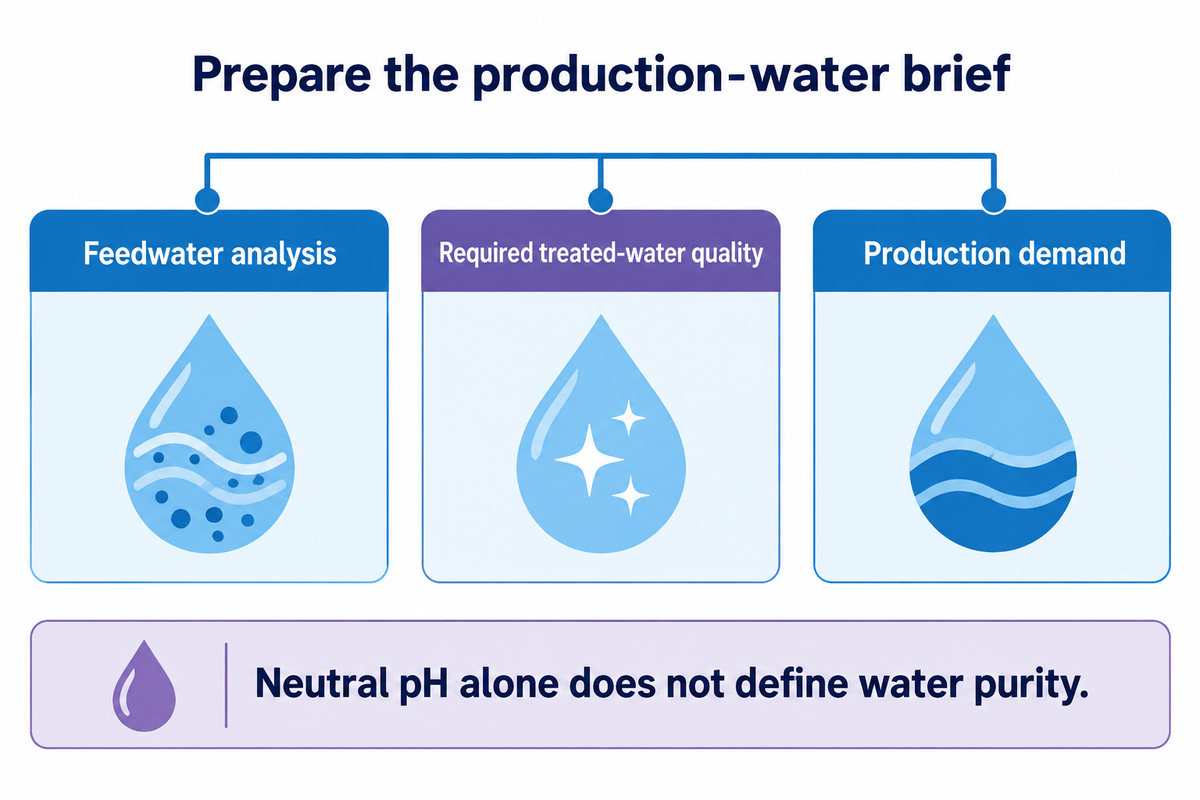
Prior to treating production water, define its use and quality requirements. Quality personnel define the test method and acceptance limits, operations records feedwater changes and demand, and procurement transforms those requirements into a comparable supply scope. A neutral pH of 7 doesn’t fully define a water purity specification.
To specify purity levels for many industrial processes, list conductivity, any process pH requirements, and the relevant contaminant limits at the point of use. This gives semiconductor processes or cooling systems a defined testing scope. Removing different classes of contaminants and impurities involves different treatment mechanisms, so the treatment train follows the application.
Mass Technology provides reverse osmosis water treatment systems for commercial and industrial use including bottling line integrations. For a system discussion, prepare an analysis of the feedwater, required treated-water quality, and your production demand. Select the capacity of the RO system after you define your quality requirement.
Key takeaway
Interpret a DI water pH result alongside its temperature, conductivity and sampling conditions.
Discuss your production water requirements
Frequently asked questions
How often should a pH sensor be calibrated?
The USGS’s 1987 low-conductivity-water procedure describes calibration before and after use, plus daily electrode-performance checks. Under this procedure, electrodes should undergo daily performance checks in standard sulfuric-acid solutions with conductivities of less than 20 µS/cm.
Apply the schedule in your current measurement procedure and instrument instructions. Record buffer identity, buffer temperature and the check results so a failed check can be traced to its measurement session. Assess electrode performance again after maintenance or reconditioning. Keep that record with the pH and conductivity results for the same sample.
How does ion exchange work?
Ion exchange replaces dissolved ions with other ions held on a resin.
A deionization system combines cation and anion exchange to remove ionic material, including positive ions like calcium and negative ions such as chloride. Ions are electrically charged species. Sodium-form softening uses a different exchange process and provides softening rather than complete deionization. The ions removed depend on the ion exchange resins and their operating condition. Judge the resulting water using the tests specified for its intended use.
Can I store my pH electrode in deionized water?
No; use the storage solution specified by the electrode manufacturer.
Rinsing a probe between samples is different from storing it in DI water. Manufacturer guidance warns that prolonged RO/DI storage can shorten electrode life and cause drift. If storage has been incorrect, follow the model’s reconditioning procedure, then check calibration and sample performance before returning it to routine work.
Can I make deionized water at home?
Yes, deionizing ion-exchange cartridges remove dissolved ions; boiling tap water doesn’t perform that exchange.
The cartridge’s capacity and the feedwater determine how long it can keep removing ions. Test the treated water for its intended use; a home-treated sample doesn’t acquire a certified laboratory grade from the cartridge label alone.
How can I raise the pH of distilled water?
An alkaline additive such as sodium hydroxide (NaOH) can raise the pH of the water, but it also changes its composition.
For a purity-sensitive process, use its specified chemistry instead of adding ions merely to chase seven on the display.
References & Sources
- IAPWS: Revised Release on the Ionization Constant of H2O, 2024.
- Busenberg and Plummer: pH Measurement of Low-Conductivity Waters, USGS, 1987.
- ASTM D5464-25: pH Measurement of Water of Low Conductivity.
- ASTM D5128-14(2022): Online pH Measurement of Water of Low Conductivity.
- Marinenko et al.: Effect of Variables on pH Measurement in Acid-Rain-Like Solutions, 1986.
- Light et al.: The Fundamental Conductivity and Resistivity of Water, 2005.
- Metcalf, Peck and Arent: Effect of Potassium Chloride Additions on pH Measurements, 1990.
- ASTM D1293-18: pH of Water.
- Davison and Harbinson: Performance of Glass Electrodes in Dilute Acids, 1988.
- EPA: Overview of Drinking Water Treatment Technologies.
- USGS Water Science School: Desalination.
- Brad Buecker: The Importance of Industrial Water and Steam Treatment, Part 7, 2024.
- Apera Instruments: LabSen 801 specifications and electrode price.
- Apera Instruments: LabSen 803 specifications and electrode price.
- pHionics: The Guide to pH Drift, 2020.
- Chempros: A user’s question about pH measurement in DI water (anecdotal operating problem).
Author: CYH. This article draws on published measurement research, standard-method descriptions and manufacturer specifications checked in November 2026. Electrode prices are dated manufacturer listings; the cited instruments and research belong to their respective manufacturers and authors.