Get in Touch with Masstech
Ion Exchange Resin for Water Treatment: Chemistry, SAC/SBA Types, Regeneration & Sizing Guide

Contents
show
Quick Engineering & Procurement Summary, Ion Exchange Resin (TL;DR):
- Core Definition: An ion exchange resin consists of insoluble, cross-linked polymer microbeads (0.3 to 1.2 mm, 16 to 50 U.S. mesh). These hold mobile counter-ions (Na+, H+, Cl−, OH−). Counter-ions can be reversibly exchanged with dissolved ions of the same charge sign in equivalent amounts.
- Five functional classes: Industrial media covers Strong Acid Cation (SAC, 1.8 to 2.2 eq/L) and Weak Acid Cation (WAC, 3.5 to 4.5 eq/L). Anion classes cover Strong Base Anion Type I and Type II (SBA, 1.1 to 1.5 eq/L) and Weak Base Anion (WBA, 1.3 to 1.9 eq/L). Specialty selective chelating resins add 1.1 to 1.8 eq/L capacity for heavy metals.
- Softening vs. deionization: Sodium-form water softening removes hardness (Ca2+, Mg2+) but slightly raises total dissolved solids (TDS). By contrast, H+/OH− mixed-bed deionization produces high-purity water down to 0.055 μS/cm (18.18 MΩ·cm at 25 °C).
- 2026 unit pricing (volume basis): Standard 8% DVB SAC softener media runs $45 to $170 per ft³ ($1.59 to $6.00/L). Strong base anion Type I gel grades run $130 to $435 per ft³ ($4.59 to $15.36/L). Mixed-bed DI grades run $235 to $739 per ft³, and PFAS-selective resins run $300 to $1,440 per ft³.
What Is Ion Exchange Resin and How Does Electrostatic Counter-Ion Swap Work?
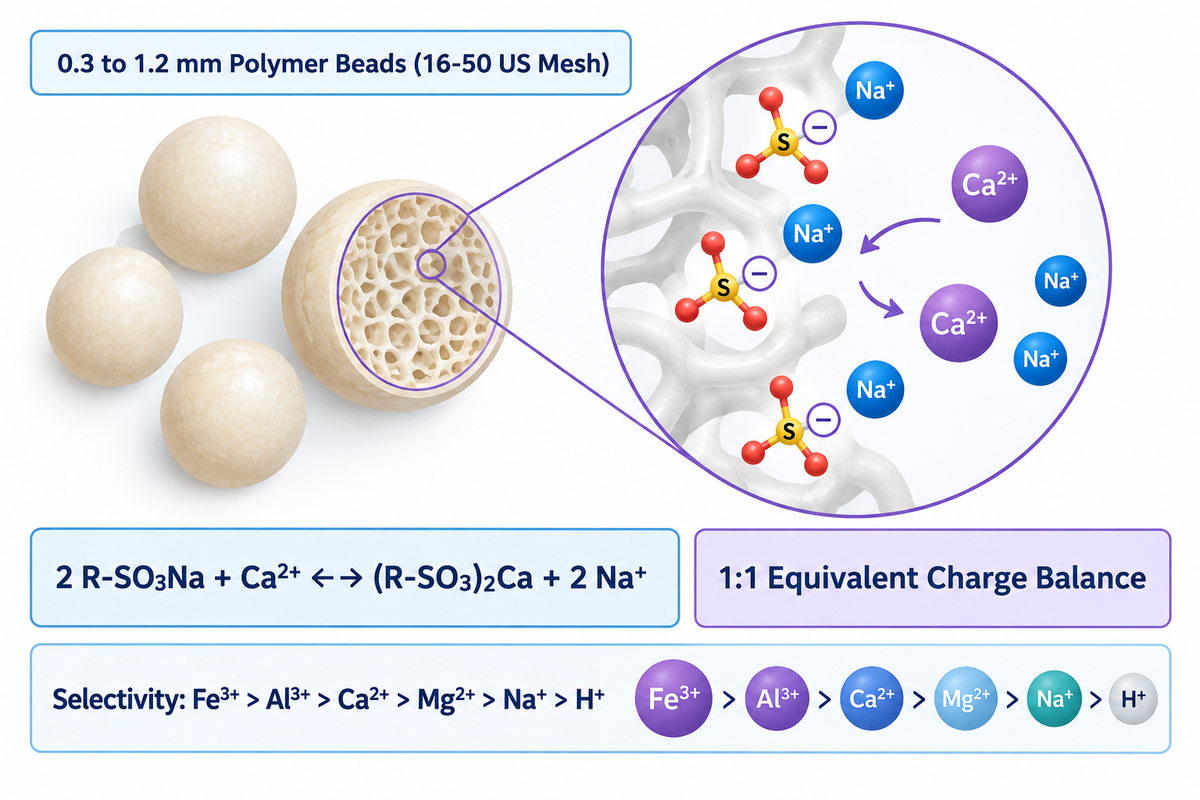
Ion exchange resins are water-insoluble, cross-linked polymer beads typically measuring 0.3 to 1.2 mm (16 to 50 US mesh). Each bead carries ionizable functional groups; in weak resins, their charge depends on water pH. As described in the DuPont Water Solutions ion exchange technical literature, functional groups have mobile counter-ions (Na+, H+, Cl−, or OH−). Those counter-ions are reversibly exchanged with dissolved ions in water on a strict 1:1 chemical equivalent basis.
Each resin bead must be electrically neutral always. As such, the ion exchange process balances electrical charge rather than particle count. In water treatment, water softening (sodium cycle) follows the cation exchange reaction:
2 R−SO3Na + Ca2+ ⇌ (R−SO3)2Ca + 2 Na+
In this cation exchange reaction, “R” represents the resin matrix, the insoluble polymer. The −SO3− group is the fixed sulfonic acid exchange site. The double arrows show that the ion exchange reactions are fully reversible. After the resin beads become saturated with hardness ions, a concentrated brine regenerates the IX resin bed. This shifts the resin exchange equilibrium and restores the original sodium form.
How Does Ion Exchange Resin Work in Water Purification?
During water purification, dissolved ions in water diffuse across the liquid film at the surface of the resin. They then enter the hydrated pores of the polymer. At ambient feedwater concentrations below roughly 1,500 mg/L TDS, ion exchangers prefer ions of higher electrical valence and smaller hydrated radius. As per Chapter 8 of the Veolia Handbook of Industrial Water Treatment, thermodynamic selectivity follows two standard sequences.
- Strong acid cation order: Fe3+ > Al3+ > Pb2+ > Ba2+ > Ca2+ > Mg2+ > K+ > NH4+ > Na+ > H+.
- Strong base anion order: SO42− > I− > NO3− > Br− > Cl− > HCO3− > OH− > F−.
This selectivity order shows how ion exchange resins remove target contaminants. It also establishes an operational boundary. Ion exchange material mainly captures dissolved charged ions, while strong base anion beds also neutralize weakly dissociated acids, such as dissolved CO2 and reactive silica (H4SiO4). As confirmed by University of Nebraska-Lincoln Extension NebGuide G1491, water softening doesn’t take out bacteria, hydrogen sulfide, silt, sand, or uncharged organics. Thus, engineers account for ion exchange units alongside filtration and disinfection in a multi-stage treatment train when developing industrial water treatment plant (WTP) architecture and mass balance sizing .
What Are Ion Exchange Resins Made Of? Polystyrene-DVB vs. Polyacrylic Matrices and Gel vs. Macroporous Beads
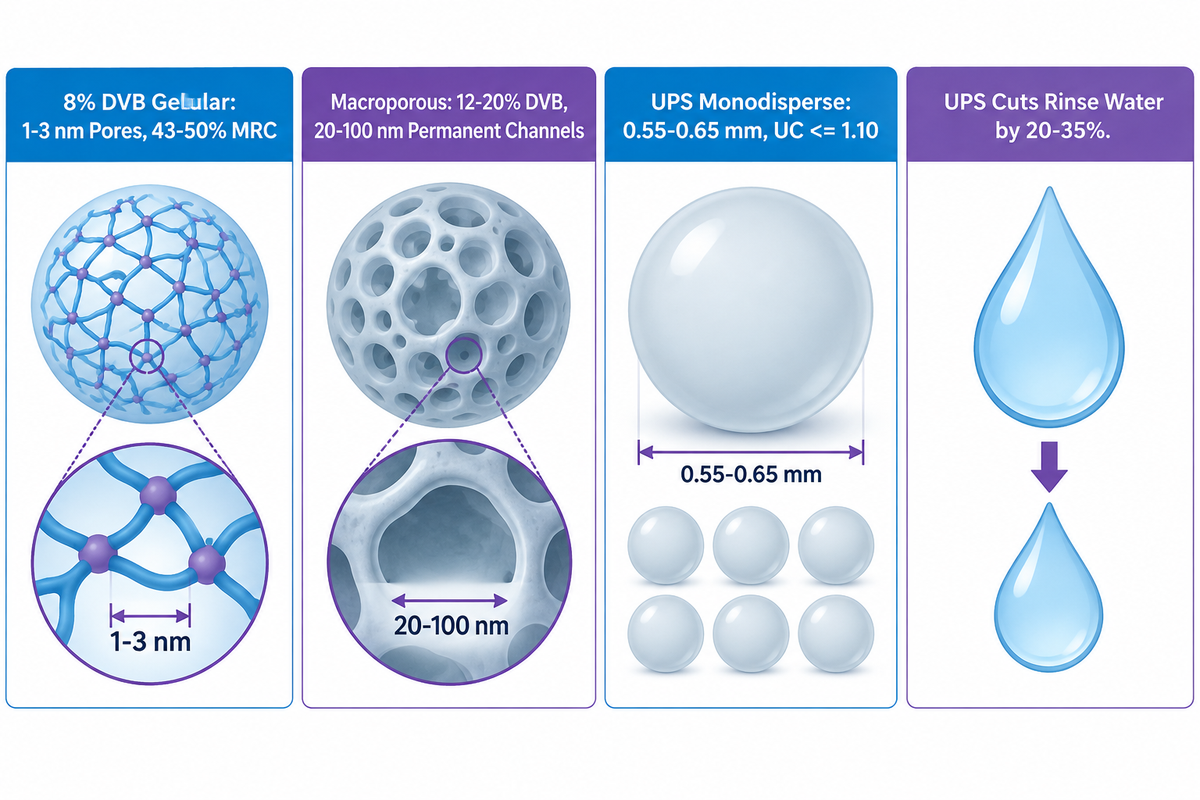
Before functionalization and hydration, the base copolymer skeleton of commercial ion exchange resin beads is synthesized from styrene (or acrylic monomers) cross-linked with divinylbenzene (DVB). Standard gelular resins use 8% to 10% DVB and rely on 1 to 3 nm hydration pores; 43% to 50% moisture retention is an example that varies with the grade and ionic form. Macroporous resins use 12% to 20% DVB to form permanent 20 to 100 nm channels that resist oxidants and osmotic shock.
What Are Ion Exchange Resins Made Of?
Modern synthetic ion-exchange resins consist of polystyrene or polyacrylate cross-linked with divinylbenzene (DVB), with their chemistry tracing back to two foundational United States patents. Gaetano D’Alelio received US Patent 2,366,007 for the sulfonation of styrene-divinylbenzene copolymers, creating an insoluble synthetic cation exchange resin. On April 1, 1952, Charles H. McBurney at Rohm and Haas received US Patent 2,591,573 for reacting haloalkylated styrene-DVB beads with tertiary amines to create strong base anion resins.
Resin beads are produced by means of aqueous suspension polymerization. In this process, liquid styrene monomers are suspended in water and divinylbenzene (DVB) monomers are incorporated. DVB has two vinyl groups. It cross-links neighboring polymer chains to form a rigid 3-dimensional polymer structure. Without DVB cross-linking, linear sulfonated polystyrene would simply dissolve in water. DVB determines the degree of swelling of the beads, how rapidly they swell, the moisture holding capacity of the beads and their chemical strength.
For surface waters which are humic and fulvic acid rich, manufacturers use aliphatic polyacrylics instead of polystyrenes. Polyacrylic resin structure is hydrophilic and is therefore capable of desorbing large anions. For bead size control, there are two different production methods. The first generates a uniformity coefficient of 1.40 to 1.60, which corresponds to a relatively broad size distribution, and is referred to as the Gaussian distribution method. Uniform Particle Size (UPS monodisperse) beads measure 0.55 to 0.65 mm with a uniformity coefficient of 1.10 or less. Beads of 0.55 to 0.65 mm are produced by this method.
| Resin Structure | DVB Cross-Linkage | Pore Size & Moisture (MRC) | Exchange Kinetics & Capacity | Best Operating Fit |
|---|---|---|---|---|
| Standard Gelular (8% DVB Styrenic) | 8% DVB | 1–3 nm hydration pores; 43%–50% MRC | Fast small-ion kinetics; 10%–15% higher working capacity than macroporous | Low-chlorine well water softening and standard demineralization |
| High-Crosslink Gel (10% DVB Styrenic) | 10% DVB | <2 nm tight mesh; moisture retention varies by grade and ionic form | Slightly slower cold-water diffusion; higher volume capacity (2.1–2.2 eq/L) | Chlorinated municipal softeners and warm-water service |
| Macroporous / Macroreticular | 12%–20% DVB (porogen-formed) | 20–100 nm permanent pores even when dry | Lower total capacity; fast diffusion for bulky organics and PFAS | High-TOC surface water, oxidizing streams, and high-pressure condensate |
| Polyacrylic (Acrylic-DVB) | 5%–10% DVB | Hydrophilic gel or macroporous; 55%–65% MRC | High capacity in WAC grades (3.5–4.5 eq/L); reversible humic elution in polyacrylic anion grades | Organic scavenger beds, WAC dealkalization, and tannin-rich feeds |
| Uniform Particle Size (UPS Monodisperse) | 8%–12% DVB | 0.55–0.65 mm diameter; UC ≤1.10 (vs. 1.4–1.6 Gaussian) | Lower pressure drop; cuts rinse water volume by 20%–35% | Packed-bed counter-current demineralizers and mixed-bed polishers |
Choosing between standard gelular resins and macroreticular anion resins depends on oxidants and organic load. Standard 8% DVB gel grades offer the lowest purchase price. They also maximize the capacity of the resin for water softening and demineralization on clean groundwater. If free chlorine exceeds 0.1 mg/L, upstream carbon dechlorination reduces chlorine exposure, while higher-crosslinked SAC grades, such as 10% DVB gel, can offer greater resistance to oxidative decrosslinking. If TOC exceeds 3 to 5 mg/L, pair SBA beds with hydrophilic polyacrylic anion scavengers to improve organic desorption.
What Are the Main Types of Ion Exchange Resin? SAC, WAC, SBA (Type I & II), WBA, and Chelating Resins
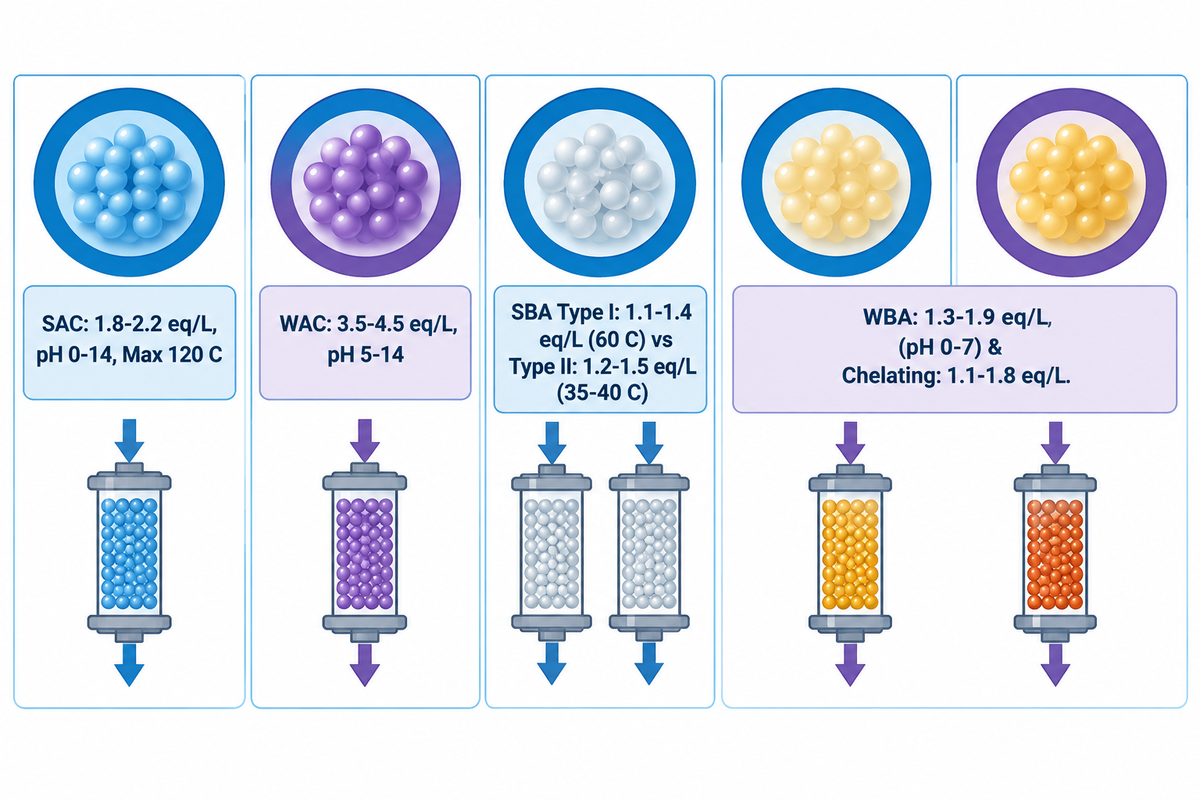
Industrial ion exchange resins fall into five functional-group classes. Strong Acid Cation (SAC) resins hold 1.8 to 2.2 eq/L across pH 0 to 14 up to 120 °C, while Weak Acid Cation (WAC) resins hold 3.5 to 4.5 eq/L at pH 5 to 14. Strong Base Anion Type I (1.1 to 1.4 eq/L, max 60 °C in OH− form) and Type II (1.2 to 1.5 eq/L, max 35 to 40 °C) handle full anion stripping. Weak Base Anion (WBA, 1.3 to 1.9 eq/L, pH 0 to 7) and chelating resins (1.1 to 1.8 eq/L) cover acid absorption and heavy metals.
What Are Some Examples of Resins Used in Water Treatment?
Well recognized commercial types of ion-exchange media span the whole spectrum of classes. Common SAC grades include DuPont AmberLite HPR1100 and Purolite C100E, while WAC dealkalization uses AmberLite IRC86 and LANXESS Lewatit CNP80. Typical anion grades are AmberLite IRA402 and Purolite A400 (SBA Type I), Purolite A300 (SBA Type II), and Lewatit MP62 (WBA). Polishing and metal recovery rely on Purolite MB400 (mixed bed DI resin) and Lewatit TP 207 (iminodiacetic chelating resin).
Knowing how resin functions differ between strong and weak groups prevents costly sizing errors. Strong acid and strong base resins stay ionized across pH 0 to 14, so they split neutral salts like NaCl. Weak resins use carboxylic (−COOH) or tertiary amine groups whose ionization depends on water pH. In the hydrogen form used for dealkalization, WAC resins remove cations associated with bicarbonate alkalinity. Free-base WBA resins adsorb strong mineral acids (HCl, H2SO4) while passing weakly ionized silica (H4SiO4, pKa ≈ 9.8) and carbon dioxide.
A strict temperature limit separates Type I and Type II base anion resins. SBA Type I uses trimethylammonium groups (−N+(CH3)3). It operates up to 60 °C in hydroxide form and strips reactive silica below 20 ppb. SBA Type II swaps one methyl group for a hydroxyethyl group (−N+(CH3)2C2H4OH). That change boosts caustic regeneration efficiency by 15% to 25%. However, it cuts the maximum OH− temperature to 35 to 40 °C due to faster Hofmann degradation. Our 9-Class Ion Exchange Resin Functional Group & Operating Matrix below maps all nine commercial grades. For standard functional-group classifications, see Chapter 8 of the Veolia Handbook of Industrial Water Treatment.
| Resin Class | Functional Group | Total Capacity (eq/L) | Operating pH | Max Temp (°C) | Primary Target Ions & Regenerant |
|---|---|---|---|---|---|
| 1. SAC (Na+ Form) | Sulfonate (−SO3−Na+) | 1.8–2.2 eq/L | 0–14 | 120 °C | Ca2+, Mg2+, Ba2+, Sr2+; 8%–12% NaCl brine |
| 2. SAC (H+ Form) | Sulfonic acid (−SO3H) | 1.8–2.2 eq/L | 0–14 | 120 °C | All cations (Ca2+, Mg2+, Na+, K+); HCl or stepped H2SO4 |
| 3. WAC (H+ Form) | Carboxylic acid (−COOH) | 3.5–4.5 eq/L | 5–14 | 120 °C | Alkalinity-bound hardness (Ca/Mg bicarbonates); near-stoichiometric acid |
| 4. SBA Type I | Trimethylammonium (−N+(CH3)3) | 1.1–1.4 eq/L | 0–14 | 60 °C (OH−) / 100 °C (Cl−) | All anions incl. SiO2 (<20 ppb) & CO2; warm 4% NaOH |
| 5. SBA Type II | Dimethylethanolamine quat | 1.2–1.5 eq/L | 0–14 | 35–40 °C (OH−) / 80 °C (Cl−) | Strong/weak anions at lower caustic dose; 4% NaOH (≤35 °C) |
| 6. WBA (Free Base) | Tertiary amine (−N(CH3)2) | 1.3–1.9 eq/L | 0–7 | 60–100 °C | Strong mineral acids (SO42−, Cl−, NO3−); NaOH, NH3, or Na2CO3 |
| 7. Mixed-Bed DI (40:60) | 40% SAC (H+) + 60% SBA-I (OH−) | 0.55–0.75 eq/L net | 0–14 | 60 °C | Ultrapure polishing to 0.055 μS/cm; backwash-separated HCl + NaOH |
| 8. Chelating Resin | Iminodiacetic or aminophosphonic | 1.1–1.8 eq/L | 2–11 | 80–90 °C | Selective heavy metal (Cu2+, Ni2+, Zn2+, Pb2+) & brine polishing; acid + NaOH |
| 9. PFAS / Nitrate-Selective SBA | Tributyl / triethyl quaternary amine | 0.8–1.1 eq/L | 4–10 | 60 °C | PFOA/PFOS (<4.0 ppt) & NO3− over SO42−; single-use disposal or brine |
Chelating resins form coordinate covalent bonds with transition metal ions. In high-alkalinity demineralizers, positioning WAC resins before SAC resins and WBA resins before SBA resins reduces acid and caustic demand by 30% to 50%.
Water Softening (Na+ Form) vs. Two-Bed and Mixed-Bed Deionization (H+/OH− Form): How Resin Configurations Differ
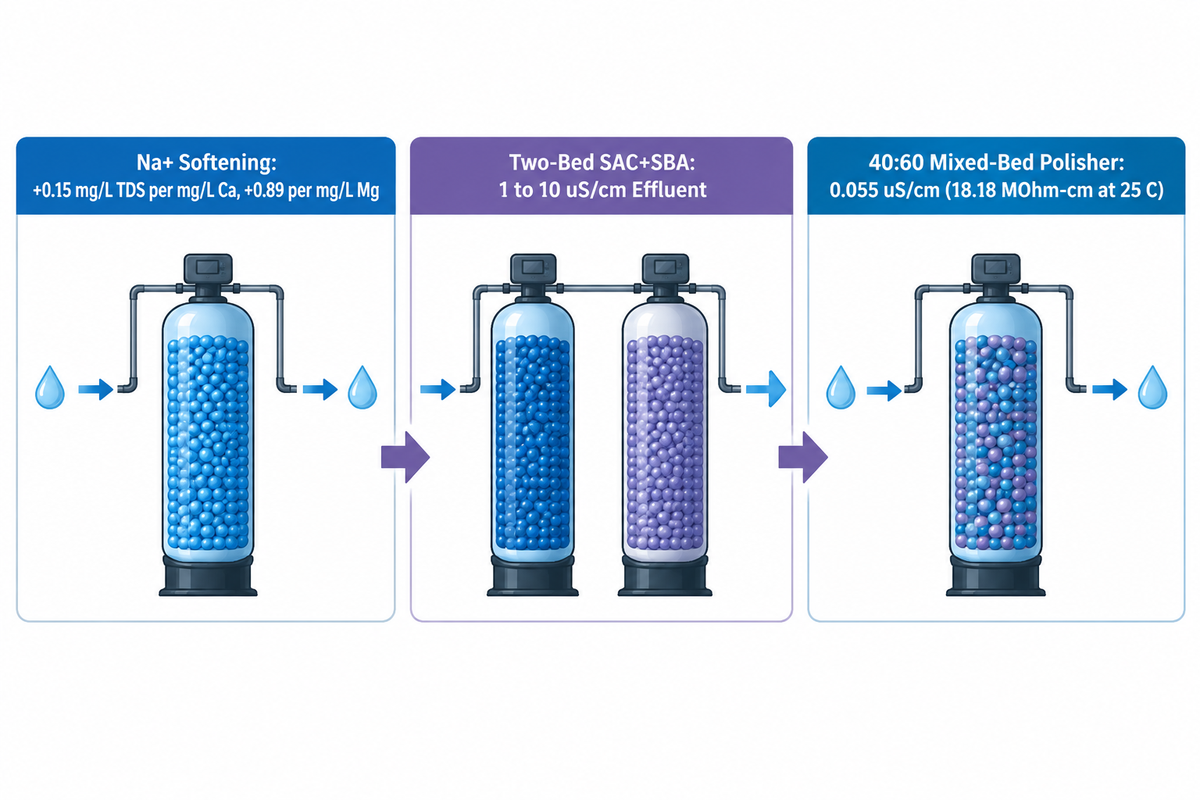
A sodium-cycle water softener removes calcium and magnesium hardness (less than 1 mg/L as CaCO3) without lowering total dissolved solids (TDS). A two-bed SAC+SBA demineralizer reduces the effluent conductivity to 1 to 10 µS/cm. For ultrapure water, a 40:60 volume-ratio H+/OH− mixed-bed polisher can reduce the conductivity to 0.055 to 0.1 µS/cm (18.18 MΩ·cm at 25 °C at the lower end of this conductivity range).
Purchasers of plant equipment expect that lowering TDS or reducing boiler conductivity with water softeners would result from removing the heavier ions. The difference in atomic weights between the exchanged ions explains why soft water actually carries slightly more gravimetric TDS than raw hard water.
- Calcium swap mass gain: One mole of Ca2+ weighs 40.08 g, while two moles of released Na+ weigh 45.98 g (2 × 22.99 g). Removing 1 mg/L of calcium adds roughly 0.15 mg/L of net TDS.
- Magnesium swap mass gain: One mole of Mg2+ is 24.31 g, while two moles of Na+ are 45.98 g. Swapping 1 mg/L of Mg2+ for Na+ (one mole Mg for two moles Na) adds 0.89 mg/L TDS.
- Alkalinity unchanged: Per Chapter 8 of the Veolia Water Handbook, sodium zeolite softening doesn’t reduce bicarbonate alkalinity or boiler blowdown rates.
True water demineralization pairs hydrogen-form cation exchange resin with hydroxide-form anion exchange resin. In vessel one, H+ ions replace all cations and convert dissolved salts to dilute acids (HCl, H2SO4, H2CO3). In vessel two, strong base exchange swaps OH− for all anions. That completes the demineralization process as H+ and OH− combine to form pure water (H+ + OH− → H2O).
For complete demineralization of water, engineers place a mixed-bed polisher downstream of two-bed vessels or reverse osmosis. At the stated total exchange capacities (2.0 eq/L vs. 1.3 eq/L), SAC resin holds roughly 1.5 times the capacity of SBA resin. Mixed beds therefore blend 40% cation and 60% anion by volume for a 1:1 equivalent balance. At 25 °C, theoretical pure water hits 0.05501 μS/cm conductivity (18.18 MΩ·cm resistivity). When monitoring demineralized water, keep two things in mind. First, atmospheric CO2 quickly lowers unbuffered pH (see why deionized water pH shifts rapidly upon atmospheric CO2 exposure). Second, low conductivity confirms ionic purity only; resin beds don’t sanitize water and require downstream UV or ozone disinfection.
How to Size an Ion Exchange Resin Bed: Exchange Capacity (eq/L & kgr/ft³), EBCT, and Column Hydraulics
Engineers size industrial resin beds on practical operating capacity, such as 1.0 to 1.4 eq/L (roughly 20,000 to 30,000 grains/ft³ as CaCO3), rather than a fixed 55% to 70% of datasheet total capacity. Standard vessels maintain at least 750 to 900 mm (30 to 36 inches) of bed depth. Service flow runs at 8 to 40 BV/h (1.5 to 7.5 minutes EBCT) with 50% to 75% backwash expansion freeboard.
Sizing a vessel from datasheet total exchange capacity causes early hardness or sodium breakthrough 35% to 50% before schedule. Actual resin capacity shifts with regenerant dose, feedwater sodium ratio and leakage limits. Use one constant for conversion between metric and US units.
1.0 eq/L = 1.0 meq/mL = 50.0 g CaCO3/L = 21.85 kilograins (kgr) CaCO3/ft³ (1 ft³ = 28.317 L)
Per US EPA drinking water treatment technology guidance, hydraulic loading rates and breakthrough bed volumes shift with resin grade and raw water chemistry. Therefore, pilot testing is essential for specialty contaminants. Plant engineers can also evaluate the raw water ionic load before sizing using our feedwater TDS and reverse osmosis compatibility checker.
Worked Engineering Example: 10 m³/h Industrial Softener Resin Bed Sizing Calculation
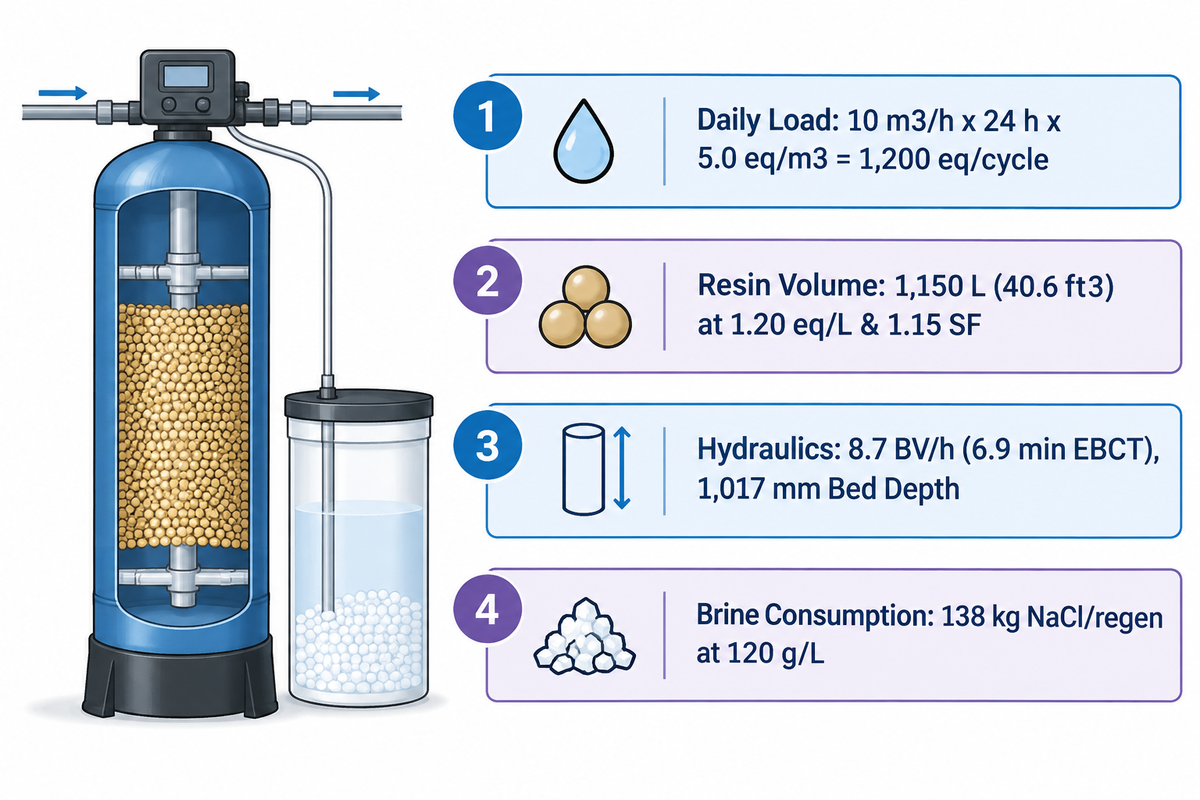
Consider a beverage plant softening Q = 10 m³/h (44.0 GPM) of borehole raw water for a 24-hour service cycle. Feedwater hardness is 250 mg/L as CaCO3 (5.0 eq/m³ or 14.6 grains per gallon). We select 8% DVB SAC cation resin operating at Cop = 1.20 eq/L (60 g CaCO3/L or 26,220 grains/ft³) with a 120 g NaCl/L (7.5 lb/ft³) brine dose and a 1.15 safety factor.
| Design Step | Engineering Formula | Calculated Value | Hydraulic Check |
|---|---|---|---|
| 1. Daily Ionic Load | Q × t × Cfeed = 10 m³/h × 24 h × 5.0 eq/m³ | 1,200 eq / cycle | 60 kg CaCO3 removed per 24 h |
| 2. Required Resin Volume | (1,200 eq × 1.15) ÷ 1.20 eq/L | 1,150 L (40.6 ft³) | Shipping weight: ~920 kg at 800 g/L |
| 3. Specific Flow Rate & EBCT | 10,000 L/h ÷ 1,150 L; 60 min ÷ BV/h | 8.7 BV/h (6.9 min EBCT) | Inside 8–40 BV/h design window |
| 4. Vessel Diameter & Bed Depth | 1,200 mm ID vessel (area = 1.131 m²) | 1,017 mm bed depth | Exceeds 750 mm min; velocity 8.84 m/h |
| 5. Salt Consumption per Cycle | 1,150 L × 120 g NaCl/L | 138 kg NaCl / regen | Needs ~1,780 mm straight-side vessel (75% freeboard) |
How to Regenerate Ion Exchange Resin: 4-Stage Brine, Acid, and Caustic Schedules vs. Resin Replacement
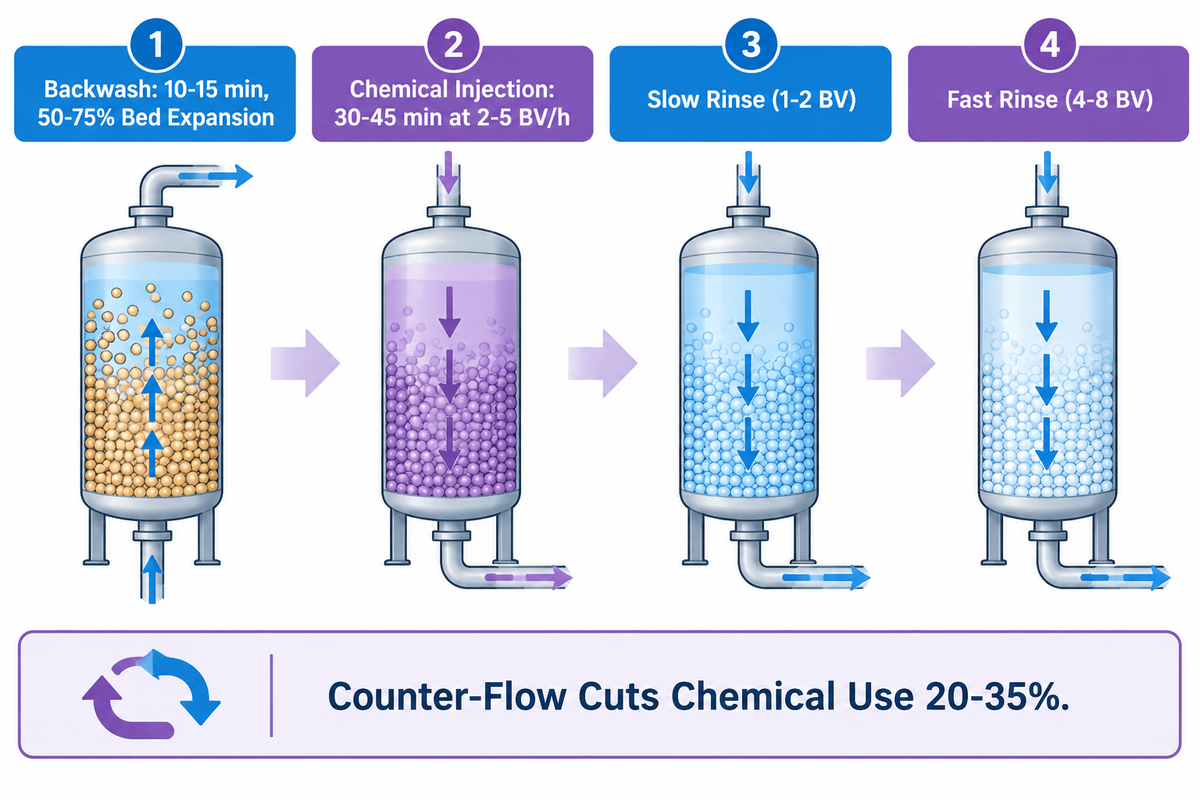
Separate-bed resin regeneration runs on 8% to 12% NaCl brine (90 to 240 g/L of resin) for softeners and 4% to 6% HCl (75 to 150 g/L of resin) or stepped 0.8% to 6.0% H2SO4 (100 to 160 g/L of resin) for cation beds; dosages refer to active chemical per resin volume. SBA Type I anion beds use 3% to 5% NaOH (80 to 140 g/L of resin) heated to 38 to 50 °C for silica removal; Type II grades require the lower temperature limit stated in their datasheet. Under low-chlorine service, SAC resin lasts 7 to 15 years while SBA resin lasts 3 to 6 years.
Proper regeneration of the resin follows four hydraulic steps from DuPont TechFact 45-D01131 for Separate Beds.
- Backwash (10 to 15 minutes): Reverse flow upward to expand the bed by 50% to 75%, flushing out silt and broken fines.
- Chemical Injection (30 to 45 minutes at 2 to 5 BV/h): Feed a concentrated brine, acid, or caustic to strip captured ions from exchange sites.
- Slow Displacement Rinse (1 to 2 BV): Gently push the residual regenerant slug through the lower bed at the injection flow rate.
- Fast Rinse (4 to 8 BV at service flow): Flush remaining salts to drain until effluent hardness or conductivity meets the target specification.
| Application & Regenerant | Solution Strength | Co-Flow Dosage | Counter-Flow Dosage | Critical Process Safeguard |
|---|---|---|---|---|
| Softener SAC (NaCl Brine) | 8%–12% (10% typical) | 90–240 g/L (5.6–15.0 lb/ft³) | 70–120 g/L (4.4–7.5 lb/ft³) | Use low-hardness evaporated salt (<0.1% insolubles) |
| Demin SAC (HCl Acid) | 4%–6% | 75–150 g/L (4.7–9.4 lb/ft³) | 40–80 g/L (2.5–5.0 lb/ft³) | HCl introduces no sulfate to cause CaSO4 precipitation; compatible rubber-lined or acid-resistant nonmetallic vessels can be used. |
| Demin SAC (Stepped H2SO4) | Step 1: 0.8%–2.0%; Step 2: 4%–6% | 100–160 g/L (6.2–10.0 lb/ft³) | 60–110 g/L (3.7–6.9 lb/ft³) | A weak initial step reduces the risk of CaSO4 gypsum scale. |
| Demin SBA (Caustic NaOH) | 3%–5% (4% typical) | 80–140 g/L (5.0–8.7 lb/ft³) | 45–90 g/L (2.8–5.6 lb/ft³) | Preheat to 38–50 °C for SBA-I silica strip (≤35 °C for SBA-II); use softened/DI dilution water |
Counter-current flow of the packed beds reduces chemical usage by 20% to 35%, and holds sodium leakage to under 1 ppm. Mixed-bed polishers using conventional separated acid and caustic regeneration need backwash stratification so that the denser cation beads settle below the less dense anion beads. They also require 15% to 20% more acid and caustic than separate beds. Plant budgets need to consider the cost of neutralizing the spent brine and acid/caustic effluent before sewer discharge.
Is It Worth Replacing Resin in a Water Softener or Demineralizer?
Routine exhaustion in regenerable softener and demineralizer beds calls for chemical regeneration, while exhausted single-use media and disposable polishing cartridges are replaced. Resin replacement makes economic sense when replacement and subsequent operation cost less than regeneration, cleaning, and continued operation of the existing bed, including chemical, wastewater treatment, and downtime costs. For light-commercial softeners, fresh media costs $100 to $350 versus $800 to $2,500 for a full new unit. Rebedding therefore pays off whenever the control valve and tank remain intact.
Industrial demineralizer operators track bed health via annual ASTM D2187 standard test methods and ResinTech anion replacement guidelines. Replace the resin if operating capacity drops over 20% to 25%. Differential pressure above 1.0 to 1.5 bar (15 to 22 psi) can indicate hydraulic restriction, while SAC moisture retention above 60% can indicate degradation if it exceeds the original specification for the same ionic form. Small polishing plants often avoid on-site chemicals by leasing off-site exchange tanks ($40 to $100 per ft³ per cycle).
Ion Exchange Resin Fouling and Degradation: How to Diagnose Chlorine Oxidation, Organic Humics, Iron, and CaSO4 Scaling
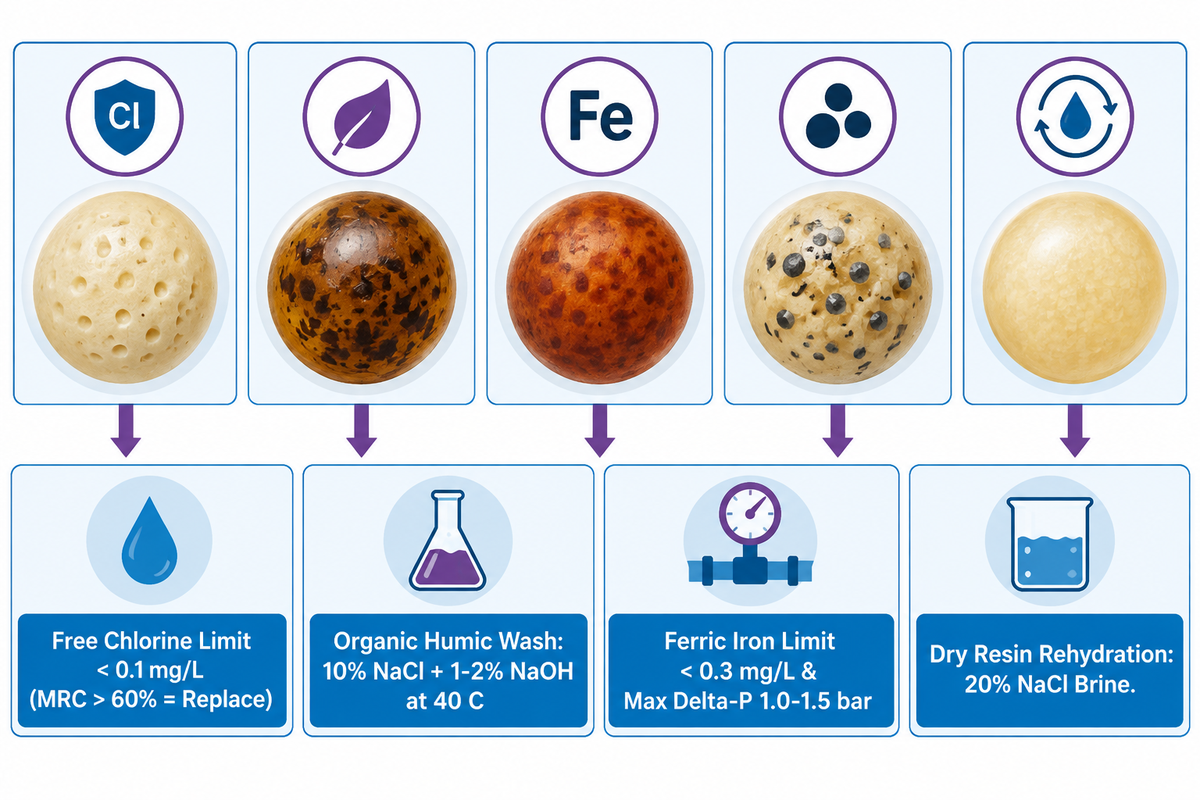
Keep continuous free chlorine below 0.1 mg/L, dissolved iron below 0.3 mg/L, and bed differential pressure below 1.0 to 1.5 bar (15 to 22 psi). Exceeding the free chlorine threshold can lead to DVB decross-linking and moisture retention of 60% or greater. Ferric iron fouling and gypsum scaling are also possible.
Operators often mistake chlorine oxidation for simple dirt or iron fouling. Per DuPont Oxidation Stability TechFact 45-D01457, free chlorine cleaves DVB cross-links in polystyrene SAC beads. The swollen beads turn soft and mushy, compact under flow, and cause sudden pressure drops. Across r/WaterSofteners field diagnostics, opening the valve isolation loop can restore line pressure immediately, indicating a restriction within the bypassed assembly. Brown fines caught in faucet aerators point to cracked distributor baskets.
Iron fouling happens for a different chemical reason. According to Penn State Extension water softening guidance and UNL Extension NebGuide G1714, dissolved ferrous iron (Fe2+) exchanges cleanly. However, ferric iron (Fe3+) that has been oxidized from exposure to air or chlorine precipitates as insoluble red iron hydroxide that clogs the beads. Chapter 8 of the Veolia Handbook also warns that improper sulfuric acid dosing causes irreversible calcium sulfate (CaSO4) fouling inside cation pores.
| Failure Mode | Field / Lab Indicator | Root Cause | Rehabilitation / Prevention | Replacement Trigger |
|---|---|---|---|---|
| 1. Chlorine Decrosslinking | MRC >60%, mushy beads, ΔP >1.5 bar | Free Cl2 >0.1 mg/L cleaving DVB cross-links | Irreversible; prevent with GAC or NaHSO3 dechlorination + 10% DVB resin | Immediate full bed replacement |
| 2. Organic Humic Fouling (SBA) | Long rinse tails, low effluent pH, dark tea-colored beads | Fulvic/humic acids trapped in styrenic gel pores | For SBA Type I, the warm alkaline brine squeeze uses 10% NaCl + 1%–2% NaOH at 40 °C for 4–12 h. | Strong-base capacity loss >25% post-brine wash |
| 3. Ferric Iron Coating | Rust-brown beads, premature hardness leakage | Feed Fe >0.3 mg/L oxidized to insoluble Fe(OH)3 | Sodium hydrosulfite reducing wash, citric-acid complexing/acid cleaning, or hydrochloric-acid cleaning; upstream iron filter | Cemented bed channeling or >20% capacity loss |
| 4. CaSO4 Gypsum Scaling | White precipitate crust, severe channeling | >2% initial H2SO4 on high-Ca2+ SAC bed | Prevent via stepped 0.8%–2.0% H2SO4 ramp or switch to HCl | Permanent pore blinding after HCl soak |
| 5. Thermal / Osmotic Shock | >10% cracked/broken beads, silica breakthrough | SBA-II >40 °C or rehydrating dry resin in tap water | Hold SBA-I ≤60 °C; rehydrate dried resin in 20% NaCl brine | >15% broken beads or high fines carryover |
Ion Exchange Resin vs. Reverse Osmosis: Selective PFAS/Nitrate Removal, FDA 21 CFR 173.25 Compliance, and Hybrid RO-to-IX Bottling Lines
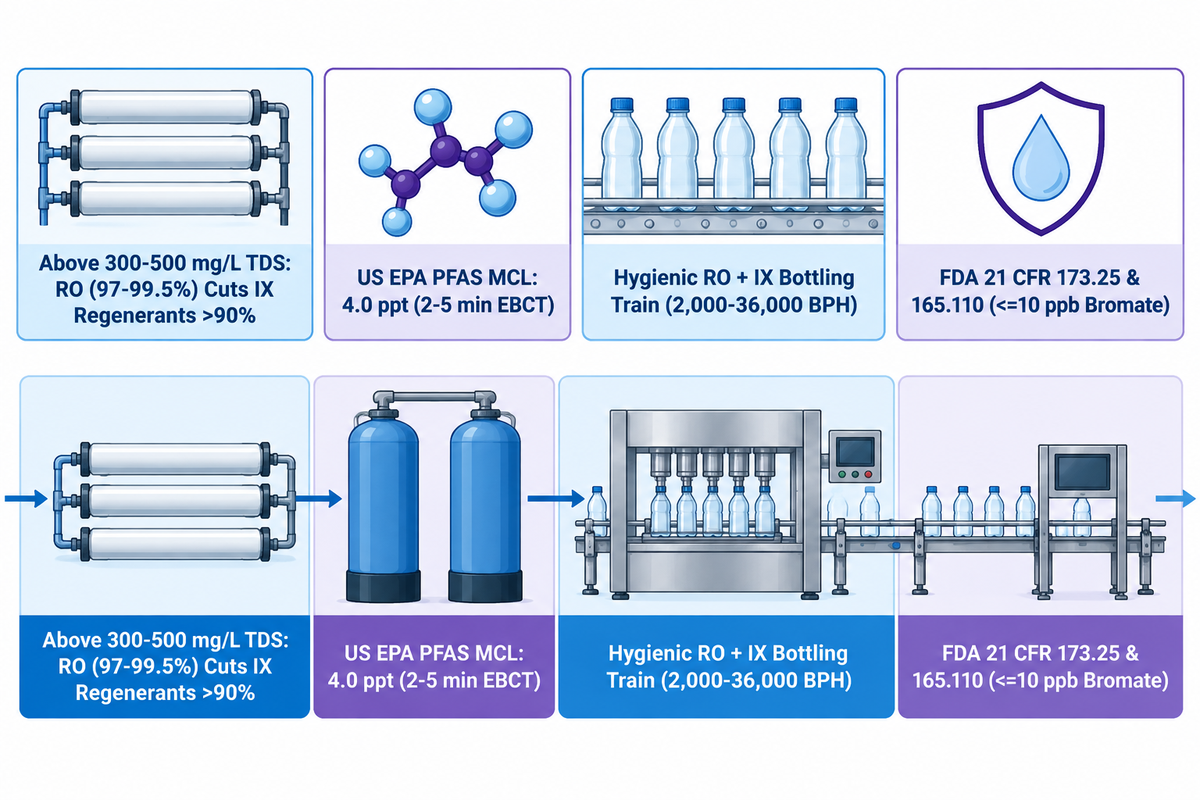
Above 300 to 500 mg/L feedwater TDS, installing reverse osmosis (97% to 99.5% bulk salt rejection) ahead of ion exchange polishing cuts regenerant chemical use by over 90%. For trace PFOA and PFOS removal, US EPA drinking water regulations set 4.0 ppt (ng/L) MCLs and list ion exchange (2 to 5 minutes EBCT) as a Best Available Technology.
Process engineers evaluating RO pretreatment at 300-ppm feedwater TDS weigh operating costs and treatment requirements when sizing water treatment systems. Ion exchange systems also excel at selectively removing hardness, nitrate, or PFAS without wasting 25% to 35% of the raw water as RO reject concentrate. Standalone demineralizers burn through acid and caustic quickly if the total dissolved solids (TDS) of the raw water exceeds 300 to 500 mg/L. Comparing total costs means considering the balance between IX regenerants and spent-resin disposal and RO pump power and concentrate discharge. Model that trade-off directly with our 5-year reverse osmosis water treatment total cost of ownership calculator.
Potable and beverage compliance rests on three separate legal frameworks that buyers should keep distinct.
- US EPA PFAS Rule (40 CFR Part 141): Finalized in April 2024 at 4.0 ppt for PFOA and PFOS and 10 ppt for PFHxS, PFNA, and HFPO-DA. In May 2026, EPA proposed extending eligible public utility compliance deadlines from 2029 to 2031. Competing background sulfate lowers short-chain PFAS capacity, so site piloting is important.
- Material Safety vs. Performance Certification: US FDA 21 CFR 173.25 governs food-contact polymer compositions and extractives. Likewise, NSF/ANSI/CAN 61 certifies non-leaching health safety only; it does not certify contaminant removal performance (covered separately by NSF/ANSI 44).
- Bottled Water Quality Standards: US FDA 21 CFR 165.110 sets ≤10 ppm USP TDS for Purified Water and ≤10 μg/L bromate for bottled water. Section 410 of the FD&C Act links new EPA drinking-water MCLs to FDA bottled-water rulemaking.
Per trade reports in Beverage Industry and Food Engineering, water makes up 85% to 90%+ of finished drinks. Modern bottling plants therefore combine RO and ion exchange water treatment into an 8-stage hygienic process water train. Raw water passes through screening, multimedia/UF filtration, carbon dechlorination (<0.1 mg/L Cl2), and a Na+ softener before entering high-pressure RO. Permeate then enters IX mixed-bed polishing and UV/ozone sanitization (≤10 ppb bromate) prior to automated filling.
MassTech pairs its commercial reverse osmosis water treatment systems (0.5 to 50 T/H) with 2,000 to 36,000 BPH CGF 3-in-1 filling lines. See our water treatment industrial reverse osmosis systems guide for more details on membrane designs. You can also see how PET water bottles are manufactured and rinsed on automated bottling lines.
Ion Exchange Resin Price per Cubic Foot, Liter, and Kilogram: 2026 Manufacturer Cross-Reference and RFQ Checklist
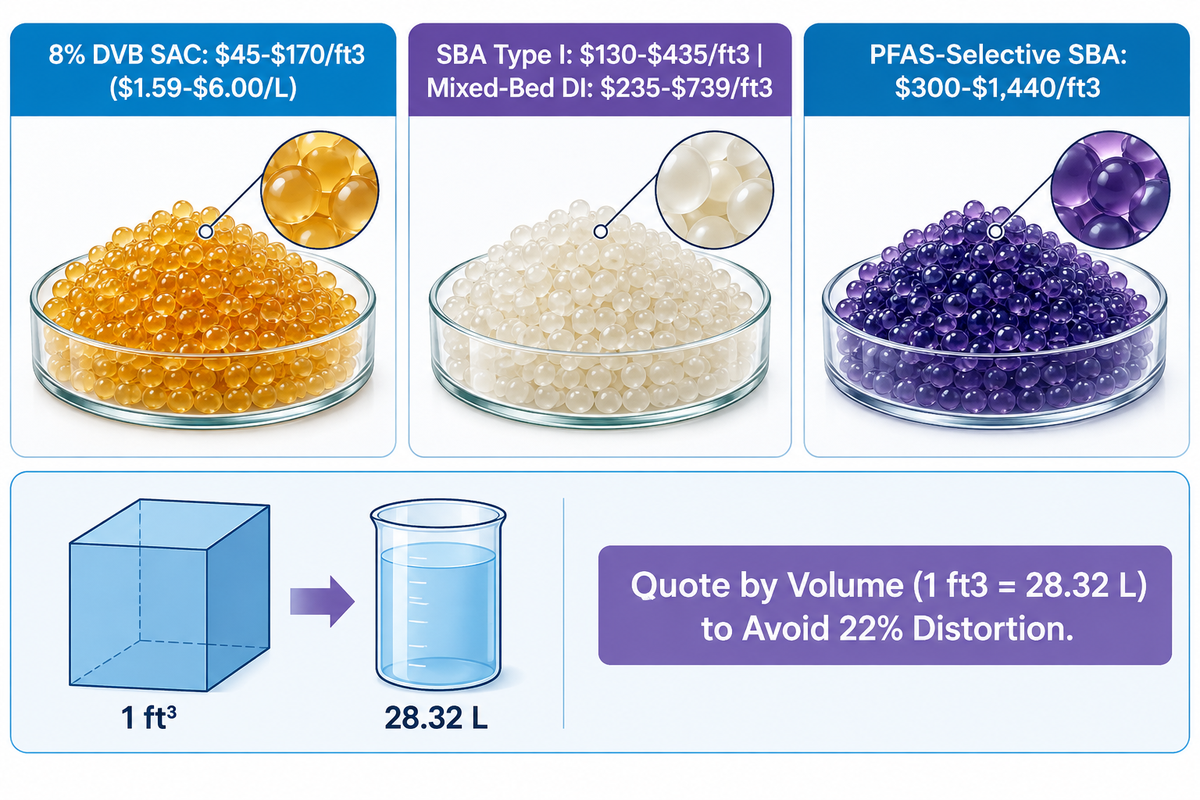
In 2026 benchmarks from SAMCO Technologies and Serv-A-Pure, standard 8% DVB SAC softener resin costs $45 to $170 per ft³ ($1.59 to $6.00/L, or $1.98 to $7.50/kg at 800 g/L). Strong base anion Type I gel resin runs $130 to $435 per ft³ ($4.59 to $15.36/L). Mixed-bed DI resin runs $235 to $739 per ft³, and PFAS-selective resin runs $300 to $1,440 per ft³.
Comparing quotes solely by $/kg instead of $/L or $/ft³ distorts resin costs by up to 22%. Vessels are loaded by volume (1 ft³ = 28.32 L), yet resin grades with different salt and water contents have different densities. Moist SAC cation resin is 800 to 850 g/L (50 to 53 lb/ft³). Some moist SBA anion and PFAS products have wet bulk densities of 670 to 720 g/L (42 to 45 lb/ft³). Our 9-Grade Ion Exchange Resin Pricing & Brand Cross-Reference Matrix below standardizes all nine grades across volume, weight, density, and global brands.
| Resin Grade | Wet Density | Price ($/ft³) | Price ($/L) | Price ($/kg) | Representative Brand Cross-Reference |
|---|---|---|---|---|---|
| 1. Standard 8% DVB SAC (Na+) | 800 g/L (50 lb/ft³) | $45–$170 | $1.59–$6.00 | $1.98–$7.50 | AmberLite HPR1100 Na, Purolite C100E, Lewatit S100, ResinTech CG8, Diaion SK1B, INDION 225 Na |
| 2. High-Crosslink 10% DVB SAC | 830 g/L (52 lb/ft³) | $75–$200 | $2.65–$7.06 | $3.19–$8.51 | AmberLite HPR1200, Purolite C100x10, Lewatit S1567, ResinTech CG10 |
| 3. Weak Acid Cation (WAC) | 760 g/L (47 lb/ft³) | $110–$220 | $3.88–$7.77 | $5.11–$10.22 | AmberLite IRC86 / HPR8300, Purolite C104Plus, Lewatit CNP80, ResinTech WACMP, Diaion WK10 |
| 4. SBA Type I Gel (Cl−) | 700 g/L (44 lb/ft³) | $130–$435 | $4.59–$15.36 | $6.56–$21.94 | AmberLite HPR4800 / IRA402, Purolite A400, Lewatit M500, ResinTech SBG1, Diaion SA10A, INDION GS 300 |
| 5. SBA Type II Gel (Cl−) | 700 g/L (44 lb/ft³) | $145–$460 | $5.12–$16.24 | $7.31–$23.20 | AmberLite IRA410, Purolite A300, Lewatit M600, ResinTech SBG2, Diaion SA20A |
| 6. Weak Base Anion (WBA) | 680 g/L (42 lb/ft³) | $135–$390 | $4.77–$13.77 | $7.01–$20.25 | AmberLite IRA96 / HPR9600, Purolite A100, Lewatit MP62, ResinTech WBMP, Diaion WA30 |
| 7. Mixed-Bed DI (40:60 H+/OH−) | 710 g/L (44 lb/ft³) | $235–$739 | $8.30–$26.10 | $11.69–$36.76 | AmberLite MB20, Purolite MB400, Lewatit NM60, ResinTech MBD-10, Diaion SMNUP |
| 8. Chelating Heavy-Metal Resin | 720 g/L (45 lb/ft³) | $280–$850 | $9.89–$30.02 | $13.74–$41.69 | AmberLite IRC748, Purolite S930Plus, Lewatit TP 207, ResinTech SIR-300 |
| 9. PFAS-Selective SBA Resin | 680 g/L (42 lb/ft³) | $300–$1,440 | $10.59–$50.85 | $15.57–$74.78 | AmberLite PSR2 Plus, Purolite PFA694E, ResinTech SIR-110-HP |
Low figures reflect multi-pallet wholesale orders (25 L bags or 1,000 L supersacks). Industrial resins are also shipped with lot-specific Certificates of Analysis (COA) verifying the ASTM D2187 moisture retention, whole-bead counts (≥95%), and salt-splitting capacity.
7-Parameter Industrial Ion Exchange Resin RFQ Checklist
- Raw water ion analysis: List Ca2+, Mg2+, Na+, HCO3−, Cl−, SO42−, SiO2, TOC, Fe/Mn, pH, and free chlorine (mg/L).
- Effluent water quality target: Define max hardness (<1 mg/L), conductivity (μS/cm), reactive silica (<20 ppb), or PFAS/nitrate limits.
- Polymer and cross-link grade: state gel vs. macroporous, styrene-DVB (8% vs. 10%) vs. polyacrylic, and Gaussian vs. UPS bead size.
- Ionic form & wet density: Confirm Na+ vs. H+ (cation) and Cl− vs. OH− (anion) with volume pricing ($/L or $/ft³).
- Temperature & regeneration mode: State maximum continuous contact with water (°C), co-flow vs. counter-flow packed bed, and regenerant chemistry.
- Mandatory certifications: Request NSF/ANSI/CAN 61, FDA 21 CFR 173.25 food-contact compliance, and lot-specific ASTM D2187 COA.
- Downstream integration: align resin volume with RO pretreatment and bottling speed; see our mineral and purified water bottling line buyer evaluation checklist
Frequently Asked Questions
How long does ion exchange resin last before it needs replacement?
In pretreated systems with free chlorine less than 0.1 mg/L, Strong Acid Cation (SAC) softening resin is effective for 7 to 10 years. In low-oxidant industrial plants, SAC beds can last up to 15 years. Strong Base Anion (SBA) demineralization resin, on the other hand, typically lasts for 3 to 6 years. Thermal Hofmann degradation occurs gradually on quaternary ammonium groups. Over time, humic substances can also become irreversibly bound to the resin.
Is cation exchange resin positively or negatively charged?
Cation exchange resin has functional groups attached to its polymer matrix that provide negatively charged exchange sites. Strong acid grades carry negatively charged sulfonate (−SO3−) sites, while weak acid grades carry carboxylate (−COO−) sites. These fixed negative sites attract and hold mobile positively charged cations (Na+, H+, Ca2+, Mg2+). On the other hand, strong-base anion exchange resin has permanently charged quaternary ammonium groups that bind negatively charged anions, while weak-base anion resin develops positively charged sites when its amine groups are protonated.
Who is the CEO of Ion Exchange (India) Ltd, and who are the top global resin manufacturers?
Rajesh Sharma is the Executive Chairman of Ion Exchange (India) Ltd, the manufacturer of INDION resins. Indraneel Dutt is the Managing Director and CEO. Worldwide, leading industrial ion exchange resin producers are DuPont Water Solutions (AmberLite), Ecolab / Purolite, LANXESS (Lewatit), and Mitsubishi Chemical (Diaion). Other important producers are ResinTech, Thermax (Tulsion), Samyang (TRILITE) and Sunresin (Seplite).
Does unused ion exchange resin expire in storage?
Sealed ion exchange resin has a warehouse shelf life of 2 to 5 years if stored between 5 °C and 40 °C in original moisture-barrier bags. Never allow beads to freeze or dehydrate.
How do you safely rehydrate dried ion exchange resin without shattering the beads?
Never pour tap or deionized water directly onto dry ion exchange resin. Rapid osmotic water uptake causes swelling and shatters cross-linked polymer beads. To rehydrate dry resin safely, soak the beads in a 20% to 25% saturated sodium chloride brine solution for 2 to 4 hours. Drain half the brine, dilute to 10% NaCl for 1 hour, and then flush with fresh water before standard regeneration.
Is food-grade ion exchange resin toxic or safe for drinking water?
NSF/ANSI/CAN 61 certification addresses drinking-water contact health effects, NSF/ANSI 44 covers residential cation-exchange water softeners, and US FDA 21 CFR 173.25 regulates ion-exchange resins used in treating food and aqueous beverages, including extractives limits and pretreatment requirements.
References & Sources
- U.S. National Archives / Food and Drug Administration (FDA). Electronic Code of Federal Regulations: 21 CFR § 173.25 – Ion-Exchange Resins (Secondary Direct Food Additives). https://www.ecfr.gov/current/title-21/chapter-I/subchapter-B/part-173/subpart-A/section-173.25.
- U.S. National Archives/Food and Drug Administration (FDA). Electronic Code of Federal Regulations: 21 CFR § 165.110 – Bottled Water Standards of Identity and Quality. Available at: https://www.ecfr.gov/current/title-21/chapter-I/subchapter-B/part-165/subpart-B/section-165.110
- U.S. Environmental Protection Agency (EPA). “Final PFAS National Primary Drinking Water Regulation and Overview of Drinking Water Treatment Technologies.” (https://www.epa.gov/sdwa/and-polyfluoroalkyl-substances-pfas)
- United States Patent and Trademark Office (USPTO). Patent US2366007A: Production of synthetic polymeric compositions comprising sulphonated polymerizates of poly-vinyl aryl compounds (Gaetano F. D’Alelio, General Electric Co., Granted Dec 26, 1944). Available at: https://patents.google.com/patent/US2366007A/en
- United States Patent and Trademark Office (USPTO). Patent US2591573A: Resinous insoluble reaction products of tertiary amines with haloalkylated vinyl aromatic hydrocarbon copolymers (Charles H. McBurney, Rohm & Haas Co., Granted Apr 1, 1952). Available at: https://patents.google.com/patent/US2591573A/en
- Veolia Water Technologies. Handbook of Industrial Water Treatment – Chapter 08: Ion Exchange, Water Demineralization & Resin Testing. Available at: https://www.watertechnologies.com/handbook/chapter-08-ion-exchange
- DuPont Water Solutions. Ion Exchange Fundamentals (TechFact 45-D01462), Recommended Operating Conditions for Separate Beds (45-D01131), and Oxidation Stability (45-D01457). Available at: https://www.dupont.com/water/technologies/ion-exchange-ix.html
- ASTM International. ASTM D2187-17: Standard Test Methods for Physical and Chemical Properties of Particulate Ion-Exchange Resins. https://www.astm.org/d2187-17.html
- University of Nebraska-Lincoln Extension & Penn State Extension. Drinking Water Treatment: Water Softening (NebGuide G1491 & G1714) and Penn State Water Softening Guide. Available at: https://extensionpubs.unl.edu/publication/g1491/na/html/view
- NSF International. NSF/ANSI Standard 61: Drinking Water System Components, Health Effects Scope. https://www.nsf.org/knowledge-library/nsf-ansi-standard-61-drinking-water-system-components-health-effects
WHY WE WRITE THIS
MassTechX publishes practical engineering guides for beverage producers, plant owners, procurement teams, and packaging line buyers who need to compare filling, blowing, labeling, water treatment, and end-of-line equipment with less guesswork. Our goal is to explain the real production constraints behind capacity, liquid type, container format, hygiene requirements, spare parts, and after-sales service before a buyer commits to a bottling line.
ABOUT OUR BUSINESS
Mass Technology is a Zhangjiagang-based beverage filling machine manufacturer in Jiangsu, China. We design and manufacture complete bottling line solutions for water, carbonated drinks, juice, beer, wine, cans, bottle blowing, bottle labeling, water treatment, and related packaging systems. Our published equipment range covers 2,000–36,000 BPH production lines, with deployment experience across 60+ countries.
OUR SERVICES
We support buyers through plant layout design, equipment selection, manufacturing, factory acceptance testing, shipping coordination, on-site installation, operator training, and long-term after-sales service. MassTechX projects are supported by a 2-year warranty, 24-hour engineer response, and 5-working-day international spare parts dispatch commitment.
DATA MATRIX // MANUFACTURER PROFILE
NAMEMass Technology Engineering Team
ROLEBeverage Filling Line Manufacturer
BRAND NAMEMassTechX / Mass Technology
COMPANYZhangjiagang Mass Technology Co., Ltd.
LOCATIONZhangjiagang, Jiangsu, China
CAPACITY RANGE2,000–36,000 BPH
PRODUCT RANGEWater Filling, CSD Filling, Juice Filling, Beer Filling, Wine Filling, Can Filling, Bottle Blowing, Bottle Labeling, Water Treatment
GLOBAL REACH60+ Countries
WARRANTY2 Years
SERVICE SLA24-Hour Engineer Response / 5-Working-Day Spare Parts Dispatch
WEBSITEmasstechx.com
Related Posts
Trending now