Get in Touch with Masstech
A Plant Guide to 5 Gallon Water Bottle High Pressure Washers

Contents
show
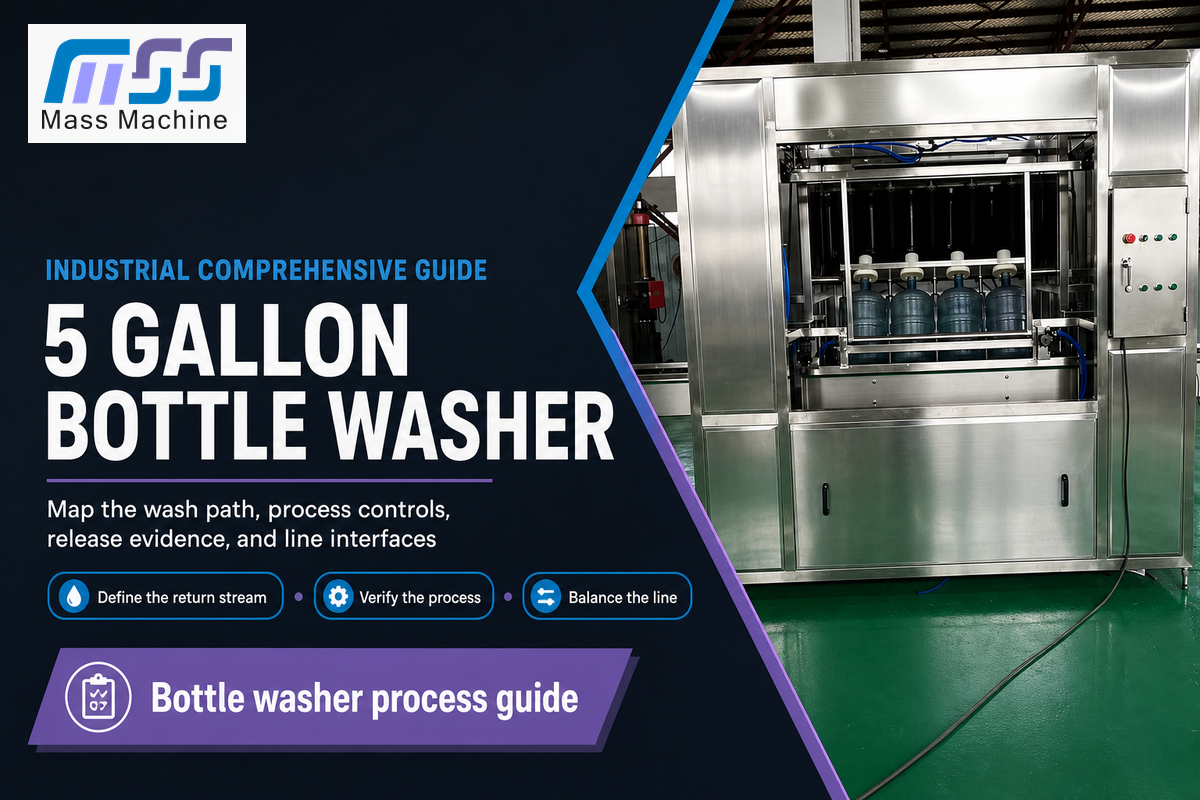
A 5 gallon water bottle high pressure washer is industrial equipment for washing returnable large-format water bottles before refilling. It is not a consumer pressure washer that draws water from a bucket. One useful buying question is not “How much pressure?” but “Which bottle conditions, process controls, evidence, and line interfaces must this system handle?”
This guide owns the educational decision: terminology, stages, controls, bottle routing, line balance, release evidence, troubleshooting, and request-for-quotation preparation. Commercial configurations and project inquiry remain on the separate MassTech solution page.
What Is a 5 Gallon Water Bottle High Pressure Washer?
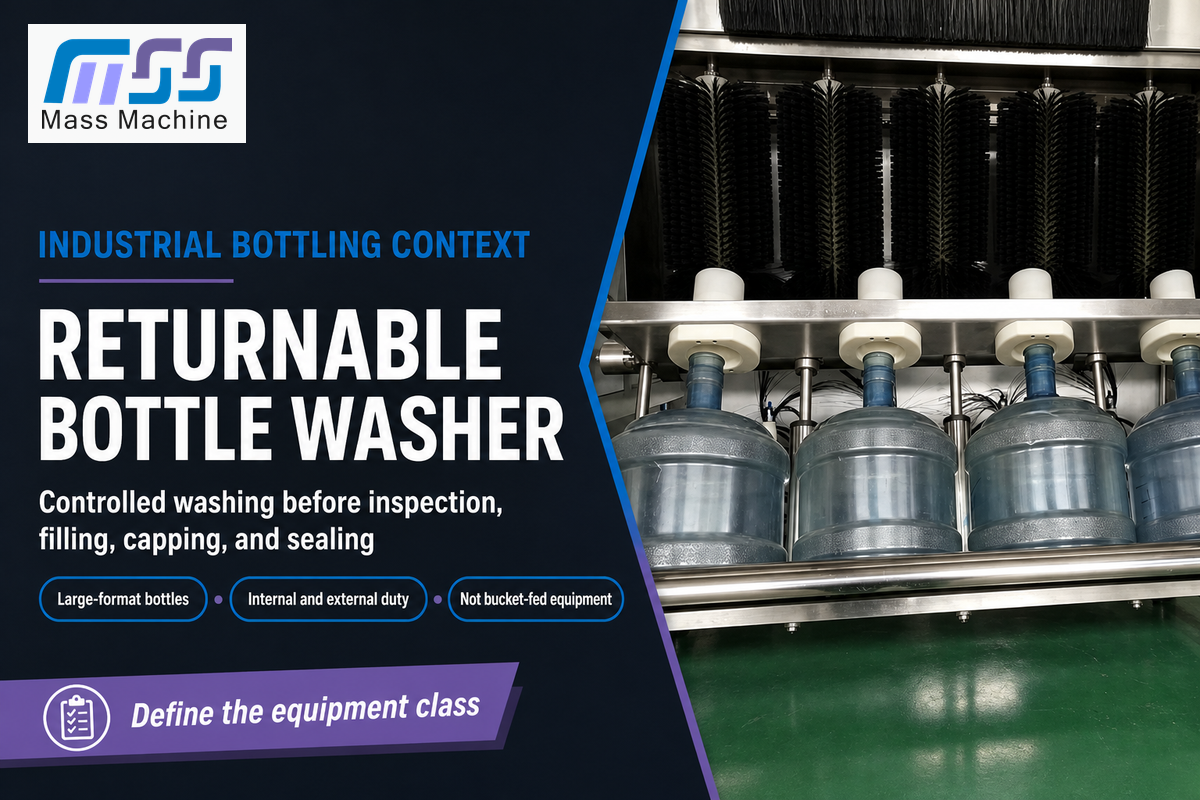
The short answer: An industrial 5 gallon bottle washer directs controlled jets and, depending on the system, other cleaning or sanitizing stages at the inside and outside of returnable bottles. It prepares accepted containers for inspection and filling. “High pressure” describes one mechanism; it does not, by itself, prove cleanliness or sanitation.
This phrase is unusually ambiguous. Retail search results often show portable pressure washers supplied by a five-gallon bucket. By contrast, a bottling plant means a machine or integrated line intended for large returnable containers commonly sold as 5 gallon, 18.9 L, or 20 L bottles. Because the washer sits inside a food-processing line, applicable FDA duties and the plant’s hazard controls—not the product label—define acceptable duty.
Those size labels are not a dimensional guarantee. Height, diameter, neck finish, handle, material, and deformation can vary. Confirm the actual drawing and samples rather than assume every “5 gallon” container will travel, invert, drain, or transfer alike.
Buyer shorthand can blur the same industrial duty into washing machine, bottle washing, water bottle washer, bottle cleaning, or 5-gallon bottle washer. Awkward searches such as “high pressure 5 gallon” and “washer 5 gallon” are query labels, not separate equipment classes. In practice, a 5 gallon container may also be described as a 5 gallon plastic bottle or a 20 liter bottle, yet those labels still do not define geometry or material. For that reason, gallon bottle washing requirements should begin with controlled bottle families and samples.
Why More Pressure Does Not Automatically Mean a Cleaner Bottle
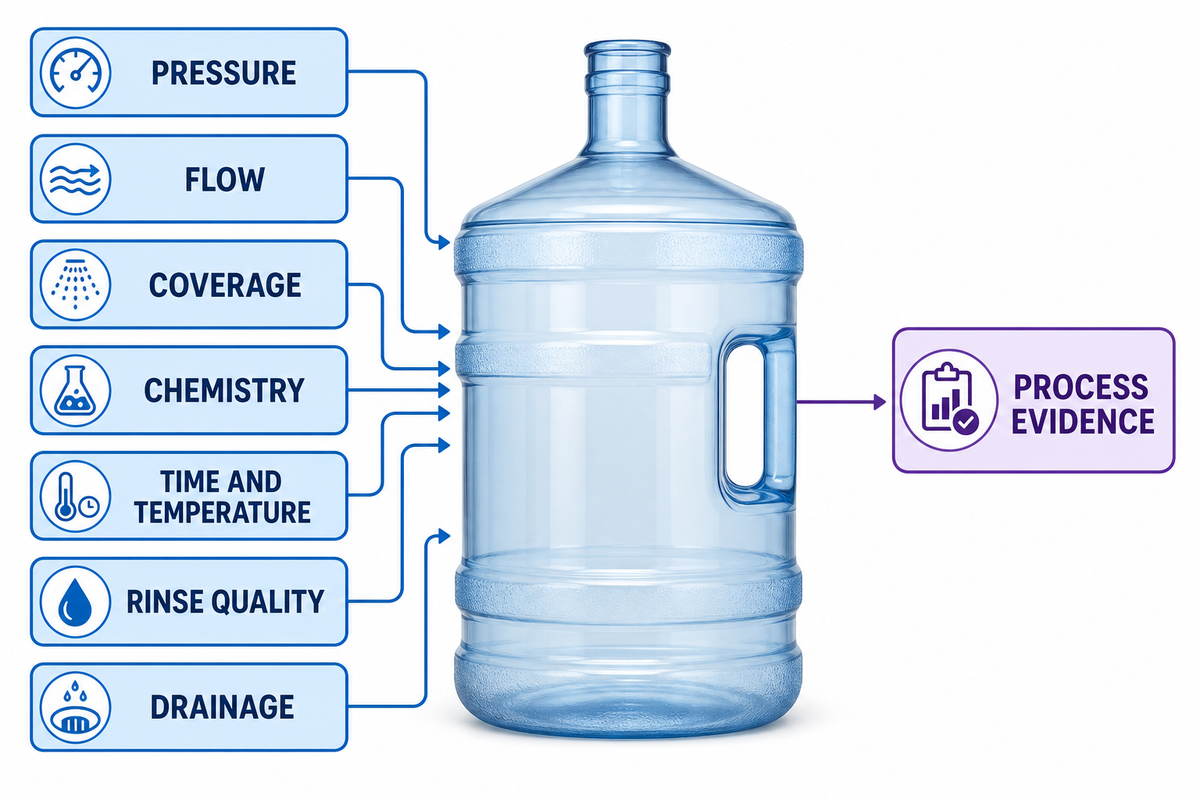
Pressure can help deliver mechanical action, but it cannot answer whether the jet reached every internal surface, whether flow was adequate, whether the soil responded to the selected chemistry, or whether time, temperature, rinse quality, and drainage matched the plant’s process. Cleaning performance is a coordinated system, not a pressure gauge reading. Because coverage can fail behind shoulders or handles, EHEDG’s public validation scope supports verifying a defined process instead of treating one setpoint as the result.
PROCECO’s technical explanation connects pressure with flow, spray coverage, nozzle distance, pump power, and machine geometry. That source concerns parts washers, so its numeric examples are not transferred to water bottles. Its physical lesson is still useful: increasing one variable can change several others.
An ISPE article on pharmaceutical glassware washers recommends trials that vary machine speed, pressure, temperature, and container size while checking coverage and outcomes. Pharmaceutical acceptance limits do not apply automatically to bottled water, but the validation logic challenges the same shortcut: a setpoint is not proof.
Practical distinction: pressure is an input. Coverage, residue removal, rinse condition, drainage, inspection, and any required microbiological or chemical result are evidence. Buyers need both the operating window and the method used to show that the intended result was achieved.
How the Five-Stage Bottle Path Works
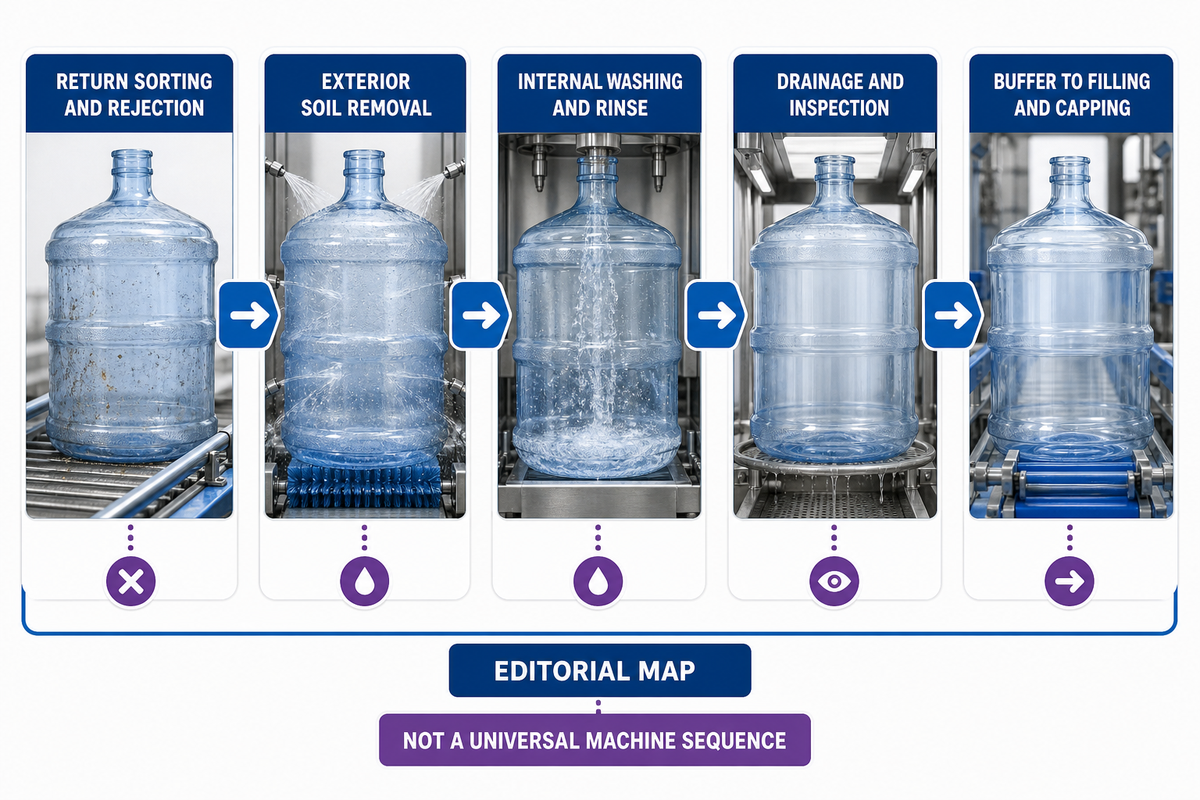
The Five-Stage Bottle Path is an editorial map for locating responsibilities and lost good-bottle output. It is not a universal machine sequence. Some plants combine stages, add separate pre-wash or label-removal equipment, or reject particular bottles before they ever reach the washer.
- Return sorting and rejection: identify wrong bottles, severe damage, foreign objects, unknown residues, odor, or conditions the approved process cannot address.
- Exterior soil removal: manage loose dirt, labels, adhesive, handle-area soil, and body contamination without assuming that exterior appearance represents the bottle interior.
- Internal washing and rinse: invert or position the bottle, deliver the defined stages, and control jet coverage, flow, chemistry, temperature, time, and water quality as applicable.
- Drainage and inspection: allow effective draining, protect cleaned surfaces, identify visible defects or residue, and route bottles to release, rewash, investigation, or rejection.
- Buffer to filling and capping: transfer accepted bottles without uncontrolled delay, recontamination, unstable accumulation, or a control mismatch with the filler and capper.
For United States bottled-water operations, 21 CFR Part 129 is a key public reference. It requires multiservice containers to be washed, rinsed, sanitized, and inspected just before filling, capping, and sealing. Its concrete duties do not make a vendor’s stage diagram universal.
Which Washer Configuration Fits Your Return Stream?
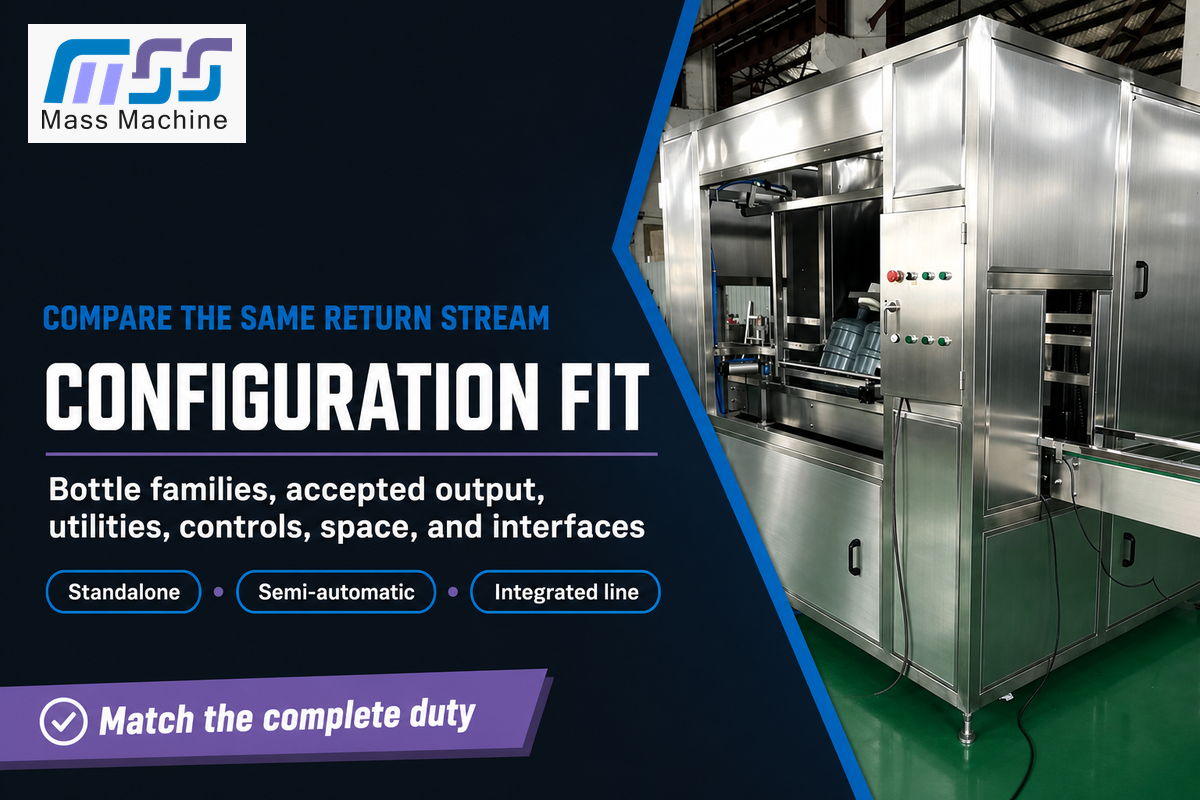
Configuration choice depends on incoming bottle variability, labor, target good-bottle output, available floor space, utilities, controls, and how the washer must communicate with inspection, filling, and capping. Standalone equipment offers separation; an integrated line reduces handling but makes interface assumptions more consequential.
In supplier briefs, a bottling machine quotation may bundle the washer with other bottling equipment, while a water bottling machine brief may cover the whole line. Terms such as automatic 5 gallon bottle system, fully automatic, programmable, and adjustable are incomplete until the supplier identifies which motions, recipes, guides, and interfaces they describe. Compare footprint, reliability, versatility, and precision through drawings, trials, alarms, repeatability evidence, and service access rather than adjectives alone.
| Configuration | When it may fit | Questions to resolve | Hidden risk |
|---|---|---|---|
| Standalone washer | Existing plant has separate inspection, buffering, or filling assets | Transfer method, clean-bottle protection, buffer capacity, and control handoff | Manual or open transfer can break the hygiene chain |
| Semi-automatic system | Lower-volume or variable work where an operator can load, inspect, or move bottles | Ergonomics, cycle consistency, operator protection, and repeatable loading | Labor variation can become process variation |
| Brush-assisted washer | Exterior deposits or labels require contact beyond spray action | Bottle scuffing, brush wear, cleanability, debris control, and changeover | Brush condition may become an unmonitored variable |
| High-pressure internal pre-wash | Accepted bottles need a dedicated soil-removal step before the validated main cycle | Soil scope, containment, drainage, nozzle access, and downstream process ownership | A pre-wash may be mistaken for complete cleaning |
| Integrated washer-filler-capper | One coordinated line is needed for transfer, accumulation, filling, and capping | Good-bottle rate, controls, utilities, reject routes, access, and recovery after stops | A filler or capper constraint can reduce washer output |
How to choose a 5 gallon bottle washer?
Start with representative bottles and a written process requirement. Define accepted and rejected incoming conditions, bottle families, evidence required after washing, sustained good-bottle demand, utilities, floor plan, controls, downstream interfaces, and maintenance access. Then compare quotations against the same duty rather than comparing unrelated stage counts or pressure labels.
How Soil, Labels, and Bottle Damage Change the Cycle
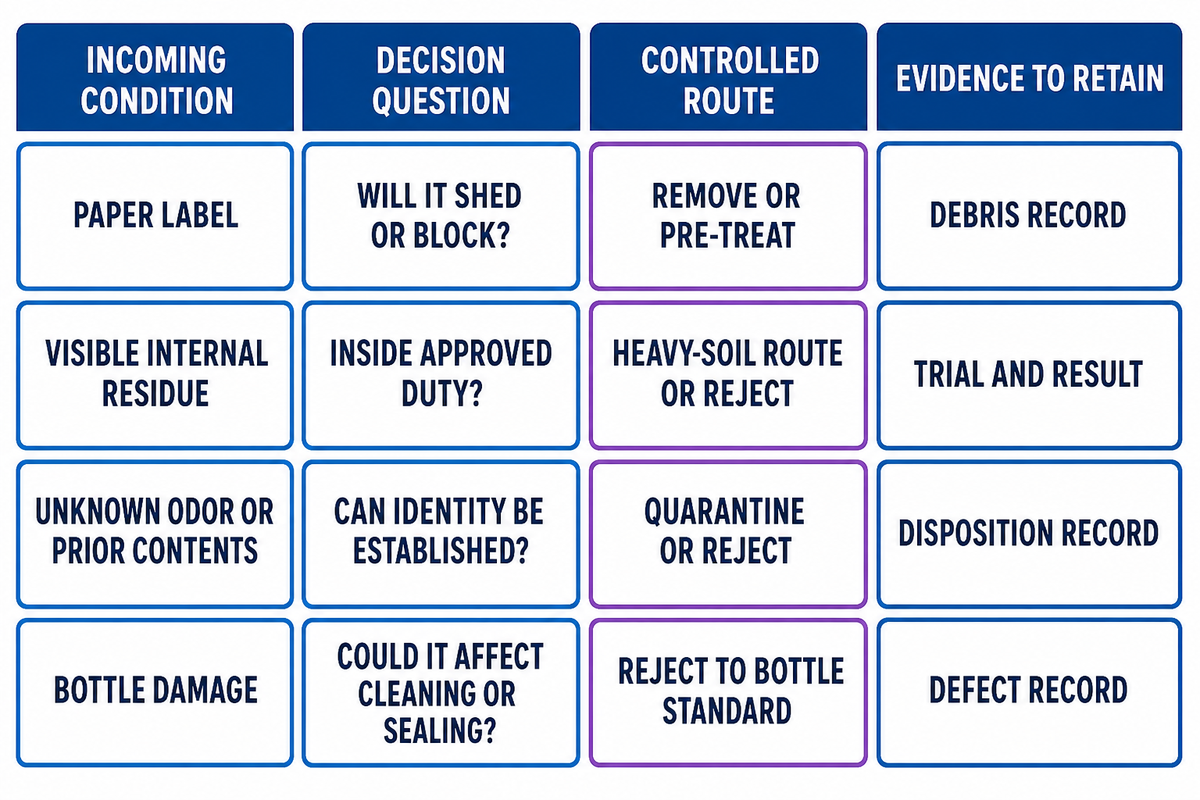
A returned-bottle stream is rarely uniform. The Soil-to-Cycle Decision Matrix turns visible condition and known history into questions for the plant’s approved wash, rewash, investigation, or rejection rules. It deliberately avoids prescribing an unverified chemical concentration, temperature, contact time, or pressure.
A peer-reviewed study of 90 personal reusable bottles found that contamination varied with bottle material, refill frequency, beverage type, and cleaning behavior. It is not an industrial 5-gallon validation study. Its narrow value here is showing why design and use history can change cleanability.
| Incoming condition | Decision question | Possible controlled route | Evidence to retain |
|---|---|---|---|
| Loose dust or light external soil | Is it inside the approved washer duty? | Normal accepted cycle when the plant procedure permits | Representative trial and inspection result |
| Paper label | Will the label fragment, detach, or load filters and drains? | Approved label-removal or pre-treatment stage | Label family, removal result, debris route |
| Film label or stubborn adhesive | Does residue remain after the planned stage? | Qualified pre-treatment, rewash, or rejection | Adhesive sample and acceptance definition |
| Visible internal residue | Is the residue known, compatible, and inside the validated soil challenge? | Approved heavy-soil route or rejection | Soil identity, trial condition, outcome method |
| Unknown odor or unknown prior contents | Can the plant establish identity and safe disposition? | Quarantine and investigation; reject when unresolved | Traceability and disposition record |
| Algae-like film or persistent discoloration | Is it removable, and how will the result be demonstrated? | Validated challenge route, rewash, or rejection | Before-and-after evidence and test method |
| Crack, deep scratch, deformation, or damaged neck | Can it compromise cleaning, drainage, transport, filling, or sealing? | Reject according to the bottle standard | Defect type, limit, and reject record |
| Mixed bottle dimensions | Can transport, inversion, nozzles, seals, and guides handle every family? | Controlled changeover or family-specific route | Drawing, sample, change parts, setup record |
| Clean-looking return | Does appearance hide history or internal risk? | Normal approved process, not an inspection-only release | Process record and release evidence |
Do not force an unknown bottle through a familiar recipe. An unidentified chemical, oil, foreign object, hazardous residue, or damaged container needs a controlled disposition. “The washer is high pressure” is not a hazard assessment.
Which Seven Process Controls Should the Plant Verify?
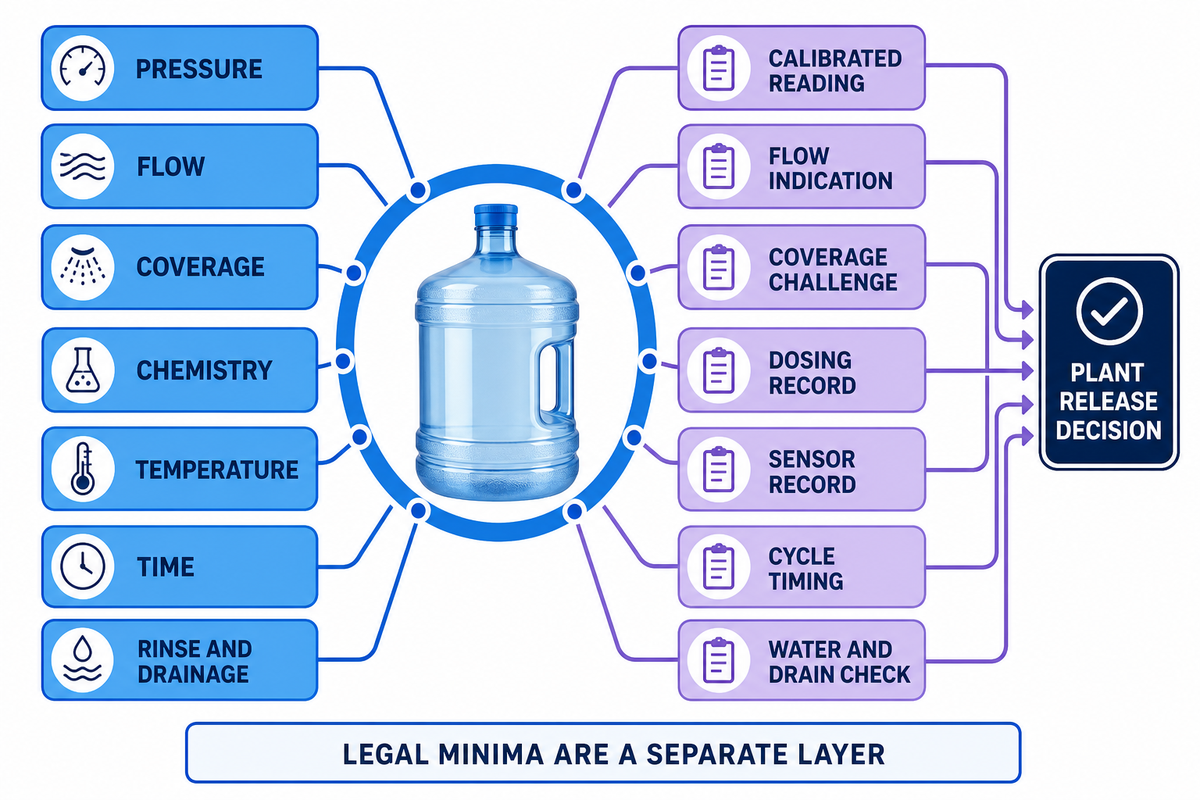
The Seven-Control Verification Map separates variables that are often collapsed into one sales claim. Each control needs an owner, operating evidence, an allowable response to drift, and a connection to the plant’s release decision. In a regional water plant, one owner may monitor utilities while another releases bottles; the map makes that handoff reviewable. The map is an editorial framework, not a regulation or MassTech-owned validation model.
| Control | Question it answers | Example evidence | What it cannot prove alone |
|---|---|---|---|
| Pressure | Was the intended pressure available at the relevant point? | Calibrated reading, alarm, trend, or test record | Complete internal coverage |
| Flow | Was enough liquid delivered through the circuit? | Flow indication, pump condition, nozzle check | Correct chemistry or contact time |
| Coverage | Did the spray reach the defined bottle surfaces? | Qualified coverage challenge and bottle-family trial | Microbiological or chemical acceptance |
| Chemistry | Was the approved agent present in the intended operating window? | Dosing record, concentration method, replenishment control | Temperature, exposure time, or rinse removal |
| Temperature | Did the process reach and hold the defined thermal condition where required? | Calibrated sensor record and alarm response | Coverage or soil compatibility |
| Time | Did each relevant stage provide the defined exposure? | Cycle timing, line-speed relationship, stop/restart logic | Correct pressure, flow, or chemistry |
| Rinse and drainage | Was the final-rinse condition controlled and could the bottle drain and remain protected? | Water-quality evidence, drain check, inspection, protected transfer | The entire plant release decision |
Applicable legal minima are a separate layer from equipment settings. Part 129 includes specific minimum conditions for certain sanitizing methods as well as testing and record duties. Before defining an operating window, the plant should verify the current rule, its market, bottle material, hazard analysis, and any state or customer requirements.
Cleaning solution selection belongs to the approved process, not to a generic washer claim. Equipment that can wash bottles still needs a qualified stage sequence, and calling one station a rinser does not prove final-rinse quality. Heavy-duty construction and resistant materials should likewise be tied to the actual chemistry, temperature, cleaning method, and inspection plan.
If final-rinse or process-water design is still open, review the broader water treatment system context with the responsible water-quality team. A washer cannot correct an undefined water specification by adding pressure.
How to Balance Washer Throughput With Filling and Capping
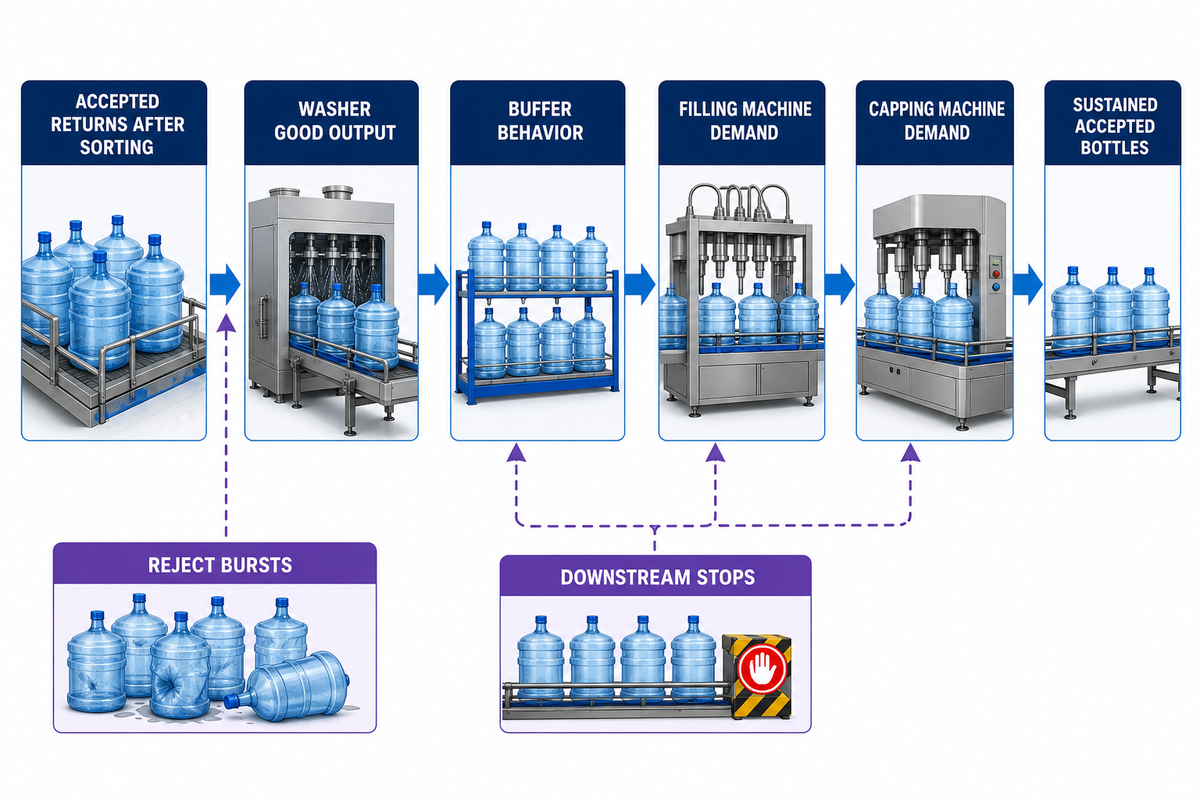
Size the line around sustained accepted bottles, not a nameplate rate in isolation. Returned-bottle sorting, rejects, changeovers, recovery after stops, buffer behavior, filler demand, cap supply, and downstream discharge can all lower good-bottle output even when the washer itself reaches its stated mechanical speed. Buffer risk rises because reject bursts and downstream stops can leave the washer starved or blocked while its controls report normal speed.
In drinking water and mineral water operations, bottle water production is sometimes used as shorthand for the complete production line. That wording can hide separate constraints in gallon bottle filling, bottle water filling, washing, conveying, and the capping machine. Likewise, “5 gallon bottle water filling” or “gallon bottle water filling machine” may describe a downstream scope rather than washer performance. Model accepted output and labor costs at each interface before combining those scopes in one rate claim.
A Packworld returnable-glass case shows that sorting and multi-supplier integration can constrain the line. Its numbers are not transferred. Map every handoff before accepting a bottles-per-hour efficiency claim.
Input rateAccepted return bottles available after sorting, not the total number unloaded.
Washer good outputBottles released after wash, drain, inspection, rewash, and reject decisions.
Buffer behaviorAccumulation capacity, protection, first-in/first-out logic, and response during a downstream stop.
Downstream demandWhat the filler and capper can accept during normal operation, recovery, and changeover.
For downstream equipment context, compare the dedicated 5 gallon water filling machine page and the wider water filling machine portfolio. Those pages own filling-line capability; this guide keeps the discussion at the interface and evidence level.
What is the main difference between a standalone washer and an integrated line?
A standalone washer creates a defined boundary that the plant must bridge with transfer, buffering, controls, and clean-bottle protection. An integrated line coordinates more of those functions within one system, but it also ties washer performance to filler, capper, conveyor, utility, and control assumptions. Neither is automatically better.
How Should Quality Teams Validate Bottle Release?
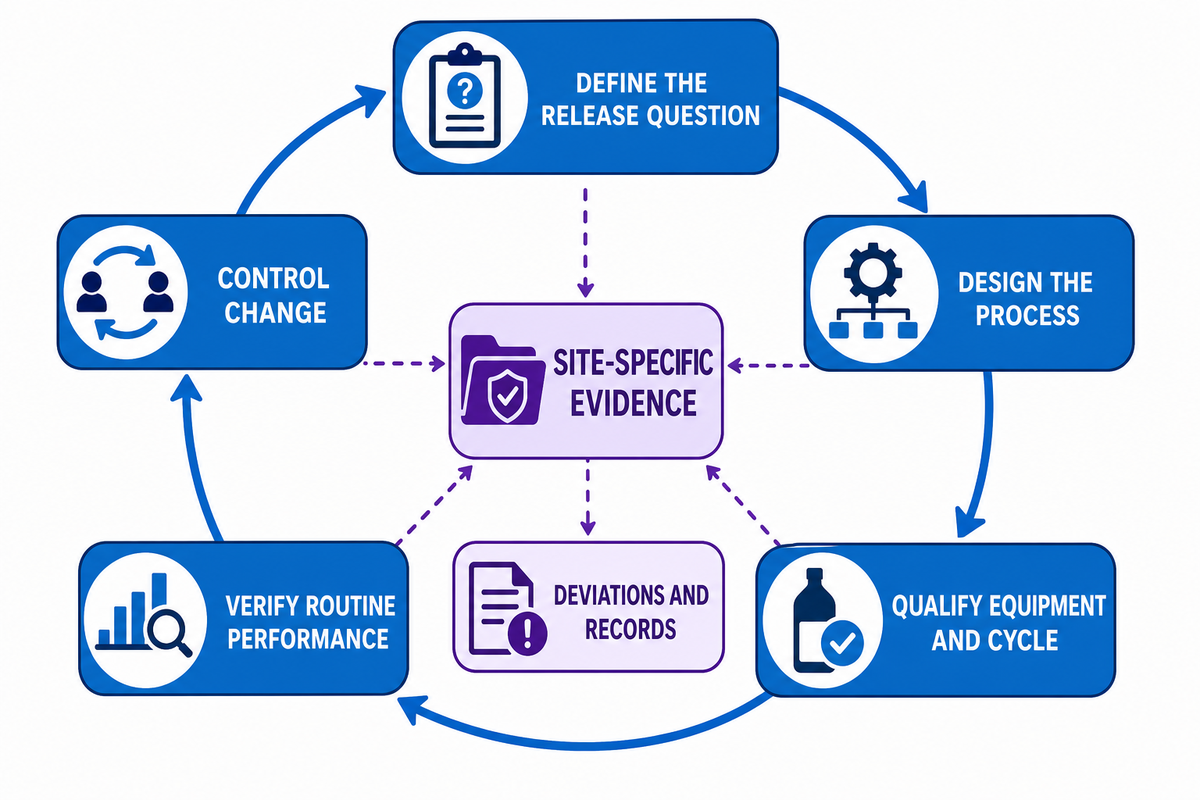
A release plan should connect the plant’s hazards and acceptance criteria to observable bottle condition, controlled process parameters, challenge evidence, test results, deviations, and records. Visual inspection matters, but it cannot universally replace coverage, process, rinse, or outcome evidence required by the applicable plant and market.
- Define the release question: specify the bottle family, incoming condition, intended next step, applicable requirements, and what “acceptable” means.
- Design the process: document the stages, critical inputs, utilities, alarms, sampling, rewash and reject logic, and protection after sanitizing.
- Qualify the equipment and cycle: challenge representative bottle families and worst-condition accepted samples using approved methods.
- Verify routine performance: review operating records, deviations, maintenance, calibration, inspection, and applicable testing over time.
- Control change: reassess bottle geometry, labels, soil, chemistry, utilities, nozzles, speed, software, and downstream interfaces when they change.
Public scope for EHEDG Guideline 45 distinguishes cleaning validation, monitoring, and verification and treats validation as site-specific. Paid guideline criteria were not accessed or reconstructed. This guide uses only that public scope.
United States compliance boundary: Part 129 does not create a parameter vacuum. Section 129.80 contains concrete minimum conditions for listed sanitizing methods, at least weekly finished-product total-coliform testing, and record retention for at least two years. Other applicable federal, state, customer, or hazard-control requirements may add duties. Confirm the current text with the responsible compliance team.
What Belongs in an RFQ and Factory Acceptance Test?
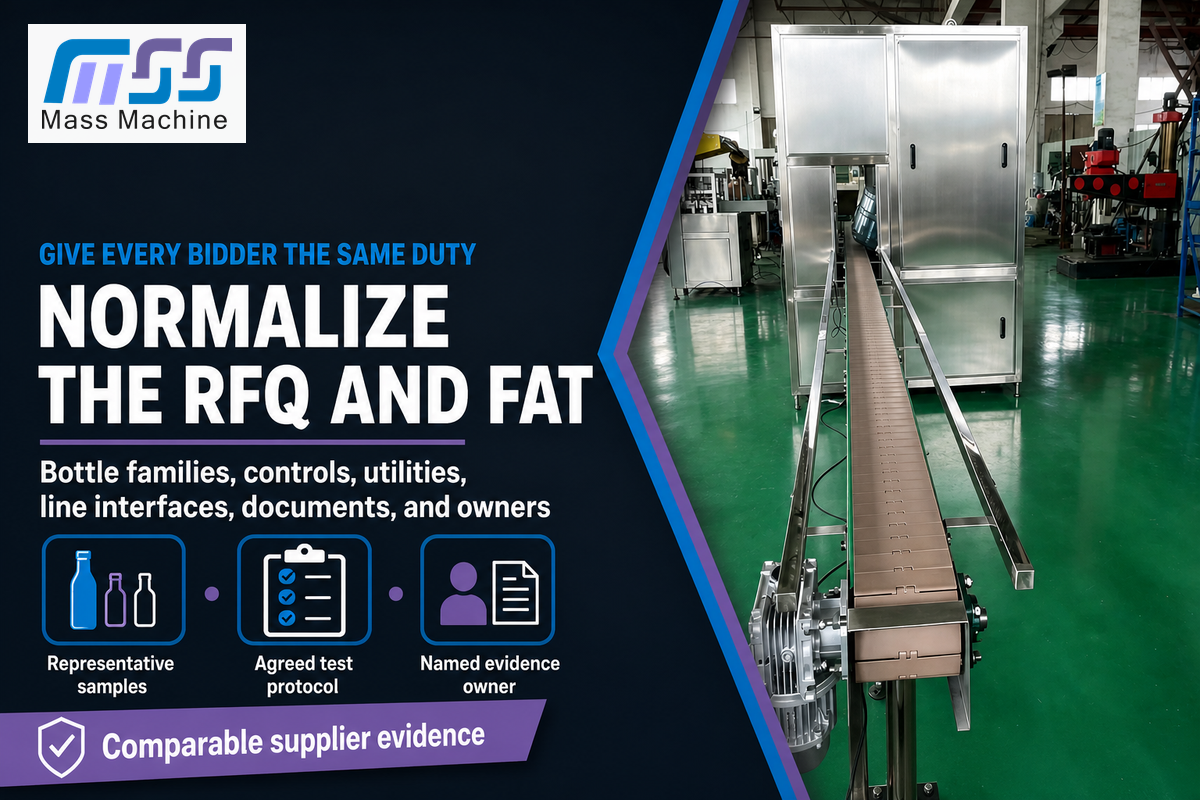
A request for quotation should make every bidder answer the same bottle duty, evidence need, interface, and ownership question. Comparison risk grows because suppliers may define bottle acceptance, utilities, interfaces, and proof differently unless the request fixes those boundaries. A factory acceptance test should then show that the built system matches the agreed design and can run representative bottles through the intended sequence, controls, alarms, rejects, and records.
| Decision row | Request from each supplier | Factory acceptance test evidence | Owner |
|---|---|---|---|
| Bottle families | Drawings, materials, necks, handles, deformation range, and change parts | Run approved samples from every intended family | Process engineering |
| Incoming condition | Accepted soil, labels, defects, exclusions, and reject route | Challenge cleanest, typical, and worst accepted bottles | Quality |
| Process stages | Sequence, recirculation, fresh rinse, drainage, and protection boundaries | Observe the complete sequence and stop/restart behavior | Process engineering |
| Controls | Pressure, flow, coverage, chemistry, temperature, time, rinse, alarms, and records | Challenge sensors, alarms, interlocks, and data capture | Quality and automation |
| Good-bottle output | Rate basis, reject assumptions, changeover, uptime boundary, and buffer | Measure accepted output under the agreed test protocol | Operations |
| Utilities | Water qualities, flows, pressures, power, air, drainage, exhaust, and waste load | Verify connections, ranges, alarms, and drainability | Plant engineering |
| Line interfaces | Conveyors, filler, capper, controls, protocols, accumulation, and reject signals | Simulate upstream and downstream stops and recovery | Automation |
| Cleanability | Stainless steel and other materials, access, drain points, dead areas, nozzle and filter service | Inspect access, drainage, cleaning procedure, and maintenance tasks | Quality and maintenance |
| Documentation | Drawings, manuals, certificates, parts, software backups, calibration, and test protocols | Reconcile delivered documents with the built machine revision | Procurement |
| Service and change control | Response path, spare parts, remote support, training, and change notification | Close deviations and name post-delivery owners | Procurement and maintenance |
After the scorecard is complete, use the 5 gallon water bottle high pressure washer solution page for commercial configuration and engineering inquiry. If filling-machine selection is the unresolved decision, route that work to how to choose a 5 gallon water filling machine instead of duplicating it here.
Which Symptoms Point to Washer Maintenance Problems?
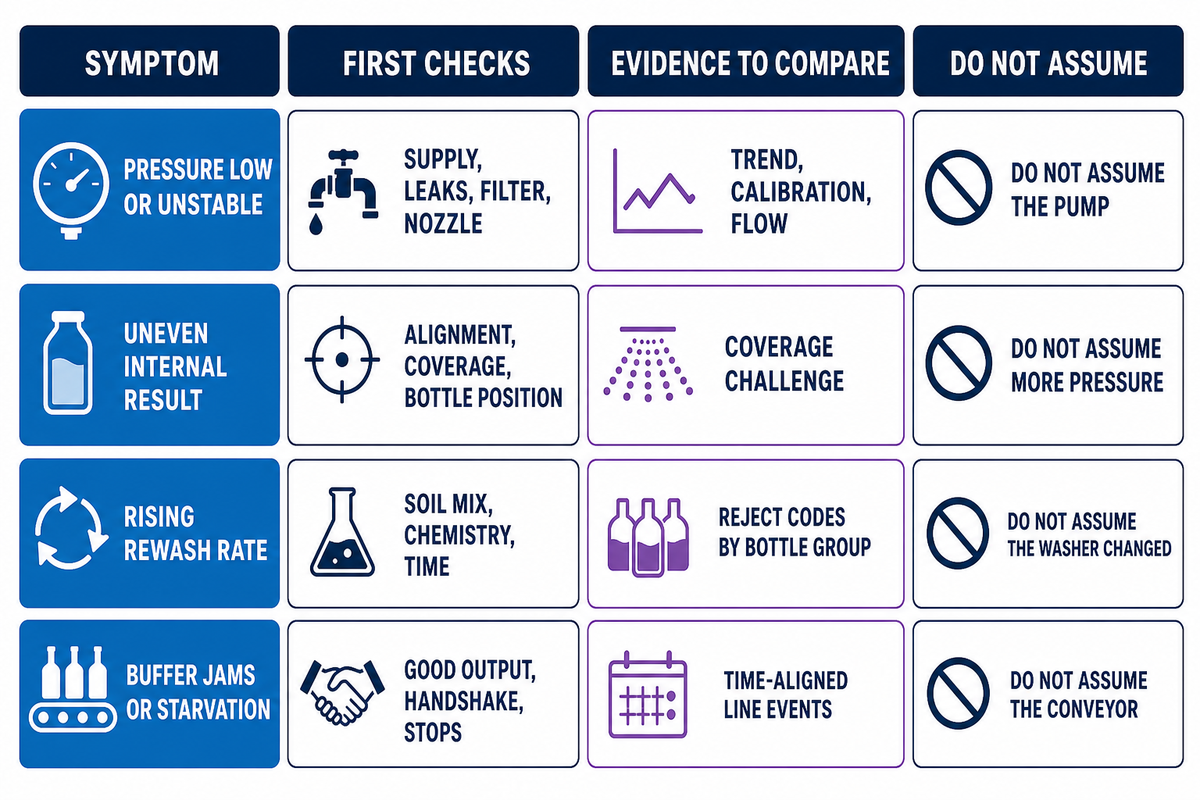
A symptom should start a structured check, not an immediate parts swap. Pressure loss, uneven cleaning, rising rejects, residue carryover, slow drainage, or unstable transfer can originate in the bottle stream, utilities, nozzles, filters, pumps, tanks, dosing, controls, drainage, or downstream equipment.
When guides rotate bottles, the maintenance check should connect motion, bottle position, nozzle alignment, and drainage rather than treating rotation as proof of coverage.
| Symptom | First checks | Evidence to compare | Do not assume |
|---|---|---|---|
| Pressure low or unstable | Supply, leaks, pump, filter, nozzle wear or blockage, valve state | Trend, calibration, flow, maintenance history | The pump is automatically at fault |
| Uneven internal result | Nozzle alignment, motion, coverage, bottle position, family changeover | Coverage challenge and sample pattern | Higher pressure will correct shadowing |
| Rising rewash rate | Incoming soil mix, labels, chemistry, temperature, time, coverage | Reject codes by bottle group and shift | The washer changed without checking returns |
| Visible residue after rinse | Previous stage carryover, rinse condition, flow path, drainage | Stage record, water evidence, bottle inspection | Appearance identifies the chemical |
| Slow drainage | Bottle angle, geometry, guide setup, drain path, air and transfer timing | Family-specific drain observation | All 18.9 L and 20 L bottles drain alike |
| Frequent nozzle blockage | Filtration, debris from labels, scale, tank condition, cleaning procedure | Debris identity, filter differential, service interval | Blockage is random |
| Bottle damage | Guides, grippers, inversion, temperature change, impacts, defective returns | Damage location, bottle family, machine position | Every crack began inside the washer |
| Buffer jams or starvation | Good-output rate, reject bursts, control handshake, downstream stops | Time-aligned washer, conveyor, filler, and capper events | The mechanical conveyor alone is the bottleneck |
Public patent disclosures show that washer concepts may monitor pressure, flow, temperature, chemistry indicators, fluid levels, speeds, nozzle condition, and lance position. Those patents do not prove MassTech ownership, certification, or commercial performance. They simply reinforce why a troubleshooting plan should compare several signals.
When Should You Move From a Standalone Washer to an Integrated Solution?
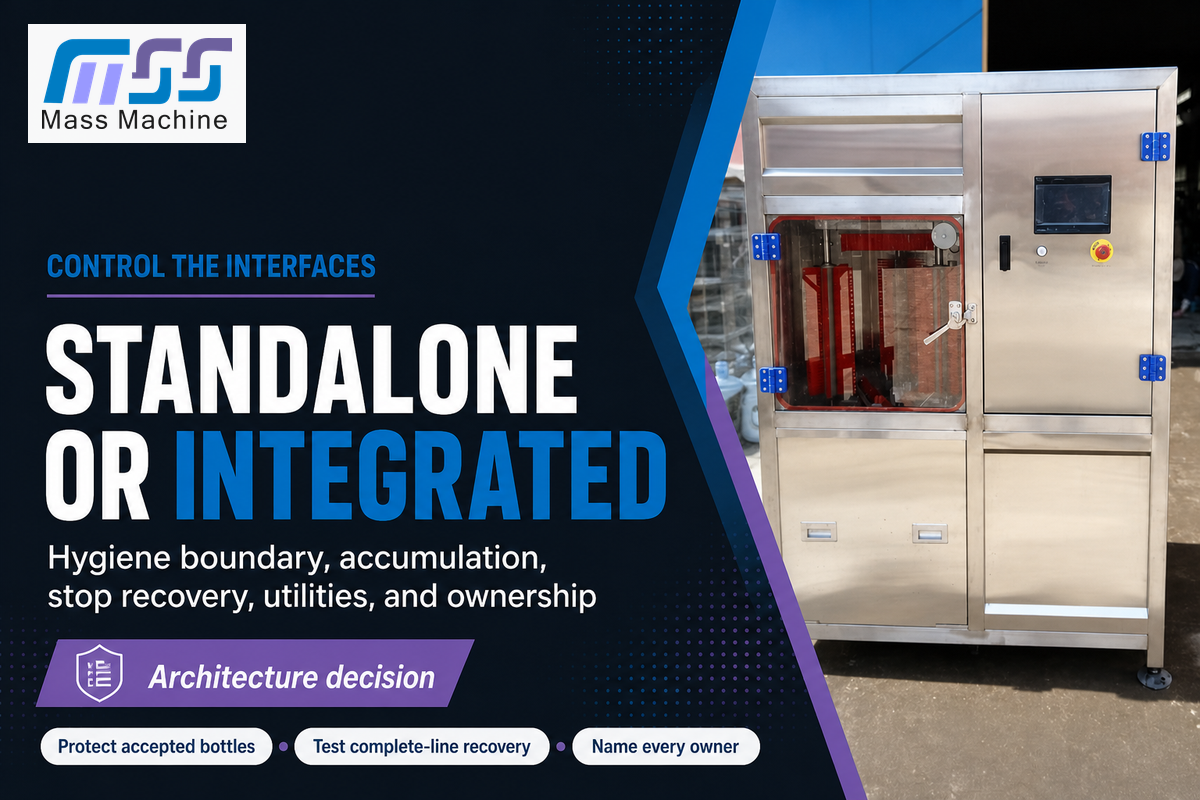
Move toward integration when open transfer, repeated handling, uncontrolled accumulation, incompatible controls, or separate service ownership prevents the plant from protecting accepted bottles and sustaining required output. Interface risk rises because every open transfer or control handoff adds an owner, a recovery path, and a possible hygiene gap. Stay standalone when separation improves flexibility and the interfaces can be controlled, documented, cleaned, maintained, and recovered reliably.
- Confirm who owns the hygiene boundary after the bottle leaves the final wash or sanitizing stage.
- Map protection against recontamination through drainage, accumulation, filling, capping, and sealing.
- Test how the complete line behaves when the washer, filler, capper, or conveyor stops.
- Verify that utilities and drains support simultaneous peak demand, cleaning, and recovery conditions.
- Define which supplier closes an interface fault and how software or component changes are controlled.
A concise overview of the manufacturer’s stated engineering and production background is available on the Mass Technology engineering and manufacturing overview. That first-party page supports company context only. It is not independent evidence that a particular washer meets a plant’s bottle, output, sanitation, or regulatory requirements.
Frequently Asked Questions
Is a 5 gallon water bottle high pressure washer the same as a bucket-fed pressure washer?
No. In an industrial bottling context, the phrase refers to machinery that washes returnable large-format bottles before inspection and refilling. A bucket-fed pressure washer is portable consumer or maintenance equipment that uses a five-gallon container as its water source. The two products solve different problems, use different controls, and should not share the same vendor shortlist or technical specification.
What is the best way to clean a 5-gallon water jug in an industrial plant?
There is no universal cycle for every bottle, soil, material, market, and machine. The plant should define accepted incoming conditions, applicable requirements, process stages, critical controls, rinse and drainage needs, release evidence, rewash logic, and rejection criteria. Representative bottle trials and a controlled factory acceptance test are more defensible than copying an unsupported pressure, temperature, chemical, or time setting from another application.
Is there a machine that washes returnable water bottles?
Yes. Industrial suppliers offer standalone, semi-automatic, brush-assisted, internal pre-wash, and integrated washer-filler-capper configurations. The right choice depends on actual bottle dimensions and materials, incoming condition, required process evidence, sustained good-bottle demand, utilities, floor space, controls, downstream interfaces, and maintenance access. Ask each supplier to test representative bottles and document exclusions.
Can high pressure sanitize a 5-gallon bottle by itself?
No. Pressure is a mechanical input, not a complete sanitation result by definition. Coverage, flow, chemistry, temperature, exposure time, rinse condition, drainage, bottle condition, and applicable requirements may all matter. The approved process and evidence must show the intended result, while deviations require a defined response rather than an operator guess.
What information should a plant send before requesting a washer quote?
Send bottle drawings and samples; material and neck details; labels and typical soil; cleanest, average, and worst accepted returns; target good-bottle demand; reject and rewash rules; required process and release evidence; available water, power, air, drainage, and floor space; filler and capper details; control protocols; preferred automation level; market requirements; and the planned factory acceptance test. Also identify conditions that must be rejected rather than forced through the wash process. Include the current inspection method, downstream stop-and-restart behavior, cleaning records, changeover expectations, and who owns each line interface. Photos alone cannot reveal odor, deformation under handling, internal residue, neck damage, or how a real bottle drains, so representative samples remain important.
Can one machine wash both 18.9 L and 20 L bottles?
Possibly, but the volume label is not enough. Confirm height, diameter, neck finish, handle, material, deformation range, transport guides, grippers, inversion, nozzle position, seals, drainage, and change parts. The supplier should demonstrate every intended bottle family, document the changeover, and identify any bottle that falls outside the approved range and limits.
Turn Bottle Samples into a Reviewable Washer Requirement
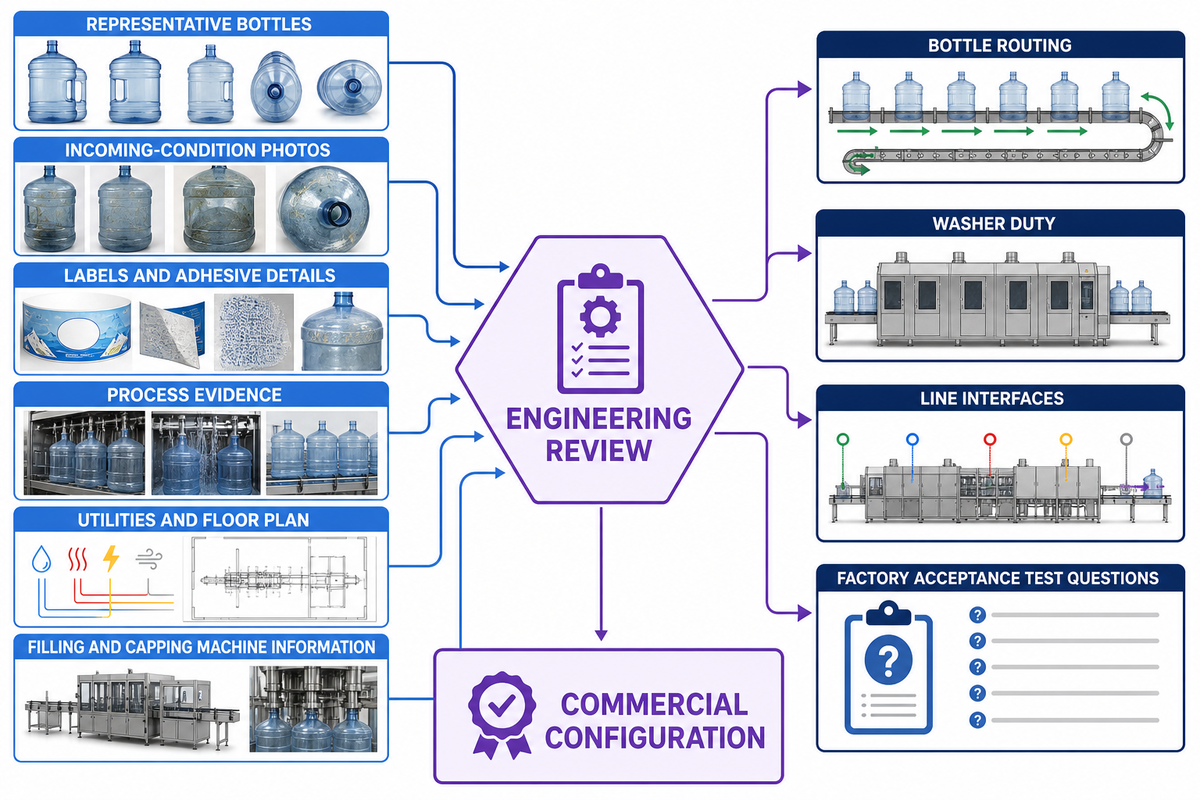
Send MassTech representative bottles, incoming-condition photos, labels and adhesive details, target accepted output, required process evidence, utilities, floor plan, and downstream filler/capper information. For a U.S. bottled-water project, include the applicable Part 129 duties; other markets need their own references. For a regional water plant or beverage producer, this prevents a commercial quote from hiding unresolved bottle and line assumptions. The engineering review can then separate bottle routing, washer duty, line interfaces, and factory acceptance test questions before a commercial configuration is proposed.
References & Sources
- Electronic Code of Federal Regulations, 21 CFR Part 129. Used for United States bottled-water processing, sanitation, testing, record, and container-handling requirements.
- U.S. Food and Drug Administration, Bottled Water Regulatory Information. Used to locate current bottled-water regulatory resources, not as an equipment recipe.
- EHEDG Guideline 45 public catalogue page. Used only for the public scope of site-specific cleaning validation, monitoring, and verification.
- Sun et al., The Cleanliness of Reusable Water Bottles. Personal-bottle study used with an explicit non-industrial scope limitation.
- ISPE, Validation of an Automated Glassware Washer. Used for cross-application lifecycle and factory acceptance test logic; pharmaceutical limits are not transferred.
- PROCECO, Effect of Machine Size, Flow and Pressure in Cleaning. Used for general pressure-flow-coverage interdependence; parts-washer numbers are not transferred.
- Packworld, Optimizing the Sorting and Filling of Returnable Glass. Used for sorting and line-integration context, not transferred performance metrics.
- EP0634230A1 and EP0636427A1. Used as public design disclosures with assignee and legal-status limits, not as MassTech ownership or validation evidence.
Editorial scope: This article is industrial buyer education. It does not replace the current regulation, a plant hazard analysis, a validated cleaning or sanitizing process, laboratory testing, equipment instructions, or professional legal, food-safety, and engineering review.
WHY WE WRITE THIS
MassTechX publishes practical engineering guides for beverage producers, plant owners, procurement teams, and packaging line buyers who need to compare filling, blowing, labeling, water treatment, and end-of-line equipment with less guesswork. Our goal is to explain the real production constraints behind capacity, liquid type, container format, hygiene requirements, spare parts, and after-sales service before a buyer commits to a bottling line.
ABOUT OUR BUSINESS
Mass Technology is a Zhangjiagang-based beverage filling machine manufacturer in Jiangsu, China. We design and manufacture complete bottling line solutions for water, carbonated drinks, juice, beer, wine, cans, bottle blowing, bottle labeling, water treatment, and related packaging systems. Our published equipment range covers 2,000–36,000 BPH production lines, with deployment experience across 60+ countries.
OUR SERVICES
We support buyers through plant layout design, equipment selection, manufacturing, factory acceptance testing, shipping coordination, on-site installation, operator training, and long-term after-sales service. MassTechX projects are supported by a 2-year warranty, 24-hour engineer response, and 5-working-day international spare parts dispatch commitment.
DATA MATRIX // MANUFACTURER PROFILE
NAMEMass Technology Engineering Team
ROLEBeverage Filling Line Manufacturer
BRAND NAMEMassTechX / Mass Technology
COMPANYZhangjiagang Mass Technology Co., Ltd.
LOCATIONZhangjiagang, Jiangsu, China
CAPACITY RANGE2,000–36,000 BPH
PRODUCT RANGEWater Filling, CSD Filling, Juice Filling, Beer Filling, Wine Filling, Can Filling, Bottle Blowing, Bottle Labeling, Water Treatment
GLOBAL REACH60+ Countries
WARRANTY2 Years
SERVICE SLA24-Hour Engineer Response / 5-Working-Day Spare Parts Dispatch
WEBSITEmasstechx.com