Get in Touch with Masstech

A beer filling machine is used to translate the finalized beer into a container, such as bottles, cans, kegs or growlers, while keeping oxygen absorption minimized. It’s no great secret that if you buy a beer filling machine that isn’t compatible with the beer you’re making, you can expect problems with quality, shelf-life and you’ll end up with less beer and wasted resources. This post cover both the world of benchtop and fully automatic in-line filling with all you need to know, such as the specifications, throughput bands, economics, and more.
Quick Specs: Beer Filling Machine at a Glance
| Equipment tiers | 5 (bottling wand/beer gun → counter-pressure bench → semi-auto monoblock → automatic inline filler/seamer → industrial isobaric line) |
| Throughput range | A few units/min (manual) → 2,000–36,000 BPH/CPH (industrial) |
| Formats | Bottle · can · keg · growler/crowler |
| Key quality spec | Dissolved oxygen / total package oxygen (TPO), measured in ppb |
| Price band | ~$50 hand tool → $20k entry canning line → $250k+ inline line |
What a Beer Filling Machine Is, and the 5 Equipment Tiers
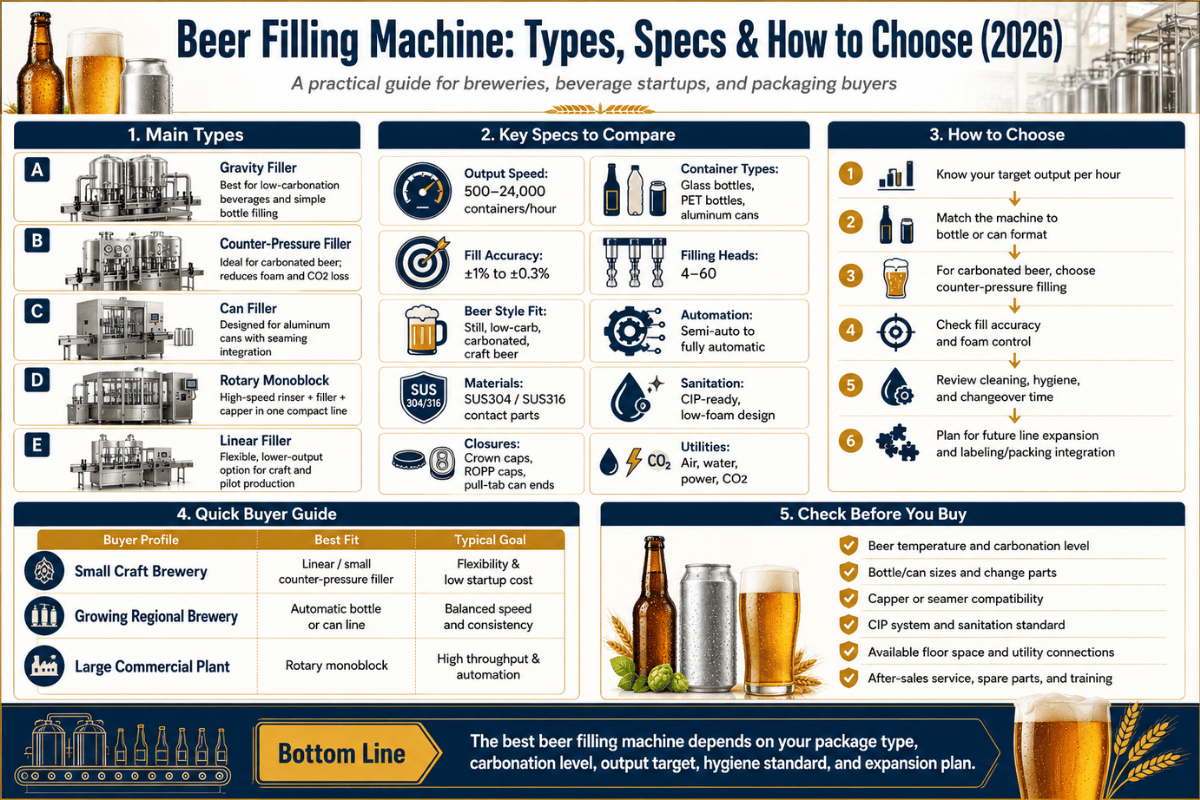
Buying a beer filling machine can take you through so many options, from the roughly $50 bottle filler for the beer enthusiast to a fully automated beer bottle filling line, a stainless-steel unit that rinses, fills and caps thousands of bottles each hour through the same core filling operation.
Whether you call it a beer bottle filler, a filling system or a fully automatic beer bottle line, the underlying filling process is the same, only scale and oxygen control change. To work out which tier you’re at, use the beer filling equipment spectrum below.
| Tier | Typical output | Format | Typical user |
|---|---|---|---|
| 1. Bottling wand / beer gun | ~1–2 bottles/min | Bottle | Homebrewer, R&D batches |
| 2. Counter-pressure bench filler | ~2–6 bottles/min | Bottle, growler | Advanced homebrew, taproom |
| 3. Semi-auto rinse-fill-cap monoblock | ~600–4,000 BPH / 6–25 CPM | Bottle, can | Nano / small brewery |
| 4. Automatic inline filler/seamer | ~25–100 CPM / up to ~12,000 BPH | Can, bottle | Growing production brewery |
| 5. Industrial isobaric line | 2,000–18,000+ BPH/CPH | Bottle, can, keg | Regional / contract packager |
The output rates here are based on craft beverage-equipment specs and Mass Technology beer-line design configuration.
| Machine type | Tier | Format | Typical output | DO control | Indicative price |
|---|---|---|---|---|---|
| Bottling wand | 1 | Bottle | ~1 btl/min | Minimal | ~$15–50 |
| Beer gun | 1 | Bottle / growler | ~1–2 btl/min | CO2 purge by feel | ~$80–200 |
| Counter-pressure bench filler | 2 | Bottle / growler | ~2–6 btl/min | Pre-pressurize + gentle fill | Low hundreds–thousands |
| Semi-auto rinse-fill-cap monoblock | 3 | Bottle | ~600–4,000 BPH | Purge + level fill | Mid five figures |
| Inline filler/seamer (atmospheric) | 4 | Can | ~25–100 CPM | CO2 purge + undercover gas + fob | ~$20k–120k+ |
| Inline filler/seamer (counter-pressure) | 4 | Can | ~25–50 CPM | Isobaric counter-pressure | Configuration-dependent |
| Rotary filler | 5 | Bottle / can | Thousands/hr | Full purge train | Six figures+ |
| Manual can seamer | 1 | Can / crowler | ~1–2 can/min | Underlid gas optional | Low thousands |
| Automatic can seamer | 4 | Can | Inline with filler | Servo seam + gas | Bundled with line |
| Crowler machine | 2 | 32oz can | Seam-to-order | CO2 purge | Low–mid thousands |
| Growler / keg filler | 2 | Growler / keg | Varies | Counter-pressure | Hundreds–thousands |
The jump that matters most isn’t Tier 1 to Tier 2, it’s Tier 3 to Tier 4, where filling and seaming become a single automated, oxygen-controlled operation. That’s also where the buying decision stop being about price and starts being about cost per can, which we’ll quantify later.
Three things buyers routinely underweight belong in the same decision: sanitary design (food-contact 304/316L stainless steel and a real CIP cycle), operator safety around moving parts and CO2-purged spaces, and fill accuracywhich in the US is a TTB net-contents compliance and tax matter, not just a machine spec.
Counter-Pressure vs Gravity vs Beer Gun: Why Beer Needs Pressure
Beers contain dissolved CO2, and as much as you try to restrict CO2’s release into the form of foam, oxygen is guaranteed to get in at that point. This specific factor explains how beer filling machinery is different from the rest of the equipment made for liquids.
- A fill based on gravity and ambient air is well-suited for low-carbonated beer – or drinks below 2.7 volumes of CO2; when a drink is above this level, foam and froth are formed as it begins to enter the fill container.
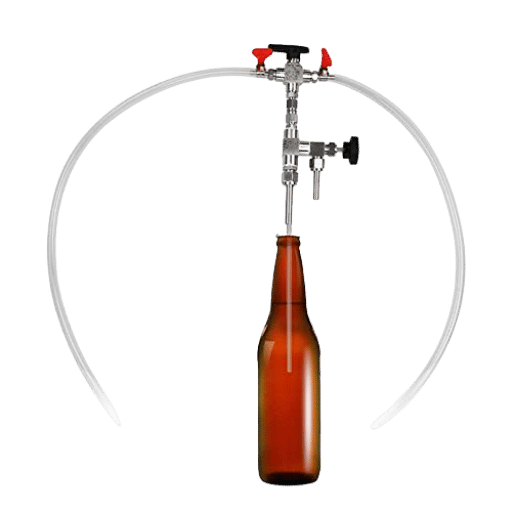
- Beer gun – hand-operated filler device for the CO2 gas purging followed by filling the container via bottom filling. Fast and low-cost but dependent on the operator for optimal speed, control, and purge.
- In the filling bowl, CO2 is allowed into the container until its interior pressure equals that of the brew’s and thereafter it begins flowing gently in an effort to control CO2 saturation, preserve color, and flavor as well as temperature when necessary and thus it’s standard for higher-volume and high-CO2 levels of drinks.
Is a beer gun bad for dissolved oxygen and shelf life?
Contrary to claims seen in many online communities, careful Beer gun-based production – if you Purge the bottle enough to get a change sound, and then carefully use low levels of pressure during filling – it isn’t so bad! Both, of course, introduce a tiny amount of air back in when you’re filling so neither process is “0 oxygen”.
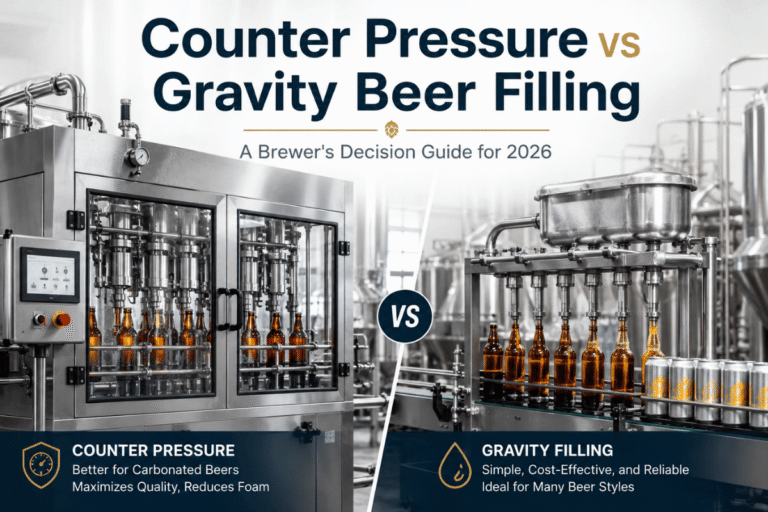
It’s not your gadget, it’s your shelf-life horizon. For beer that will be gone in days or weeks, the relatively poorly controlled product of a beer gun is almost always acceptable. For packaged beer destined for a long, slow life in the distribution chain for months, the lower and more repeatable oxygen pickup of counter-pressure (and inline) filling justifies the extra investment. For a side-by-side comparison of the two basic principles, consult our complementary guide on counter-pressure vs gravity beer filling.
⚠️ Worth knowing
In blind triangular tests with a Czech dark lager, the homebrewing-research project Brülosophy concluded that the beer produced via beer gun or counter-pressure filling were “equally crisp and clean, and didn’t show any significant differences of oxidation over the test time.” In the context of the experiment, counter-pressure buys consistency and shelf life, it does not magically make all fills perfect. Brewers Association guidelines concur by saying from the reverse that although counter pressure doesn’t waste filler product, bottles that go through counter pressure filling may not last any longer because the package is not sealed perfectly air tight.
Dissolved Oxygen, Foam & CO2: The Specs That Decide Shelf Life
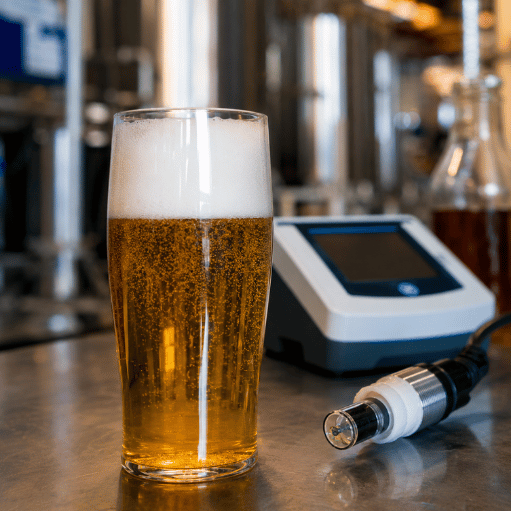
Total package oxygen (TPO) is the single number that separates a serious beer filling machine from a gadget. Oxygen is what turns a fresh, hop-forward beer into wet cardboard. Industry measurement guidance notes that even a typical crown closure leaks roughly 1–2 ppb of oxygen into the package per day, which can add up to as much as ~180 ppb over a three-month shelf life. Your fill step decides how much of your TPO budget is gone before the beer even ship.
| Tier | DO control method | Practical TPO outlook |
|---|---|---|
| Beer gun (manual) | Manual CO2 purge by feel | Variable; operator-dependent |
| Counter-pressure bench | Pre-pressurize + gentle fill | Lower, more repeatable |
| Automatic inline can line | CO2 pre-purge, undercover gassing, fob/foam-on | ~15–20 ppb pickup achievable on capable lines |
| Industrial isobaric line | Full purge train + flow-meter fill + tight headspace control | Lowest, tightly controlled |
TPO forecast shown are based on typical commercial packaging equipment specs and best practices as presented by industry brewing-science guidelines. These values are all subject to CO2 quality, filler head temperature, and operator care.
Two structural facts help here. First, cans tend to start with lower oxygen than bottlesbrewing-chemistry guidance notes that bottles are harder to evacuate while a seamed can end gives a hermetic seal with effectively no further oxygen ingress. Second, oxygen control is engineered at the fill head: CO2 flood purging before filling, undercover gassing, and an induced foam (“fob”) that pushes air out of the headspace just before sealing. Patented can-filling methods go further, one approach doses about 0.1 mL of liquid nitrogen just before seaming to set internal pressure and drive out oxygen, and packaging specs target headspace oxygen at or below 1% v/v.
📐 Engineering Note
Set your TPO target by style and shelf life, not by habit. Hop-forward and hazy beers oxidize fastest and benefit most from a low-DO fill; a pasteurized lager bound for long distribution needs tight headspace control. And remember the ceiling: packaging guidance generally treats even a well-filled, low-DO beer as having roughly a six-month quality window, a better filler extends freshness, it doesn’t make beer immortal. Treat ppb targets as directional rather than absolute, too: brewing-chemistry work has shown that TPO measurements vary between methods and laboratories, so your number is most useful as a trend you control, not a figure you compare bragging-rights-style against another brewery.
The filler is where your oxygen budget is won or lost. We size the purge, foam-on and capping sequence to the beer and the route to market – a taproom growler and a six-month export pallet are not the same engineering problem.
Mass Technology Engineering Team
Bottle, Can, Keg or Growler/Crowler: Choosing Your Format
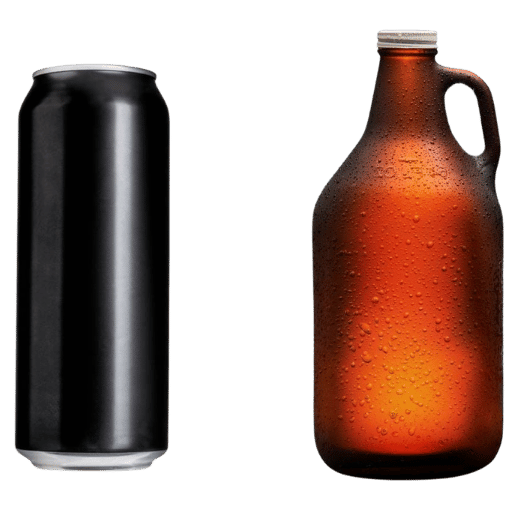
Format drives equipment, so decide it first. The Bottle-vs-Can-vs-Keg Format Decision Tree below routes most breweries cleanly:
Format Decision Tree
- Selling mostly on-premise / draft? Keg (keg washer-filler), lowest packaging cost per pint.
- Taproom to-go, small variable batches? Growler or crowler (counter-pressure growler filler or a seam-on-demand crowler machine).
- Distributing, shelf-life and light-protection critical? Can, total light barrier, strong oxygen barrier once seamed, lighter to ship, fully recyclable.
- Premium / cellaring / heritage brand identity? Bottle – choose amber glass for light protection.
A crowler is simply a single large (often 32oz) aluminum can seamed to order at the bar – it gives a taproom a sealed, light-proof package without committing to a full canning line. Kegs and growlers keep packaging capital low while you find your volume; cans and bottles are where you commit equipment once distribution is real.
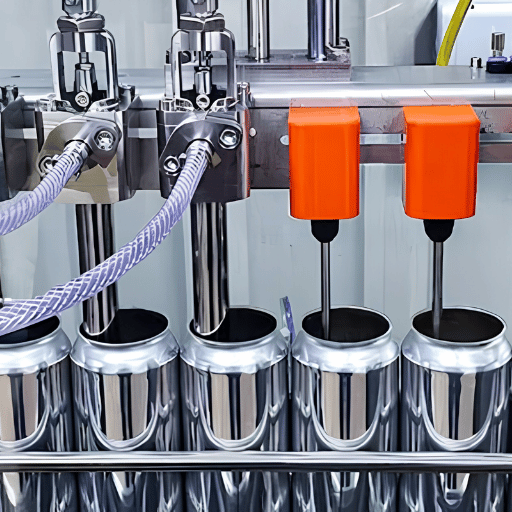
Can Seamers & Crowler Machines: How Beer Canning Works
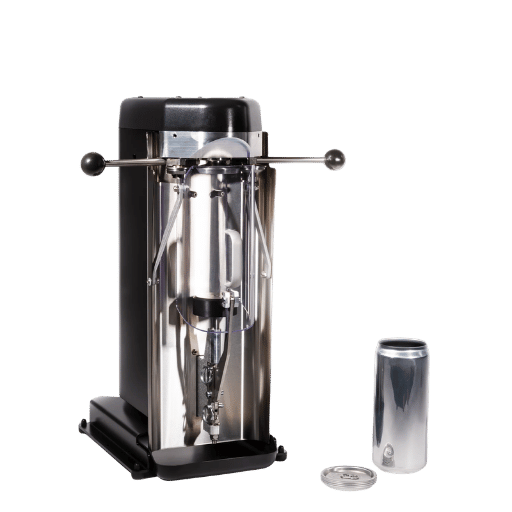
Canning adds a step bottling doesn’t have: the double seam. The can body flange and the lid curl are rolled together in two operations into an interlocked, hermetic fold. Get it wrong and you’ve leakers and oxygen ingress; get it right and the can is the best oxygen barrier in the cooler.
Seamers scale with the filler. A manual or tabletop seamer suits crowlers and the smallest batches; semi-automatic seamers feed by hand; automatic inline filler/seamers seam every can in the flow. Whatever the scale, seam quality is verified with the same physical check, per double-seam guidance, the body hook should sit approximately parallel to the cover hook, with adequate overlap and “% butting.”
What size canning machine does a small brewery need?
Map output to your packaging day, not your dreams. Entry tabletop filler/seamers run roughly 6-12 cans per minute; compact automated systems around 25 CPM; integrated craft lines up to 50-100 CPM, with rotary systems reaching several hundred CPM. A nano-brewery canning one batch a week is well served at the low end; a brewery canning multiple SKUs daily needs Tier 4. Buying far above your real cans-per-day just ties up cash and floor space.
📐 Engineering Note
Keep a seam gauge and log on the line. Operators commonly hold tolerances in the range of seam height ~0.095-0.101, body hook ~0.055-0.075, and cover hook ~0.053 minimum, tearing down and measuring seams at set intervals. A seam scope that compares each measurement to spec turns “looks fine” into a record you can defend. Get your exact targets from your can and end supplier – specs vary by container family, and final acceptability rests on a visual teardown plus measurements, not on dimensions alone.
Capacity & Speed: Sizing from Homebrew to Production
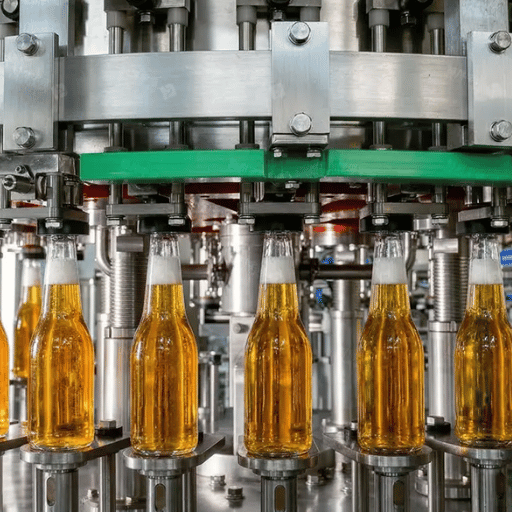
This is where passion meets spreadsheets. For small to medium breweries (the typical audience here), bottling machine production volumes vary from 700-4,000 BPH on small and medium-small lines to 4,000-12,000 BPH for medium-large lines, and the industrial beer lines can span 2,000 up to 18,000+ BPH (for glass), 18,000+ CPH for cans. Yet the deciding factor really isn’t raw speed alone, but rather the Manual-to-Automatic Crossover Threshold.
The nudge to change from a bench filler to an inline filler/seamer is seldom the headline machine price. It’s the point your total cost per package, labor hours, oxygen headspace variance, mishandled beer, exceeds what an automatic line would run. In beer-line projects, that’s the line, not the part number, that gets a brewery to automate.
Worked example: when does manual stop paying?
Suppose you’re outputting 250 cases/mo (6,000 12 oz cans) from the field. Running at a practical effective ~2 cans/min on an average hand-fed bench line adds about 50 hours packaging time to every month’s operation– not including changeover or quality control! But the 25-CPM automatic takes those 6,000 cans just about 4 hours to process once running. When your added labor, loss and oxidation (oxygen) penalties outweigh the operating cost of a line purchase, there’s the line-purchase tipping point. it comes sooner than most think.
Then, when you’re there, your combined-automated beer filling line-or an individual can filling machine-take over what used to be hours of handwork with a consistent low-oxygen fill designed to do what any patented headspace-oxygen control methods aim for.
What a Beer Filling Machine Costs

prices differ from unit to unit depending on how they’re configured, so consider the ranges to follow to be rough estimates for your planning purpose – they’re not quotes. Actual prices depends on factors including format,fill speed,degree of automation,container material, and whether you include just one or multiple modules. Machine costs could also differ by as much as an order of magnitude between models in the same tier once options and ancillaries are included.
| Tier | Indicative price |
|---|---|
| Bottling wand / beer gun | ~$50–$400 |
| Counter-pressure bench filler | Low hundreds to low thousands |
| Entry automated canning line | ~$20,000–$30,000+ |
| Mid automated filler/seamer | ~$60,000–$120,000+ |
| Industrial inline line | Six figures and up, configuration-dependent |
The number that ought to win that decision is cost-per-package. We crunched those numbers with an independent brewery finance consultant at around $0.35-$0.50 per 16oz can for contract/mobile canning vs. about $0.10-$0.18 per can at home once the upfront costs have been incurred. that about quarter per can difference is precisely the “driver” on this crossover math – multiply by your expected annual cans, and that total quickly beats what you paid for. And of course there’s fill accuracy – another cost of its own, whether it’s a filling too much beer or too little (and inviting TTB net-contents penalties).
Industry Outlook: The Shift from Bottles to Cans

When buying a filling equipment today, plan the equipment for where your beer package is going. The biggest Structural story in US craft brewing has been from glass to aluminum, cans accounted for approximately 78% of packaged craft beer volume by 2025 versus about 22% for glass according to the Brewers Association – it may be leveling off, but has re-set the packaging “default”. So the decision to buy a canning line, even if it’s to replace a bottle filler today makes sense in that no market intelligence we see would suggest any return for glass packaging to today’s or tomorrow’s glass consumption rates.
A second factor lowering the barrier was the rise of mobile and contract canning making it possible for a brewery to test the market demand before purchasing any hardware. Today a first time canner purchased is most often made as an upgrade to a brewery that started out as a contract canner. (Mobile canning market data will fluctuate wildly by research and Geography – treat numbers directional not factual)
Frequently Asked Questions
What is the best beer filling machine for a small brewery?
View Answer
For most nano and small breweries, a semi-automatic rinse-fill-cap monoblock (bottles) or a compact automated filler/seamer (cans) at roughly 6–25 units per minute is the sweet spot of low oxygen pickup and affordable capital. The best choice is the smallest machine that comfortably covers your busiest packaging day with a little room to grow into.
Can one machine fill both bottles and cans?
View Answer
Some systems offer bottle-and-can changeover kits, but seaming a can is a different mechanical job from crowning a bottle, so dual-format machines trade some speed for flexibility. If you are firmly one format, a dedicated line is cleaner and cheaper to run; if you truly need both, validate the changeover before you buy.
How many 22 oz bottles do you get from 5 gallons of beer?
View Answer
Five US gallons is about 18.9 liters. That fills roughly 29 bombers at 22 oz (0.65 L each), about 53 standard 12 oz bottles (0.355 L), or about 40 cans at 16 oz (0.473 L) — before you subtract trub loss and the beer left in the filler lines, which typically costs you one to a few units per batch. Plan packaging materials with a little overage.
Is counter-pressure filling necessary for homebrew?
View Answer
Not always — for beer you’ll drink within a few weeks, a carefully used beer gun is usually fine, and plenty of homebrewers bottle this way for years without issues. Counter-pressure earns its keep when you bottle highly carbonated styles or need months of reliable shelf stability in distribution.
What dissolved oxygen level should packaged beer target?
View Answer
Lower is better, measured in parts per billion of total package oxygen (TPO). Capable automated lines can hold pickup in roughly the ~15–20 ppb range, while a careful manual fill is more variable. The exact target depends on beer style and intended shelf life: hop-forward and hazy beers oxidize fastest and need the tightest control, whereas a pasteurized lager bound for long distribution still benefits from a low, repeatable number you can measure and trend.
Do I need a separate machine to fill kegs?
View Answer
Usually yes — keg washing and counter-pressure keg filling typically use dedicated equipment rather than a bottle or can filler, because the fill geometry and cleaning cycle are different. Some integrated lines offer a keg module, but most breweries run keg filling as its own station alongside the bottle or can packaging line.
Why We Wrote This Guide
Mass Technology builds beer filling and bottling lines, counter-pressure fillers, can lines and seamers running from a few thousand up to 18,000 BPH/CPH, for breweries in 60+ countries. We wrote this because most “beer filling machine” pages are product brochures with no oxygen numbers, no cost-per-can economics and no honest take on when a beer gun is good enough. Reviewed by the Zhangjiagang Mass Technology Co., Ltd. technical team.
Explore Mass Beer Filling Lines →
Grown past the bench filler? Discuss the sizing of our can lines to your cans-per-day needs with one of our engineering team.
References & Sources
- Malt Beverage Labeling: Net ContentsAlcohol and Tobacco Tax and Trade Bureau (TTB)
- The Science Behind Packaging Quality (Dissolved & Total Package Oxygen)American Society of Brewing Chemists (ASBC)
- Craft Brewers and CansBrewers Association
- A Guide to Can Defects and Basic Components of Double Seam ContainersAssociation of Food and Drug Officials (AFDO)
- Patent AU2007214288B2, Wine Packaged in Cans (liquid-nitrogen dosing at seaming)Google Patents
- Craft Beer Canning Line Buyer’s GuideCraft Brewing Business
Related Articles
- Counter-Pressure vs Gravity Beer Fillingthe fill-method comparison in depth
- Can Filling Machinededicated isobaric can filling and seaming
- Carbonated Drink Filling Machineisobaric filling for CSD and sparkling beverages
- Bottle Labeling Machineend-of-line labeling for your packaged beer