Get in Touch with Masstech

By CYH, Packaging & Beverage Line Engineer at Zhangjiagang Mass Technology Co., Ltd. (MassTech) · Technical Review against NIST Handbook 133 & IBWA Standards (Updated November 2026)
Twenty-four 16.9 fl oz (500 ml) bottles is the North American retail standard when buyers ask how many water bottles are in a case. A single 24-pack holds 405.6 fluid ounces of drinking water. That volume equals 3.17 US gallons or 12.0 liters. Grocery stores, vending operators, and co-packers build their tray dimensions and shrink-wrap tooling around this 4×6 bottle matrix.
Case counts of bottles can vary depending on the retail channel or type of bottled water size. Warehouse clubs like Costco and Sam’s Club pack 35, 40, or 45 bottles of 16.9 oz water on wider 5×7 or 5×8 trays. Smaller 8 oz (237 ml) mini bottles ship in 24-packs, 48-packs, or 70-packs for schools and airlines. The larger 1 liter (33.8 fl oz) and 1.5 liter (50.7 fl oz) formats drop to a case count of 12 bottles.
Direct Answer: A standard retail case of water contains 24 bottles of 16.9 fl oz (500 ml) each. It holds 405.6 fluid ounces (3.17 US gallons or 12.0 liters) and weighs 26.4 to 30.0 pounds. Wholesale club cases hold 35 to 40 bottles (4.62 to 5.28 gallons), while 1-liter cases hold 12 bottles.
Quick Engineering & Logistics Reference: Standard 16.9 fl oz (500 ml) Water Case
- The standard retail case count of water is 24 bottles, organized in a 4 × 6 tray collation matrix.
- Warehouse club count is 35, 40, or 45 bottles per case arranged in a 5×7, 5×8, or 5×9 matrix.
- A single bottle volume is 16.907 US fl oz (500 ml / half a liter / 2.11 US cups) per the NIST Handbook 133 net contents tables.
- Net liquid for a 24-pack is 405.6 US fl oz (3.17 US gallons / 12.0 liters), where 7.57 bottles equal one gallon.
- Gross case weight is 26.4 to 27.2 lbs (12.0 to 12.3 kg) in shrink film, or 30.0 lbs (13.6 kg) in a corrugated box.
- A GMA 48×40 pallet load is 72 cases (1,728 bottles, 6 layers) or 84 cases (2,016 bottles, 7 layers) weighing 1,980 to 2,400 lbs.
24 Bottlesstandard 16.9 oz retail case count
3.17 Galnet water in a 24-pack (12.0 L)
7.57 Bottles16.9 fl oz bottles per US gallon
72–84 Casesstandard 48×40 GMA pallet load
How Many Water Bottles Come in a Standard Case by Bottle Size?
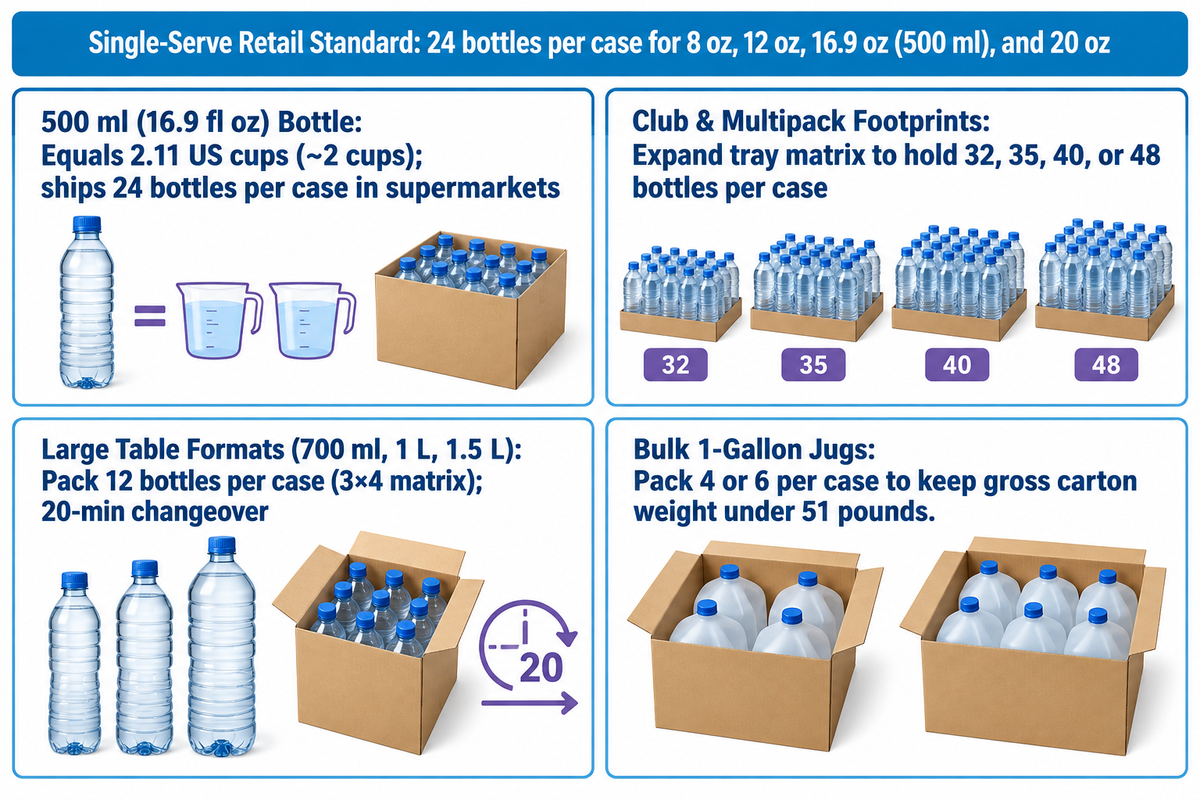
A standard case of bottled water holds 24 bottles for 8 oz, 12 oz, 16.9 oz (500 ml), and 20 oz single-serve formats. Larger 700 ml, 1 liter, and 1.5 liter bottles pack 12 per case. Bulk 1-gallon jugs pack 4 or 6 per case to keep gross carton weight under 51 pounds.
In the beverage industry, bottled water is usually sold in eight primary container volumes. Each water bottle size pairs with a specific corrugated tray footprint and shrink-wrap collation pattern. A standard single-serve water bottle contains 16.9 fluid ounces (500 ml). That single bottle of water equals 2.11 US cups, or roughly 2 cups of liquid. In supermarkets and convenience stores, the 500 ml bottle is the most common size and ships 24 bottles per case.
Smaller bottles typically serve hospitality, catering, and school nutrition programs. Both 8 or 12 oz containers ship 24 per case in standard foodservice cartons. Event planners ordering custom bottled water in 8 oz, 12 oz, or 16.9 oz sizes also receive 24-bottle cases. Suppliers sell these packs in multiples of 2 cases with a 10-case minimum order. However, wholesale clubs bundle 35 or 40 bottles per case. Buyers ordering by the case must specify both single bottle volume and pack matrix (4×6 versus 5×8) on purchase orders.
How Many Bottles Fit in a Case?
Twenty-four bottles fit in a standard retail case for 8 oz, 12 oz, 16.9 oz, and 20 oz formats. Twelve bottles fit in a standard case for 1-liter water and 750 ml wine (3×4 matrix). Bulk club water multipacks expand the tray footprint to hold 32, 35, 40, or 48 bottles.
Secondary packaging machinery groups cylindrical PET containers into rectangular grid patterns before wrapping. As detailed in Packaging World private-label case packing reports, wraparound tray packers switch between 4×6 (24-pack) and 3×4 (12-pack) collations in under 20 minutes. The master table below compares all eight commercial water bottle sizes against wine and beer case standards.
| Water Bottle Size (US & Metric) | Standard Retail Case Count | Club / Bulk Pack Count | Tray Collation Matrix | Net Liquid Volume (Std Case) | Primary Application |
|---|---|---|---|---|---|
| 8 fl oz (237 ml) Mini | 24 bottles (or 12-pack) | 48, 70, or 80 bottles | 4×6 (2 layers for 48-pk) | 192 fl oz (1.50 gal / 5.68 L) | Conferences, airlines, school lunches |
| 12 fl oz (355 ml) Hospitality | 24 bottles | 32 or 36 bottles | 4×6 matrix | 288 fl oz (2.25 gal / 8.52 L) | Hotel rooms, corporate reception, clinics |
| 16.9 fl oz (500 ml) Standard | 24 bottles | 28, 32, 35, 40, or 45 bottles | 4×6 (retail) / 5×8 (club) | 405.6 fl oz (3.17 gal / 12.0 L) | Supermarkets, vending, events, emergency |
| 20 fl oz (591 ml) Vending | 24 bottles | 28 bottles | 4×6 or 4×7 matrix | 480 fl oz (3.75 gal / 14.2 L) | Cold-vault convenience stores, vending |
| 23.7 fl oz (700 ml) Sports Cap | 12 or 24 bottles | 24 or 28 bottles | 3×4 or 4×6 matrix | 284.4 or 568.8 fl oz (8.4 or 16.8 L) | Gym hydration, athletic events, transit |
| 33.8 fl oz (1 Liter / 1 l) | 12 bottles | 15 or 18 bottles | 3×4 or 3×5 matrix | 405.6 fl oz (3.17 gal / 12.0 L) | Table service dining, long-haul travel |
| 50.7 fl oz (1.5 Liter) | 12 bottles (or 6-pack) | 12 bottles | 3×4 or 2×3 matrix | 608.4 fl oz (4.75 gal / 18.0 L) | European supermarket multipacks, family dining |
| 128 fl oz (1 US Gallon / 3.785 L) | 4 or 6 jugs | 6 jugs | 2×2 or 2×3 RSC carton | 512 or 768 fl oz (4.0 or 6.0 gal) | Emergency preparedness, distilled water |
| Cross-Category: Beer / Soda (12 oz) | 24 cans or bottles | 30 or 36 cans | 4×6 matrix (or 4×6-packs) | 288 fl oz (2.25 gal / 8.52 L) | Standard beverage distribution benchmark |
| Cross-Category: Wine (750 ml / 25.4 oz) | 12 glass bottles | 6 bottles (heavy glass) | 3×4 partitioned RSC box | 304.3 fl oz (2.38 gal / 9.0 L) | 9-liter international case accounting unit |
Source: Compiled from NIST Handbook 133 and commercial beverage tray packing specifications.
How Many Gallons and Liters Are in a 24-Pack, 32-Pack, and 40-Pack Case?
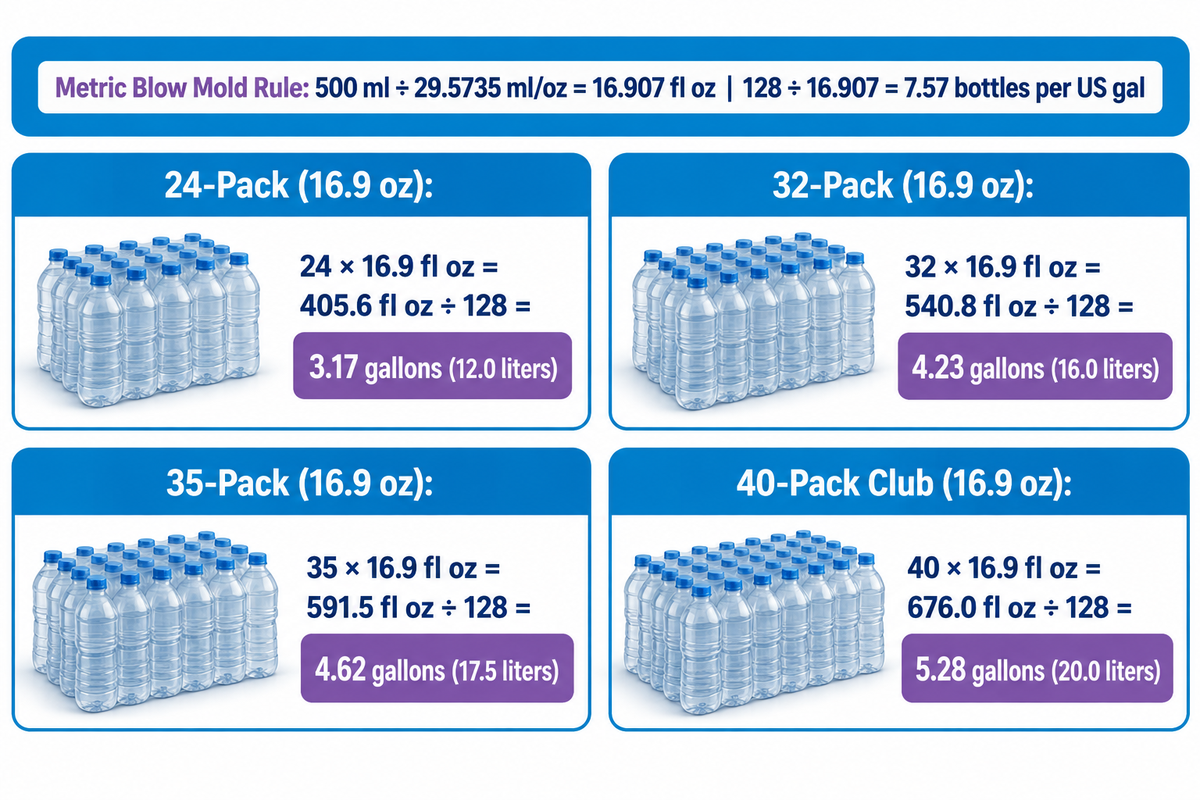
A 24-pack of 16.9 fl oz (500 ml) water bottles holds 3.17 US gallons (405.6 fl oz or 12.0 liters). A 32-pack holds 4.23 US gallons (540.8 fl oz or 16.0 liters). A 40-pack wholesale club case holds 5.28 US gallons (676.0 fl oz or 20.0 liters).
3.17-Gallon Standard Case Constant for Beverage Buyers
The 3.17-Gallon Standard Case Constant defines the exact liquid volume inside both a 24-pack of 500 ml bottles and a 12-pack of 1-liter bottles (12.0 liters or 405.6 US fluid ounces). Both formats deliver identical liquid mass on a filling line.
Procurement teams frequently make a costly conversion mistake when converting ounces to gallons. Many buyers treat a 16.9oz bottle of water as a 16 oz US pint (473 ml) under United States customary units or Imperial units. Under that false assumption, eight bottles equal one gallon and a 24-pack equals 3.0 gallons. In fact, a standard PET water bottle is blown to a 500 ml metric mold. Dividing 500 milliliters by 29.5735 milliliters per US fluid ounce yields 16.907 fluid ounces per bottle.
How Many Gallons of Water Come in a Case of Water?
Three point one seven (3.17) US gallons come in a standard 24-pack case of 16.9 fl oz water, while 4.62 to 5.28 gallons come in 35-pack and 40-pack club cases. Because there are 128 fluid ounces in a US gallon (3,785.41 ml), dividing 128 by 16.907 proves that 7.57 standard bottles equal 1 gallon per MyLabelWater’s bottled water ounce conversion guide . Please see MyLabelWater’s bottled water ounce conversion guide to learn more.
Exact volumetric math prevents inventory shortages. Multiply bottles by 16.9 fl oz to get total ounces per case. Then divide the total by 128 ounces in a US gallon.
- For 24 bottles of 16.9 oz: 24 × 16.9 fl oz = 405.6 fl oz ÷ 128 = 3.17 gallons of water (24 × 0.5 L = 12.0 liters).
- For 32 bottles of 16.9 oz: 32 × 16.9 fl oz = 540.8 fl oz ÷ 128 = 4.23 gallons of water (32 × 0.5 L = 16.0 liters).
- For 35 bottles of 16.9 oz: 35 × 16.9 fl oz = 591.5 fl oz ÷ 128 = 4.62 gallons of water (35 × 0.5 L = 17.5 liters).
- For 40 bottles of 16.9 oz: 40 × 16.9 fl oz = 676.0 fl oz ÷ 128 = 5.28 gallons of water (40 × 0.5 L = 20.0 liters).
| Case Format & Bottle Size | Total Fluid Ounces (US fl oz) | Total US Gallons (128 oz/gal) | Total Metric Volume (Liters) | Equivalent 5-Gallon Jugs |
|---|---|---|---|---|
| 12-Pack (16.9 fl oz / 500 ml) | 202.8 fl oz | 1.58 gal | 6.00 L | 0.32 jugs |
| 24-Pack (8 fl oz / 237 ml Mini) | 192.0 fl oz | 1.50 gal | 5.68 L | 0.30 jugs |
| 24-Pack (12 fl oz / 355 ml) | 288.0 fl oz | 2.25 gal | 8.52 L | 0.45 jugs |
| 24-Pack (16.9 fl oz / 500 ml Std) | 405.6 fl oz | 3.17 gal | 12.00 L | 0.63 jugs |
| 28-Pack (16.9 fl oz / 500 ml) | 473.2 fl oz | 3.70 gal | 14.00 L | 0.74 jugs |
| 32-Pack (16.9 fl oz / 500 ml) | 540.8 fl oz | 4.23 gal | 16.00 L | 0.85 jugs |
| 35-Pack (16.9 fl oz / 500 ml) | 591.5 fl oz | 4.62 gal | 17.50 L | 0.92 jugs |
| 40-Pack (16.9 fl oz / 500 ml Club) | 676.0 fl oz | 5.28 gal | 20.00 L | 1.06 jugs |
| 45-Pack (16.9 fl oz / 500 ml Club) | 760.5 fl oz | 5.94 gal | 22.50 L | 1.19 jugs |
| 48-Pack (8 fl oz / 237 ml Dual-Layer) | 384.0 fl oz | 3.00 gal | 11.36 L | 0.60 jugs |
Source: Calculated per US FDA 21 CFR 101.7 dual net quantity declarations (1 US fl oz = 29.5735 ml; 1 US gal = 128 fl oz).
Why Wholesale Clubs and Major Brands Use 28, 32, 35, and 40-Bottle Cases
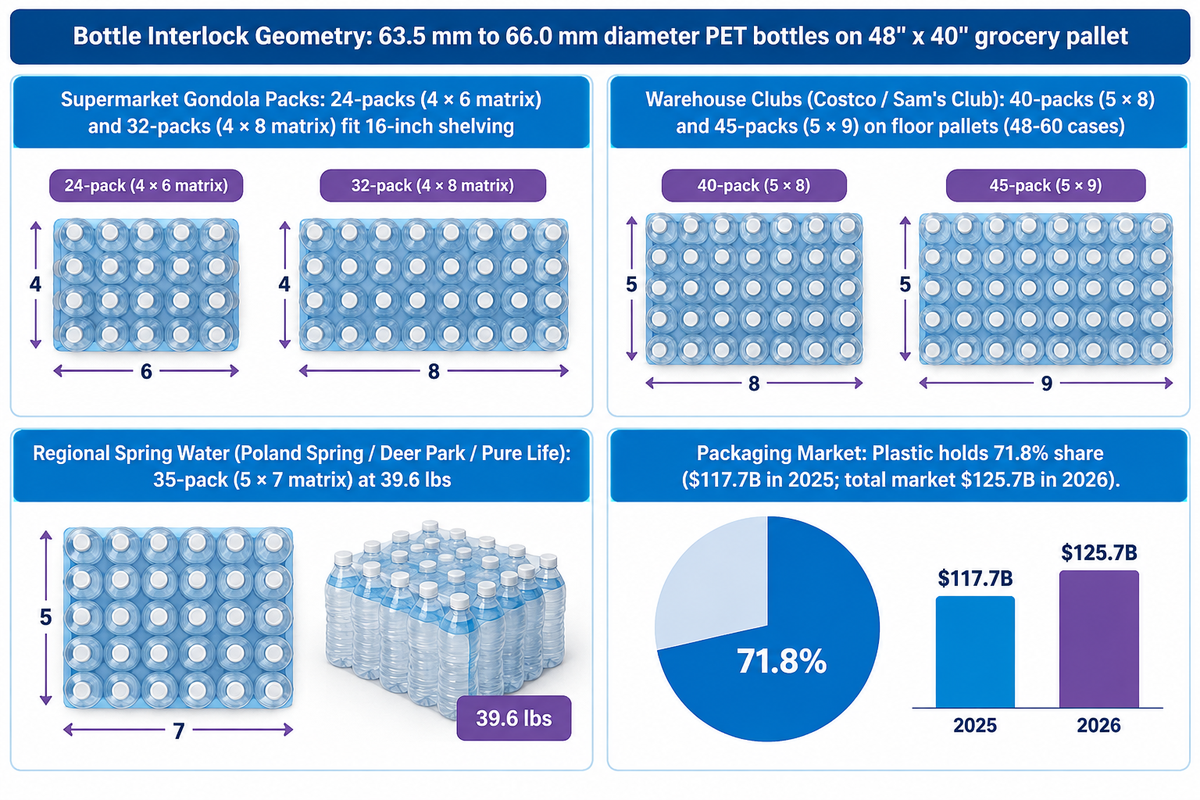
Wholesale clubs and national beverage brands use 28, 32, 35 and 40-bottle cases to maximize pallet cube density (48 to 60 cases per 48″ x 40″ wood pallet) while lessening the tare weight of the secondary corrugated tray and shrink-wrap per bottle for high-volume retail floor displays.
4×6-to-5×8 Case Collation Matrix Across Retail Channels
The 4×6-to-5×8 Case Collation Matrix governs how cylindrical 63.5 mm to 66.0 mm diameter PET water bottles interlock on a 48″ x 40″ grocery pallet without overhanging the wood deck.
Why did national brands move away from uniform 24-packs? According to Market Research Future’s bottled water packaging report, plastic accounts for 71.8% of the global market ($117.7 billion in 2025). Total packaging revenue reached $125.7 billion in 2026 per Grand View Research. As resin and freight costs climbed, retailers engineered channel-specific pack counts across four sizes (24, 32, 35, and 40 bottles).
Supermarkets use 24-packs (4 × 6 matrix) and 32-packs (4 × 8 matrix) so cases can fit 16-inch deep gondola shelving. Regional spring water brands like Poland Spring and Deer Park, along with Pure Life, use a 35-pack (5 × 7 matrix). This format increases bottle count per tray while keeping the carton weight at 39.6 pounds. Warehouse clubs like Costco and Sam’s Club use 40-packs (5 × 8 matrix) and 45-packs (5 × 9 matrix) sold directly off floor pallets.
| Retailer / Water Brand | Bottle Size | Bottles per Case | Pack Collation Matrix | Cases per 48×40 Pallet | Bottles per Pallet |
|---|---|---|---|---|---|
| Costco (Kirkland Signature) | 16.9 fl oz (500 ml) | 40 bottles | 5×8 tray + shrink film | 48 cases (8 Ti × 6 Hi) | 1,920 bottles |
| Costco (Kirkland Mini) | 8.0 fl oz (237 ml) | 70 bottles | 5×7 × 2 stacked layers | 48 cases | 3,360 bottles |
| Sam’s Club (Member’s Mark) | 16.9 fl oz (500 ml) | 40 or 45 bottles | 5×8 or 5×9 tray + film | 48 cases (40-pk) / 42 cases (45-pk) | 1,920 or 1,890 bottles |
| Walmart (Great Value) | 16.9 fl oz (500 ml) | 24, 32, or 40 bottles | 4×6, 4×8, or 5×8 | 72–84 (24-pk) / 48–60 (40-pk) | 1,728 to 2,400 bottles |
| Poland Spring / Deer Park / Pure Life | 16.9 fl oz (500 ml) | 24, 28, 35, or 40 bottles | 4×6, 4×7, 5×7, or 5×8 | 72 (24-pk) / 54 or 60 (35/40-pk) | 1,728 to 2,100 bottles |
| Dasani / Aquafina | 16.9 fl oz (500 ml) | 24 or 32 bottles | 4×6 or 4×8 film bundle | 72 cases (24-pk) / 54 cases (32-pk) | 1,728 bottles |
| Fiji Natural Artesian Water | 500 ml (16.9 oz) / 1 L | 24 (500 ml) / 12 (1 L) | 4×6 or 3×4 RSC corrugated box | 60 to 72 cases | 1,440 to 1,728 bottles |
Source: Compiled from Walmart Commercial Pallet Water Specifications and wholesale club distribution standards.
How Much Does a Case of Water Weigh and Measure? (Mass Balance Worked Example)
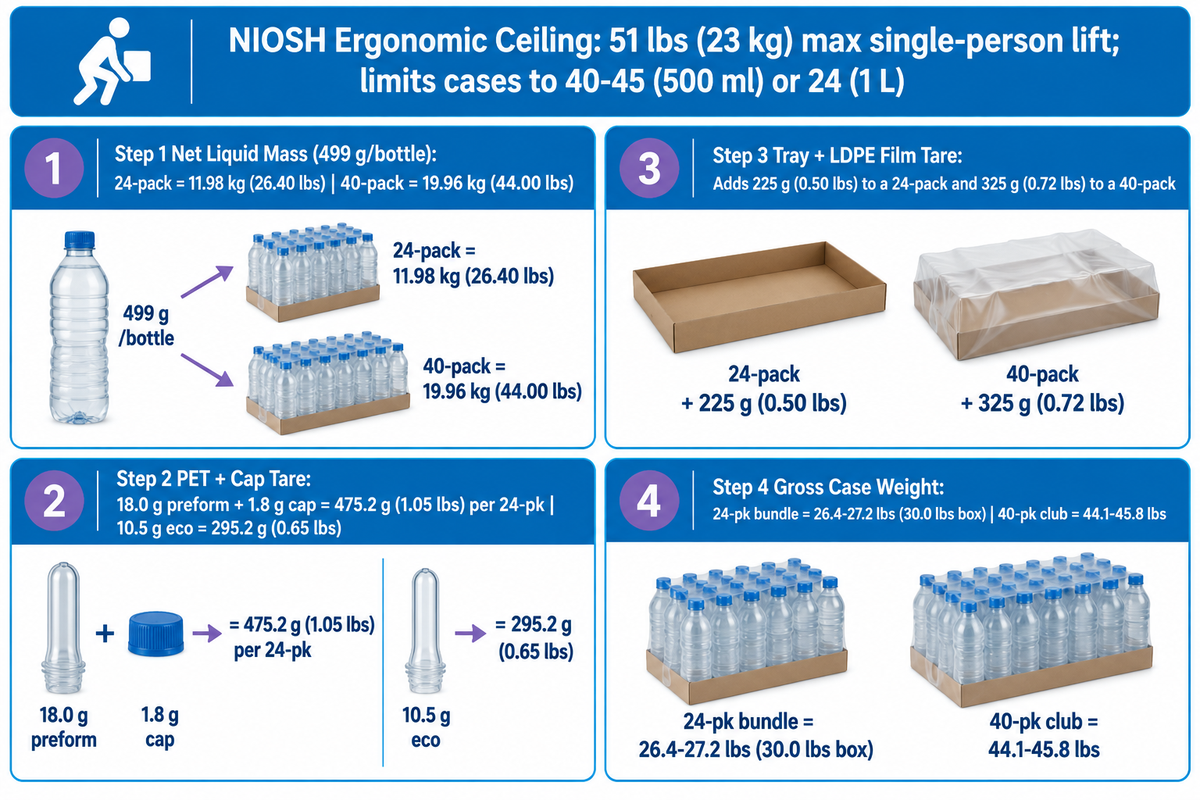
A standard 24-pack of 16.9 fl oz (500 ml) water weighs 26.4 to 27.2 pounds (12.0 to 12.3 kg) in shrink-wrapped tray packaging. In a heavy corrugated shipping box, a 24-pack of water weighs 30.0 pounds (13.6 kg). A 40-pack club case of water weighs 44.1 to 45.8 pounds (20.0 to 20.8 kg).
51-Pound NIOSH Case-Weight Ceiling in Manual Handling
The 51-Pound NIOSH Case-Weight Ceiling sets the maximum recommended single-person manual lifting load under ideal conditions (23 kg / 51 lbs). This threshold limits commercial water cases to 40 to 45 half-liter bottles or 24 one-liter bottles.
Why does a 24-pack of 16.9 oz water weigh 26.4 pounds on a supermarket pallet, but 30 pounds in parcel shipping? One US fluid ounce of water weighs 1.043 ounces avoirdupois (8.345 pounds per gallon at 20°C). So the liquid in a 24-pack weighs between 25.0 and 26.4 pounds (11.34 and 11.98 kg). The remaining weight comes from primary PET resin and secondary carton tare.
As documented in BottlePreform’s PET preform weight specifications, a rigid 500 ml still-water preform with a 28 mm PCO 1881 neck weighs 18 grams. Ultra-lightweight eco-bottles drop to a mass of 9.5 to 12.5 grams. Carbonated 500 ml bottles use a 20 gram preform, and 1-liter bottles use a preform in the range of 24 to 28 grams, as stated in our PET preform weight and neck-finish engineering guide. Let’s now run the mass balance for 24- and 40-pack cases.
Worked Engineering Mass Balance: 24 vs 40-Packs of 16.9 fl oz (500 ml) Bottled Water
Assumed inputs: Density of water at 20°C is 0.998 g/ml (499 g per 500 ml bottle). Standard still-water PET preform weight is 18.0 g (or 10.5 g ultra-lightweight), and the HDPE cap plus label weighs 1.8 g. Secondary tare is 180 g for a 24-pack tray (260 g for a 40-pack tray) plus 45 to 65 g for LDPE shrink film, or 1,750 g for a double-wall shipping box.
- Step 1, Net Liquid Mass: For a 24-pack, 24 × 499 g equals 11,976 g (11.98 kg or 26.40 lbs at 500 ml fill). For a 40-pack, 40 × 499 g equals 19,960 g (19.96 kg or 44.00 lbs).
- Step 2, Primary PET + Cap Tare: At 18.0 g preform plus 1.8 g cap and label (19.8 g per bottle), 24 bottles add 475.2 g (1.05 lbs). With a 10.5 g eco-bottle (12.3 g total), 24 bottles equate to 295.2g (0.65 lbs), and 40 bottles equate to 492g (1.08 lbs).
- Step 3, Secondary Tray + Shrink Film Tare: A corrugated tray plus LDPE film adds 225 g (0.50 lbs) to a 24-pack and 325 g (0.72 lbs) to a 40-pack.
- Step 4, Total Gross Case Weight: On these inputs, a shrink-wrapped 24-pack weighs 12.50 to 12.68 kg (26.4 to 27.9 lbs), while a heavy parcel shipping box reaches 30.0 lbs (13.6 kg) per BottleYourBrand shipping specifications. A 40-pack club bundle weighs 20.0 to 20.8 kg (44.1 to 45.8 lbs), matching the 2,114 lb pallet weight across 48 cases (44.04 lbs per case).
Scope Note: These calculations take into account PET shrink-wrapped tray bundles and parcel boxes. Returnable glass cases add between 8 to 11 kg of glass tare and can’t be estimated with the PET preform equations.
Workers commonly unstack lower tiers of a pallet, which are below knee height, or lift cases above shoulder height. In those postures, 40-pack cases (44.1 to 45.8 lbs) and 24-pack 1-liter cases (53 to 55 lbs) approach or exceed the 51-pound NIOSH lifting limit. Bottling plants and warehouses use vacuum tube lifters or scissor lift tables to avoid back injuries from manual depalletizing.
| Case Configuration | Net Liquid Weight | Gross Weight (Shrink Bundle) | Gross Weight (RSC Box) | Exterior Dimensions (L × W × H) |
|---|---|---|---|---|
| 24 × 8 fl oz (237 ml) Mini | 12.5 lbs (5.68 kg) | 13.4 lbs (6.1 kg) | 15.0 lbs (6.8 kg) | 120 cases per 48×40 pallet (compact 4×6 tray) |
| 24 × 12 fl oz (355 ml) Hospitality | 18.8 lbs (8.52 kg) | 20.1 lbs (9.1 kg) | 22.0 lbs (10.0 kg) | 15.0 × 10.0 × 8.0 in (8″ H × 10″ W × 15″ L) |
| 24 × 16.9 fl oz (500 ml) Standard | 25.0–26.4 lbs (12.0 kg) | 26.4–27.2 lbs (12.0–12.3 kg) | 30.0 lbs (13.6 kg) | 16.0 × 11.0 × 9.0 in (9″ H × 11″ W × 16″ L) |
| 32 × 16.9 fl oz (500 ml) Grocery | 35.2 lbs (16.0 kg) | 36.2 lbs (16.4 kg) | Not applicable (film bundle) | 20.5 × 10.5 × 8.5 in (521 × 267 × 216 mm) |
| 35 × 16.9 fl oz (500 ml) Promotional | 38.5 lbs (17.5 kg) | 39.6 lbs (18.0 kg) | Not applicable (film bundle) | 18.0 × 13.0 × 8.5 in (457 × 330 × 216 mm) |
| 40 × 16.9 fl oz (500 ml) Club Pack | 44.0 lbs (20.0 kg) | 44.1–45.8 lbs (20.0–20.8 kg) | Not applicable (tray + film) | 19.5 × 12.5 × 8.5 in (495 × 318 × 216 mm) |
| 12 × 33.8 fl oz (1 Liter) Case | 26.4 lbs (12.0 kg) | 27.3 lbs (12.4 kg) | 29.5 lbs (13.4 kg) | 13.5 × 10.2 × 11.2 in (343 × 259 × 284 mm) |
| 6 × 1 US Gallon (3.785 L) HDPE | 50.1 lbs (22.7 kg) | Not applicable (carton only) | 52.5 lbs (23.8 kg) | 18.5 × 12.5 × 12.5 in (470 × 318 × 318 mm) |
Source: Mass balance derived from the BottlePreform PET specifications and shipping cartons.
How Many Cases of Water Fit on a Standard Pallet and Full Truckload?
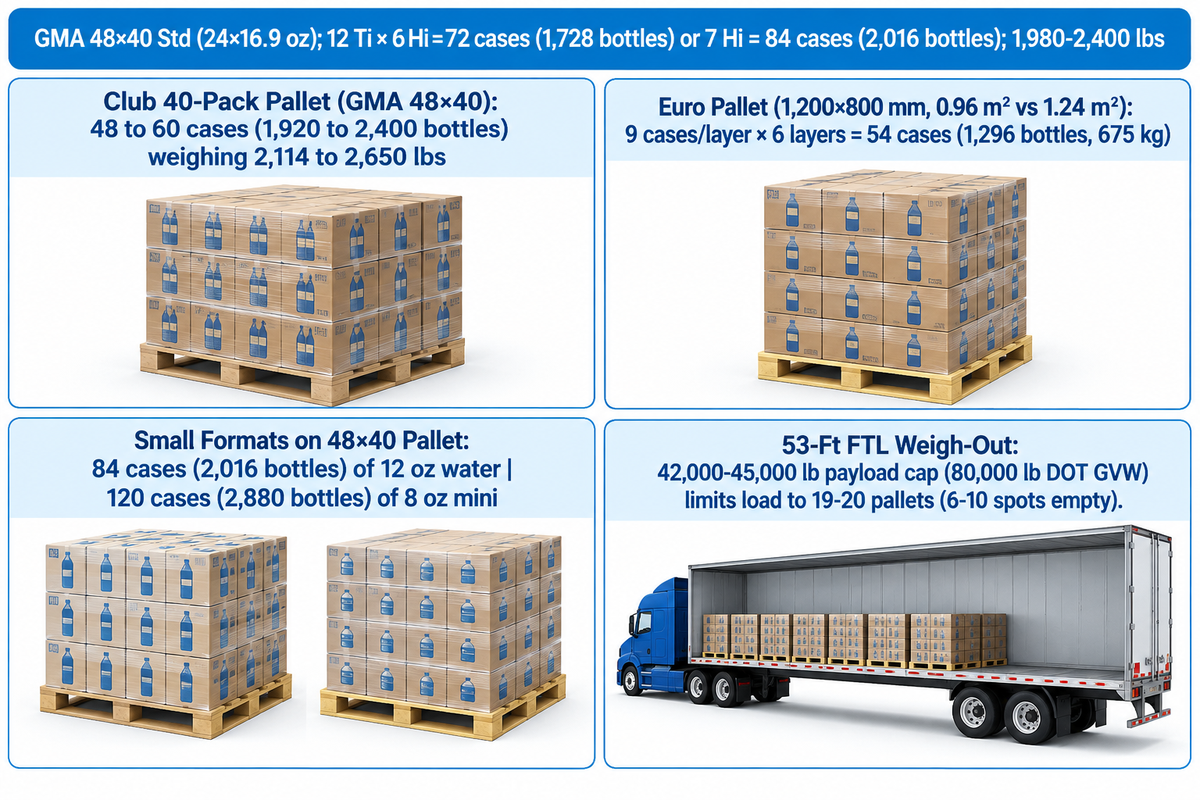
A standard 48 × 40 inch GMA pallet holds 72 to 84 cases of 24-pack 16.9 fl oz water bottles (1,728 to 2,016 bottles). That full pallet weighs 1,980 to 2,400 pounds. For 40-pack wholesale club cases, a pallet holds 48 to 60 cases (1,920 to 2,400 bottles) weighing 2,114 to 2,650 pounds.
72-Case GMA Ti-Hi Pallet Rule for Warehouse Loading
The 72-Case GMA Ti-Hi Pallet Rule establishes 12 cases per layer (12 Ti) stacked 6 layers high (6 Hi) as the baseline North American grocery pallet configuration for 24-pack 500 ml bottled water. This configuration states that 12 cases are loaded on each layer (12 Ti) and that a pallet is made up of 6 layers (6 Hi).
Warehouse managers use Ti-Hi to calculate pallet capacity. Tier (Ti) is case count on one flat layer, and Height (Hi) is the number of vertical layers. According to AFewImports warehouse fulfillment benchmarks, a 48”x40” wood pallet can hold 72 cases (1,728 bottles) of 16.9 oz water at 6 layers (Hi) high. That same pallet can hold 84 cases (2,016 bottles) of 12 oz water, or 120 cases (2,880 bottles) of 8 oz mini water. Regional spring water bottlers like Crystal Geyser also ship 84-case pallets (12 Ti × 7 Hi) of 16.9 oz 24-packs using thicker PET bottles.
In European plants using 1,200 × 800 mm Euro pallets (EUR/EPAL), deck area is smaller than a US GMA pallet (0.96 m² vs. 1.24 m²). Consequently, a Euro pallet holds 9 cases of 24×500 ml per layer across 6 layers. That stack totals 54 cases (1,296 bottles) and weighs 675 kg.
When booking full-truckload (FTL) freight, logistics planners must account for highway axle weight limits. As indicated in Qeep Logistics 53-foot dry van specifications and HotShot Trucking’s dry van loading guide, the cubic capacity of a 53-foot dry van is limited to 26 straight or 30 turned pallets. However, legal highway payload is capped at 42,000 to 45,000 pounds under the 80,000-pound US DOT gross vehicle weight limit. Bottled water loads weigh out before they cube out at 19 to 20 pallets per truckload, leaving 6 to 10 pallet spots empty.
| Case Format & Pallet Standard | Ti × Hi (Cases/Layer × Layers) | Total Cases / Pallet | Total Bottles / Pallet | Gross Pallet Weight (incl. 40 lb Deck) | Max Pallets per 53-ft FTL (44,000 lb Cap) |
|---|---|---|---|---|---|
| 24 × 16.9 oz (GMA 48×40 Std) | 12 Ti × 6 Hi | 72 cases | 1,728 bottles | ~1,980–2,200 lbs (898–998 kg) | 20 to 22 pallets (1,440–1,584 cases) |
| 24 × 16.9 oz (GMA 48×40 High-Stack) | 12 Ti × 7 Hi | 84 cases | 2,016 bottles | ~2,280–2,400 lbs (1,034–1,089 kg) | 19 to 20 pallets (1,596–1,680 cases) |
| 40 × 16.9 oz (Club GMA 48×40) | 8 Ti × 6 Hi (or 10 × 6) | 48 cases (or 60 cases) | 1,920 (or 2,400) bottles | 2,114–2,200 lbs (48-cs) / 2,680 lbs (60-cs) | 20 pallets (48-cs) / 16 pallets (60-cs) |
| 35 × 16.9 oz (GMA 48×40) | 9 Ti × 6 Hi | 54 cases | 1,890 bottles | ~2,180 lbs (989 kg) | 20 pallets (1,080 cases / 37,800 bottles) |
| 24 × 12 oz (GMA 48×40) | 12 Ti × 7 Hi | 84 cases | 2,016 bottles | ~1,730–1,890 lbs (785–857 kg) | 23 to 25 pallets (1,932–2,100 cases) |
| 24 × 8 oz Mini (GMA 48×40) | 20 Ti × 6 Hi | 120 cases | 2,880 bottles | ~1,650–1,800 lbs (748–816 kg) | 24 to 26 pallets (2,880–3,120 cases) |
| 6 × 1 US Gallon (GMA 48×40) | 12 Ti × 4 Hi | 48 cases | 288 gallon jugs | ~2,560 lbs (1,161 kg) | 17 pallets (816 cases / 4,896 gallons) |
| 24 × 500 ml (Euro Pallet 1200×800 mm) | 9 Ti × 6 Hi | 54 cases | 1,296 bottles | ~1,488 lbs (675 kg) | 32 to 33 Euro pallets per EU curtain-sider |
Source: Compiled from AFewImports Pallet Guide and Qeep Logistics 53-Foot Trailer Payload Standards.
Case of Water vs. Gallon Jugs: Unit Cost and Wholesale Price Breakdown
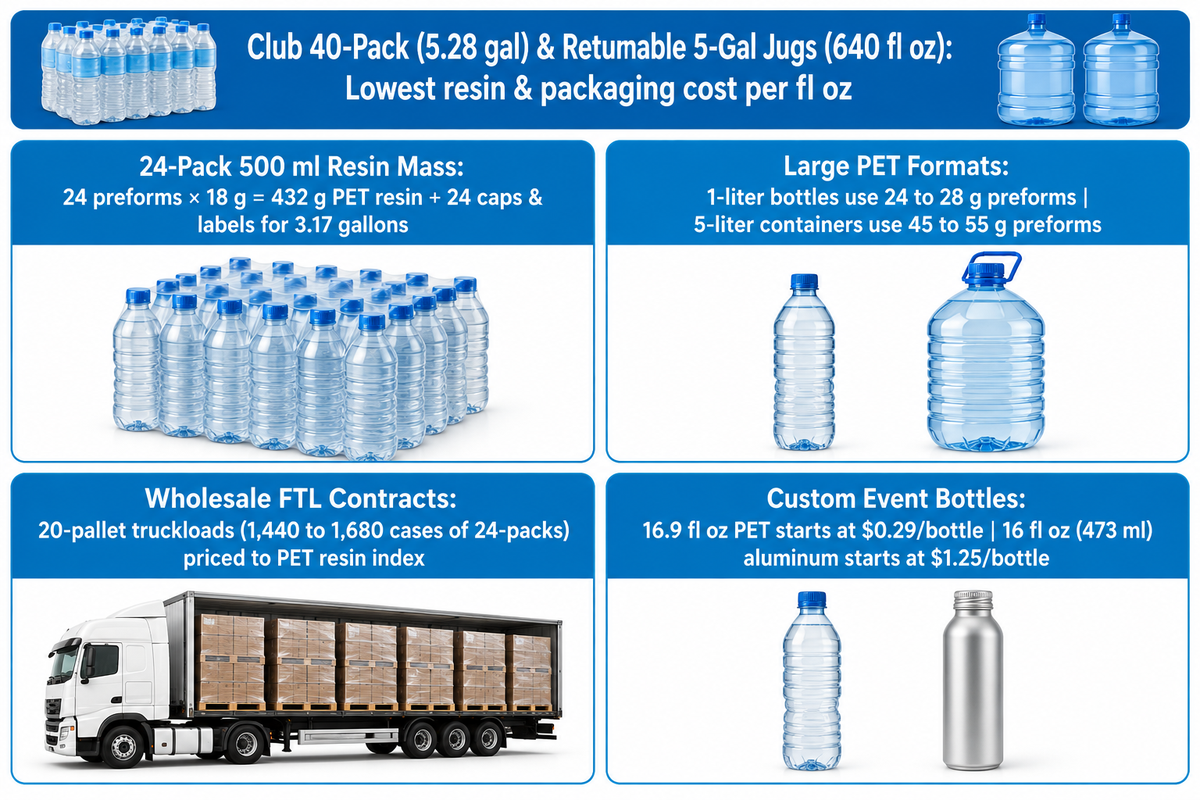
A 40-pack wholesale club case of 16.9 fl oz bottles (5.28 US gallons) and returnable 5-gallon dispenser jugs (640 fl oz) have lower primary resin and packaging costs per fluid ounce than 24-pack supermarket cases (3.17 US gallons) or convenience single-serve bottles.
Is It Cheaper to Buy a Case of Water or Gallons of Water?
Buying a case of 40 from a warehouse club (5.28 US gallons) or refilling returnable 5-gallon dispenser jugs (640 fl oz) requires far less plastic resin per gallon than buying 24-pack single-serve cases. In conventional grocery stores, bulk 1-gallon and 5-gallon containers can cost less per fluid ounce than 24-pack cases.
Why does primary and secondary packaging format drive the unit cost difference? According to BottlePreform’s PET preform weight data, packaging 3.17 gallons into twenty-four 500 ml still-water bottles consumes 24 preforms at 18 grams each (432 grams of PET resin), 24 caps, 24 labels, and shrink film. In contrast, 1-liter containers use 24 to 28 gram preforms and 5-liter containers use 45 to 55 gram preforms. Washing returnable 5-gallon bottles on commercial 5-gallon polycarbonate bottle washing and filling lines spreads container cost across dozens of refill cycles.
Where’s the Cheapest Place to Buy a Case of Water?
The lowest retail case prices are found at warehouse clubs (Costco Kirkland Signature, Sam’s Club Member’s Mark) and high-turn discount grocers, who sell 40-pack (5×8) bundles directly off 48-case floor pallets. Commercial buyers ordering full 20-pallet truckloads (1,440 to 1,680 cases of 24-packs) directly from co-packers receive quote-based contract pricing tied to PET resin index rates.
For promotional events requiring custom labeled bottles, unit pricing reflects short-run waterproof BOPP label setup. According to MyLabelWater’s commercial bottled water guide, custom 16.9 fl oz PET water bottles start at $0.29 per bottle, while resealable 16 fl oz (473 ml) aluminum water bottles start at $1.25 per bottle.
| Purchasing Channel & Format | Net Water Volume | Primary Resin per Unit | Published Starting Price | Pallet Case Density | Primary Cost Driver |
|---|---|---|---|---|---|
| Warehouse Club 40-Pack (16.9 oz) | 5.28 gal (676 fl oz) | 9.5–18 g PET preform/bottle | Quote-based club pallet tier | 48 to 60 cases / pallet | Full-pallet floor display; 5×8 tray economy |
| Supermarket Retail 24-Pack (16.9 oz) | 3.17 gal (405.6 fl oz) | 18 g still / 20 g carbonated PET | Quote-based FTL contract | 72 to 84 cases / pallet | Shelf stocking labor & 24-pack film tare |
| 1-Liter Hospitality Case (12-Pack) | 3.17 gal (405.6 fl oz) | 24–28 g PET preform/bottle | Quote-based distributor tier | 60 to 72 cases / pallet | Heavier 28 mm preform & RSC box walls |
| 5-Liter Bulk Container (4-Pack) | 5.28 gal (20.0 L) | 45–55 g PET preform/jug | Quote-based wholesale tier | 48 cases / pallet | Low cap-to-liter ratio & thick-wall blow mold |
| Custom-Labeled 16.9 oz PET (Pallet) | 3.17 gal (24-pack) | 18 g PET preform + BOPP label | $0.29 / bottle (MyLabelWater) | 72 cases / pallet (30 lb box) | Custom waterproof label setup & LTL freight |
| Custom 16 oz Resealable Aluminum | 3.00 gal (24-pack) | Rigid aluminum bottle + screw cap | $1.25 / bottle (MyLabelWater) | 60 to 72 cases / pallet | Aluminum can body & threaded closure |
Source: Compiled from MyLabelWater, BottlePreform, and BottleYourBrand specifications.
How Many Cases of Water Do You Need for Events, Crews, and Emergency Storage?
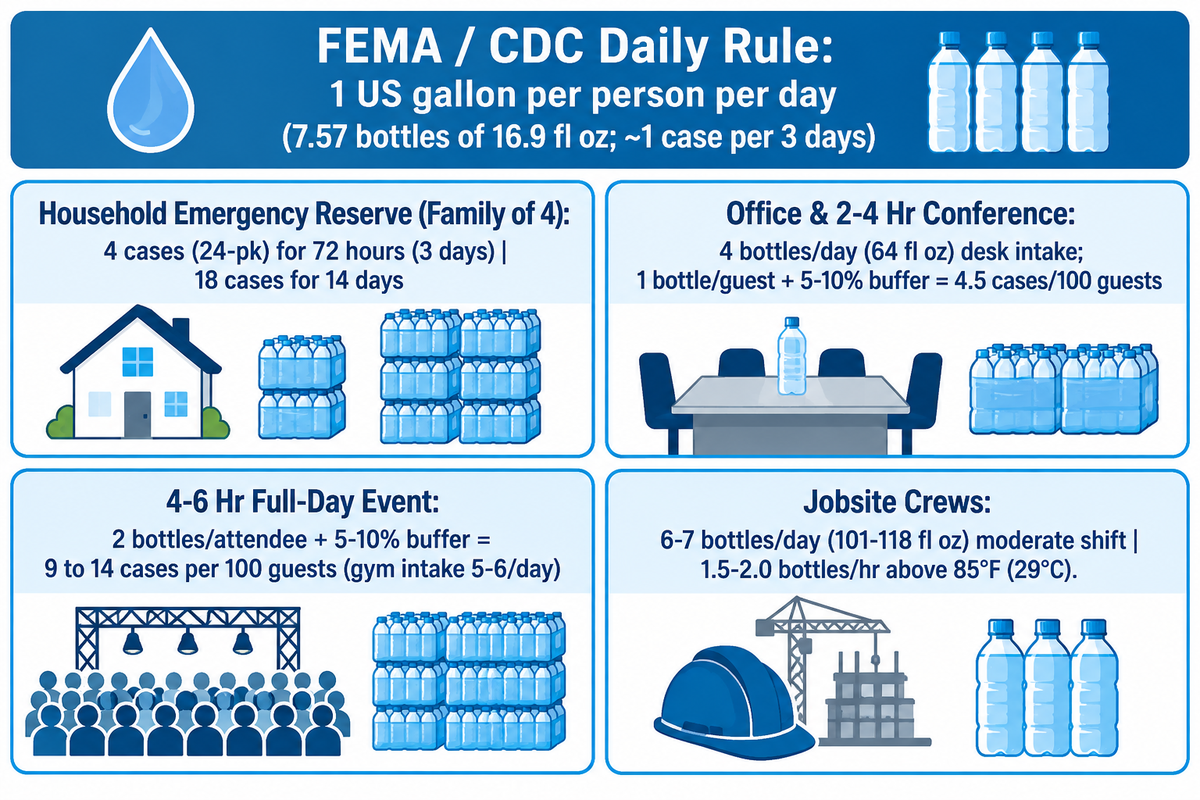
For emergency preparedness, FEMA and the CDC recommend 1 US gallon of water per person per day (7.57 bottles of 16.9 fl oz). That’s about one 24-pack case per person every 3 days. For events, plan 1 bottle per attendee for short indoor meetings and 2 bottles for full-day outdoor gatherings.
Sizing a bottled water order requires matching the right bottle and case count to ambient heat and duration. According to FEMA emergency supply guidelines and CDC emergency water directives, each household must store a minimum of 1 gallon per person per day for 3 days. In hurricane and seismic zones, according to IBWA storage guidelines, a 14-day supply is recommended. Because one 24-pack holds 3.17 gallons, a family of four needs 4 cases for 72 hours or 18 cases for two weeks.
For daily hydration and commercial events, adult consumption scales with temperature per Glacier Fresh daily bottle intake data and MyLabelWater event planning guidelines:
- Office and half-day conferences: Desk workers drink about 4 bottles per day (64 fl oz). For a 2-to-4-hour conference, budget 1 bottle per attendee plus a 5 to 10 percent buffer (4.5 cases of 24-packs per 100 guests).
- Events with 4-to-6 hour duration: Budget 2 bottles per attendee. Allow 9-to-14 cases per 100 guests. Gym-goers drink 5 to 6 bottles per day. Budget 2 bottles per attendee for a 4-to-6-hour event plus a 5 to 10 percent buffer (9 to 14 cases per 100 guests).
- Industrial and construction crews: Outdoor workers in hot weather require 6 to 7 bottles (101 to 118 fl oz) per day during moderate shifts. During heavy heat stress conditions exceeding 85°F (29°C), intake rises to 1.5 to 2.0 bottles per hour.
| Planning Scenario | Target Allowance per Person | People Served per 24-Pack | 24-Packs Needed (per 100 People) | 40-Packs Needed (per 100 People) |
|---|---|---|---|---|
| Half-Day Indoor Conference (2–4 hrs) | 1.1 bottles (with guest buffer) | 21.8 people | 5 cases (120 bottles) | 3 cases (120 bottles) |
| Full-Day Event / Outdoor Wedding (6 hrs) | 2.2 to 3.3 bottles (with guest buffer) | 7.2 to 10.9 people | 10 to 14 cases (240–336 bottles) | 6 to 9 cases (240–360 bottles) |
| Industrial / Jobsite Crew (8-hr Shift, >85°F) | 7 to 12 bottles per worker/shift | 2.0 to 3.4 workers | 30 to 50 cases per shift | 18 to 30 cases per shift |
| FEMA 72-Hour Emergency Reserve | 3.0 gal (22.7 bottles / 3 days) | 1.05 people for 3 days | 95 cases (1.32 GMA pallets) | 57 cases (1.19 club pallets) |
| FEMA 14-Day Disaster Stockpile | 14.0 gal (106 bottles / 14 days) | 0.23 people (4.42 cases/person) | 442 cases (6.14 GMA pallets) | 265 cases (5.52 club pallets) |
Source: Based on the FEMA and CDC 1-gallon-per-person-per-day standards.
Secondary Packaging Engineering: Film-Only Bundles vs. Corrugated Trays and Wrap-Around Cases
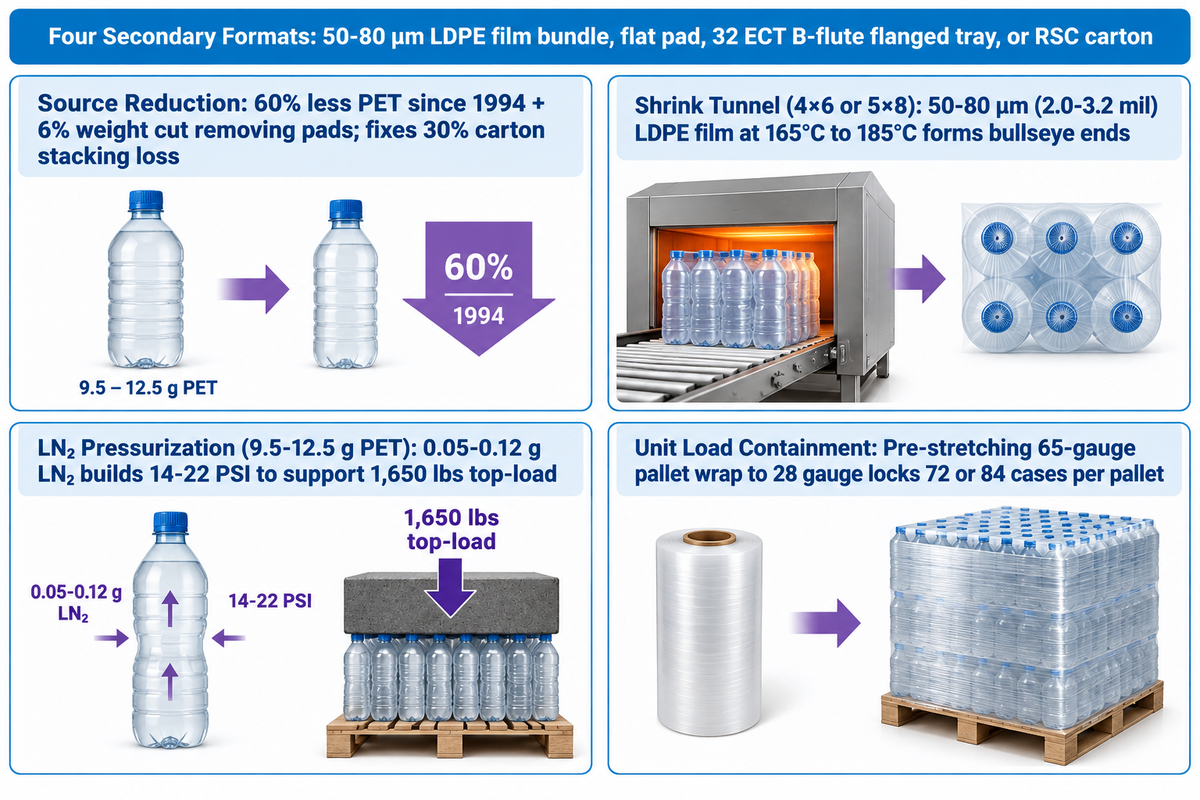
Commercial water bottlers package 24-pack and 40-pack cases using four secondary formats: film-only shrink bundles (50 to 80 micron LDPE), corrugated flat pads with film, flanged trays (32 ECT B-flute) with film, or wrap-around RSC cartons. Plants use 60 to 75 micron film bundles for nitrogen-dosed 9.5 to 12.5 g bottles and flanged trays for 40-pack club pallets.
Over the past three decades, primary water bottle engineering changed dramatically. According to Lantech’s PET bottle source-reduction study, bottlers cut plastic content in half-liter PET water bottles by 60% since 1994. Eliminating corrugated pads in favor of film-only bundles reduced total packaging weight by another 6%. Replacing corrugated boxes with shrink film also eliminated the 30% stacking-strength loss of non-square cartons, shifting 100% of vertical pallet load onto the PET bottles.
” Logistics and distribution environments experience some of the highest pallet failure rates. Replacing corrugated cases with shrink film solved the 30% case stacking strength issue, leaving thin-wall PET bottles susceptible to crushing and load failure without nitrogen dosing and calibrated containment force.
Lantech Packaging Engineering Report, Stretch Wrapping Bottled Water & Source Reduction
Ultra-lightweight 9.5 to 12.5 gram 500 ml still-water PET bottles in film-only bundles collapse under 6-layer pallet loads without corrugated walls or liquid nitrogen (LN2) dosing. Plants blow these thin-wall containers on fully automatic rotary and linear PET stretch blow molding machines. Dosing 0.05 to 0.12 grams of liquid nitrogen right before capping pressurizes each bottle to 14 to 22 PSI. That internal pressure turns a thin PET cylinder into a rigid column that supports 1,650 pounds of static top-load on the bottom pallet layer.
Downstream, automated bottle packaging and shrink-wrap case packing systems wrap each 4×6 or 5×8 pack in 50 to 80 micron (2.0 to 3.2 mil) LDPE shrink film. Heat tunnels operating at 165°C to 185°C shrink the film tightly and form bullseye openings on both ends. As Robopac USA beverage pallet wrapping studies and USPTO Patent US10407595B2 confirm, pre-stretching 65-gauge pallet wrap to 28 gauge locks all 72 or 84 cases into a stable unit load.
| Secondary Packaging Format | Film & Board Specification | Minimum 500 ml Preform Weight | LN2 Pressurization Required? | Best Retail / Logistics Channel |
|---|---|---|---|---|
| Film-Only Bullseye Bundle | 60–75 µm (2.4–3.0 mil) LDPE shrink film; zero cardboard | 9.5–12.5 g (with LN2) or ≥15.5 g (still) | Mandatory below 14 g preform (14–22 PSI) | Supermarket 24-packs & 32-packs (lowest BOM cost) |
| Corrugated Flat Pad + Shrink Film | 32 ECT B-flute bottom pad + 55–65 µm LDPE film | 10.5–14.0 g PET preform | Recommended for 6–7 layer pallets | Regional grocery 24-packs on roller conveyors |
| Flanged Corrugated Tray + Shrink Film | 32 ECT B-flute 38–55 mm wall tray + 50–65 µm film | 9.5–13.5 g PET preform | Mandatory for 40-pack 5×8 club trays | Costco / Sam’s Club 35-pack & 40-pack pallet displays |
| Wrap-Around Corrugated RSC Carton | 32–44 ECT B/C-flute enclosed die-cut blank; hot-melt glue | 18.0–28.0 g PET or glass bottles | Not required (carton walls bear top load) | Export containers, e-commerce parcel, premium 1 L water |
Source: Compiled from Lantech, Packaging Digest, and MassTech secondary packaging standards.
Commercial Bottling Line Sizing: Matching RO Water Treatment and Filler BPH to Case Packer Speed
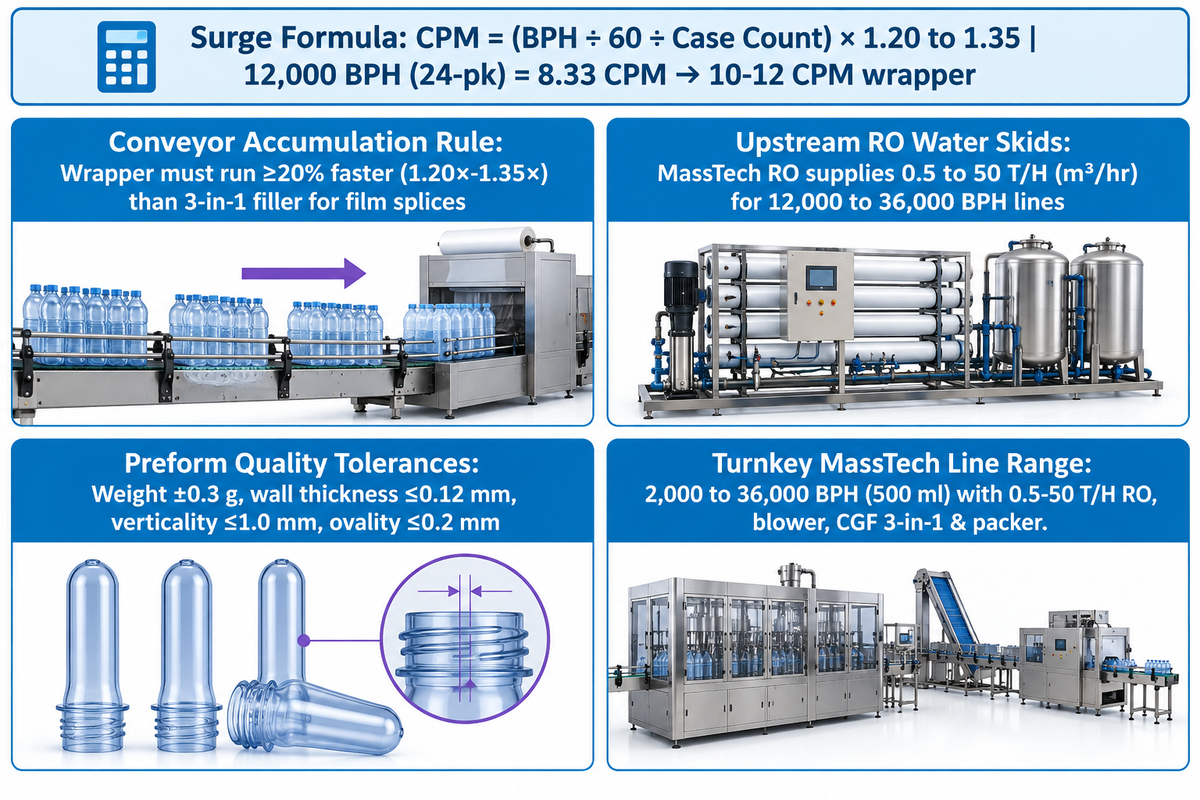
To size a 500 ml (16.9 fl oz) water bottling line, divide filler speed in bottles per hour (BPH) by 60 minutes and by case count (24 or 40), then multiply by a surge factor of 1.20 to 1.35. A 12,000 BPH line outputs 8.33 cases/min (24-pack), needing a 10 to 12 CPM shrink wrapper.
In a case study by Packaging Digest, if the shrink wrapper isn’t running at least 20% faster than the 3-in-1 rinse-fill-cap water bottling monoblock, immediately backups occur on the conveyor. As highlighted in Packaging Digest multipurpose bottling line case studies, sizing the case packer at 1:1 nominal filler speed causes immediate conveyor backups. Every film-roll splice or tray reload stalls the filler unless the shrink wrapper runs at 1.20 to 1.35 times the speed of the 3-in-1 rinse-fill-cap water bottling monoblock .
Upstream, incoming municipal or borehole water passes through MassTech beverage-grade reverse osmosis water treatment systems. MassTech RO skids supply 0.5 to 50 T/H (m³/hr) of purified water for rinsing and filling. High-speed starwheel transfer at 12,000 to 36,000 BPH also requires strict preform accuracy. Incoming preforms must meet BinPallet’s PET preform quality tolerances: weight variation within ±0.3 g, wall thickness variation ≤0.12 mm, verticality ≤1.0 mm, and ovality ≤0.2 mm.
Which Manufacturers Supply Turnkey Automated Water Bottling, Shrink-Wrap Case Packing, and Palletizing Lines?
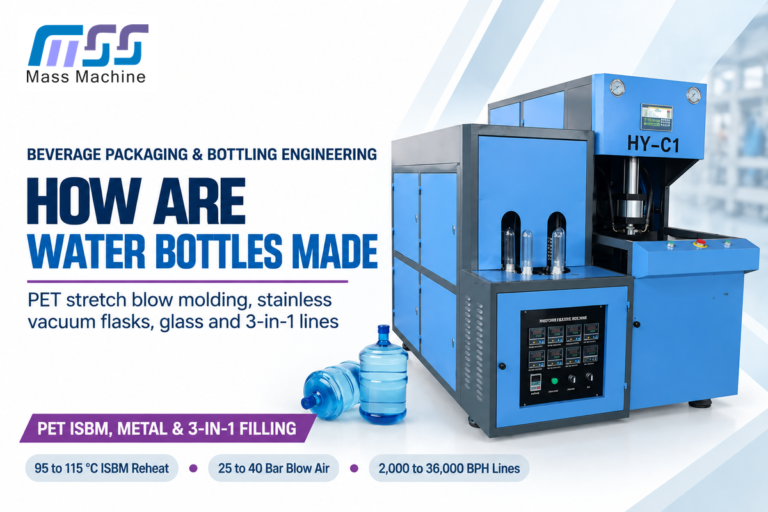
Zhangjiagang Mass Technology Co., Ltd. (MassTech) manufactures turnkey PET water bottling lines from 2,000 to 36,000 BPH (500 ml). Each line incorporates RO water treatment (0.5 to 50 T/H), PET stretch blow molding, CGF 3-in-1 rinse-fill-cap monoblocks, shrink-film or tray case packers, and palletizers.
| 3-in-1 Monoblock Speed (500 ml) | Nominal 24-Pack Output | Nominal 40-Pack Output | Required Case Packer Speed (1.25× Surge) | Net Product Water Demand | Recommended MassTech RO Skid |
|---|---|---|---|---|---|
| 3,000 BPH (CGF 14-12-5) | 2.08 CPM (125 cs/hr) | 1.25 CPM (75 cs/hr) | 3 to 5 CPM linear shrink wrapper | 1.50 T/H (m³/hr) | 2.0 to 3.0 T/H RO skid |
| 6,000 BPH (CGF 18-18-6) | 4.17 CPM (250 cs/hr) | 2.50 CPM (150 cs/hr) | 6 to 8 CPM shrink wrapper | 3.00 T/H (m³/hr) | 4.0 to 5.0 T/H RO skid |
| 12,000 BPH (CGF 32-32-10) | 8.33 CPM (500 cs/hr) | 5.00 CPM (300 cs/hr) | 10 to 12 CPM continuous wrapper | 6.00 T/H (m³/hr) | 8.0 to 10.0 T/H RO skid |
| 18,000 BPH (CGF 40-40-12) | 12.50 CPM (750 cs/hr) | 7.50 CPM (450 cs/hr) | 16 to 18 CPM tray & film packer | 9.00 T/H (m³/hr) | 12.0 to 15.0 T/H RO skid |
| 24,000 BPH (CGF 50-50-15) | 16.67 CPM (1,000 cs/hr) | 10.00 CPM (600 cs/hr) | 22 to 25 CPM high-speed wrapper | 12.00 T/H (m³/hr) | 16.0 to 20.0 T/H RO skid |
| 36,000 BPH (CGF 72-72-18) | 25.00 CPM (1,500 cs/hr) | 15.00 CPM (900 cs/hr) | 32 to 35 CPM dual-lane wrapper | 18.00 T/H (m³/hr) | 25.0 to 30.0 T/H RO skid |
Source: MassTech CGF 3-in-1 Water Filling Machine and Reverse Osmosis Engineering Specifications (masstechx.com).
When preparing a request for quotation (RFQ) for a turnkey water bottling plant, copy the specification checklist below into your inquiry. Equipment suppliers use the six parameters to size the blower, filler, and shrink wrapper around the same pack matrix.
RFQ checklist — copy these into your quote request:
| Parameter | Recommended range | Why it matters | How to verify |
|---|---|---|---|
| Bottle volumes & neck finish | 237 ml (8 oz), 500 ml (16.9 oz), 1,000 ml (1 L); 28 mm PCO 1881 or 29/25 neck | Locks starwheel pocket pitch, capper chuck profile, and preform feed rails | Provide 2D preform & bottle drawings (±0.3 g weight, ≤0.2 mm ovality) |
| Target case collation matrices | 4×6 (24-pack), 4×8 (32-pack), 5×8 (40-pack), 3×4 (12-pack 1 L) | Determines multi-lane divider rails, tray loader width, and film roll width | Run 30-minute changeover trial across 24-pack and 40-pack recipes during FAT |
| Shrink wrapper surge speed (CPM) | 1.20× to 1.35× nominal filler CPM (10–12 CPM for 12,000 BPH 24-packs) | Prevents 30-second film splice stops from backing up the 3-in-1 rotary filler | Verify accumulation conveyor buffer (≥45 seconds) during continuous FAT run |
| PET preform weight & LN2 dosing | 9.5–18.0 g preform; 0.05–0.12 g liquid nitrogen dosing (14–22 PSI internal) | Prevents bottom-tier pallet crush on 6-layer film-only bundles | Measure sealed bottle top-load (≥180 N) and internal pressure after 24 hrs |
| LDPE shrink film & tray grade | 50–80 µm (2.0–3.2 mil) co-extruded LDPE film; 32 ECT B-flute tray | Holds 26.4 to 45.8 lb bundles rigid during forklift handling and 72-case stacking | Inspect bullseye seal symmetry after 165–185 °C tunnel pass and drop-test 3 cases |
| Upstream RO water treatment capacity | 1.30× to 1.45× net filler flow (8–10 T/H RO skid for 12,000 BPH) | Supplies continuous rinsing, CIP sanitation, and purified product water | Review raw water report and verify permeate conductivity during commissioning |
Frequently Asked Questions
Q: How Many 16.9 oz Water Bottles Make a Gallon, and How Many Gallons Are in a 24-Pack?
Seven point five seven (7.57) standard 16.9 fl oz (500 ml) water bottles equal one US liquid gallon (128 fluid ounces), and a 24-pack case holds 3.17 US gallons (12.0 liters).
Dividing 128 fluid ounces by 16.907 fluid ounces per half-liter bottle gives 7.5708 bottles per gallon. Drinking 8 full bottles provides 135.2 fluid ounces (1.056 gallons). Multiplying 24 bottles by 16.9 fluid ounces yields 405.6 fluid ounces (3.17 gallons). A 40-pack wholesale club case provides 676.0 fluid ounces, which equals 5.28 US gallons or 20.0 liters.
Q: Why Is a Standard Single-Serve Water Bottle 16.9 Fluid Ounces Instead of 16 Ounces?
Standard single-serve water bottles hold 16.9 US fluid ounces because global PET stretch blow molds are standardized on the metric 500-milliliter (0.5-liter) volume.
One US fluid ounce equals 29.5735 milliliters. Dividing 500 milliliters by 29.5735 equals 16.907 US fluid ounces. Under US FDA 21 CFR 101.7 and NIST Handbook 133 dual-declaration labeling rules, North American beverage brands print both measures on the front label. Every standard bottle of water reads 16.9 FL OZ (1.05 PT) (500 mL).
Q: How Many Cases of Bottled Water Can You Stack High in a Warehouse Without Crushing?
Standard 24-pack cases of 16.9 oz PET water stack 6 to 7 layers high (72 to 84 cases) on a single 48×40 inch GMA wood pallet.
In warehouse floor storage, full pallets of lightweight PET water bottles (9.5 to 12.5 gram preforms in shrink film) should be stacked no more than 2 pallets high. Stacking 3 pallets high requires liquid nitrogen pressurization (14 to 22 PSI) or selective steel pallet racking. Exceeding 2 pallets high on open floors deforms bottom-tier bottles and causes pallet lean.
Q: How Do You Calculate Shrink-Wrapper Speed (CPM) and Reverse Osmosis Capacity for a Water Bottling Plant?
Divide your filler speed in bottles per hour (BPH) by 60 minutes and by the case bottle count, and multiply by 1.20 to 1.35 to size the shrink-wrap case packer in cases per minute (CPM).
For example, a 12,000 BPH monoblock filling 500 ml bottles into 24-packs outputs 200 bottles per minute, or 8.33 nominal cases per minute. With a 1.25 surge, a continuous shrink wrapper would run at 10.5-12 cases per minute. Multiplying 8.33 CPM by a 1.25 surge factor requires a 10.5 to 12 CPM continuous shrink wrapper so accumulation conveyors clear smoothly after a film splice. Upstream, 12,000 bottles per hour at 0.5 liters each equates to 6,000 liters per hour (6.0 T/H) of finished water. Accounting for RO concentrate reject, bottle rinsing, and CIP, the MassTech RO system would be sized at 8.0-10.0 T/H.
Q: How Many 8 oz Mini Water Bottles Come in a Case and on a Pallet?
A retail case of 8 fl oz (237 ml) mini water holds 24 or 48 bottles (70 at Costco).
On a 48×40 inch GMA pallet, 24-pack 8 oz cases stack 20 cases per layer by 6 layers high, totaling 120 cases or 2,880 mini bottles.
Q: How Long Does a Sealed Case of Bottled Water Last in Storage?
Under US FDA 21 CFR 165.110 rules, bottled water has no mandatory expiration limit, though bottlers print an 18-to-24-month best-by date for taste quality.
As detailed in Food Safety Magazine’s FDA 21 CFR 177.1630 PET stability review, polyethylene terephthalate is slightly gas-permeable over multi-year storage. Store sealed cases at 50°F to 70°F (10°C to 21°C) out of direct sunlight. Always place cases on wood or plastic pallets off bare concrete floors away from fuel or chemical fumes.
Planning a Commercial Water Bottling & Shrink-Wrap Case Packing Line?
Share your target bottle volumes (237 ml to 1.5 L), case collation formats (24-pack 4×6 or 40-pack 5×8), and hourly output target (2,000 to 36,000 BPH) with Zhangjiagang Mass Technology Co., Ltd. Our engineers will configure a matched RO water treatment skid, PET blow molder, CGF 3-in-1 filling monoblock, and case packing layout.
Engineering & Editorial Disclosure: This technical guide was prepared by the beverage packaging engineering team at Zhangjiagang Mass Technology Co., Ltd. (MassTech). Volumetric conversions follow NIST Handbook 133 and US FDA 21 CFR 101.7 standards. Emergency water allowances follow FEMA and CDC guidelines, and pallet weights reflect standard GMA 48×40 inch and US DOT 80,000 lb GVW limits.
References & Sources
- NIST Handbook 133: Checking the Net Contents of Packaged Goods National Institute of Standards and Technology (U.S. Department of Commerce)
- Bottled Water Storage & FDA 21 CFR 165.110 Quality Standards International Bottled Water Association (IBWA)
- Emergency Preparedness Water Supply Guidelines (1 Gallon per Person per Day) Federal Emergency Management Agency (FEMA / U.S. Department of Homeland Security)
- CDC Emergency Water Supply Minimum Guidelines U.S. Centers for Disease Control and Prevention (CDC)
- Polyethylene Terephthalate (PET): The Safety and Storage Stability of Bottled Water (FDA 21 CFR 177.1630) Food Safety Magazine
- US Patent US10407595B2: Multipack PET Bottle Collation and Shrink Wrap Reduction United States Patent and Trademark Office (USPTO)
- Versatile Wraparound Case and Tray Packing for Private-Label Bottled Water Packaging World
- Multipurpose Beverage Bottling Case and Tray Shrink Packing Operations Packaging Digest
- Bottled Water Packaging Market Size & Growth Report (2026–2033) Grand View Research
- Global Bottled Water Packaging Market Share Analysis Market Research Future (MRFR)