Get in Touch with Masstech

Soda Can Size: Complete Dimensions Chart (12 oz, Mini, Slim, Sleek & Tallboy) + Canning Line Guide

Contents
show
Beverage Packaging & Canning Line Engineering Guide
By CYH, Packaging & Beverage Line Engineer at Zhangjiagang Mass Technology Co., Ltd. (MassTech),
This document includes comments and observations on the CMI and CFIA standards.
Choosing the correct soda can size influences downstream decisions on a beverage production line. A 2 mm difference in can size affects starwheel geometry, line changeover, a twist rinser, a double-seamer chuck, and a counter-pressure filling valve. Consumers are not packaging engineers and do not distinguish between a regular soda or Coca-Cola container and a 12 oz drink. Packaging engineers differentiate finished and seamed dimensions of a can and unseamed brite-can dimensions. They take these into account when choosing a can size.
This document analyzes beverage industry for carbonated soft drink packaging across the global market. It outlines the choice of materials used in the production of energy drinks, hard seltzers, and craft beers. In the modern soda industry, selecting the right format starts with understanding all cans available. This document breaks down soda can dimensions in inches, centimeters and millimeters. This includes various formats and sizes of single serve canned beverages. It outlines how each of these sizes relate to tooling used in rotary canning line and what label sizes correspond to these can sizes.
Quick Engineering Reference: Standard 12 oz (355 ml) US Soda Can (211 × 413)
- Net Liquid Volume: 12 US fl oz (355 ml); overflow brimmer capacity is 372 to 375 ml (~4.8% headspace).
- Finished Seamed Height: 4.83 in (12.27 cm / 122.68 mm) after double seaming.
- Unseamed Brite Flange Height: 4.812 in (122.22 mm) per Can Manufacturers Institute (CMI) standards.
- Outside Body Diameter (211 Body): 2.60 in (6.60 cm / 66.04 mm); outer circumference is 8.17 in (207.47 mm).
- Lid End Specification (202 End): 2.063 in (52.40 mm) neck plug inside diameter; 2.13 in (54.10 mm) finished seamed lid outside diameter.
- Tare & Gross Weight: 14.9 g (0.53 oz) empty aluminum can weight; ~370 g (13.05 oz) to 384 g (13.5 oz) filled.
What Is the Standard Soda Can Size in Inches, Millimeters, and Ounces?
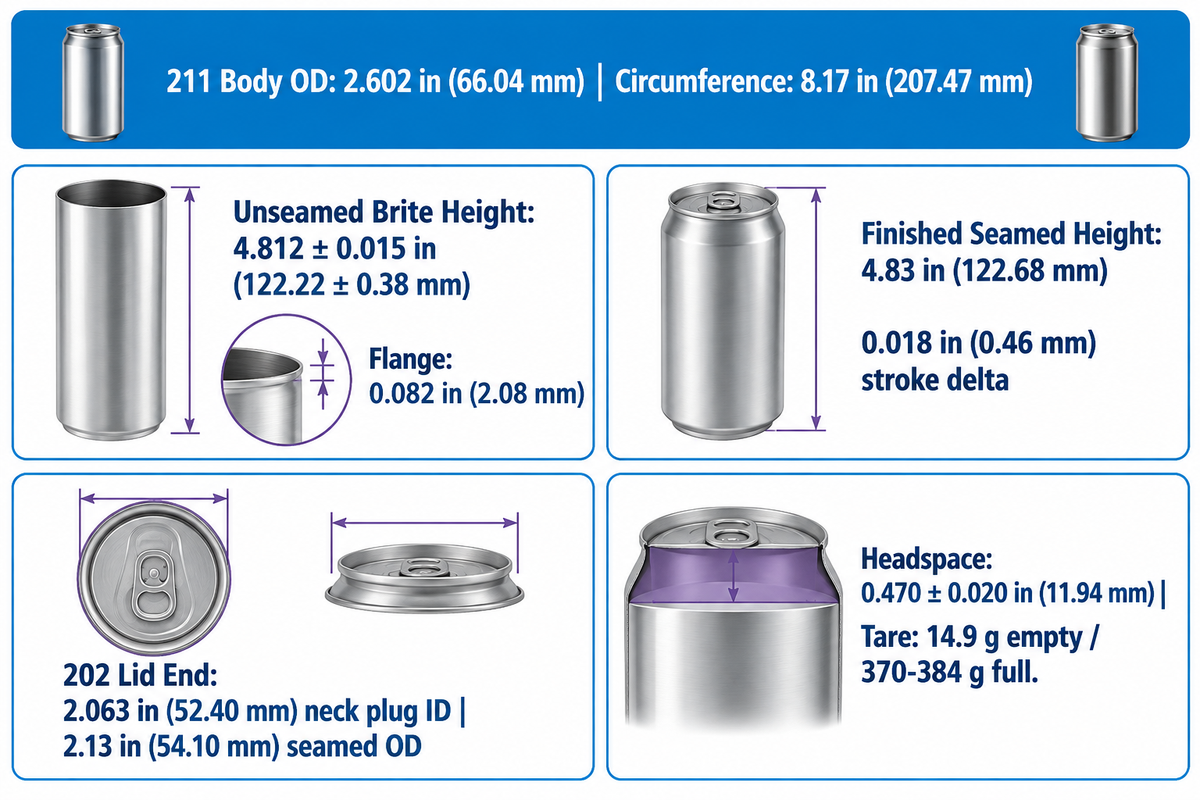
A North American standard size soda can holds 12 US fluid ounces (355 ml). It measures 4.83 inches (122.68 mm) in height and 2.60 inches (66.04 mm) in body diameter. The seamed 202 lid has a diameter of 2.13 inches (54.10 mm) and an empty can weighs 14.9 grams (according to InchesGuide and CMI 202 standards).
In North America, a typical “regular” soda can is 12 ounces (355 ml) and carries code 211×413. Plant engineers ordering empty brite cans should not set filler strokes using the retail measurements. Empty standard aluminum cans are delivered on bulk pallets with an open top flange.
According to the official CMI 202 Beverage Can and End Specifications, an unseamed 12 oz can stands 4.812 ± 0.015 inches (122.22 ± 0.38 mm) tall. Its unseamed flange width measures 0.082 inches (2.08 mm), and the maximum flange diameter reaches 2.255 inches (57.28 mm) before seaming. Once the seamer crimps the 202 lid onto the body flange, the finished 12oz standard height settles at 4.83 inches (122.68 mm).
Even top packaging distributors occasionally mix up unseamed and finished numbers in public charts. For example, TricorBraun’s aluminum can FAQ lists the 4.81-inch unseamed height and 0.72-inch (18.3 mm) neck height for 12 oz cans. That table, however, gives nominal three-piece codes instead of actual two-piece drawn-and-wall-ironed (DWI) wall diameter codes. Calibrating filler lifter cylinders requires separating the 4.812-inch empty flange height from the 4.83-inch finished height. A 0.018-inch (0.46 mm) over-stroke crushes the thin neck shoulder before counter-pressure sealing begins.
| Dimensional Parameter (12 oz / 355 ml 211×413 Can) | Imperial Specification (in / oz) | Metric Specification (mm / cm / g) | Engineering Role on Canning Line |
|---|---|---|---|
| Body Outside Diameter (OD) | 2.602 in (ANC 2.600 in) | 66.04 mm (6.60 cm) | Sets starwheel pocket radius, guide rail width, and carton cell pitch |
| Outer Body Circumference | 8.17 in | 207.47 mm (20.75 cm) | Determines BOPP wrap label length and shrink-sleeve layflat width |
| Unseamed Flange Can Height | 4.812 ± 0.015 in | 122.22 ± 0.38 mm | Sets depalletizer sweep height and filler centering-bell lifter stroke |
| Finished Seamed Can Height | 4.83 in | 122.68 mm (12.27 cm) | Governs pasteurizer tunnel clearance, checkweigher gates, and case height |
| Neck Plug Inside Diameter (ID) | 2.063 in | 52.40 mm | Matches 202 end countersink plug fit and filler nozzle vent-tube centering |
| Unseamed Body Flange Width | 0.082 in | 2.08 mm | Forms the body hook during 1st-operation double seaming |
| Finished Seamed 202 Lid OD | 2.13 in (Unseamed curl: 2.340 in) | 54.10 mm (Unseamed curl: 59.44 mm) | Dictates 202 seaming chuck diameter and PakTech top-clip ring snap |
| Standard Headspace Depth | 0.470 ± 0.020 in | 11.94 mm | Provides ~17 to 20 ml gas expansion cushion above 355 ml liquid fill |
| Empty Tare vs. Full Weight | 0.53 oz empty / ~13.0–13.5 oz full | 14.9 g empty / 370–384 g full | Sets in-line X-ray fill-level rejection thresholds and pallet gross weight |
How Do Mini, Slim, Sleek, Standard, and Tallboy Soda Can Sizes Compare?
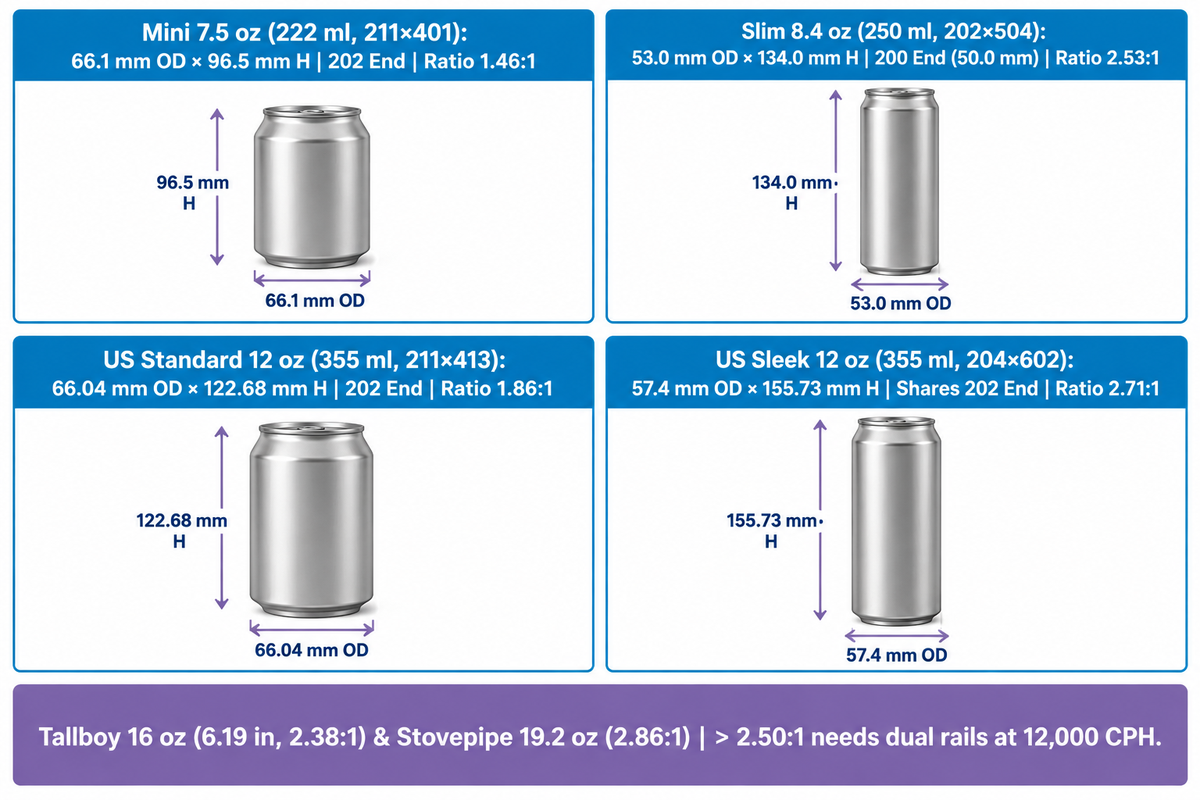
There are eight primary retail profiles for commercially-available beverage cans. Small formats include the 7.5 oz (222 ml) mini and 8.4 oz (250 ml) slim cans. Mainstream and bigger cans range from 330 ml and 355 ml up to 950 ml, spanning 3.80 to 7.60 inches high per Aluminum-Can.com and Cask data.
When beverage founders discuss beer can sizes and other soda formats, one expensive mistake is top of mind. During initial purchases, beer distributors sometimes confuse slim cans with other, thinner-walled, cans. Both formats hold single-serve beverages and project a premium hand-feel on retail shelves. Convenience stores also stock 16 oz tallboys and 19.2 oz stovepipes for cold-box grab-and-go displays.
A 250ml (8.4 oz) slim can uses a 202 body diameter (53.0 to 53.3 mm / 2.10 in). It requires a smaller 200 lid end measuring 50.0 mm across. By contrast, a 330 ml or 355 ml (12 oz) sleek can uses a 204 body diameter (57.4 mm / 2.26 in). That sleek body pairs with the standard 202 lid end (54.1 mm). As confirmed by lid compatibility engineering guides, an energy drink brand choosing a 12 oz sleek can keeps the exact same 202 lid inventory used on standard 12 oz cans. For specialty releases, beverage producers also evaluate 20 oz cans, 24 oz beverage containers, and 32 oz crowlers.
| Format Name | Volume (fl oz / ml) | Industry Code | Body OD (in / mm) | Height (in / mm) | Lid End | Slenderness Ratio | Primary Beverage Application |
|---|---|---|---|---|---|---|---|
| Mini Can | 7.5 oz (222 ml) | 211×312 / 401 | 2.60 in (66.1 mm) | 3.80 in (96.5 mm) | 202 | 1.46 : 1 | Portion-control colas, airline mixers, kids’ juice |
| Slim 250 | 8.4 oz (250 ml) | 202×503 / 504 | 2.09 in (53.0 mm) | 5.28 in (134.0 mm) | 200 | 2.53 : 1 | Energy drinks, RTD espresso, canned wine spritzers |
| Euro Standard / Stubby | 11.2 oz (330 ml) | 211×408 | 2.60 in (66.04 mm) | 4.54 in (115.19 mm) | 202 | 1.74 : 1 | European & Asian soft drinks, classic lager beer |
| Euro Sleek 330 | 11.2 oz (330 ml) | 204×512 | 2.26 in (57.4 mm) | 5.75 in (146.05 mm) | 202 | 2.54 : 1 | EU Coca-Cola, sparkling water, export RTDs |
| US Standard 12 oz | 12.0 oz (355 ml) | 211×413 | 2.60 in (66.04 mm) | 4.83 in (122.68 mm) | 202 | 1.86 : 1 | North American regular soda, sparkling water, standard beer |
| US Sleek 12 oz | 12.0 oz (355 ml) | 204×602 | 2.26 in (57.4 mm) | 6.13 in (155.73 mm) | 202 | 2.71 : 1 | Hard seltzers, prebiotic sodas, functional energy drinks |
| Australia Classic | 12.7 oz (375 ml) | 211×501 | 2.68 in (68.0 mm) | 5.08 in (129.0 mm) | 202 | 1.90 : 1 | Australian & NZ soft drinks and domestic beer cans |
| Tallboy / US Pint | 16.0 oz (473 ml) | 211×603 / 604 | 2.60 in (66.04 mm) | 6.19 in (157.23 mm) | 202 | 2.38 : 1 | Craft beer industry 4-packs, iced tea, 16 oz energy drinks |
| European Pint | 16.9 oz (500 ml) | 211×610 | 2.60 in (66.04 mm) | 6.61 in (167.84 mm) | 202 | 2.54 : 1 | European & UK 500ml beer, cider, and energy drinks |
| Stovepipe / C-Store | 19.2 oz (568 ml) | 211×707 | 2.60 in (66.04 mm) | 7.44 in (189.0 mm) | 202 | 2.86 : 1 | Convenience store single-serve high ABV IPAs, 24 oz / 24oz alternatives |
| Crowler | 32.0 oz (950 ml) | 307×710 / 400 | 2.86 in (72.6 mm) | 7.60 in (193.0 mm) | 300 | 2.66 : 1 | Taproom draft fills and specialty micro canning runs |
To evaluate conveyor stability across different can sizes, we apply The Neck-to-Body Slenderness Ratio (height divided by body diameter). A standard 12-ounce (211×413) can has a 1.86:1 slenderness ratio (122.68 mm divided by 66.04 mm). This low center of gravity keeps mini cans and standard cans stable during depalletizing. When a plant switches to a 12 oz sleek can (204×602), the ratio jumps to 2.71:1 (155.73 mm divided by 57.4 mm). A 19.2 oz stovepipe reaches 2.86:1. Any format exceeding a 2.50:1 ratio needs dual-rail Delrin side guides and vacuum transfer belts. Otherwise, empty 14.9-gram cans tip over at 12,000 cans per hour (CPH).
Consider a real production decision frequently discussed by packaging managers on r/beer practitioner threads. A regional co-packer running 12 oz standard (211×413) and 16 oz tallboy (211×604) cans launched a 12 oz sparkling water. Both 12 oz sleek (204×602) and 12 oz standard cans share the 202 end. Selecting sleek cans let the plant keep its existing 202 seamer chucks and lid feed magazines. Technicians only swapped the polymer starwheels and conveyor side guides. Had the brand chosen a 250 ml slim can (200 end), every changeover would have required a full seamer chuck rebuild.
Aluminum Can Anatomy and Three-Digit Industry Codes (211×413 vs 204×413)
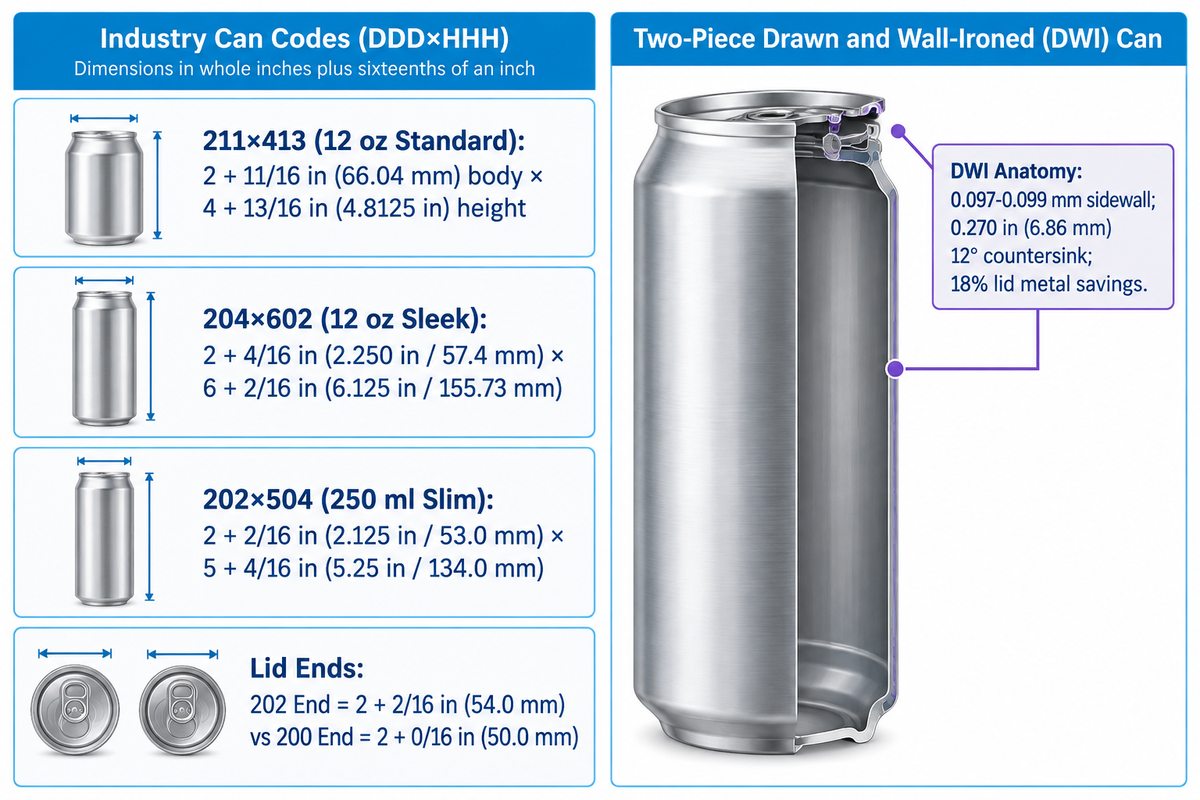
Packaging engineers specify aluminum beverage cans using a six-digit industry code (DDD×HHH). The first digit represents whole inches, and the next two digits represent sixteenths of an inch. A standard 12 oz can is 211×413, indicating a 2-11/16 inch nominal diameter class by 4-13/16 inch unseamed height per Levapack’s industry code guide.
Reading three digit can codes can prevent costly ordering mistakes between can suppliers and machinery builders. For any three digit group, the first digit is represented in whole inches and the last two digits are divided by 16.
- 211×413 (12 oz US Standard): Height is 4 + 13/16 inches = 4.8125 inches, matching the CMI 4.812 in unseamed height. The 211 body code equals 2 + 11/16 inches (2.6875 in historical seam diameter, or 66.04 mm drawn wall).
- 204×602 (12 oz US Sleek): Body code 204 equals 2 + 4/16 inches (2.250 in / 57.4 mm body diameter). Height code 602 equals 6 + 2/16 inches (6.125 in / 155.73 mm height).
- 202×504 (8.4 oz / 250 ml Slim): Body code 202 equals 2 + 2/16 inches (2.125 in / 53.0 mm body diameter). Height code 504 equals 5 + 4/16 inches (5.25 in / 134.0 mm height).
- 202 vs. 200 Lid End Codes: A 202 lid end denotes 2 + 2/16 inches (2.125 in / 54.0 mm nominal seamed diameter). A 200 lid end denotes 2 + 0/16 inches (2.000 in / 50.0 mm nominal seamed diameter).
Modern soda cans are Drawn and Wall-Ironed (DWI) two piece pressure vessels. The press cups, redraws, and irons the metal down to a 0.097 to 0.099 mm sidewall thickness. The base retains a thicker, concave dome. The top shoulder is necked in several stages to allow a 2.602 inch (211) body to accept a 2.063 inch (202) plug lid. As described in USPTO patents US20100044383A1 and US8757953B2, this lightweighting trend reduces the weight of the lid aluminum by approximately 18%. To resist internal pressures, a 0.270 inch (6.86 mm) deep countersink bead with a 12-degree wall angle is formed in AA5182-H48.
“Body Outside Diameter: 2.602 ± .007 in. (ANC 2.600 Nominal); Flange Width: .082 ± .008 in.; Flange Can Height: 4.812 ± .015 in.; Neck Plug Diameter: 2.063 ± .007 in.; Headspace: .470 ± .020 in.; 202 End Curl Diameter: 2.340 ± .006 in.; Countersink Depth: .270 ± .005 in.; Chuck Wall Angle: 12° Ref.”
Regional Soda Can Standards Across North America, Europe, Australia, and Asia
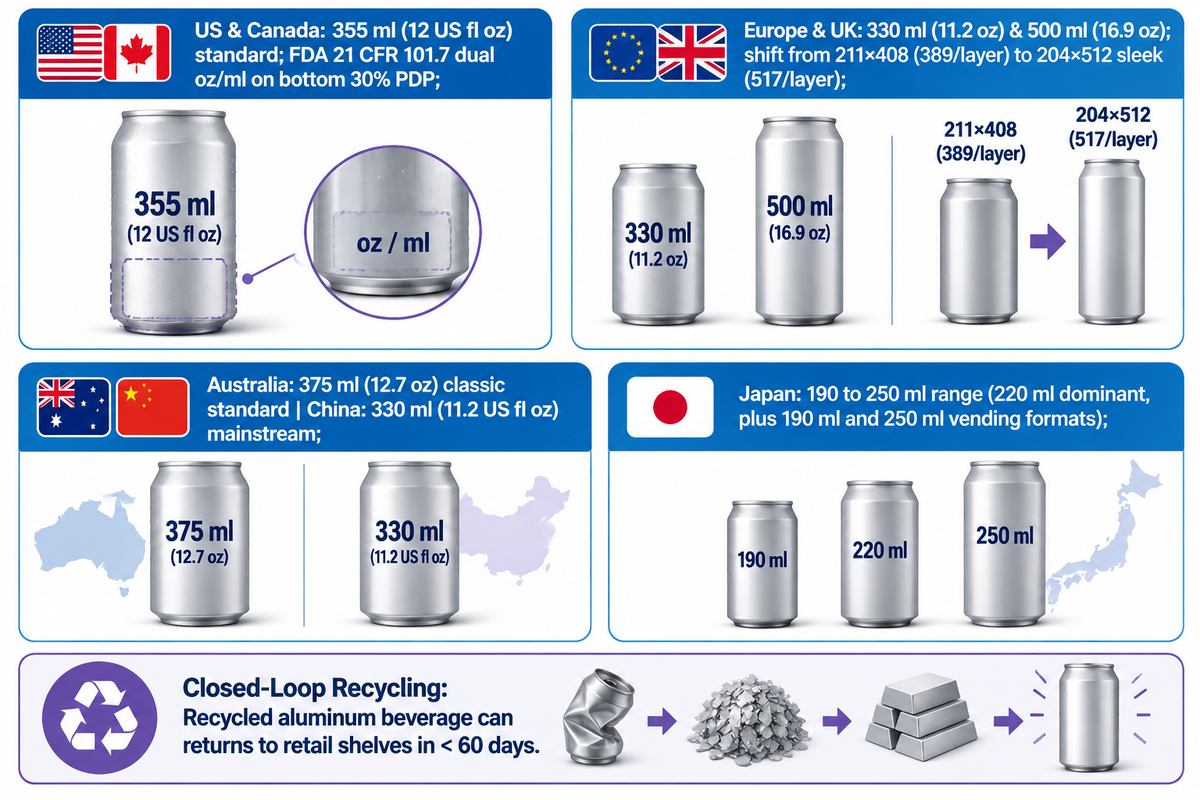
Global beverage cans uses different regional volume standards across its four primary markets. The 355 ml (12 US fl oz) standard is the dominant standard in both the US and Canada. Meanwhile, 330 ml (11.2 US fl oz) leads across Europe and China, 375 ml leads in Australia, and 190 ml to 250 ml cans dominate Japan per international beverage dimension benchmarks . The standard in Japan is a range of 190-250 ml, with the dominant standard being 220 ml, with the remainder being 190 and 250 ml. International beverage dimension benchmarks show 330 ml standard beverage cans dominate in most developed economies.
Why do global size differences persist despite the fact that aluminum coil stock is traded globally? In the United States, post-prohibition brewers and soft drink bottlers matched their early metal cans to the 12 oz glass bottle. Under US FDA 21 CFR 101.7, retail beverage containers sold in America must print dual net quantity declarations. Labels must show both US fluid ounces and metric milliliters on the bottom 30% of the principal display panel.
In Europe and the United Kingdom, metric packaging directives standardized single-serve soft drinks at 330 ml (11.2 oz). European brewers also standardized larger cans at 500ml (16.9 oz). Over the past five years, European brands shifted 330 ml production away from the traditional 211×408 stubby format (66.04 mm diameter). Most new lines now run the 204×512 Euro sleek format (57.4 mm diameter by 146.05 mm height). That geometry shift improves retail shelf presence and packs 517 cans per pallet layer instead of 389.
While sustainability pressures rising have maintained aluminum’s advantage against plastic and glass bottles and cans, aluminum can closures remain a challenge in recycling. According to Can Manufacturers Institute and Resource Recycling Systems (RRS) lifecycle tracking, a recycled aluminum can returns to retail shelves in less than 60 days. Closed-loop recycling is now the primary driver for reducing carbon footprint in beverage packaging. High recycled content reduces the total emissions across the entire supply chain.
How Big Is a Soda Can Label for 12 oz Standard, Sleek, and 16 oz Cans?
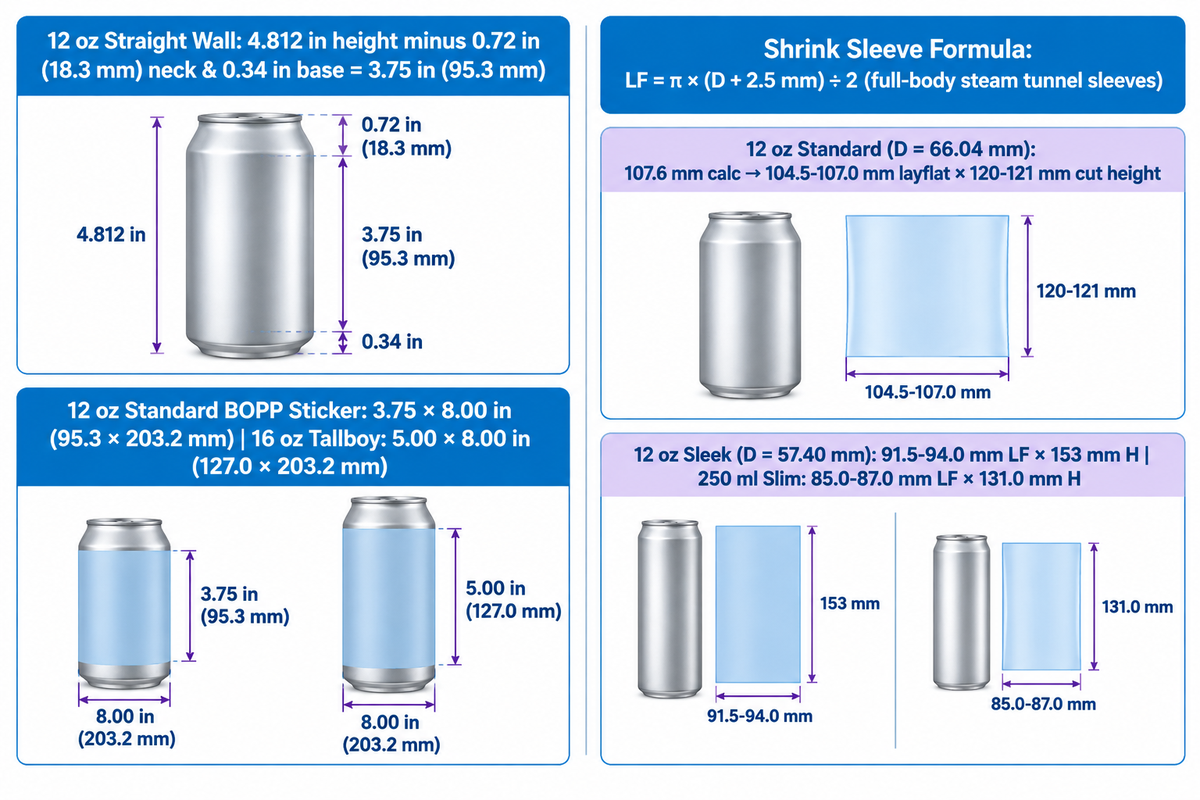
A standard 12 oz (211×413) soda can requires a 3.75-inch tall by 8.00-inch wide (95.3 × 203.2 mm) BOPP wrap label. Full-body shrink sleeves require a 104.5 mm to 107.0 mm layflat width by 121.0 mm cut height per circumference geometry and neck-height specifications.
Smaller producers and micro canning operations rarely meet the 150,000 can minimum order quantities for factory-printed cans. Rather, they purchase silver brite cans by the pallet and apply pressure-sensitive roll-fed BOPP labels or full-body heat-shrink sleeves made of PETG or OPS film.
A pressure-sensitive BOPP sticker can’t wrinkle around curved necks and domes. Its vertical height must be constrained to straight cylindrical walls. A 4.812-inch unseamed 12 oz standard can has a 0.72-inch (18.3 mm) top neck taper and a 0.34-inch bottom taper. That leaves exactly 3.75 inches (95.3 mm) of usable straight wall. Crossing into the 0.72-inch neck curve causes immediate edge flagging when cold cans sweat in retail coolers.
Full-body steam-tunnel shrink sleeves contour over the neck taper, and differ from standard calculations. Engineers compute the flat folded tube width (layflat, LF) from the outside body diameter (D) plus 2.5 mm film-slip clearance: LF = π × (D + 2.5 mm) ÷ 2. Let us run the exact worked example for two 355 ml formats:
- 12 oz Standard Can (D = 66.04 mm): Add 2.5 mm radial clearance to get a 68.54 mm target tube diameter. Multiply by π (3.1416) for a 215.3 mm circumference, then divide by 2 to get a 107.6 mm layflat width. Converters specify 104.5 to 107.0 mm layflat by 120 to 121 mm cut height.
- 12 oz Sleek Can (D = 57.40 mm): Add 2.5 mm clearance to get a 59.90 mm tube diameter. Multiply by π for a 188.2 mm circumference, then divide by 2 to get a 94.1 mm layflat width. Converters specify 91.5 to 94.0 mm layflat by 153 mm cut height.
This layflat formula is for full-body heat shrink sleeves only. Roll-fed pressure-sensitive BOPP wrap labels cannot shrink over the curved neck and must stay on the straight cylinder wall.
| Can Format & Code | Body Circumference | BOPP Sticker Size (H × W) | Shrink Sleeve Layflat Width | Shrink Sleeve Cut Height |
|---|---|---|---|---|
| 7.5 oz Mini (211×401) | 8.17 in (207.5 mm) | 2.75 × 8.00 in (69.9 × 203.2 mm) | 104.5 – 107.0 mm | 94.0 mm |
| 8.4 oz / 250 ml Slim (202×504) | 6.65 in (168.9 mm) | 4.25 × 6.50 in (108.0 × 165.1 mm) | 85.0 – 87.0 mm | 131.0 mm |
| 11.2 oz / 330 ml Standard (211×408) | 8.17 in (207.5 mm) | 3.50 × 8.00 in (88.9 × 203.2 mm) | 104.5 – 107.0 mm | 113.0 mm |
| 12 oz / 355 ml Standard (211×413) | 8.17 in (207.5 mm) | 3.75 × 8.00 in (95.3 × 203.2 mm) | 104.5 – 107.0 mm | 120.0 – 121.0 mm |
| 12 oz / 355 ml Sleek (204×602) | 7.10 in (180.3 mm) | 5.00 × 6.95 in (127.0 × 176.5 mm) | 91.5 – 94.0 mm | 153.0 mm |
| 16 oz / 473 ml Tallboy (211×604) | 8.17 in (207.5 mm) | 5.00 × 8.00 in (127.0 × 203.2 mm) | 104.5 – 107.0 mm | 155.0 mm |
Internal Carbonation Pressure, Wall Thickness, and Liner Specifications
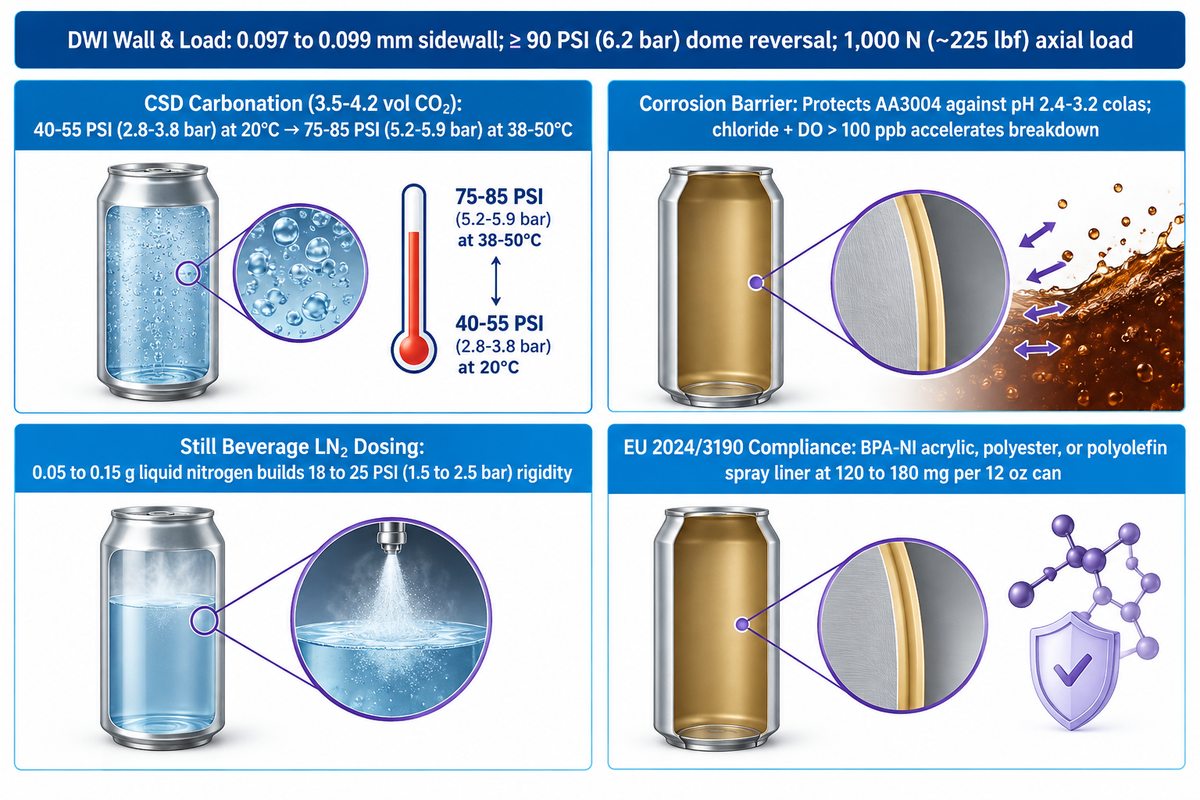
Two-piece DWI aluminum beverage cans feature a 0.097 to 0.099 mm thinned sidewall and a concave base dome. The vessel is engineered to withstand at least 90 PSI (6.2 bar) of internal dome-reversal pressure and 1,000 N (~225 lbf) of vertical axial load per structural beverage can standards.
A mid-wall thickness of 0.097 mm is barely thicker than household aluminum foil. Left unpressurized, an empty or still-liquid can, crushes easily by hand. It cannot survive 19-layer warehouse pallet stacking without internal gas pressure. What gives a filled soda can its column strength is The 90-PSI Dome-Reversal Margin.
Carbonated soft drinks formulated at 3.5 to 4.2 volumes of CO2 generate 40 to 55 PSI (2.8 to 3.8 bar) at 20°C. When filled cans pass through a 38°C warming tunnel or sit in a 50°C freight container, internal pressure climbs toward 75 to 85 PSI (5.2 to 5.9 bar). The concave bottom dome and 0.270-inch (6.86 mm) B64 or 6.35 mm CDL lid countersink prevent outward buckling below 90 PSI (6.2 bar). Conversely, non-carbonated cold-brew coffee, still tea, or juice lacks CO2 pressure. Plants filling still drinks must dose 0.05 to 0.15 grams of liquid nitrogen right before seaming to build 18 to 25 PSI (1.5 to 2.5 bar) of rigidity.
Inside the can, the bare AA3004 aluminum wall must never contact acidic beverages directly. Phosphoric and citric acid colas (pH 2.4 to 3.2) pit bare aluminum within days. A 2026 Progress in Organic Coatings corrosion study shows that chloride ions and dissolved oxygen above 100 ppb accelerate liner breakdown. In addition, European Commission Regulation (EU) 2024/3190 (effective January 2025, as tracked by the Food Packaging Forum) banned Bisphenol A (BPA) across food-contact coatings. Beverage brands exporting to Europe must specify food-grade BPA-NI acrylic, polyester, or polyolefin internal spray liners at 120 to 180 mg dry-film weight per 12 oz can.
How Do 202 vs 200 Can Ends Impact Beverage Canning Line Changeover?
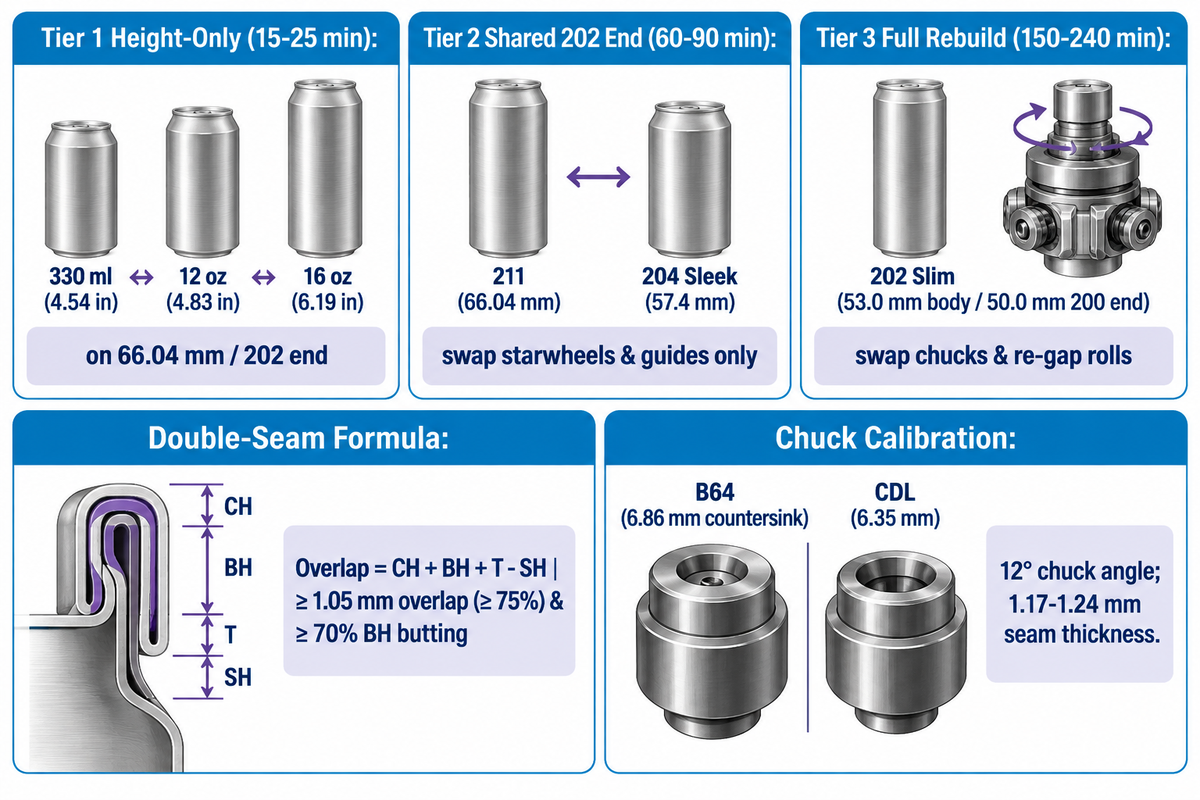
Body diameter (211 vs 204 vs 202) and lid end size (202 vs 200) can affect production downtime. Adjusting switch height from 12 oz standard to 16 oz tallboy cans takes 15 to 25 minutes. Switching body starwheels or changing 200-end seamer chucks takes 60 to 240 minutes per canning line changeover benchmarks and CFIA double-seam rules.
To schedule multi-SKU production without losing shift capacity, plant managers rely on The 202-End Commonality Rule. The 12 oz standard (211×413), 16 oz tallboy (211×604), 330 ml standard (211×408), and 12 oz sleek (204×602) formats all share the 202 lid end (52.40 mm plug / 54.10 mm seamed OD). Consequently, changeover complexity breaks into three distinct mechanical tiers on a MassTech rotary aluminum can filling and seaming monoblock:
- Tier 1 — Height-Only Changeover (15 to 25 Minutes): Switching between 12 oz standard (4.83 in), 330 ml standard (4.54 in), and 16 oz tallboy (6.19 in) cans keeps the 66.04 mm (211) body and 202 lid constant. Operators simply adjust the filler bowl and seamer head, change the stop on the depalletizer, and adjust the rinser rails.
- Tier 2 — Body Diameter Changeover with Shared 202 End (60 to 90 Minutes): Switching from 12 oz standard (211 body) to 12 oz sleek (204 body) leaves the 202 seaming chucks, rolls, and lid chutes untouched. Technicians only swap the quick-release main starwheels, infeed worm screw, and conveyor side guides from 66.04 mm to 57.4 mm.
- Tier 3 — Full Body and 200-End Seamer Rebuild (150 to 240 Minutes): Switching to an 8.4 oz / 250 ml slim can (202 body / 200 end) changes both the body (53.0 mm) and the lid (50.0 mm). Technicians must replace every seaming chuck, re-gap 1st and 2nd operation rolls with feeler gauges, swap lid separator knives, and run teardown seam tests.
“The body hook butting must be at least 70% and the overlap must meet the can manufacturer’s specifications. A knocked-down flange or false seam is a serious defect where the cover hook and body hook fail to interlock, leaving zero overlap.”
When a double seam is formed, the seamer will validate the actual double seam overlap by the formula found in AIP Publishing mechanical seam studies and OneVision seam inspection protocols: Overlap Length = CH + BH + T – SH. In that equation CH is the cover hook length, BH is the body hook length, T is the end plate thickness, and SH is the total seam height. As Peco InspX defect analysis states, a KDF or false seam may show normal external thickness when measured by a hand micrometer.
A common plant troubleshooting scenario happened when the facility switched from 12 oz B64 ends (6.86 mm countersink depth) to lightweight CDL ends (6.35 mm countersink depth). The seamer chuck seating height was not recalibrated when the ends were changed, and as a result, intermittent micro-leaks occurred. The difference in countersink depths (6.86 mm and 6.35 mm) impacted the spring load of the lifter pin against the 0.082″ unseamed flange, resulting in a false KDF during high-speed can transfer. Matching the chuck profile angle (12 degrees) to the end drawing, and the pin height to the end profile eliminated the false seam.
| Changeover / Seam Parameter | Tier 1: 211 Std ↔ 211 Tall | Tier 2: 211 Std ↔ 204 Sleek | Tier 3: 211 Std ↔ 202 Slim | 202 Double-Seam QC Target |
|---|---|---|---|---|
| Body Outside Diameter | Unchanged (66.04 mm) | Changes (66.04 → 57.4 mm) | Changes (66.04 → 53.0 mm) | 66.04 mm / 2.602 in (211 body) |
| Lid End Size | Unchanged (202 End) | Unchanged (202 End) | Changes (202 → 200 End) | 52.40 mm plug / 54.10 mm OD |
| Filler Bowl & Seamer Height | Motorized vertical lift | Motorized vertical lift | Motorized vertical lift | Set to 4.812 in brite flange height |
| Starwheels & Feed Screws | No change required | Quick-release starwheel swap | Full starwheel & screw swap | Zero flange contact during transfer |
| Seamer Chucks & Lid Chute | No change required | No change required | Swap 202 chucks to 200 chucks | 12° chuck wall angle; 6.86 mm B64 |
| 1st & 2nd Op Seaming Rolls | No change required | Verify roll pin height only | Re-gap rolls & teardown test | Seam thickness 1.17 – 1.24 mm |
| Body Hook & Cover Hook | Constant (0.082 in flange) | Constant (0.082 in flange) | Re-verify after chuck swap | 1.45 – 1.75 mm (≥70% BH butting) |
| Actual Seam Overlap | Constant | Constant | Mandatory X-ray / teardown | ≥1.05 mm (≥75% overlap ratio) |
| Typical Line Downtime | 15 – 25 minutes | 60 – 90 minutes | 150 – 240 minutes | 100% pass before release |
Counter-Pressure Filling, Dissolved Oxygen Control, and Multi-Format Canning Lines
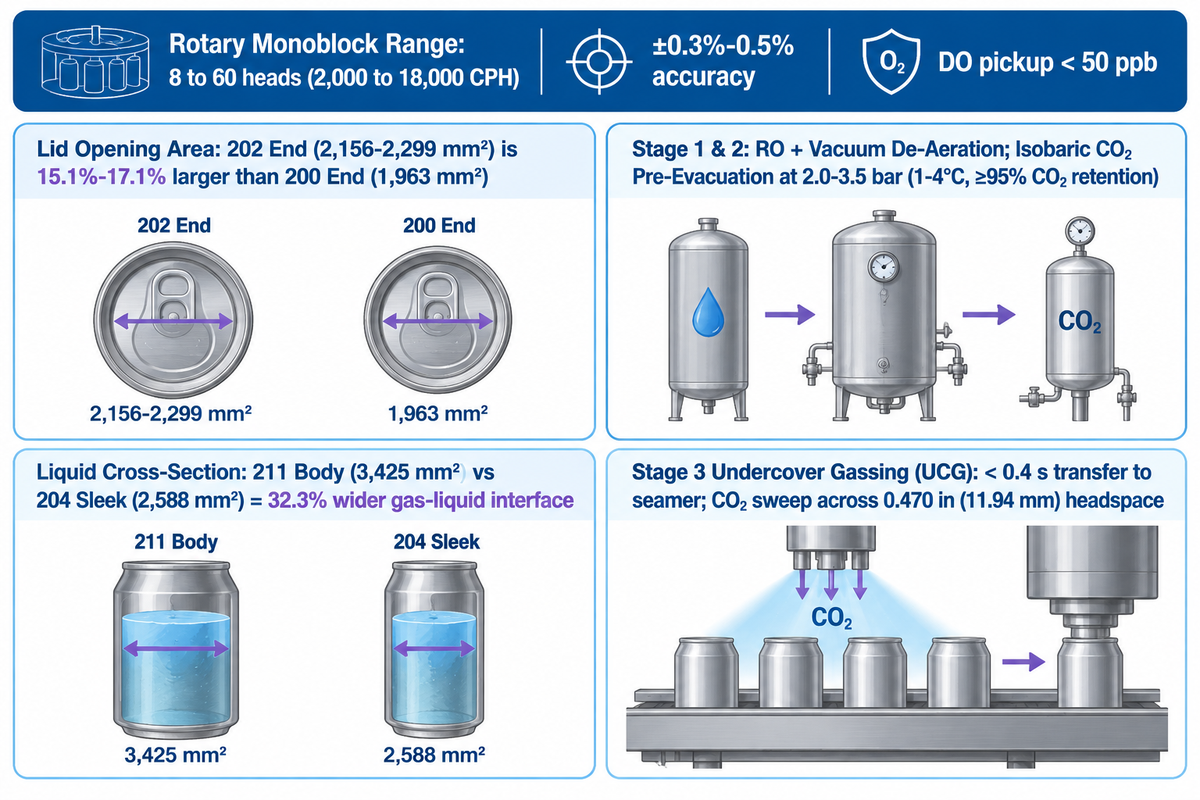
High-carbonation soda and beer cans require isobaric counter-pressure filling at 2.0 to 3.5 bar across 8 to 60 rotary heads (2,000 to 18,000 CPH). Modern monoblocks achieve fill accuracy within ±0.3% to ±0.5%, CO2 retention of at least 95% and dissolved oxygen pickup below 50 ppb on MassTech counter-pressure isobaric filling systems.
Can geometry directly affects oxygen pickup and foam control between the filling turret and the seaming turret. We quantify this interface through The Headspace-to-Diameter Oxygen Multiplier. A 202 lid opening (52.40 mm plug ID / 54.10 mm seamed OD) exposes 2,156 to 2,299 mm² of open headspace to air. That area is 15.1% to 17.1% larger than the 1,963 mm² opening on a 200-end slim can (50.0 mm). Inside the body, a 66.04 mm standard 211 can has a 3,425 mm² liquid cross-section versus 2,588 mm² inside a 57.4 mm sleek can. That creates a 32.3% wider gas-liquid interface during filling.
As reported in Beverage Industry and Packaging World, achieving DO pickup < 50 ppb across 202-end cans requires three synchronized stages:
- Upstream De-Aeration & Carbonation: Process water is first treated using MassTech beverage water treatment and de-aeration systems and multi-stage reverse osmosis filtration systems. Water is then vacuum-de-aerated and carbonated in-line with CO2.
- Isobaric CO2 Pre-Evacuation (2.0 to 3.5 bar): The centering bell seals against the 2.063-inch neck plug and purges air with food-grade CO2. Equalizing counter-pressure to 2.0–3.5 bar lets cold liquid (1 to 4°C) flow smoothly with ≥95% CO2 retention and ±0.3–0.5% fill accuracy.
- Tangential Undercover Gassing (UCG): The filled can leaves the snift valve and enters the seamer turret in under 0.4 seconds. Laminar CO2 jets sweep the 0.470-inch (11.94 mm) headspace right before the 202 chuck crimps the lid.
Due to differences in investment and delivery schedules for equipment, quick-change starwheel kits, and inline X-ray seam inspections based on filling head count (8-60 heads), turnkey pricing for aluminum beverage can lines requires customized quotes from the factory based on target cans per hour and SKU mix.
Pallet Configuration, Case Counts, and Selection Framework for Beverage Plants
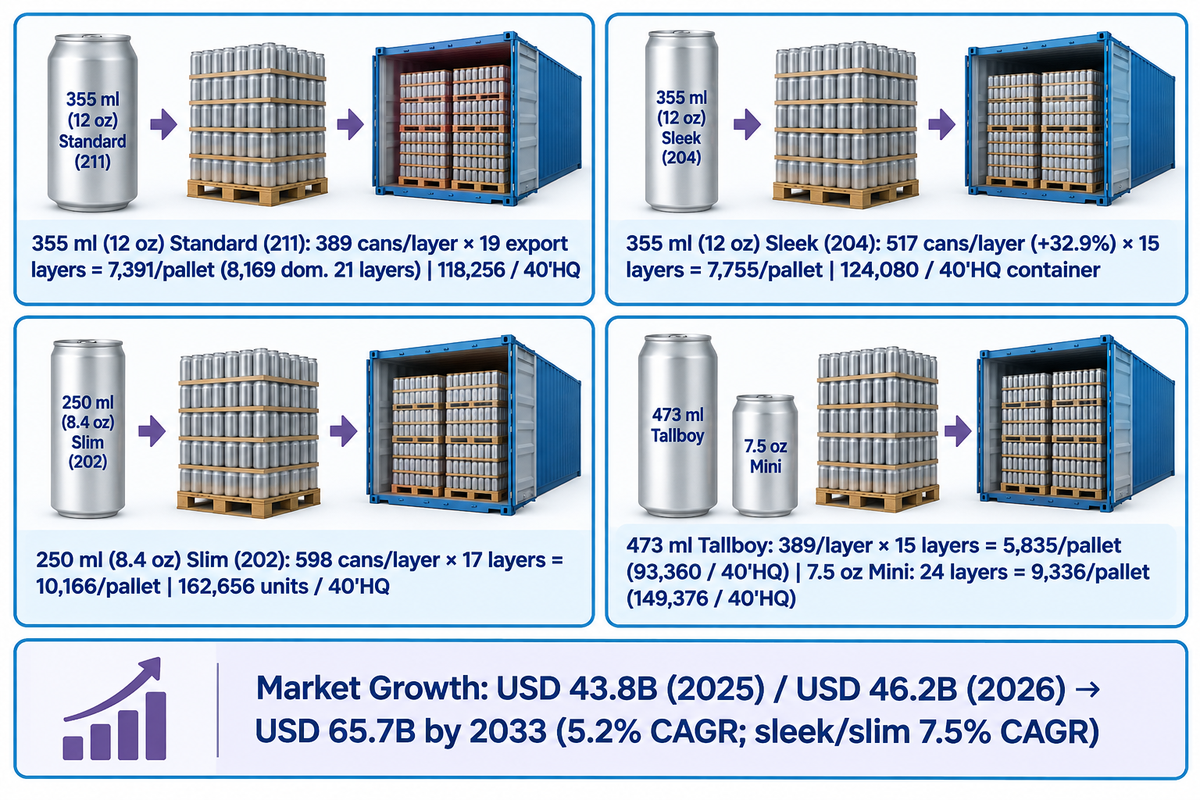
A standard North American 44 × 56 inch bulk pallet holds 389 standard 12 oz (211) cans per layer. Export pallets stack 19 layers (7,391 cans; 118,256 per 40’HQ container), while 12 oz sleek (204) cans pack 517 per layer (124,080 per 40’HQ) per container loading tables and Cask pallet specifications.
When selecting the right package for a new beverage launch, founders must balance stacking efficiency with retail shelf space. According to Grand View Research and Mordor Intelligence, the global aluminum beverage cans market reached USD 43.8 billion in 2025 (USD 46.2 billion in 2026). It is projected to hit USD 65.7 billion by 2033 at a 5.2% CAGR. Lightweight sleek and slim formats are growing faster at a 7.5% CAGR as brands improve transport efficiency and shipping costs.
Review the counter-intuitive logistics math in the table below. A 355 ml sleek can is 33.1 mm taller than a 355 ml standard can, reducing container stacking from 19 layers to 15 layers. Yet its narrower 57.4 mm diameter fits 32.9% more cans on every honeycomb layer (517 vs 389 cans). Consequently, a 40-foot high-cube (40’HQ) container ships 124,080 empty 12 oz sleek cans compared to 118,256 standard 12 oz cans. Ocean export containers cap 12 oz standard pallets at 19 layers (7,391 cans) to clear door headers. By contrast, North American domestic dry-van trucks accept 21-layer pallets holding 8,169 cans.
| Can Format & Volume | Body × End Code | Cans / Layer (44×56″ Pallet) | Export Layers / Pallet | Cans / Export Pallet | Total Cans / 40’HQ Container | Recommended Channel & Line Strategy |
|---|---|---|---|---|---|---|
| 250 ml (8.4 oz) Slim | 202 Body / 200 End | 598 cans | 17 layers | 10,166 cans | 162,656 units | Dedicated energy drink or wine spritzer line (200 seamer chuck) |
| 330 ml (11.2 oz) Standard | 211 Body / 202 End | 389 cans | 20 layers | 7,780 cans | 130,680 units | EU/Asia export soda & lager; shares 211/202 tooling with 355/473 ml |
| 330 ml (11.2 oz) Sleek | 204 Body / 202 End | 517 cans | 16 layers | 8,272 cans | 133,760 units | EU modern sleek CSD & RTDs; shares 202 seamer chuck with standard |
| 355 ml (12 oz) Standard | 211 Body / 202 End | 389 cans | 19 layers (21 domestic) | 7,391 cans (8,169 dom.) | 118,256 units | Universal North American grocery 12-packs, 24-packs & vending |
| 355 ml (12 oz) Sleek | 204 Body / 202 End | 517 cans | 15 layers | 7,755 cans | 124,080 units | Premium functional soda & hard seltzers (60–90 min starwheel swap) |
| 473 ml (16 oz) Tallboy | 211 Body / 202 End | 389 cans | 15 layers (16 domestic) | 5,835 cans (6,224 dom.) | 93,360 units | Craft beer & energy drink 4-packs (15–25 min height lift from 12 oz) |
| 500 ml (16.9 oz) Euro Pint | 211 Body / 202 End | 389 cans | 14 layers | 5,446 cans | 91,476 units | EU/UK retail multipacks; 15-min height adjustment from 330/473 ml |
| 568 ml (19.2 oz) Stovepipe | 211 Body / 202 End | 389 cans | 12 layers | 4,668 cans | 74,688 units | C-store single-serve cold box; runs on 211/202 tall-stroke fillers |
| 7.5 oz (222 ml) Mini | 211 Body / 202 End | 389 cans | 24 layers | 9,336 cans | 149,376 units | Calorie-control multipacks; shares 211/202 tooling with 12 oz standard |
Your facility may be scaling a dedicated 12 oz soda line or building a flexible co-packing plant. While designing container draws to match MassTech’s carbonated soft drink filling lines or turnkey carbonated beverage packaging equipment, you will eliminate changeover bottlenecks on equipment fabrication.
Need a Multi-Format Canning Line Engineered for Your Can Drawings?
Send our engineering team your target can profiles (211 Standard, 204 Sleek, or 202 Slim), carbonation volume (GV), and hourly output target between 2,000 to 18,000 CPH. We will create a design for rotary counter-pressure filling and 202/200 seaming with changeover tooling.
Frequently Asked Questions
Why Is a US Can of Pop 12 Fluid Ounces Instead of 8 Ounces?
US beverage cans standardized to 12 US fluid ounces (355 ml) to match the pre-existing 12 oz heritage longneck beer and soda glass bottles.
Steel cans and two-piece aluminum cans scaled across North America in the late 1930s to the 1950s. Bottlers were looking for a container that would fit the existing 6-pack and 24-pack case packers, cooler shelves, and coin-operated vending machines. Smaller 7.5 oz (222 ml) mini cans and 8 oz (237 ml) portion packs showed up decades later for airline galley carts and 100-calorie mixer packs.
How Much Does an Empty 12 oz Aluminum Can Weigh Compared to a Full Case?
An empty modern 12 oz (355 ml) drawn-and-wall-ironed aluminum soda can weighs approximately 14.9 grams (0.53 ounces), while a filled 24-pack case weighs 9.1 to 9.3 kilograms (20.0 to 20.5 pounds).
That 14.9 gram empty tare weight breaks down into about 11.7 grams for the AA3004 body and about 3.2 grams for the AA5182 202 Stay-On-Tab lid. Filled with 355 ml of diet soda, the total weight of the can is about 370 grams (13.05 oz). If filled with sugar-sweetened regular soda at a 1.04 specific gravity, the total weight of the can is about 384 grams (13.5 oz) before adding the cardboard tray or the plastic carrier rings.
What Are the Five Structural Parts of a Two-Piece Aluminum Beverage Can?
A two piece aluminum beverage can consists of an ironed sidewall, a concave pressure-resistant base dome, a multi-stage tapered neck, a top seaming flange and the 202 Stay-On-Tab lid.
Food cans of the type under consideration weld a flat sheet into a cylinder with a top and bottom lid. By contrast, a DWI beverage can stamps the bottom dome and 0.097 mm sidewall from a single aluminum disk. The top is die-necked down from 66.04 mm to a 52.40 mm neck plug opening. The lip is die flanged to 0.082 inch, and double seamed to the easy open end after filling.
Can One Rotary Canning Monoblock Run Both 250 ml Slim and 500 ml Standard Cans?
Yes, a multi-format rotary counter-pressure canning monoblock can run both 250 ml slim (53.0 mm body, 200 lid) and 500 ml standard (66.04 mm body, 202 lid) cans using modular change parts.
Those two formats vary in height (134.0 mm vs 167.84 mm), body diameter (202 vs 211), and lid end diameter (200 vs 202). Change over between the two formats follows a Tier 3 schedule and takes between 150-240 minutes.
How Many 12 oz Cans Fit on a Standard 44 x 56 Inch Bulk Manufacturing Pallet?
A standard 44 × 56 inch bulk aluminum canner pallet holds 389 standard 12 oz (66.04 mm) cans per nested layer, totaling 7,391 cans on a 19-layer export pallet or 8,169 cans on a 21-layer domestic truck pallet.
When beverage plants switch to 12 oz sleek cans (57.4 mm diameter), each pallet layer holds 517 cans across 15 layers for 7,755 cans per export pallet. For 16 oz tallboy cans (66.04 mm diameter by 157.23 mm height), the layer count stays at 389 cans across 15 to 16 layers. That stack yields 5,835 to 6,224 empty cans per pallet.
References & Sources
- Can Manufacturers Institute (CMI) – Official 202 Beverage Can and End Dimensional Specifications
- Can Manufacturers Institute (CMI) / RRS — Aluminum Beverage Can Closed-Loop Recycling Turnaround Study (<60 Days)
- U.S. Food and Drug Administration (FDA) eCFR — 21 CFR § 101.7 Declaration of Net Quantity of Contents (Dual Fluid Ounces and Milliliters)
- Canadian Food Inspection Agency (CFIA) — Preventive Controls for Food: Metal Can Double-Seam Defects (Knocked-Down Flange & False Seam)
- Aluminum-Can.com Engineering Reference — Aluminum Can Dimensions Chart: Standard, Sleek & Slim Sizes, Pressure Ratings, and 40’HQ Container Loading
- Aluminum-Can.com Technical Guide — Standard, Sleek, and Slim Cans: 202 vs. 200 Lid End Compatibility
- Cask Global Canning Solutions — Beverage Can Technical Specifications & Bulk Pallet Stacking Guide
- InchesGuide Measurement Reference — Standard 12 oz Soda Can Dimensions, Circumference, Weight, and Regional Sizes
- Levapack Packaging Machinery — Three-Digit Can Size Code System and Open vs. Sealed Can Height Guide
- TricorBraun Packaging — Aluminum Can Dimensions, Neck Height, and 32 oz Crowler Specifications FAQ
- AIP Publishing (AIP Conference Proceedings) — Mechanical Analysis of Double-Seam Overlap and Body Hook Butting in Aluminum Beverage Cans
- OneVision Corporation — Double-Seam Inspection Formulas and Overlap Percentage Thresholds
- Peco InspX — In-Line Detection of False Seams and Knocked-Down Flange Can Defects
- Wiley / Chemistry – An Asian Journal (2025) — European Commission Regulation (EU) 2024/3190 Bisphenol A (BPA) Ban in Food-Contact Materials
- Food Packaging Forum — Beverage Can Internal Coatings and BPA-NI Regulatory Compliance
- ScienceDirect / Progress in Organic Coatings (2026) — Electrochemical and Corrosion Performance of Internal Coatings in Thin-Wall Aluminum Beverage Cans
- USPTO / Google Patents — US8757953B2 Double Seaming Chuck-Knockout Tooling & US20100044383A1 High-Strength Beverage Can End Geometry
- Beverage Industry Magazine — Productivity, Sanitary Design, and Dissolved Oxygen Control on Can Filling and Seaming Machines
- Packaging World — Multi-Format Co-Packer Rotary Can Filling Line Operations
- Grand View Research & Mordor Intelligence — Global Aluminum Beverage Cans Market Size & 2026-2033 Forecast (Mordor Aluminum Cans Market Analysis)
WHY WE WRITE THIS
MassTechX publishes practical engineering guides for beverage producers, plant owners, procurement teams, and packaging line buyers who need to compare filling, blowing, labeling, water treatment, and end-of-line equipment with less guesswork. Our goal is to explain the real production constraints behind capacity, liquid type, container format, hygiene requirements, spare parts, and after-sales service before a buyer commits to a bottling line.
ABOUT OUR BUSINESS
Mass Technology is a Zhangjiagang-based beverage filling machine manufacturer in Jiangsu, China. We design and manufacture complete bottling line solutions for water, carbonated drinks, juice, beer, wine, cans, bottle blowing, bottle labeling, water treatment, and related packaging systems. Our published equipment range covers 2,000–36,000 BPH production lines, with deployment experience across 60+ countries.
OUR SERVICES
We support buyers through plant layout design, equipment selection, manufacturing, factory acceptance testing, shipping coordination, on-site installation, operator training, and long-term after-sales service. MassTechX projects are supported by a 2-year warranty, 24-hour engineer response, and 5-working-day international spare parts dispatch commitment.
DATA MATRIX // MANUFACTURER PROFILE
NAMEMass Technology Engineering Team
ROLEBeverage Filling Line Manufacturer
BRAND NAMEMassTechX / Mass Technology
COMPANYZhangjiagang Mass Technology Co., Ltd.
LOCATIONZhangjiagang, Jiangsu, China
CAPACITY RANGE2,000–36,000 BPH
PRODUCT RANGEWater Filling, CSD Filling, Juice Filling, Beer Filling, Wine Filling, Can Filling, Bottle Blowing, Bottle Labeling, Water Treatment
GLOBAL REACH60+ Countries
WARRANTY2 Years
SERVICE SLA24-Hour Engineer Response / 5-Working-Day Spare Parts Dispatch
WEBSITEmasstechx.com
Related Posts
Trending now