Get in Touch with Masstech

Industrial wash-process guide · Updated September 2026
Define the basket and soil, separate each process stage, expose hidden cleanability risks, build acceptance evidence, and carry one frozen cleaning duty from proposal review through FAT and SAT.
In short: an industrial basket washing machine should be selected only after the team defines what enters, what must leave, what the site can supply, and what evidence releases a cleaned basket. A catalogue cycle is not a cleaning specification, and a visually impressive demonstration is not process validation.
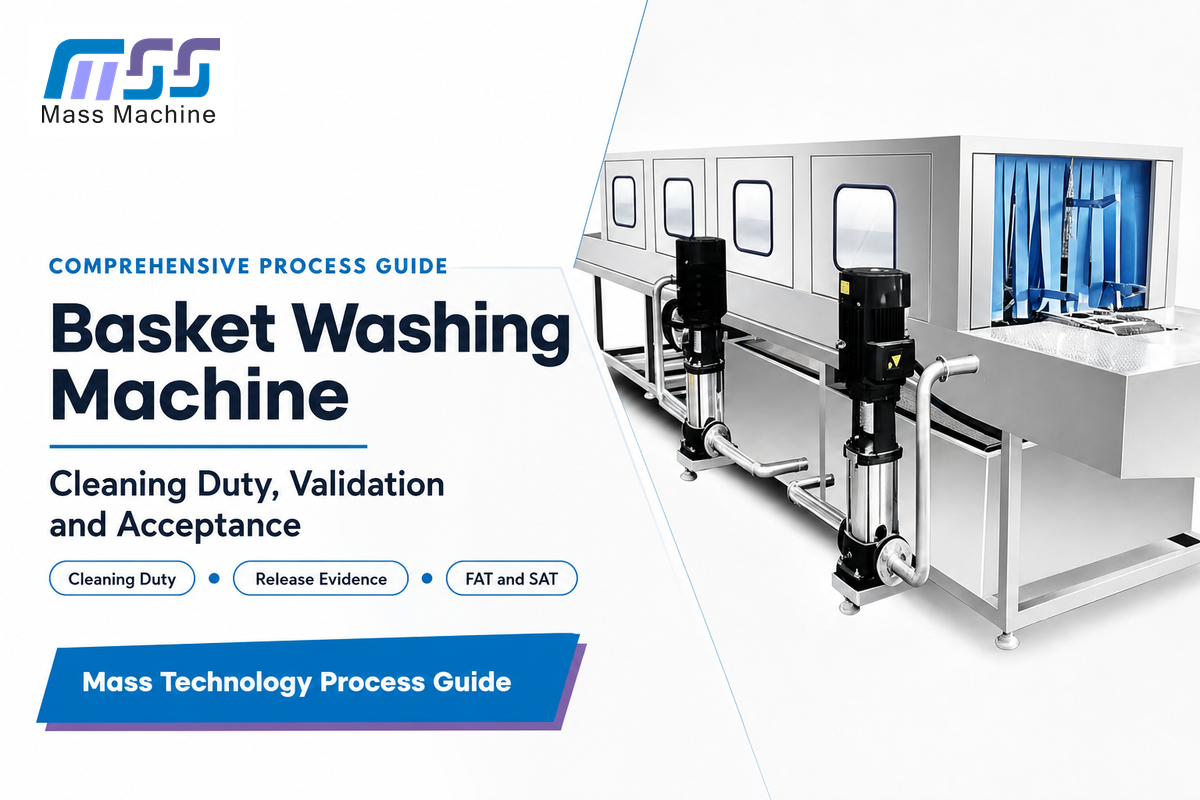
Basket washing machine refers to industrial equipment used to clean reusable baskets, crates, totes, trays, and compatible process containers in this guide. It doesn’t mean the inner basket, drum, spin cycle, or agitator in a household laundry washing machine. That distinction matters because the same head term appears in both contexts, while their loads, soils, hygiene standards, and proof requirements have little in common.
Industrial washing machine and industrial washing are broader labels. In this article, washing process refers to reusable-container treatment; it doesn’t refer to commercial washers in commercial laundries or to loads of laundry.
This article also has a deliberately different job from Mass Technology’s basket washing machine solution page. The solution page owns equipment configuration, available project options, commercial fit, quotation, and inquiry intent. This field guide owns the information that should exist before and after that decision: cleaning-duty definition, process boundaries, verification, troubleshooting, maintenance records, utilities, and acceptance testing.
Scope and safety: the examples below are decision tools, not a universal recipe, chemical instruction, regulatory determination, or substitute for the approved equipment manual. Container material, soil, product-contact status, chemical label, site food-safety plan, local discharge rules, and energy-control procedure govern the installed process.
1 · Define
Basket family, soil, throughput, endpoint, and utilities
Basket family, soil, throughput, endpoint, and utilities
2 · Control
Presentation, reach, chemistry, time, rinse, and drying
Presentation, reach, chemistry, time, rinse, and drying
3 · Prove
Worst case, measured parameters, limits, repeats, and deviations
Worst case, measured parameters, limits, repeats, and deviations
4 · Sustain
Daily checks, change control, troubleshooting, FAT, and SAT
Daily checks, change control, troubleshooting, FAT, and SAT
12-Field Basket-Type Input Matrix
Engineering Note: use this matrix to standardize how proposals and trials receive data. The numbers below are recording-resolution examples, not process limits or machine specifications; a project may use finer than 1 mm geometry or 1 sec timing precision when the measurement method requires it.
Optional measurement fields: when they are relevant to the duty, record flow to 0.1 L/min, concentration to 0.1 g/L, water quality to 1 µS/cm, differential pressure to 1 kPa, extraction airflow to 1 m³/h, sound to 1 dB, ambient humidity to 1%, rotation to 1 rpm, and a selected temperature difference to 1 °C. These are data-field examples, not target settings, acceptance limits, or offered machine specifications.
| Category | Input field | Example recording format | Decision supported |
|---|---|---|---|
| Identity | Basket type and sample ID | Site code, drawing revision, photograph | Separates genuinely different families |
| Geometry | Length, width, height | 1 mm length; 1 mm width; 1 mm height | Guides, openings, clearances, and orientation |
| Mass | Empty and maximum loaded mass | 0.1 kg empty; 0.1 kg loaded | Handling and transport load |
| Rate | Peak return window | Count in each 1 hr peak window | Buffering and released throughput |
| Soil age | Time from soiling to wash | 1 min, 1 hr, or 1 day reporting bands | Worst-case challenge preparation |
| Soil load | Prepared soil or retained bulk material | 0.1 kg per basket; 1 kg per batch | Wash-water and filtration challenge |
| Water supply | Available pressure and metered volume | 0.1 bar pressure; 0.1 m³ per measured run | Utility sufficiency and water balance |
| Temperature | Inlet, controlled wash, and exit readings | 1 °C inlet; 1 °C wash; 1 °C exit resolution | Process record and heat balance |
| Time | Cycle, dwell, and operating window | 1 sec cycle; 1 min dwell; 1 hr window | Exposure and capacity calculation |
| Electrical | Supply and measured demand fields | 1 V, 1 A, 1 Hz, and 1 kW reporting resolution | Electrical-system and heating review |
| Space | Clearance and occupied floor area | 1 mm clearance; 1 m² floor-area increments | Access, service, and layout review |
| Data quality | Timestamp and instrument resolution | 1 sec timestamp; 1% displayed resolution | Traceable FAT, SAT, and trend records |
1. What Is an Industrial Basket Washing Machine?
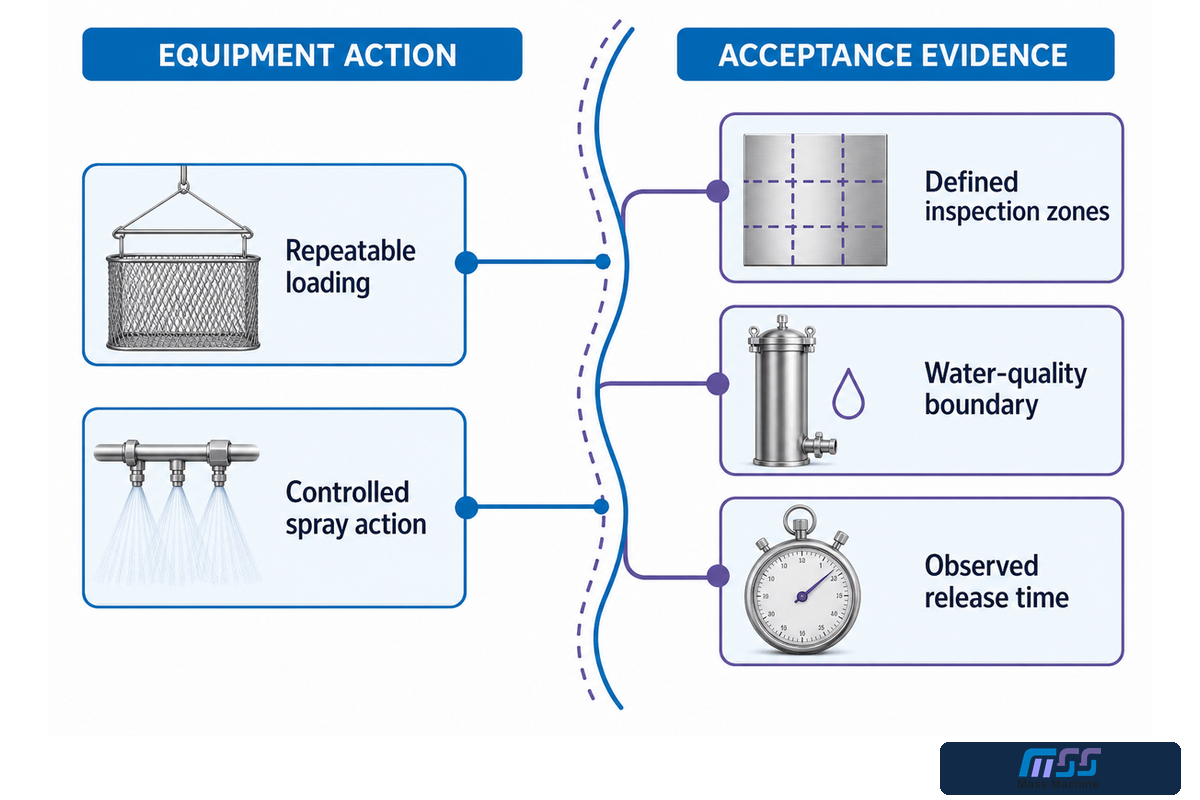
An industrial basket washing machine presents reusable containers to a controlled sequence of soil removal, washing, rinsing, optional sanitation, drainback, and sometimes drying. That process sequence gives the input matrix above an operating context instead of treating basket data as catalogue fields. The equipment makes those actions more repeatable and contained; it doesn’t automatically prove that every surface was reached or that a defined hygiene endpoint was achieved.
Load
Defined reusable basket, crate, tote, or tray families
Defined reusable basket, crate, tote, or tray families
Process
Soil removal, wash, rinse, optional sanitation, drainback, and drying
Soil removal, wash, rinse, optional sanitation, drainback, and drying
Output measure
Released baskets per peak window, not nameplate cycles alone
Released baskets per peak window, not nameplate cycles alone
Acceptance
Site-defined evidence; no universal temperature, pressure, or chemistry
Site-defined evidence; no universal temperature, pressure, or chemistry
Machine names alone aren’t a reliable basis for comparison. One washer may handle a continuous flow of one crate family. Another may run mixed baskets in batches. Some applications need only visible-soil removal. Others require a site-approved residue, allergen, or microbiological release method. Even containers with the same outer dimensions may behave differently because ribs, handholds, labels, hinges, textured surfaces, or stacked soil create different spray shadows and drainback paths.
| The system may provide | It does not prove by itself | Evidence still required |
|---|---|---|
| Repeatable loading and transport | Compatibility with every basket family | Representative dimensions, weight, orientation, and trials |
| Controlled spray and mechanical action | Complete coverage behind ribs or inside corners | Defined inspection zones and challenge runs |
| Detergent or sanitizer dosing | Correct product use or a validated hygiene result | Label-compatible method, measurement, and site approval |
| Recirculation, filtration, and a drain connection | Permission to reuse or discharge every water stream | Water-quality boundary, destination, consent, and monitoring |
| A repeatable wash cycle | Required released baskets per shift | Observed load-to-release time at steady operation |
The useful buying question is not “How powerful is the washer?” It is “Which defined cleaning duty can the complete installed process repeat and prove?”
2. Start with the Cleaning Duty, Not the Machine Catalogue
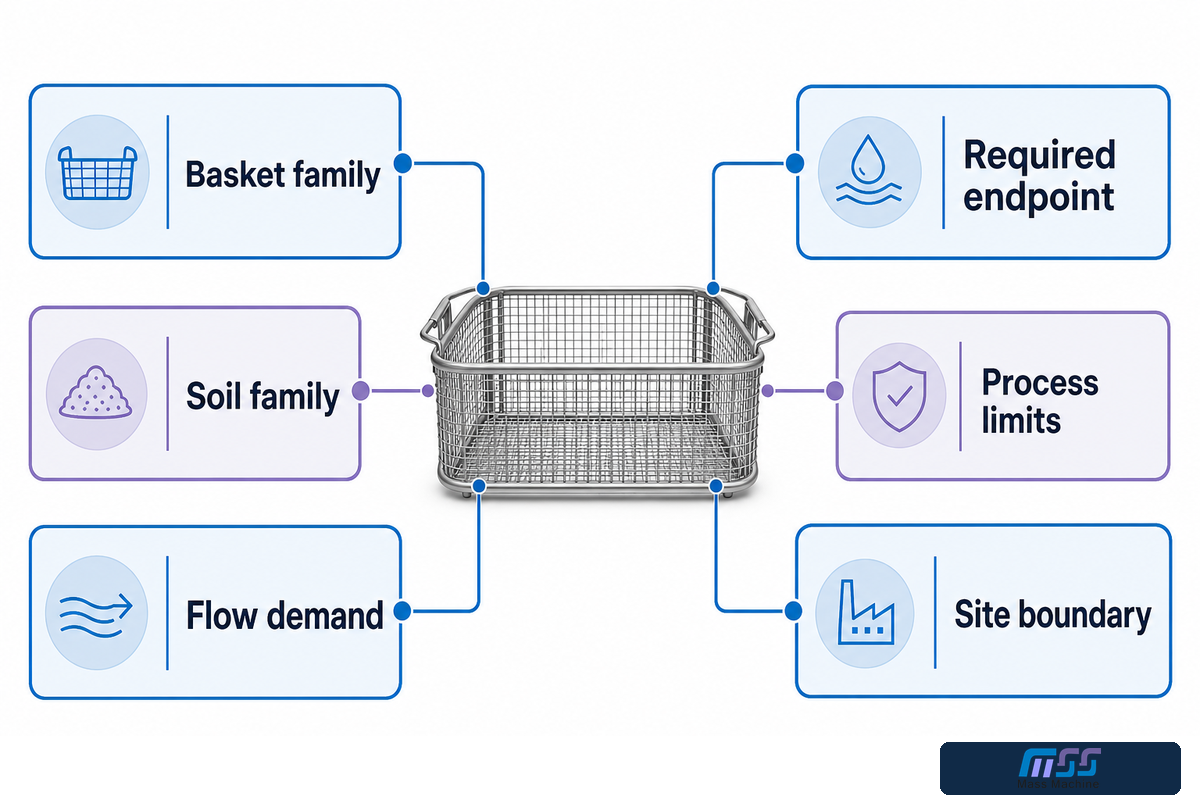
The cleaning duty is the frozen description of the real job. It keeps operations, QA, engineering, and procurement from comparing proposals against different assumptions. Reusable Packaging Association guidance treats a returnable-container program as more than a hardware choice: container handling, wash controls, quality checks, logs, and validation all belong to the system.
Buyer Asset: Cleaning Duty Record
Create one record for each basket family that can materially change the process. Don’t average unlike containers into a “standard basket.”
| Field | What to record | Why it changes the decision | Owner |
|---|---|---|---|
| Basket family | Drawing, samples, dimensions, weight, material, ribs, holes, lids, damage | Controls handling, spray access, drainback, and compatibility | Operations + Engineering |
| Soil family | Identity, amount, adherence, age, seasonality, and pre-removal | Changes cleaning mechanism and worst-case challenge | QA + Operations |
| Flow demand | Average, peak, surge duration, return pattern, buffer, and changeover | Separates nameplate speed from released output | Operations |
| Required endpoint | Visible soil, residue, allergen, microbial, dryness, or next-use rule | Defines the test and release evidence | QA |
| Process limits | Material temperature, chemistry, food-contact, cross-contact, and handling restrictions | Eliminates unsafe or incompatible assumptions | QA + EHS |
| Site boundary | Water, heat, power, air, extraction, drainage, floor, access, and labor | Exposes utility and installation bottlenecks | Engineering |
Buyer action: nominate the hardest legitimate basket-and-soil combination. Use it as a named challenge item, not as an unspoken exception discovered during commissioning.
Three shortcuts usually weaken the record. First, nominal basket size hides features that control spray reach. Second, daily total hides the peak return window that determines buffering and staffing. Third, “sanitary” or “food grade” isn’t an acceptance criterion. QA must state what’s inspected or tested, where, how often, against which limit, and who releases the load. A supplier can customize handling or wash stages only after these inputs are explicit.
Mass Technology’s public crate-fit input builder and throughput target calculator can organize early project inputs. Treat those outputs as planning records, not independent proof of installed cleaning performance.
3. Why Washing, Rinsing, Sanitizing, and Drying Are Separate Controls
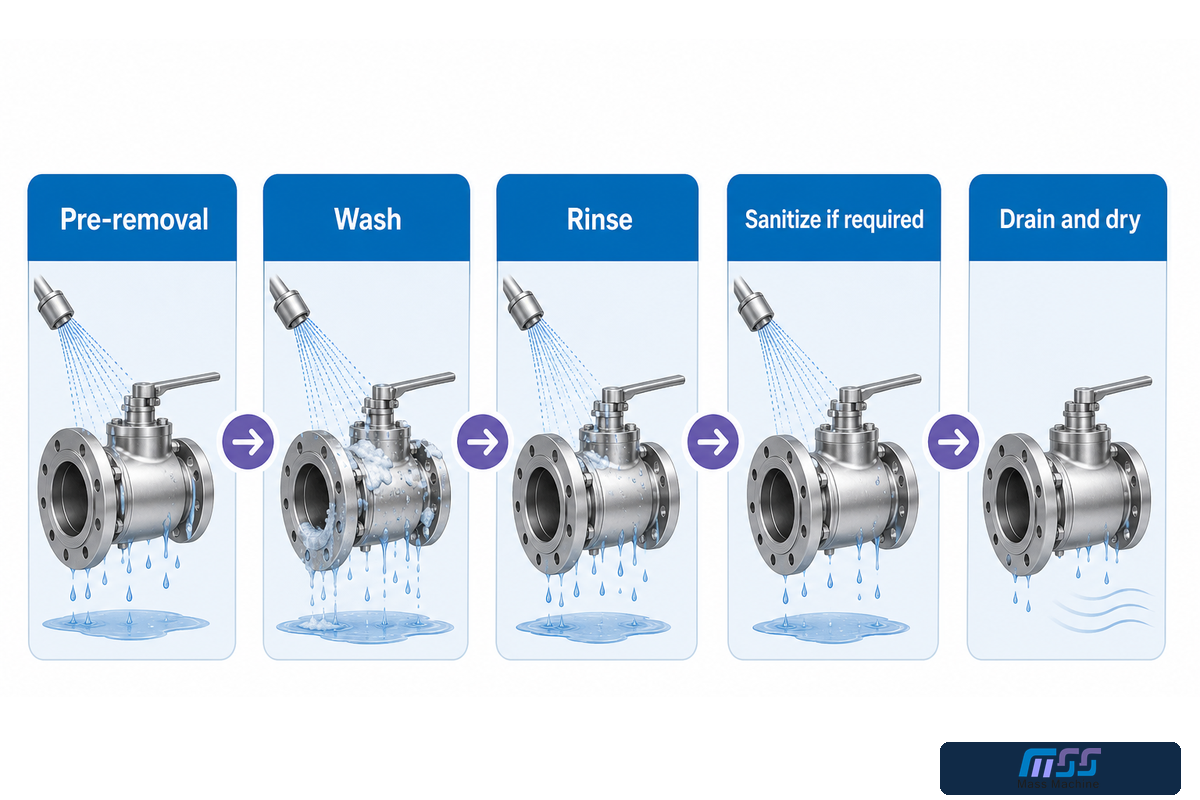
Washing removes defined soil through a combination of mechanical action, chemistry, temperature, and time. These separate controls turn the cleaning duty from the previous section into measurable process stages. Rinsing controls loosened soil and chemical carryover. Sanitizing, when required, applies a separate site-approved treatment after cleaning. Drainback and drying control retained liquid and the condition presented to the next use. Combining these words into one “hygienic cycle” hides where failure occurred.
Reusable-crate guidance from FAO describes cleaning and sanitizing as related but distinct activities, while food-safety guidance for harvest containers similarly separates debris removal, detergent washing, rinsing, sanitizing, and air drying. These sources are useful for process order, not for copying one temperature or concentration into an industrial washer.
| Stage | Primary job | Typical evidence | Do not assume |
|---|---|---|---|
| Dry or manual pre-removal | Remove bulk material before it loads wash water | Defined incoming condition and exception route | Every load may safely enter as received |
| Wash | Detach and transport soil | Coverage, time, temperature control, detergent condition, and filter state | More pressure or heat always improves the result |
| Rinse | Remove loosened soil and unacceptable carryover | Rinse-water quality and residue endpoint | Recirculated wash water suits the final boundary |
| Sanitize, if required | Apply the approved treatment to a cleaned surface | Product, concentration or method, exposure, coverage, and test result | Sanitizer compensates for remaining soil |
| Drain and dry | Control retained liquid and next-use condition | Inspection zones, dwell, air path, and residual-moisture rule | A hot exit basket is dry everywhere |
Exact values belong to the validated site process. Water temperature can affect soil removal, material behavior, worker exposure, chemistry, and energy efficiency simultaneously. Detergent can help release stubborn stains or fat but create foam or rinse demand when misapplied. A softener may be relevant to a water-supply problem, yet it isn’t a universal cleaning upgrade. These interactions are why copied settings are weak evidence.
4. Find Where a “Stainless” Machine Can Still Fail Hygienically
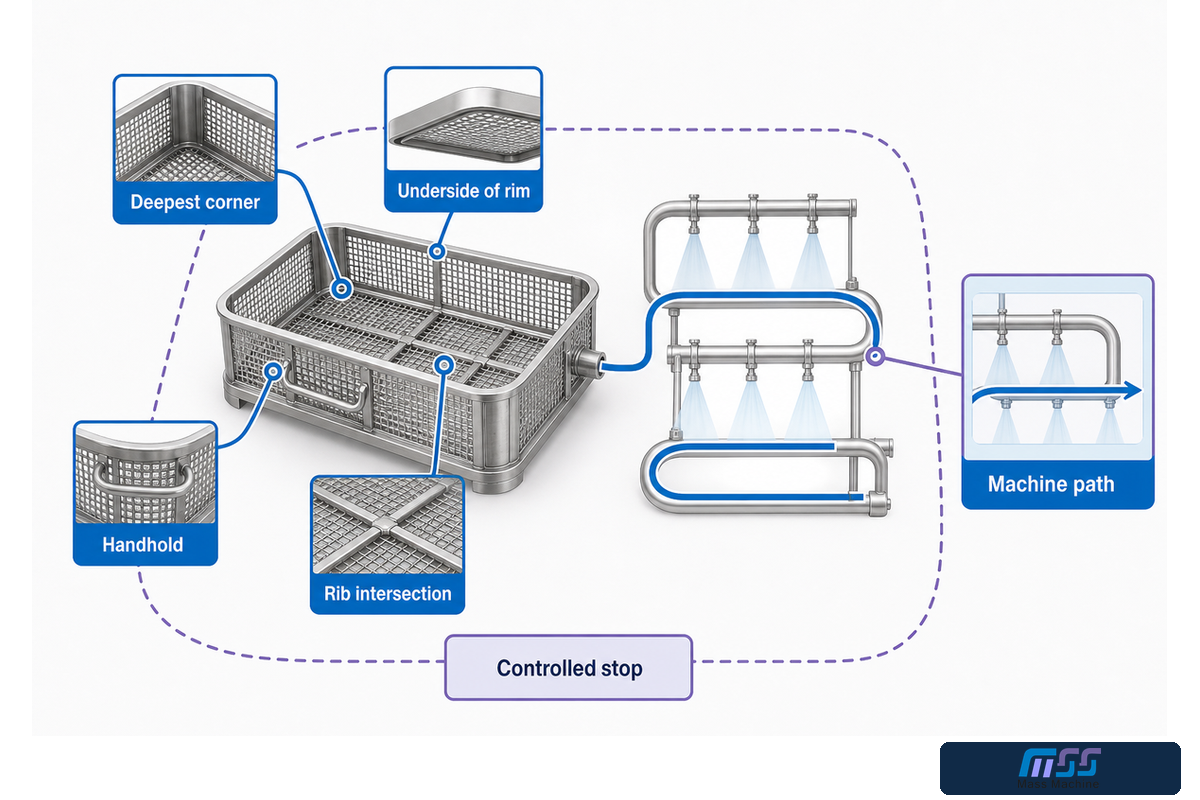
Stainless construction can support durability and material compatibility, but it doesn’t by itself establish hygienic design. Review access, drainage, crevices, hollow sections, joints, seals, fasteners, cable and pipe penetrations, filter removal, belt or guide contact points, spray shadows, dirty-to-clean segregation, and the route used by condensed or retained liquid.
The current ISO/DIS 14159 page describes a draft revision concerning hygiene risks in machinery. Its draft status matters: use the principles as a design-review lens, then verify the applicable final standards and customer requirements for the project. Do not turn a scope page into a certification claim.
Buyer Asset: Drainback Walkdown
After a controlled stop and only under the site’s energy-control procedure, trace where water remains. The walkdown is an inspection method, not permission to enter or reach into equipment.
- Mark five challenge surfaces on the basket: deepest corner, underside of rim, handhold, rib intersection, and any damaged or textured area.
- Trace the matching machine path: entry guides, wash zone, transitions, rinse boundary, discharge, and clean-side handling.
- Record standing water, reverse drainage, foam, debris traps, shadowed areas, and surfaces that can’t be inspected or cleaned safely.
- Confirm how removable parts, filters, screens, and nozzles are accessed and returned to a known condition.
- Assign each finding to design correction, procedure, preventive maintenance, or a documented limitation.
Hidden bottleneck exposed: a basket can look clean from its open face while retained water or soil remains behind a rib, under a rim, at a guide contact, or beyond a blocked spray path.
A published basket-washing design identifies orientation and spray-shadow problems and proposes basket rotation as one response. That document is useful for recognizing the mechanism, not for proving that any specific commercial design eliminates it. Likewise, field research on reusable plastic containers has shown that a defined cleaning sequence may still leave a meaningful contamination risk in the studied context. The practical lesson is scoped: visual cleanliness is one endpoint, not universal proof of every hygiene claim.
5. Build Proof Before You Call a Basket Clean
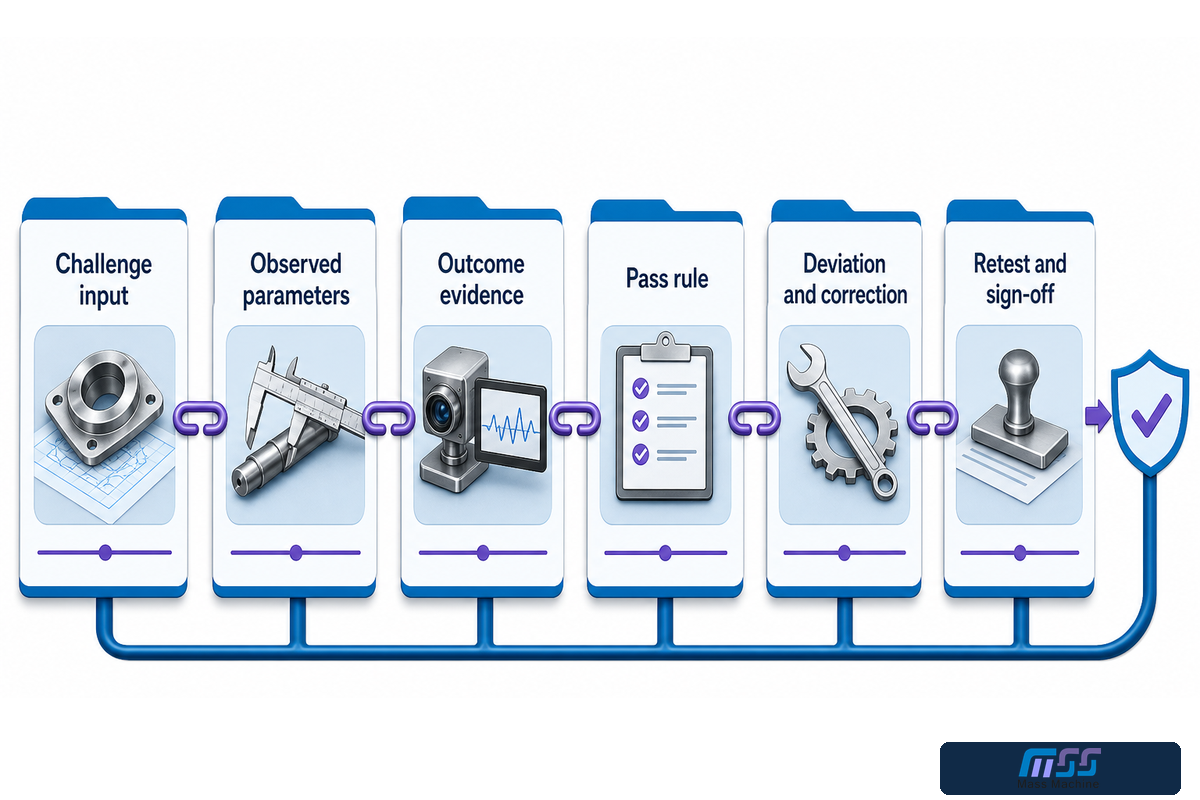
A demonstration answers “Can the machine run?” Acceptance evidence answers a harder question: “Did the agreed worst-case load meet the agreed endpoint under recorded conditions, repeatedly, with deviations resolved?” The difference isn’t paperwork for its own sake. It prevents a good-looking trial from being generalized to baskets, soils, loads, or utilities that were never tested.
Buyer Asset: Clean-Release Evidence Packet
Use one packet per challenge condition. Require repeat runs after the process reaches the agreed steady state; the exact sample plan and limits must come from the responsible site functions.
| Packet section | Required entry | Failure it prevents |
|---|---|---|
| Challenge input | Basket ID, condition, soil identity, preparation, age, amount, orientation, and load | Testing an easy sample that is not representative |
| Observed parameters | Actual time, temperature, chemistry, flow or pressure indication, speed, rinse, and utility condition | Recording only control-panel targets |
| Outcome evidence | Inspection map, residue result, allergen or microbial test where justified, drainback, and dryness | Treating one front-facing photo as proof |
| Pass rule | Explicit limit, method, instrument, calibration state, and decision owner | Moving the goal after results are known |
| Deviation and correction | What departed, disposition, cause, controlled change, and affected scope | Quietly excluding failed runs |
| Retest and sign-off | Repeat results, remaining limitations, QA, operations, engineering, and supplier signatures | Releasing an unresolved or ownerless process |
Choose the endpoint before the run. For a visible-soil claim, define lighting, locations, basket condition, and rejection rule. For residue or allergen control, use the site-approved sampling method and responsible laboratory or QA procedure. For a microbiological claim, define organism or indicator, sampling plan, method, limit, and interpretation with qualified food-safety expertise. Don’t upgrade a visual result into a pathogen-reduction claim.
Records should capture actual observations, not idealized copies of the recipe. A perfectly flat temperature or mechanically identical entry on every line can be less credible than a realistic trace with tolerances, deviations, and corrections. The evidence packet should let a reviewer reconstruct what happened without relying on memory.
6. Draw the Water and Wastewater Boundary Stage by Stage
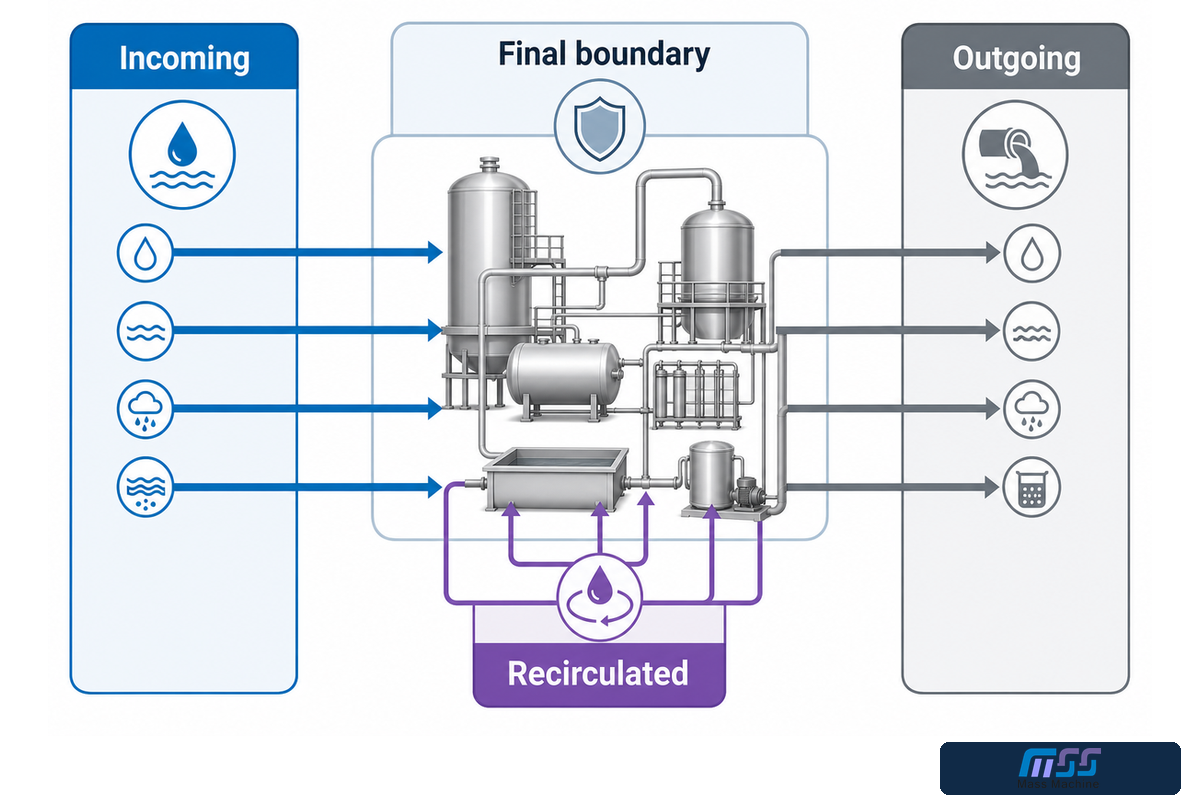
Water reuse isn’t one yes-or-no feature. It also extends the clean-release record upstream: water routes and discharge routes must support the evidence the site intends to collect. An early wash tank, a filtered recirculation loop, a rinse stream, and a final product-contact boundary perform different jobs. A staged design can move cleaner water toward later stages, but a published design option isn’t permission to reuse water for every application.
Buyer Asset: Utility Boundary Sketch
Draw the process as streams rather than one machine box. Use blue for incoming water, purple for recirculated wash water, and grey for discharge or treatment.
Incoming
Source, quality, pressure, temperature, flow, backflow protection, and owner
Source, quality, pressure, temperature, flow, backflow protection, and owner
Recirculated
Tank, filtration, soil loading, chemistry, overflow, refresh rule, and monitoring
Tank, filtration, soil loading, chemistry, overflow, refresh rule, and monitoring
Final boundary
Rinse or sanitation purpose, acceptable quality, carryover control, and test
Rinse or sanitation purpose, acceptable quality, carryover control, and test
Outgoing
Drain route, collection, heat, solids, chemicals, treatment, consent, and destination
Drain route, collection, heat, solids, chemicals, treatment, consent, and destination
Hidden bottleneck exposed: the enclosure may be correctly sized while water supply, heating recovery, extraction, drain capacity, treatment, or final-rinse quality prevents stable operation.
Current UK pollution-prevention guidance provides a useful jurisdiction-specific example: potentially contaminated cleaning water may be trade effluent, so drains, containment, consent, treatment, and destination need to be understood. Other locations use different terminology and authorities, but the engineering question remains the same: where does each stream go, under whose acceptance, and with what evidence?
Include energy and air on the same sketch. Heating large quantities of water, replacing warm water lost through overflow, moving extraction air, or compensating for an uninsulated route can dominate operating cost. Any energy savings or efficient cleaning claim should be tied to the proposed heat and water balance, operating schedule, released output, and measured baseline. The same is true for “efficient water use”: record liters per released basket under the defined duty rather than relying on one catalogue value.
The public wash-process readiness scorecard can help identify missing project inputs before a configuration discussion. It’s a readiness aid, not a substitute for the site utility survey or discharge approval.
7. Keep the Accepted Process Stable in Daily Operation
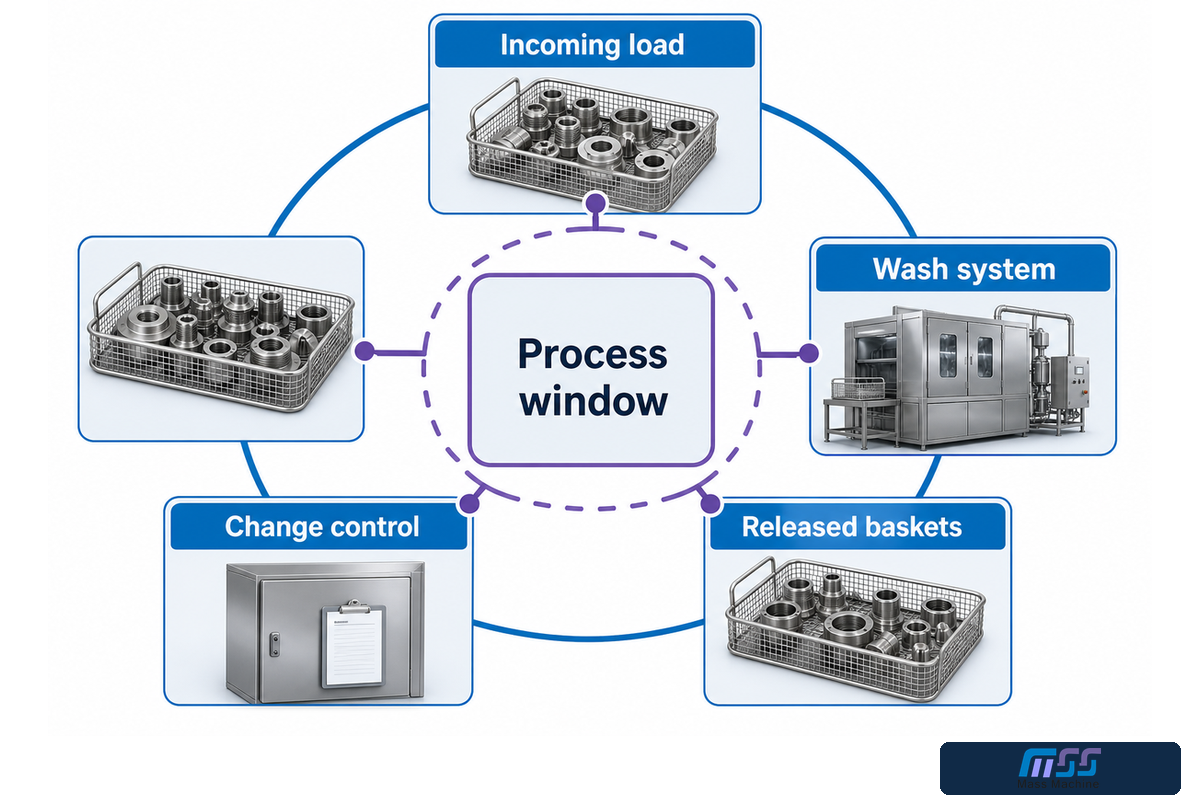
Validation establishes a process under defined conditions; daily control asks whether those conditions still exist. The utility boundary from the previous section becomes part of that operating baseline. Nozzle wear or blockage, filter loading, tank condition, chemistry drift, conveyor speed, cycle time, loading orientation, seals, doors, alarms, water supply, and soil age can change washing results without a dramatic machine fault.
| Control | Check | Evidence | Escalation trigger |
|---|---|---|---|
| Incoming load | Correct family, orientation, soil range, and prohibited items | Load record and exception count | New basket or soil outside the Cleaning Duty Record |
| Wash system | Nozzles, filters, tank, level, leaks, abnormal vibration, and alarms | Pre-start and in-shift checks | Blocked path, abnormal trend, or repeated intervention |
| Process window | Actual time, water temperature, dosing method, and speed | Timestamped readings and corrections | Out-of-limit value or unreliable instrument |
| Released baskets | Representative inspection locations and required tests | Pass, rewash, hold, or reject record | Clustered failure or basket-family difference |
| Change control | Chemistry, basket, recipe, nozzle, filter, software, utility, or maintenance change | Approved change and required recheck | Change can affect a validated boundary |
Daily maintenance should define what operators may inspect, what trained maintenance personnel may access, and what requires energy isolation. OSHA’s hazardous-energy rule is a United States example: cleaning, unjamming, servicing, or maintenance can require control of unexpected startup or stored energy when employees are exposed. Applicability and the actual procedure belong to the installed site.
In the manufacturing industry, large-scale sites can give frequently used baskets a short maintenance window. Plan regular cleaning of accessible zones, technical support boundaries, and component-lifespan records around the peak return window instead of relying on a “heavy duty” label.
Do not normalize recurring intervention. If operators frequently clean the filter, clear one guide, change a recipe, or reset an alarm to maintain proper operation, record the frequency of use and investigate the mechanism. Ease of operation comes from removing hidden work, not from leaving it outside the official cycle.
8. Troubleshoot by Evidence, One Controlled Change at a Time
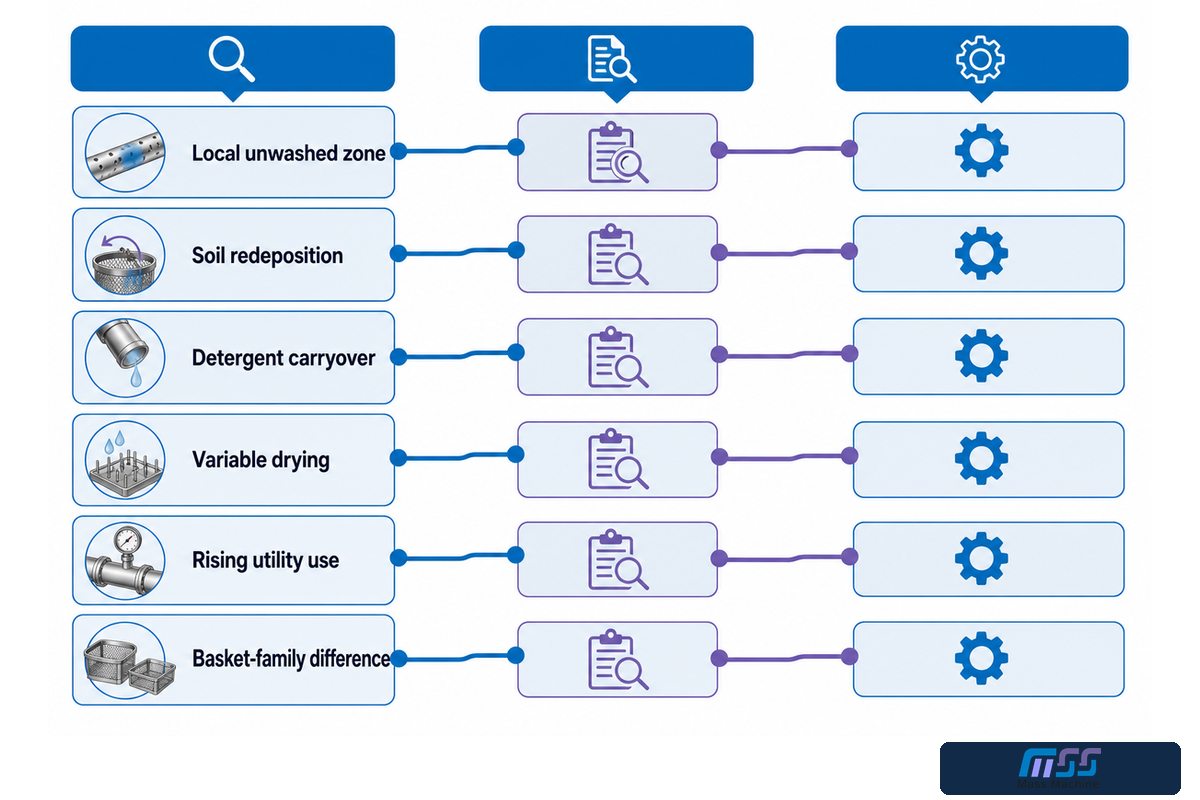
A one-variable-at-a-time check is useful for fault isolation when the baseline can be held stable. It isn’t a complete validation design and shouldn’t replace a risk-based study of interactions. Keep basket, soil preparation, soil age, load, orientation, inspection method, and all unrelated process settings fixed; change one suspected mechanism and record the result.
| Symptom | Possible mechanism | Evidence to collect | Controlled action | Escalate when |
|---|---|---|---|---|
| One local unwashed zone | Spray shadow, blocked nozzle, orientation, or guide contact | Failure map, nozzle check, presentation photo, and repeat location | Correct one coverage variable and rerun the fixed challenge | Access requires unsafe intervention or design change |
| Soil redeposits broadly | Overloaded bath, filtration, overflow, or carryover | Tank and filter condition, soil loading, water sequence, and trend | Restore the accepted water-control condition | The recurrence indicates capacity or routing mismatch |
| Detergent carryover or foam | Dosing, product choice, rinse, air entrainment, or water quality | Actual dosing, label method, foam location, rinse quality, and hardness | Verify dosing before changing rinse time | Product compatibility or release claim is uncertain |
| Variable drying or retained drops | Drainback geometry, load orientation, air path, or dwell | Wet-zone map, basket family, orientation, air condition, and exit time | Test one presentation or drainback change | Residual moisture threatens next use or secondary contamination |
| Rising water or energy use | Leak, overflow, refresh rule, heating loss, rewash, or false throughput assumption | Metered streams, released baskets, rewash rate, and operating hours | Correct the verified loss mechanism | Utility capacity or wastewater approval is affected |
| Results differ by basket family | Geometry, material, damage, soil age, or mixed loading | Separate family records and matched challenge runs | Split the Cleaning Duty Record and retest | One recipe cannot meet both accepted duties |
Don’t change chemistry, water temperature, speed, and nozzle arrangement together and then claim the winning factor is known. Conversely, don’t use one-variable testing where interactions are the central risk. The objective here is disciplined diagnosis: locate the mechanism, return the process to control, and decide whether a formal revalidation is required.
9. Turn FAT and SAT into Acceptance Evidence, Not a Demonstration
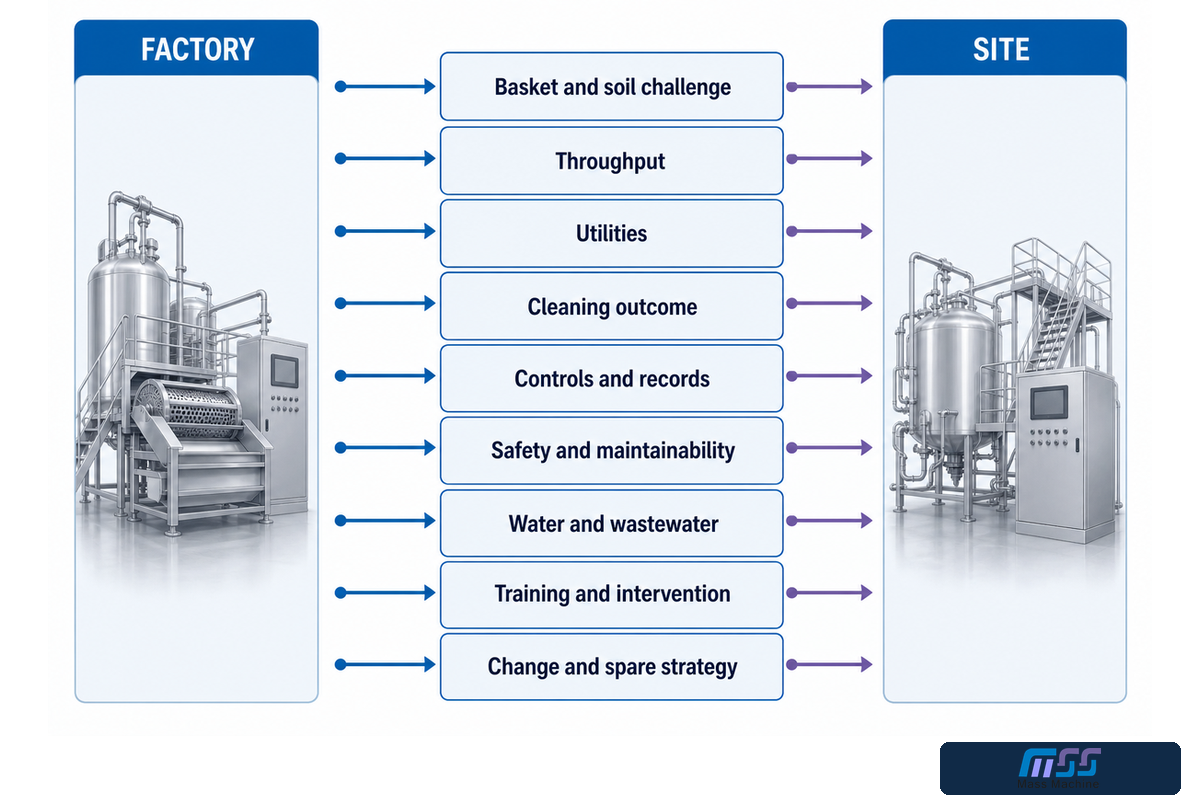
Factory Acceptance Testing and Site Acceptance Testing should share the same frozen cleaning duty, challenge items, pass criteria, and evidence packet. FAT checks what can be proven under declared factory conditions. SAT checks the installed process with site water, heat, power, drainage, extraction, upstream handling, downstream protection, operators, and real interfaces.
| Evidence item | FAT focus | SAT focus | Release rule |
|---|---|---|---|
| Basket and soil challenge | Correct samples, preparation, orientation, and repeatability | Real incoming variation and approved exception route | Named duty passes without hidden exclusions |
| Throughput | Steady equipment cycle and handling assumptions | Released baskets with site labor, buffers, rewash, and changeover | Agreed peak window is met under defined conditions |
| Utilities | Declared factory supply and measured demand | Actual pressure, flow, heat recovery, power, air, extraction, and drains | No unowned site limitation remains |
| Cleaning outcome | Inspection map and agreed test method | Site-approved sampling, handling, and clean-side protection | All defined limits pass or deviations are closed |
| Controls and records | Recipes, alarms, interlocks, data, manuals, and calibration status | Access levels, backups, operating procedures, and change control | Named owners can reproduce and review the record |
| Safety and maintainability | Guarding concept, safe access, service tasks, and documentation | Installed risk controls, energy isolation, training, and maintenance route | Responsible site functions approve remaining risk |
| Water and wastewater | Declared stream map, overflow, solids, heat, chemistry, and factory discharge route | Installed drains, containment, treatment, monitoring, and accepted destination | Every stream has a named owner and permitted route |
| Training and intervention | Operator tasks, maintenance access, alarm response, and energy-isolation concept | Site roles, competence, safe procedure, and escalation path | Named personnel can perform and document each task safely |
| Change and spare strategy | Wear items, approved equivalents, software revision, and recheck trigger | Site stock, replacement record, approval owner, and post-change evidence | A material change cannot bypass the agreed acceptance boundary |
Freeze the test before discussing exceptions. Record the instrument and calibration state, actual settings, steady-state duration, sample count, every failed run, the corrective action, retest rule, documents, training, spare or wear items, and named sign-off owners. If factory utilities differ from site utilities, state the difference rather than treating FAT as installed performance.
Only after this evidence is defined should procurement compare a commercial basket-washing configuration. Mass Technology describes its company and manufacturing focus on the About Mass Technology page; project-specific suitability still depends on the documented duty and acceptance plan.
Frequently Asked Questions
Is washing the same as sanitizing for reusable food crates?
No. Washing removes soil and residues; sanitizing applies an approved treatment after cleaning when the site requires that endpoint. Remaining soil can shield surfaces or consume chemistry, so adding sanitizer doesn’t repair a failed wash. Define the required release claim with QA, the chemical supplier, container-material limits, applicable rules, and the site sanitation program, then verify the actual process.
What information should I send before requesting a basket washer proposal?
Send drawings or samples for every basket family, maximum dimensions and weight, soil types and age, daily and peak return pattern, food-contact status, required rinse or sanitation endpoint, residual-moisture rule, utilities, wastewater constraints, floor and access limits, and the evidence required at FAT and SAT. This keeps the quotation from being based on nominal basket size or nameplate throughput alone.
How do I tell whether poor cleaning comes from the machine or the process?
Hold basket family, soil preparation, age, orientation, load, inspection method, and unrelated settings stable. Map the failure, collect nozzle, filter, chemistry, time, temperature, and water evidence, then change one suspected mechanism. A repeated local defect suggests reach or geometry; broad variation may indicate loading, soil, bath condition, or timing. Escalate when diagnosis requires unsafe access or a design change.
Can an industrial basket washer reuse wash water safely?
Not by default. Water reuse may suit selected stages, but final-rinse quality, carryover, product-contact risk, monitoring, and local rules require site validation.
What should operators check every day?
Check the incoming basket family and soil range, guards and safety devices, tank and filter condition, nozzle blockage, dosing and temperature readings, cycle timing, water supply, leaks, abnormal vibration, alarms, and representative exit baskets. The exact list, limits, response, and safe-access method must come from the approved machine manual, site operating procedure, and energy-control program.
Conclusion: Freeze the Duty, Prove the Process, Then Choose the Configuration
A basket washing project becomes easier to evaluate when the sequence is disciplined. Define each basket-and-soil family. Separate washing, rinsing, sanitation, drainback, and drying. Inspect spray shadows and retained-water zones. Build the Clean-Release Evidence Packet. Draw every utility and wastewater stream. Carry the same frozen duty into FAT, SAT, daily control, and change management.
- If demand is low or highly variable, stabilize the manual cleaning and evidence process before automating it.
- If a trial is inconclusive, improve the challenge and measurement rather than accepting a vague demonstration.
- If water, heat, drainage, or clean-side handling is the bottleneck, correct that boundary before blaming the enclosure.
- If the duty and acceptance packet are ready, use them to compare configurations on the same basis.
Bring a defined cleaning duty to the project review
Share the basket families, soil challenge, peak return window, utilities, and acceptance evidence you need. The discussion can then focus on fit and open risks instead of a generic catalogue cycle.
Related Mass Technology Resources
- Basket washing machine configurations and project inquiry
- Crate-fit input builder for basket geometry
- Throughput target calculator for peak-flow planning
- Trash bin washing machine guide for facility containers
- Industrial drum washing machine solution
References & Sources
- Reusable Packaging Association: guidelines and best practices for returnable containers in food supply chains.
- FAO: reusable plastic crates in fresh produce supply chains.
- University of Minnesota Extension: cleaning and sanitizing harvest containers and surfaces.
- Food Control: field and challenge evidence concerning reusable plastic containers.
- ISO/DIS 14159: Safety of machinery, Hygiene requirements for the design of machinery (draft scope page).
- PR3 Washing Standard scope page (used to distinguish reusable foodware scope from transport-crate scope).
- UK Government: pollution prevention for businesses.
- OSHA 29 CFR 1910.147: control of hazardous energy.
- CN209379606U published patent document (basket orientation and spray-shadow problem definition).
- CN215143114U published patent document (staged water-routing design option).