Get in Touch with Masstech

Process, quality and acceptance guide · Updated September 2026
Soda can filling is a practical control path connecting product condition, counter-pressure filling, foam diagnosis, double-seam evidence and FAT-to-SAT acceptance.
In short: It includes more than the moment liquid enters a can. It is a connected package-control process: confirm the can and end, deliver the beverage in a validated condition, manage pressure through the filling cycle, place the end, form the double seam and release cans against defined evidence. When foam, low fill or leaks appear, diagnose the pattern before changing a setting.
Soda can filling looks simple in high-speed video: cans arrive, liquid is dispensed, ends drop and are inserted, and filled cans are removed. The reality of production is much more difficult. A can may be dimensionally correct but paired with the wrong end or coating basis. Foaming can begin because the incoming beverage changed even while the filler remains stable. Even a tidy-looking seam may require internal evaluation. A line may achieve its mechanical rate and produce fewer accepted cans than the project anticipated.
This paper has a different emphasis than that of Mass Technology’s page for soda can filling equipment and configuration. The solutions page deals with different models and configurations of machines, their nominal capacities, commercial comparisons, project quotation and RFQ intent. This guide deals with the process, quality evidence, logic of troubleshooting, and boundaries of acceptance. Separating these issues will assist buyers and operators in locating the relevant page without having to answer the same commercial query with two different URLs.
Scope: the instruments described below are editorial position frameworks and shouldn’t be regarded as machine manuals, universal process recipes, legal opinions or substitutes for the approved can/end specification. The beverage owner, can and end suppliers, equipment documentation, validated methods, qualified personnel and requirements in the target market control the real production and release decisions.
1–2 · Define
Process boundary and package compatibility
Process boundary and package compatibility
3–5 · Stabilize
Product state, fill cycle and foam evidence
Product state, fill cycle and foam evidence
6–8 · Prove
Seam, hygiene, safety and diagnosis
Seam, hygiene, safety and diagnosis
9–10 · Accept
Saleable output and FAT/SAT dossier
Saleable output and FAT/SAT dossier
1. See Soda Can Filling as One Connected Control Path
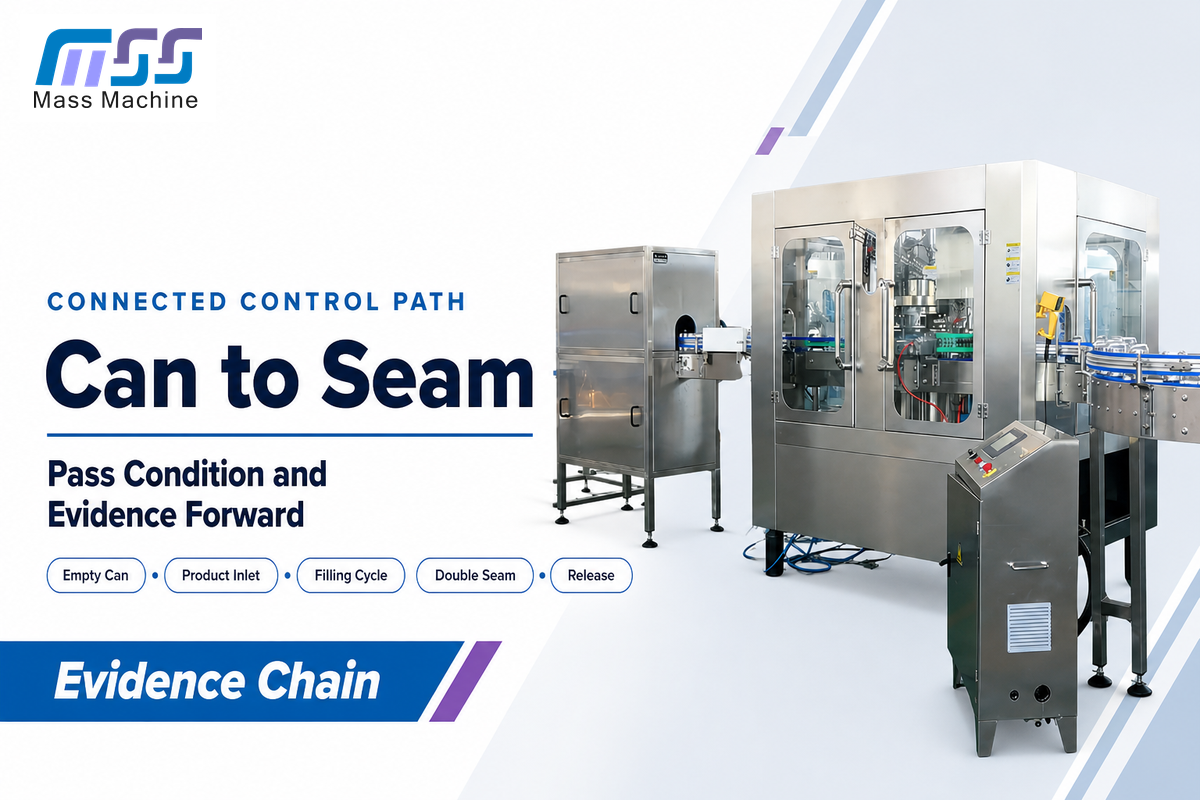
Direct Answer: the operational boundary runs from an approved empty can and conditioned beverage to a filled, seamed and inspected package at a named release point. Each step builds upon the previous step’s condition and provides evidence for the subsequent step.
An effective line map begins before the filler. The cans have a body format, neck and flange condition, level of cleanliness and history of handling. The beverage arrives with temperature, dissolved gas, gas composition and pressure, and history of transfer. The filler operates a defined cycle. The end is then presented, seated and seamed before inspection, coding, secondary packaging and release.
Editorial Asset: Can-to-Seam Control Spine
Use this spine to identify where a state is created, where it becomes evident and which record should cross the boundary.
| Stage | Control question | Evidence passed forward | Typical false conclusion |
|---|---|---|---|
| Empty-can supply | Is the approved body format undamaged and traceable? | Supplier, code, lot, condition and hold status | “It is the same diameter, so it is compatible.” |
| Product inlet | Is the beverage inside its approved operating window? | Temperature, gas/pressure, batch and time history | “The filler setting caused every foam event.” |
| Filling cycle | Did the valve sequence reach its intended states? | Head/station, alarms, timing and measured result | “Low visible level always means short fill.” |
| End placement | Was the correct end presented without damage? | End code, lot, presence/orientation and rejects | “The seamer can correct a presentation defect.” |
| Double seam | Did both operations form the specified closure? | Head, sample, visual, dimensional and internal evidence | “No immediate leak means the seam is proven.” |
| Release boundary | What counts as an accepted, saleable can? | Good count, rejects, stops, tests and disposition | “Nameplate speed equals delivered good output.” |
The spine alters the troubleshooting approach. If several heads start to drift after the beverage has warmed, start by looking at the common state of the product. If one head exhibits a symptom and adjacent heads are stable, the evidence points to a local path. If the closure fails only on one end lot, the filler may not be the first place to look for the problem. The map supports not assigning a root cause to a symptom that’s visible.
2. Freeze Can, End and Beverage Compatibility Before Line Setup
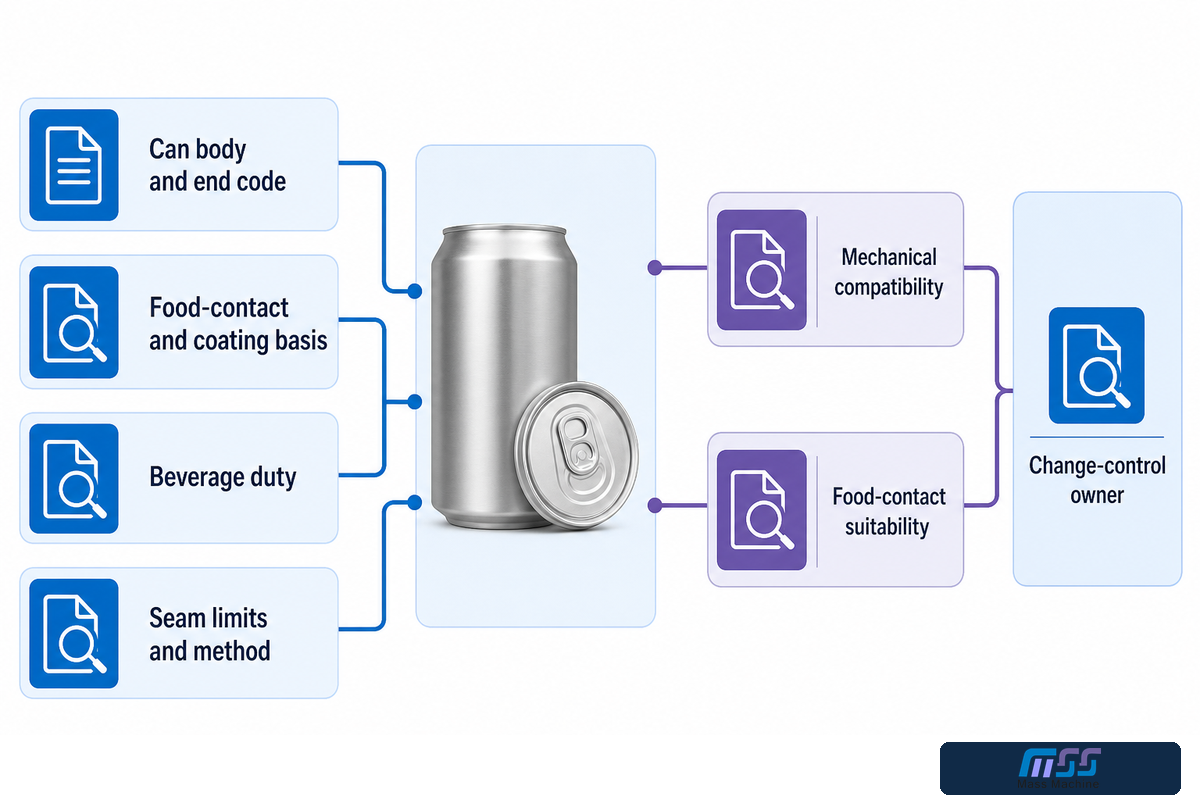
Direct Answer: “standard can” isn’t a usable release specification. Freeze the can body and end codes, drawings, material and coating basis, product characteristics, intended processing, supplier limits, approved methods, sampling duties and change-control owners before approving change parts or seam settings.
Mechanical compatibility and food-contact suitability are separate questions. The body and end may fit the line, yet dimensional fit alone does not establish that an internal coating or other food-contact component is authorized for the beverage and intended conditions of use. The FDA explains that a food-contact authorization can depend on the substance identity, manufacturer or supplier, specifications and conditions of use. Other target markets require their own review.
Terminology note: search results may call the package an aluminum can, aluminium drink can or soft drink can; may call the end a lid; describe carbonated water as a beverage base; and use automation for mechanized controls. This guide will use the terms can, end, beverage, and control system as these terms will help clarify the production record.
| Controlled field | Source of truth | Interface affected | Change trigger |
|---|---|---|---|
| Can body and end code | Approved supplier specification | Handling, end placement, chuck and rolls | New supplier, revision, plant or format |
| Food-contact/coating basis | Applicable authorization and supplier declaration | Beverage, storage and processing conditions | Formula, coating, supplier or market change |
| Beverage duty | Approved product and process specification | Product preparation, filler and package | Recipe, carbonation or treatment change |
| Seam limits and method | Can/end supplier plus seamer documentation | First and second operation, inspection | Any body/end/tooling combination change |
This first anti-cannibalization boundary specifies what must be defined for a soda canning process and beverage canning line project, including the counter pressure can filler, and not which Mass Technology model to select. There may be similar portions of a system for a carbonated beverage production line and a beer can filling machine, but design behavior, oxygen control objectives, package specifications, and a validated release plan may differ. Once the function is defined and the question becomes Soda can filling machine, Soda can filling for sale or Soda can filling machine for sale, proceed to the commercial solution page instead of expanding this article into a second catalog.
3. Condition the Beverage Before It Reaches the Filler
Direct answer: the filler gets a physical product state rather than just a recipe name. Pressure change at a valve can be impacted by temperature, dissolved carbon dioxide, feed pressure, tank behavior, transfer agitation, product composition and time in the system.
The behavior of the foam isn’t controlled by one knob. Peer-reviewed research on bubble and foam behavior discusses the role of carbonation, temperature, composition, interfaces and methods of measurement in what is observed. Lower product temperature helps retain dissolved gas. However, “colder is always better” isn’t a prudent operating instruction. There are limits set by product quality, equipment design, sanitation and the validated beverage window.
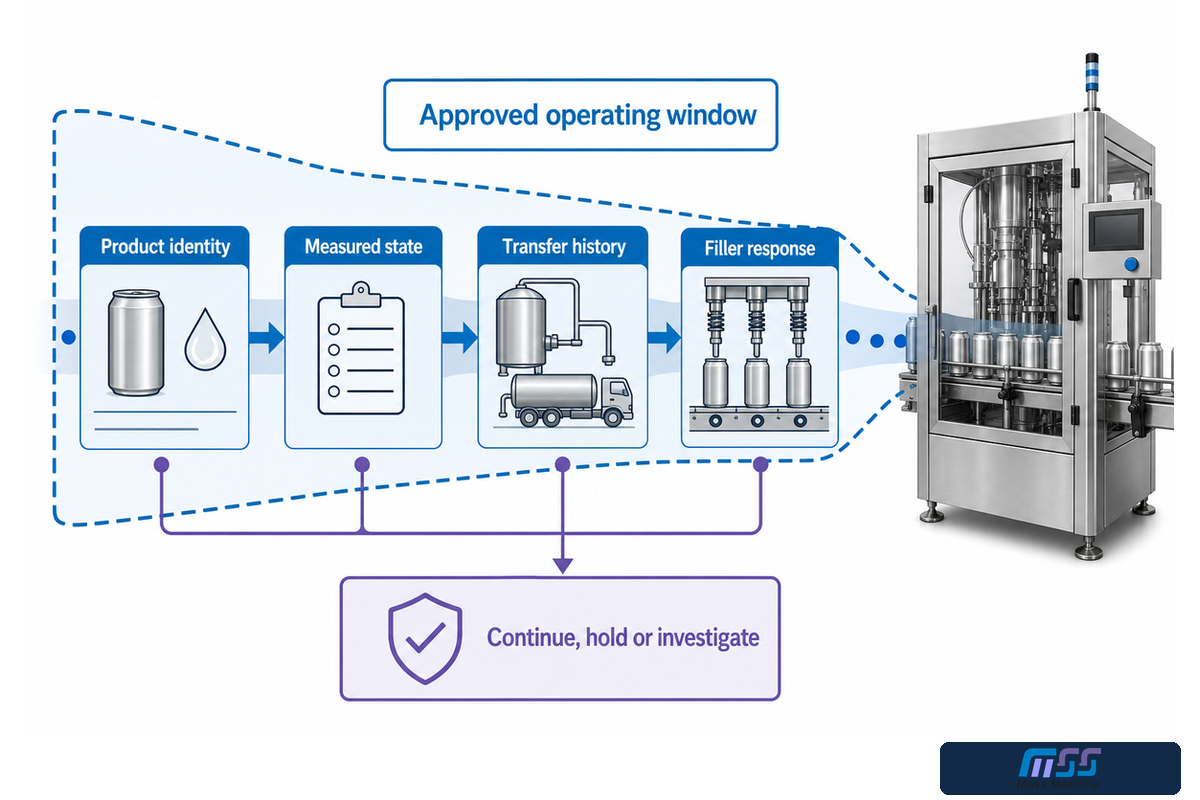
Editorial Asset: Cold-Product Stability Corridor
Set an approved corridor, rather than copying a temperature or pressure value from another beverage.
- Record the product identity: batch, recipe revision and planned package.
- Record the measured state: approved temperature, carbonation or pressure-related method and sampling point.
- Record the transfer history: tank status, pump or transfer events, residence time and interruptions.
- Filler response: Foam signature, fill measure, valve/head identity and time onset.
- Disposition: continue, hold, investigate, recondition or escalate under the site’s plan.
14-Signal Diagnostic Snapshot
Illustrative data only: The figures provided are examples of the level of time-matched detail a diagnostic record may potentially capture. They shouldn’t be considered as setpoints, limits or acceptance criteria. Replace them with the values described in the approved recipe, instrumentation, package specifications and test plan.
| Signal type | Illustrative event sample | Illustrative stable sample | Why the paired record matters |
|---|---|---|---|
| Product inlet temperature | 3.2 °C | 3.0 °C | Separates a shared inlet shift from a local head pattern. |
| Bowl product temperature | 3.4 °C | 3.1 °C | Shows whether product state changed across transfer. |
| Product inlet pressure | 2.6 bar | 2.7 bar | Links supply behavior to the filling event. |
| Bowl gas pressure | 2.2 bar | 2.3 bar | Preserves the gas-side condition rather than a setting alone. |
| Equalization time | 0.8 sec | 0.7 sec | Provides cycle context for pressure-related symptoms. |
| Product-flow time | 2.4 sec | 2.3 sec | Lets the team compare commanded time with measured result. |
| Vent or snift time | 0.5 sec | 0.4 sec | Connects foam onset to the release stage. |
| Fill-measure deviation | +0.9% | +0.3% | Keeps quantity evidence separate from visible height. |
| First-operation seam width | 2.1 mm | 2.0 mm | Binds the reading to the operation and sample. |
| Finished-seam thickness | 1.2 mm | 1.2 mm | Shows why one dimension alone is not a seam verdict. |
| Time since conveyor stop | 18 min | 25 min | Tests whether stop-and-restart history tracks the event. |
| Sampling window | 30 min | 30 min | Keeps comparisons on the same observation boundary. |
| Sample hold time | 5 min | 5 min | Prevents unequal settling time from distorting the comparison. |
| Observation interval | 10 min | 10 min | Keeps trend frequency consistent across the run. |
Trend analysis of these fields together is recommended. Evidence consists of an observed value of temperature paired with a location of a sample. An observed value of pressure paired with product ID or instrument status also can be valuable. The record of value provides evidence on the status of the inlet and the individual heads and package during the operation.
4. Understand the Counter-Pressure Filling Cycle
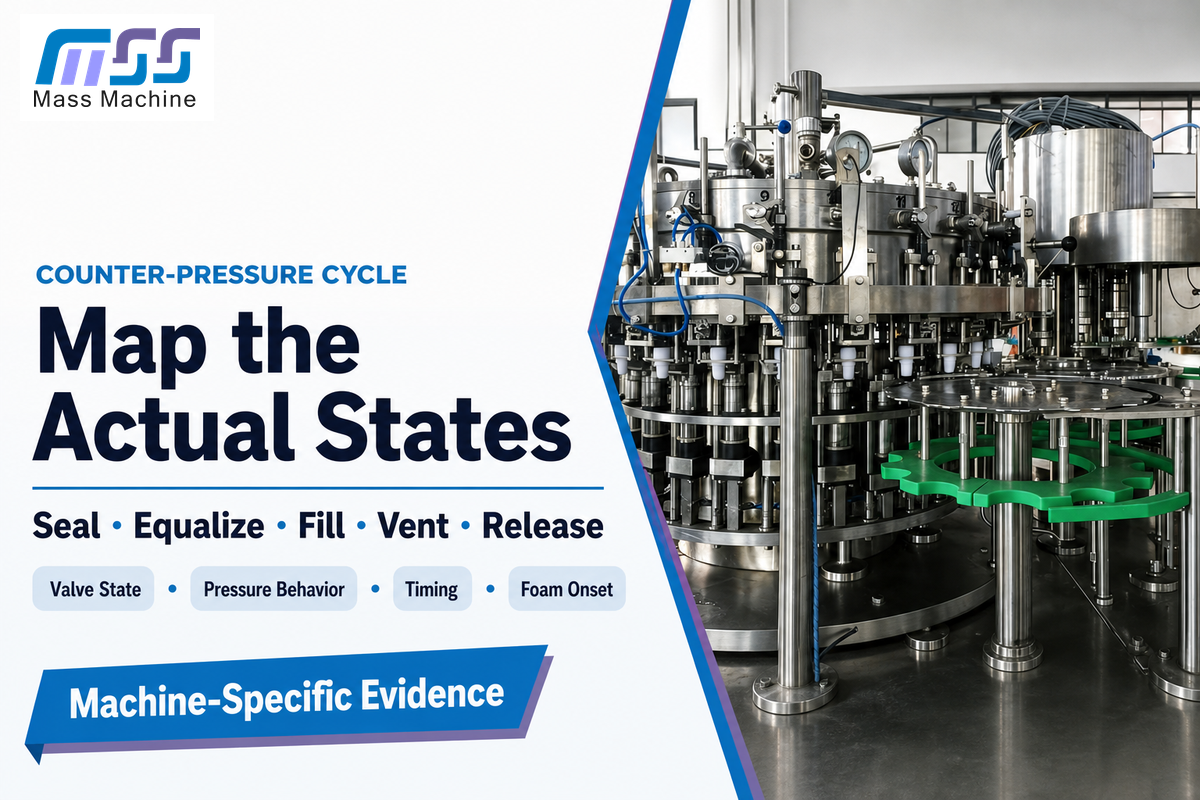
Direct answer: A typical counter-pressure cycle establishes a seal between the can and filling path, may purge the container, equalizes gas pressure, admits product, controls venting or snift and then releases the filled can for end placement. The exact sequence, valve arrangement and the control of the mechanism is specific to each machine.
Counter pressure helps mitigate the shock that leads to excessive gas breakout. Counter pressure doesn’t eliminate foam. Purge, unequalized pressure, disturbed product flow, a restricted vent path, rapid depressurization, unstable inlet, or other factors can lead to a later symptom. The foam observed at the end of the cycle may have started upstream or several valve states earlier.
Map out each stage to align evidence with what the actual machine can do. This may include state feedback, pressure behavior, timing, alarm history, head number, product result, or a safe observation as documented in the equipment procedure. Don’t speculate a step that’s missing by extrapolating from another filler design. Both KHS and Sidel illustrate that filling is an application-specific process for different kinds of beverages and packaging. Thus, a general web sequence can’t replace the machine manual.
| Typical stage | Intended condition | Evidence to review | Do not assume |
|---|---|---|---|
| Seal and optional purge | Defined can-to-valve interface and gas path | Can position, seal condition, valve state | Every machine purges the same way |
| Equalization | Managed pressure difference before flow | Machine state, pressure behavior, timing | A longer time is always better |
| Product flow | Controlled entry with stable inlet supply | Head result, inlet state, flow-related alarms | One fill result identifies one cause |
| Venting/release | Controlled transition before transfer | Foam onset, timing and product condition | Counter pressure eliminates gas breakout |
5. Control Foam, Fill Amount and Headspace Together
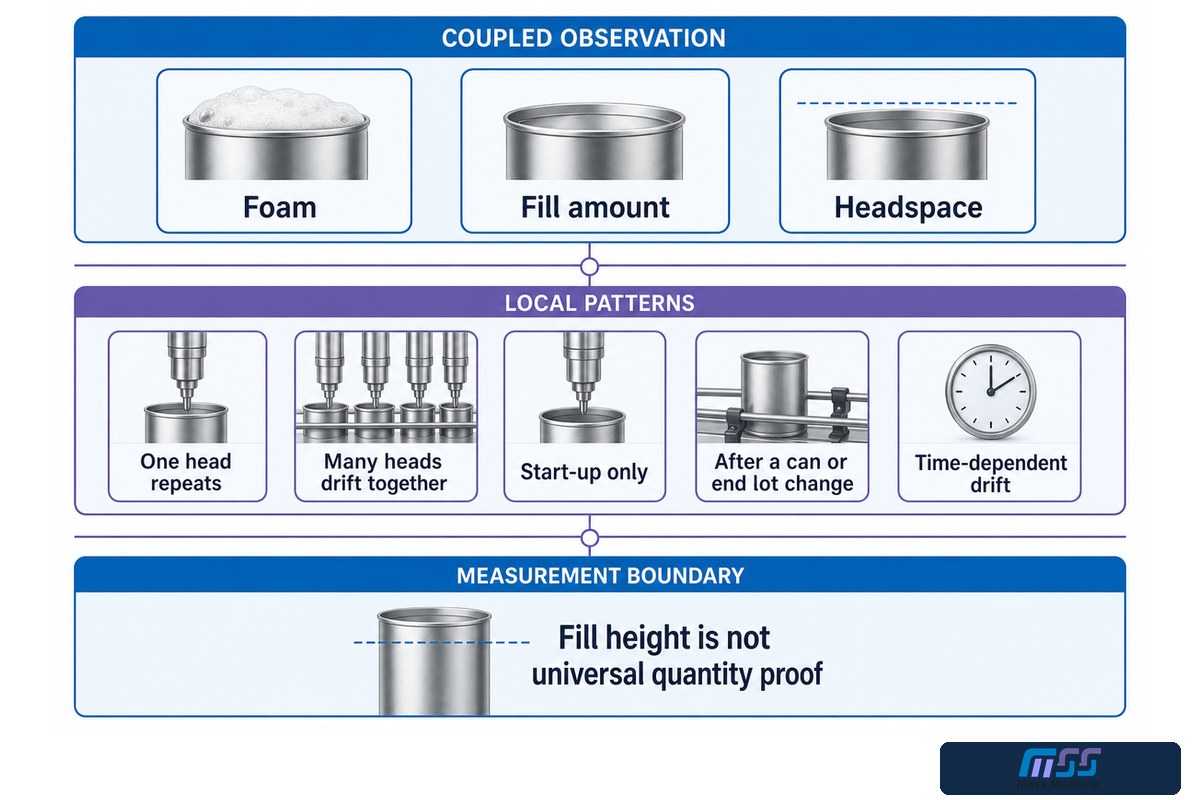
Direct answer: foam, fill amount and headspace are coupled observations. Product state, valve behavior, can condition, acceleration, dwell before end placement and the measurement method can affect the visible result. Record the pattern before selecting an intervention.
A low visible liquid level may be actual quantity, foam collapse, product temperature, package geometry or measurement timing. Fill height alone is not universal quantity proof. The approved method may rely on mass, volume, level or an automated inspection proxy, but each method needs defined sampling, instrument control and interpretation.
Editorial Asset: Valve-and-Head Diagnostic Fingerprint
| Observed pattern | Evidence to collect | First safe question | Do not conclude yet |
|---|---|---|---|
| One head repeats | Head ID, adjacent-head comparison, valve state and sample result | Is the signal truly local and repeatable? | The beverage is globally wrong |
| Many heads drift together | Product inlet state, tank/transfer events and time trend | What shared condition changed? | Every valve needs adjustment |
| Start-up only | Warm-up, retained product, first-can sequence and stabilization time | Which start-up boundary was not yet stable? | Steady-state settings are wrong |
| After a can/end lot change | Lot codes, condition, dimensions and seam evidence | Did the package input change? | The filler created the closure defect |
| Time-dependent drift | Temperature, pressure, stops, cleaning state and wear indicators | Which condition tracks the onset? | A recent adjustment caused it |
Legal-metrology boundary: a process target isn’t the same as packaged-goods conformity. In the United States, the NIST packaged-goods guidance distinguishes the lot-average requirement from individual-package shortages and the applicable Maximum Allowable Variation. Several acceptable fill-height readings don’t establish both. Other jurisdictions may use different sampling and enforcement rules.
6. Seam Immediately, Then Prove the Double Seam
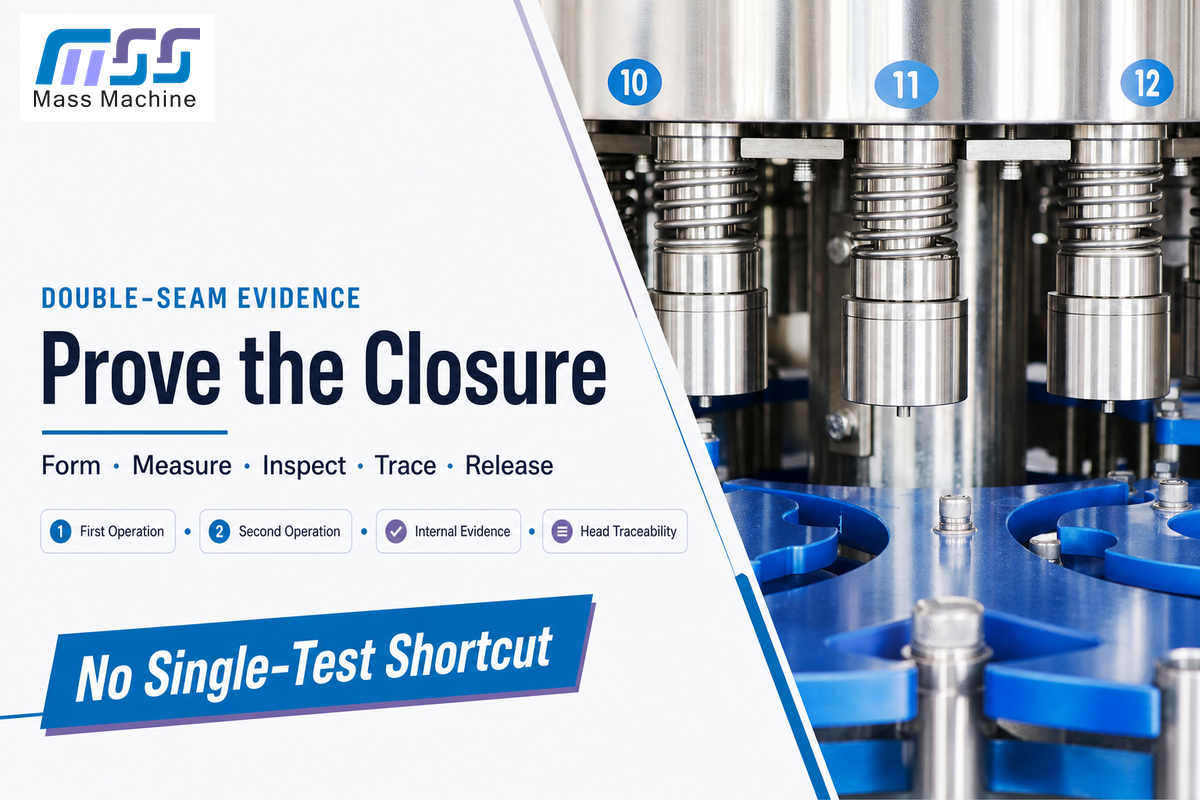
Direct Answer: the end is placed on the filled can and first- and second-operation tooling forms an interlocked double seam. Releases must use the specified inspection methods and limits for the actual can/end combination — not a dimension copied from the internet.
According to Crown, closure is two dependent forming operations. The first operation develops the interlock; the second compresses and completes the seam. This sequence of operations defines several interfaces: body flange, end curl, compound, chuck, rolls, lifter/base-plate behavior, end presentation and filled-can handling. A problem at one interface can be a wrinkle, false seam, droop, sharp seam, leakage or internal measurement that’s outside the approved limit.
Editorial Asset: Double-Seam Evidence Set
Each case must be linked to the code of the can, end code, seamer head, sample time, method, applicable supplier limit and disposition.
- External visual examination for visible formation and damage signals.
- External measurements made with the approved instrument and method.
- Section or teardown evidence where the specification requires internal assessment.
- Leak or package-integrity evidence should be used within its specified capability and not as a substitute for all other assessments.
- Traceability and response covering head, sample, lot, hold scope, correction, and verified restart.
Ardagh’s double-seam reference separates visual examination, external measurements, seam section, and teardown evaluations. Ferrum’s training material covers first- and second-operation interpretation and manual or automated measurements. Both sources explain what categories of evidence are needed. The approved can/end and seamer documentation still supplies the real limits and frequency for the package.
A rapid leak test may be useful, but “it didn’t leak” isn’t a complete seam release. This test may not find all issues that can exist within the internal structure of the package, may have a limited detection threshold, and may not represent the conditions that can occur during distribution.
7. Keep Hygiene and Safety Controlled Through Changeover
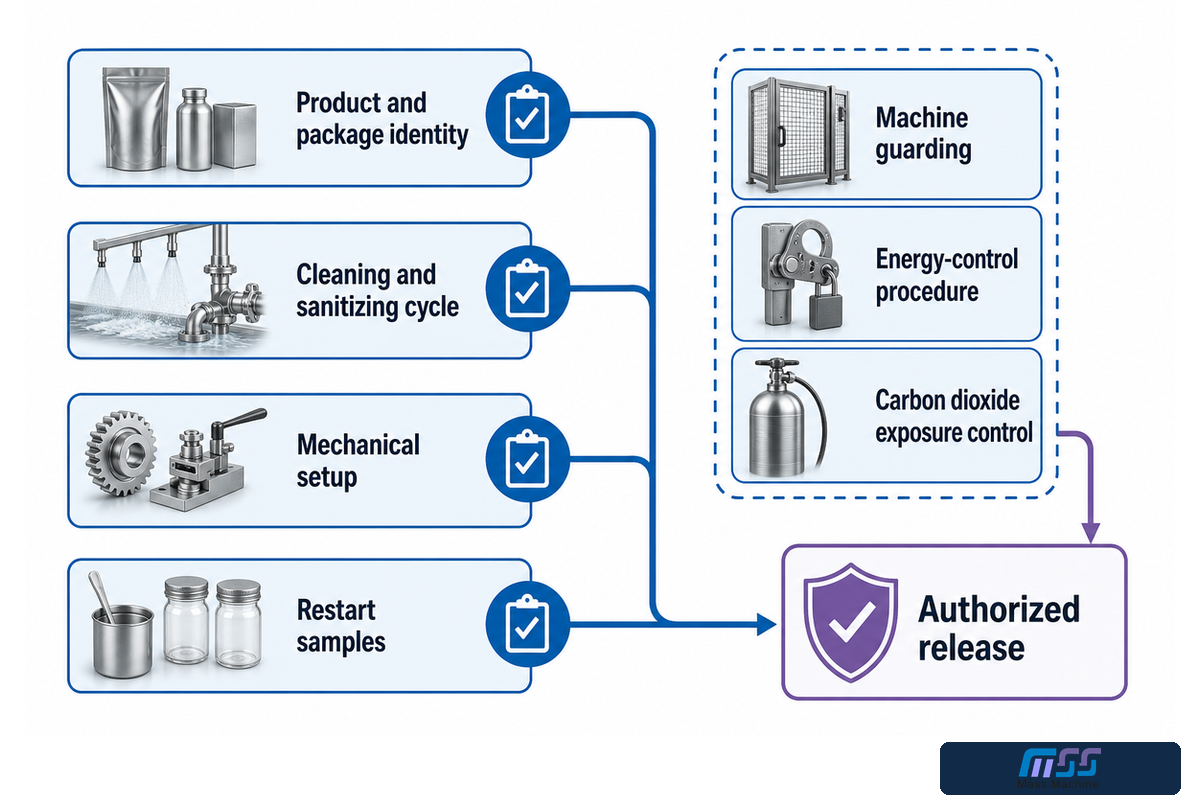
Direct answer: cleaning removes soils and sanitizing is a controlled step that occurs separately. This would include product-contact surfaces, valves, tanks, transfer paths, dead legs, drainage, chemical use, rinse or verification requirements, controls, and restart release for the actual beverage and equipment.
For US food operations, 21 CFR 117.40 addresses cleanable design and sanitary maintenance, while 21 CFR 117.80 requires filling and packaging operations to protect food against applicable contamination hazards. A completed cleaning cycle is not automatically a verified release. The record should show which cycle was performed, what was checked and how deviations were controlled and who released the line.
Machine-safety boundary: cleaning, unjamming, setup and inspection can bring a person within actively dangerous zones of rotating, pinching, pressurized or suddenly energized parts. OSHA’s general machine-guarding and hazardous-energy requirements establish separate duties. This guide never authorizes bypassing an interlock or replacing the site’s energy-control procedure.
CO2-safety boundary: carbon dioxide is a process input and an occupational hazard. OSHA has documented potential asphyxiation during CO2 transfer and accumulation. Leak response, ventilation, monitoring, confined-space assessment, exposure evaluation and emergency procedures are part of the facility safety program. A stable carbonation reading doesn’t assure a safe atmosphere.
| Changeover record | Minimum question | Release evidence |
|---|---|---|
| Product and package identity | What changed from the previous run? | Approved duty and lot/code confirmation |
| Cleaning/sanitizing cycle | Which validated procedure and parameters apply? | Cycle record, checks and deviations |
| Mechanical setup | Were authorized change parts and settings verified safely? | Setup signoff and safety restoration |
| Restart samples | Which fill, seam and package checks permit release? | Traceable samples and owner decision |
8. Diagnose by Station, Head and Time Before Adjusting
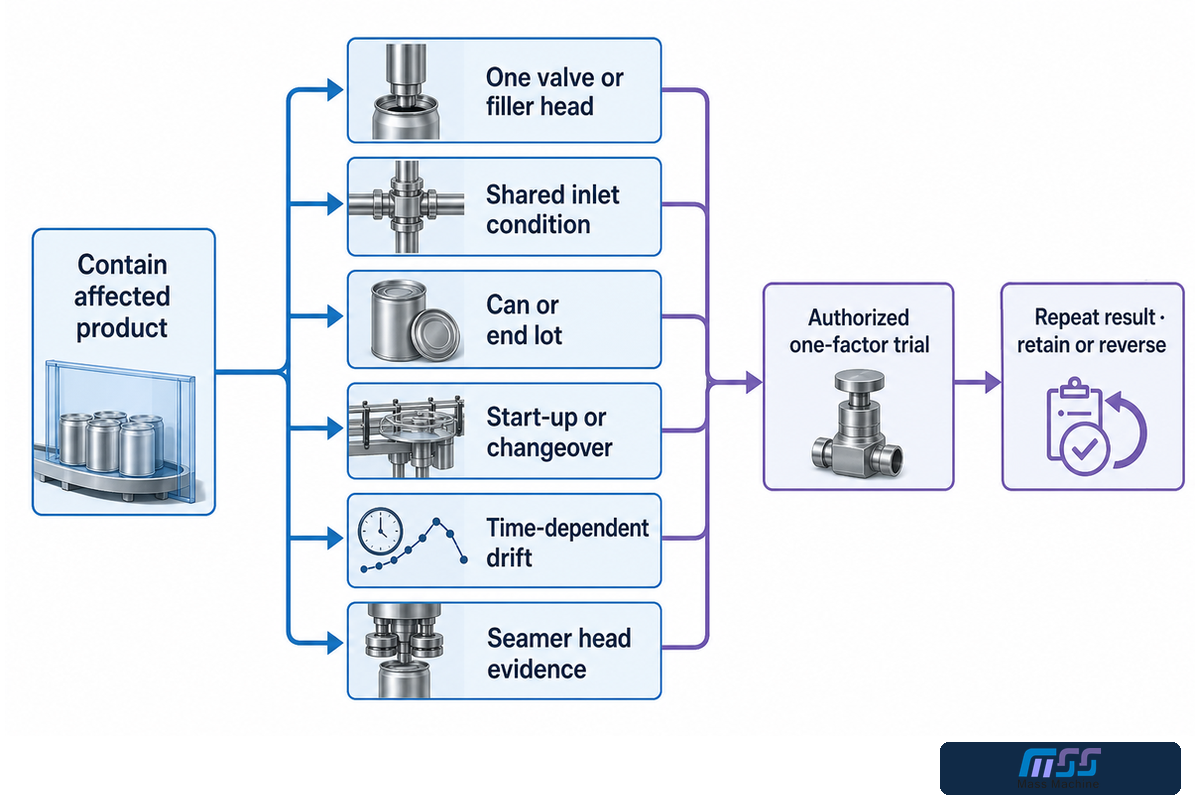
Direct answer: contain affected product, and then classify the signature. Ask whether the symptom is restricted to one valve or seamer head, one lane, one can/end lot, start-up, the period after changeover, a time-dependent drift or the entire system. That pattern determines what to check next.
Consider an intermittent low-fill complaint. If the same filler head repeats the event, look at that head and its neighbors, while the same product state is held constant. If all heads move together after a tank or transfer event, look at the common inlet. If the fill measure is stable, but seam leakage appears on one seamer head, keep the filler results and closure evidence separate. A repair made at the wrong boundary may improve the next sample by chance while leaving the mechanism untouched.
Safe one-factor trial rule: define the contained scope, authorization, factor, expected signal, measurement, stop condition and rollback before the change. One better can is not root-cause proof. Repeatability across the expected head, time or condition is stronger evidence.
Record the intervention history. A line that has received several untracked adjustments no longer has a clean baseline. Capture the prior state, the person and reason for the change, the affected boundary, the result and the decision to retain or reverse it. This is what turns troubleshooting from trial-and-error into a traceable investigation.
9. Measure Sustained Saleable Cans, Not Only Nameplate Speed
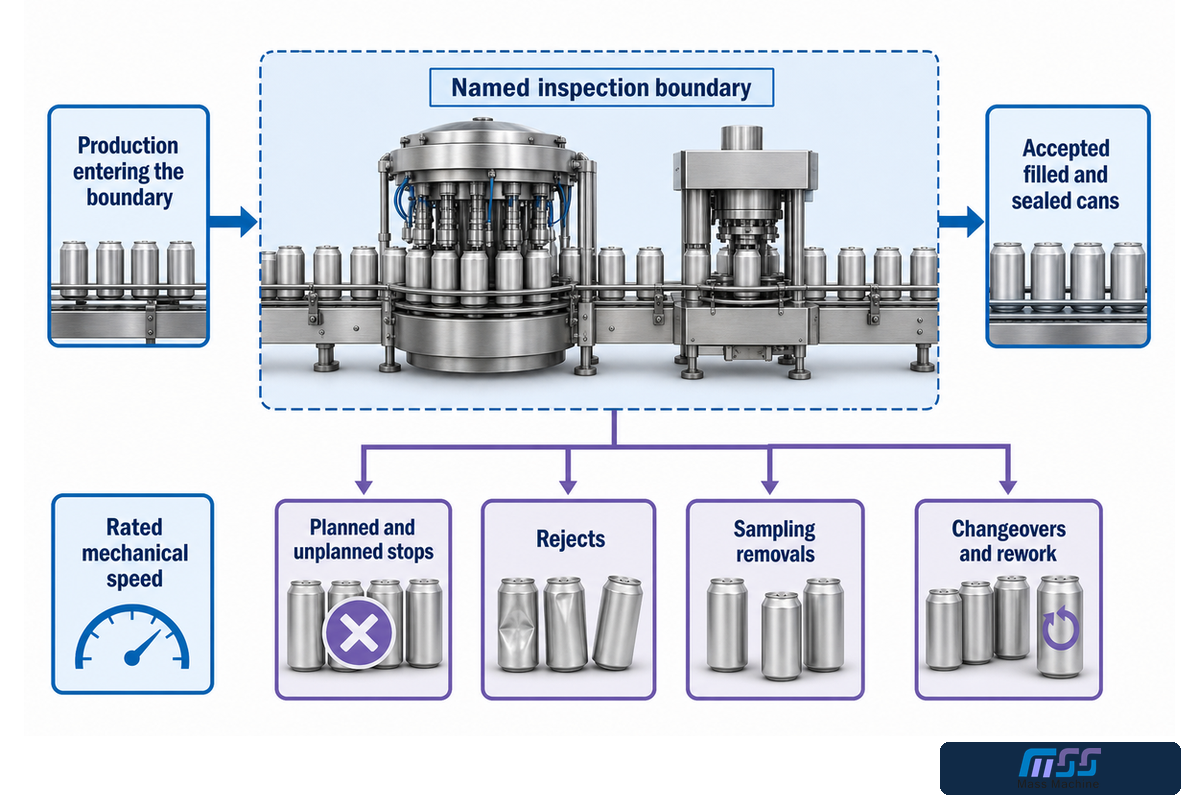
Direct answer: useful output is accepted, filled and sealed cans at a named inspection boundary over an agreed run. Report planned and unplanned stops, rejects, sampling removals, changeovers and rework separately; a faster nameplate rate in cans per minute is not useful if loading or sensor response reduces accepted output.
Rated mechanical speed is useful for equipment context, but it can’t describe the installed line by itself. Depalletizing, empty-can handling, filler, end feed, seamer, conveyors, coding, inspection, accumulation and secondary packaging interact. If a downstream stop repeatedly starves or blocks the filler-seamer, the achieved good-can rate can differ from the isolated machine rate.
Before undertaking a trial, establish the numerator and denominator. For instance, saying “accepted cans after named fill and seam inspection within the stable test window” is preferable to saying “production.” Also state whether testing samples, commencement cans, planned stops and material shortages are included. Stop-history estimates may be used to provide some information about accumulation. However, a production trial or a more suitable line model may still be required.
At the plant, “good-can” definition must also comply with pertinent packaged goods regulations. In US commerce, a lot may still fail its average requirement or individual package requirement, even if the line’s internal process indicator appears to be stable during the test. Be sure to retain the legal-metrology evaluation and don’t bury it within an overall efficiency number.
10. Turn FAT and SAT into an Acceptance Dossier
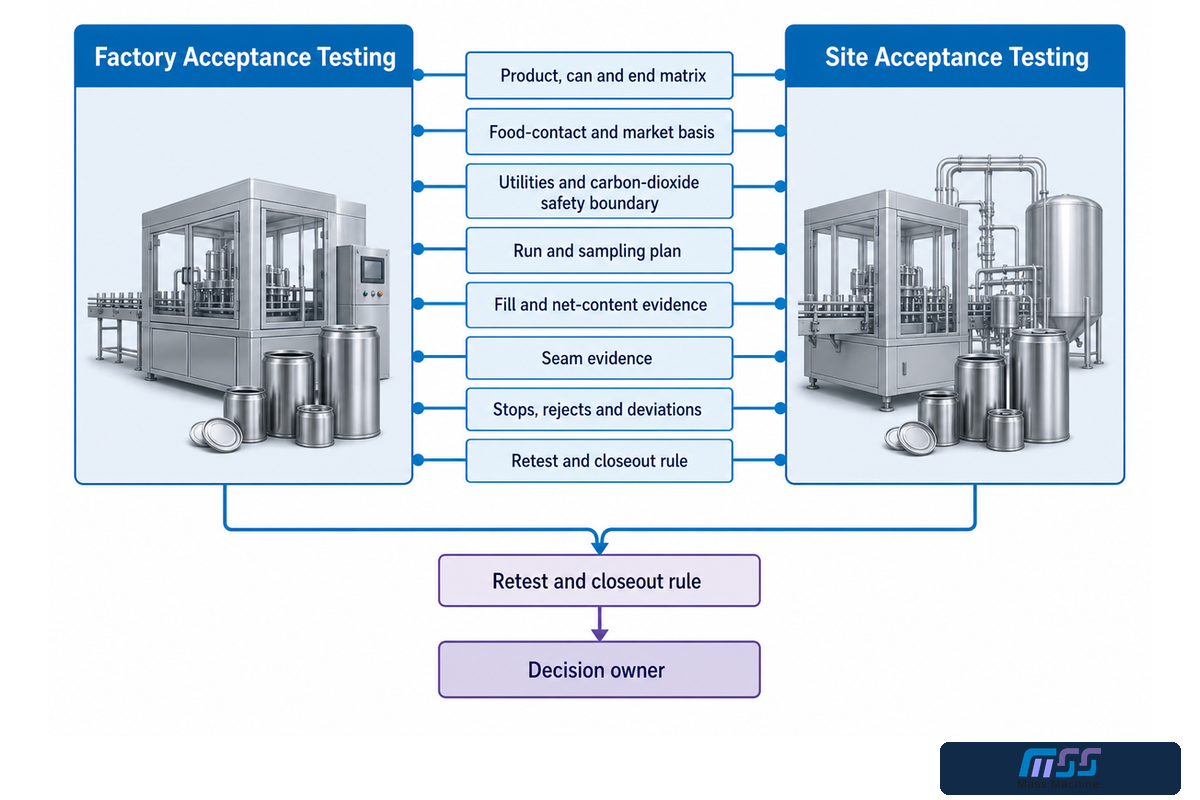
Direct Answer: Factory Acceptance Testing and Site Acceptance Testing should rely on a frozen duty and comparable evidence. Evidence should be recorded for the factory and the installed site, respectively. Good can, valid sample and completion of runs shouldn’t be defined on the day of the test.
Editorial Asset: Saleable-Can Acceptance Dossier
| Frozen field | FAT record | SAT record | Decision owner |
|---|---|---|---|
| Product, can and end matrix | Tested materials and substitutions | Installed-site materials and lots | Buyer/product/package owner |
| Food-contact and market basis | Documents available for test package | Documents applicable to sale package | Compliance owner |
| Utilities and CO2 safety boundary | Factory conditions and controls | Site supply, ventilation, monitoring and procedures | Site engineering/EHS |
| Run and sampling plan | Duration, stable window and sample map | Same duty plus site-specific conditions | Joint test team |
| Fill and net-content evidence | Approved process method and results | Applicable packaged-goods method and results | Quality/legal-metrology owner |
| Seam evidence | Head/sample traceability and approved checks | Installed seamer and actual can/end lots | Quality/seamer specialist |
| Stops, rejects and deviations | Cause, duration, count and disposition | Same fields with site interfaces visible | Named approvers |
| Retest and closeout rule | Invalidation trigger, contained retest and evidence disposition | Site-specific retest trigger, retained samples and final release record | Joint test team |
Retest should also be frozen. State which deviation invalidates the run, which permits a contained retest and who accepts the evidence. Samples and raw records retained will help resolve disputes. Without these, FAT and SAT will be demonstrations instead of acceptance tests.
Ready to define the equipment duty?
Use the guide to freeze product, pack and acceptance evidence. Review the available soda-can line in the context of that duty, including the product, package, utilities, acceptance boundary, sampling plan, expected run window, and the people authorized to accept or reject the evidence.
11. Frequently Asked Questions
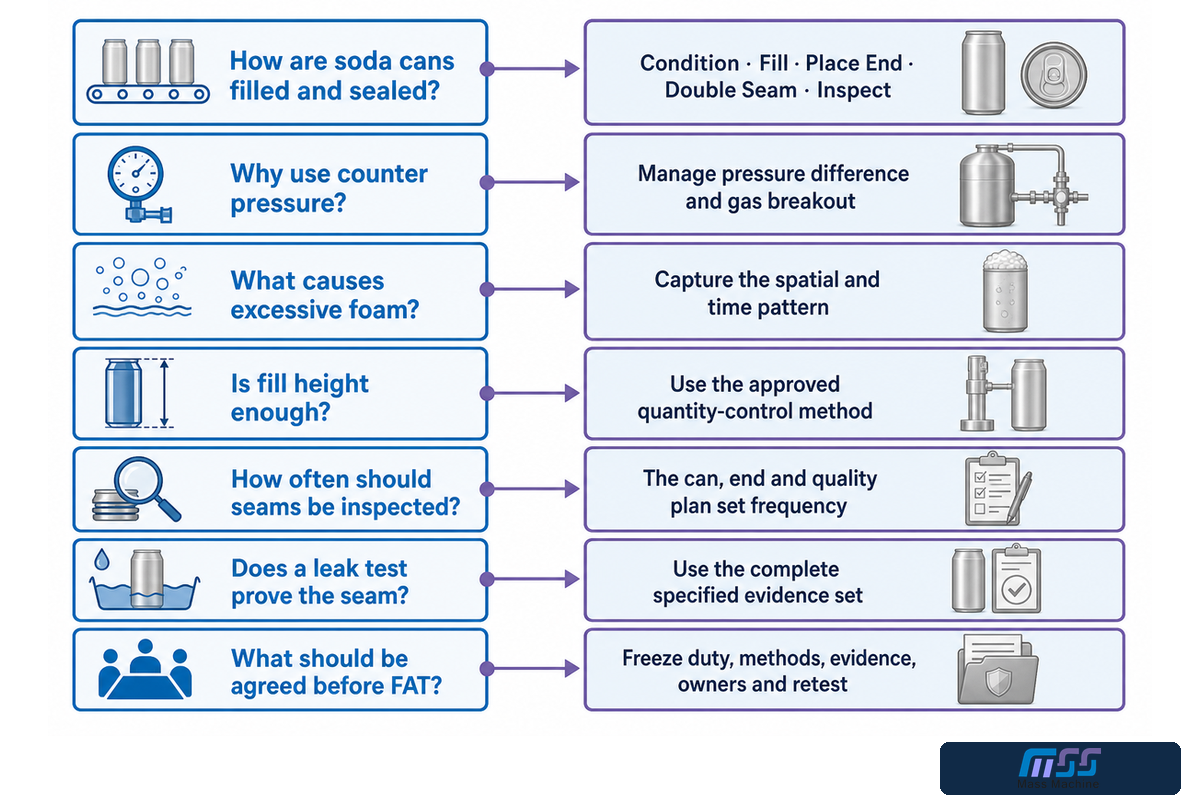
How do manufacturers fill and seal a soda can?
They condition and supply the carbonated beverage, present an approved empty can, use a pressure-managed filling cycle, place the correct end and form a two-operation double seam. The finished can is then checked against defined fill, seam, package and release evidence. The important point is that each step passes a controlled condition to the next one: the beverage state affects the fill, the filled can must reach end placement without uncontrolled delay or disturbance, and the seam must be evaluated against the approved can-and-end specification. A clean-looking can is therefore an observation, not the complete release record.
Why is counter-pressure filling used for soda?
It manages the pressure difference between the product system and the can so the beverage can enter with less uncontrolled gas breakout. It reduces one important cause of foaming but doesn’t eliminate problems from temperature, transfer, valve behavior, venting, timing or package handling. The actual pressure sequence must come from the validated beverage duty and machine documentation, not a generic setting copied from another line.
What causes excessive foam during can filling?
Possible causes include an off-window beverage state, unstable supply, nucleation or agitation, one valve path, seal/equalization behavior, venting or release timing and handling before seaming. The spatial and time pattern should be captured before changing a setting. A many-head event suggests a different investigation path from a repeatable single-head event, even when the visible foam looks similar.
Is fill height enough to prove the correct quantity?
No. Fill height can be useful within a qualified method, but temperature, foam collapse, container geometry and timing affect what’s seen. Use the approved quantity-control method.
How often should a double seam be inspected?
The applicable can/end specification, seamer documentation, risk assessment and quality plan must set the frequency. Don’t copy an interval from a generic guide without confirming that it applies to the package and process.
Does a leak test prove the double seam is good?
It proves only what the defined test can detect under its stated conditions. A complete release may also require visual examination, external dimensions, seam sections or teardown evidence, depending on the approved can/end and quality plan.
What should be agreed before a soda canning line FAT?
Agree the product and package matrix, test materials, food-contact basis, utilities, operating window, run duration, stable-test boundary, sampling, methods, limits, stop/reject accounting, seam evidence, retained samples, deviations, owners and retest rules.
Control the Package Before Selecting the Configuration
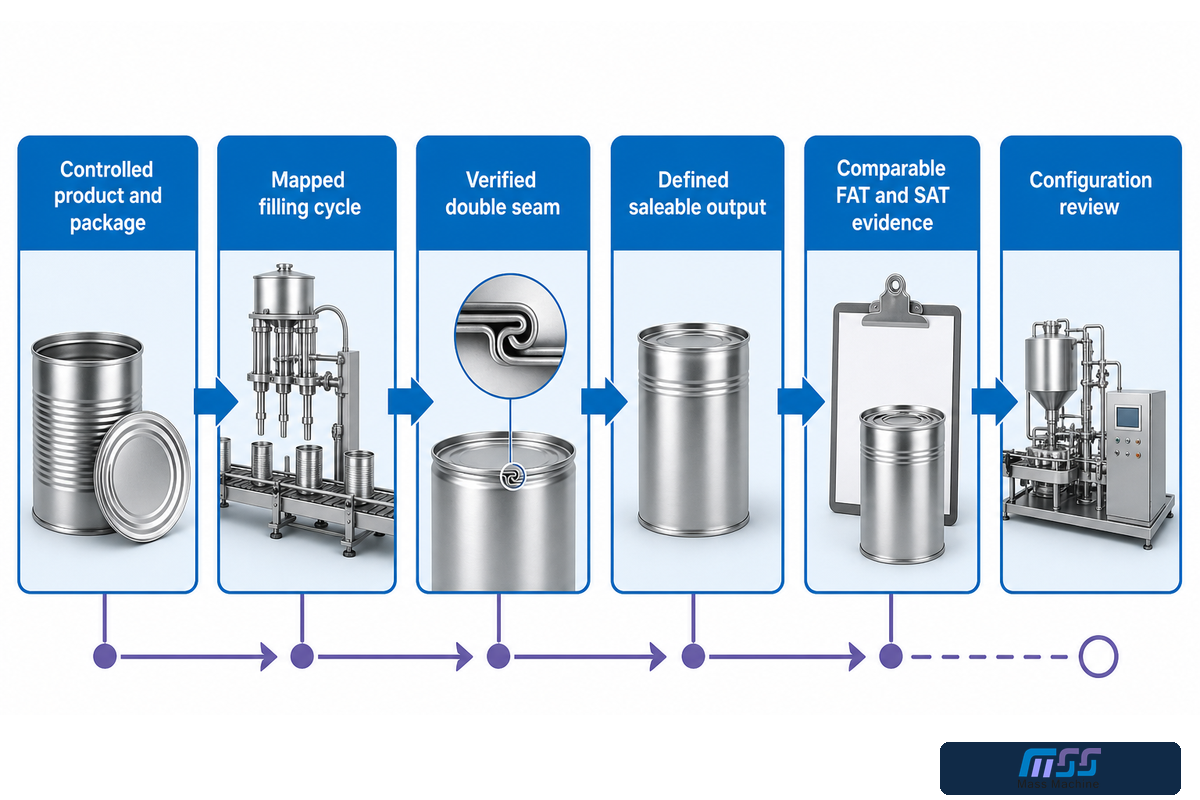
A dependable soda can filling project begins with a controlled product and package, not a headline speed. Connect the can-to-seam path. Validate the state of the beverage. Map the actual valve cycle. Diagnose patterns before explaining apparent maladjustments. Prove the double seam and define saleable output at a named boundary. Then do the same for FAT and SAT.
For machine configuration, capacity and quotation issues, please contact Mass Technology’s commercial soda can filling solution. For company background, manufacturing scope and contact details, see About Mass Technology.
References & Sources
- U.S. FDA, Determining the Regulatory Status of Components of a Food Contact Material
- eCFR, 21 CFR 117.40 Equipment and Utensils
- eCFR, 21 CFR 117.80 Processes and Controls
- For clarifying regulatory issues regarding packaged goods, refer to NIST, Net Contents of Packaged Goods FAQs.
- For clarifying regulatory issues regarding machinery, refer to OSHA, 1910.212 General Requirements for All Machines.
- OSHA, 1910.147 Control of Hazardous Energy
- OSHA, Potential Carbon Dioxide Asphyxiation Hazard Bulletin
- Peer-reviewed review, Bubbles, Foam Formation and Stability in Carbonated Drinks
- Crown, Seaming Essentials
- Ardagh Metal Packaging, Double Seams & Critical Performance Parameters
- Ferrum, Can-Seaming Training Program