Get in Touch with Masstech

Shrink sleeve labels are the 360 full-body packaging method where a printed plastic film is slid onto a container, then exposed to heat or steam to shrink it onto the exact shape of that container. This format is responsible for most of the craft-brewery, nutritional supplement, household spray and other designable-container type cans, bottles and jars. This guide is written from the perspective of a filling-line and label-applicator manufacturer rather than a label printer, which is why film types, formats, design rules and equipment are all covered in one article – the way that a real production line has to consider them.
Quick Specs: Shrink Sleeve Labeling at a Glance
| Coverage | 360° full-body wrap, no front/back panels |
| Common Films | PETG, PVC, PLA, OPS (PETG dominant in North America) |
| Typical Shrink Ratio | 55–78% transverse direction, 2–8% machine direction |
| Tunnel Heat Sources | Steam (~180–200°F), forced hot air, infrared radiant |
| Line Throughput Range | 100–600 containers per minute, depending on applicator and tunnel pairing |
| Typical MOQ | Low thousands per design (sub-1,000 possible on digital presses) |
What Is Shrink Sleeve Labeling? Definition and How It Differs From Other Labels

Shrink sleeve labeling is a decorating method that slides a pre-printed tube of heat-sensitive film over a bottle or can, then shrinks the film tight to every curve of the container under heat or steam. That creates a continuous 360-degree printed surface (often described in the industry as a full 360° wrap) that becomes part of the container outline, with no edges, gaps, or front-and-back panels. Unlike a pressure-sensitive label, which sticks to a flat or cylindrical face, a shrink sleeve conforms to the entire container shape, including necks, shoulders, and hourglass curves.
Shrink sleeve packaging reached the mainstream in the early 1980s. After the 1982 Chicago pharmaceutical poisoning incident, the U.S. Food and Drug Administration introduced 21 CFR 211.132 tamper-evident packaging requirements, and shrink sleeve bands quickly became the most visible tamper indicator on over-the-counter medication. That same perforated-sleeve mechanism, where the band visibly tears when the cap is opened, is now standard on beverage caps, nutraceutical bottles, and personal-care closures across the food and beverage and consumer goods markets.
The Shrink Sleeve Labeling Process: From Printed Tube to Finished Container in Four Stages
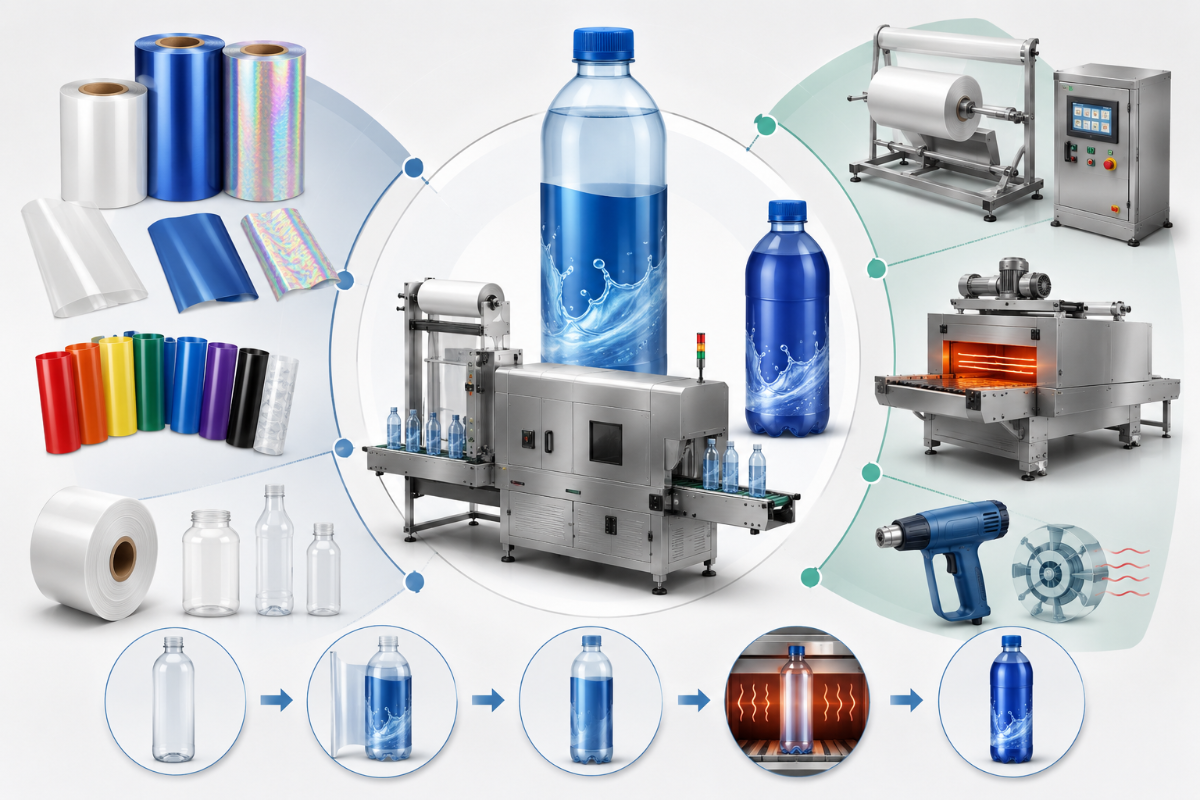
There are four production key-stages that every shrink sleeve line has—film printing, converting, application and shrinking. If there are wrinkles, distortion lines, tears, scuffing or other issues on the finished end product, it helps to know a priori where each of those operations lives so that the culprit can be identified:
- Films are usually printed with either flexo- or digital-presses, with the graphics printed on the inside of a transparent flexible web so it is not as scratched or damaged during converting and shrinking.
- Washed and dried on the inside surface to protect the print from heat during shrinking, the printed web is converted on a wide-format converting machine into a seamed roll or slit roll for on-line shipment.
- After printing, that web is converted into individual sleeves by seaming the two long edges with a solvent or hot-melt adhesive, producing a flat tube that can be opened over a container.
- A shrink sleeve applicator opens each tube, cuts it to the correct sleeve length, and drops it over the bottle, can, or jar as the container moves down the line.
How Are Shrink Sleeve Labels Applied at Production Speed?
Most beverage lines consume sleeves stored on rolls, have a vertical cutting apparatus in the appliсator that will slit the sleeve tube into one piece at a time, and use a mandrel that opens the tube at the bottom as it is lowered onto the bottle. Production rate is 99% limited by the capacity of the tunnel to flow even heat without distorting the graphics. Steam tunnels carry latent heat at a relatively low surface temperature and are usually paired with full-body PETG sleeves on glass bottles and aluminum cans where graphic clarity matters most.
Forced hot-air tunnels deliver higher temperatures and are common on tamper-evident bands and lines where in-house steam infrastructure is not available.
📐 Engineering Note
Ink-on-inside printing is what makes a shrink sleeve scuff-resistant once it leaves the line. It is for this reason that improper handling at the conversion stage rather than at the applicator stage is the primary cause of cosmetic problems on the finished article.
Shrink Sleeve Film Materials Compared: PETG vs PVC vs PLA vs OPS
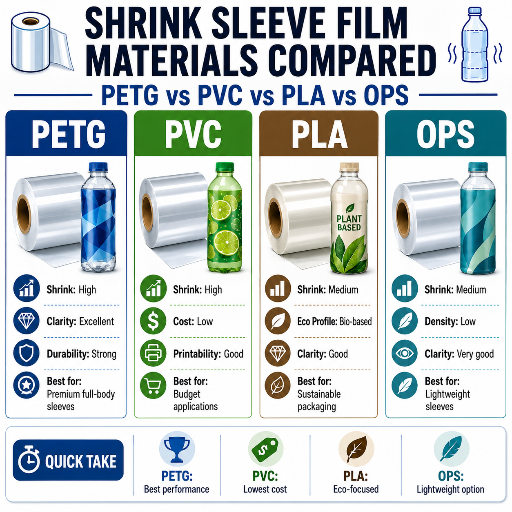
Four shrink film types cover nearly every production sleeve in the current market. Choosing the right shrink sleeve material depends on shrink ratio, optical clarity, the recyclability of the container, and price per metre of film. Select of appropriate shrink sleeve is also relate it to the container shape, as all types of shrink film have different function ability in tight neck and tapered shoulders.
PETG own the largest share of food and beverage market in North America due to its excellent clarity and recyclability pathway, which PVC unable to achieve.
| Film | Transverse Shrink | Optical Clarity | Recycling Path | Relative Cost Index | Typical End-Use |
|---|---|---|---|---|---|
| PETG (polyethylene terephthalate glycol-modified) | 70–78% | Excellent clarity, holds vivid color | APR-Critical-Guidance-compatible when paired with perforated tear strip | 1.0× (baseline) | Beverage cans and bottles, personal care, supplements |
| PVC (polyvinyl chloride) | 55–65% | Good clarity, slight haze on thicker gauges | Contaminates PET recycling streams; restricted in parts of Europe | 0.75× | Household and industrial bottles where recyclability is not a brand claim |
| PLA (polylactic acid) | 65–70% | Good clarity | Compostable in industrial facilities only | 1.5× | Premium eco-positioned brands |
| OPS (oriented polystyrene) | 60–70% | Lower clarity, slight matte feel | Limited curbside recycling acceptance | 0.85× | Tamper-evident bands on dairy and food jars |
Material choice depends most heavily on the type of base container being labelled. The contamination of the recycling stream with PVC is a key reason to develop a PETG sleeve or a tear-strip sleeve that is easily removable before recycling: Brands that build sustainability into their packaging claim should specify a PETG sleeve that has earned a Critical Guidance recognition from the Association of Plastic Recyclers, or specify a tear-strip-equipped sleeve that the consumer can remove before recycling.
Equipment Inside the Shrink Labeling Line: Sleeve Applicators and Shrink Tunnels
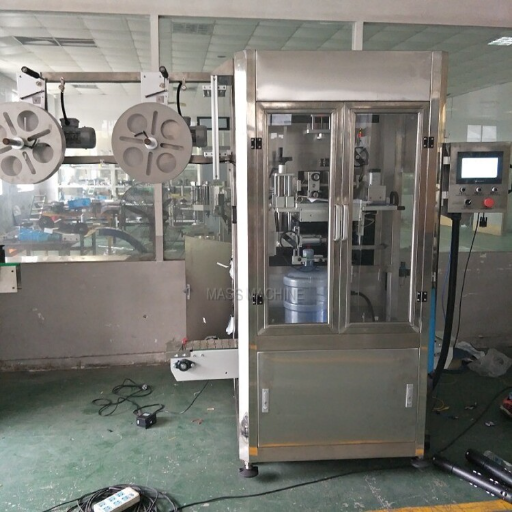
Fundamentally, from the equipment manufacturer point of view, a shrink sleeve labeling line is two coupled machines: a sleeve applicator that deposits the tube on the container, and a shrink tunnel that fixes the tube to the container shape. Both machines have to be set to fit to the bottle geometry, to the line speed, and to the type of film, before throughput and efficiency statements have any real value.
Sleeve Applicators
There are two kinds of sleeve applicators: vertical and horizontal. Vertical applicators accommodate the widest range of containers – from 200mL beverage cans to 2L PET bottles – and work best with rotary filling lines running between 200 and 600 containers per minute. Horizontal applicators are also used on some strange custom shrink applications where the container must be transported on its side for sleeve application, often on flexible packaging or odd-twist closures.
For a soft drink manufacturer running one SKU at high speed with custom shrink sleeves, the default would be vertical applicator integrated with a servo-driven mandrel; for a contract packager running multiple short runs of many SKUs, the changeover time would take precedent over maximum speed.
Shrink Tunnels
Shrink tunnels are divided into 3 technological routes, each of which is suitable for the combination of film and container.
- Steam tunnels apply saturated heat at about 180-200F (82-93C) totally around the entire container, which provides the least graphic distortion on full-body PETG sleeves with complex graphics. Steam tunnel systems normally require an in-plant steam boiler or a built-in boiler module.
- Forced hot-air tunnels (a heat tunnel category) use electric heating elements and recirculating fans, run drier and hotter than steam, and pair well with tamper-evident bands and shorter sleeves where in-plant steam is not available.
- Infrared radiant tunnels use directed bulbs and are well suited to tamper-evident neck bands, combo packs, and short-sleeve applications where targeted heat outperforms ambient warm air.
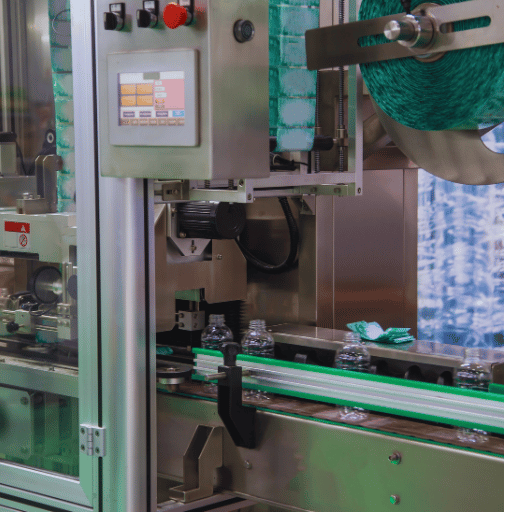
If a brand is launching a new line and the container will be a PET bottle or aluminum can with full-body PETG, a steam tunnel paired with a vertical servo applicator is the path of least graphical distortion. Brands that want to integrate the sleeve step into an existing filling line should look at a turnkey shrink sleeve labeling machine line that arrives matched to the upstream filler and the downstream conveyor speed, since mismatched throughput is the most common cause of bottle pile-ups at the tunnel inlet.
Sleeve Formats: Full-Body, Tamper-Evident Bands, Neck Bands, and Multi-Packs
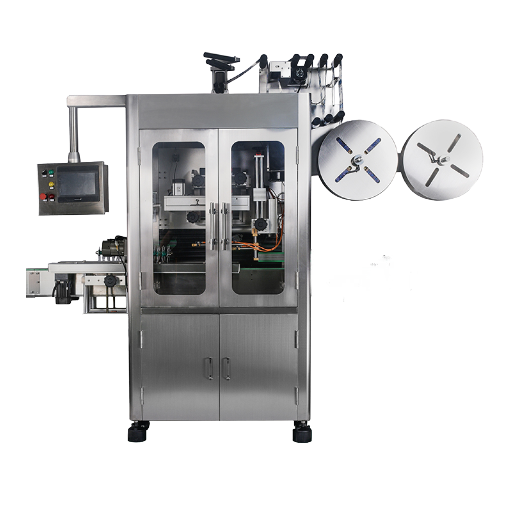
Shrink sleeve labels come in four standard formats, each covering a different part of the container and serving a different brand or regulatory requirement.
- Full-body shrink sleeves give the entire container — from neck to base — a 360° printed surface. They are commonly used on craft beverage cans, supplement bottles, and household sprays where brand exposure from every angle is desired, including intense product information panels.
- Full-body sleeves with tamper-evident cap include a perforated tear line on the closure enabling the consumer to break the seal. This is the most common visible indicator satisfying 21 CFR 211.132 standards for over-the-counter medicines and dietary supplements.
- Neck bands and tamper-evident bands only cover the cap and neck area. They are standard on bottled juice, condiments, and personal-care closures where the container body already has a pressure-sensitive label.
- Multi-pack and combo-pack sleeves package two or more containers together for a two-for-one deal, a sample-with-product promotional campaign, or a holiday bundle. They are common on beverage four-packs and beauty product launches.
Designing for Shrink: Seven Pre-Distortion Rules That Save Reprints
Approving flat-rectangle artwork is the biggest costing error related to shrink sleeve labels is having artwork designed as a flat rectangle when the actual printed label may warp on the injection-molded container. Since the film shrinks unevenly (bodies shrink less, shoulders and necks shrink more) designs must be pre-distorted on a shrink-mapped template ahead of the print order. These seven guide lines provide the foundation for a first-try success on the initial operation.
- Design all artwork in an actual container shape on a shrink-mapped template, not on an unadjusted flat template to account for banding on the neck.
- Position the logo, trademark symbols, regulatory language, and brand identifiers in the low-shrink body area of the container instead of the band or neck zone where the film deforms most.
- Keep barcodes on a flat or near-cylindrical area of the container – never on a tapered curve, since a barcode deforms more than 1.5% in either direction it begins to reject on the scanner.
- Avoid very fine strokes, fine illustration detail, and type smaller than roughly 6 point in the high-shrink zones near the shoulder.
- Design the overlap for the seam intentionally, avoid continuous patterns in the same plane as the seam line, and accept the seam meet point will be different by a few millimeters on each container.
- Lock down the ink colors callouts to one industry printing standard before the pre-distortion math is run, so ink density is not recalculated on top of geometry corrections.
- Approve the first heated sample on the actual container prior to the full run (regard it as a limited test run of the artwork rather than a flat proof print) so that fine design elements such as text and images near the shoulder are validated prior to full production.
📐 Engineering Note
Pre-distortion templates are calibrated to a particular film and particular container, not generics. Ask the converter for a shrink curve map of the precise film grade you plan to print on using a standard template from last year on a fresh film batch is one of the most frequent reprint demands in the business.
Shrink Sleeves vs. Pressure-Sensitive Labels vs. Printed Cans: When to Choose Each
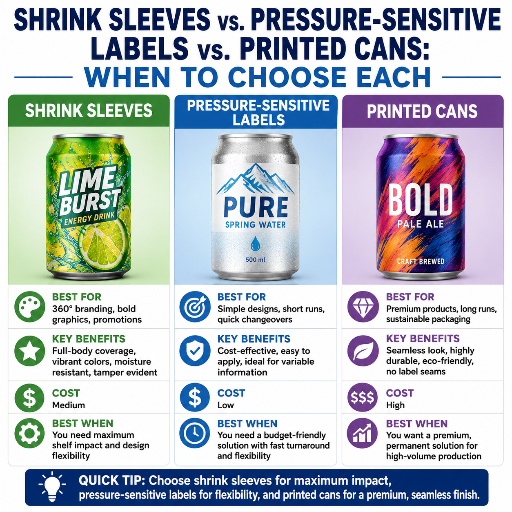
Shrink sleeve labeling does not always beat other printed labels for all applications, though its versatility over curved containers can be hard to beat. For a straight-sided bottle in a short run, a pressure sensitive label is quicker to run through and easier and cheaper to set up. For high volume drink cans that can run a single design all year, direct-printed aluminum is a lower cost per unit solution. All three formats compete on coverage, container flexibility and economics not quality.
| Attribute | Shrink Sleeve | Pressure-Sensitive Label | Printed Can |
|---|---|---|---|
| Coverage | 360° entire container | Front and back panels only | 360° can body only |
| Container shape flexibility | Any shape including curves and contours | Cylindrical or flat faces only | Aluminum cans only |
| Tamper-evident option | Yes, via perforated tear cap | Not typical | Not applicable |
| Setup cost | Higher (applicator + tunnel) | Lower | Variable, lower with digital direct print |
| Per-unit cost at scale | Mid-range | Low | Drops steeply as run size grows |
| Typical MOQ | Low thousands per design | Low hundreds | ~1,500–2,000 cans per design (digital), 50,000+ per design (offset) |
| Best for | Curved containers, full-wrap branding, tamper-evidence | Short runs, frequent design changes | High-volume planned can runs |
Cost Drivers and MOQ Reality for Shrink Sleeve Labeling Projects
There is no blanket cost per run for a shrink sleeve label but every quote is affected by the same 5 cost drivers. Anyone asking for a quote should consider each one before committing to reading the bottom line price.
Five Cost Levers Behind Every Quote
- Container size and shape – larger or more contoured containers burn more film and need more temperature tuning per cycle.
- Film material grade – PETG is the mid-priced ready-to-ship default, PVC is the lowest cost, PLA is the most expensive, and OPS is priced between PETG and PVC.
- Print run quantity – per-unit cost declines sharply following the first 5,000 sleeves over the first 50,000 sleeves as setup cost is amortized across more units.
- Color count and finish – a 4 color process run traditionally is an order of magnitude cheaper than a color design with metallic, custom matched ink or soft touch overcoat.
- Application method – in-house applicator and tunnel is a capital expense up-front but eliminates the per unit cost that a contract applicator will charge.
MOQ is where most procurement teams are amazed. A conventional flexo press often has an MOQ in the low thousands per design, because the setup time for multiple plates has to be amortized across that the run length. On digital it’s often in the low hundreds, but at a premium to a conventional process.
A real procurement puzzle is never “how low is it” but “what process dictates my optimum run length and price”. Quoting an MOQ as a constraint and not a contract obligation typically leads to more cost-effective sourcing.
Industry Outlook: Sustainability, Recyclable Sleeves, and Where Shrink Sleeve Labeling Is Heading in 2026
Two market trends are reshaping shrink sleeve labeling specification decisions in 2026, and both pull in the same direction — toward PETG and away from PVC. The global stretch and shrink sleeve label market was valued at USD 16.5 billion in 2024 and is projected to grow at a compound annual rate of 5.9% through 2034. The PETG sub-segment is growing faster, with one industry forecast putting the PETG-type shrink sleeve label market at USD 1.5 billion in 2024 and on a 7.2% compound annual growth path to USD 2.8 billion by 2033.
Both numbers are driven by the same factor: recyclability. PVC weeps into the PET recycling flow and that friction has moved beverage & household brands to PETG sleeves that the Association of Plastic Recyclers has given green light to for PET packages. The down-range implication for a package engineer wiring in a 2026 line is a perforated tear strip PETG sleeve is becoming the specification of choice and a PET package using PVC will become more and more unfriendly to brand sponsors’ sustainability platform.
A brand operator introducing a new 2026 line should factor the PETG film premium into the project rather than the future migration.
$16.5B
Global market value 2024
5.9%
CAGR 2025–2034
7.2%
PETG sub-segment CAGR
Frequently Asked Questions
Q: What is the cost of a shrink sleeve label printing machine?
View Answer
The cost of a small benchtop digital shrink sleeve printing press generally is in the range of USD 25,000-80,000 and a production flexographic press with sleeve seaming (and other ‘peripheral units’) is in the range of USD 250,000-800,000(depending on width and number of colour stations). The majority of brand owners purchase printed sleeves from a converter, not spend money printing sleeves.
Q: What can I use to seal a shrink sleeve seam?
View Answer
Manufacturing sleeves are seamed at the converter with a solvent based or hot melt seam adhesive to lock the two edges of the printed film into a continuous tube. After a seam pull test the sleeves are wound onto delivery rolls for the consumer never to see the seam line on a finished container.
Q: What are the four main types of container labeling?
View Answer
The four most commonly used in industry are pressure sensitive adhesives labels, shrink sleeve labels, in-mould labels applied during the container moulding process and direct print direct onto the container. Each have a different frequency of application depending on the shape of the containers, the run size and message space required for the brand.
Q: Can a shrink sleeve be used on any container shape?
View Answer
Any form shape. It will handle inverted necks, hour-glass shapes and formed aluminium cans that no flat adhesive label can follow. May be too tight a neck radius or too extreme a contour to be produced from the available shrink film – in which case switch to a PETG grade with a higher shrink-factor or a partial sleeve and body-label combination.
Q: Are shrink sleeves recyclable?
View Answer
PETG sleeves identified as following the Association of Plastic Recyclers Critical Guidance protocol can be recycled through the PET recycling stream and processed together with the bottle. PVC sleeves cannot be – they contaminate the PET reclaim. Less obvious win is perforated tear-strip sleeves than the consumer can remove before trashing provides the easiest contribution to recyclability when the brand wants to keep PVC or specify PLA.
Q: What is the minimum order quantity for shrink sleeves?
View Answer
Production minimums on a flexographic press tend to be a few thousand per artwork. Digital presses can easily achieve a hundred run cost-efficiently but at a premium per label unit. A converter running both digital and flexo can quote either approach with a common sample artwork.
Planning a Shrink Sleeve Labeling Line?
Mass Technology supplies complete filling and shrinking-labelling production lines configured with a suitable sleeve applicator running sleeve film and a compatible shrink tunnel working with the filler upstream and infeed and outfeed conveyors downstream. Please discuss your requirements with our engineering department or ask to see a sample layout.
About This Analysis
Written from the perspective of an equipment manufacturer building water, beverage and heat-shrink labelling production lines through the range of outputs from 2,000 to 36,000 per hour. Author’s process and equipment tips are for a production line integration perspective and not true label printing advice.
References & Sources
- 21 CFR 211.132 Tamper-Evident Packaging Requirements for Over-the-Counter Human Drug Products – U.S. Food and Drug Administration, Electronic Code of Federal Regulations
- APR Design Guide for Plastics Recyclability — Association of Plastic Recyclers
- Stretch & Shrink Sleeves Market Size, Growth Report 2025-2034 — Global Market Insights
- PETG Type Shrink Sleeve Label Market Size, Future Growth and Forecasts to 2033 – Strategic Packaging Insights
- How the 1982 Tylenol Tragedy Led to Sealed Packaging – Smithsonian Magazine