Get in Touch with Masstech

Updated July 2026.
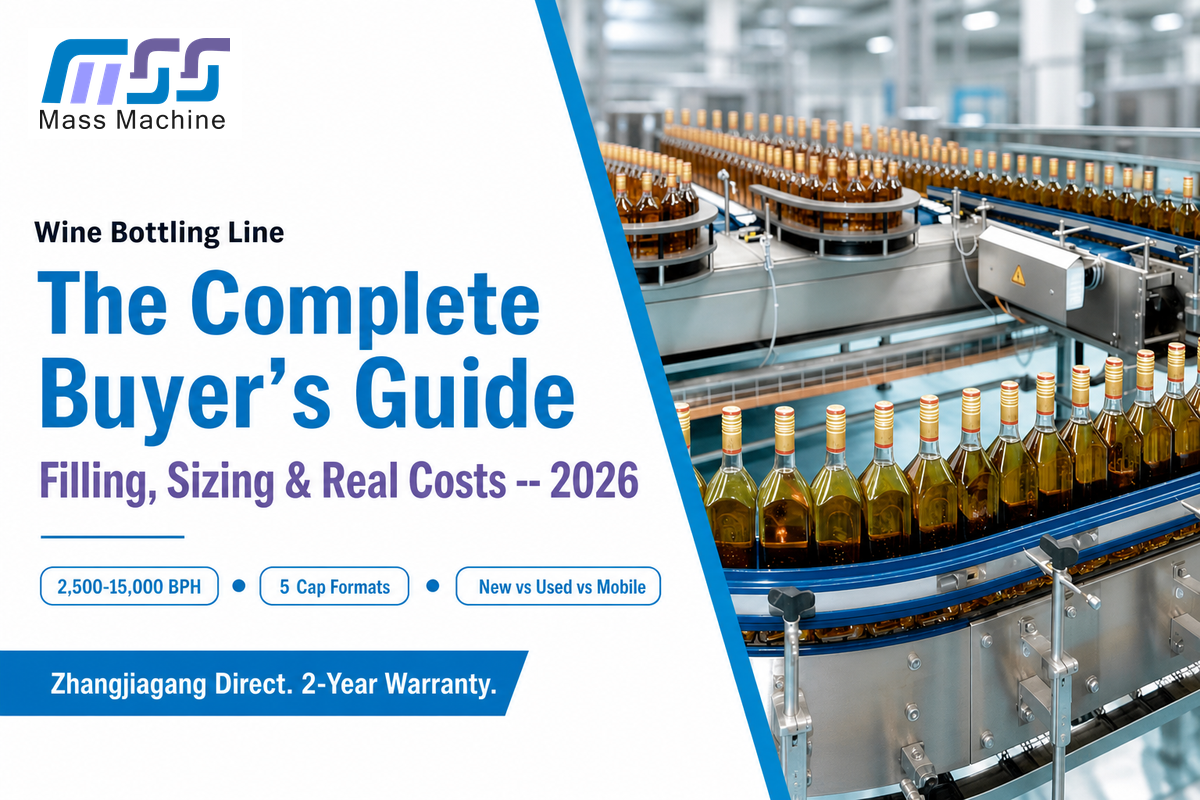
A wine bottling line is the sequence of machines — rinser, filler, corker or capper, capsule applicator, and labeler — that turns clean, empty glass from the supplier into a sealed, market-ready bottle of wine. Purchasing the wrong line costs twice: first in capital expenditure, then again when oxidation losses or SKU bottlenecks show up after your first bottling day. This guide covers filling-method selection, cap-format planning, capacity sizing, the new-versus-used-versus-mobile decision, real costs, supplier comparison, installation compliance, and where the category is headed in 2026.
Quick Specs
| Capacity range | 2,500–15,000 BPH (330 ml basis), five capacity tiers |
| Filling methods | Gravity, micro-negative pressure (vacuum), isobaric, AOX inert-gas |
| Cap formats | Natural cork, T-cork, ROPP, screw cap (Stelvin), crown |
| Bottle range | Height 160–340 mm, diameter 50–100 mm |
| Wetted materials | AISI 304 standard, AISI 316 optional for low-pH fruit wines |
What a Wine Bottling Line Actually Includes
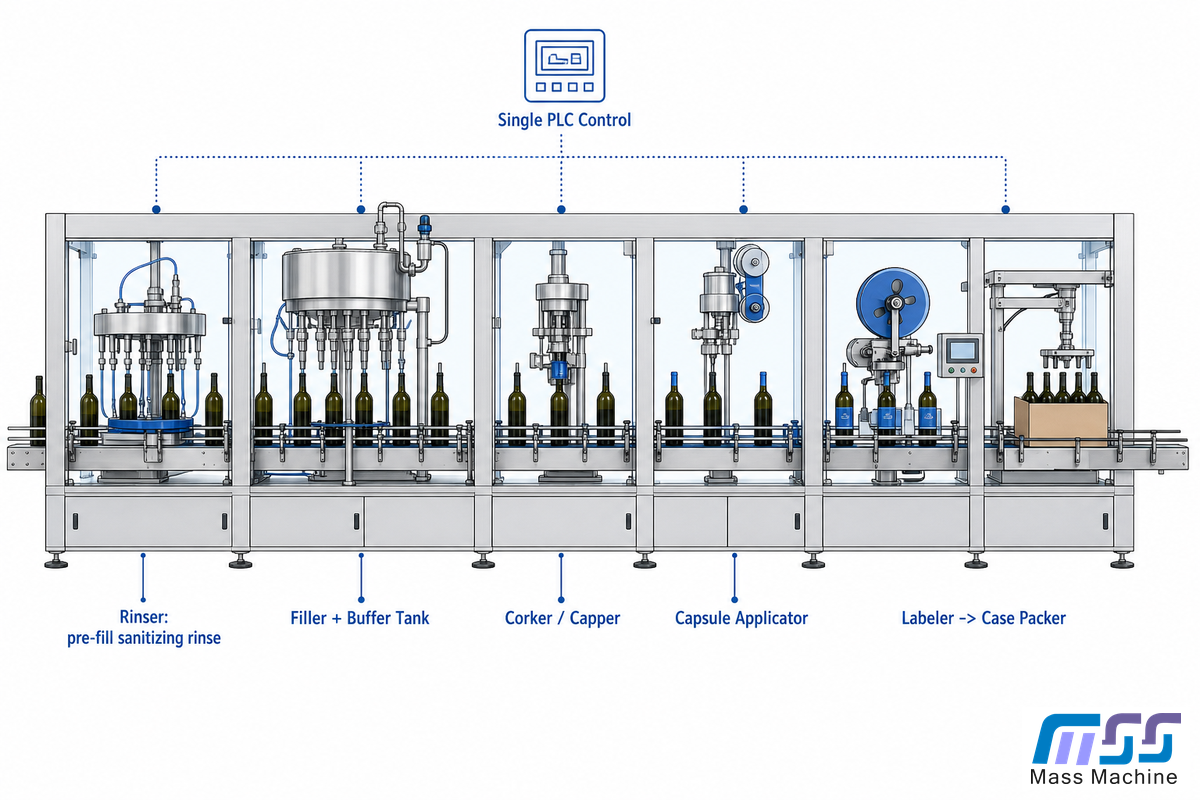
A wine bottling line is the end-to-end array of machines — rinser, filler, corker or capper, capsule applicator, and labeler — that turns empty glass into a sealed, market-ready bottle, running as one coupled system rather than separate stations. It ends at a case-packing or palletizing station, not at the filler.
Some very small, boutique producers still use siphons or gravity feed straight from a tank, but that approach caps out at low BPH and isn’t how any commercial wine filling machine on the market actually works. On a monoblock configuration, the filling stations are coupled by a single drive that connects these elements to create efficiencies of scale. Mass Technology’s MSGF series, for example, starts with a rinser, feeds the header tank to the filler bowl and filler valve, then moves the bottle into a capper, all on a single integrated PLC-controlled frame.
Most commercially produced lines, including those built by manufacturers such as Mass Technology (Zhangjiagang, China), follow this same textbook approach. Mass Technology’s own MSGF lineup spans five size models producing 2,500–3,000, 4,500–5,000, 8,000–9,000, 12,000–13,000, and 14,000–15,000 bottles per hour (BPH) respectively. A new bottle, shipped from the glass manufacturer, arrives “hot and virtually sterile,” so empty bottles are typically just rinsed right before filling rather than run through a full wash cycle. For many producers, case-packing and palletizing throughput — and how quickly finished bottles and filled bottles move into cardboard cases prior to shipping — is set more by per-box or per-pallet batching than by the filler’s raw line rate.
Core Bottling Equipment Components, Beyond Just the Filler
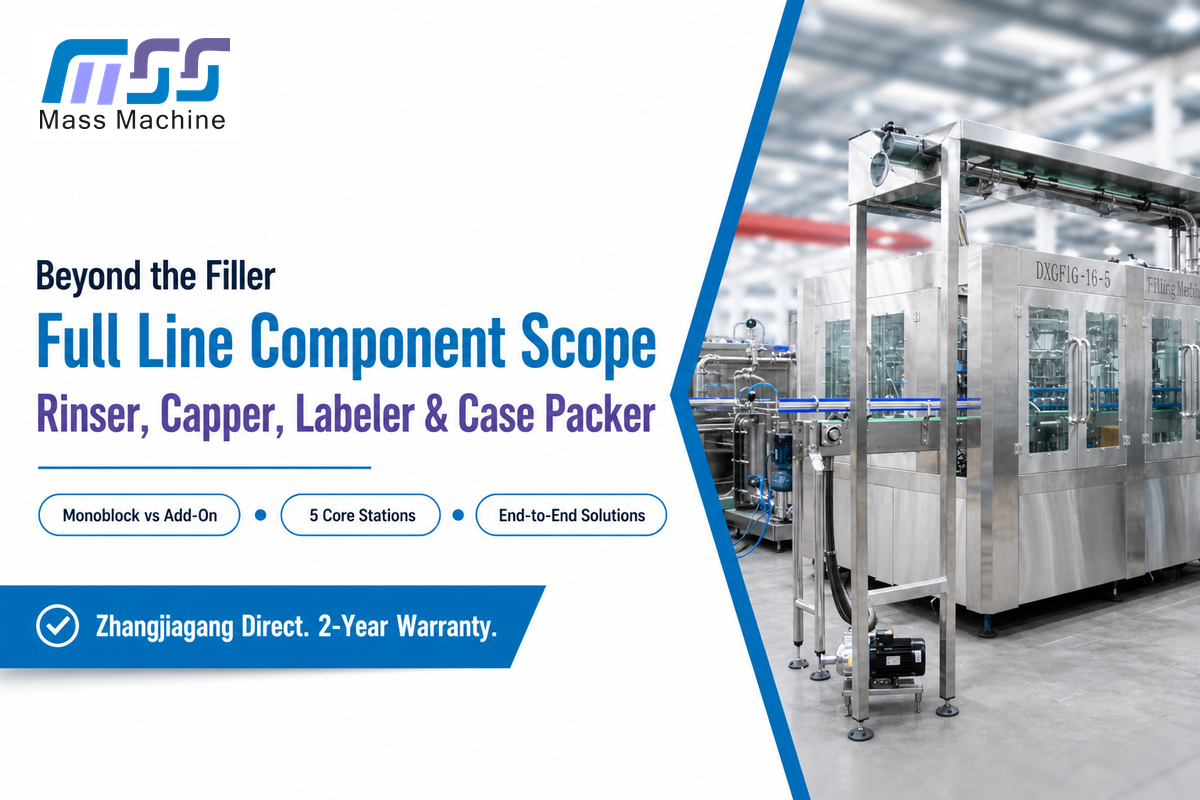
The “total line scope” includes not only the filling components but also capsule application machines, front and back labeling machines, in-line inspection equipment, case packing stations and palletizing machines. These are normally added at an extra cost once the core filler and bottling equipment is identified. However, even the rinser, filling unit, capper, and associated buffer tanks can have their own separate set of add-ons or customizations.
| Component | Typical scope | Function |
|---|---|---|
| Rinser | Monoblock-integrated | Filtered-water or inert-gas rinse before fill |
| Filler + buffer tank | Monoblock-integrated | Header tank feeds filling valves at set pressure |
| Corker / capper | Monoblock-integrated (1 head standard) | Cork insertion or cap torque application |
| Second cap head | Add-on module | Second closure family (see cap-format section below) |
| Capsule / foil applicator | Add-on module | Tamper-evidence + presentation |
| Labeler + case packer | Add-on module (Tier 2/3 scope) | Front/back label, case erecting and packing |
Running all of these bottling components by a single supplier can keep spare-parts inventory simple, and may reduce the learning curve on new equipment for your technicians, as many wear parts can be common across your conveyor, valves, and capper head, for example. Small producers may still run semi-automatic fillers, in which a human operator moves bottles from one otherwise-automated station to the next, and can typically upgrade them in a piecemeal fashion rather than a complete overhaul to a fully automated set-up-even once automated, a changeover, and some quality control, will still require a trained person at the console. Whichever add-ons you choose, keep OSHA machine-guarding compliance in scope for every new station, since each added conveyor or inspection unit is its own point-of-operation hazard.
Choosing a Filling Method: Gravity vs Vacuum vs Isobaric vs AOX
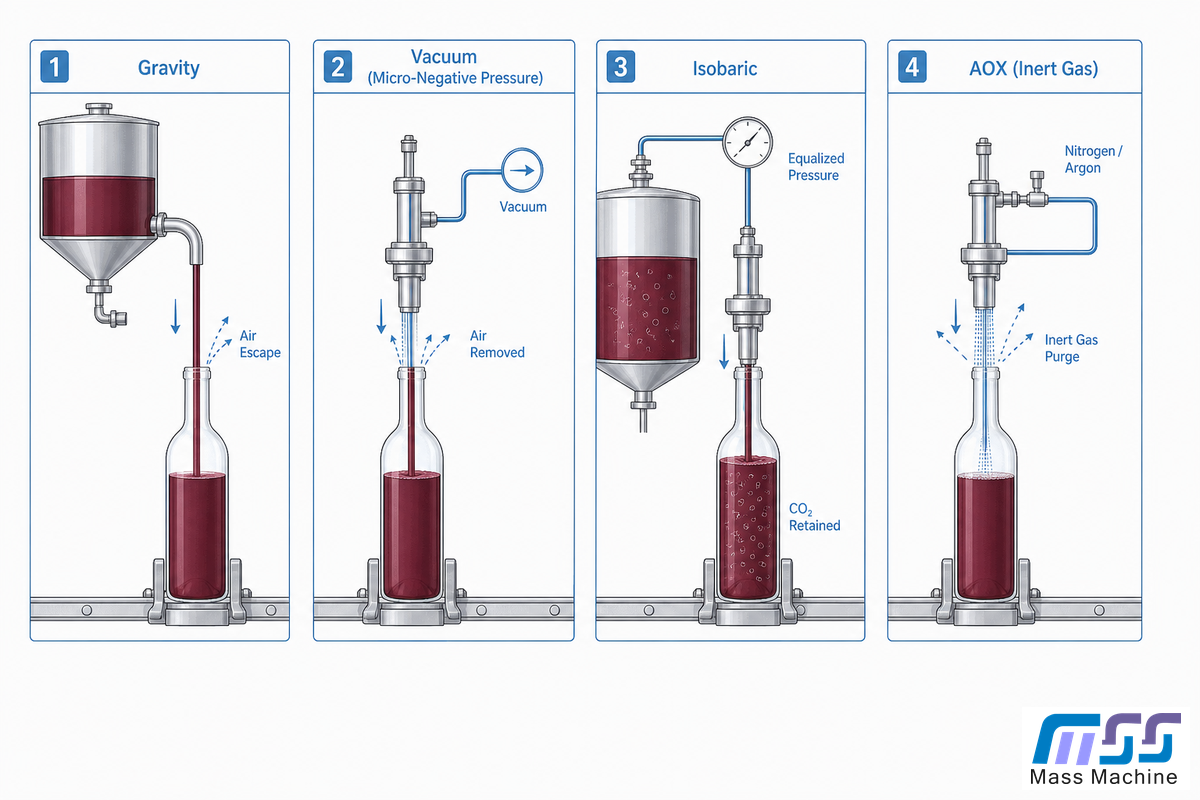
Wine quality is affected most strongly by the filling method choice, as it dictates how much oxygen your wine is exposed to during the fill process. In the wine literature from institutions like the Australian Wine Research Institute (AWRI) in Australia and Virginia Tech, we’re told that “total package oxygen” (TPO)-oxygen dissolved in the wine as well as air/gas in contact with the wine on its surface, and “entrapped” within the closure-makes a significant, and readily measurable, difference to the wine’s development over time, and that elevated concentrations are a direct cause of “premature oxidation”.2 Virginia Tech reports how much oxygen exposure is incurred: “bottling…can add 0.5-2 mg O 2 /L to the wine.”3 And they state that an uncompensated 750ml bottle that skips fill enhancements such as vacuum filling, vacuum corking, or an inert-gas flush could have the air in its headspace–about 1ml–contain roughly 1.4mg of oxygen.4 Iowa State University Extension offers a key piece of information: “most wines consume most of their dissolved oxygen and headspace air oxygen within 90 days of bottling-which time frame a poorly selected filling method will manifest as a taste defect, rather than as a file error.4”
The physical means by which a filler moves wine into bottles is that, in a leveler and then a filling head, either a gravity feed or a pumped, pressurized line delivers wine from the fill bowl to the spout(s).
The number of spouts scales with line size and product flowrate: smaller, slower lines run 6 to 12 spouts, while a large continuous-flow line can carry well over 100, each dispensing wine at a precisely controlled rate per minute to hit a target bottles-per-minute run speed with minimal foaming. A nitrogen dosing system protects the wine from oxygen right at the surface of the wine, in the fill-height gap just below the closure, sparging the headspace with inert gas to flush out what a gravity fill would otherwise trap.
💡 Pro Tip — the counter-intuitive part
What often comes as a surprise, though, is that slower doesn’t necessarily mean gentler or safer for the wine’s shelf life, with some industry data indicating that lower speeds actually result in higher TPOs from prolonged exposure to air.5 If you instinctively “slow it down to be careful,” double-check the filling method first-because it makes more of a difference than speed.
What Is Total Package Oxygen (TPO) and Why Does It Matter for Wine?
Total Package Oxygen (TPO) is the overall amount of oxygen a sealed bottle retains the instant it leaves the line: dissolved oxygen in the wine itself, headspace oxygen above the fill surface, and oxygen that absorbs into or diffuses through the closure over time. AWRI separates these three sources deliberately, because a filling method that controls dissolved oxygen well doesn’t automatically control the other two.
Even a filling method that effectively controls dissolved oxygen (as a simple vacuum fill does) may not control headspace or closure-entrained oxygen — meaningful TPO can still be picked up after the fill if those steps aren’t managed together. Mass Technology’s MSGF platform targets this with micro-negative-pressure filling as the default for oxidation-sensitive still wines, which the manufacturer reports meaningfully reduces oxidation pickup versus gravity filling; treat any single-supplier percentage claim as directional rather than independently audited until you request their test data.
| Wine type | Recommended method | Why |
|---|---|---|
| Still red/white, mid-tier | Gravity | Lowest capital, simplest CIP, moderate oxygen tolerance |
| Premium still, aging program | Vacuum (micro-negative pressure) | Pulls headspace air ahead of the fill, reduces DO pickup |
| Sparkling, Champagne, Prosecco | Isobaric | Equalizes bottle/tank pressure (1–3 bar) to hold dissolved CO2; a patented engineering category, not a marketing term6 |
| Fruit/dessert wine, vinegar, sauce SKUs on the same line | Gravity or AOX add-on | Higher viscosity or lower oxidation sensitivity tolerates simpler mechanics |
Cap & Closure Format, Why Most Wineries Need More Than One
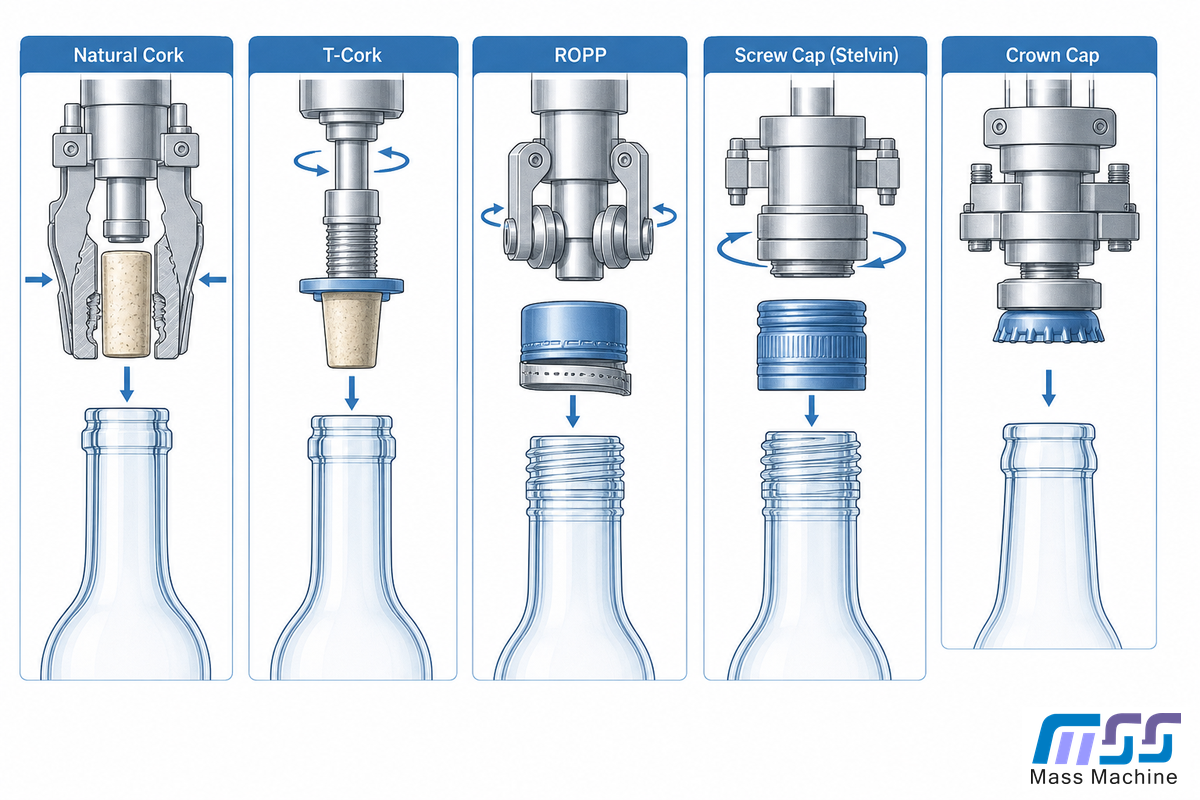
Closure selection is as much about brand positioning as mechanical engineering. In most premium segments, natural cork still signals “cellar-worthy,” while screw cap is the dominant, standard closure on Australian and New Zealand table wines and is gaining share in the mid-price US market; T-cork serves fortified wines like Port and Sherry, and crown cap is used during traditional-method sparkling fermentation before disgorgement and resealing. The mechanical difficulty is that each closure needs different tooling, a vacuum-operated corker for natural cork, screw-cap-style insertion for T-cork, and controlled torque for ROPP and screw closures, and most lines ship with only a single closure head as standard. On a vacuum corker for natural cork, the jaws grip the bottle neck, compress the cork to less than the neck’s internal diameter, and a corking plunger drives it in with a single downward stroke to insert it and create the seal.
The top of the cork should sit flush with, or just below, the top of the bottle’s opening; an oversized cork seated too high leaks just as readily as an undersized one. Front-label application and any additional closure step typically run on the same conveyor immediately after the corker or capper, a layout large bottling OEMs including Krones already build directly into their own monoblocks. Whatever closure you choose, label and container details still need to clear TTB net-contents labeling requirements before the case leaves the dock.
“The biggest mistake we’ve seen wineries new to bottling do, is to buy a filler-only machine, planning to add a rinser in future. Before they know it they’re spending more than the integrated monoblock would cost, and have wasted the space needed to add it later on.”
R&D Manager, Mass Technology
The Two-Line Trap is the closure-side version of that same mistake: a winery buys a single-cap-head line for its current cork-only SKU, then adds a second physical line for screw cap or T-cork rather than a second head on the first line, doubling floor space, spare-parts inventory, and operator training instead of adding a 15–30 minute changeover step.
How Long Does Cap-Format Changeover Take on a Multi-Cap Line?
On a monoblock designed for quick capping head swaps, transitioning from, say, cork to screw cap isn’t a complete overhaul; it’s as simple as switching heads and recalibrating torque. Manufacturers commonly estimate it takes between 15 to 30 minutes for an experienced operator to achieve this, making it perfectly feasible to produce corked bottles in the morning and switched caps in the afternoon on the same physical line – an ideal solution for many who’ve fallen into the “Two-Line Trap.”
| Wine / market | Best-fit closure |
|---|---|
| Premium aged red | Natural cork |
| Mid-tier still wine, daily-drinking | Screw cap (Stelvin) |
| Fortified (Port, Sherry) | T-cork |
| Sparkling (interim, pre-disgorgement) | Crown cap |
| Export to Australia/New Zealand | Screw cap (near-universal requirement) |
Sizing Your Line to Annual Case Volume
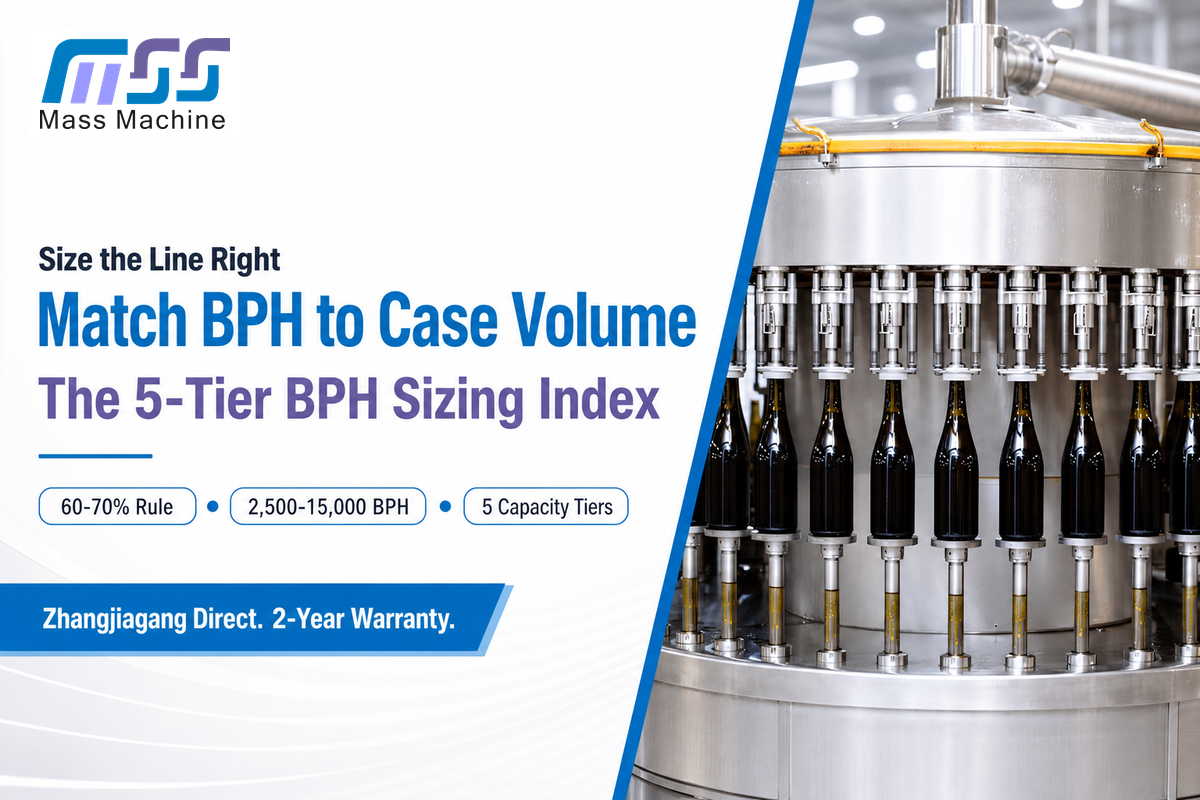
The most frequent sizing miscalculation isn’t purchasing a line that’s too small, but rather over buying capacity that you won’t necessarily need yet. As a rule of thumb, it’s recommended to plan your capacity at around 60 to 70% of a line’s stated hourly production rate during its peak production month. This approach leaves room for error and prevents overtaxing your equipment, as running close to maximum capacity constantly causes wear and diminishes your buffer against unexpected downtime. Fill-volume precision matters at any speed: TTB’s net-contents rules require the stated volume to match what’s actually in the bottle, so a capacity plan that pushes a line past its comfortable operating range risks fill accuracy along with wear.
The 5-Tier BPH Sizing Index
This isn’t merely a reference document; it’s a strategic guide designed to assist you in making optimal decisions when your projected volume falls into a gray area between different tiers, and when considering how factors like footprint and staffing would change in tandem with BPH.
| Tier / model class | Annual cases | BPH range | Typical workforce | Boundary guidance |
|---|---|---|---|---|
| Tier 1 — Entry/craft | Under 15K | 2,500–3,000 | 3–4 | Round up if a growth plan exists within 24 months |
| Tier 1+ — Boutique | 15K–50K | 4,500–5,000 | 4–5 | Round up — mid-line upgrade downtime costs more than the capital delta |
| Tier 2 — Mid-scale (most-installed) | 50K–120K | 8,000–9,000 | 5–6 | Round down only if multi-SKU changeovers already eat >20% of run time |
| Tier 2+ — Regional bottler | 120K–180K | 12,000–13,000 | 6–8 | Evaluate 2-shift staffing before jumping tiers |
| Tier 3 — Industrial, multi-shift | 180K+ | 14,000–15,000 | 8–10 | Confirm downstream labeler/case-packer keeps pace before committing |
| Boundary check — Tier 1 / Tier 1+ | ~13K–17K | 3,000–4,500 gap | — | No model sits between these BPH bands — buy the larger tier |
| Boundary check — Tier 1+ / Tier 2 | ~45K–55K | 5,000–8,000 gap | — | Same gap issue — verify against your actual peak-month case count, not annual average |
| Boundary check — Tier 2 / Tier 2+ | ~110K–130K | 9,000–12,000 gap | — | Confirm cap-head count needs before jumping — larger tiers add a second head by default |
| Boundary check — Tier 2+ / Tier 3 | ~170K–190K | 13,000–14,000 gap | — | Model the second shift’s real labor cost before this jump, not just the equipment delta |
It’s important to note that the cited nameplate BPH and a line’s actual sustained throughput aren’t the same. Treating them as equal often leads to planning oversights. One winery owner reported that his 2,500 BPH line actually averaged around 2,000 bottles per hour after factoring in time for label changes and scheduled stops7. A 2025 peer-reviewed scheduling study similarly found that planning based on nameplate capacity alone can significantly understate real-world bottling performance. Factors such as clogged filters, the fluid dynamics of wine, and operational sequencing all influence the actual rate at which a line can run.7, 8 Therefore, assume any suggested percentage conversion between actual and nameplate throughput is a generalization rather than a precise figure applicable to your specific line. Before signing off on a quote, build this anticipated buffer into your capacity calculations.
New Line, Used Equipment, or Mobile Bottling Service?
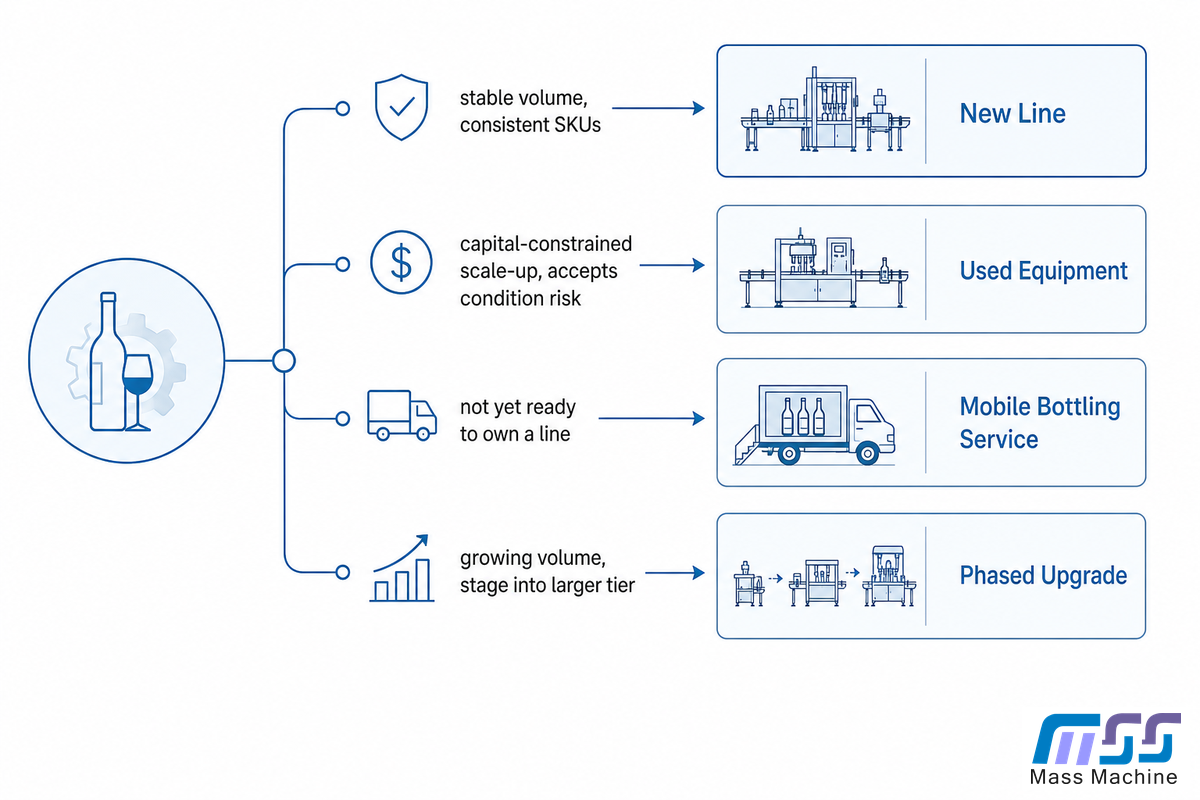
New, used, and mobile bottling each fit a different production stage: new lines suit stable volume above roughly 15,000-20,000 cases/year with SKU consistency, used equipment suits capital-constrained scale-ups willing to accept condition risk, and mobile bottling suits smaller producers not yet ready to own a line. This is the question competitors selling only new equipment have little incentive to walk you through.
The 4-Path Sourcing Formula below lays out when each acquisition path makes sense. Whichever path you choose, OSHA’s machine-guarding rules apply to used equipment exactly as they do to new — a missing guard doesn’t come with a used-price discount on liability.
✔ Advantages of owning a new line
- Full production control & scheduling flexibility
- Warranty and predictable maintenance
- No booking lead time once installed
⚠ Limitations of owning a new line
- Highest upfront capital
- The bottling line may stand unused for much of the year when volumes are lower
- Dedicated operator staffing required
Studies examining the economics of winery bottling indicated that an estimated volume of 200,000 to 250,000 cases annually is required to justify the investment in an owned line, including costs for housing, staffing, and maintenance, compared to using a mobile bottler. Below this volume, a used equipment route or mobile bottling solutions can be more financially prudent, even for wineries that eventually intend to purchase their own line.9 Due diligence is a must when shopping for used equipment; wine forum participants often discuss the merits of acquiring higher-capacity single units versus several smaller fillers, as well as buying directly from wineries that are ceasing operation.10 Real-world market values can be found; listings in winemaking classified ads sometimes show individual used components, like a capsule applicator, in the $10,000-$20,000 range (this is more illustrative than a true market average, but a helpful baseline when a wine bottling line for sale appears too good to be true).11
What Fails First on a Used Wine Bottling Line?
Filling-valve wear, capping-head torque drift, and undocumented CIP/sanitation history are the three things most likely to fail first on a used wine bottling line, in that order. Filling valves sit in constant wetted contact with wine and are the hardest component to source generically; torque calibration drift on the capping head causes inconsistent seals; and gaps in CIP history carry real biological risk, since the bottling line is the last opportunity to control contaminants before the product ships.
Before signing, request the maintenance logs and a formal CIP log, not just a photograph of the unit. Do an on-site inspection of all possible leak locations around valve stems, confirm that all surfaces in contact with product are sanitized (no pitting or film that harbors microorganisms), and check with the seller that the line’s cleaning and sanitation program used metabisulfite between batches. A lot of used wine lines currently on the market come from a small winery or a whole bottling plant that closed or was absorbed by a larger concern — that doesn’t necessarily suggest equipment failure, but it explains why you’re buying it.
⚠️ Common misstep
A very common mistake when buying a first bottling line is sizing forpeak-season activity rather than for current output levels.
This results in an underutilized and often over-leveraged line that would have been unnecessary had the winery considered a smaller, portable, or perhaps an even greater investment in hand-bottling capacity in the early going.
What a Wine Bottling Line Actually Costs
Pricing an industrial wine bottling line breaks into four cost buckets: equipment CAPEX, import/shipping, installation and training, and on-site spares. A supplier whose hygienic-design paperwork actually references a real standard such as ISO 14159 is a reasonable proxy for whether their itemized quote will hold up the same way.
One widely referenced budgeting heuristic from WineBusiness Monthly (Curtis Phillips, 2004, still cited in 2025-era industry surveys) is: $2 per case × annual case production × a 4–5 year amortization window — treat this as an industry rule of thumb, not an audited average, useful for a first budget conversation rather than a final quote.
Worked example — 10,000 cases/year
$2/case × 10,000 cases × 4.5 years (midpoint) ≈ $90,000 indicative equipment budget. That range is consistent with published FOB pricing for boutique-tier monoblocks (roughly $58,000–$75,000 ex-works for a 4,500–5,000 BPH platform), before freight, duty, installation, and training are added.
The size and range of the final number the buyer will see in their quote depend on other elements, such as cap-head count and configuration (a two-cap-head monoblock costs more than a single-head unit but resolves The Two-Line Trap described earlier), the voltage and frequency used in the wine-producing regions, the automation of the CIP system and whether labeling and case packing equipment are included in the price.
For a bottle line sourced internationally, Ocean freight, duty (0%-12%, destination dependent), customs brokerage, site installation and operator training add another 25%-40% to the equipment’s FOB (ex-works) pricing.
How Wine Bottling Line Suppliers Compare
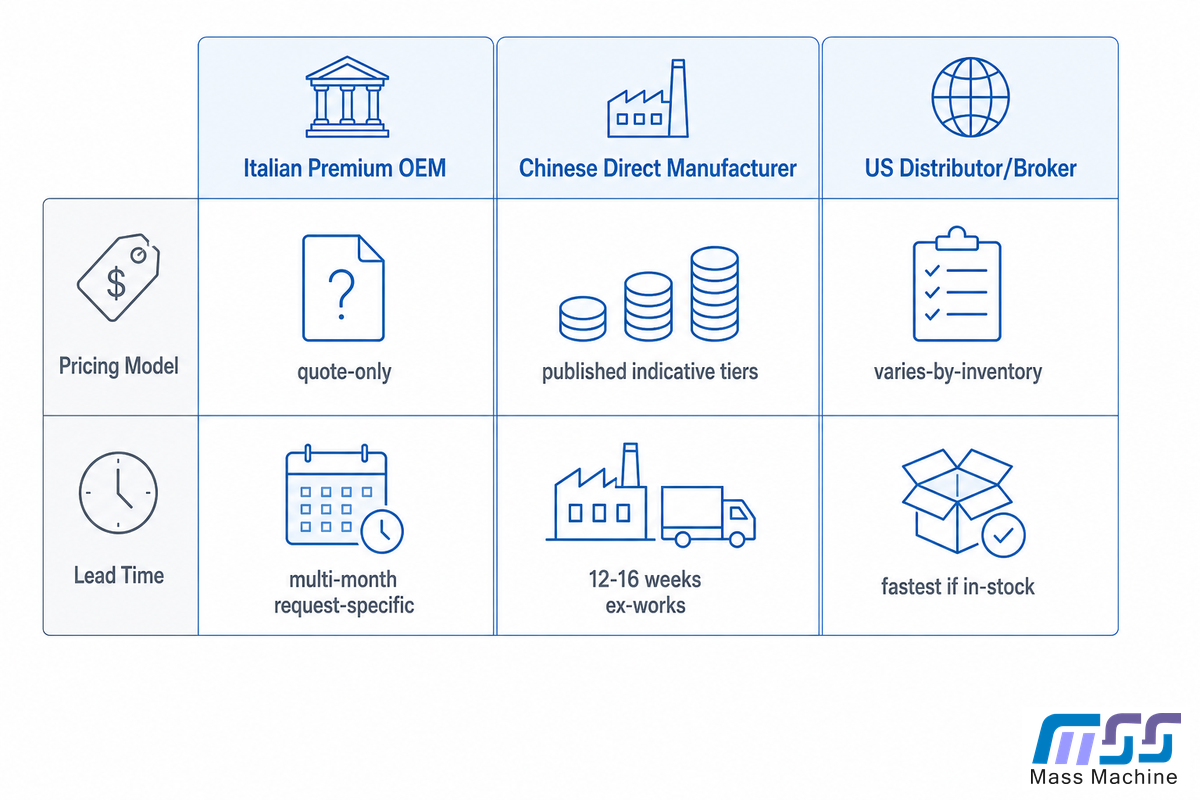
Because the majority of on-line comparisons of winemaking and bottling equipment come from wine sales distributors and brokers rather than directly from OEMs(original equipment manufacturers) we can find ourselves comparing brand versus function, rather than product specifications directly.
Top providers in the business, namely, Italian manufacturers such as Quinti Co.Mac, and Chinese producers like Mass Technology-all differ on transparency regarding pricing and lead time-may be worth directly investigating rather than relying on the information listed in their marketing collateral.
Don’t judge suppliers just by sticker price. TTB has approved a broad range of US wine container sizes in recent years, from the classic 750ml standard down to the 100-200ml range and up to multi-liter formats, while EU markets work from a separate approved list–the two lists do not completely overlap, so if you export, match your bottle format to the approved list in your destination market, not just the US list. Hygienic design compliance (ISO 14159, detailing hygiene requirements for machinery and the explanatory documentation a manufacturer must supply) and packaging-machinery construction records (ANSI/PMMI B155.1) are concrete enough that a quote or spec sheet should address them directly, not just assert compliance.
The Origin-to-Lead-Time Scorecard below separates the pricing-transparency question from the lead-time question, because they don’t always move together.
| Origin type | Typical pricing model | Typical lead time |
|---|---|---|
| Italian premium OEM | Quote-only, request-based | Longer (multi-month, request-specific) |
| Chinese direct manufacturer | Published indicative tiers, FOB ranges | 12–16 weeks ex-works, plus ocean freight |
| US distributor/broker | Varies by inventory position | Fastest if in-stock, otherwise pass-through |
Installation, CIP Sanitation & Compliance
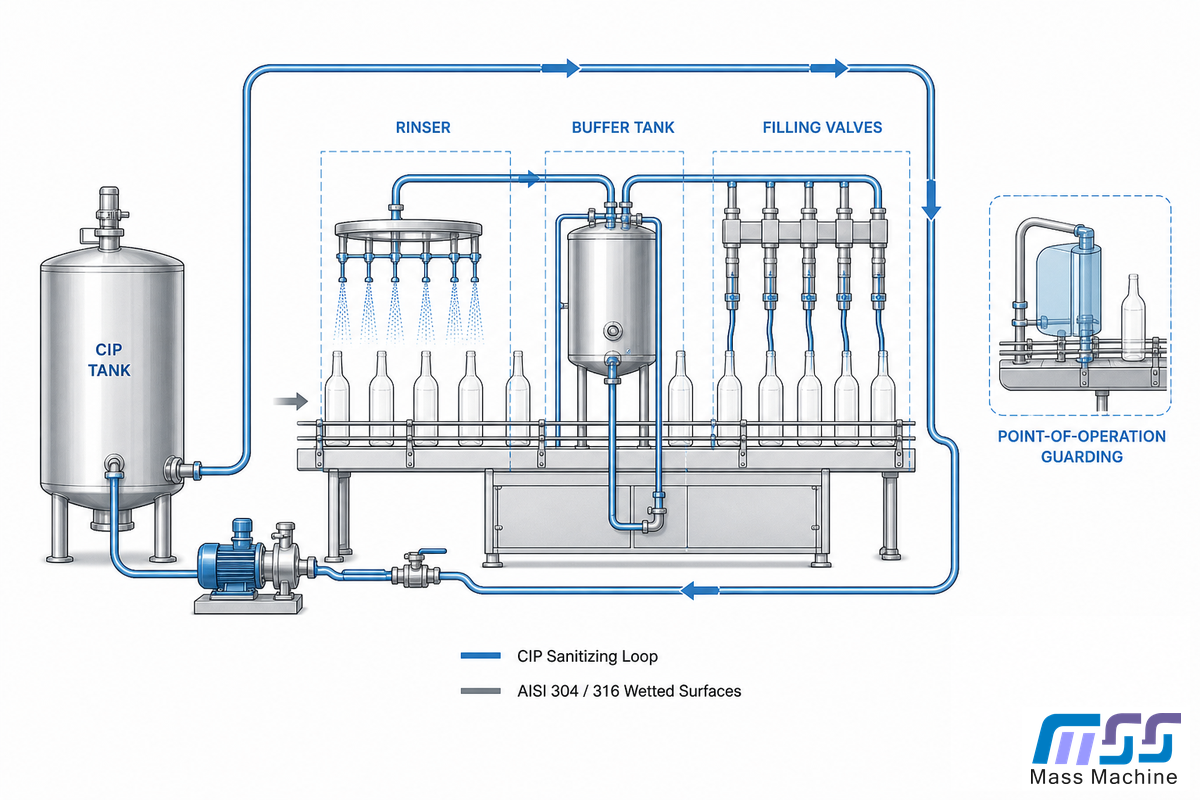
The wine bottling operation, being the last stage of control over wine quality prior to shipment out of the winery means that a valid CIP (clean-in-place) sequence is as essential as any mechanical component specifications, because as we shall show, the selection of materials for the wetted surfaces follows a simple principle in relation to wine chemistry:
📐 Engineering Note
AISI 304 stainless steel has become the de facto standard wetted surface material used in all facets of winery equipment for food contact-designed sanitary equipment.17 Insist upon AISI 316 for fruit wines as well as those products whose high acidity implies the need to protect wetted surfaces against chloride-driven pitting over decades and the service life of your machinery –this is not a specification about an FDA coating regulation but rather about selecting the material grade most suited to the corrosive environment of food production, and in selecting a supplier verify the specific food contact and sanitary standards to which its fabrication processes hold up (e.g., 3-A Sanitary Standards, NSF) – again, getting it in writing not just accepting generic claims.
Food contact is only one compliance issue. OSHA’s machine-guarding standard (29 CFR 1910.212) requires point-of-operation guarding and protection against ingoing nip points and rotating parts, directly relevant to a line’s conveyor systems, fillers, cappers, and labelers, and is worth confirming in writing before commissioning, not assumed. Manual labor is still required around most lines even at full automation, for changeovers, quality inspection, and to repack any bottles a downstream inspection station rejects rather than let a bottleneck compress the line’s overall run rate. Certifications to request from any supplier: CE Marking (EU Machinery Directive 2006/42/EC) if exporting to Europe, ISO 9001:2015 for manufacturing quality management, and EHEDG-aligned hygienic design documentation for the wetted path — and confirm food-contact material compliance along the lines of FDA food-contact substance guidance.
Industry Outlook: What’s Changing for Wine Bottling in 2026
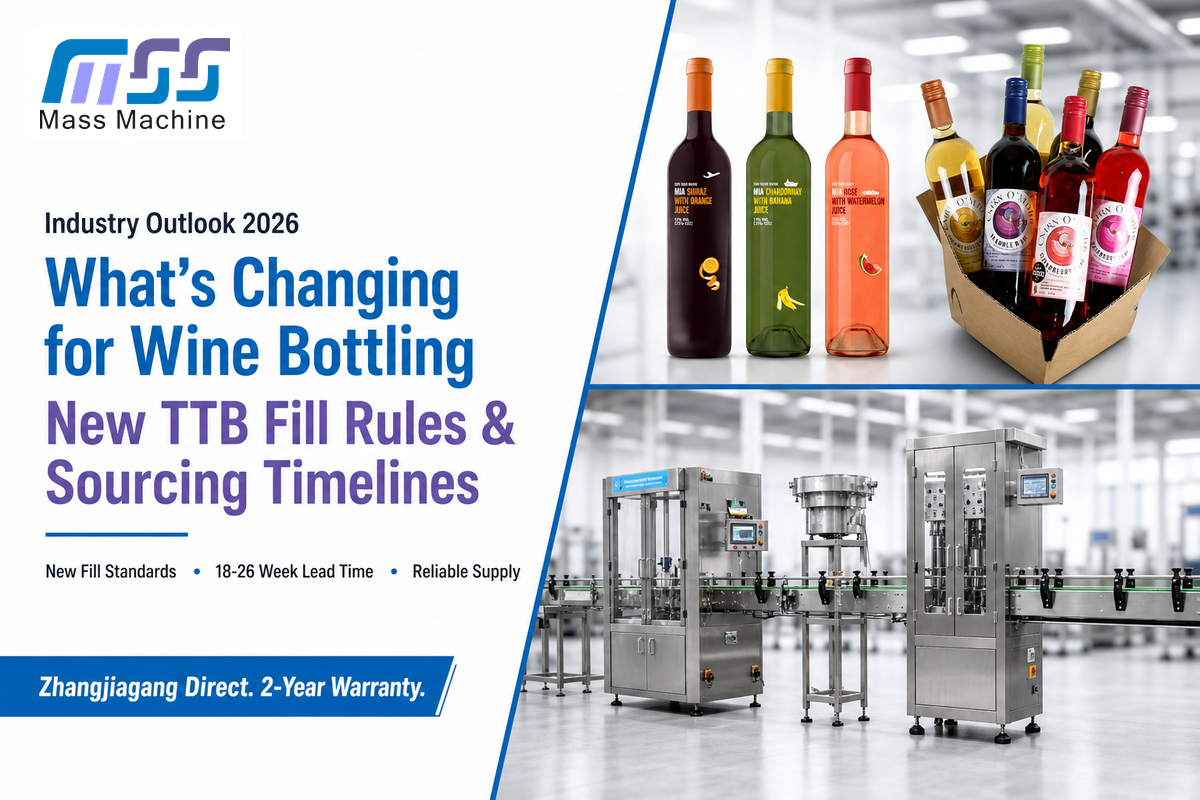
There are two structural trends which should impact on the timing of a bottling line purchased in 2024-5 for a 2026-27 grape vintage. First, international production has contracted globally and has been re-allocating across regions. Second, TTB (US Alcohol and Tobacco Trade Bureau) container flex-ibility is steadily widening.18 TTB has approved new wine standard of fill for 180-720 ml sizes beyond traditional fill levels, and initiated 2024-5 rulemaking to add allergen, and nutritional information labeling.19 A line that, and labels which can’t, adapt to new authorized fill standards represents a true and immediate bottle neck.
On timing of sourcing: A high-end OEM in Italy will be on an RFQ and 12 months+ lead time schedule; a directly sourced Chinese line will likely be 12-16 weeks EXW plus 4-6 weeks of transit for an ocean shipment – say 18-26 weeks to final installation and commissioning. If you’re aiming for a specific 2026 or 2027 harvest time bottling, you may want to be initiating RFQs now for that window 5-6 months out and considering a multi-cap-format platform for broader future SKU usage, before a second product launch forces a redo of your original choice. Estimates of the global wine bottling equipment market size from multiple market research firms generally sum up within the low-single billion dollar territory with some mid-single digit annual growth-helpful for thinking about how much R&D/investment to expect from suppliers, but not as a substitute for your own planning.20
FAQ, Wine Bottling Line Buyer Questions
Q: How much does a wine bottling line cost, and what drives wine bottling line price?
View Answer
The common industry budgeting rule of thumb: $2/case of annual production life-costed over 4-5 years. For a 10,000-case winery, that comes out to about $90,000 for equipment spend. A 4,500-5,000 BPH boutique monoblock will likely have a factory direct price listing of around $58,000-$75,000 ex-works for factory supplied packaging but factory freight/duty/installation/training on an internationally purchased line may approach a further 25-40% increase.
These figures can be useful starting points, but get a configured quotation for your particular SKUs and cap heads.
Q: What’s the difference between gravity, vacuum, and isobaric wine filling?
View Answer
Gravity filling uses atmospheric pressure to flow wine into the bottle — the cheapest equipment to buy, best suited to still wine that can tolerate a small amount of oxygen. Vacuum (micro-negative pressure) filling applies a gentle vacuum to the bottle before filling, minimizing headspace oxygen pickup — the better option for premium or oxidation-sensitive still wines.
Isobaric Filling: there is a pressure match between the atmosphere of the bottle and the filler tank, often 1-3 bar. All the dissolved CO2 will remain in the solution.This method is essential for filling any carbonated products such as Champagne, Prosecco etc, because of the massive carbonation loss if using a gravity filler with these drinks.
Q: Should I buy a new line, used equipment, or use a mobile bottling service?
View Answer
That’s all dependent upon volume and control needs, too, though, and not simply your budget. Wine production economics indicate that approximately 200,000-250,000 cases per year is about where the volume becomes significant enough to amortize the costs of staffing and housing an in-house line to make it more cost effective than hiring an outsider; below that range, it becomes more logical to opt for a contracted bottler or an established, dependable secondary equipment line (often a used one), even if you intend to buy one in the future. A new line is viable once your SKUs, workload and production needs stabilize.
Q: How do I evaluate whether used wine bottling equipment is in good condition before buying?
View Answer
Don’t just take their word on maintenance. Ask for specific details about filling-valve wear and capping-head torque calibration, as well as their documented CIP/sanitation cadence – if you’re filling, the bottling line is the last opportunity you have to control spoilage organisms before they hit customers.
Q: Can one bottling line handle multiple cap types?
View Answer
This usually comes in the form of a dual-head filler, the standard setup for winemakers dealing with a mixed portfolio of SKUs. Changeovers to entirely different closure family types, say a cork and a screw cap, are typically on the order of 15-30 minutes with a trained operator, making it possible to perform mixed-sku runs without needing two entirely separate and fixed lines.
Q: What capacity should I size for my annual case volume?
View Answer
Don’t buy based on the “max rate” numbers on paper. Size a bottling line for 60% of the total rated BPH at your maximum month load, not 100% nameplate capacity – running this hard every shift wears down equipment faster and doesn’t leave much buffer for downtime. If your project total cases fall within 10-15% of atier and you have a concrete growth plan over the next 2 years, it’s likely time to size up.
Key Factors to Consider Before You Request a Quote
- Before comparing the BPH across models (see next point), confirm which filling method-gravity/vacuum/isobaric- is dominant for your facility -’ the wrong process can create more loss through oxidation than the line itself would cost.
- Be sure to find out if a second cap head is standard or an upcharge – avoid becoming stuck in the “two-line trap”.
- Size to 60–70% of peak-month load, not nameplate capacity.
- Your total annualcasevolume should factor into new-vs-used and mobile bottling cost analyses.
- Ask for documented CE/ISO 9001/EHEDG verification, in writing, along with machine-guarding details as specified by OSHA.
Ready to size and price a wine bottling line for your production plan? See Mass Technology’s full MSGF specification range and request a configured quotethe same 5-model platform referenced throughout this guide, with published indicative pricing and 12–16 week lead times.
Related Articles
- Complete Water Bottling Line Cost: 2026 Setup & Price Guidethe same cost-planning approach applied to water lines
- Mineral Water Filling: How a Bottling Line Worksline architecture fundamentals for a different beverage category
- Beer Bottling Machine: Specs, Cost & How to Choosehow filling-method tradeoffs differ for carbonated beverages
- How to Choose a 5 Gallon Water Filling Machine: A B2B Buyer’s Guide
- Mass Technology, Beverage Filling Equipment Manufacturerfull product portfolio
References & Sources
- Wine bottling operations reference, textbook chapter on bottling wine, monoblock and station-sequence definitions.
- Australian Wine Research Institute, Understanding Total Package Oxygen
- Virginia Tech Enology Notesoxygen pickup during bottling
- Iowa State University Extension, A Deeper Look at Oxidation
- Industry reporting on bottling-line oxygen pickup by line speed, Wines & Vines (H. Letaief research).
- EP2236454B1, Valve assembly for an isobaric filling machine, Google Patents
- Reddit r/ProWinemakers, practitioner-reported nameplate vs. actual bottling throughput.
- Optimal Scheduling of the Wine-Bottling Process, Applied Sciences (MDPI), 2025
- WineBusiness Analytics (Wines & Vines) — owned-line vs. mobile-bottling economics reporting.
- WineBusiness.com Classifiedsused bottling equipment listings.
- Wine bottling operations reference, sanitation and spoilage-organism control at the bottling line.
- Curtis Phillips, “Product Review: Bottling Monoblocks,” WineBusiness Monthly, cited in 2025-era industry surveys.
- TTB, Wine Labeling: Net Contents
- ISO 14159:2002, Safety of machinery, hygiene requirements
- PMMI, ANSI/PMMI B155.1 Packaging Machinery Safety Standard
- FDA, Food Contact Substances Guidance (21 CFR 175.300)
- OSHA 29 CFR 1910.212, Machine Guarding
- TTB, New Standards of Fill for Wine and Distilled Spirits
- Future Market Insights, Coherent Market Insights, Maximize Market Research, Fortune Business Insights, wine bottling machine market sizing reports, 2025–2026.
Why We Write This
Mass Technology’s own MSGF wine-line engineering specifications — capacity tiers, filling-method configurations, and cap-format tooling — anchor this guide, cross-checked against independent regulatory sources (TTB, FDA, OSHA), enology research (AWRI, Virginia Tech, Iowa State Extension), and peer-reviewed bottling-process literature. Where a claim comes only from our own product data, we’ve flagged it as directional rather than independently audited. Reviewed by the Zhangjiagang Mass Technology Co., Ltd. technical team.