Get in Touch with Masstech
Industrial Drum Washing Machine Guide: From Residue to Release

Contents
show
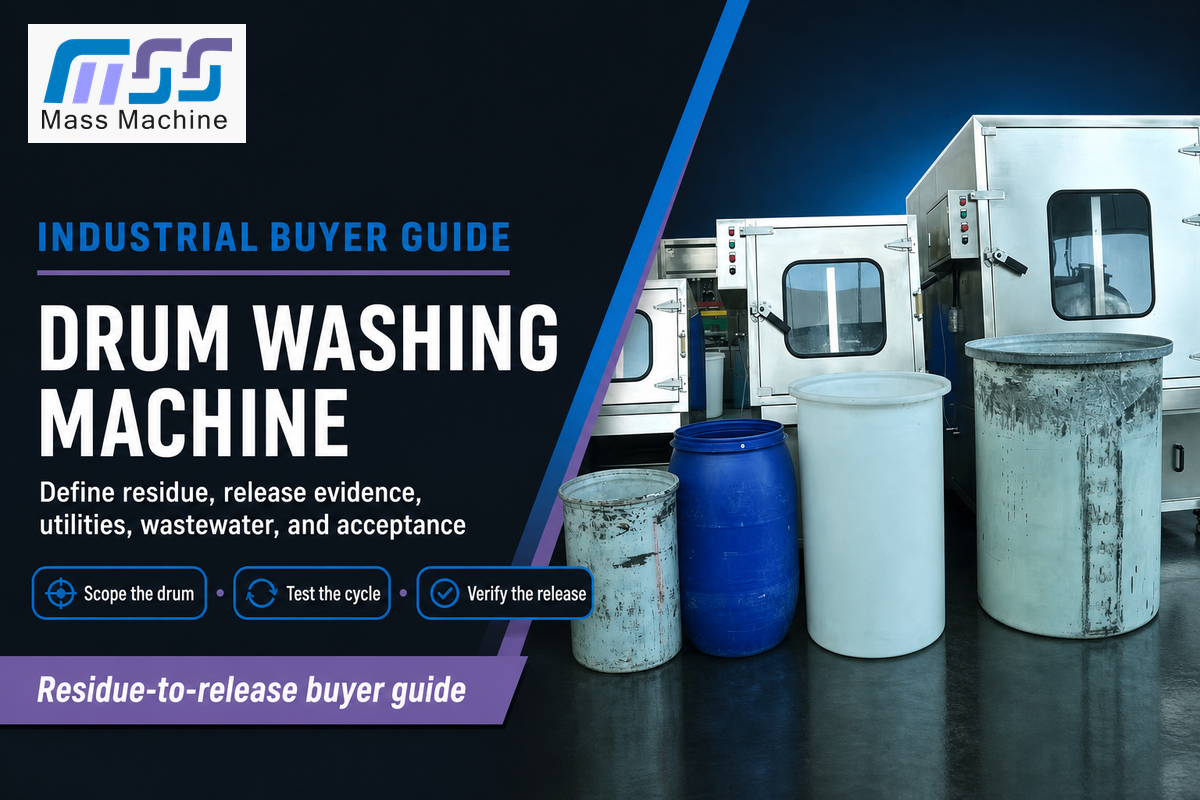
An industrial drum washing machine is a purpose-built system for cleaning reusable industrial containers. It should be specified from the container, residue, intended next use, and release test—not from pressure alone. This guide covers equipment that cleans drums as containers. It does not cover the rotating drum in a laundry machine or a rotary machine that washes small parts.
Start with the most useful buying question: not “How powerful is the washer?” but “What must be removed, from which surface, and what evidence will allow this drum to return to service?” Once those facts are explicit, you can compare wash mechanisms, draft a trial, size the entire cell, plan wastewater handling, and send suppliers the same acceptance protocol.
Key takeaway
Define the drum, residue, next use, and release evidence before choosing a wash mechanism or comparing cycle times.
What an Industrial Drum Washing Machine Actually Washes
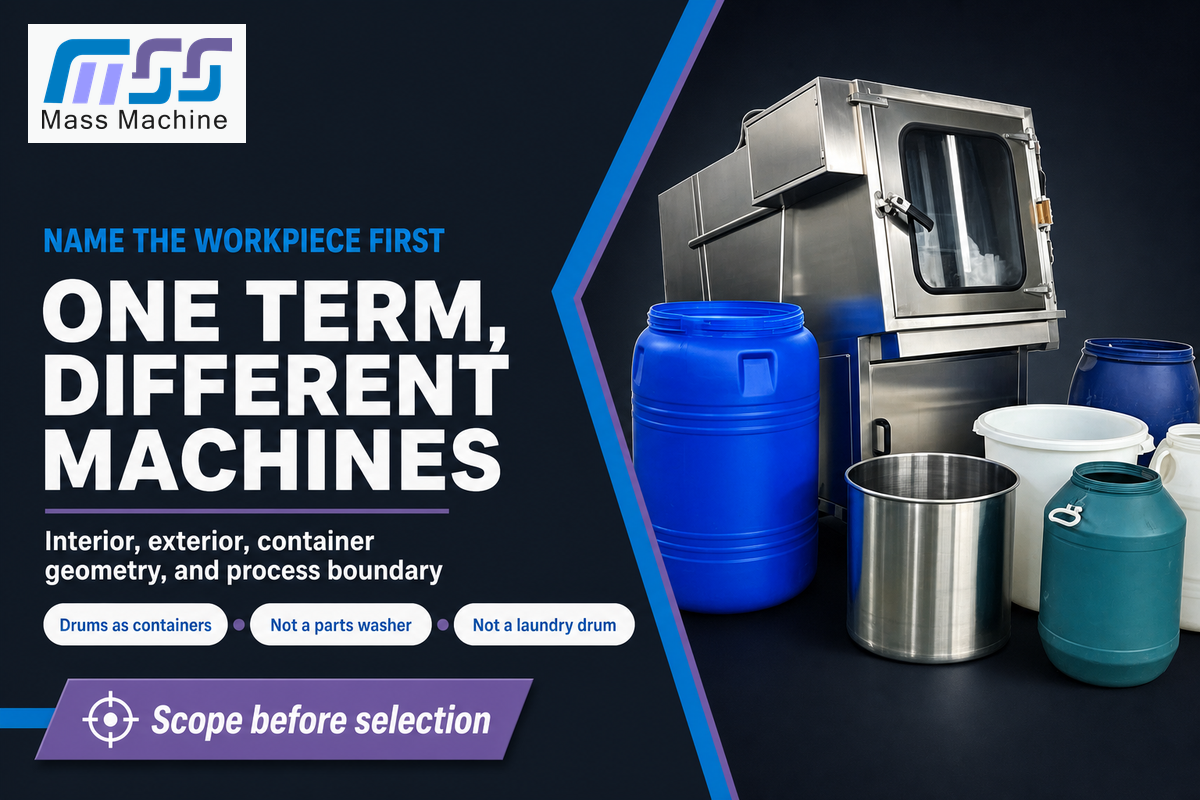
For this primer, a drum washer is a purpose-designed machine or washing cell that cleans the interior, exterior, or both surfaces of reusable industrial containers. Depending on the project, those containers may include open-top drums, tight-head barrels, pails, or selected bins.
This term is inconsistent in searches, however. Some vendors call a rotary washer that washes small components in a perforated cylinder a drum washer. Others use the term for a cell that washes produce in a rotating drum. These are different workpieces and different processes.
Search results often group broad labels together. A drum washer system or another industrial washing machine may refer either to containers or parts, so treat phrases such as drum washer applications, drum washer features, washing systems, and cleaning solutions as category labels rather than proof of fit. The right drum washer is the one whose workpiece, access, chemistry, utility demand, and release method match the facility’s documented problem. Effective drum washing begins with that distinction.
| Equipment class | Workpiece | Typical motion | Residue target | Do not substitute it for |
|---|---|---|---|---|
| Industrial container drum washer | Metal or plastic containers, including a stainless steel drum, barrel, or pail | Container fixed, indexed, conveyed, or rotated while spray/contact devices work | Residue on the container itself | Parts washing without a container-release requirement |
| Industrial parts washers, including aqueous rotary drum parts washers | Fastener, metalworking, or other machined parts | Tumbling action or indexed advance through a rotating drum | Oil, chips, or process soil on parts | Cleaning a drum for reuse |
| Produce drum washer | Fruit or vegetables | Produce advances through a rotating cylinder | Field soil on food products | Industrial-container decontamination |
| Laundry machine | Textiles | Textiles tumble in a perforated drum | Textile soil | Rigid container washing |
| Garbage can washer or trash-bin washer | Wheeled bins or waste containers | Bin indexed, tilted, or held for internal/external spray | Waste residue on bin surfaces | Closed-head drum access without verification |
| Automatic drum or bottle washer | Small bottles or other packages, depending on the design | Indexed or continuous package handling | Application-defined package residue | Full-size industrial-container washing without dimensional proof |
| Bottle washer | Small reusable bottles | Bottle inverted or indexed over dedicated nozzles | Residue inside a narrow-neck bottle | Large-drum handling and drainage |
| Basket or crate washer | Open lattice baskets and crates | Workpiece conveyed or held through spray zones | Residue on open framework | Closed-container internal cleaning |
| IBC washer | Intermediate bulk containers | Large container fixed while a cleaning device enters through an opening | Internal or external IBC residue | Assuming drum fixtures fit larger containers |
| Fixed tank cleaning system | Installed vessels or process tanks | Cleaning device works in place | Process residue inside a fixed vessel | Portable-drum loading and release flow |
Search language can hide the same scope problem. Phrases such as industrial drum washer, 55 gallon drum washer, steel drum washing machine, chemical drum washer, plastic drum washing machine, barrel washing machine, and rotary drum washer describe overlapping but not automatically equivalent requests. Treat each phrase as a prompt to identify the actual workpiece, residue, and release decision.
Adjacent container categories also need their own envelope. A trash bin washing machine must accommodate wheel and lid geometry, while a 5-gallon bottle high-pressure washer works with a much smaller opening and handling format. A MassTech basket washing solution deals with open lattice workpieces. Similar words don’t make these applications interchangeable.
Do
- Name the workpiece and every size variant.
- State whether internal, external, or complete washing is required.
- Compare quotations only within the same equipment class.
Don’t
- Use “drum washer” as the complete specification.
- Transfer parts-washer cycle claims to container release.
- Assume equal nominal volume means equal access or drainage.
Start With Drum Material, Geometry, and Previous Contents
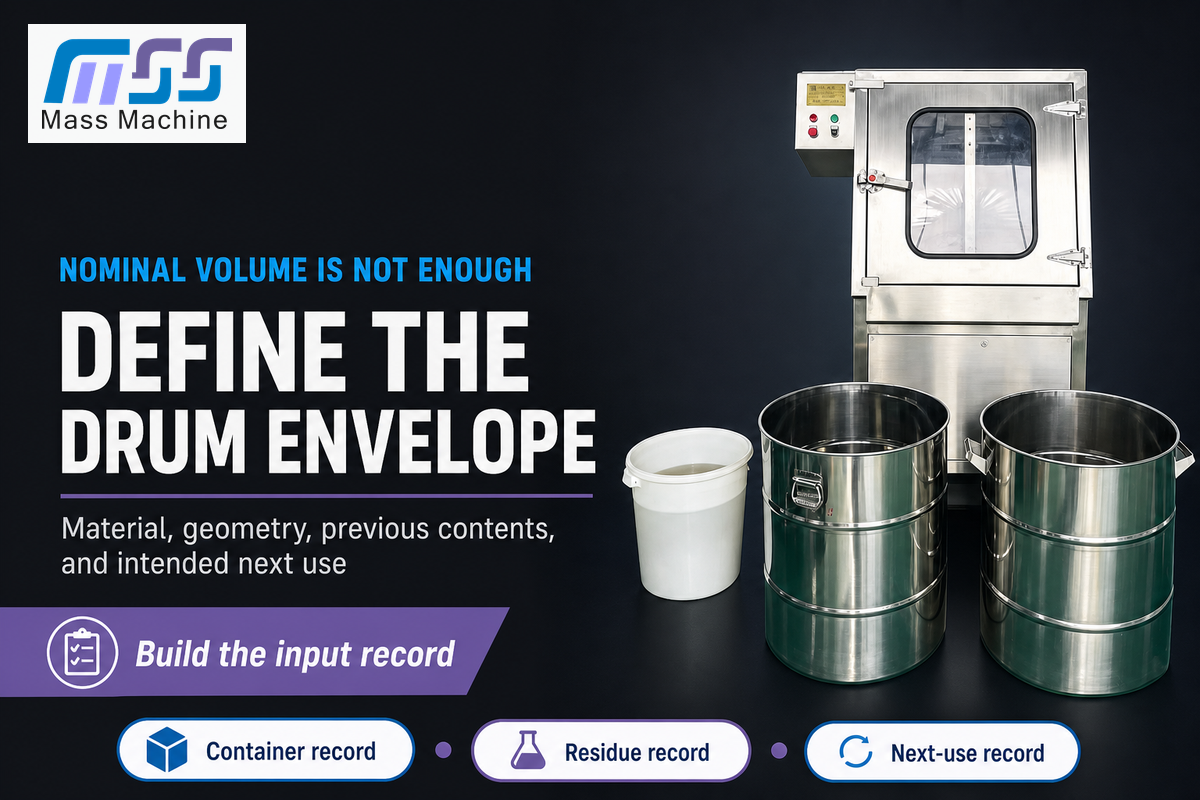
A nominal 200-litre or 55-gallon label does not tell a supplier enough. Record drum size from measured height, diameter, opening, and handling features, then add the material, lining, closure, chime, internal baffles, liner, deformation, and drainage orientation. Add the previous contents, their known hazards, whether the residue has dried or cured, how long it has aged, and the drum’s intended next use. Where dimensions remain uncertain, use the existing barrel fit checker as a geometry follow-on rather than guessing from capacity alone.
Which residue evidence belongs in a drum-washer trial?
Residue behavior determines what a cleaning mechanism must do. A water-soluble liquid may respond to controlled spray and rinsing, while a dried film may need soaking, compatible chemistry, heat, contact action, or safe pre-removal. Record whether a viscous product drains slowly enough to constrain the recovery system.
Particles can block nozzles or recirculate unless filtration is designed for them. A contaminant can also behave differently on bare steel, a coating, or plastic, and on interior versus exterior surfaces. That is why a sample wash must represent the actual surface, residue age, and next-use acceptance test. A detergent name or pressure value by itself does not establish compatibility or release.
Stop before specification if a drum has unknown contents, is leaking, is visibly damaged, shows unexpected pressure, contains a potentially incompatible residue, or lacks an established safe opening and handling method. Quarantine it and route it to the site’s qualified safety, environmental, or hazardous-material owner. A wash recipe is not a way to make an unknown container safe to open.
- Container record: material, lining, nominal and measured dimensions, openings, closures, features, damage, and photos.
- Residue record: product identity, safety information, concentration, age, amount, solubility, viscosity, particles, cure behavior, and incompatible agents.
- Next-use record: reuse purpose, prohibited carryover, required integrity checks, release owner, and traceability needs.
- Trial record: representative worst-case drum, wash inputs, sample location, test method, acceptance limit, and failed-drum disposition.
Match Mechanical Action and Chemistry to Residue Behavior
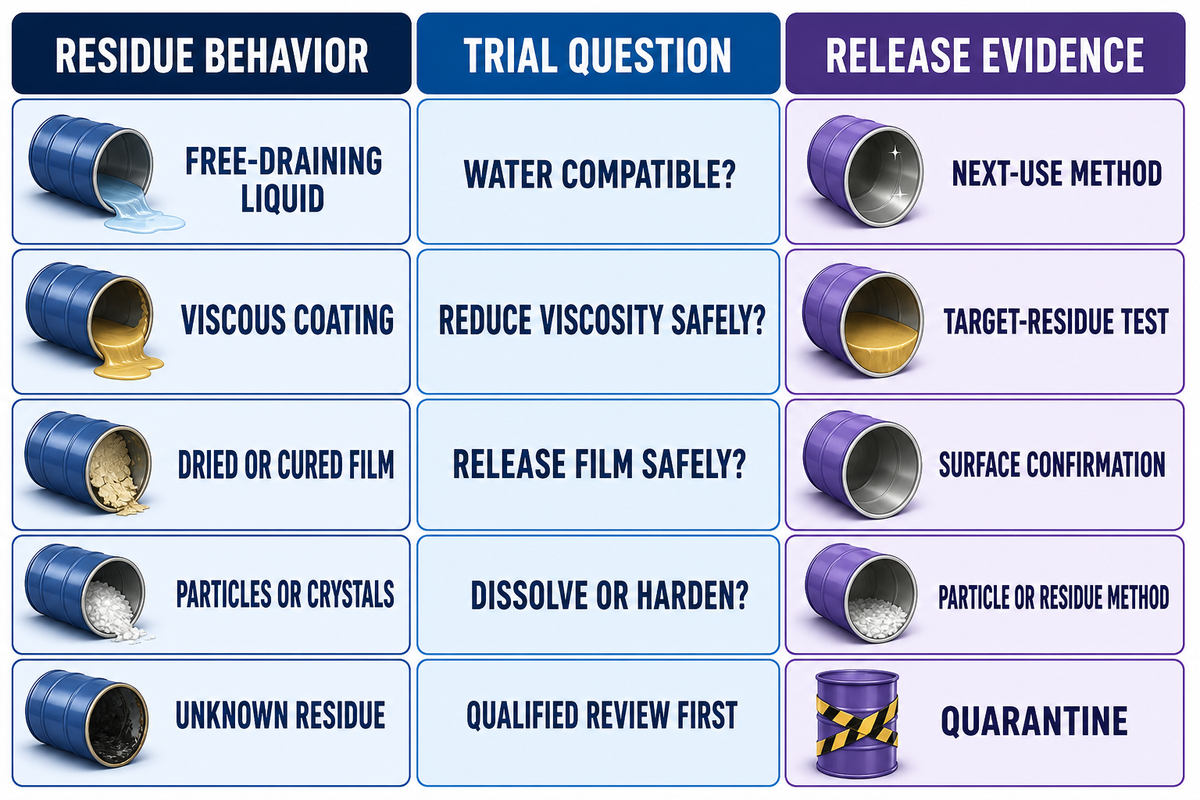
Higher pressure is only one possible source of mechanical action. The drum material, previous contents, and residue behavior established in the previous step set the boundaries for comparing mechanical action and chemistry. Cleaning also depends on spray coverage, impact at the surface, contact time, chemistry, temperature, access to shadow zones, drainage, and whether loosened soil is removed or redeposited.
As a configuration-specific example, Alfa Laval publishes an 80–1000 psi pressure range, 3–8 gpm flow, 32–190°F fluid temperature, a 2.5 ft cleaning radius, and a 2–4 min cycle for one named 30- and 55-gallon device. That broad first-party envelope is evidence against transferring one setting universally; it is not a recipe for another machine or residue.
Residue-to-Release Matrix
Use the following Residue-to-Release Matrix to turn observable soil behavior into trial questions. It is an editorial buyer tool, not a standard or a proprietary MassTech method.
| Residue behavior | Precondition to record | Candidate mechanical action | Chemistry question | Rinse evidence | Release test | Verify first |
|---|---|---|---|---|---|---|
| Free-draining liquid | Drain time and retained pockets | Directed internal spray and controlled drainage | Is water compatible and sufficient? | Trend rinse appearance or a justified process indicator | Next-use-specific method | Vents, bungs, folds, and collection route |
| Viscous coating | Temperature and age | Soak, recirculation, spray impact, or compatible contact action | What reduces viscosity without damaging the drum? | Defined sampling point after rinse | Target-residue or justified surrogate test | Heating limit, filtration, and carryover |
| Dried or cured film | Cure history and adhesion | Contact action, staged soak, or safe pre-removal | Can the chemistry swell or release the film safely? | Check for detached fragments and redeposition | Surface-specific confirmation | Coating damage and inaccessible areas |
| Particles or crystals | Particle size and load | Flush pattern with recovery and filtration | Will dissolution help or create a harder deposit? | Filter and final-rinse observation | Particle/residue method suited to next use | Nozzle blockage and recirculation |
| Unknown or incompatible residue | Identity unavailable or conflicting | None until qualified review | Do not select by trial and error | Not applicable | Not applicable | Quarantine; establish safe handling and disposition |
The matrix does not choose a detergent or certify compatibility. It identifies the assumption that a representative trial must test. After documenting residue behavior, the residue-cycle planner can support a model-specific conversation without replacing the acceptance plan.
Build a Wash Cycle as a Testable Process, Not a Timer Setting
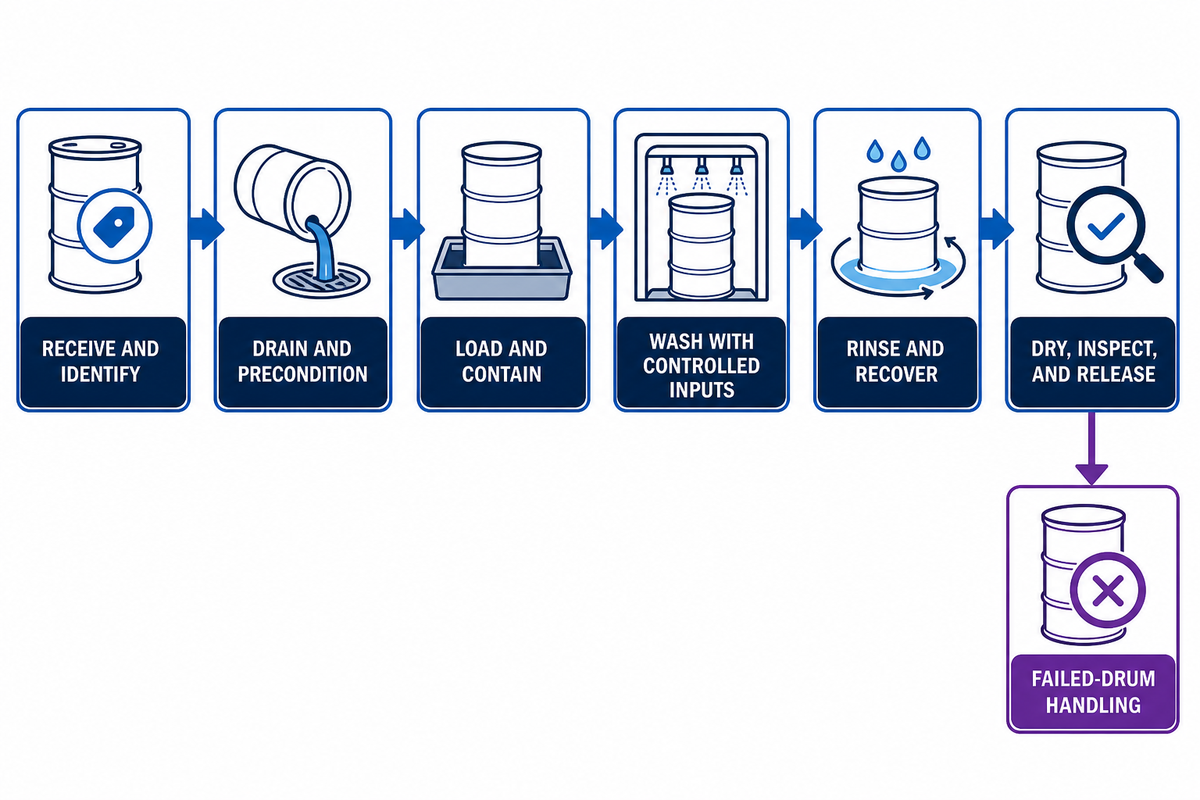
Spray time describes only part of the operation. Selected mechanical action and chemistry still have to operate within a complete, testable sequence. Receiving, identification, safe opening, draining, loading, preconditioning, washing, rinsing, drying, unloading, inspection, and failed-drum handling can each control quality or output.
Put a measurable input, an observation, and an acceptance point around the sequence before asking a supplier for cycle time.
- Receive and identify — match the drum to its previous-content record and isolate damage, leakage, unknown contents, or unexpected pressure.
- Drain and precondition — record retained material, drain time, temperature, and any approved soak or safe pre-removal.
- Load and contain — verify orientation, closure handling, access, guarding, extraction, and collection before motion begins.
- Wash with controlled inputs — record chemistry, temperature, flow or pressure where relevant, contact action, time, and filtration condition.
- Rinse and recover — separate wash and rinse decisions, collect the stream through the approved route, and sample at the defined point.
- Dry, inspect, and release — apply the documented evidence method and segregate any failed drum instead of silently re-running it.
In the United States, OSHA’s general machine-guarding rule addresses hazards from rotating parts and includes an interlocked-enclosure provision for revolving drums, barrels, and containers. Supplier safety features may support the design review, but they do not by themselves prove compliance with OSHA for a specific application. Whether and how the rule applies requires a site-specific review; this guide doesn’t assert that any MassTech model is certified to it. Likewise, depressurization and hazardous-material handling must be established outside the wash recipe.
Define “Clean Enough” Before Selecting the Machine
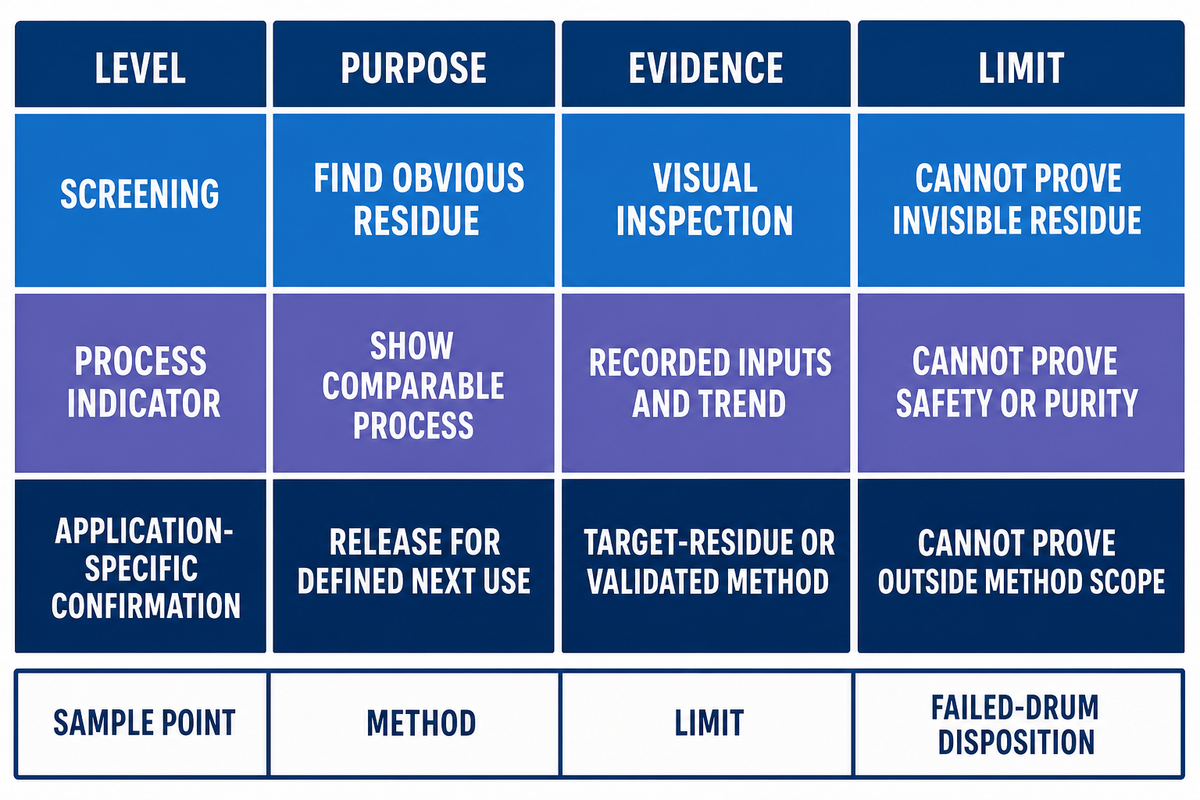
“Clean” is not a useful acceptance term until it has a sample point, method, limit, and failed-drum disposition. An acceptance plan links each drum to those four items, and the exact evidence depends on previous contents and next use.
Marketing promises such as efficient removal of contaminants, complete cleaning, thorough cleaning, or optimal cleaning results are not acceptance criteria. Translate each promise into a named residue, sample location, method, numerical or categorical limit, and failed-drum action before comparing suppliers.
Under US hazardous-waste rules, an empty-container determination has a specific legal scope. The US Environmental Protection Agency warns that a drum meeting that empty-container provision may still retain significant hazardous residue. Regulatory empty therefore does not mean clean for reuse.
Clean-release verification compass
This clean-release verification compass is an editorial framework. It helps a buying team discuss evidence depth; it isn’t a regulation, validation standard, or promise that one method fits every application.
| Level | Purpose | Examples | What it cannot prove alone | Decision owner |
|---|---|---|---|---|
| 1. Screening | Find obvious residue, damage, pooled liquid, odor, or incomplete drainage | Documented visual inspection and condition check | Absence of invisible, soluble, hazardous, or use-critical residue | Trained operator under the site procedure |
| 2. Process indicator | Show that a controlled wash/rinse process behaved comparably | Justified rinse indicator, recorded inputs, filter condition, and trend review | Application-specific safety or purity without a demonstrated relationship | Process and quality owner |
| 3. Application-specific confirmation | Release for a defined next use | Target-residue, surface, microbiological, or other validated method where applicable | Uses, materials, or hazards outside the method’s scope | Qualified quality, regulatory, or compliance owner |
Pharmaceutical cleaning-validation literature is useful for the principle that surface-residue interaction, analytical methods, monitoring, nonroutine soils, change control, and maintenance affect a validated process. Those concepts are cited here within pharmaceutical scope and don’t automatically impose pharmaceutical requirements on general industrial drum washing.
Cleaning release also doesn’t establish transport-package integrity, leakproofness, markings, closure condition, or eligibility for hazardous-material service. If a cleaned drum will return to regulated transport, route those questions to the applicable transport rules and the qualified compliance owner.
Size the Whole Washing Cell, Not the Nozzle Cycle
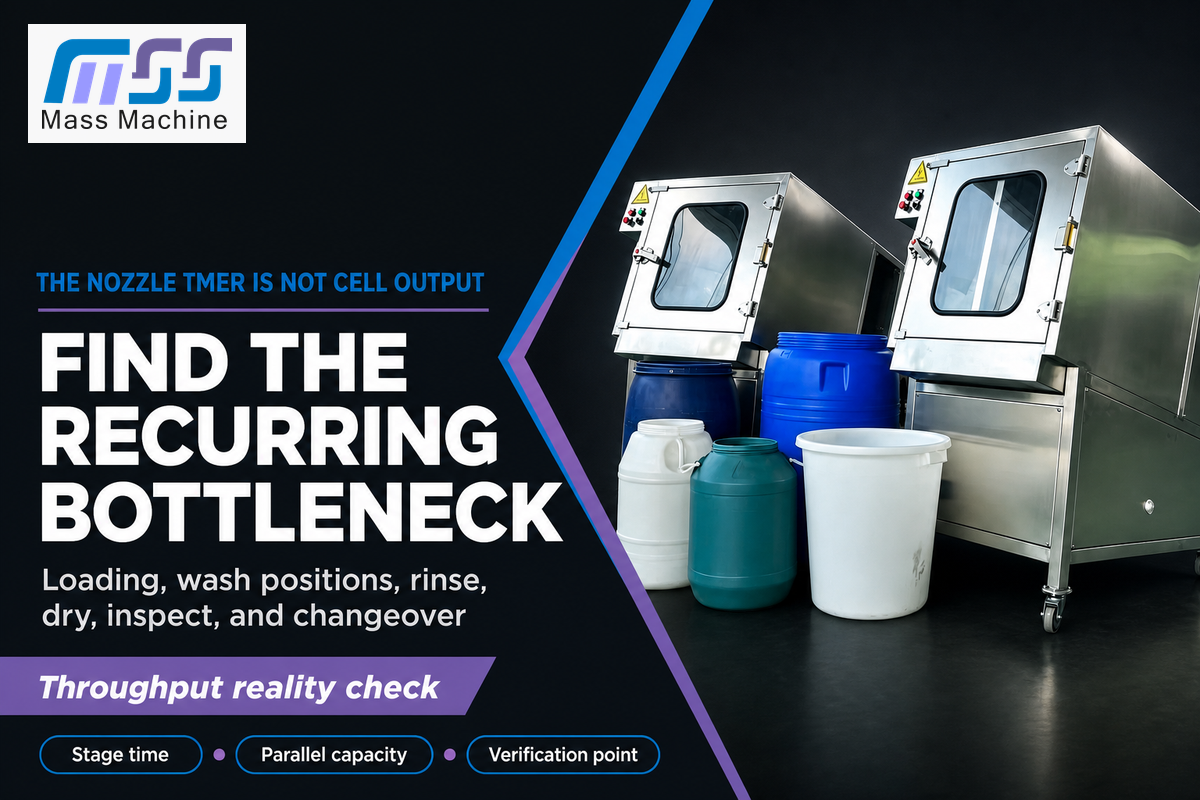
For this guide’s cell-capacity check, define real capacity as the throughput of the slowest recurring stage, corrected for parallel positions and planned operating conditions. A 3-minute spray cycle is not automatically 20 drums released per hour when loading, draining, heating recovery, rinsing, drying, inspection, or changeover takes longer.
Labels such as high-throughput, high-volume, high volume, high-throughput applications, or equipment for demanding industrial production environments are not capacity evidence. For large volumes, time the complete route under representative operating conditions and require repeatable results at the release point, not only a fast nozzle cycle.
For instance, an Arcus vendor case lists 20 L and 25 L chemical drums, 3–5 min batching of up to 9 drums, and 100–150 drums/hr. Those are vendor-reported, case-specific numbers, not a stand-alone standard or a MassTech capacity claim.
How should buyers compare batch, indexed, and conveyor evidence?
Container-washing drum washers may be batch, indexed, or conveyor based. In batch operation, a machine loads one or more drums, completes defined stages, and then unloads before starting the next batch. In an indexed cell, containers move between fixed stations in controlled increments so operations can overlap.
A conveyor line moves compatible containers through sequential zones and suits stable, repeatable flows. None is inherently best. Batch handling can suit variable residues and lower volumes; indexed or conveyor cells can support higher repeatability when container geometry and acceptance are stable. Do not confuse these systems with a rotary parts washer that tumbles small parts inside a drum.
Cell Bottleneck Register
Treat the Cell Bottleneck Register as an editorial planning screen. Record each stage’s cycle input, parallel capacity, buffer, interruption mode, verification point, and owner.
| Stage | Observed time per drum | Parallel positions | Effective capacity | Typical interruption | Verification |
|---|---|---|---|---|---|
| Drain and load | 4 min | 1 | 15 drums/hour | Slow residue drainage | Load-ready checklist |
| Wash and rinse | 6 min | 2 | 20 drums/hour | Filter service or heat recovery | Cycle record |
| Dry | 8 min | 3 | 22.5 drums/hour | Air or temperature limit | Dryness criterion |
| Inspect and release | 5 min | 1 | 12 drums/hour | Sampling and documentation | Release record |
In this hypothetical example, effective capacity is parallel positions × 60 ÷ minutes per drum. Inspection and release sets the lowest recurring capacity at 12 drums per hour, not the two-position wash stage at 20. This example excludes uptime, breaks, changeovers, rejected drums, and unscheduled maintenance; those require site data. Once the cell inputs are known, the drum washer class selector is the appropriate commercial follow-on.
The next table is this guide’s editorial layout-screening checklist. Its questions do not replace site electrical, environmental, or safety review.
| Interface | Input to provide | Screening question | Trial or design evidence |
|---|---|---|---|
| Water | Available quality, flow, pressure, and temperature | Could supply limit fill, rinse, or recovery? | Measured supply profile |
| Heat | Energy source and measured recovery time | Could temperature drift between batches? | Worst-case heat-up/recovery trial |
| Electrical and controls | Approved site supply, applicable area-classification decision, and interfaces | Do the approved supply and interfaces support motors, heaters, extraction, and integration? | Approved electrical schedule |
| Drainage and extraction | Collection route, peak flow, vapor, and ventilation needs | Could collection, vapor, or ventilation limits stop washing? | Site environmental and safety review |
Treat Rinse Water and Drum Reuse as Separate Decisions
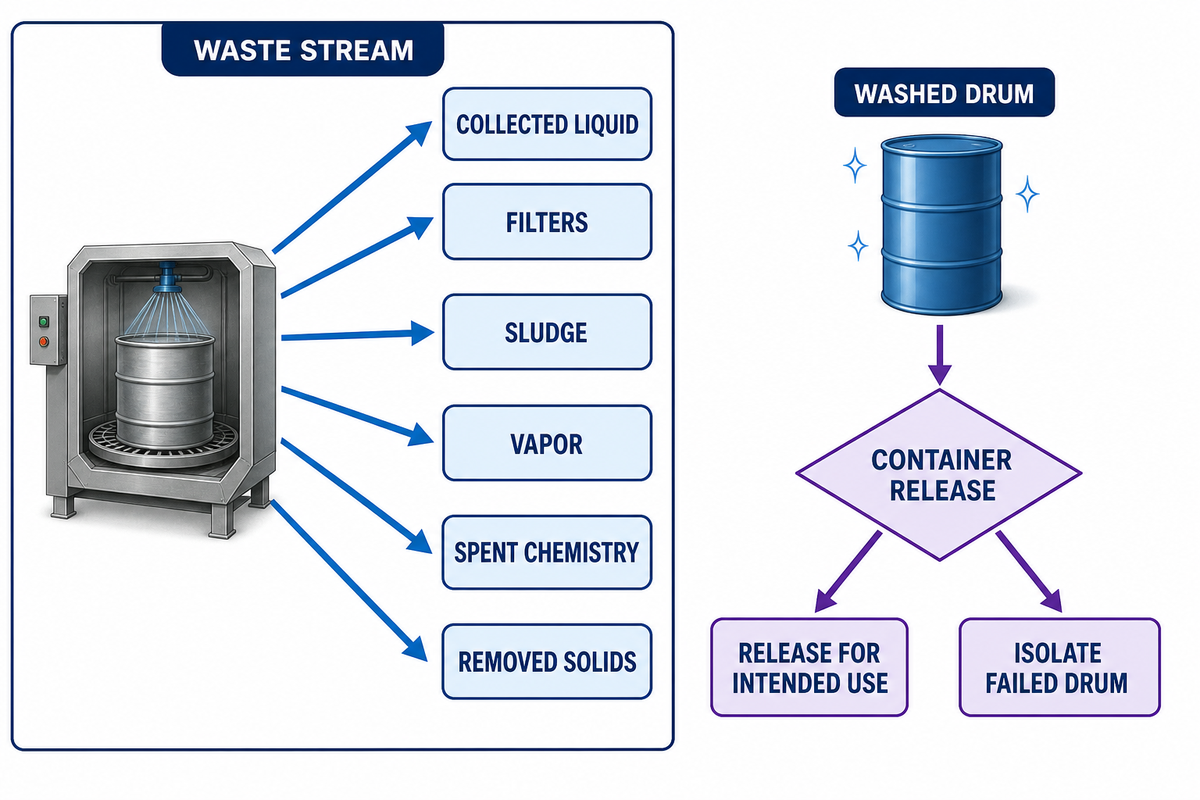
Washing does not make residue disappear; it transfers residue into collected liquid, filters, sludge, vapor, spent chemistry, or removed solids. That material balance belongs beside the whole-cell capacity and utility assumptions, not outside them. The project therefore needs two independent decisions: where each waste stream may go, and whether the container may return to its intended use. Safe disposal of streams containing hazardous substances must be assigned to the site’s qualified environmental or waste owner rather than assumed from the wash-cycle description.
In the United States, the EPA’s Industrial Effluent Guidelines overview explains that technology-based standards apply to industrial discharges to surface waters and municipal treatment works. The actual route depends on sector, pollutants, permits, pretreatment, and local requirements.
Situations That Justify Rejecting the Wash Route
- Unknown previous contents: no defensible compatibility or release plan can be built until provenance is resolved.
- Damaged, leaking, absorbent or degraded surfaces: cleaning may not repair damage or remove lodged-in residue.
- Incompatible lining or chemistry: the selected process could ruin the container or produce a new risk.
- No suitable acceptance method: the team cannot show that the result meets the next-use requirement.
- No approved effluent or waste route: operating the washer would create a stream the site is not prepared to manage.
Do
- Characterize each collected stream.
- Assign drum release and waste approval separately.
- Isolate failed drums and record their disposition.
Don’t
- Call a legal-empty drum clean for reuse.
- Assume rinse water can be reused or discharged universally.
- Let the washer purchase precede route approval.
Maintenance Failures That Change Cleaning Results
Even a cycle that passed during commissioning can drift as spray devices block, brushes wear, filters load, pumps lose performance, seals leak, heaters recover slowly, sensors shift, or dirty solution carries over. Maintenance is therefore part of the cleaning-control strategy, not only a spare-parts schedule. Use the manufacturer’s manual for intervals, then add process-based triggers tied to observed result drift.
Do not invent a universal replacement-hour figure.
In a hypothetical maintenance scenario, the same worst-case drum might pass after commissioning but show residue in one shadow zone after filter service. Compare the documented spray pattern, nozzle condition, flow, filter setup, and release-test result before and after service. The equipment may run normally while the cleaning result has changed. ISPE’s pharmaceutical-context discussion likewise treats maintenance and change control as factors that can affect an established cleaning process; this guide doesn’t extend pharmaceutical requirements to every drum washer.
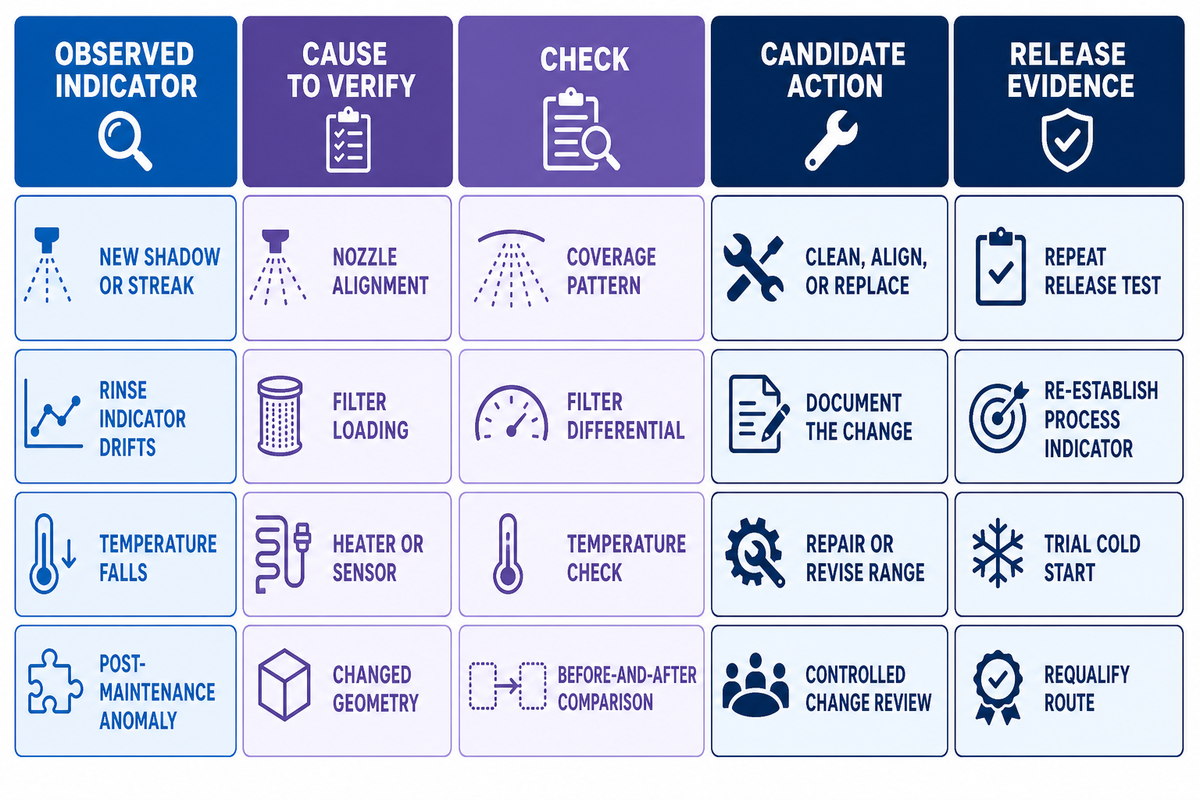
The next table is an editorial troubleshooting screen, not a diagnosis or maintenance manual. Treat each candidate cause as a question to confirm against the manufacturer’s instructions and controlled before-and-after evidence.
| Observed indicator | Candidate cause to verify | Check | Candidate action | Release evidence |
|---|---|---|---|---|
| New shadow or streak | Blocked or misaligned nozzle; worn contact element | Coverage pattern and component condition | Confirm with the manual; clean, align, or replace as applicable | Repeat representative release test |
| Rinse indicator drifts | Filter loading, carryover, chemistry concentration, or poor drainage | Filter differential, solution condition, and drain path | Confirm the cause and document the change | Re-establish the process indicator relationship |
| Cycle temperature falls | Heater, sensor, supply, or recovery limitation | Independent temperature check and recovery profile | Confirm with the manual; repair or revise the controlled range | Trial worst-case cold start or repeated batches |
| Unexpected residue after service | Changed geometry, controls, spray pattern, or component material | Change record and before/after comparison | Review as a controlled change | Requalify the affected route |
Write the Sample-Wash and RFQ Acceptance Protocol
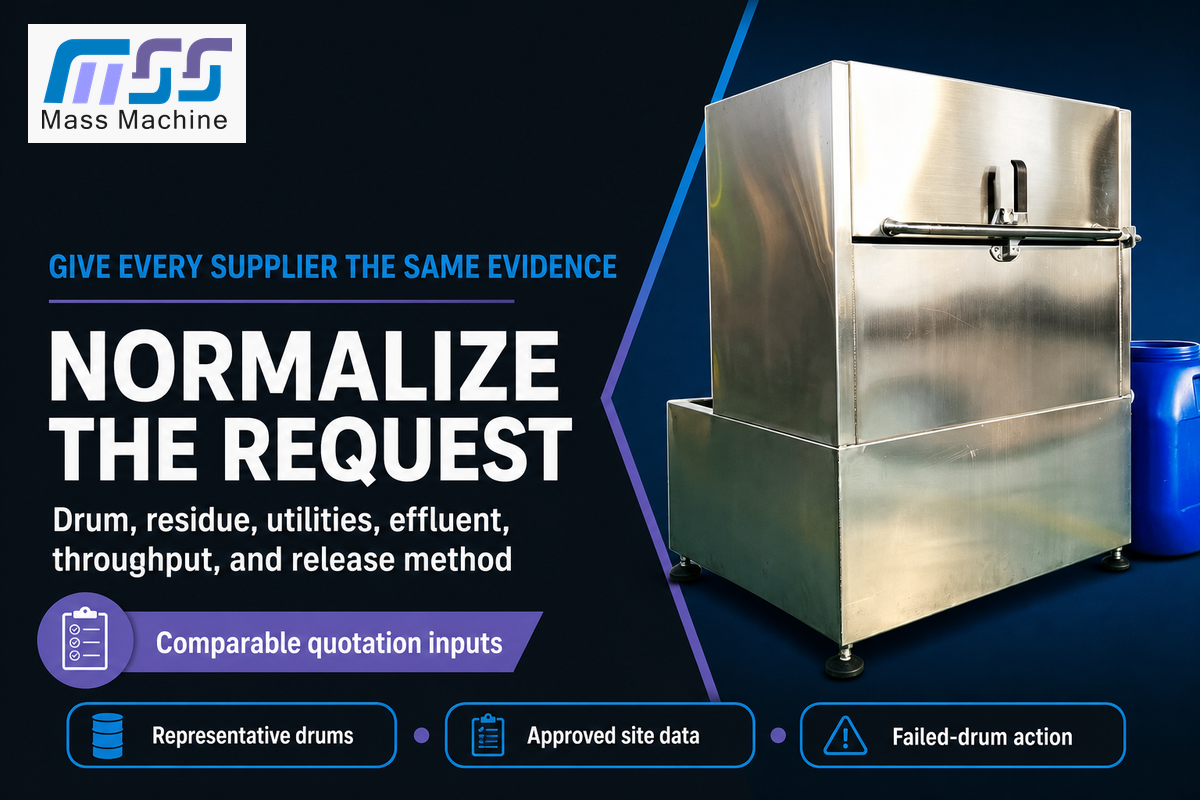
Give every supplier the same representative drums, residue conditions, utilities, scope boundary, and release method. This comparison document prevents a low quotation from winning simply because it omitted drainage, drying, wastewater, testing, controls, or changeover. Copy the following table into the request and replace every “project-defined” entry with your approved data.
RFQ checklist — copy these into your quote request:
| Parameter | Recommended range | Why it matters | How to verify |
|---|---|---|---|
| Container envelope | Project-defined min/max dimensions, mass, opening, and features | Controls fit, access, handling, and drainage | Dimensioned drawing plus worst-case sample |
| Residue challenge | Actual product, age, amount, and worst credible condition | Determines mechanism and chemistry assumptions | Representative trial drums and safety information |
| Next use and release | Named sample point, method, limit, and failed-drum action | Defines what “clean” means | Signed acceptance protocol and test report |
| Cell throughput | Required released drums/hour and operating pattern | Prevents nozzle time from substituting for cell output | Timed end-to-end trial including handling and release |
| Site utilities | Measured water, heat, air, electrical, drainage, and extraction envelope | Exposes interface bottlenecks | Supplier utility schedule checked against site measurements |
| Effluent and waste | Approved collection, treatment, recovery, or disposal route | Defines system boundary and operating permission | Site environmental review and sample characterization plan |
| Changeover and maintenance | Project-defined residue families, inspection points, and access needs | Controls cross-contamination and sustained performance | Demonstrated cleanout, inspection, and maintenance procedure |
| Documentation | Drawings, manuals, controls records, trial data, and agreed certificates | Makes commissioning and future changes auditable | Document register tied to acceptance milestones |
After the evidence inputs are complete, keep model selection in a separate commercial discussion. Tie that discussion to the actual drum and acceptance method; neither this guide nor a preliminary quotation can promise a universal cleaning result.
Why August 2026 Is a Planning Start, Not a Drum-Reuse Deadline
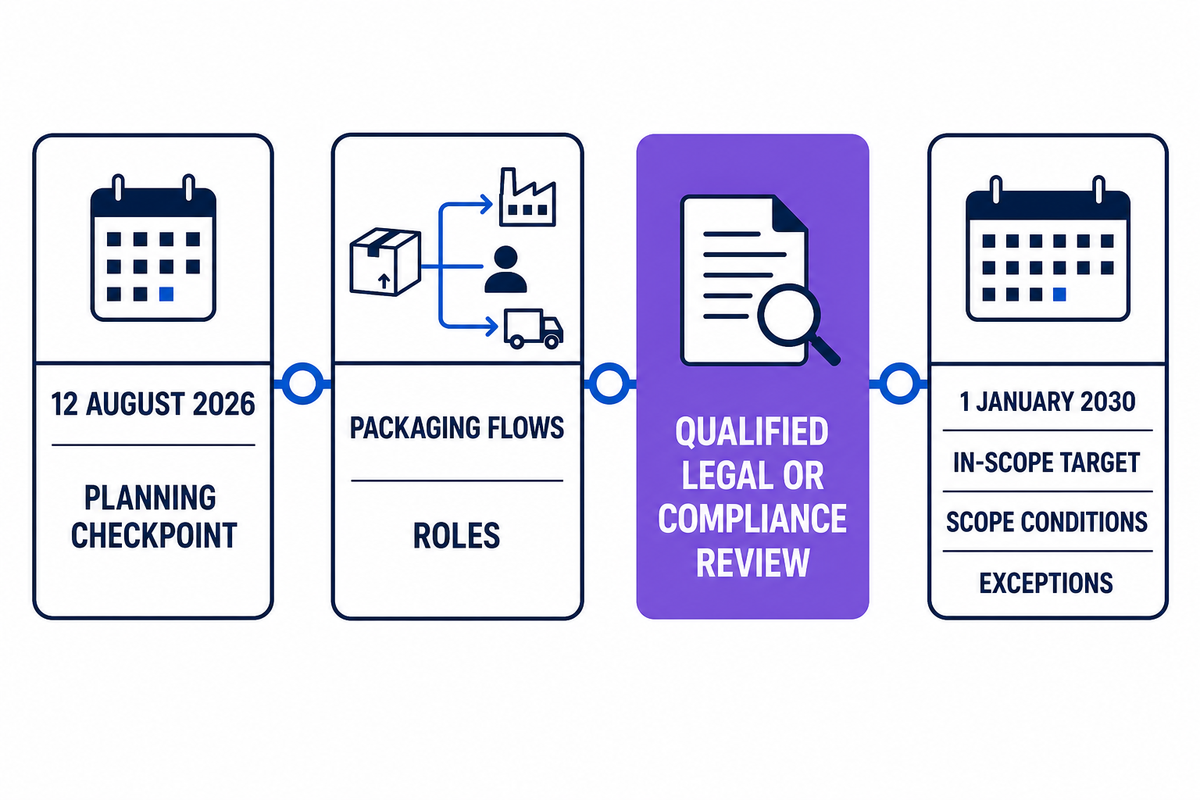
Regulation (EU) 2025/40 generally applies from 12 August 2026. The same request-for-quotation discipline should therefore keep regulatory planning separate from the sample-wash acceptance protocol. That date is a useful planning checkpoint for organizations in its scope, but it is not the start date of the drum-specific transport-packaging reuse target.
Article 29 sets the relevant in-scope target from 1 January 2030 and includes scope conditions and exceptions that must be assessed against the actor and packaging flow.
Washing equipment doesn’t create compliance, prove that a particular drum is reusable, or decide which economic operator owns an obligation. Treat the regulation as a reason to map packaging flows, roles, evidence, and reuse decisions early. Then obtain qualified legal or compliance review for the actual European Union operation. This article excludes commercial market-growth forecasts because they aren’t needed to establish the regulatory dates.
Frequently Asked Questions
What is an industrial drum washing machine?
An industrial drum washing machine cleans reusable containers such as open-top drums, barrels, pails, or selected bins through a controlled combination of drainage, spray, contact action, chemistry, rinsing, and sometimes drying. The specification should state the container, previous contents, intended next use, target rate, and release test. It does not by itself determine safe opening, clean-enough release, regulated transport eligibility, or suitability for a new product; each decision needs its own qualified owner, method, limit, and record.
Can a drum washer be customized?
Suppliers may describe a machine as customizable or offer customization such as loading changes, spray or brush coverage, heating, filtration, rinsing, hot air drying, in-line handling, controls, materials, or turnkey integration. Those options matter only when they match the documented washer needs.
“Custom” isn’t proof of fitness: name the changed interface or assumption, test it with representative drums, and define the evidence that releases the trial. A modification matters only when it controls a named residue, geometry, utility, safety boundary, or release criterion under representative conditions, with failed-drum handling defined before the trial and the result recorded in the acceptance file.
Which assumptions must be normalized before comparing quotations?
For this guide’s quotation comparison, record container range, handling, wash stages, heating, filtration, drying, controls, materials, effluent scope, testing, documentation, installation, and commissioning as explicit scope fields. A generic market number would hide those assumptions. Compare quotations against the same sample-wash and acceptance protocol, then request a model-specific quotation. Also record potential site-side scope—utility upgrades, wastewater handling, guarding interfaces, floor work, spare parts, training, and application-specific qualification or validation support—rather than assuming a base-machine price includes it.
Which maintenance observations should trigger a release recheck?
Maintenance commonly covers spray coverage, nozzle blockage, brushes, filters, pumps, seals, heaters, sensors, and residue carryover. Inspect the documented spray pattern and release-test trend after service that can change process performance. Follow the machine manual and process-drift evidence rather than applying a universal replacement interval.
Are automated industrial washing machines worth it?
Automation is worth evaluating when manual cleaning can’t deliver the required rate, repeatability, containment, or evidence with acceptable labor and downtime. Include loading, drainage, utilities, chemistry, effluent, drying, changeover, maintenance, failed drums, and verification. Treat volume and variability as project-screening inputs, not a universal routing rule: compare controlled manual or semi-automatic and automated routes against the same release evidence.
Can plastic and steel drums use the same wash program?
Only after the material, lining, temperature, chemistry, geometry, previous contents, and release evidence have been checked. Confirm both worst-case materials in the sample-wash protocol before approving one recipe for them. Equal nominal volume does not establish equal compatibility, access, drainage, or cleaning response.
Convert the Cleaning Problem Into Evidence
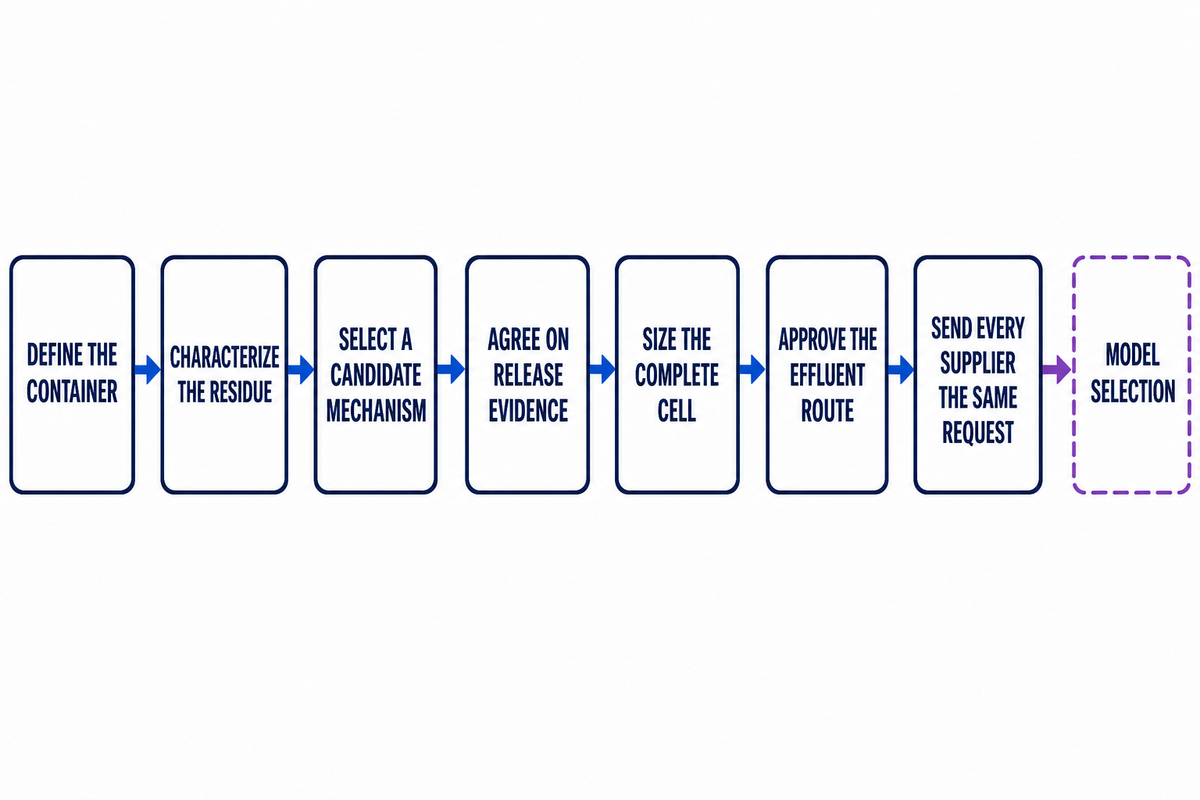
Follow a defensible buying sequence: define the container, characterize the residue, select a candidate mechanism, agree on release evidence, size the complete cell, approve the effluent route, and send every supplier the same request. The hard work is preserving those boundaries when a convenient pressure, cycle-time, or “clean” claim appears.
This guide was prepared from current public regulatory, technical, and first-party sources. Its three named frameworks are editorial buyer aids, not standards, proprietary MassTech methods, or validated outcome models. No MassTech certification, patent ownership, customer result, or universal cleaning performance is asserted.
Check model fit against the completed request
Use the drum envelope, previous contents, worst-case residue, site utilities, wastewater route, target rate, and release test to compare the request with the available solution.
References & Sources
- US EPA, Used Drum Management and Reconditioning
- Electronic Code of Federal Regulations, 40 CFR 261.7, Residues of Hazardous Waste in Empty Containers
- US EPA, Industrial Effluent Guidelines
- US OSHA, 29 CFR 1910.212, General Requirements for All Machines
- EUR-Lex, Regulation (EU) 2025/40 on Packaging and Packaging Waste
- EUR-Lex, Packaging and Packaging Waste from 2026, Official Summary
- ISPE, Cleaning Validation Program Maintenance in a Process Life-Cycle
- Alfa Laval, 30- and 55-Gallon Drum Cleaning Device
- Arcus Cleaning Systems, Vasa Automated Drum Cleaning Case Study
- Electronic Code of Federal Regulations, 49 CFR 173.24, General Packaging Requirements
- US OSHA, 29 CFR 1910.120, Covered Hazardous-Waste Operations
- SRS Engineering, DWC Series Indexed Conveyor Description
- Dempsco, Aqueous Washer Operating Types
- Better Engineering, Rotary Drum Parts Washer Description
- US NIST, Manufacturing Process and Bottleneck Information Model
- Punjab Agricultural University, Horticultural Produce Washing Machine
- Speed Queen Commercial, Washer-Extractor Product Brochure
- Freund, Wheeled and Palletized Bin Washing Cabinet
- Vitro Pharma Machinery, Automatic Rotary Bottle Washer
- Numafa, Industrial Conveyor Crate Washers
- Suncombe, Industrial IBC Washers
- PNR, Fixed Tank Cleaning Heads
WHY WE WRITE THIS
MassTechX publishes practical engineering guides for beverage producers, plant owners, procurement teams, and packaging line buyers who need to compare filling, blowing, labeling, water treatment, and end-of-line equipment with less guesswork. Our goal is to explain the real production constraints behind capacity, liquid type, container format, hygiene requirements, spare parts, and after-sales service before a buyer commits to a bottling line.
ABOUT OUR BUSINESS
Mass Technology is a Zhangjiagang-based beverage filling machine manufacturer in Jiangsu, China. We design and manufacture complete bottling line solutions for water, carbonated drinks, juice, beer, wine, cans, bottle blowing, bottle labeling, water treatment, and related packaging systems. Our published equipment range covers 2,000–36,000 BPH production lines, with deployment experience across 60+ countries.
OUR SERVICES
We support buyers through plant layout design, equipment selection, manufacturing, factory acceptance testing, shipping coordination, on-site installation, operator training, and long-term after-sales service. MassTechX projects are supported by a 2-year warranty, 24-hour engineer response, and 5-working-day international spare parts dispatch commitment.
DATA MATRIX // MANUFACTURER PROFILE
NAMEMass Technology Engineering Team
ROLEBeverage Filling Line Manufacturer
BRAND NAMEMassTechX / Mass Technology
COMPANYZhangjiagang Mass Technology Co., Ltd.
LOCATIONZhangjiagang, Jiangsu, China
CAPACITY RANGE2,000–36,000 BPH
PRODUCT RANGEWater Filling, CSD Filling, Juice Filling, Beer Filling, Wine Filling, Can Filling, Bottle Blowing, Bottle Labeling, Water Treatment
GLOBAL REACH60+ Countries
WARRANTY2 Years
SERVICE SLA24-Hour Engineer Response / 5-Working-Day Spare Parts Dispatch
WEBSITEmasstechx.com