Get in Touch with Masstech

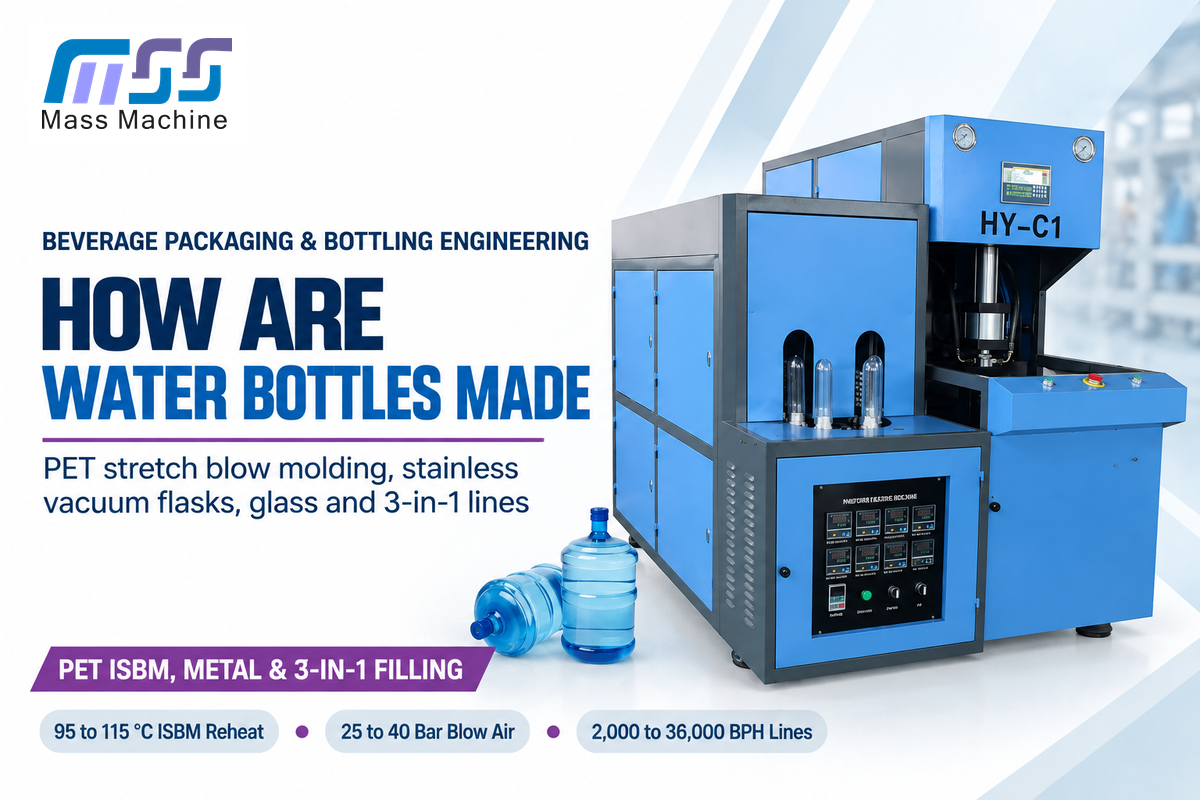
How Are Water Bottles Made? From PET Preform Stretch Blow Molding to Metal, Glass, and High-Speed Bottling Lines

Contents
show
Quick Engineering Summary, How Are Water Bottles Made (TL;DR):
- Disposable PET Plastic Water Bottles: Factories dry food-grade polyethylene terephthalate (PET) resin pellets at 165°C to 175°C for 4 to 6 hours. This step lowers moisture below 50 ppm. Multi-cavity presses then injection-mold the molten resin at 270°C to 285°C into test-tube preforms. Two-stage stretch blow molders reheat those preforms to 95°C to 115°C. A core rod and 25 to 40 bar compressed air expand each bottle in 1.8 to 2.5 seconds.
- Reusable Metal & Glass Water Bottles: Insulated 304 or 316 stainless steel bottles use deep drawing, hydroforming, and inner-wall copper plating. A tailless brazing furnace at 520°C to 980°C and 10-3 Pa vacuum then seals the interlayer. Aluminum bottles use cold impact extrusion with a food-grade liner. Glass bottles are formed at 1,500°C in a press-and-blow machine and subsequently heat treated at 550°C.
- Bottling Line Integration & Unit Cost: Blowing preforms on-site cuts empty-bottle transport volume by a 7:1 ratio. Preform specifications lock in 85% to 90% of container material cost before blowing (per FillerScope), while integrated 0.5 to 50 T/H reverse osmosis (RO) skids feed 2,000 to 36,000 BPH 3-in-1 monoblocks (per MassTech).
How Are Water Bottles Made Step by Step? (PET, Metal, and Glass Overview)
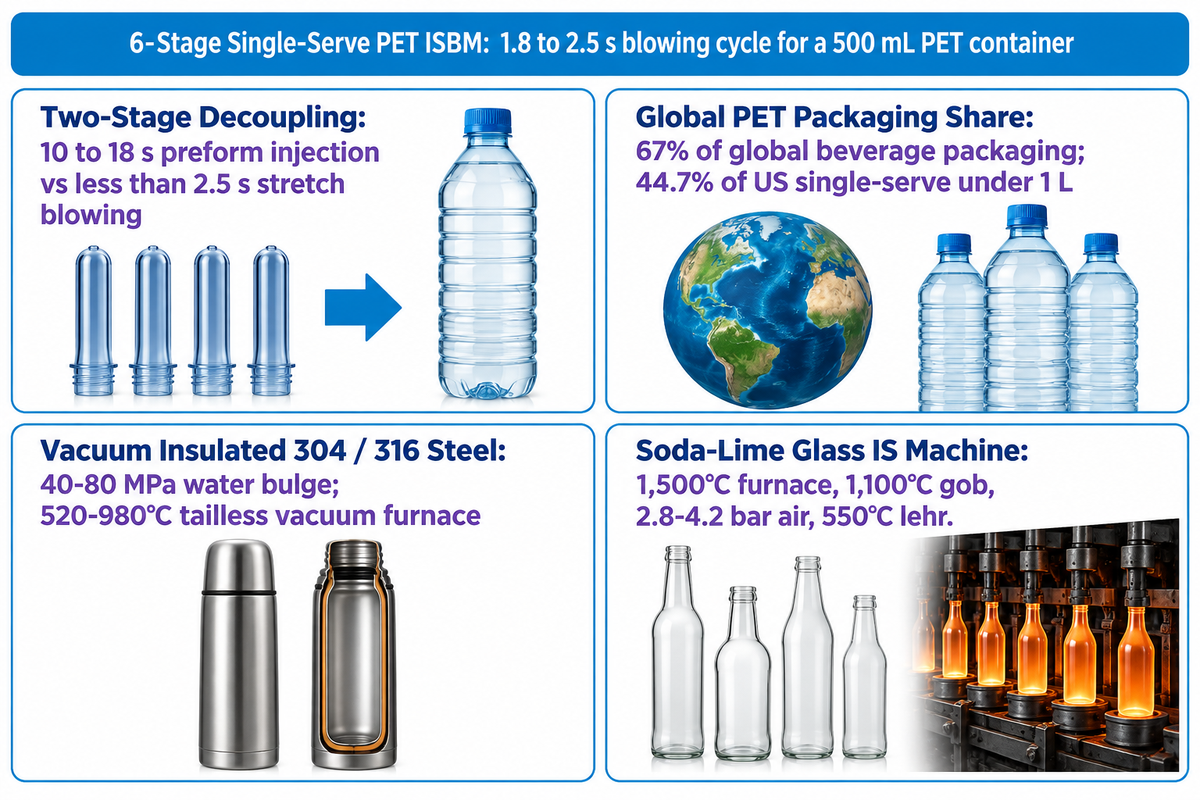
How water bottles are made starts with a 6-stage process that takes 1.8 to 2.5 seconds to blow a 500 mL PET container via a two-stage injection stretch blow molding machine (ISBM) (per FillerScope and ISBT benchmarks). This process also involves thermo-pneumatic stretching of polymers as well as the formation of glass and metal. Plants making water bottles across different types of water bottles rely on distinct thermal transitions to lock in wall strength.
When beverage startups tour our assembly floor at MassTech, buyers often assume one machine turns raw plastic pellets into filled water containers in a single step. In real production, high-speed plants where plastic bottles are made split preform injection molding and stretch blow molding into two stages. Injection molding a thick preform takes 10 to 18 seconds per cycle. Blowing the preform into a finished bottle takes less than 2.5 seconds. Decoupling the production process prevents bottlenecking of a 24,000-bottle-per-hour filling line.
To benchmark the exact factory physics across disposable and reusable drinkware, we developed The 4-Material Bottle Forming Matrix below. According to a peer-reviewed Purdue University and Amcor study on PET beverage packaging, PET accounts for 67% of global beverage packaging. It also represents 44.7% of US single-serve plastic containers under 1 liter. Bulk hydration lines mold high-density polyethylene (HDPE) into a rigid water gallon jug. Office cooler lines instead use polycarbonate (PC) or Tritan dispenser units. Plants form reusable drinkware from aluminum, annealed glass, and stainless steel.
| Bottle Type & Material Grade | Primary Raw Material Feedstock | Core Forming Process | Key Processing Temperature | Forming Pressure / Vacuum | Typical Cycle Time | Unit Weight (500–750 mL) |
|---|---|---|---|---|---|---|
| Single-Serve PET Water Bottle (Resin Code #1) | Virgin PET or rPET pellets (IV 0.72–0.76 dL/g, per FillerScope) | Two-stage injection stretch blow molding (ISBM) | 270–285°C melt; 95–115°C IR reheat | 6–12 bar pre-blow; 25–40 bar final blow | 1.8–2.5 s (blowing) | 9.5–12.5 g (still water) |
| Sparkling Water PET Bottle (Resin Code #1) | High-IV copolymer PET pellets (IV 0.80–0.84 dL/g) | Two-stage ISBM with petaloid base mold | 275–285°C melt; 98–115°C IR reheat | 8–14 bar pre-blow; 35–40 bar final blow | 2.0–2.8 s (blowing) | 18.5–24.0 g |
| 1-Gallon Water Jug (HDPE Resin Code #2) | High-density polyethylene pellets (0.95–0.96 g/cm³) | Continuous extrusion blow molding (EBM) | 175–205°C parison extrusion | 5–8 bar pneumatic parison inflation | 6.0–10.0 s per mold | 55.0–68.0 g (3.78 L jug) |
| 5-Gallon Dispenser Bottle (PC #7 / PET #1) | Polycarbonate or heavy-wall BPA-free PET resin | Single-stage or two-stage heavy stretch blow | 280–310°C (PC) or 275°C (PET) | 12–15 bar pre-blow; 30–38 bar high blow | 25.0–45.0 s per bottle | 680–750 g (18.9 L) |
| Reusable Sports Bottle (PP #5 / Tritan #7) | Polypropylene or Tritan copolyester pellets | Single-stage injection stretch blow molding | 210–240°C (PP); 260–280°C (Tritan) | 10–25 bar single-station blow air | 12.0–20.0 s total cycle | 85.0–145.0 g |
| Vacuum Insulated Flask (AISI 304 / 316 Steel) | 18/8 (304) or 316 stainless steel coil (0.4–0.6 mm) | Deep drawing, hydroforming, laser weld & vacuum braze | 520–980°C tailless vacuum furnace | 40–80 MPa water bulge; 10-3 Pa vacuum | 4–6 h furnace batch | 240–360 g |
| Single-Wall Metal Bottle (AISI 304 Steel) | 304 stainless steel circular sheet blanks | 5-to-7-stage progressive punch press drawing | Cold forming + 1,040°C bright annealing | 100–250 ton mechanical press force | 8.0–15.0 s per press | 130–180 g |
| One-Piece Aluminum Bottle (AA 1070 Alloy) | AA 1070 pure aluminum cylindrical slugs | Cold impact extrusion + neck rotary swaging | Cold punch; 200–230°C internal liner cure | 300–600 ton impact ram force | 0.6–1.2 s per stroke | 65.0–110.0 g |
| Soda-Lime Glass Bottle (Standard Flint Glass) | Silica sand, soda ash, limestone & cullet batch | IS machine press-and-blow + annealing lehr | 1,500°C furnace; 1,100°C gob; 550°C lehr | 2.8–4.2 bar compressed air blow | 4.0–7.0 s per section | 280–420 g |
| Borosilicate Glass Bottle (Thermal-Shock Glass) | Silica sand + boron trioxide (B2O3 thermal-shock batch) | Tubing rotary flame forming or press-and-blow | 1,600–1,650°C melt; 580°C annealing lehr | 2.5–3.5 bar air forming | 6.0–12.0 s per unit | 220–330 g |
There are six sequential factory stages in the production of all single-serve drink lines. These stages include dehumidifying resin drying, multi-cavity preform molding and cooling, infrared oven reheating, biaxial stretch rod blowing, and rinsing, filling and capping.
Stage 1 of Plastic Water Bottles: PET Resin Drying and Preform Injection Molding
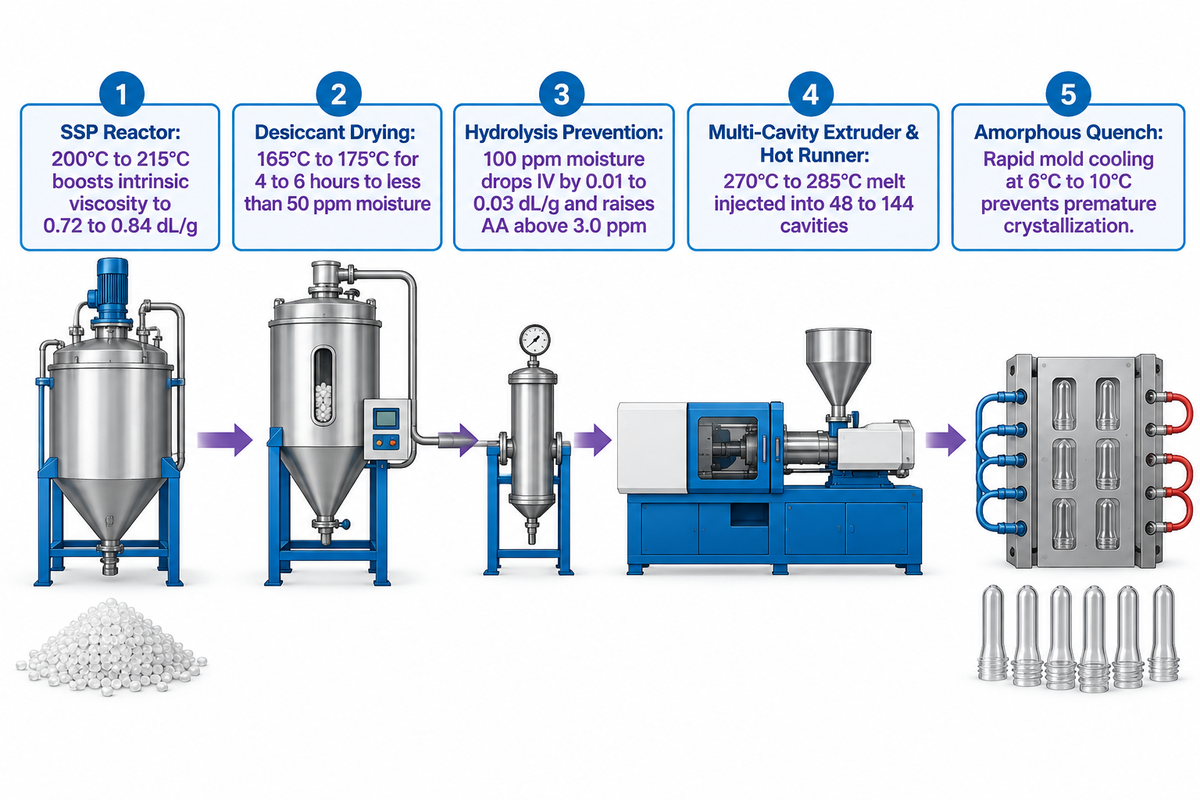
Bottle-grade PET resin pellets must be dried at 165°C to 175°C for 4 to 6 hours to a moisture level of less than 50 ppm, according to ASTM D4603 and FillerScope’s PET preform specification guide. Multi-cavity presses then injection-mold dried resin at 270°C to 285°C into amorphous preforms. Not using this desiccant drying step allows water to break ester linkages inside the extruder screw and reduce bottle strength.
In plant commissioning trials, melting PET resin with even 100 ppm moisture drops intrinsic viscosity (IV) by 0.01 to 0.03 dL/g. Hydrolytic degradation also causes residual acetaldehyde (AA) to increase above 3.0 ppm. High acetaldehyde imparts a fruity, plastic odor and off-taste to still drinking water. Factories use closed-loop molecular-sieve hoppers at a -40°C dew point to remove moisture. Operators hold moisture at 30 to 40 ppm at the throat of the extruder.
“PET is hydrophilic and, therefore, will attract water molecules. Reprocessing moist PET at high temperatures will result in hydrolysis and break the polymer chain.”
Once dried, plastic pellets enter a plasticizing extruder barrel heated to 270°C to 285°C. A servo-hydraulic clamp then melts and injects the material through a balanced valve-gate hot runner system into 48, 72, 96, or 144 water-cooled mold cavities. Rapid cooling at 6°C to 10°C quenches the preform wall in an amorphous, transparent state. Before blowing, crystals can’t grow. For details on balancing hot-runner cavities, see our multi-cavity PET preform injection molding and neck finish design guide.
Common Mistake #1: Mixing 28mm PCO 1881 and PCO 1810 Closures. A 28mm PCO 1881 cap will never seal on a legacy PCO 1810 preform neck. Both finishes measure 28 mm across the outer threads. However, the thread lead and seal-land height differ by 0.5 to 1.0 mm, causing capper jams and transit leaks.
What Is a PET Bottle Made Of?
PET bottle is produced from polyethylene terephthalate, a thermoplastic polyester polymer synthesized by reacting purified terephthalic acid (PTA) with monoethylene glycol (MEG). The specific grade of plastic used in beverage preforms contains a low percentage of isophthalic acid (IPA) comonomer modifier, as per FillerScope. That modifier slows crystallization during preform cooling and reheat blowing. After melt polycondensation, amorphous pellets enter a solid-state polymerization (SSP) reactor at 200°C to 215°C. SSP raises intrinsic viscosity to 0.72 to 0.84 dL/g and strips volatile acetaldehyde so the raw material used to make the bottle meets food safety rules.
Which Material Is Used in a Water Bottle?
The primary material used in a single-serve disposable water bottle is food grade polyethylene terephthalate (PET, resin code #1). Multi-liter jugs, reusable bottles, and their caps, use plastic materials tailored to stiffness and heat resistance. Material engineers distinguish FDA-cleared beverage grades from non-food polymers when evaluating different types of plastic. Plants that process plastics including impact grade acrylonitrile butadiene and styrene are called Appliance molding plants. Optical enclosures and mechanical wear rings rely on cast acrylic sheets and nylon, respectively. Like non-food blow-molded storage containers, Household drums used for storing liquid detergent and Cosmetic shampoo do not pass drinking water migration tests. Virgin or decontaminated resin is a must in vessels used to store purified water and commercial food or beverages.
| Resin / Component | Polymer Chemistry | Intrinsic Viscosity / Density | Target Water Container | Key Processing & Food Safety Notes |
|---|---|---|---|---|
| Still Water PET | Polyethylene terephthalate (#1) | IV 0.72–0.76 dL/g; 1.38 g/cm³ | 330 mL small bottles to 1.5 L water | 9.5–12.5 g preform (500 mL); 26/22 neck weighs 2.0–2.8 g vs 3.5–4.5 g for 28mm PCO 1881. |
| Sparkling Water PET | High-IV copolymer PET (#1) | IV 0.80–0.84 dL/g; 1.38 g/cm³ | Carbonated water & soft drinks | Withstands 4–6 bar carbon dioxide pressure and prevents stress cracking. |
| Food-Grade rPET | Post-consumer recycled PET (#1) | IV 0.60–0.72 dL/g flake (SSP to 0.76) | Food-contact rPET water bottles (per EU Directive 2019/904) | Decontaminated via caustic wash, vacuum extrusion, and SSP per FDA LNO / EFSA. |
| Dairy & Jug HDPE | High-density polyethylene (#2) | Density 0.95–0.96 g/cm³ | 1-gallon water jug & bulk containers | Translucent moisture barrier; molded via continuous extrusion blow molding. |
| Closure PP / HDPE | Polypropylene (#5) or HDPE (#2) | Density 0.90–0.95 g/cm³ | 26/22 & PCO 1881 tethered caps | Compression-molded or injection-molded with tamper-evident security bands. |
| Reusable Tritan / PC | Copolyester / Polycarbonate (#7) | Tg 95–145°C; high impact toughness | 5-gallon cooler dispenser & sports bottles | Durable resin for multi-year reuse; Tritan eliminates bisphenol-A (bpa) concerns at high temperatures. |
Stage 2 of Plastic Water Bottles: Infrared Reheating and Stretch Blow Molding (ISBM)
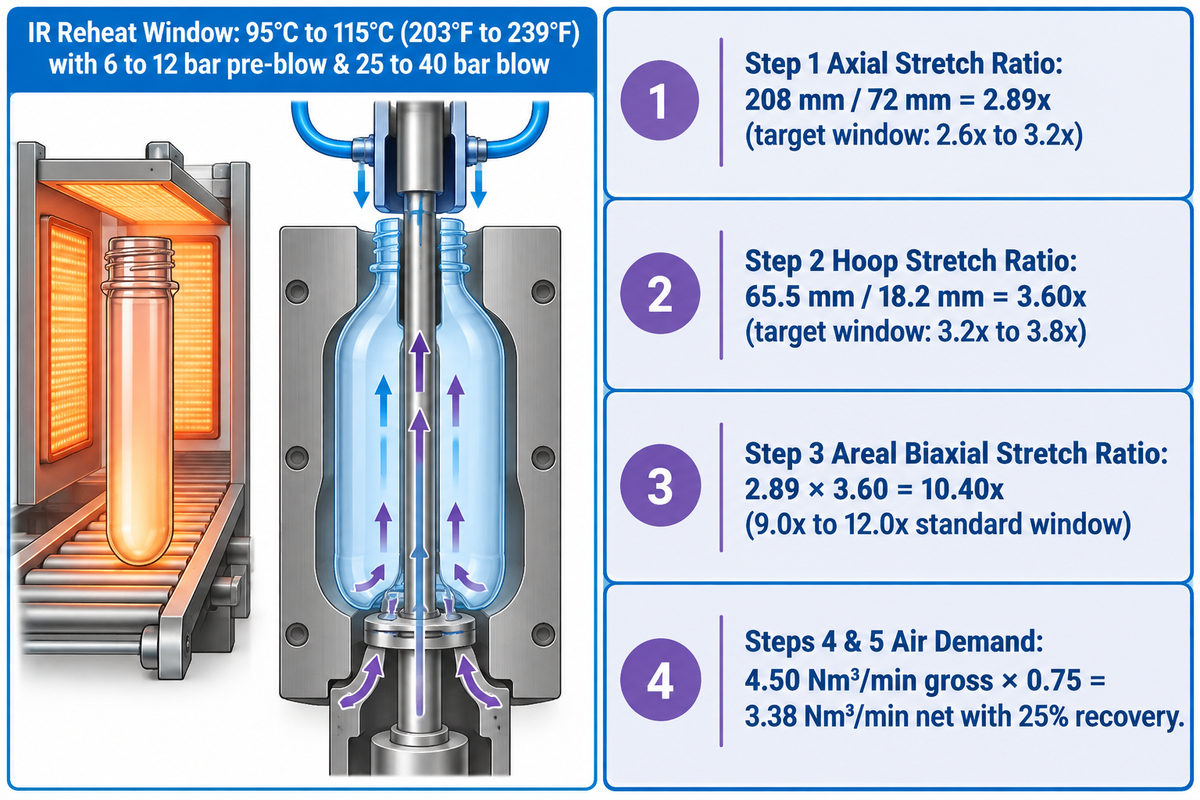
Two-stage stretch blow molding machines reheat cooled PET preforms to a 95°C to 115°C (203°F to 239°F) window, per USPTO Patent US7820257B2. They apply 6 to 12 bar pre-blow air with a stretch rod, followed by 25 to 40 bar (360 to 580 psi) final blow air for a 10.4x areal stretch ratio. Think of a cold PET preform like tangled spaghetti threads. Pulling cold threads snaps them, and melting turns them into soup. Warming them just above their 67°C to 81°C glass transition lets you pull a tight, clear weave.
Inside the blow molding machine, neck-ring mandrels spin each preform past 6 to 10 rows of near-infrared quartz lamps. A water-cooled reflector shield keeps the threaded neck below 55°C so cap threads never deform. We call this narrow conditioning profile The 2-Stage ISBM Thermal Window. According to ISBM process troubleshooting data, temperature differences above 5°C between the outer skin and inner preform wall cause uneven expansion. Closed-loop infrared pyrometer feedback improves wall uniformity by 15% to 20% and cuts drift correction time by 40%.
Next, gripper arms transfer the heated preform into a 7075-T6 aluminum shell mold. A servo-driven steel rod drops at 1.2 to 1.8 m/s to stretch the preform vertically to the base pedicel. Simultaneously, low-pressure pre-blow air (6 to 12 bar) inflates a bubble. That air cushion stops the hot polymer from touching the cold 8°C to 12°C mold wall early. Milliseconds later, 25 to 40 bar high-pressure air forces the PET into the fine ribs and base valleys. Explore our engineering guide to the PET stretch blow molding process for valve-timing charts.
Worked Calculation: The 10.5x Biaxial Stretch-Ratio Rule & 35-Bar Air Demand
Assumed inputs: We blow a 500 mL (0.50 L) still water bottle at 12,000 bottles per hour (200 bottles/min) from a 12.5 g PCO 1881 PET preform. The preform heated body length below the neck support ring is 72 mm, and the mid-wall diameter is 18.2 mm. The final bottle body length below the neck is 208 mm, and the bottle outer diameter is 65.5 mm. High-blow operating pressure is 35 bar gauge (36 bar absolute). The mold dead-space factor is 1.25, and the machine uses a 25% air recovery valve block.
- Axial Stretch Ratio (SRaxial): Divide heated bottle body length by heated preform body length: 208 mm / 72 mm = 2.89x (target window: 2.6x to 3.2x).
- Hoop Stretch Ratio (SRhoop): Divide final bottle diameter by preform mid-wall diameter: 65.5 mm / 18.2 mm = 3.60x (target window: 3.2x to 3.8x).
- Areal Biaxial Stretch Ratio (SRareal): Multiply axial ratio by hoop ratio: 2.89 × 3.60 = 10.40x (matching the 9.0x to 12.0x standard PET window and USPTO US7820257B2 geometry).
- Gross 35-Bar Free Air Consumption: Multiply bottle volume (0.50 L), dead space factor (1.25), absolute pressure ratio (36), and speed (200 bottles/min): 0.50 × 1.25 × 36 × 200 = 4,500 L/min = 4.50 Nm³/min.
- Net Compressor Demand with 25% Air Recovery: Multiply gross air demand by (1 – 0.25): 4.50 × 0.75 = 3.38 Nm³/min of ISO 8573-1 Class 0 oil-free compressed air.
Scope & Application Note: The result sizes the high-pressure booster for standard 500 mL cylindrical molds at sea level. It doesn’t include altitude derating above 1,000 meters, 7-bar actuator air, or heat-set hot-fill blow-back air.
How Reusable Metal, Vacuum-Insulated Stainless Steel, and Glass Water Bottles Are Made
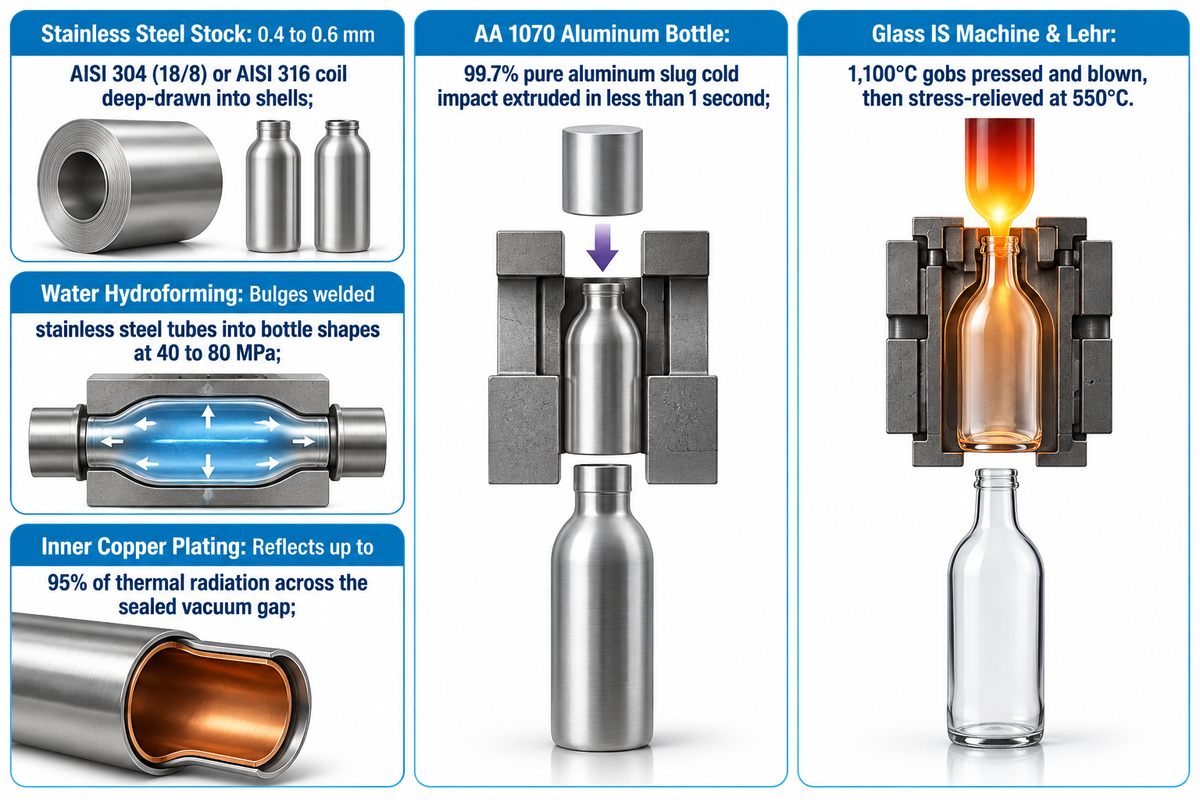
Insulated stainless steel water bottles require a 10 -3 to 10 -4 Pa vacuum sealed at 520°C to 980°C for 4 to 6 hours inside a tailless brazing furnace, per GB/T 29606 and EN 12546-1 standards. Aluminum bottles, on the other hand, are formed by single-stroke cold impact extrusion. Glass bottles, on the other hand, melt silica batch at 1,500°C. Reusable drinkware factories use metal stamping presses, laser welders, and thermal furnaces as opposed to polymer extruders. Unlike injection stretch blow molding (ISBM) for PET bottles, metal and glass container lines rely on mechanical forming and furnace annealing.
To manufacture a double-wall insulated stainless steel bottle, food-grade AISI 304 (18/8) or AISI 316 steel sheets, which are 0.4 to 0.6 mm thick, are first uncoiled. Hydraulic deep-drawing presses then punch circular blanks into cylindrical cups. High-pressure water hydroforming, on the other hand, bulges welded steel tubes to form bottle shapes at 40 to 80 MPa. The inner liner of the bottle, however, receives an electrolytic copper plating. That copper, microscopically thin, acts as a mirror to reflect up to 95% of thermal radiation across the vacuum gap.
The operators insert the inner liner into the outer shell and weld the lip seam at the neck. They then place a brazing solder bead over the bottom evacuation pin hole and load hundreds of flasks into a tailless vacuum furnace. The chamber pumps down to a pressure of 10-3 Pa and heats up to a temperature of 520°C to 980°C to melt the solder plug and create a vacuum. Losing the vacuum above 1 Pa or not plating the walls with copper causes sweat to form on the walls of the flask. This sweat is very problematic for thermal tests as it reduces cold retention from 24 hours to less than 6 hours.
| Manufacturing Dimension | Vacuum-Insulated Stainless Steel (304 / 316) | One-Piece Aluminum Bottle (1070 Pure Alloy) | Soda-Lime & Borosilicate Glass Bottles |
|---|---|---|---|
| Raw Material Stock | 0.4–0.6 mm 18/8 (304) or 316 steel coil | AA 1070 pure aluminum slug disc | Silica sand, soda ash, limestone, and recycled cullet batch |
| Primary Forming Method | Multi-stage deep drawing or water hydroforming + laser seam welding | Cold impact extrusion (300–600 ton ram) + rotary neck swaging | 1,500–1,650°C furnace gob feeder + IS machine press-and-blow |
| Thermal / Vacuum Treatment | 520–980°C tailless vacuum brazing for 4–6 h to 10-3–10-4 Pa | Trichloroethylene-free wash + 200–230°C liner curing oven | 550–580°C annealing lehr for 30–60 min to relieve internal stress |
| Internal Barrier / Coating | Electropolished bare passivated stainless steel (no organic liner) | Mandatory food-grade BPA-NI epoxy or polyamide-imide spray liner | Inert bare glass surface (hot-end tin oxide + cold-end polyethylene lubricity coat) |
| Factory QC Verification | Hot-air thermal imaging (zero exterior warm spots) & helium leak test | Enamel rater electrical conductivity test (<5 mA pinhole check) | Polariscope residual stress check, wall thickness & thermal shock test |
One-piece aluminum water bottles start as coin-shaped slugs of 99.7% pure 1070 aluminum. A high-speed ram pushes a cold metal slug up against a punch in less than 1 second. Bare aluminum comes in contact with acidic beverages and releases corrosion, so every bottle gets an internal BPA-non-Intent (BPA-NI) epoxy or polyamide liner cured at 200°C to 230°C. Glass bottles drop molten 1,100°C glass gobs into an Individual Section (IS) machine where they use a plunger to press the glass and blow air to remove trapped air and moisture. Each glass container then travels through a 550°C annealing lehr so internal stress does not shatter the wall.
Inside the Bottling Plant: Water Purification, Air Conveyors, and 3-in-1 Rinsing-Filling-Capping Lines
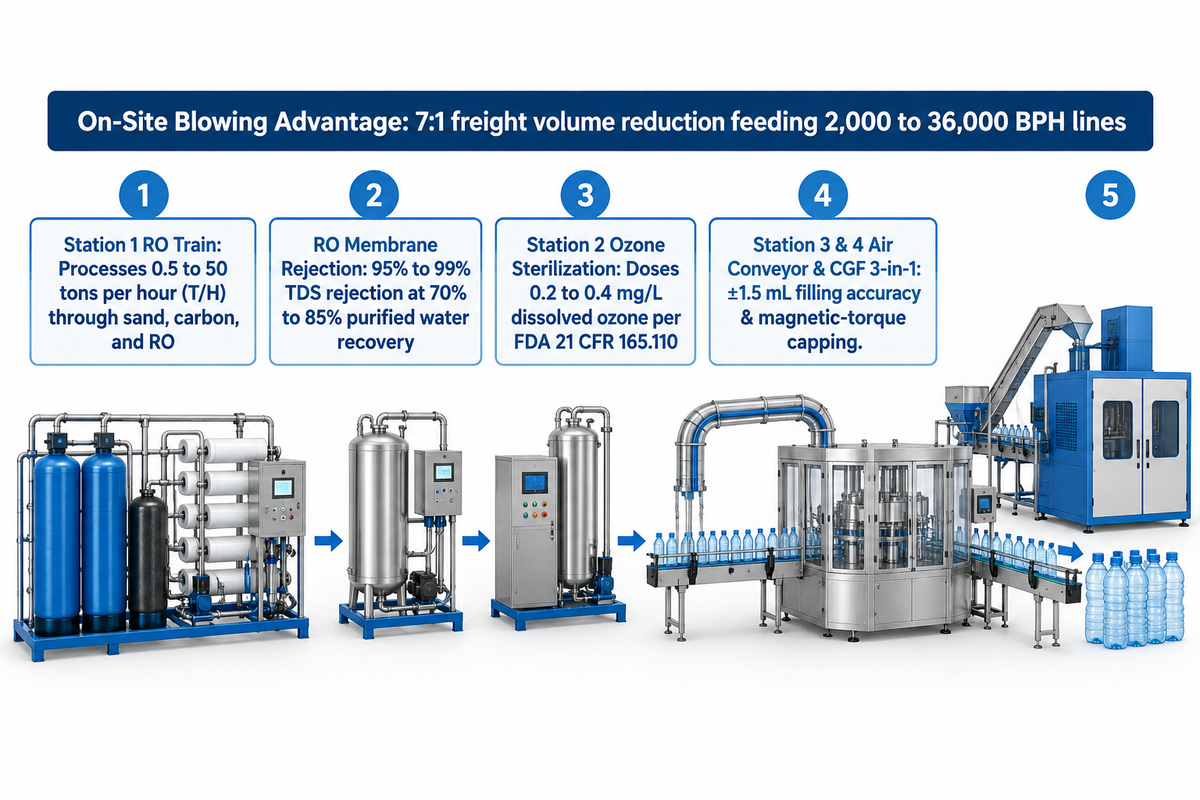
Beverage plants achieve a 7:1 freight volume reduction by shipping compact preforms and blowing them on-site into a 2,000 to 36,000 BPH 3-in-1 CGF monoblock, per MassTech engineering data. The same trailer holds fewer than 100,000 empty pre-blown bottles. Blowing bottles a few minutes prior to filling is more economical than shipping empty container trailer loads to have them blown at the filling line. It also helps maintain the integrity of bottle interiors.
While the blow molder expands preforms, raw source water passes through a multi-stage purification train. MassTech industrial reverse osmosis water treatment systems process 0.5 to 50 tons per hour (T/H) of water through quartz sand filters, activated carbon beds, and spiral-wound RO membranes. Those membranes achieve 95% to 99% total dissolved solids (TDS) rejection at 70% to 85% water recovery. Before filling, an ozone generator doses 0.2 to 0.4 mg/L of dissolved ozone per US FDA 21 CFR 165.110 bottled water standards. Ozone sterilizes both the liquid and the cap interior without leaving chemical residuals.
Blown PET bottles follow neck rings along HEPA-filtered air conveyors, and are loaded into CGF 3-in-1 monoblock machines for rinsing, filling, and capping. Suspending a container by the neck ring allows operators to switch across a range of products (from 330 mL small bottles to 1.5 L bottles) without adjusting guide rails. Inside the ISO Class 7 enclosure, rotary grippers invert bottles for ozonated rinsing. Gravity or flow-meter valves fill to ±1.5 mL, and magnetic-torque heads apply caps before downstream packing into standard 24-pack and 40-pack water bottle case counts and pallet configurations . Before final packing into standard 24 and 40-pack water bottle case counts and pallet configurations, bottles are packed in cartons, and the pallets are stored in a warehouse.
| Bottling Line Station | Core Engineering Function | Operating Specification | Hygiene & Food Contact Standard |
|---|---|---|---|
| 1. Multi-Stage RO + Ozone Skid | Silica sand, activated carbon, precision filter, RO & ozone mixing tower | 0.5–50 T/H capacity; 95–99% TDS rejection; 0.2–0.4 mg/L ozone | AISI 304 / 316L sanitary tubing; FDA 21 CFR 165.110 compliance |
| 2. Two-Stage PET Stretch Blower | Infrared preform conditioning + biaxial rod/air stretch blowing | 2,000–36,000 BPH; 95–115°C oven; 25–40 bar oil-free air | ISO 8573-1 Class 0 oil-free air; closed-loop chilled mold water |
| 3. Neck-Ring Air Conveyor | High-velocity air-cushion transport from blower to filler starwheel | Supports 26/22 and 28mm PCO 1881 neck rings at 1–3 m/s | 304 stainless air duct with G4/F8 intake air filtration |
| 4. CGF 3-in-1 Monoblock | Synchronized rotary bottle rinsing, filling, and screw capping | 18-18-6 up to 72-72-18 valves; magnetic torque 0.8–2.2 Nm | AISI 316L liquid contact parts; ISO Class 7 laminar HEPA hood |
| 5. Labeling & Case Packing | Roll-fed OPP hot-melt or PVC/PETG shrink sleeve + film wrapper | Laser batch coding + PE shrink tunnel (165–185°C) or carton packer | Optical cap-height, fill-level, and label-presence rejection sensors |
One-Stage vs. Two-Stage Blow Molding and Linear vs. Rotary Equipment Selection
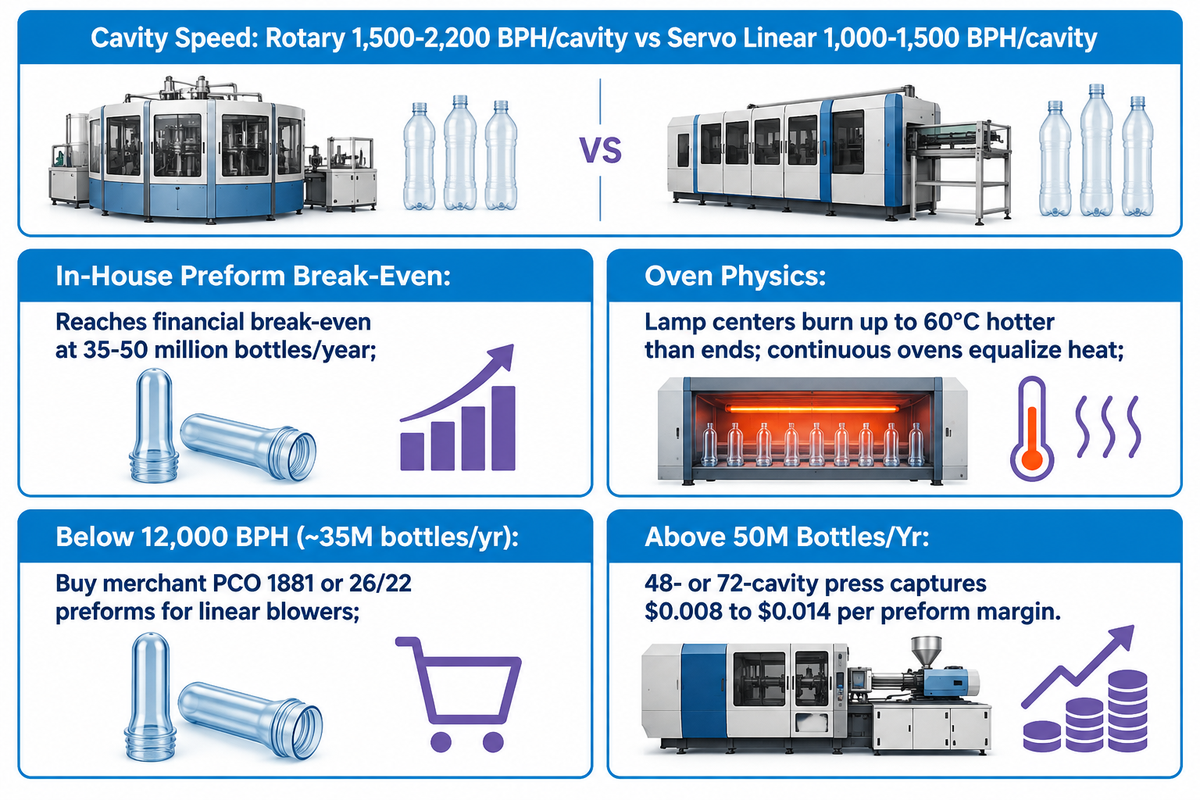
Rotary stretch blow molders can produce between 1,500-2,200 BPH per cavity compared to 1,000-1,500 BPH per cavity by servo linear blowers, according to SpecialChem’s rotary vs. linear engineering guide. Preform injection molding can reach financial break-even at 35-50 million bottles per year in house, according to MassTech line sizing audits. Using the wrong blowing architecture can either starve the filling monoblock or lock up six-figure capital in idling injection presses.
According to practitioner analysis on SpecialChem and engineering tooling discussions, rotary blow molders cost roughly twice as much as linear machines of equal cavitation. Traditional indexing linear ovens heat preforms in stationary groups of 2 to 8. Because infrared lamp centers burn up to 60°C hotter than lamp ends, outer cavities in an indexing oven receive less heat and blow uneven walls. Continuous-motion linear ovens solve this by moving every preform past every lamp at constant speed. Selecting neck-up linear transport for necks under 33 mm also eliminates the 4-cylinder preform inverter that causes most mechanical jam-ups.
We refer to this capacity trade off as The 12,000-BPH Blow-vs.-Buy-Preform Crossover . Below approximately 12,000 BPH (or approximately 35 million bottles per year on a single shift) purchasing merchant PCO 1881 or 26/22 preforms is more economical. Blow Molding plants blow them on fully automatic linear and rotary PET bottle blowing machines. Above approximately 50 million bottles per year, a 48- or 72-cavity preform press captures a converter margin of $0.008 to $0.014 per preform.
| Plant Scenario & Line Speed | Recommended Machinery Architecture | Preform Supply Strategy | Output per Cavity | Mold Changeover Time | Typical Blower / Press CAPEX | Primary Engineering Trade-Off |
|---|---|---|---|---|---|---|
| Startup / Local Brand (1,000–2,500 BPH) | 2-cavity semi-automatic or basic servo linear two-stage blower | Buy 100% merchant preforms | 800–1,200 BPH/cav | 25–40 minutes | Requires a custom quote (varies by cavities & servo tier) | Lowest entry cost; higher labor per 1,000 bottles |
| Regional Water Line (4,000–6,000 BPH) | 4-cavity continuous-oven servo linear two-stage blow molder | Buy merchant PCO 1881 / 26/22 preforms | 1,200–1,500 BPH/cav | 30–45 minutes | Requires a custom quote (varies by cavities & servo tier) | Fast SKU switches across 330 mL, 500 mL, and 1.5 L |
| Mid-Speed Multi-SKU Line (8,000–12,000 BPH) | 6- to 8-cavity high-speed servo linear two-stage blow molder | Buy preforms (or toll-mold with local converter) | 1,300–1,600 BPH/cav | 45–60 minutes | Requires a custom quote (varies by cavities & servo tier) | Half the CAPEX of a rotary blower at 12,000 BPH |
| High-Speed Dedicated Line (16,000–24,000 BPH) | 10- to 14-cavity rotary two-stage stretch blow molder | In-house 48/72-cavity preform press (>45M bottles/yr) | 1,800–2,200 BPH/cav | 90–150 minutes | Requires a custom quote (varies by cavities & servo tier) | Superior wall uniformity on sub-9.5 g ultralight preforms |
| Mega Bottling Complex (30,000–48,000+ BPH) | 16- to 24-cavity rotary Blow-Fill-Cap Combiblock | Dedicated in-house 96/144-cavity preform hall | 2,000–2,400 BPH/cav | 120–180 minutes | Requires a custom quote | Eliminates air conveyors and empty-bottle rinsers |
| 3- to 5-Gallon Bulk Line (150–1,200 BPH) | 1- or 2-cavity heavy-preform linear stretch blow molder | Buy 320–750 g heavy PET preforms | 90–450 BPH/cav | 45–75 minutes | Requires a custom quote (varies by cavities & servo tier) | Extended infrared soak zones for 4.5–8.0 mm thick walls |
| Cosmetic / Wide-Mouth Jar (1,500–4,000 BPH) | Single-stage injection stretch blow molding (ISBM) machine | Direct resin pellet-to-bottle on 1 rotary carousel | 250–600 BPH/cav | 180–240 minutes | Requires a custom quote (varies by cavities & servo tier) | Pristine blemish-free surface; slow injection cycle limits BPH |
| Hot-Fill Juice / Tea Bottle (6,000–18,000 BPH) | Heat-set linear or rotary blower (oil-heated 110–140°C molds) | High-IV (0.78–0.84 dL/g) heavy PET preforms | 900–1,600 BPH/cav | 60–120 minutes | Requires a custom quote (varies by cavities & servo tier) | Heat-set crystal orientation resists 85–92°C hot filling |
| 1-Gallon HDPE Water Jug (1,200–3,600 BPH) | Continuous shuttle or wheel extrusion blow molder (EBM) | Direct HDPE pellet extrusion parison (no preform) | 300–600 BPH/cav | 60–90 minutes | Requires a custom quote (varies by cavities & servo tier) | Forms integral pinched handle; automatic flash deflashing |
Quality Control, Laboratory Testing, and Common Bottle Manufacturing Defects
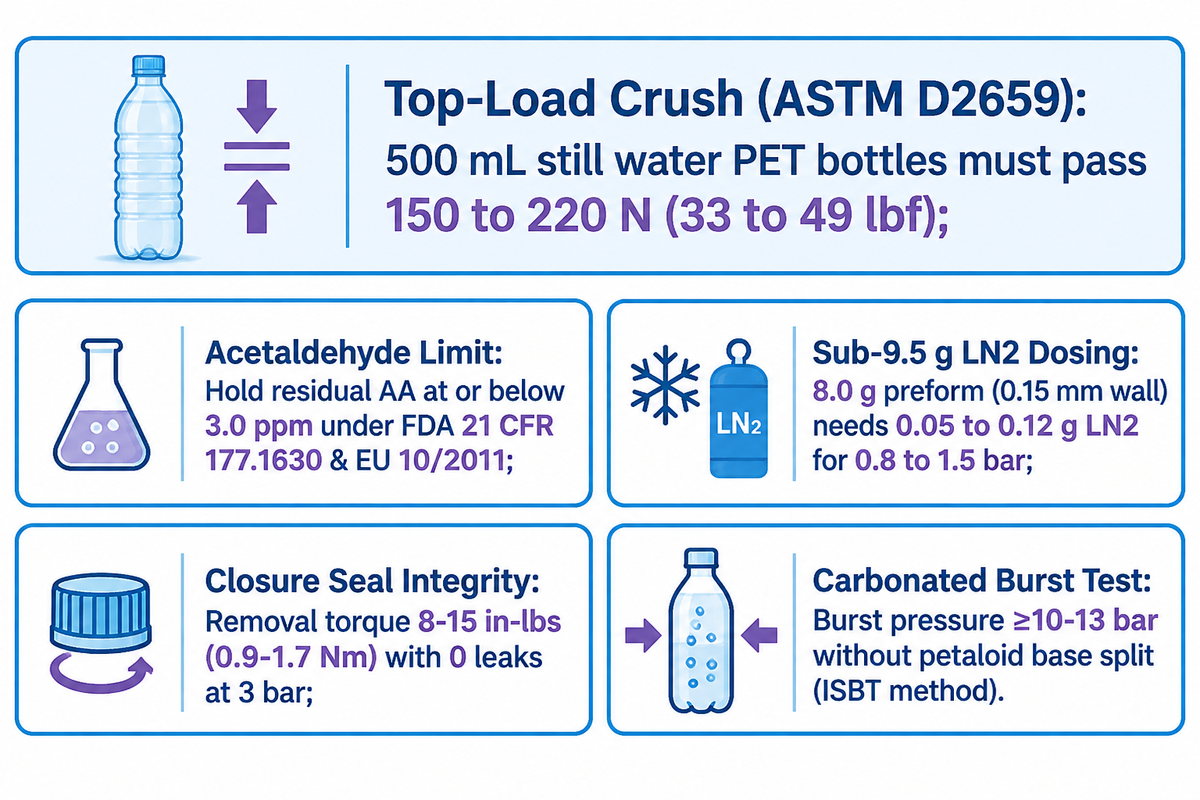
Commercial 500 mL still water PET bottles must pass a vertical top-load crush resistance of 150 to 220 N (33 to 49 lbf) per ASTM D2659. They must also hold residual acetaldehyde at or below 3.0 ppm under US FDA 21 CFR 177.1630 and EU Regulation 10/2011 food-contact standards. Without inline vision inspection and destructive lab testing, minor infrared lamp drift or mold condensation turns into pallet collapse during summer warehouse stacking.
Common Mistake #2: Lightweighting Below 9.5 g Without Liquid Nitrogen Dosing. Dropping a 500 mL still water preform from 12.0 g to 8.0 g cuts minimum wall thickness to 0.15 mm. Operators must dose 0.05 to 0.12 g of liquid nitrogen (LN2) before capping to create 0.8 to 1.5 bar internal pressure. Otherwise, ultra-light bottles suffer vacuum paneling and bottom-layer carton crushing.
Troubleshooting articles by Plastics Technology note that most structural and visual defects in PET stretch-blown bottles are traced to preform heating and/or pre-blow times. The table below provides the 10 most common production defects, their physical causes, and the acceptance limits set by the laboratory.
| Defect / QC Parameter | Visual or Physical Symptom | Root Cause in Molding or Blowing | Corrective Machine Adjustment | ASTM / ISBT Lab Acceptance Standard |
|---|---|---|---|---|
| 1. Pearlescence (Stress Whitening) | Milky white rings on the inside bottle wall | Preform blown too cold (<90°C) causing micro-voids during stretching | Raise IR lamp zone output or delay pre-blow pressure start (per ISBM Machine) | Zero visible pearlescence; uniform wall profile (per ISBM Machine) |
| 2. Thermal Crystallization Haze | Cloudy, brittle patches on the outer bottle surface | Preform overheated (>118°C) in IR oven or insufficient cooling airflow | Lower IR lamp percentage and increase oven exhaust fan speed | Optical clarity verified via light-transmission inspection (per FillerScope) |
| 3. Off-Center Base Gate | Injection gate dimple shifts off the base center axis | Stretch rod misaligned, worn rod tip, or uneven preform circumferential temperature | Re-center stretch rod to mold base cup and verify mandrel rotation | Gate eccentricity ≤1.5 mm from base geometric center |
| 4. Thin Shoulder / Heavy Base | Top shoulder collapses easily while base feels thick | Pre-blow pressure too low or delayed; material dragged to base by rod | Advance pre-blow valve timing by 15–30 ms and increase Zone 1–2 heat | Section weight distribution within ±0.4 g of target spec |
| 5. Rocker Bottom (Base Bulge) | Bottle rocks on flat conveyor after ejection | Base pedicel insufficiently cooled or high-blow exhaust opened early | Drop base mold cooling water to 8–10°C and extend high-blow hold 0.1 s | Base clearance ≥1.5 mm; perpendicularity ≤1.8 mm |
| 6. Post-Fill Vacuum Paneling | Sidewalls suck inward 24–72 hours after capping | Warm water fill cooled in sealed bottle, or oxygen headspace permeation | Add 0.05–0.12 g liquid nitrogen dosing or deepen circumferential ribs | Top-load crush ≥150–220 N per ASTM D2659 |
| 7. Acetaldehyde (AA) Off-Taste | Sweet, fruity odor detectable in still drinking water | PET dried above 50 ppm moisture or barrel melt exceeded 285°C | Verify dryer -40°C dew point, reduce screw RPM, and lower nozzle heat | Preform headspace AA ≤3.0 ppm (per FillerScope & ISBT) |
| 8. Cap Thread Leak / Stripping | Water weeps past closure seal during drop or squeeze test | Neck overheated (>55°C) in IR oven or mismatch between 1881/1810 cap | Increase neck shield chilled water flow and calibrate capper torque | Removal torque 8–15 in-lbs (0.9–1.7 Nm); 0 leaks at 3 bar |
| 9. Mold Sweat Marks | Water droplet dimples stamped into bottle exterior | Chilled mold temperature (8–10°C) is below factory ambient dew point | Enclose blow clamp with dry dehumidified air curtain or raise water 2°C | 100% pass on inline high-speed camera surface inspection |
| 10. Carbonated Burst Failure | Petaloid foot splits under internal CO2 pressure | Low resin IV (<0.80 dL/g) or under-stretched amorphous base valley | Switch to 0.80–0.84 dL/g CSD resin and calibrate stretch rod cushion | Burst pressure ≥10–13 bar without base split (ISBT method) |
How Much Does It Cost to Make a Water Bottle and Set Up a Bottling Line?
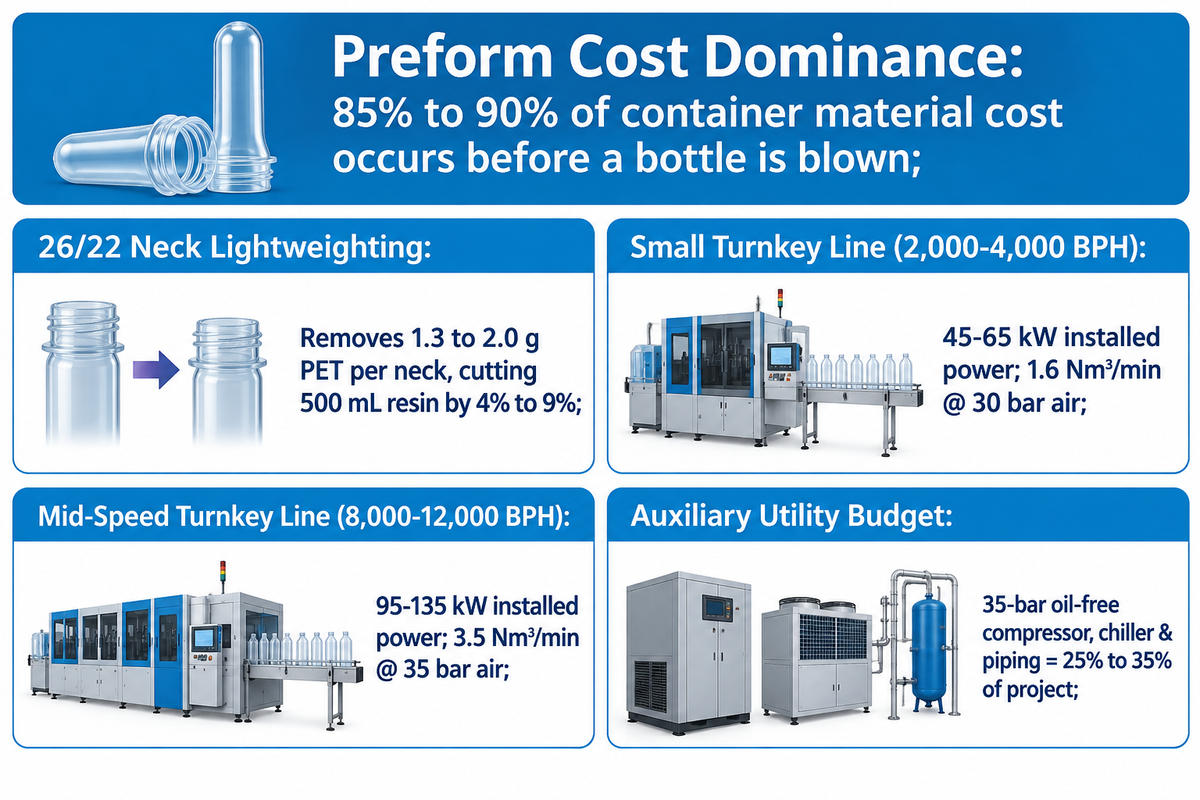
As mentioned in FillerScope’s PET preform specification guide, 85% to 90% of the container cost occurs before a single bottle is blown. Complete 2,000 to 36,000 BPH turnkey water bottling lines integrating 0.5 to 50 T/H reverse osmosis skids require a custom quote, according to MassTech engineering specifications. The same applies to multi-stage insulated 304 stainless steel bottle lines.
Raw resin weight dominates plastic bottle economics. According to FillerScope’s PET preform specification guide, preform specification sets 85% to 90% of the container material cost before blowing. Switching from a 28 mm finish to a 26 mm lightweight neck removes 1.3 to 2.0 g of PET per neck, cutting resin by 4% to 9% on a 500 mL bottle (per FillerScope). According to NAPCOR’s 2025 report via Packaging Dive, trimming single-serve bottle preforms from 21 g to 18.5 g saved the equivalent of 800 million bottles of virgin plastic in 2025.
| Cost Component | Technical Specification | Low-Volume Line (2,000–4,000 BPH) | High-Speed Line (12,000–24,000 BPH) | Share of Unit Cost |
|---|---|---|---|---|
| 1. PET Preform | 9.5–12.5 g virgin PET or 25% rPET blend | Requires a custom quote (merchant preform index) | Requires a custom quote (in-house resin + SSP index) | 85%–90% of container material cost (per FillerScope) |
| 2. HDPE / PP Closure | 1.1–1.85 g 26/22 or 28mm PCO 1881 cap | Requires a custom quote (by cap weight 1.1–1.85 g) | Requires a custom quote (servo wrapper automation) | Included in non-preform packaging share (per FillerScope) |
| 3. Bottle Label | 35–45 micron BOPP wrap-around or PVC/PETG sleeve | Requires a custom quote (BOPP vs shrink sleeve) | Requires a custom quote (roll-fed OPP volume) | Included in non-preform packaging share (per FillerScope) |
| 4. RO Water & Blowing Energy | 0.5 L RO/ozonated water + IR oven & 35-bar air kWh | Requires a custom quote (local kWh & water tariff) | Requires a custom quote (with VFD & air recovery) | Utility operating cost (varies by local kWh tariff) |
| 5. Secondary Case Film & Labor | PE shrink film (50–70 micron) + line operators | Requires a custom quote (PE film gauge & shift wage) | Requires a custom quote (servo wrapper automation) | Secondary packaging & labor share |
| Total Ex-Factory Unit Cost | Finished 500 mL Bottled Water | Requires a custom quote (resin + utility BOM) | Requires a custom quote (high-speed in-house BOM) | 100% |
Which Manufacturers Supply Complete PET Water Bottle Blowing, Rinsing, Filling, and Capping Lines?
There are two tiers in the equipment market for the complete PET water bottle blowing and filling lines. The first tier includes the high-speed integrators from Europe and Japan such as Sidel, Krones, KHS, SIPA and Nissei ASB. The second tier includes specialized turnkey CGF 3-in-1 manufacturers from Zhangjiagang Mass Technology Co., Ltd. (MassTech) in China. European rotary combiblocks serve mega-plants running 36,000 to 80,000+ BPH. MassTech engineers integrated 2,000 to 36,000 BPH lines with 0.5 to 50 T/H RO water treatment, servo blowers, air conveyors and CGF monoblocks at competitive factory-direct budgets (custom quote by line speed) as per MassTech.
| Plant Capacity Tier | Core Machinery Scope | Power & 35-Bar Air Utility | Typical Equipment Budget (FOB) | Representative Manufacturers |
|---|---|---|---|---|
| Small Turnkey Line (2,000–4,000 BPH) | 2–4T/H RO skid + 2–4 cav linear blower + CGF 14-12-5 filler + labeler + PE wrapper | 45–65 kW installed; 1.6 Nm³/min @ 30 bar | Requires a custom quote (configured by RO & filler valves, per MassTech) | MassTech (masstechx.com) |
| Mid-Speed Turnkey Line (8,000–12,000 BPH) | 10T/H RO skid + 6–8 cav servo linear blower + CGF 24-24-8 / 32-32-10 filler + OPP labeler | 95–135 kW installed; 3.5 Nm³/min @ 35 bar | Requires a custom quote (configured by blower cavities, per MassTech) | MassTech, SIPA, KHS |
| High-Speed Turnkey Line (18,000–36,000 BPH) | 20–30T/H double-RO + rotary blower + CGF 50-50-15 / 72-72-18 filler + servo wrapper | 180–280 kW installed; 7.5–12 Nm³/min @ 35 bar | Requires a custom quote (configured by rotary valves & RO stage, per MassTech) | MassTech, Sidel, Krones, KHS |
When budgeting for a new plant, omitting the 35-bar oil-free air compressor, water chiller, and transformer piping would underestimate total project expenditures by 25% to 35%. Use the procurement checklist below when requesting formal quotes from machinery manufacturing companies.
Buyer RFQ Specification Checklist for a Turnkey Water Bottling Line
- Target Bottle Volumes & Drawings: Specify exact bottle volumes (330 ml, 500 ml, 1.5 L), bottle diameter, height and preform gram weight (9.5 g to 24 g).
- Neck Finish Standard: Confirm whether preforms and caps use 28mm PCO 1881, 26/22 short-neck, or EU EN 17665 tethered closures.
- Rated line speed (BPH): state desired output in bottles per hour at 500 mL reference size, and planned shift hours per day.
- Report of analysis of raw water: provide TDS and hardness of raw water to size single or double stage RO membranes.
- Liquid Contact & Utility Standards: Specify AISI 304 vs. AISI 316L stainless steel contact surfaces, factory voltage/frequency (e.g., 380V/50Hz or 480V/60Hz), and 35-bar air recovery inclusion.
What Is Changing in Water Bottle Manufacturing (2025–2026 Industry Outlook)
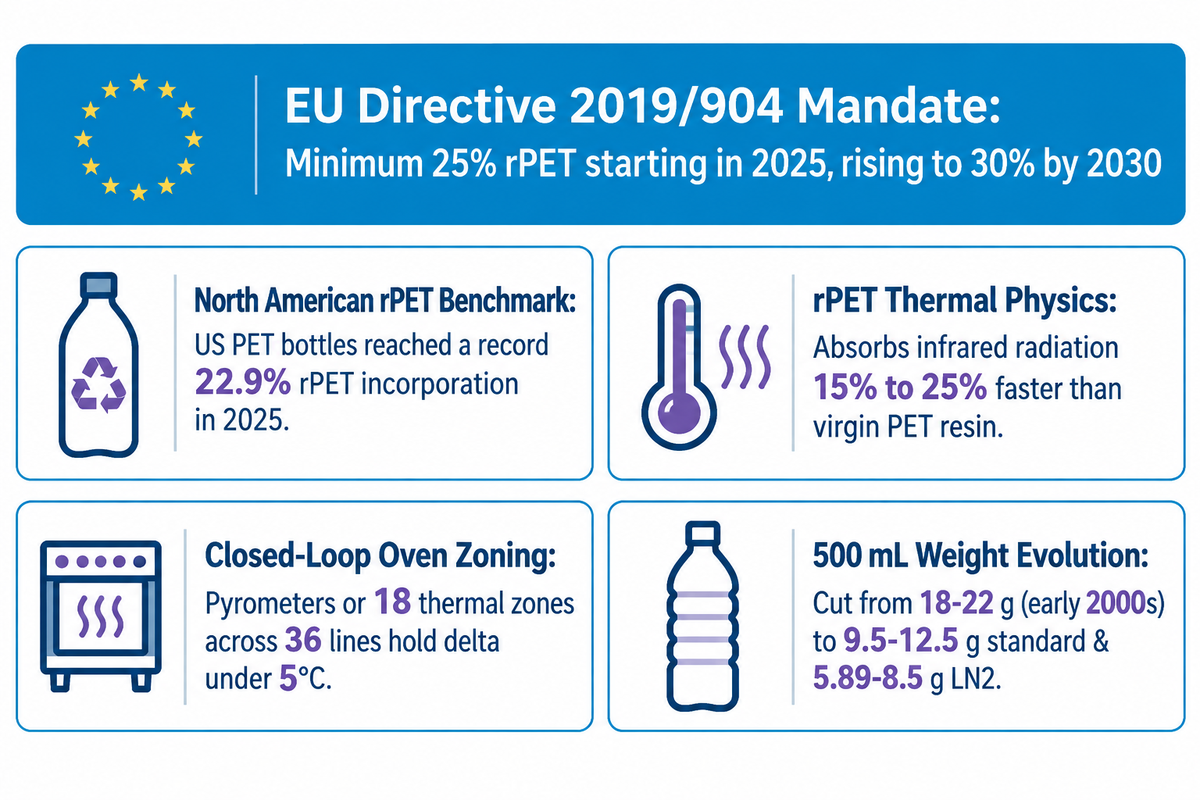
A minimum 25% recycled PET (rPET) content is mandated across the European Union starting in 2025 (rising to 30% by 2030) under EU Single-Use Plastics Directive (EU) 2019/904 and Decision (EU) 2026/1425. Meanwhile, US PET bottles reached a record 22.9% rPET incorporation in 2025, per NAPCOR’s 2025 PET Recycling Report. These reforms and the push for greater sustainability will impact how OEMs specify capping heads and sorting lines.
Running 25% to 100% post-consumer rPET preforms on legacy open-loop blow molders causes frequent haze and wall-thickness drift. Because rPET contains microscopic residual colorants and reheat additives, it absorbs infrared radiation 15% to 25% faster than virgin PET. Modern blow molders counter this with closed-loop infrared pyrometers or Sidel’s EvoBLOW diode-laser oven system featuring 18 thermal zones across 36 commercial lines. Those controls hold the preform inner-to-outer temperature delta under 5°C. At the same time, NAPCOR’s 2025 report warned that extreme lightweighting creates a recycling trade-off. Ultra-light bottles flatten easily on municipal recovery facility (MRF) conveyors, causing optical air-jets to mistakenly blow lightweight PET bottles into the paper stream.
When Did Plastic Water Bottles Become Popular and How Have Weights Changed?
Plastic water bottles became commercially popular after Nathaniel Wyeth patented the biaxially oriented PET beverage bottle in 1973, replacing heavy glass containers by the late 1980s. Over the past two decades, finite-element preform redesign and short-neck finishes have cut the weight of a 500 mL still water bottle by nearly 50%. Early 2000s 500 mL PET bottles weighed 18 to 22 grams. By 2025, standard commercial preforms weigh 9.5 to 12.5 grams, and ultra-light nitrogen-dosed designs reach 5.89 to 8.5 grams. Major beverage companies cut the wall of single serve bottles from 21 grams to 18.5 grams, eliminating 800 million bottles worth of virgin plastic in 2025.
| 2025–2026 Industry Driver | Verified Quantitative Benchmark | Required Blow Molder & Filling Line Upgrade |
|---|---|---|
| EU 2019/904 & Decision 2026/1425 rPET Mandate | 70% of EU marine litter is single-use plastics & fishing gear across 10 target items, per EU Directive (EU) 2019/904 | Install closed-loop IR pyrometer feedback or laser oven zoning to handle faster rPET heat absorption |
| North American rPET Growth (NAPCOR 2025) | US bottle rPET content rose from 20.7% (2024) to 22.9% (2025), while US recycling rate was 29% vs 30.2% in 2024, per NAPCOR / Packaging Dive | Upgrade desiccant dryers and IV monitoring for 0.60–0.76 dL/g blended rPET preforms |
| Mandatory Tethered Closures (EN 17665) | Caps must remain attached to containers ≤3.0 L across EU markets (26/22 & PCO 1881 tethered bands) | Retrofit CGF monoblock cap chutes, pick-and-place stars, and magnetic torque heads for hinged bands |
| Sub-9.5g Lightweighting + LN2 Dosing | 500 mL still water preforms reduced to 7.5–9.5 g (5.89 g ultralight limit) + 0.05–0.12 g LN2 | Mount vacuum-insulated liquid nitrogen micro-doser between filling starwheel and capper |
Frequently Asked Questions
How Is Plastic Made Before It Becomes a Water Bottle Preform?
Bottle-grade polyethylene terephthalate (PET) plastic is produced through a two-stage chemical polymerization process from refined crude oil and natural gas hydrocarbons. Those pellets then enter a solid-state polymerization (SSP) reactor at 200°C to 215°C to boost intrinsic viscosity to 0.72–0.84 dL/g and strip residual acetaldehyde before preform molding.
Why Are Plastic Water Bottles Molded as Preforms First Instead of Blown Directly?
Molding thick test-tube preforms first via injection molding lets factories form the threaded neck finish (28mm PCO 1881 or 26/22) to ±0.05 mm sealing tolerances while keeping the body amorphous. Reheating the preform to 95°C to 115°C and axial and radial stretching, orients the polymer chains in a cross linked, mesh-like structure. This reduces freight volume by a factor of 7:1 and improves gas barrier properties, and clarity.
Are Water Bottles Made and Filled in the Same Factory?
Typically, molding and bottle blowing/filling occur at separate facilities. Dedicated plastics converters run 72- to 144-cavity injection presses 24 hours a day to mold millions of compact preforms and ship them in bulk octabins. The beverage bottling plant has an on-site bottle blowing/filling facility where the preforms are expanded. Enclosed air conveyors transport the bottles to a 3-in-1 monoblock which performs rinsing, filling, and capping.
How Do You Calculate Stretch Ratios and High-Pressure Compressed Air Consumption for a PET Blow Molder?
To determine the actual areal biaxial stretch, multiply the hoop stretch ratio by the axial stretch ratio (9.0x to 12.0x for standard PET). The axial stretch equals the final bottle body length to the heated preform body length (2.6x to 3.2x). The hoop stretch equals bottle outside diameter to preform mid-wall diameter (3.2x to 3.8x). To size the 30-to-40-bar air compressor, multiply total mold volume by the dead-space factor (1.25), absolute pressure ratio, and blowing speed in bottles per minute. Variable frequency drives on air compressors also reduce bottle wall thickness variation by up to 20%, per ISBM Machine engineering data.
What Temperature Is Used to Blow Mold PET Water Bottles?
PET preforms are injection-molded at 270°C to 285°C (518°F to 545°F) and cooled to room temperature. Blow molders then reheat them in an infrared oven to 95°C to 115°C (203°F to 239°F) right before stretching.
Can 100% Recycled PET (rPET) Be Used to Manufacture New Water Bottles?
Yes, post-consumer PET bottles that pass hot caustic washing, optical flake sorting, vacuum extrusion decontamination, and solid-state polycondensation (SSP) under US FDA or European EFSA food-contact approvals can be molded into 100% rPET preforms. Because rPET absorbs infrared heat 15% to 25% faster than virgin resin, blow molders use closed-loop pyrometers to prevent thermal haze and microplastics shedding.
References & Sources
- Benyathiar, P.; Kumar, P.; Carpenter, G.; Brace, J.; Mishra, D. K. (Purdue University & Amcor Rigid Packaging). Polyethylene Terephthalate (PET) Bottle-to-Bottle Recycling for the Beverage Industry: A Review. NIH PubMed Central (PMC9231234). https://pmc.ncbi.nlm.nih.gov/articles/PMC9231234/
- Single-Use Plastics Directive (EU) 2019/904 and Commission Implementing Decision (EU) 2026/1425 on Recycled Plastic Content in Beverage Bottles published by the European Commission Directorate General for Environment. https://environment.ec.europa.eu/topics/plastics/single-use-plastics_en
- United States Patent and Trademark Office (USPTO). Patent US7820257B2: Preforms for preparing lightweight stretch blow molded PET copolymer containers and methods for making and using same (The Coca-Cola Company & Plastic Technologies, Inc.). https://patents.google.com/patent/US7820257B2/en
- FillerScope Packaging Engineering Reference. PET Preform Specification Guide: Intrinsic Viscosity, Drying Moisture Limits, and Neck Finish Standards (PCO 1881 vs. 26/22). https://www.fillerscope.com/pet-preform-specification-guide/
- Packaging Dive / National Association for PET Container Resources (NAPCOR). NAPCOR 2025 PET Recycling Report: US Bottle rPET Content Reaches 22.9% Amid Lightweighting Shifts. https://www.packagingdive.com/news/napcor-pet-recycling-rate-2025-drop-recycled-content-bottle-thermoforms/874370/
- SpecialChem Plastics Engineering Guide (OTT Consulting). Rotary or Linear Stretch Blow Molding Machines: Equipment Selection & Oven Heating Physics. https://www.specialchem.com/plastics/guide/rotary-or-linear-that-is-the-question
- ISBM Machine Engineering Resources. How to Fix Frequent Issues in the Stretch Blow Molding Process (Pearlescence, Haze, and Closed-Loop Heating). https://isbmmachine.net/resources/how-to-fix-frequent-issues-in-the-stretch-blow-molding-process/
- U.S. Federal Science Portal (Science.gov). US FDA 21 CFR 177.1630 (Polyethylene Phthalate Polymers) & 21 CFR 165.110 (Bottled Water Quality Standards). https://www.science.gov/topicpages/p/polytrimethylene+terephthalate+ptt.html
WHY WE WRITE THIS
MassTechX publishes practical engineering guides for beverage producers, plant owners, procurement teams, and packaging line buyers who need to compare filling, blowing, labeling, water treatment, and end-of-line equipment with less guesswork. Our goal is to explain the real production constraints behind capacity, liquid type, container format, hygiene requirements, spare parts, and after-sales service before a buyer commits to a bottling line.
ABOUT OUR BUSINESS
Mass Technology is a Zhangjiagang-based beverage filling machine manufacturer in Jiangsu, China. We design and manufacture complete bottling line solutions for water, carbonated drinks, juice, beer, wine, cans, bottle blowing, bottle labeling, water treatment, and related packaging systems. Our published equipment range covers 2,000–36,000 BPH production lines, with deployment experience across 60+ countries.
OUR SERVICES
We support buyers through plant layout design, equipment selection, manufacturing, factory acceptance testing, shipping coordination, on-site installation, operator training, and long-term after-sales service. MassTechX projects are supported by a 2-year warranty, 24-hour engineer response, and 5-working-day international spare parts dispatch commitment.
DATA MATRIX // MANUFACTURER PROFILE
NAMEMass Technology Engineering Team
ROLEBeverage Filling Line Manufacturer
BRAND NAMEMassTechX / Mass Technology
COMPANYZhangjiagang Mass Technology Co., Ltd.
LOCATIONZhangjiagang, Jiangsu, China
CAPACITY RANGE2,000–36,000 BPH
PRODUCT RANGEWater Filling, CSD Filling, Juice Filling, Beer Filling, Wine Filling, Can Filling, Bottle Blowing, Bottle Labeling, Water Treatment
GLOBAL REACH60+ Countries
WARRANTY2 Years
SERVICE SLA24-Hour Engineer Response / 5-Working-Day Spare Parts Dispatch
WEBSITEmasstechx.com
Related Posts
Trending now