Get in Touch with Masstech

Updated October 2026
Aluminum Can Filling is a controlled process built around a defined package, not a volume label. The can body, end, internal liner and beverage must fit the intended process. The production line must handle, fill and close the package, while maintaining evidence for release. Questions in package definition go beyond machine settings. This guide focuses on can-family identity, geometry-to-interface mapping and lot-linked qualification evidence.
Aluminum can filling qualifies the can body, end, liner, beverage and line interfaces as one controlled system. Confirm package identity, handling condition, a verified format recipe and recorded inspection before releasing a production lot.
Package qualification at a glance
- A nominal volume doesn’t identify the complete can format.
- A seam symptom may originate before the seamer.
- Food-contact permission doesn’t prove beverage-specific shelf life.
- Inspection records need a link to the package lot and production window.
This document describes the definition of package and integration with the production line for changeover and quality. Use the aluminum can filling machine solution page for the remaining information including models and quotes. More information on diagnosis of carbonation and foam and dealing with counter-pressure can be found in the Soda Can Filling guide.
1. What Aluminum Can Filling Includes
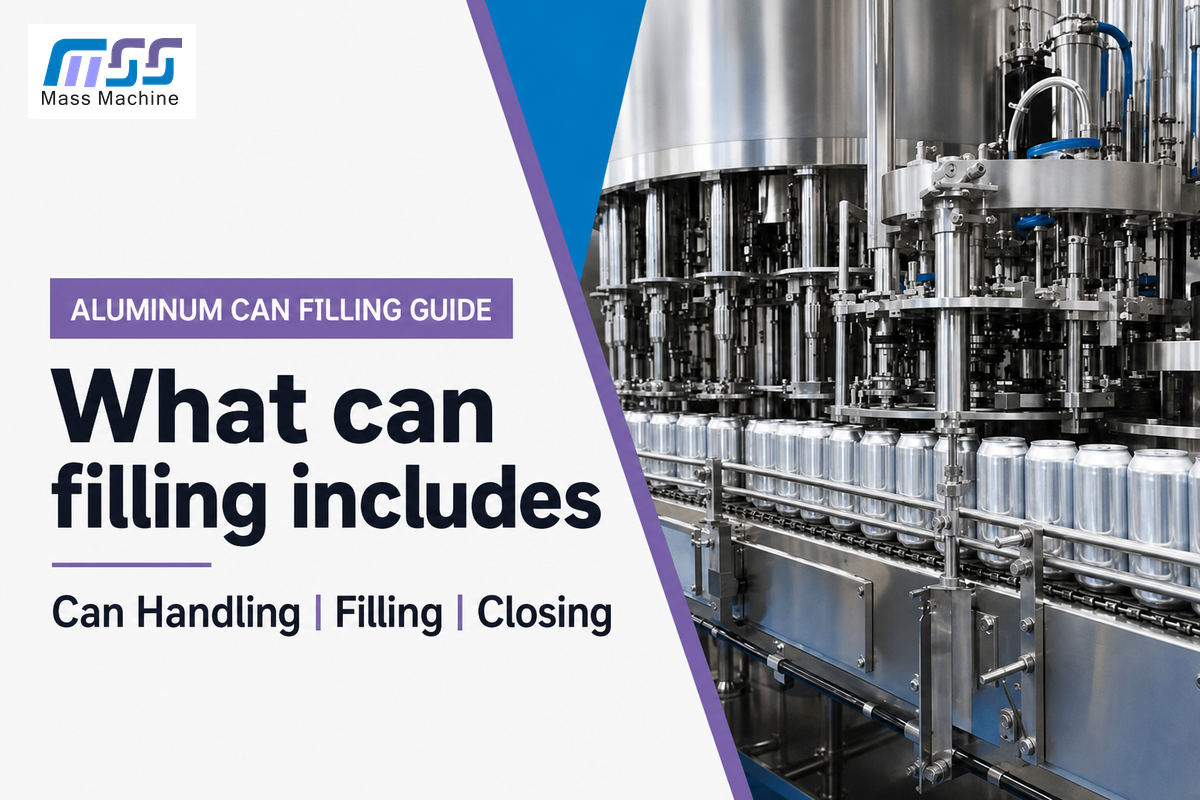
Aluminum beverage can filling covers receipt of empty cans, controlled handling, preparation, filling, end placement, seaming and inspection. Package qualification connects those operations: the approved body and end must arrive intact, match the installed line format and remain identifiable through the production window. Release then is up to the site’s approved control plan.
Between the filling and sealing operation of the package, many factors come into play including the support and transfer of the can, and the timing and presentation of the end to the closing operation. Defects in the package may happen during can manufacture and filling, closing, processing and handling. According to the Canadian Food Inspection Agency’s metal-can guidance, a can defect may occur outside the closing process, including during manufacture, filling, processing or handling. This may warrant an investigation beyond the seamer.
Review the package in both directions. Engineering checks whether the machinery, including the filling valve, can run the format. Quality assurance checks what observations and measurements support acceptance. Procurement verifies the supplier’s current documents. The operations team preserves the recipe and records used for that particular run. Responsibilities meet at the identity of the package, rather than at the output of a single machine.
Common mistake: A typical mistake is viewing “automatic filling and sealing” as a self-contained qualification statement. Automation describes how work is performed; it doesn’t define the approved body, end, liner or acceptance evidence. A stainless steel frame is equally insufficient as proof of compatibility.
2. Freeze the Can Family Before Machine Settings
A package family has a defined identity that includes body geometry, end code, liner, supplier and process duty. Nominal capacity is but one feature. Package drawings and approval references let the engineer connect the physical container to change parts and inspection requirements, while purchasing can distinguish an approved alternative from an unqualified substitution.
Ball’s beverage-can portfolio names Standard, Sleek, Slim and King families. Crown’s end portfolio describes its own closure options. These are attributed product descriptions, not a universal interchangeability chart. Ask the body and end maker for the controlled combination relevant to your order.
Can Family Input Register
The Can Family Input Register marries approved package identities with line interfaces and release documents that depend on it.
| Field | Source of truth | Line or quality consequence | Limitations / Not suitable for |
|---|---|---|---|
| Body supplier and lot | Delivery record and package specification | Material identity and suspect-lot isolation | Unidentified mixed pallets |
| Format family | Approved body drawing | Change parts and support geometry | Volume-only descriptions |
| Nominal volume | Approved package specification | Product and net-content plan | Inferring dimensions from mL alone |
| Body diameter and height | Drawing revision and dimensional method | Guides, transfers and lifts | Generic setup dimensions |
| Neck and flange requirements | Body/end supplier documents | End presentation and closing interface | Accepting damaged samples as references |
| End supplier, code and lot | Approved end specification | End feed and seam requirements | Assumed cross-supplier substitution |
| Liner or coating reference | Package approval dossier | Food-contact and product-compatibility review | General “food grade” wording alone |
| Decoration and code area | Approved artwork and coding trial | Printing, label and inspection visibility | Assuming decoration changes are invisible to sensors |
| Beverage and process duty | Product/process approval | Pressure, thermal and storage qualification | Transferring approval to another drink |
| Approval revision and status | Controlled release record | Which combination may run | Obsolete drawings or unsigned changes |
Food-contact materials must be assessed separately, and U.S. 21 CFR 175.300 covers specified resinous and polymeric coatings and conditions of use. Regulatory approvals don’t prove suitability for a particular beverage, heating route or storage period. Product-specific package assessments should be requested rather than extending a coating statement beyond its limits.
Consider a purchasing team proposal to replace the current aluminum can with a slimmer body of the same nominal volume. Since the can artwork and commercial description are the same, this type of substitution might appear minor, but it still needs qualification. The register would reveal many of the unstated questions (e.g. body diameter, neck/flange requirements, end code, drawing revision). Copying mechanical references isn’t an option. The procurement team requests the package documents first, and then engineering and quality review and define the trial evidence. The focus is on qualification of the proposed substitution rather than assumed conformity.
3. Protect Empty Cans from Depalletizer to Filler
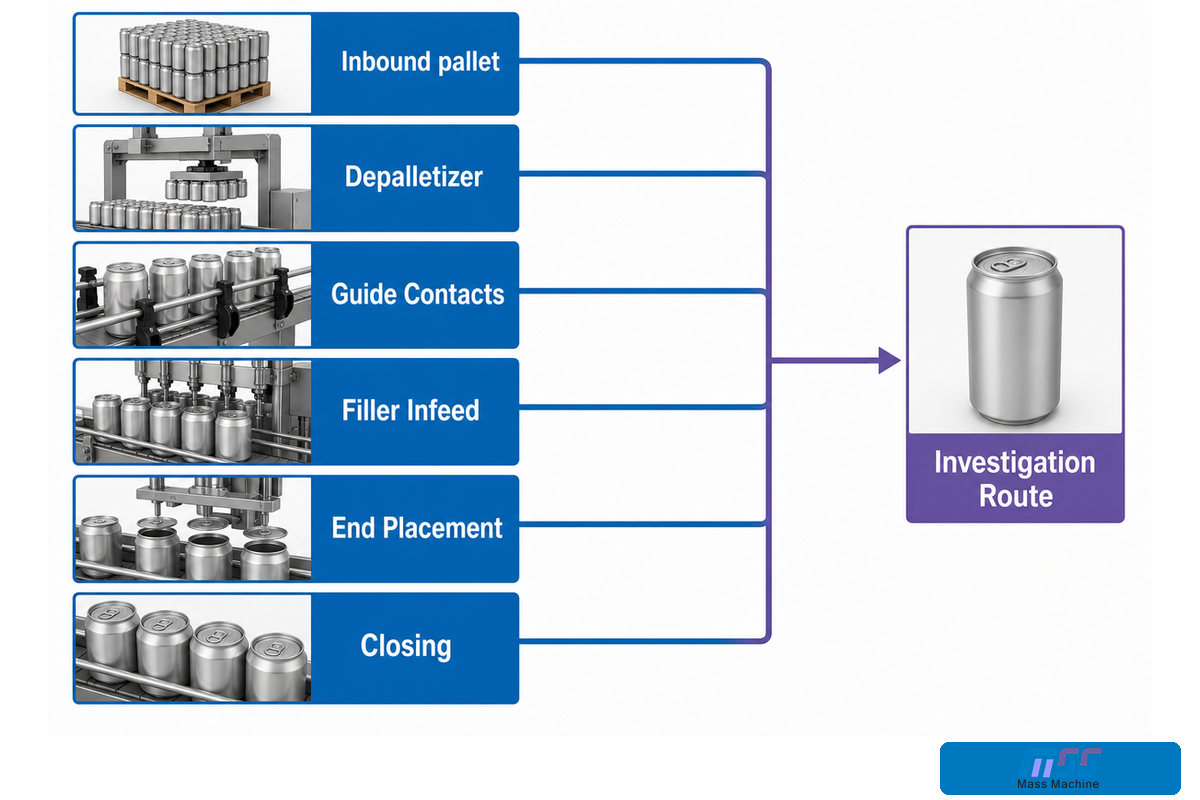
Protection of empty cans means retaining the approved body geometry and condition of the can during all contacts. First, check the transport condition of the pallet and can handling contacts before directing a defect to the filler for correction. Comparing observations before and after a transfer can narrow an investigation, although a dent alone does not identify its cause. Denting of the can may be observed during transport, but that observation alone doesn’t identify the cause.
Following the site’s handling procedure, unload and stack pallets. Before releasing palletized loads to conveyor, inspect for damaged layers, contamination and mismatched lot labels. Separately track body dents and neck/flange damage. Location of damage is important because it may affect closure interface. Don’t turn an informal observation into a formal rejection limit.
Damage Propagation Cascade
The Damage Propagation Cascade maps inspection locations from inbound pallet to seam examination in order to enable an upstream disturbance to remain visible.
Follow the sequence: Inbound pallet, depalletizer, guide contacts, preparation station, filler infeed, filler discharge, end placement and closing. The map shows an investigation route. It doesn’t prove that the first observed defect was generated at that position.
Handling records, if kept, describe the location, package lot, condition and disposition. Photographs may show a contact pattern; measurements require method definition. Hygiene contamination and residues require an approved response. Visual cleanliness doesn’t establish completion of the preparation step.
KHS lists guide edge damage to lightweight cans in their technical account. Use that example as a reason to inspect contacts on your line, not as proof that all damaged cans are caused by that mechanism. Remove scrap from held material and retain samples in accordance with the site procedure.
4. Translate Can Geometry into Line Interfaces
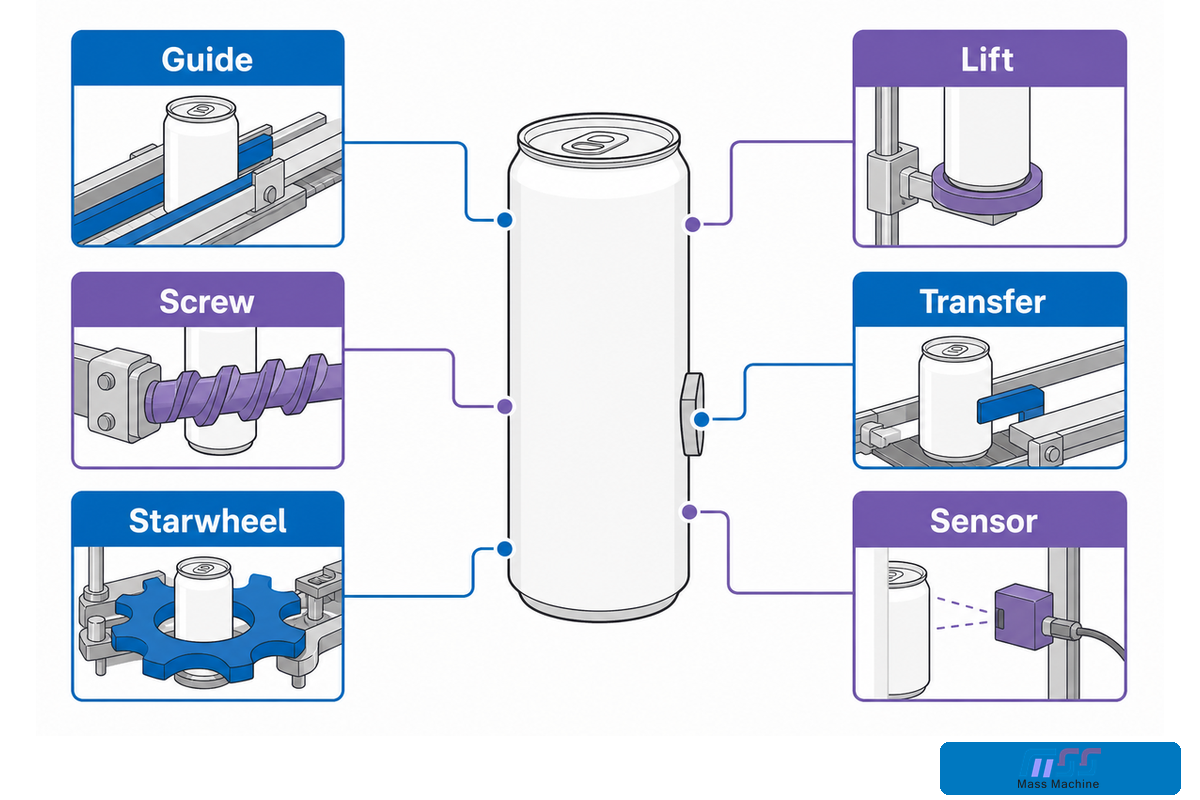
Can geometry becomes a line-interface question whenever a container meets a guide, screw, starwheel, lift, transfer or sensor. The can filling machine range covers model selection; this guide stays with package fit and evidence. A format change can affect a number of contacts even if beverage and nominal volume stay the same. It’s the engineer’s responsibility to trace the changed dimensions to the affected assemblies and verify the installed state against approved drawings and instructions.
Distinguish three changes: diameter of the body, height of the body, and end family. A change in diameter can impact lateral guidance and transfer fit; a change in height can affect support and reference elements; and an end change can impact feeding and the closing combination approved. Once again, these are review prompts, not general adjustments. The exact mechanical settings, pneumatic functions and spare parts are specific to the machinery.
| Change | Interfaces to review | Evidence to retain |
|---|---|---|
| Body diameter | Guides, screws, stars and transfers | Approved parts and dry-handling observations |
| Body height | Lifts, references, supports and sensors | Installed-state checks and first-off results |
| End family | End feed and closing tooling | Approved body/end pair and seam evidence |
| Decoration | Code area and optical inspection | Readable code and challenge samples |
| Beverage/process duty | Product path and package approval | Current product/process qualification |
Verify actual samples through the affected handoffs using approved trials and safety procedures. The phrase “format supported” in a spreadsheet doesn’t reveal the last operator’s reference or the installed parts. Record both. If a glass bottle or plastic bottle filling machine is used as a comparison, it does not mean the same transfer logic applies to a canning machine; the can package needs its own handling and end-placement checks.
5. Match the Package to the Beverage Process Route
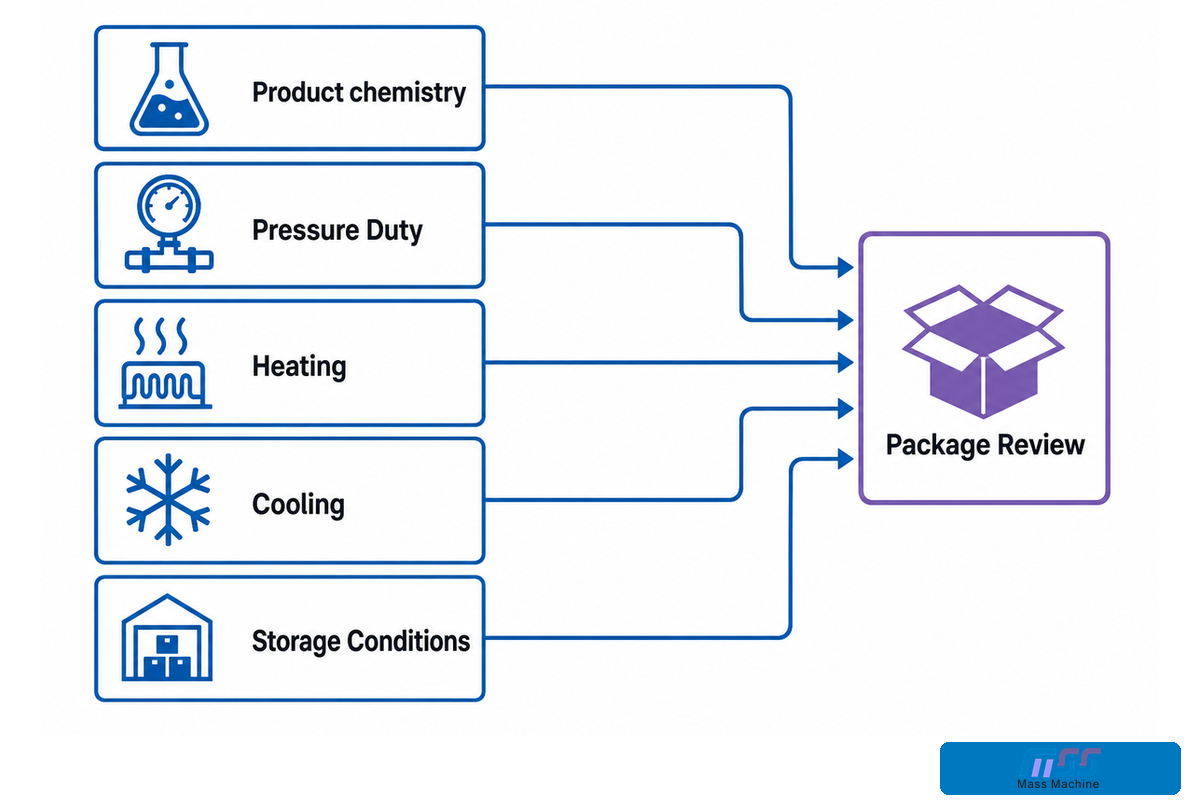
Package approval should follow the beverage and processing route. Different drinks can make different demands on the can, closure and filling process. Product chemistry, pressure duty, heating, cooling and storage conditions therefore belong in the review; a successful run with one drink does not qualify another. Running a successful package through the processing line doesn’t warrant approval for another package.
In the food packaging review, the internal liner is part of the package assessment. Ask which beverage composition, process exposure and shelf-life the assessment covers. A recyclable claim for the aluminum body is an environmental statement; it doesn’t answer food contact and corrosion questions. Experience with steel or tin cans for canned food doesn’t mean that thin-wall aluminium beverage containers are automatically approved.
Juice fillings may require a different processing route from water fillings; beer cans raise product-quality questions beyond a format fit. How to measure the pressure and how to design a process to use nitrogen or carbonate a drink are process-related questions. For beer-specific process choices, see the beer can filling machine guide. “Constant pressure” in a brochure isn’t a qualified product.
The U.S. regulatory scope depends on the category and the activity. The preventive controls guidance of the FDA outlines various exemptions or modified requirements for qualifying juice activities, low-acid canned foods and certain alcoholic beverages facilities. Those exemptions do not waive all food safety requirements. Check the actual beverage product and facility to verify the pathway, rather than quoting Part 117 as generic.
Thermal routes need their own documented package review. Heat treatment, steam exposure, if applicable, and the subsequent cool-down process should be part of the validated product/process. This guide doesn’t offer universal temperatures, pressures, or oxygen levels, or prescribe thermal schedules.
6. Treat Filling, End Placement and Seaming as One Interface

The filling-to-closing interface should allow for stable can presentation and the correct end, while the package is moved into the seamer. Review support, transfer and timing when troubleshooting closure issues. Different questions are answered by visual examination, internal seam measurement and leakage testing. One observation shouldn’t be interpreted as an assessment of package integrity.
Krones’ integrated filler-seamer design illustrates one supplier’s coordinated architecture. That product description supports attribution to that design; it doesn’t establish identical timing, changeover capability or performance for every filling-and-sealing machine.
The CFIA’s guidance separates external examination from internal examination and seam assessment. Follow the approved body/end supplier’s requirements and site’s validated inspection methodology. Even the most sophisticated instrument can’t be considered completely correct without the right method, reference and interpretation. Appearance alone can’t give an internal seam dimension.
Let’s say a new end lot has been added to an existing filling line, and, during a first-off inspection, seaming concerns have been raised. Tweaking the seamer, before the starting condition has been documented, alters another variable. The team first checks the body/end approval, tooling, and end feed identity. They review retained samples and the relevant inspection results. They check transfer presentation. The package remains held while the cause and affected window are assessed. Following the evidence review, the team makes a line or setup adjustment only if the site procedure approves it and records its verification in the same change record.
The assumption shouldn’t be made that every closing symptom is a filling fault. Likewise, replacing closing tooling can’t repair a damaged flange that’s arriving from upstream.
7. Lock a Verified Changeover Recipe
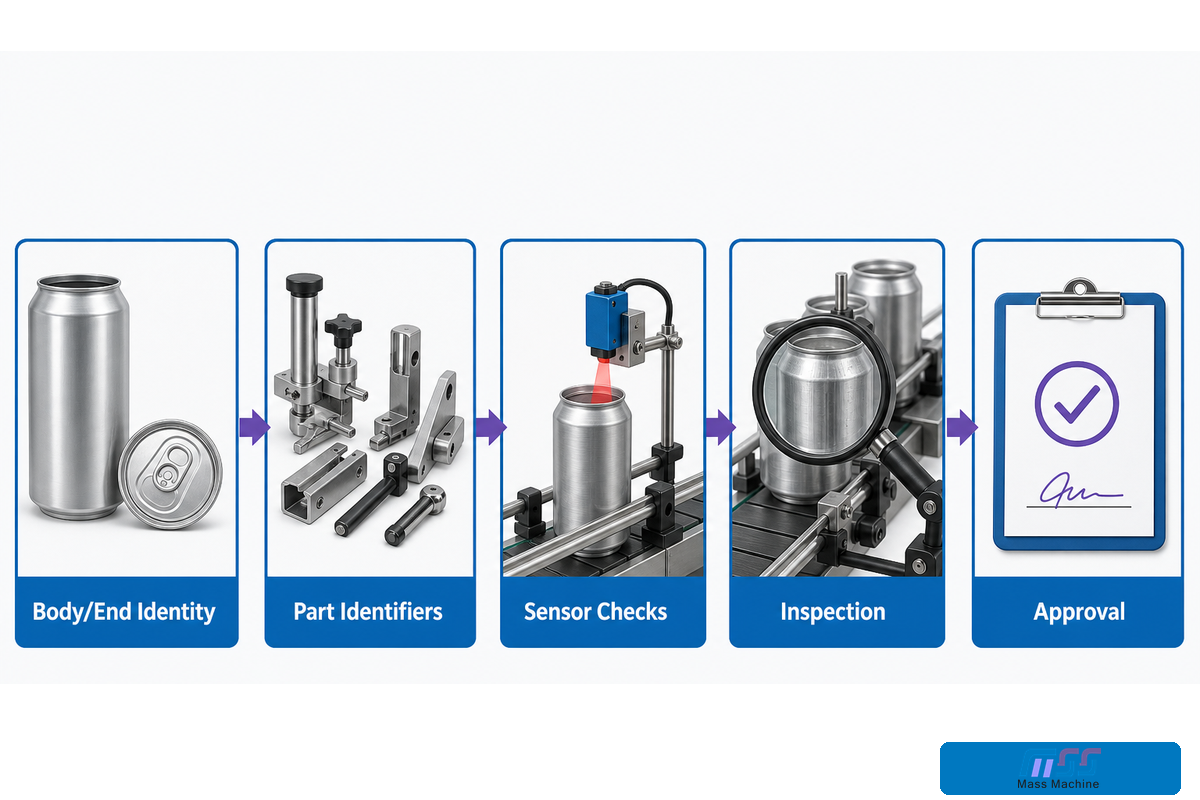
A verified format recipe records the package, change parts, references, sensor states, evidence used to approve the first production window, along with process settings, signoff, and revision. The intention is to arrive at an approved state of the system that can be repeated, rather than relying on the memory of previous settings.
Format Recipe Lock
The Format Recipe Lock ties installed parts and settings to a specific approved package and first-off release record.
Keep the body/end identity, part identifiers, references, end-feed state, sensor checks, inspection and approval. Capture deviations when visible. Replacement parts, if similar to the original part, require an identity and installation check. Don’t standardize one changeover time to different equipment or formats.
Changeover safety requires a task-level assessment. OSHA’s hazardous-energy standard and its minor-servicing guidance distinguish covered work from a limited exception during normal production. The exception requires routine, repetitive, integral activity and effective alternative protection. If its full conditions are unmet, follow the applicable energy-control requirements. The site’s competent assessment and procedures govern the actual task.
OSHA describes the exception’s activity criteria as “routine, repetitive, and integral”. Those words alone do not satisfy the separate effective-protection condition.
Remove ambiguity from the handover: identify which state is approved, which check remains open and who can authorize release. Production pressure shouldn’t turn an unfinished setup into an undocumented trial to reduce changeover time.
8. Inspect at Named Control Points
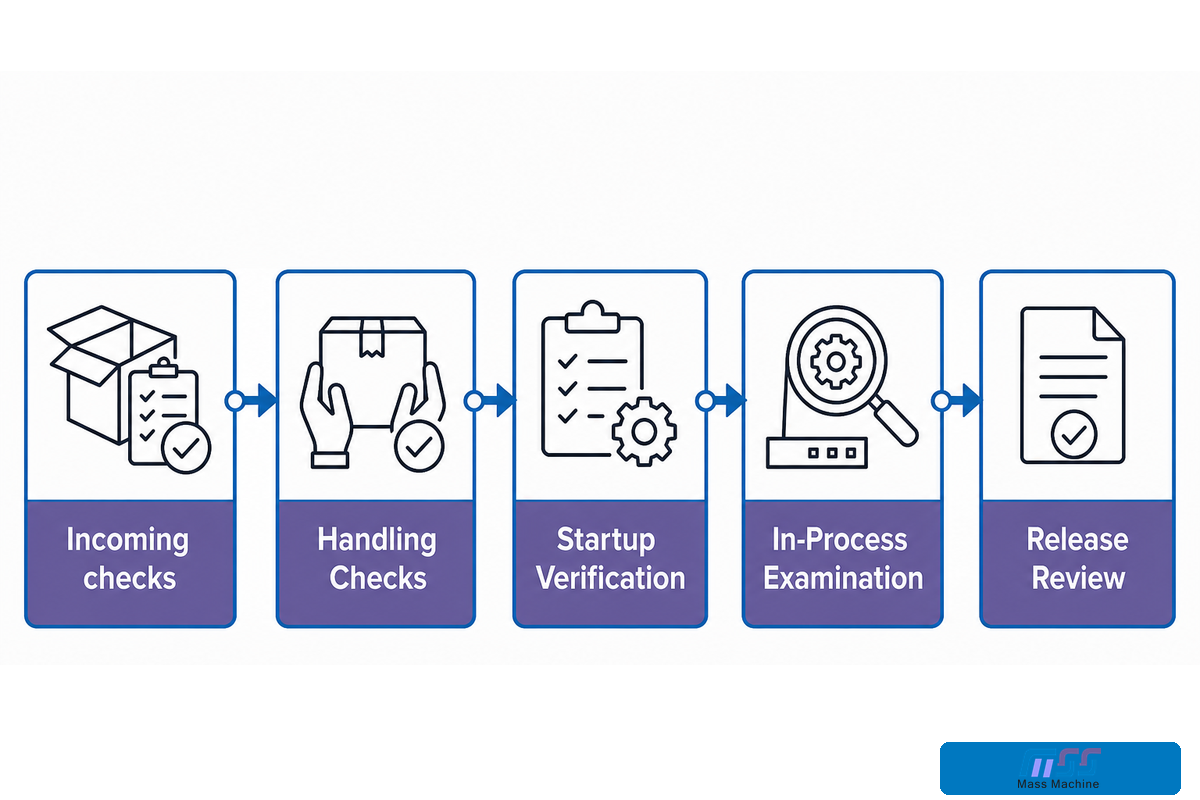
Perform inspections at named locations, using defined methods and owners, and retain the results. Incoming checks, handling checks, startup verification, in-process examination and release review answer different questions. Set limits and frequencies through the approved package and site control plan; this guide provides no universal seam or sampling values.
| Control point | Question or method | Owner and record | Limitations / Not suitable for |
|---|---|---|---|
| Incoming pallet | Identity and visible condition | Receiving: lot and condition record | Proving internal package integrity |
| Body/end document review | Approved combination and revision | Quality: current package dossier | Uncontrolled supplier substitutions |
| After critical handling | Condition before/after contact | Operations: location and sample record | Inferring cause from one photograph |
| Filler infeed | Format identity and presentation | Engineering: installed-state check | Using volume as the sole identity |
| First-off fill | Approved fill or net-content method | Quality: measured result and method | Confusing level appearance with net content |
| First-off closure | Specified seam examinations | Quality: package-specific seam record | Using a generic seam value |
| In-process package | Scheduled control-plan checks | Operations/quality: time-linked results | Invented universal inspection intervals |
| Code and packing | Readability and lot association | Packing: code verification | Assuming a readable code is a complete genealogy |
| Reject and hold | Disposition and affected window | Quality: hold/reject record | Mixing held stock with released material |
| Final release | Evidence completeness and approval | Authorized reviewer: release decision | Releasing with unresolved exceptions |
Inline weighing and inspection can be effective, but their methods need to be validated for the application. Laser coding, vision checks and other inspection features need to have challenge samples and a documented response to failures. The mere existence of an instrument doesn’t answer whether the intended defect or coding error is detected.
Observations must be precise about what each method measures and what remains unresolved. Rust-like staining on metal containers needs to be identified; residues need to be assessed for their potential to affect hygiene. Distinguish these from a review of the actual liner barrier and package integrity. What does each method assess and what does it not assess?
9. Build Lot-to-Release Traceability
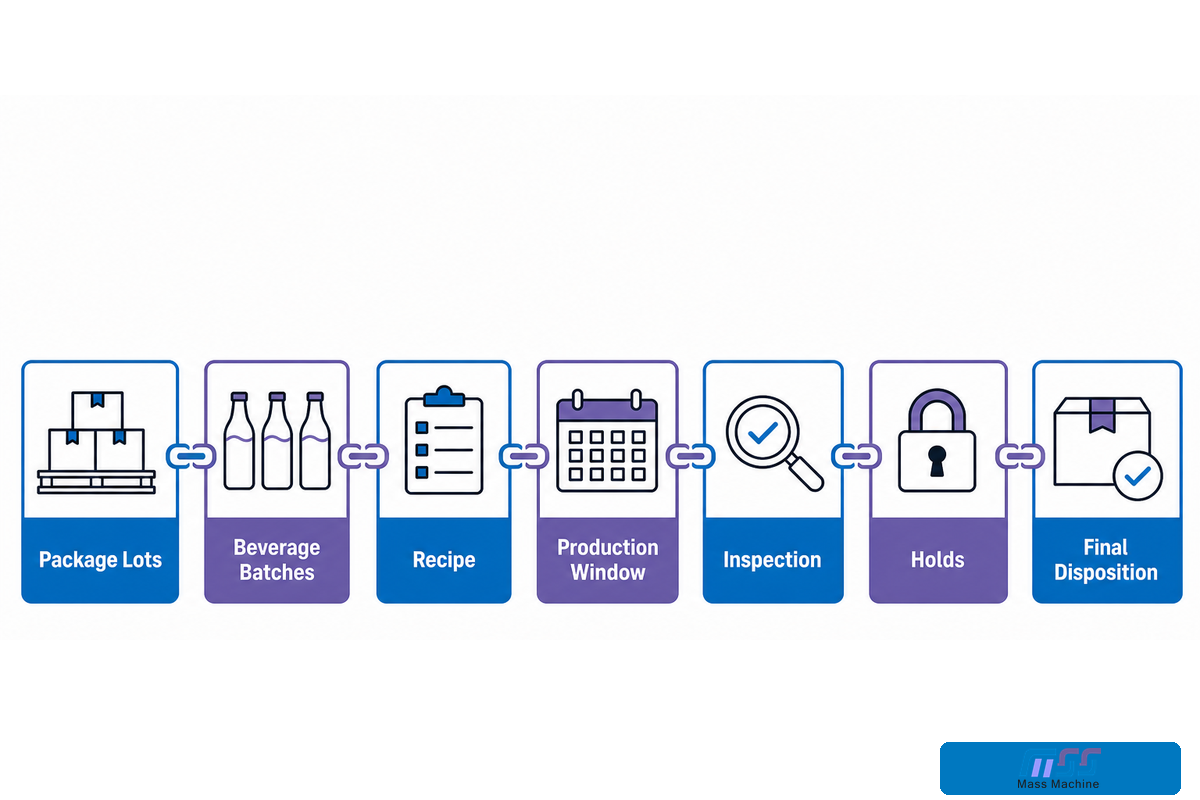
Lot to release traceability needs to link package lots to beverage batches, to the recipe and production window, to inspection, holds and final disposition. A record of this kind allows quality to reconstruct which material and state were present when a concern was raised. The framework below offers a practical example of record design, not that each beverage has the same statutory duties of traceability.
3-Window Traceability Map
The Lot-to-Release Trace Thread links package identity, process state and quality disposition through a shared production window.
A stable identifier should be used instead of free-text description that changes across departments. Attach body, end and beverage lots to the production window. Connect revision of recipe and check of installed parts; attach inspection records, holds and releases. If an end lot changes mid-run, preserve that boundary instead of assigning one end lot to the entire shift.
One exercise that labels three production windows A, B and C is useful. The body lot stays unchanged as Window B introduces end lot E-B. A concern with E-B is reviewed later. The reviewer first locates where E-B begins and ends and examines any samples retained from those production windows. Further investigation may be required to determine the role of shared body material; the records don’t prove E-B was the cause of the concern. Packing records connect the assessed windows to finished stock, and quality documents the hold and disposition. Missing times and lots are shown as gaps rather than assumed to be safe.
The FDA’s additional traceability rule concerns certain foods on the Food Traceability List and qualifying activities, with exemptions; it does not automatically apply to every canned beverage. Identify your legal obligations separately from the record you decide to keep for your internal quality assurance.
Test the record joins with a mock retrieval. Can quality personnel identify the package and process records without interpreting the operator’s shorthand? Can packing isolate the held stock? Can procurement pose an evidence-based question to the supplier? An untested database or a code printed on every can doesn’t, by itself, answer those questions.
10. Qualify a New Can Family Across Beverages
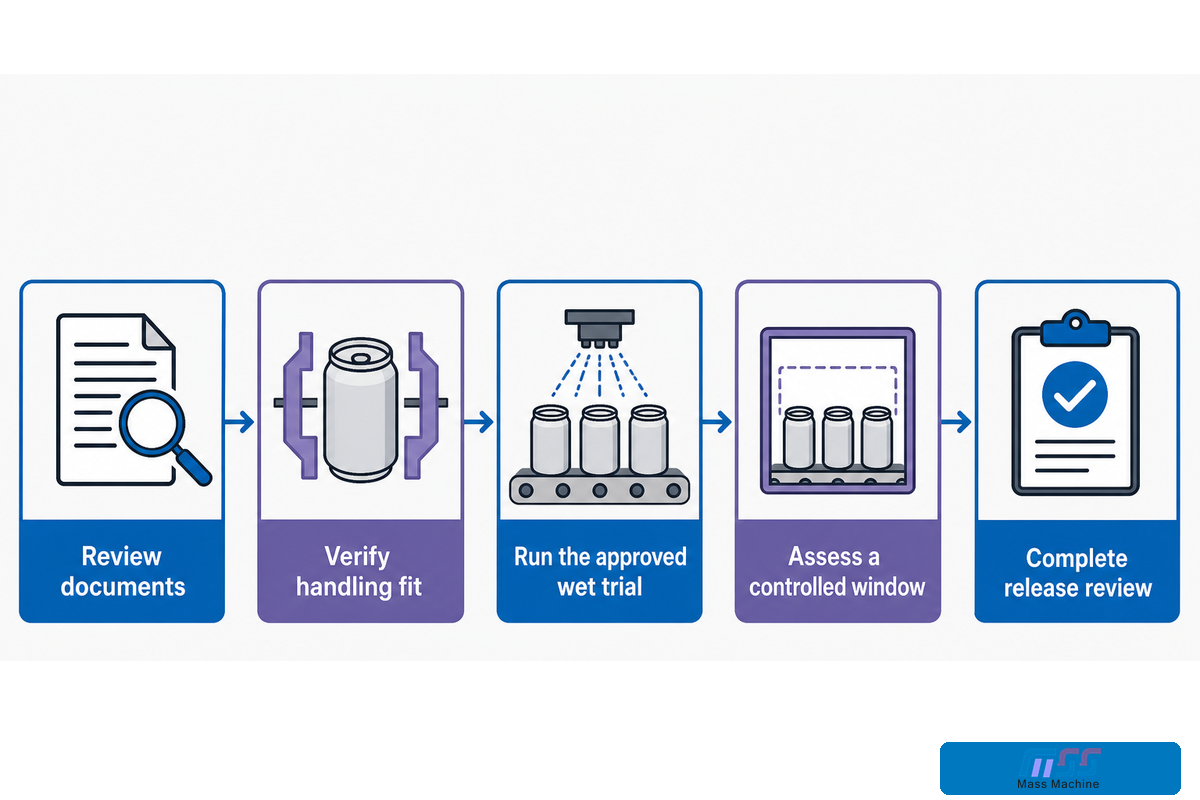
A new can family needs staged qualification: review the documents, confirm handling fit, evaluate the approved wet trial, examine a controlled production window and complete release review. Each step closes a different level of uncertainty. Carry approval forward only for the defined body, end, liner, beverage and processing duty; broader compatibility needs additional evidence.
- Review documents. Resolve package identity, drawing revisions and product/process approval before material is released for trial.
- Verify handling fit. Check affected contacts and installed change parts under the approved trial and safety procedure.
- Run the approved wet trial. Retain product and package results against defined acceptance requirements.
- Assess a controlled window. Confirm the recipe, inspection records and material joins remain intact during production.
- Authorize release. Close deviations and record the qualified combination and its limits.
When a trial should stay on hold
Keep a trial unresolved when drawings conflict, body/end approval is missing, coating evidence doesn’t cover the beverage, or inspection lacks a defined method; schedule pressure can’t substitute for these inputs. A package that has passed through dry machinery still needs filling and storage assessment before its intended production window is qualified.
Separate the open issue from unrelated performance questions. Engineering may have confirmed transfer fit while Quality is waiting on evidence of compatibility. Procurement may have the latest drawings while Operations hasn’t verified the installed part revision. Recording the owner and missing evidence prevents an unfinished approval from becoming a general rejection of the machine or an unsupported acceptance of the package.
Industry outlook: require evidence behind inspection upgrades
A 2025 Krones update on AI-based inspection describes extensions to its own inspection systems. For a new format, the useful purchasing question is which package conditions have been challenged, which reference method was used and how escapes or false rejects are recorded. Automation doesn’t replace the need for qualification.
Key takeaway
Approve a defined package and process combination with a verified recipe and joinable release evidence. Extend that approval only when the changed conditions have been assessed.
The Mass Technology company profile identifies the supplier behind this site’s equipment pages. Bring the Can Family Input Register to an engineering discussion to define the package so the review of the machine can begin.
Frequently Asked Questions
What specifications are needed before an aluminum can filling trial?
Start with the package and process references.
Provide the body and end supplier, lot identities, controlled drawing revisions, format family, nominal volume, dimensional references, end code and liner approval documents. Add the beverage composition and intended process duty, then identify the trial acceptance methods and responsible reviewers. Photographs or a sales description can help explain the format, but neither replaces the controlled documents needed to review line fit and package qualification. Keep the approved combination distinct from proposed alternatives. For a new end supplier, record what would trigger a fresh body/end approval and who owns it.
Are aluminum beverage cans lined on the inside?
Review the actual package’s internal coating specification.
The internal liner or coating belongs in the package specification and food-contact assessment. Don’t select it from the can’s exterior appearance or a general material name. Ask the supplier which formulation, conditions of use and beverage/process assessment the documents cover. Applicable food-contact permission is a separate question from corrosion behavior or shelf life with your product. A new drink or processing route may therefore need a fresh compatibility review even when the body looks unchanged. Retain the supplier revision so future purchases refer to the same approved construction.
Can the same filling line run standard, sleek and slim cans?
Compatibility depends on the defined package and machinery.
Review the actual body dimensions, end family and approved package combination against the line’s change parts, references, supports and inspection methods. A manufacturer’s format claim is a starting point for that review, not proof that every package from every supplier is interchangeable. Confirm the installed parts and first-off evidence for each qualified recipe. Don’t infer support for a slimmer can merely because its nominal volume matches a previously approved format. If one transfer or inspection device remains unchecked, mark that interface open rather than assuming line-wide approval.
Why can empty-can damage create a seam problem later?
The closing operation receives the condition created upstream.
Damage to a neck or flange can affect the package presented to closing. Manufacturing, handling, filling and closing all deserve attention during an investigation. Compare condition records at named locations and use the approved seam examination method. The location where a problem is detected doesn’t, by itself, prove where it originated or which machine adjustment will correct it.
Which records should be kept during a can-format changeover?
Keep package identity, installed state and release evidence together.
Record body/end identities, the recipe revision, installed change parts, mechanical references, sensor and end-feed checks, first-off results, deviations, approvers and the effective production window. Connect those records to material lots and packing disposition. A settings screenshot alone omits the physical parts and the evidence used to approve production.
Where should buyers compare machine models and request a quote?
Use the solution page after defining the package.
Model selection, nominal capacities, configuration and quotations belong on the site’s aluminum-can equipment solution page. Bring the completed register and the intended beverage/process route to that discussion. Copying an existing water bottling plant configuration or another container’s packing setup leaves can-specific interfaces and qualification questions unanswered.
Discuss a defined can package with Mass Technology
Share the package drawings, body/end references and beverage route so the engineering review can identify the interfaces and evidence still needed.
Evidence note: This guide has public government guidance and attributed supplier examples. Its registers, qualification sequence, and working framework are original. No private plant data, customer outcome, universal seam limits or validated processing schedule is claimed. Acceptance of package and its regulatory applicability is to be confirmed through site specialists.
References & Sources
- Metal can defects and examination, Canadian Food Inspection Agency.
- 21 CFR 175.300: resinous and polymeric coatings, Electronic Code of Federal Regulations.
- Frequently Asked Questions on FSMA, U.S. Food and Drug Administration.
- 29 CFR 1910.147: control of hazardous energy, Occupational Safety and Health Administration.
- Minor Servicing Exception, Occupational Safety and Health Administration.
- Additional Traceability Records for Certain Foods, U.S. Food and Drug Administration.