Get in Touch with Masstech

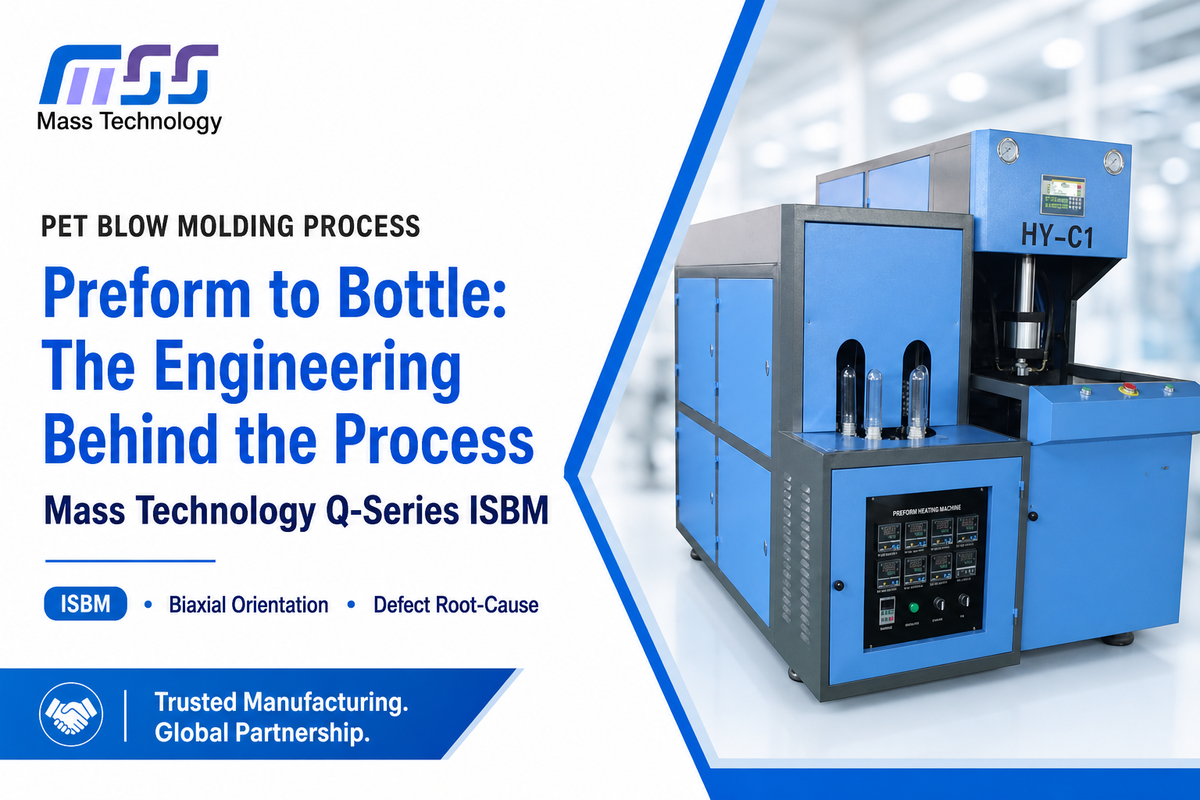
The PET blow molding process is injection stretch blow molding (ISBM): reheating a polyethylene terephthalate preform, then mechanically stretching and air-inflating it inside a mold cavity to form a clear, lightweight bottle. (Beyond North America, the same procedure is typically labeled “blow moulding.”)
Quick Specs
| Process name | Injection Stretch Blow Molding (ISBM) |
| Forming window | Above PET’s glass transition (~76-80°C), below the crystallization range |
| Minimum stretch ratio | 2:1 vertical (axial), 4:1 hoop — below these, wall thickness cannot self-level |
| Single-stage cycle time | ~13-16 seconds per shot (~250 cycles/hour) |
| Two-stage output range | 1,000 to 72,000+ bottles/hour, scalable by cavity count |
| Achievable wall variance | As little as 0.001 in. around a round bottle when self-leveling works correctly |
This guide focuses on the science of the process and the material-science principles-plus defect root causes-responsible for a steady run of plastic bottles instead of a scrap-prone one, and it’s written for process engineers and quality managers, not equipment buyers. Our bottle blowing machine buyer’s guide covers cavity counts, pricing tiers, and vendor checklists.
What Is the PET Blow Molding Process? (ISBM Defined)
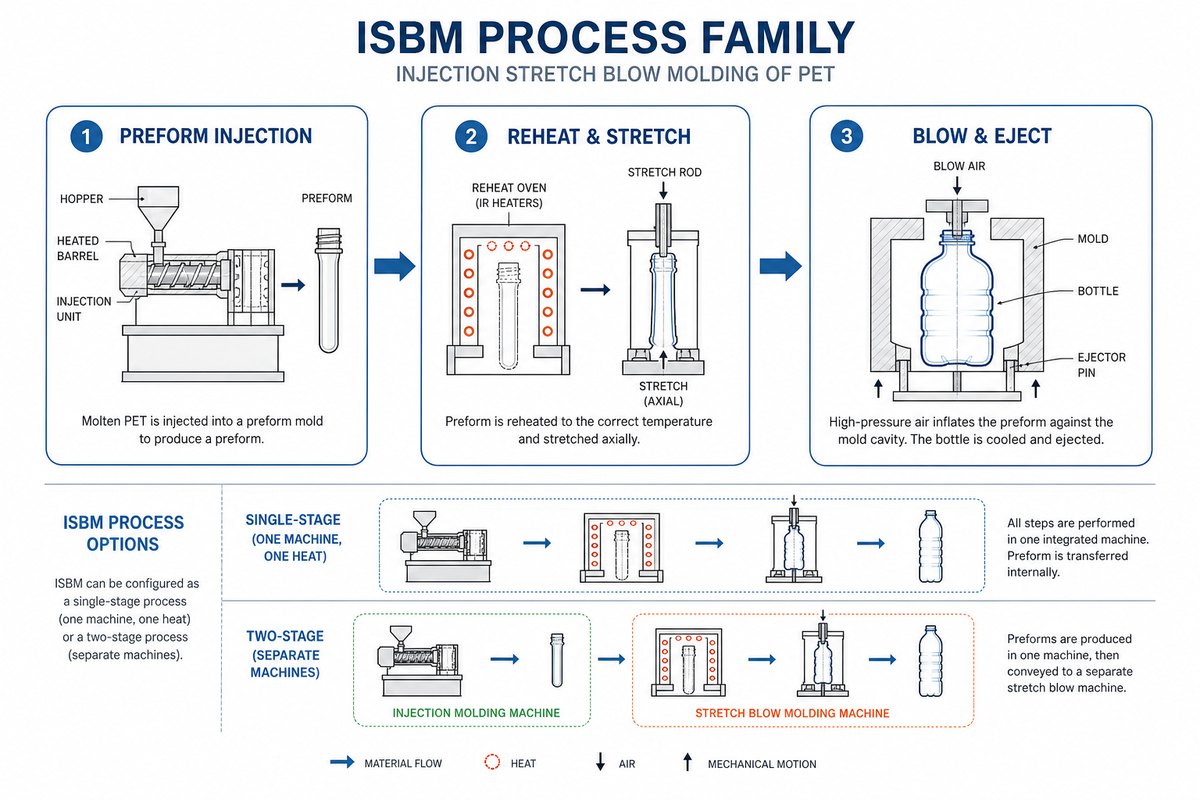
Injection stretch blow molding (ISBM) transforms a small, thick-walled preform-already carrying the finished bottle neck and thread from its own injection-molding step-into a thin-walled bottle through controlled reheating, mechanical stretching, and air inflation. The preform’s wall thickness and neck geometry are fixed before this stage ever starts, which is why preform quality decisions upstream constrain what the blow stage can still fix.
Two layouts make up this process-both properly called stretch blow moulding in the wider literature: single-stage, where preform injection and blow moulding happen on one machine in one heat cycle, and two-stage, where preforms are injection-molded separately, cooled, stored, and later reheated on a dedicated blowing machine. A related but distinct technique, injection blow molding, skips the stretch step entirely-a core pin injects and blows a preform in one motion, and is reserved for small, precision, unstretched containers and bottles-including storage containers where dimensional accuracy matters more than optical clarity-one of three main types of blow molding, each built from the same basic plastic material but a different type of plastic part at the starting line. Wikipedia’s history of blow molding traces the broader family of processes back to 1938, when American inventors Enoch Ferngren and William Kopitke built the first commercial plastic blow molding machine and sold it to the Hartford Empire Company-nearly ninety years before ISBM became the default process for a beverage bottle.
Which layout applies matters because it changes where defects originate and which quality controls actually help. What follows works through the cycle itself, the materials science that makes it work at all, and the process-stage discipline that keeps a line in specification.
The Five-Stage ISBM Cycle: What Actually Happens Inside the Machine
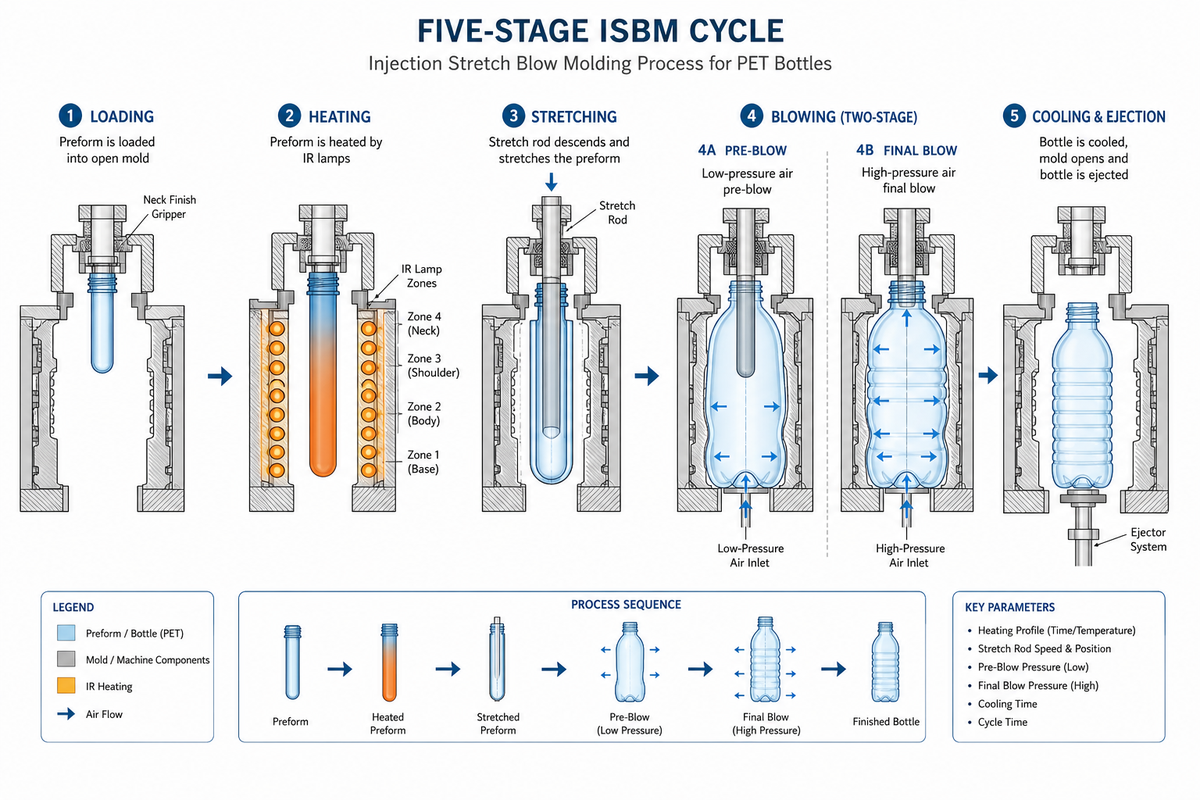
The ISBM cycle runs in five steps-loading, heating, stretching, blowing, and cooling/ejection, and the blow step itself is really two pressure stages, not one.
Preforms load neck-up onto a transfer system, pass through an infrared oven bank until the resin sits in its forming window, get mechanically stretched by a rod, then get inflated in two pressure phases before the mold open and ejects a finished bottle.
- Loading. Preforms-created the moment plastic pellets are melted and injected to create the preform in a separate, high-production injection step-are fed neck-up onto a chain, wheel, or continuous-motion transfer that carries them through the oven bank.
- Heating. Each independently controlled infrared lamp zone brings the preform into its forming window, just above the glass transition and below the melt point-the preform is heated until soft and pliable, but never melted.
- Stretching. A stretch rod descends through the mold to stretch the preform along its vertical axis before air enters, positioning the preform inside the shape of the mold cavity.
- Blowing (two pressure stages). Compressed air, staged as a low-pressure pre-blow, inflates the bulk shape first-air is blown into the preform under carefully staged air pressure-then a separate high-pressure shot presses the material into the mold’s fine detail as the cavity mold form the body of the finished part.
- Cooling and ejection. Contact with the chilled mold wall locks in the bottle’s shape and orientation; the mold opens and the part is ejected-one of thousands of identical objects in large quantities that a single tool produce in a production run.
📐 Engineering Note — why two pressure stages, not one
Without a staged blow and the careful control this implies, a high-pressure shot alone would force the thickest section of the coolest preform to the furthest extremities, leaving thin, “short-shotted” walls everywhere else.
Low-pressure pre-blow fills out the overall volume and gives the resin time to reach every corner before the high-pressure shot details fine features like threaded necks and logos into the mold. It’s an easy-to-prevent cause of the aforementioned “short shot”. When specifying the plant air supply, review air compression equipment from PanGeng against the blower's documented demand at each pressure stage, including storage and treatment requirements.
“We tested both pneumatic and servo preform-loading configurations across 600 production hours before we standardized the Q-Series on servo. The pneumatic version cost $1,800 less per machine but produced 0.4% more rejects on small-neck bottles, at 6,000 bottles per hour, that erodes a year of margin in about three months.”
Those extra rejected small-neck bottles trace to preform loading, not heating or blowing, because a servo loading system holds position far more repeatably than pneumatic loading, and the small-neck profile leave little margin for variation. It’s a reminder that the “five stages” model is a simplification: a defect that show up at ejection can trace back to loading, not the stage where you finally see it.
The Materials Science: PET Resin, Intrinsic Viscosity, and Biaxial Orientation
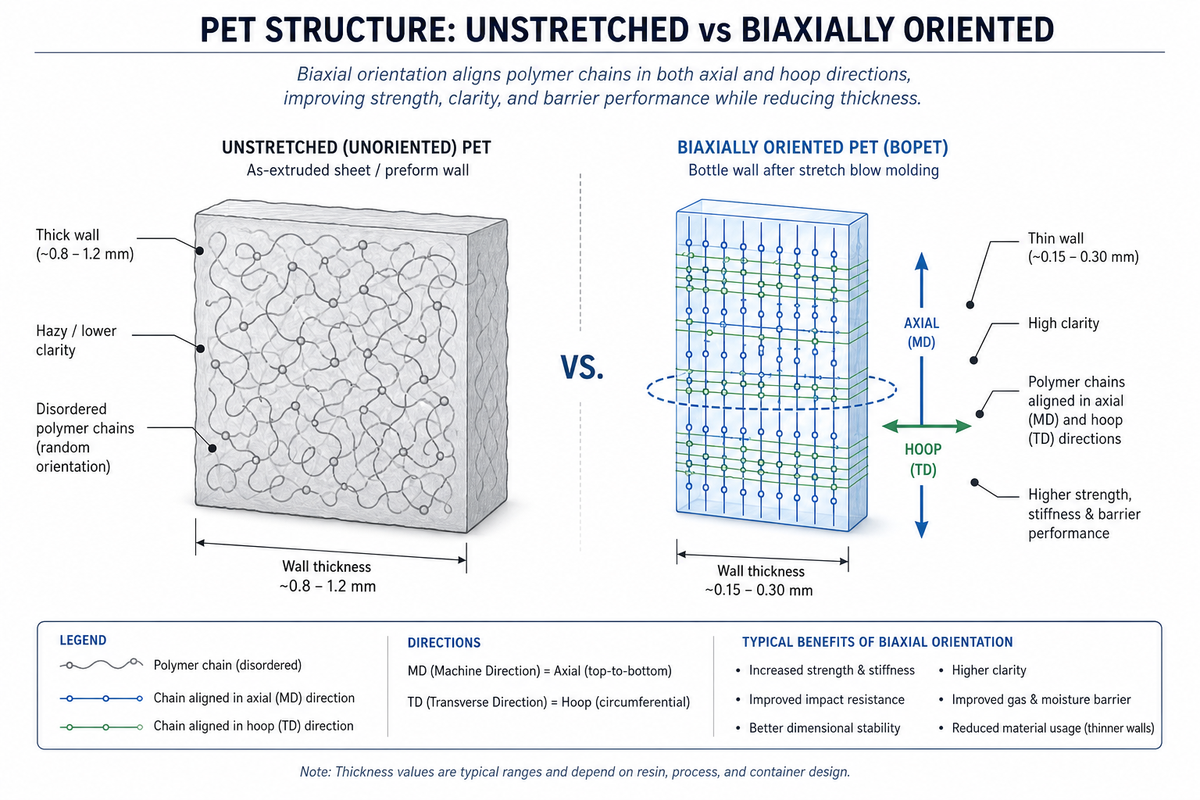
Biaxial orientation is the mechanism that gives a PET bottle its strength, clarity, and gas-barrier performance-stretching the resin in both the vertical (axial) and hoop (radial) directions aligns its polymer chains, and an unstretched or under-stretched PET part is comparatively weak and hazy by contrast. Intrinsic viscosity (IV) is the resin-quality number that sets how much stretching a given batch of PET can tolerate before it tears or fails to orient properly, and it is measured by ASTM D4603, a glass capillary viscometer method run at a standard 0.50 g/dL solution concentration and distinct from the glass transition temperature test that sets the forming window itself. Post-consumer PET resin has been measured across a range of roughly 0.35 to 0.78 dL/g depending on processing history, and bottle-grade virgin resin is specified toward the higher end of that range precisely because higher IV means longer polymer chains and more melt strength to survive the stretch.
The Orientation Window
A bottle needs at least 2:1 axial and 4:1 hoop stretch to trigger PET’s self-leveling strain-hardening effect — below that window, thinner spots keep thinning instead of self-correcting, and no amount of process tuning fixes an under-stretched design.
| Bottle format | Axial (vertical) ratio | Hoop ratio | Limitations / not suitable for |
|---|---|---|---|
| Standard round water/CSD bottle (0.5L) | ~2.2-2.5:1 | ~4-4.5:1 | Comfortably above minimum; not the limiting case |
| Hot-fill juice bottle | ~1.8-2.2:1 | ~3.5-4:1 | Lower ratio trades some clarity for the heat-resistant neck crystallization hot-fill requires |
| Wide-mouth jar / low-profile format | ~1.5-1.8:1 | ~3-3.5:1 | Close to the 2:1/4:1 floor — wall variance is harder to control, needs tighter preform tolerance |
| 5-gallon (18.9L) water container | below 1.5:1 | below 3:1 | Below the self-leveling floor by design — needs a dedicated stretch-rod and cooling-circuit configuration, not a “big bottle” setting on a standard mold |
| Custom / asymmetric shape | varies by geometry | varies by geometry | Corners and flat panels locally under-stretch even when the average ratio clears the floor — needs zone-specific heating, not just an average target |
A mold shop building a preform mold for a new SKU has to design toward whichever row applies, because a small to medium blow-up ratio-common on wide-mouth and custom formats-leaves far less margin for preform-tolerance error than the generous ratios a standard round bottle allows across its variety of shapes.
That’s why a bottle-grade PET material specification isn’t the same input as a generic plastic material specification, despite the fact that they’re both, strictly speaking, PET.
IV Drift
Intrinsic viscosity is not a fixed number once a resin ships; it drops with every reheat, reprocessing pass, and moisture exposure the material sees before the blow stage, which is why a preform’s IV certificate reflects a starting point, not a guarantee.
Intrinsic viscosity is where recycled resin actually becomes a factor, and that topic reappears in the rPET discussion below. Prior to that, though, it makes sense to go through the decision of process – single-stage, two-stage, or the venerable extrusion route – because each of those approaches responds to a unique blend of geometry and volume.
Single-Stage vs Two-Stage vs Extrusion: A Decision, Not Just a Definition
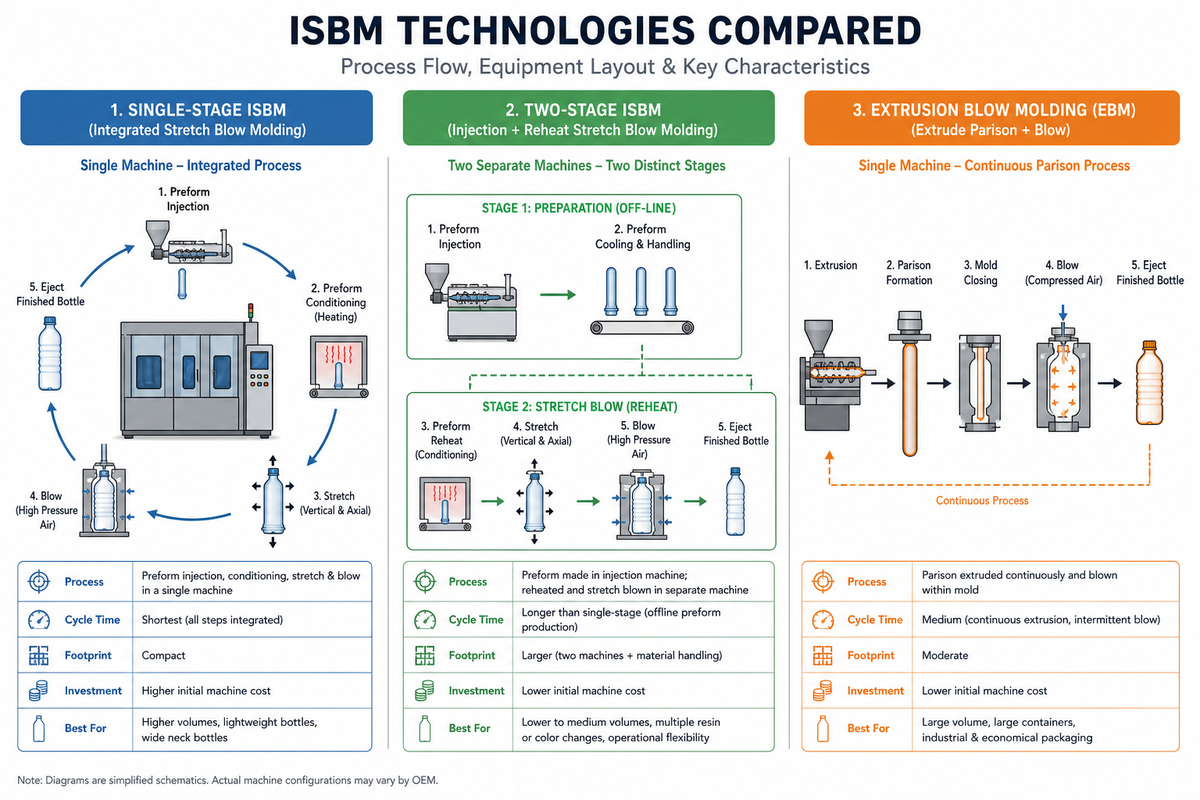
Every blow molding station and molding system across the plastics industry run one of three different formats, and selecting the correct molding process for your bottle is a features-and-economics call, not a default-procedure call. While two-stage ISBM is the prevalent process for beverages (which represent over 80% of all bottles, the majority of which run two-stage), the old truism “always pick two-stage at volume” isn’t as clear cut as you might think because it fails to account for the true weakness of both systems. Two-stage’s chief vulnerability is in preform handling during conveyance; preforms are often jostled off lines, into bulk storage, or tumbled into the blow-machine hopper, creating marks and scuffs that the stretch can flatten but not always fully hide, writes Ottmar Brandau, president of PET All Manufacturing Inc., and a 48-year plastics veteran, in Plastics Technology.
Single-stage overcomes the handling problem; there’s only one stretch blow molding machine and the preform never leave it, but at the cost of slower cycles and changeovers, as well as the non-uniformity produced by a viscous melt dividing into several runner channels. In their essence, the single-stage process and two-stage technology are both ISBM; only the equipment choice distinguishes how the preform-mold is delivered to the final bottle, and neither the single-stage process nor two-stage technology is the definitive answer for every family of hollow plastic parts on a plastic packaging line.
Single-stage
- Blemish-free bottles — preform never leaves the machine
- Best fit for oblong shapes, fixed thread orientation, low-to-mid volume
- Cycle time ~13-16 seconds (~250 cycles/hour)
- Long changeovers; needs near-continuous operation to avoid high scrap rates
- Wall unevenness from viscous heating splitting the melt into multiple channels
Two-stage
- Scales from roughly 1,000 to 72,000+ bottles/hour by cavity count
- Fast cycles, fast changeovers, preforms sourced or stored independently
- Best wall distribution for round bottles at volume
- Preform handling between injection and blow can introduce nicks/scratches
- Indexing (chain-driven) ovens can heat cavities unevenly vs. continuous-motion linear or rotary systems
It comes down to the bottle requirements first, cost second. If the bottle features a blemish-free finish, an oblong shape, or a fixed thread orientation as non-negotiable requirements, single-stage is the solution, regardless of volume. If not, do the math: A 1L round bottle, 33mm neck, 42g weight, running at 750,000 bottles/year would require approximately 1,152 hours of machine time per year running a single cavity, two-stage reheat (600-800 bottles/cavity/hour), or 576 hours running it in two cavities. On the other side, it would require 1,500 hours on a two-cavity single-stage system operating at its typical rate of ~250-cycles/hour, or 750 hours running in four cavities. Two-stage wins at this particular volume in terms of machine hours, although low-volume, perfect-bottle custom applications could still make single-stage the logical choice. Extrusion blow molding, the third family, feeds molten plastic through an extruder to form a hollow tube-a tube-like piece of plastic rather than an injection-molded preform, and belongs to HDPE and PP container production, milk jugs and detergent bottles, not PET beverage bottles, so it’s a different process family entirely (and a different moulding technology) rather than a third option for the same job. In ISBM-process and IBM-process terms alike, the preform or parison is the thing every subsequent step acts on: the isbm process stretches and blows what the injection step already made, while the ibm process blows it without the stretch.
Heating-Profile Engineering and Preform Quality
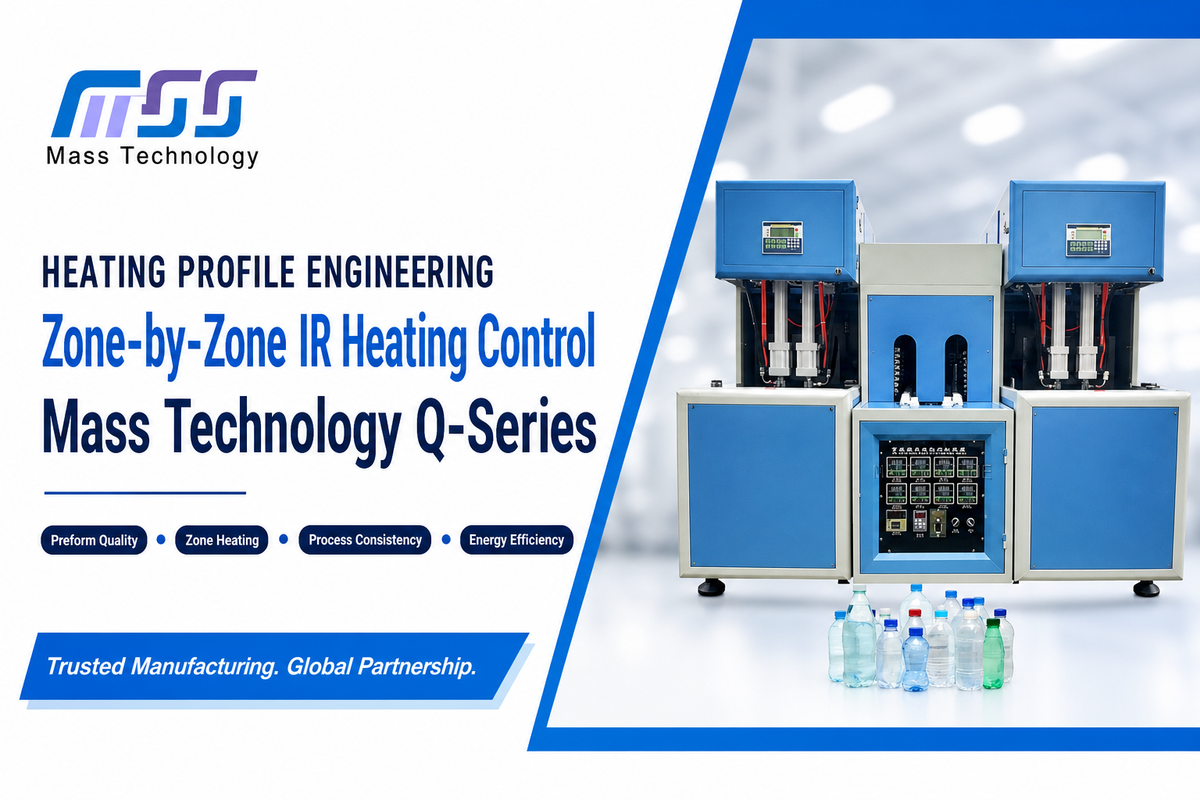
Uneven heating causes a lot of problems, although it’s not the leading one – off-center injection gates are, in Brandau’s experience, “by far the most common cause of wall thickness variation.” This is fundamentally a mechanical issue: The stretch rod needs to pin the preform’s gate on the mold’s bottom to avoid it moving as high-pressure air fills the chamber, and the gap between rod and mold should be around 0.040” smaller than the gate-wall thickness. If either isn’t correct or the pre-blow time is wrong, the wall follows the gate wherever it goes. You can adjust the oven until it’s uniformly heating all points of the preform, but that won’t help the mechanically-off-center gate.
Nevertheless, oven heating is still important on its own terms. Preform wall thickness variation over 0.004” results in uneven reheat because the thinner sections will shrink and lose temperature more as they move between the oven and mold – and the mold may also pull the gate to an uneven position before the stretch rod gets to it. This is why multi-zone IR heaters have become the norm instead of single ovens; they can be adjusted based on known bottle geometry – e.g., around a handle or a panel on the preform – to account for uneven heating of the preform rather than treat every inch of the preform as the same.
Defect Root-Cause Ledger: From Symptom to Fix
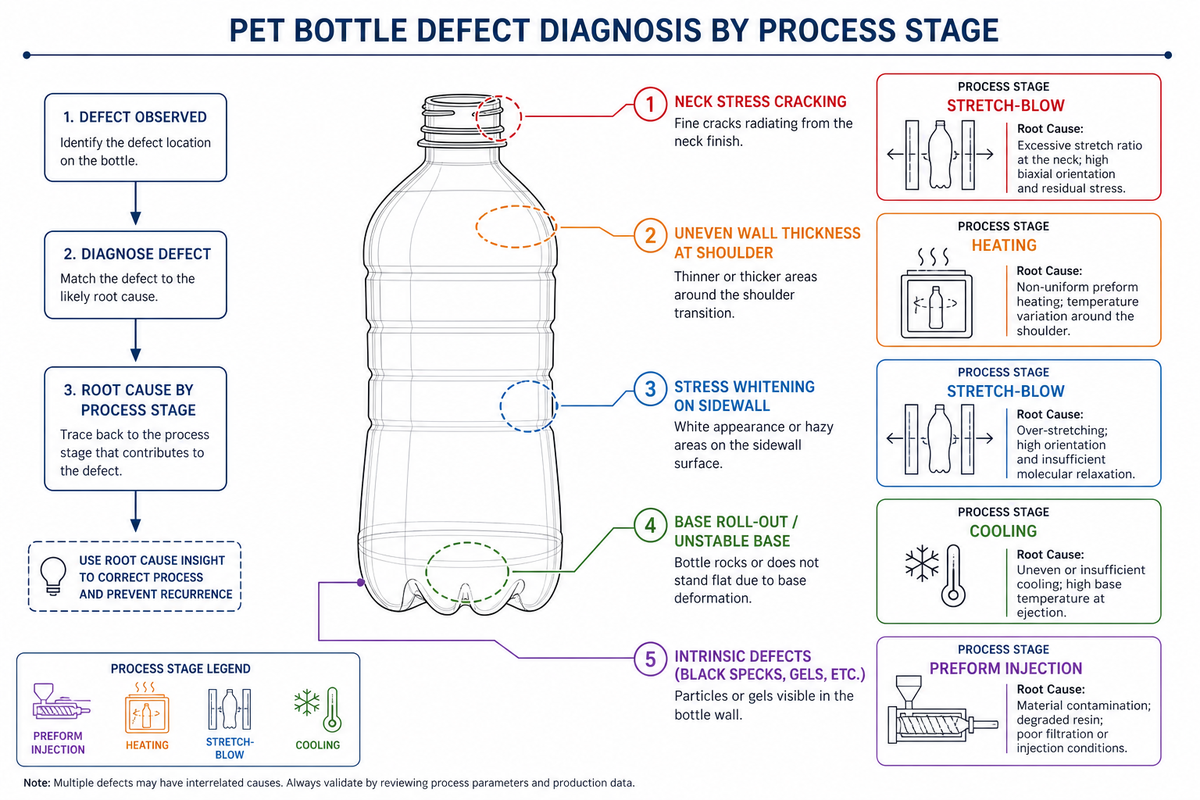
Most stretch blow moulding defects trace to one of five basic stages-preform injection, heating, stretch/blow, cooling, or ejection, and the key to solving a defect in blow moulding is knowing which stage is actually causing the problem instead of jumping straight to “heat it up.”
| Symptom | Likely root cause | Process stage | Fix | Limitations / not suitable for |
|---|---|---|---|---|
| Wall thickness follows the gate around the bottle | Off-center injection gate not pinned by the stretch rod | Preform injection / Stretch | Set rod-to-mold-bottom gap ~0.040 in. under preform gate wall thickness; check pre-blow timing | Won’t fix wall variation from heating alone if the gate is already centered |
| Pearlescence / stress whitening | Cold stretch — preform blown below its forming window | Heating | Raise IR output or dwell in the affected zone; confirm independent zone control | Doesn’t fix whitening from resin contamination — that needs a preform-supplier audit |
| Uneven wall thickness, no visible gate drift | Preform wall variance >0.004 in. causing uneven reheat | Preform + Heating | Tighten preform injection tolerance; add zone-specific IR trim | Won’t fully correct geometry-driven thinning on asymmetric bottles |
| Thin or blown-out base | Cycle time cut too aggressively; incomplete cooling before ejection | Cooling / Ejection | Extend cool time or lower base mold temperature | Trades cycle time for wall integrity — not a fix if the real constraint is a fixed throughput target |
| Haze or cloudiness | Under-forming-window blow, or preform moisture/contamination | Heating / Preform quality | Verify forming-window temperature; audit preform drying and storage | Haze from contamination is a supplier-side quality issue, not a process fix |
| Neck brittleness / stress cracking | Uncontrolled crystallization at the gate area during preform injection | Preform injection | Adjust gate design or injection cooling profile | Some neck crystallization is intentional on hot-fill bottles for heat resistance — don’t “fix” a designed feature |
| Base roll-out / ovalization | Uneven or undersized mold cooling circuit | Cooling | Check cooling-channel balance and cycle dwell at the base | Won’t resolve ovality driven by an undersized preform below the 2:1/4:1 stretch floor |
| Short shot / incomplete fill | Pre-blow pressure or dwell too low | Stretch / Blow | Increase pre-blow pressure or extend pre-blow dwell before the high-pressure shot | Won’t fix a short shot caused by an undersized preform charge |
| Flash / excess plastic at the pinch-off or gate area | Clamp tonnage or mold alignment drift | Clamping | Verify clamp tonnage and mold alignment | Doesn’t address flash from worn mold parting lines — needs mold maintenance, not a process tweak |
rPET Processing: What Changes When You Run Recycled Resin
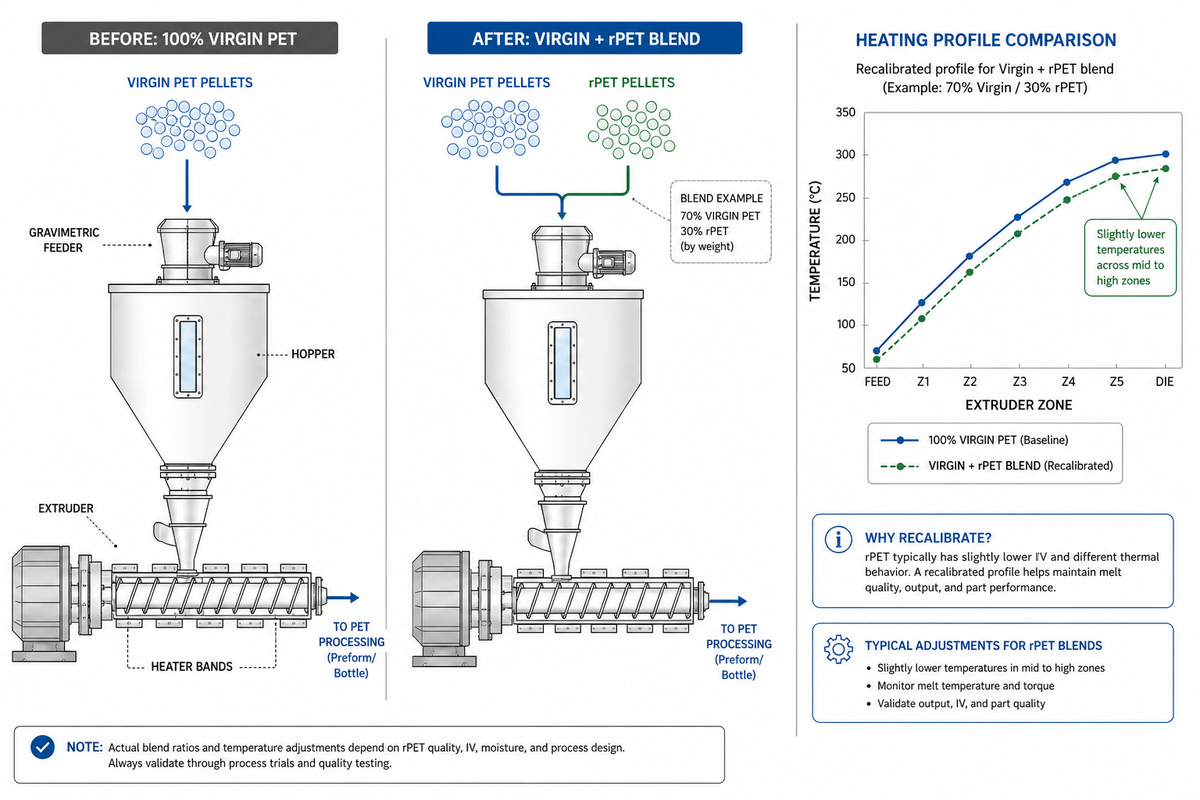
Running recycled PET in a stretch blow moulding line changes process parameters, not just the resin label on the hopper-intrinsic viscosity degrades further with every reprocessing cycle, and a peer-reviewed study measured IV dropping from about 0.80 to 0.65 dL/g across four successive extrusion passes with roughly eight minutes of cumulative melt residence time, driven by thermal and hydrolytic chain scission. Lower IV means less melt strength going into the stretch stage, which is why a straight resin swap-same heating profile, same pressures, just different pellets-is a common way to introduce reject-rate problems that get blamed on “bad rPET” instead of an un-recalibrated process.
Mass Technology’s Q-Series runs 10-50% rPET blended with virgin PET at the factory-default heating and clamping setup; running 100% rPET requires a recalibrated temperature profile plus a hybrid hydraulic clamping option, reflecting the higher moisture sensitivity and lower melt strength of fully recycled feedstock. That capability is becoming less optional: Regulation (EU) 2025/40 on Packaging and Packaging Waste entered into force on 11 February 2025 and applies generally from 12 August 2026, setting minimum recycled-content targets for single-use plastic beverage bottles that industry trackers put at roughly 30% by 2030, rising to about 65% by 2040. Spec’ing a line only for virgin PET today leaves it with a fixed shelf life if its target markets include the EU.
Preform-to-Pallet Quality Loop: A Four-Checkpoint QC Framework
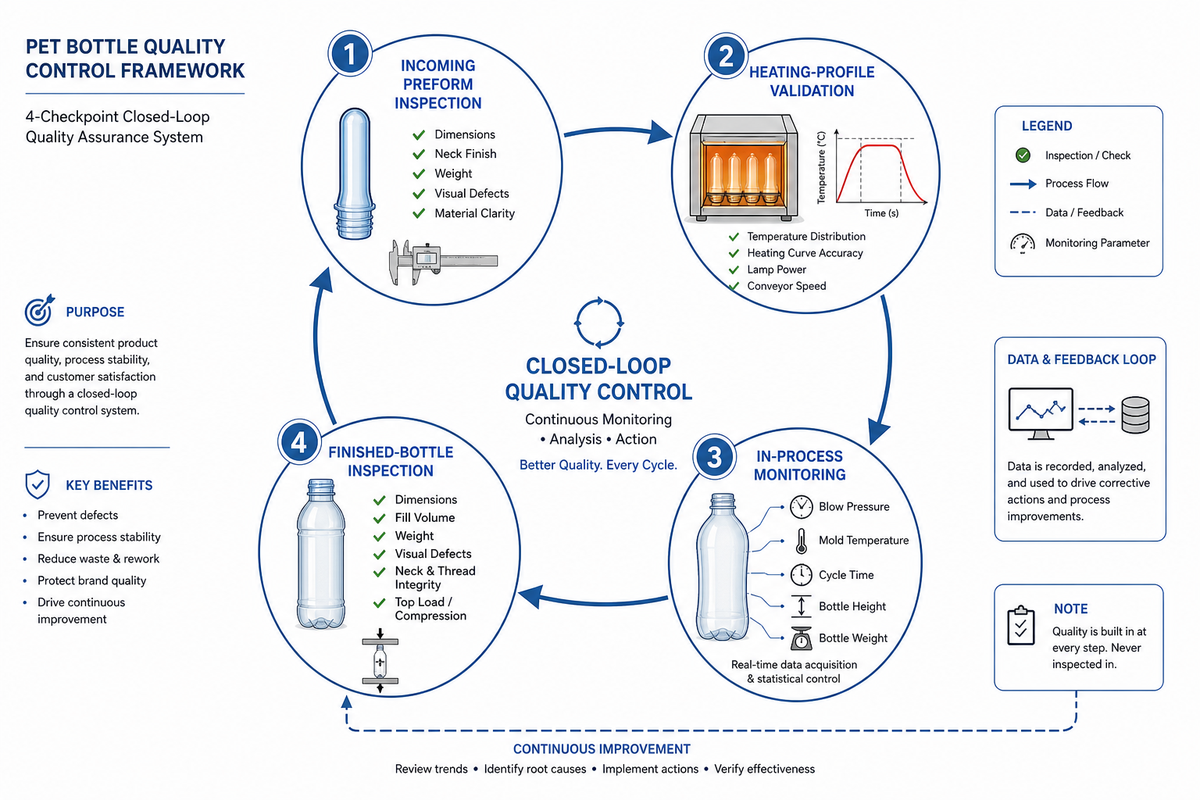
With four inspection points (incoming preform, validation of the heating profile, inline checks, and finished-bottle tests), most of the defects this moulding process generates can be identified and rectified before the finished bottles reach a pallet.
- Incoming preform inspection. Spot-check IV (per ASTM D4603), weight variance, and visual quality (haze, black specks, moisture) on every new preform lot before it reaches the oven — IV drifts with reprocessing history the same way it does across the regrind cycles measured in the rPET section above.
- Heating-profile validation. Run and log test shots for every new preform-and-bottle pairing rather than reusing a prior recipe-confirm air into the preform is staged correctly and that the preform mold opens and ejects cleanly before scaling to full production; a thermal camera check catches oven-metal proximity and non-rotation issues before they become scrap.
- In-process monitoring. Log fill weight, blow pressure, and cycle-time drift continuously so a slow degradation shows up before it crosses a reject threshold.
- Finished-bottle inspection. Burst/top-load testing plus wall-thickness mapping at the base, shoulder, and sidewall-the three zones this guide’s Defect Ledger traces to distinct root causes.
📐 Engineering Note — log a heating recipe per preform-and-bottle pair
Two bottles of the same volume but a different shoulder geometry can need different lamp profiles-a uniform temperature setting tuned for a round bottle will produce a defective oval one. Treat oven zoning as a per-SKU recipe you log and retrieve, not a permanent machine setting.
Where This Fits Your Production Line
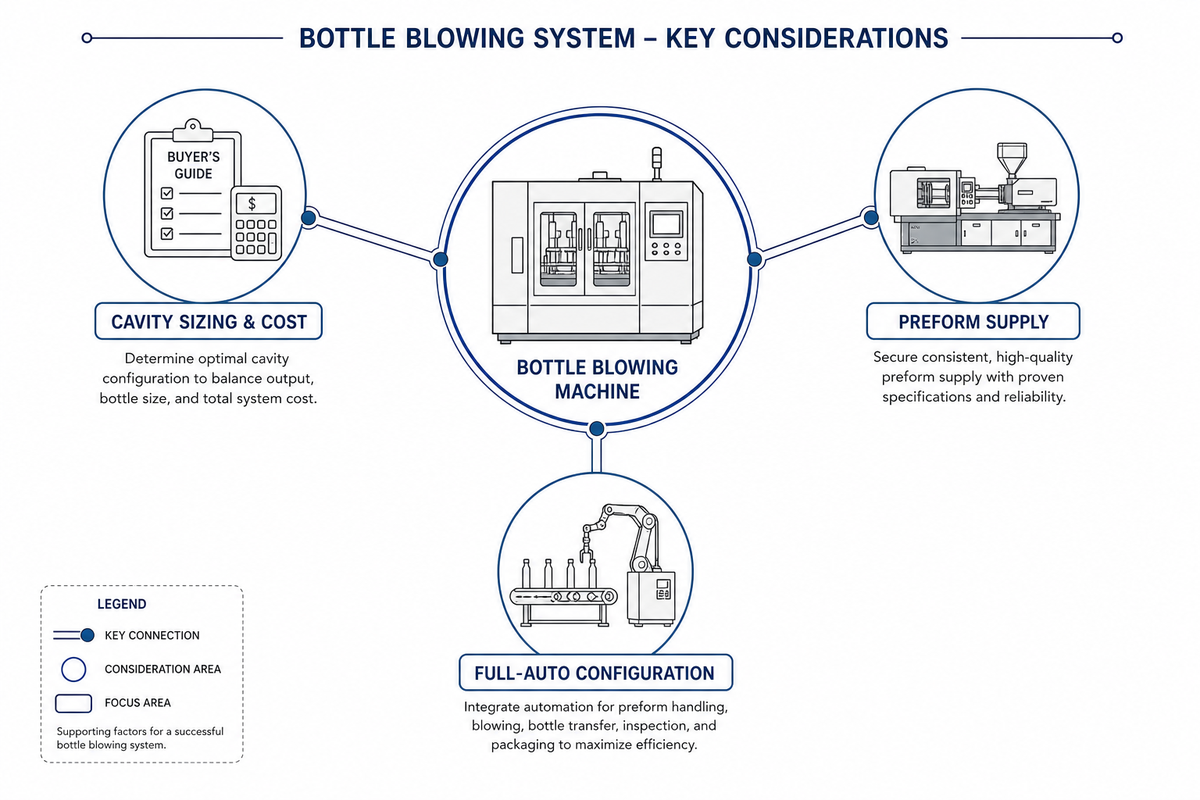
Everything above assumes you already have a machine running and the question is how to run it correctly. If you’re instead sizing cavity count and output for a new or expanded line, that’s a buyer-side decision with its own cost and lead-time variables, covered separately in our bottle blowing machine buyer’s guide.
Mass Technology’s Q-Series bottle blowing machines apply the process discipline in this guide directly – servo-driven preform loading (not pneumatic), independently controlled IR heating zones, and iron-ring cavity transfer – across 2 to 9 cavities and 1,000 to 12,000 bottles/hour, with fully automatic configurations detailed on the fully auto blowing line page. If you’re supplying your own preforms rather than buying them in, the PET preform injection line pairs with the same cavity configuration, and the cavity selector and BPH calculator runs the sizing math from the worked example above against your own annual volume target. A 5-year total cost of ownership comparison is available if energy and service-life economics factor into your equipment decision alongside the process considerations above.
Frequently Asked Questions
Q: What is the difference between injection stretch blow molding and extrusion blow molding?
Injection stretch blow molding reheats an already-injection-molded preform and mechanically stretches it before blowing; extrusion blow molding inflates a freshly extruded molten tube directly, with no separate preform or stretch step.
ISBM is the dominant process for PET because the mechanical stretch step is what triggers biaxial orientation – the strength, clarity, and gas-barrier properties a beverage bottle needs. Extrusion blow molding skips that stretch step entirely, which suits HDPE and PP containers like milk jugs and detergent bottles where clarity and barrier performance matter less than it does for a carbonated soft drink bottle, but it is not a substitute process for PET beverage bottles.
Q: What causes uneven wall thickness in PET bottles?
An off-center injection gate is the single most common cause — the stretch rod fails to pin the preform’s gate against the mold bottom, so wall thickness follows wherever the gate drifts during the blow.
Setting the stretch-rod-to-mold-bottom gap about 0.040 in. less than the preform’s gate wall thickness prevents this. Uneven heating is a real secondary cause – preform wall variance over 0.004 in. reheats unevenly and can itself pull the gate off-center by the time the rod reaches it – which is why both mechanical setup and independently zoned heating need checking together, not one or the other in isolation.
Q: Why do PET preforms need to be stretched before blowing?
Stretching orients PET’s polymer chains in both the vertical and hoop directions, and that biaxial orientation is what gives the finished bottle its strength, transparency, and gas-barrier performance — air injected into the preform without a prior stretch would simply balloon into the shape of the bottle unevenly, not orient it.
A preform blown without adequate stretch stays comparatively weak and hazy, because the polymer chains never align. Those 2:1 axial / 4:1 hoop minimum ratios exist for a reason: below that window, PET’s self-leveling strain-hardening effect – where an area that starts stretching first gets tougher, forcing cooler adjacent areas to stretch too – doesn’t have enough range to even out the wall.
Q: What intrinsic viscosity is right for PET bottle preforms?
Bottle-grade PET is specified toward the higher end of the roughly 0.35-0.78 dL/g range measured across post-consumer resin, since higher intrinsic viscosity means longer polymer chains and more melt strength to survive the stretch step. Whoever makes the preform and injects the resin into the preform mold controls this input before the blow machine ever sees it.
Ask for a certificate of analysis per lot – IV drops with every reprocessing cycle a batch has been through, so one number rarely covers every SKU.
Q: Can 100% recycled PET be processed the same way as virgin PET?
No — 100% rPET typically needs a recalibrated heating profile and, on some machines, a hybrid hydraulic clamping option, because its lower intrinsic viscosity and higher moisture sensitivity change how it responds in the forming window.
Blends up to roughly 10-50% rPET commonly run on a factory-default setup, but pushing to 100% recycled content is a process-engineering change, not a resin swap. That distinction matters more every year as recycled-content mandates like the EU’s Packaging and Packaging Waste Regulation move from optional to required for lines shipping into those markets.
Q: How is bottle quality inspected during production?
A four-checkpoint loop — incoming preform inspection, heating-profile validation, in-process monitoring, and finished-bottle testing — catches defects at the stage where they originate instead of relying on one inspection at the end of the line.
In typical final bottle inspections, wall thickness will be measured at the base, shoulder, and sidewall – as well as undergoing burst or top load testing – since the three regions can be tied back to separate failure modes: cooling, gate location, and heat distribution. But in reality, most production lines collect data for each shot on all these points, rather than making a random spot check: a base wall that has steadily crept away from specification over hundreds of cycles indicates an early cooling-circuit issue, whereas an abrupt increase is generally an indication of something changing mechanically – a worn clamp, a slipping sensor, a failed lamp. Catching these gradually worsening trends before they cause rejects is precisely the rationale behind monitoring shot-by-shot, and it is certainly more economical than learning of a wall-thickness issue when a pallet of product fails a customer’s arrival inspection.
Q: What is the “forming window” and why does it matter?
The forming window is the temperature range above PET’s glass transition (roughly 76-80°C) but below its crystallization range, where the resin is soft and stretchable without melting or clouding.
A preform value less than the window causes cold stretch defects, such as pearlescence and stress whitening; this optimum range will vary according to preform thickness, geometry and line speed, which requires oven zones to be tuned for specific products rather than set for a production run.
The Engineering Team Behind This Report
The contents of this guide reflect the combined knowledge of public process-engineering publications and the production data from the commissioning of our own Q-Series equipment, including the servo vs pneumatic testing described above. Gate position, stretch ratio, and preform values were gathered from established sources of information within the industry, and aren’t derived from in-house estimates. These values were cited individually throughout this document and can be found in the references below.
Reviewed by the Zhangjiagang Mass Technology Co., Ltd. technical team.
References & Sources
- Effects of Repeated Thermo-Mechanical Processing on the Intrinsic Viscosity of PETPMC / National Library of Medicine
- Determination of Intrinsic Viscosity of Poly(ethylene terephthalate)Talanta, ScienceDirect
- ASTM D4603-18: Standard Test Method for Determining Inherent Viscosity of PETASTM International
- Regulation (EU) 2025/40 on Packaging and Packaging WasteEUR-Lex, Official Journal of the European Union
- Blow MoldingWikipedia
- How to Address Uneven Wall Thickness in Stretch-Blow MoldingOttmar Brandau, Plastics Technology
- Blow Molding: Single- or Two-Stage PET Bottle MakingOttmar Brandau, Plastics Technology
Related Articles
- Complete Water Bottling Line Cost: 2026 Setup & Price Guide
- How to Start a Water Bottling Business
- Mineral Water Filling: How a Bottling Line Works
- Carbonated Drink Filling Machine: Types, Cost & 2026 Guide
- About Mass Technologyour Zhangjiagang engineering and manufacturing facility